PREHOSPITALPREHOSPITAL
EMERGENCY CAREEMERGENCY CARE
CHAPTER
Copyright © 2014, 2010, 2008 by Pearson Education, Inc.
All Rights Reserved
Prehospital Emergency Care, 10th
edition
Mistovich | Karren
TENTH EDITION
Musculoskeletal
Trauma
30
Prehospital Emergency Care, 10th
edition
Mistovich | Karren
Copyright © 2014, 2010, 2008 by Pearson Education, Inc.
All Rights Reserved
Learning ReadinessLearning Readiness
• EMS Education Standards, text p. 832
Prehospital Emergency Care, 10th
edition
Mistovich | Karren
Copyright © 2014, 2010, 2008 by Pearson Education, Inc.
All Rights Reserved
Learning ReadinessLearning Readiness
ObjectivesObjectives
• Please refer to page 832 of your text to
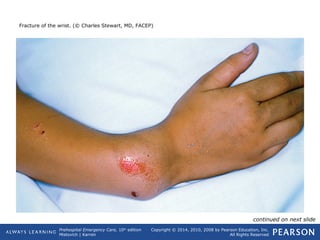
view the objectives for this chapter.
Prehospital Emergency Care, 10th
edition
Mistovich | Karren
Copyright © 2014, 2010, 2008 by Pearson Education, Inc.
All Rights Reserved
Learning ReadinessLearning Readiness
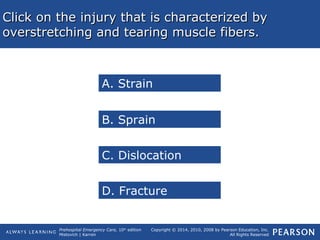
Key TermsKey Terms
• Please refer to page 833 of your text to
view the key terms for this chapter.
Prehospital Emergency Care, 10th
edition
Mistovich | Karren
Copyright © 2014, 2010, 2008 by Pearson Education, Inc.
All Rights Reserved
Setting the StageSetting the Stage
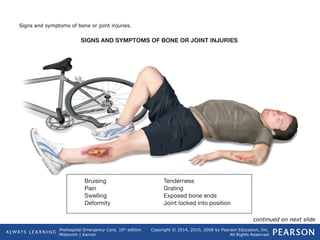
• Overview of Lesson Topics
 Musculoskeletal System Review
 Injuries to Bones and Joints
 Basics of Splinting
Prehospital Emergency Care, 10th
edition
Mistovich | Karren
Copyright © 2014, 2010, 2008 by Pearson Education, Inc.
All Rights Reserved
Case Study IntroductionCase Study Introduction
Forty-five-year-old Dominique Foster rushes
out the door of her office building. "Running
late, as usual," she thinks. As she steps off
the curb onto the parking lot, she slips on a
patch of ice and pitches to the left.
Reflexively, her left arm shoots out to stop
her fall. As she lands on her outstretched
hand, Dominique simultaneously hears and
feels a snap just above her left wrist.
Prehospital Emergency Care, 10th
edition
Mistovich | Karren
Copyright © 2014, 2010, 2008 by Pearson Education, Inc.
All Rights Reserved
Case StudyCase Study
• What are some safety considerations
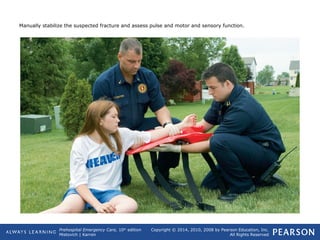
for the EMTs and patient in this
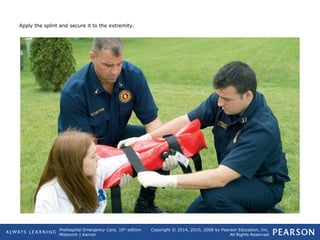
scenario?
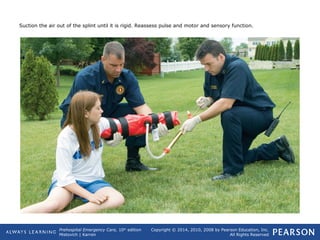
• What signs and symptoms should the
EMTs look for in their assessment?
Prehospital Emergency Care, 10th
edition
Mistovich | Karren
Copyright © 2014, 2010, 2008 by Pearson Education, Inc.
All Rights Reserved
IntroductionIntroduction
• Injuries to muscles, bones, and joints
are common.
• Such injuries vary in severity from
minor to life-threatening.
• Proper emergency care can prevent
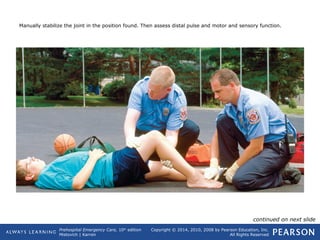
additional damage.
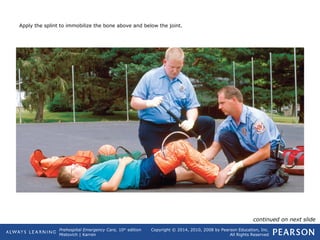
Prehospital Emergency Care, 10th
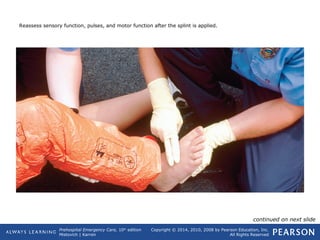
edition
Mistovich | Karren
Copyright © 2014, 2010, 2008 by Pearson Education, Inc.
All Rights Reserved
Musculoskeletal System ReviewMusculoskeletal System Review
• Functions of the musculoskeletal
system are to:
 Give the body shape
 Protect the internal organs
 Provide for movement
 Store salts and other materials
 Produce red blood cells
continued on next slide
Prehospital Emergency Care, 10th
edition
Mistovich | Karren
Copyright © 2014, 2010, 2008 by Pearson Education, Inc.
All Rights Reserved
Musculoskeletal System ReviewMusculoskeletal System Review
• Three types of muscles
 Voluntary (skeletal)
• Major muscle mass of the body
• Allows movement
 Involuntary (smooth)
• Internal organs
 Cardiac
• Heart
continued on next slide
Prehospital Emergency Care, 10th
edition
Mistovich | Karren
Copyright © 2014, 2010, 2008 by Pearson Education, Inc.
All Rights Reserved
Musculoskeletal System ReviewMusculoskeletal System Review
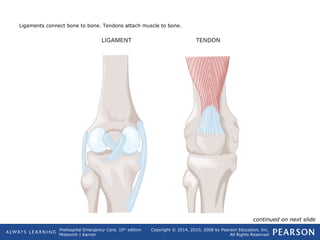
• Tendons and ligaments
• Cartilage
continued on next slide
Prehospital Emergency Care, 10th
edition
Mistovich | Karren
Copyright © 2014, 2010, 2008 by Pearson Education, Inc.
All Rights Reserved
Ligaments connect bone to bone. Tendons attach muscle to bone.
continued on next slide
Prehospital Emergency Care, 10th
edition
Mistovich | Karren
Copyright © 2014, 2010, 2008 by Pearson Education, Inc.
All Rights Reserved
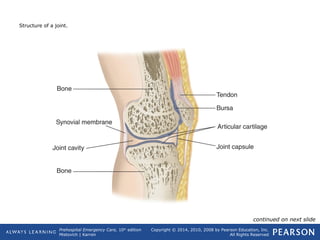
Structure of a joint.
continued on next slide
Prehospital Emergency Care, 10th
edition
Mistovich | Karren
Copyright © 2014, 2010, 2008 by Pearson Education, Inc.
All Rights Reserved
Musculoskeletal System ReviewMusculoskeletal System Review
• The skeletal system
 Supports the body
 Motion is permitted by joints.
• Flexion
• Extension
• Adduction
• Abduction
• Rotation
• Circumduction
continued on next slide
Prehospital Emergency Care, 10th
edition
Mistovich | Karren
Copyright © 2014, 2010, 2008 by Pearson Education, Inc.
All Rights Reserved
Musculoskeletal System ReviewMusculoskeletal System Review
• The skeletal system
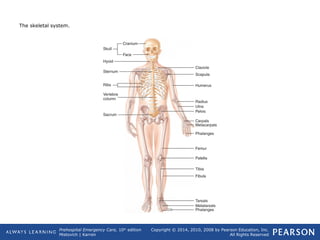
 Axial skeleton
 Appendicular skeleton
Prehospital Emergency Care, 10th
edition
Mistovich | Karren
Copyright © 2014, 2010, 2008 by Pearson Education, Inc.
All Rights Reserved
The skeletal system.
Prehospital Emergency Care, 10th
edition
Mistovich | Karren
Copyright © 2014, 2010, 2008 by Pearson Education, Inc.
All Rights Reserved
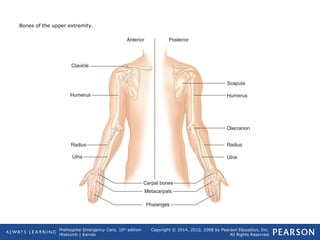
Bones of the upper extremity.
Prehospital Emergency Care, 10th
edition
Mistovich | Karren
Copyright © 2014, 2010, 2008 by Pearson Education, Inc.
All Rights Reserved
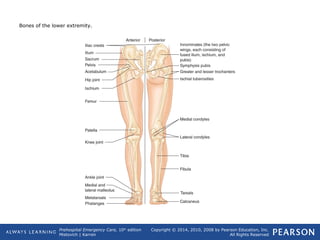
Bones of the lower extremity.
Prehospital Emergency Care, 10th
edition
Mistovich | Karren
Copyright © 2014, 2010, 2008 by Pearson Education, Inc.
All Rights Reserved
Injuries to Bones and JointsInjuries to Bones and Joints
• Types of injuries
 Fractures
 Strains
 Sprains
 Dislocations
continued on next slide
Prehospital Emergency Care, 10th
edition
Mistovich | Karren
Copyright © 2014, 2010, 2008 by Pearson Education, Inc.
All Rights Reserved
Injuries to Bones and JointsInjuries to Bones and Joints
• A fracture is a break in the continuity of
a bone.
• A fracture may be open or closed.
• Displacement of bones can cause
damage to surrounding tissues.
continued on next slide
Prehospital Emergency Care, 10th
edition
Mistovich | Karren
Copyright © 2014, 2010, 2008 by Pearson Education, Inc.
All Rights Reserved
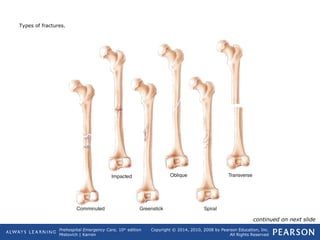
Types of fractures.
continued on next slide
Prehospital Emergency Care, 10th
edition
Mistovich | Karren
Copyright © 2014, 2010, 2008 by Pearson Education, Inc.
All Rights Reserved
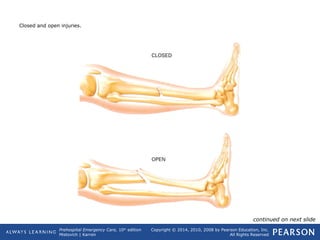
Closed and open injuries.
continued on next slide
Prehospital Emergency Care, 10th
edition
Mistovich | Karren
Copyright © 2014, 2010, 2008 by Pearson Education, Inc.
All Rights Reserved
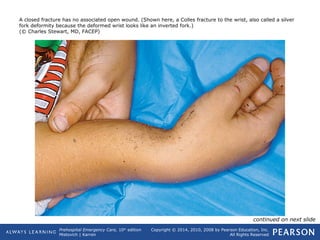
A closed fracture has no associated open wound. (Shown here, a Colles fracture to the wrist, also called a silver
fork deformity because the deformed wrist looks like an inverted fork.)
(© Charles Stewart, MD, FACEP)
continued on next slide
Prehospital Emergency Care, 10th
edition
Mistovich | Karren
Copyright © 2014, 2010, 2008 by Pearson Education, Inc.
All Rights Reserved
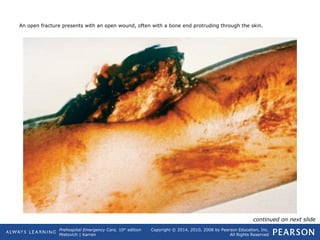
An open fracture presents with an open wound, often with a bone end protruding through the skin.
continued on next slide
Prehospital Emergency Care, 10th
edition
Mistovich | Karren
Copyright © 2014, 2010, 2008 by Pearson Education, Inc.
All Rights Reserved
Injuries to Bones and JointsInjuries to Bones and Joints
• Fracture signs and symptoms
 Pain
 Tenderness
 Deformity
 Discoloration
 Paresthesia
continued on next slide
Prehospital Emergency Care, 10th
edition
Mistovich | Karren
Copyright © 2014, 2010, 2008 by Pearson Education, Inc.
All Rights Reserved
Injuries to Bones and JointsInjuries to Bones and Joints
• Fracture signs and symptoms
 Anesthesia
 Paresis
 Paralysis/inability to move the extremity
 Decreased pulse/perfusion
continued on next slide
Prehospital Emergency Care, 10th
edition
Mistovich | Karren
Copyright © 2014, 2010, 2008 by Pearson Education, Inc.
All Rights Reserved
Fracture of the wrist. (© Charles Stewart, MD, FACEP)
continued on next slide
Prehospital Emergency Care, 10th
edition
Mistovich | Karren
Copyright © 2014, 2010, 2008 by Pearson Education, Inc.
All Rights Reserved
Injuries to Bones and JointsInjuries to Bones and Joints
• A pathologic fracture involves a
diseased bone; less force is required to
fracture the bone.
• Osteoporosis is a bone disease that
affects geriatric patients.
continued on next slide
Prehospital Emergency Care, 10th
edition
Mistovich | Karren
Copyright © 2014, 2010, 2008 by Pearson Education, Inc.
All Rights Reserved
Injuries to Bones and JointsInjuries to Bones and Joints
• Complications of fractures include:
 Hemorrhage
 Tissue damage, including nerves and
blood vessels
 Infection
 Interruption of the blood supply
continued on next slide
Prehospital Emergency Care, 10th
edition
Mistovich | Karren
Copyright © 2014, 2010, 2008 by Pearson Education, Inc.
All Rights Reserved
Injuries to Bones and JointsInjuries to Bones and Joints
• A strain occurs when overexertion or
overstretching causes muscle fibers to
tear.
• Pain is usually localized with no edema
or discoloration.
continued on next slide
Prehospital Emergency Care, 10th
edition
Mistovich | Karren
Copyright © 2014, 2010, 2008 by Pearson Education, Inc.
All Rights Reserved
Injuries to Bones and JointsInjuries to Bones and Joints
• A sprain is an injury to a joint capsule,
with damage to the connective tissue,
usually the ligaments.
• Immediate pain and tenderness with
delayed swelling and discoloration.
continued on next slide
Prehospital Emergency Care, 10th
edition
Mistovich | Karren
Copyright © 2014, 2010, 2008 by Pearson Education, Inc.
All Rights Reserved
Injuries to Bones and JointsInjuries to Bones and Joints
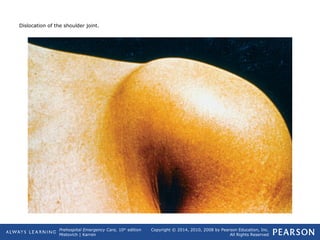
• Dislocation
 Displacement of bone from its normal
position in a joint
 Can cause damage to blood vessels and
nerves
 Presents with pain, tenderness, and
inability to use the joint
 Ligament or joint capsule damage is
likely.
continued on next slide
Prehospital Emergency Care, 10th
edition
Mistovich | Karren
Copyright © 2014, 2010, 2008 by Pearson Education, Inc.
All Rights Reserved
Dislocation of the shoulder joint.
Prehospital Emergency Care, 10th
edition
Mistovich | Karren
Copyright © 2014, 2010, 2008 by Pearson Education, Inc.
All Rights Reserved
Click on the injury that is characterized byClick on the injury that is characterized by
overstretching and tearing muscle fibers.overstretching and tearing muscle fibers.
A. Strain
B. Sprain
C. Dislocation
D. Fracture
Prehospital Emergency Care, 10th
edition
Mistovich | Karren
Copyright © 2014, 2010, 2008 by Pearson Education, Inc.
All Rights Reserved
Injuries to Bones and JointsInjuries to Bones and Joints
• General injury considerations
 All musculoskeletal injuries can present
with similar signs and symptoms.
 The force that causes the
musculoskeletal injury also may cause
other injuries.
 Always assess the mechanism of injury
and the signs and symptoms.
continued on next slide
Prehospital Emergency Care, 10th
edition
Mistovich | Karren
Copyright © 2014, 2010, 2008 by Pearson Education, Inc.
All Rights Reserved
Injuries to Bones and JointsInjuries to Bones and Joints
• Mechanism of injury
 Direct force
 Indirect force
 Twisting force
continued on next slide
Prehospital Emergency Care, 10th
edition
Mistovich | Karren
Copyright © 2014, 2010, 2008 by Pearson Education, Inc.
All Rights Reserved
Injuries to Bones and JointsInjuries to Bones and Joints
• Critical fractures
 The femur and pelvis
 Potential for significant bleeding; can be
life-threatening
continued on next slide
Prehospital Emergency Care, 10th
edition
Mistovich | Karren
Copyright © 2014, 2010, 2008 by Pearson Education, Inc.
All Rights Reserved
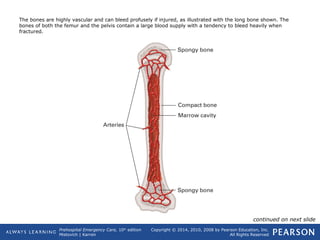
The bones are highly vascular and can bleed profusely if injured, as illustrated with the long bone shown. The
bones of both the femur and the pelvis contain a large blood supply with a tendency to bleed heavily when
fractured.
continued on next slide
Prehospital Emergency Care, 10th
edition
Mistovich | Karren
Copyright © 2014, 2010, 2008 by Pearson Education, Inc.
All Rights Reserved
Injuries to Bones and JointsInjuries to Bones and Joints
• Assessment-based approach
 Size-up the scene for safety and
mechanism of injury.
 Perform a primary assessment; do not
be distracted by the dramatic
appearance of musculoskeletal injuries.
continued on next slide
Prehospital Emergency Care, 10th
edition
Mistovich | Karren
Copyright © 2014, 2010, 2008 by Pearson Education, Inc.
All Rights Reserved
Injuries to Bones and JointsInjuries to Bones and Joints
• Assessment-based approach
 Life-threats or a pulseless or cyanotic
extremity require transport immediately
after the secondary assessment.
 For life-threatening conditions, use a
long backboard to immobilize the
patient; do not splint individual injuries
prior to transport.
continued on next slide
Prehospital Emergency Care, 10th
edition
Mistovich | Karren
Copyright © 2014, 2010, 2008 by Pearson Education, Inc.
All Rights Reserved
Injuries to Bones and JointsInjuries to Bones and Joints
• Assessment-based approach
 Perform a rapid or modified secondary
assessment as indicated by the patient's
condition and mechanism of injury.
 Inspect and palpate the injured
extremity.
continued on next slide
Prehospital Emergency Care, 10th
edition
Mistovich | Karren
Copyright © 2014, 2010, 2008 by Pearson Education, Inc.
All Rights Reserved
Injuries to Bones and JointsInjuries to Bones and Joints
• Assessment-based approach
 Check for deformity, contusions,
tenderness, swelling, and discoloration.
 Check the skin color, temperature, and
condition, and the circulation distal to
the injury site.
continued on next slide
Prehospital Emergency Care, 10th
edition
Mistovich | Karren
Copyright © 2014, 2010, 2008 by Pearson Education, Inc.
All Rights Reserved
Signs and symptoms of bone or joint injuries.
continued on next slide
Prehospital Emergency Care, 10th
edition
Mistovich | Karren
Copyright © 2014, 2010, 2008 by Pearson Education, Inc.
All Rights Reserved
Injuries to Bones and JointsInjuries to Bones and Joints
• Assess for the six "Ps"
 Pain
 Pallor
 Paralysis
 Paresthesia
 Pressure
 Pulses
continued on next slide
Prehospital Emergency Care, 10th
edition
Mistovich | Karren
Copyright © 2014, 2010, 2008 by Pearson Education, Inc.
All Rights Reserved
Injuries to Bones and JointsInjuries to Bones and Joints
• Emergency medical care
 Use Standard Precautions.
 Administer oxygen, if needed.
 Maintain in-line spinal stabilization, if
indicated.
 Splint bone and joint injuries.
continued on next slide
Prehospital Emergency Care, 10th
edition
Mistovich | Karren
Copyright © 2014, 2010, 2008 by Pearson Education, Inc.
All Rights Reserved
Injuries to Bones and JointsInjuries to Bones and Joints
• Emergency medical care
 Apply cold packs to reduce pain and
swelling.
 Elevate the extremity.
 Transport.
continued on next slide
Prehospital Emergency Care, 10th
edition
Mistovich | Karren
Copyright © 2014, 2010, 2008 by Pearson Education, Inc.
All Rights Reserved
Injuries to Bones and JointsInjuries to Bones and Joints
• Reassessment
 Vital signs
 Interventions
 Distal pulses, motor function, and
sensation
Prehospital Emergency Care, 10th
edition
Mistovich | Karren
Copyright © 2014, 2010, 2008 by Pearson Education, Inc.
All Rights Reserved
Case StudyCase Study
EMTs Kyle Velez and Ellen Peterson have
arrived on the scene, glad to see that the
first-in engine has spread some sand on the
surface of the ice to minimize chances of
further injury.
continued on next slide
Prehospital Emergency Care, 10th
edition
Mistovich | Karren
Copyright © 2014, 2010, 2008 by Pearson Education, Inc.
All Rights Reserved
Case StudyCase Study
The EMTs quickly complete a primary
assessment and determine that the patient
does not have a serious mechanism of injury
or a likelihood of spinal injuries. Their next
concern is getting her out of the cold. The
patient is doing a good job of self-splinting
the injury for the moment, so they place her
on the stretcher and load her into the
ambulance before completing a modified
secondary assessment.
continued on next slide
Prehospital Emergency Care, 10th
edition
Mistovich | Karren
Copyright © 2014, 2010, 2008 by Pearson Education, Inc.
All Rights Reserved
Case StudyCase Study
Kyle carefully examines Dominique's left
upper extremity. She has a deformity and
swelling above the wrist. Her radial pulse is
present and strong, and distal motor and
sensory function are intact. She also has a
laceration of her left palm.
continued on next slide
Prehospital Emergency Care, 10th
edition
Mistovich | Karren
Copyright © 2014, 2010, 2008 by Pearson Education, Inc.
All Rights Reserved
Case StudyCase Study
• What would be some choices of splints
that would be effective in this case?
• What principles of splinting should the
EMTs follow as they immobilize the
injury?
Prehospital Emergency Care, 10th
edition
Mistovich | Karren
Copyright © 2014, 2010, 2008 by Pearson Education, Inc.
All Rights Reserved
Basics of SplintingBasics of Splinting
• Splints are used to:
 Prevent movement of bone fragments or
ends, or dislocated joints to reduce
further injury
 Reduce pain and chances of
complications
continued on next slide
Prehospital Emergency Care, 10th
edition
Mistovich | Karren
Copyright © 2014, 2010, 2008 by Pearson Education, Inc.
All Rights Reserved
Basics of SplintingBasics of Splinting
• Complications include:
 Damage to muscles, nerves, or blood
vessels
 Conversion of a closed fracture to an
open one
 Restriction of blood flow
continued on next slide
Prehospital Emergency Care, 10th
edition
Mistovich | Karren
Copyright © 2014, 2010, 2008 by Pearson Education, Inc.
All Rights Reserved
Basics of SplintingBasics of Splinting
• Complications include:
 Excessive bleeding
 Increased pain
 Paralysis of extremities (from spinal
injury)
continued on next slide
Prehospital Emergency Care, 10th
edition
Mistovich | Karren
Copyright © 2014, 2010, 2008 by Pearson Education, Inc.
All Rights Reserved
Basics of SplintingBasics of Splinting
• General rules of splinting
continued on next slide
Prehospital Emergency Care, 10th
edition
Mistovich | Karren
Copyright © 2014, 2010, 2008 by Pearson Education, Inc.
All Rights Reserved
EMT SKILLS 30-1
General Splinting Rules
continued on next slide
Prehospital Emergency Care, 10th
edition
Mistovich | Karren
Copyright © 2014, 2010, 2008 by Pearson Education, Inc.
All Rights Reserved
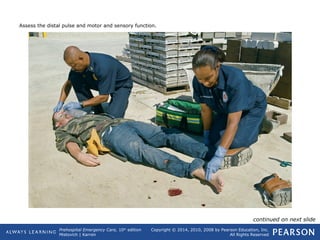
Assess the distal pulse and motor and sensory function.
continued on next slide
Prehospital Emergency Care, 10th
edition
Mistovich | Karren
Copyright © 2014, 2010, 2008 by Pearson Education, Inc.
All Rights Reserved
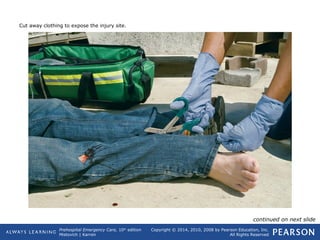
Cut away clothing to expose the injury site.
continued on next slide
Prehospital Emergency Care, 10th
edition
Mistovich | Karren
Copyright © 2014, 2010, 2008 by Pearson Education, Inc.
All Rights Reserved
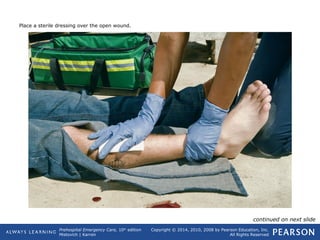
Place a sterile dressing over the open wound.
continued on next slide
Prehospital Emergency Care, 10th
edition
Mistovich | Karren
Copyright © 2014, 2010, 2008 by Pearson Education, Inc.
All Rights Reserved
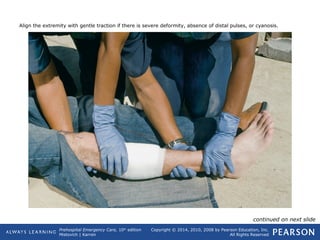
Align the extremity with gentle traction if there is severe deformity, absence of distal pulses, or cyanosis.
continued on next slide
Prehospital Emergency Care, 10th
edition
Mistovich | Karren
Copyright © 2014, 2010, 2008 by Pearson Education, Inc.
All Rights Reserved
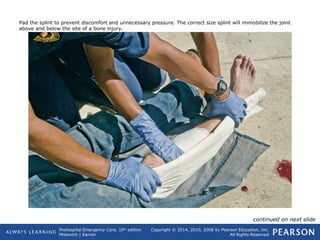
Pad the splint to prevent discomfort and unnecessary pressure. The correct size splint will immobilize the joint
above and below the site of a bone injury.
continued on next slide
Prehospital Emergency Care, 10th
edition
Mistovich | Karren
Copyright © 2014, 2010, 2008 by Pearson Education, Inc.
All Rights Reserved
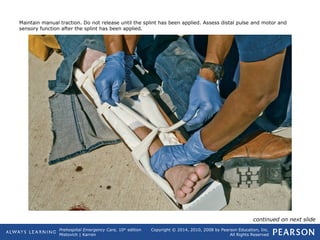
Maintain manual traction. Do not release until the splint has been applied. Assess distal pulse and motor and
sensory function after the splint has been applied.
continued on next slide
Prehospital Emergency Care, 10th
edition
Mistovich | Karren
Copyright © 2014, 2010, 2008 by Pearson Education, Inc.
All Rights Reserved
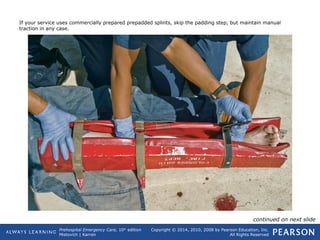
If your service uses commercially prepared prepadded splints, skip the padding step, but maintain manual
traction in any case.
continued on next slide
Prehospital Emergency Care, 10th
edition
Mistovich | Karren
Copyright © 2014, 2010, 2008 by Pearson Education, Inc.
All Rights Reserved
Basics of SplintingBasics of Splinting
• General types of splints:
 Rigid splints
 Pressure splints
 Traction splints
 Formable splints
continued on next slide
Prehospital Emergency Care, 10th
edition
Mistovich | Karren
Copyright © 2014, 2010, 2008 by Pearson Education, Inc.
All Rights Reserved
Basics of SplintingBasics of Splinting
• General types of splints:
 Vacuum splints
 Sling and swathe
 Spine board
 Improvised splints
continued on next slide
Prehospital Emergency Care, 10th
edition
Mistovich | Karren
Copyright © 2014, 2010, 2008 by Pearson Education, Inc.
All Rights Reserved
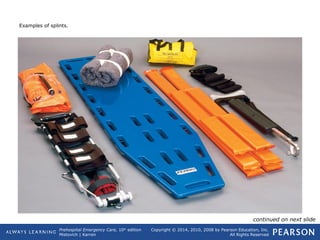
Examples of splints.
continued on next slide
Prehospital Emergency Care, 10th
edition
Mistovich | Karren
Copyright © 2014, 2010, 2008 by Pearson Education, Inc.
All Rights Reserved
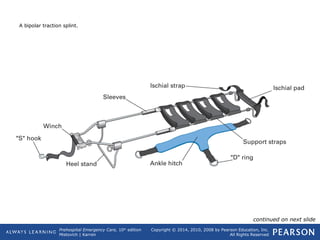
A bipolar traction splint.
continued on next slide
Prehospital Emergency Care, 10th
edition
Mistovich | Karren
Copyright © 2014, 2010, 2008 by Pearson Education, Inc.
All Rights Reserved
EMT SKILLS 30-2
Applying a Vacuum Splint
Prehospital Emergency Care, 10th
edition
Mistovich | Karren
Copyright © 2014, 2010, 2008 by Pearson Education, Inc.
All Rights Reserved
Manually stabilize the suspected fracture and assess pulse and motor and sensory function.
Prehospital Emergency Care, 10th
edition
Mistovich | Karren
Copyright © 2014, 2010, 2008 by Pearson Education, Inc.
All Rights Reserved
Apply the splint and secure it to the extremity.
Prehospital Emergency Care, 10th
edition
Mistovich | Karren
Copyright © 2014, 2010, 2008 by Pearson Education, Inc.
All Rights Reserved
Suction the air out of the splint until it is rigid. Reassess pulse and motor and sensory function.
Prehospital Emergency Care, 10th
edition
Mistovich | Karren
Copyright © 2014, 2010, 2008 by Pearson Education, Inc.
All Rights Reserved
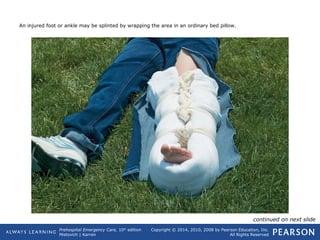
An injured foot or ankle may be splinted by wrapping the area in an ordinary bed pillow.
continued on next slide
Prehospital Emergency Care, 10th
edition
Mistovich | Karren
Copyright © 2014, 2010, 2008 by Pearson Education, Inc.
All Rights Reserved
Basics of SplintingBasics of Splinting
• Hazards of improper splinting
 Compression of nerves, tissues, blood
vessels
 Delayed transport
 Reduced distal circulation
 Aggravation of the injury
 Excessive movement
 Skin damage from improper padding
continued on next slide
Prehospital Emergency Care, 10th
edition
Mistovich | Karren
Copyright © 2014, 2010, 2008 by Pearson Education, Inc.
All Rights Reserved
Basics of SplintingBasics of Splinting
• Splinting a long-bone injury
continued on next slide
Prehospital Emergency Care, 10th
edition
Mistovich | Karren
Copyright © 2014, 2010, 2008 by Pearson Education, Inc.
All Rights Reserved
EMT SKILLS 30-3
Splinting a Long Bone
continued on next slide
Prehospital Emergency Care, 10th
edition
Mistovich | Karren
Copyright © 2014, 2010, 2008 by Pearson Education, Inc.
All Rights Reserved
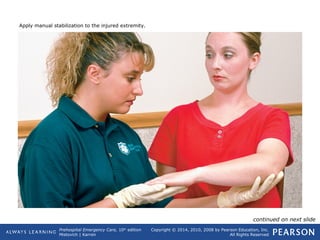
Apply manual stabilization to the injured extremity.
continued on next slide
Prehospital Emergency Care, 10th
edition
Mistovich | Karren
Copyright © 2014, 2010, 2008 by Pearson Education, Inc.
All Rights Reserved
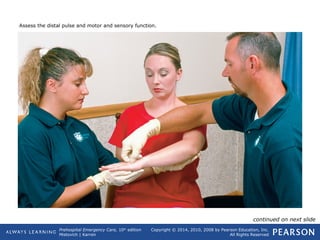
Assess the distal pulse and motor and sensory function.
continued on next slide
Prehospital Emergency Care, 10th
edition
Mistovich | Karren
Copyright © 2014, 2010, 2008 by Pearson Education, Inc.
All Rights Reserved
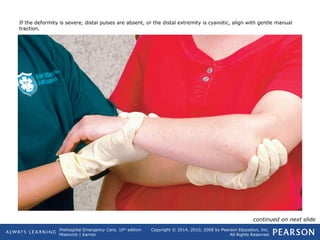
If the deformity is severe, distal pulses are absent, or the distal extremity is cyanotic, align with gentle manual
traction.
continued on next slide
Prehospital Emergency Care, 10th
edition
Mistovich | Karren
Copyright © 2014, 2010, 2008 by Pearson Education, Inc.
All Rights Reserved
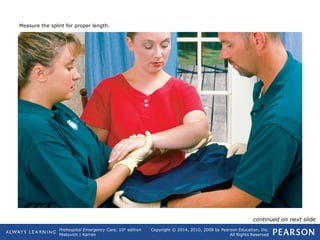
Measure the splint for proper length.
continued on next slide
Prehospital Emergency Care, 10th
edition
Mistovich | Karren
Copyright © 2014, 2010, 2008 by Pearson Education, Inc.
All Rights Reserved
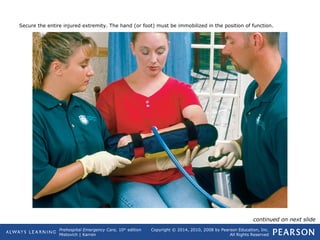
Secure the entire injured extremity. The hand (or foot) must be immobilized in the position of function.
continued on next slide
Prehospital Emergency Care, 10th
edition
Mistovich | Karren
Copyright © 2014, 2010, 2008 by Pearson Education, Inc.
All Rights Reserved
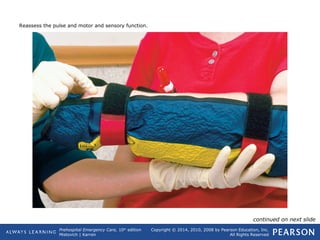
Reassess the pulse and motor and sensory function.
continued on next slide
Prehospital Emergency Care, 10th
edition
Mistovich | Karren
Copyright © 2014, 2010, 2008 by Pearson Education, Inc.
All Rights Reserved
Basics of SplintingBasics of Splinting
• Splinting a joint
continued on next slide
Prehospital Emergency Care, 10th
edition
Mistovich | Karren
Copyright © 2014, 2010, 2008 by Pearson Education, Inc.
All Rights Reserved
EMT SKILLS 30-4
Splinting a Joint
continued on next slide
Prehospital Emergency Care, 10th
edition
Mistovich | Karren
Copyright © 2014, 2010, 2008 by Pearson Education, Inc.
All Rights Reserved
Manually stabilize the joint in the position found. Then assess distal pulse and motor and sensory function.
continued on next slide
Prehospital Emergency Care, 10th
edition
Mistovich | Karren
Copyright © 2014, 2010, 2008 by Pearson Education, Inc.
All Rights Reserved
Apply the splint to immobilize the bone above and below the joint.
continued on next slide
Prehospital Emergency Care, 10th
edition
Mistovich | Karren
Copyright © 2014, 2010, 2008 by Pearson Education, Inc.
All Rights Reserved
Reassess sensory function, pulses, and motor function after the splint is applied.
continued on next slide
Prehospital Emergency Care, 10th
edition
Mistovich | Karren
Copyright © 2014, 2010, 2008 by Pearson Education, Inc.
All Rights Reserved
Basics of SplintingBasics of Splinting
• Traction splinting
 Femur fractures can be accompanied by
bleeding, pain, and muscle spasm.
 Using traction to align the femur can
reduce complications.
 Treat for a fracture if the thigh is
painful, swollen, or deformed.
continued on next slide
Prehospital Emergency Care, 10th
edition
Mistovich | Karren
Copyright © 2014, 2010, 2008 by Pearson Education, Inc.
All Rights Reserved
Basics of SplintingBasics of Splinting
• Do not use a traction splint if:
 The injury is within 1 to 2 inches of the
knee or ankle
 The knee has been injured
 The hip has been injured
 The pelvis has been injured
 There is partial amputation or avulsion
continued on next slide
Prehospital Emergency Care, 10th
edition
Mistovich | Karren
Copyright © 2014, 2010, 2008 by Pearson Education, Inc.
All Rights Reserved
Basics of SplintingBasics of Splinting
• Traction splints may be unipolar or
bipolar.
continued on next slide
Prehospital Emergency Care, 10th
edition
Mistovich | Karren
Copyright © 2014, 2010, 2008 by Pearson Education, Inc.
All Rights Reserved
Basics of SplintingBasics of Splinting
• Pelvic fracture
 Associated with pain and significant
bleeding
 Splinting methods include:
• PASG
• Commercial splints
• Improvised splints
continued on next slide
Prehospital Emergency Care, 10th
edition
Mistovich | Karren
Copyright © 2014, 2010, 2008 by Pearson Education, Inc.
All Rights Reserved
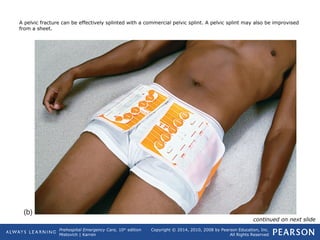
A pelvic fracture can be effectively splinted with a commercial pelvic splint. A pelvic splint may also be improvised
from a sheet.
continued on next slide
Prehospital Emergency Care, 10th
edition
Mistovich | Karren
Copyright © 2014, 2010, 2008 by Pearson Education, Inc.
All Rights Reserved
Basics of SplintingBasics of Splinting
• Compartment syndrome
 Pressure develops within the injured
area.
 The pressure exceeds the capillary
pressure needed to perfuse the tissues.
 The tissue becomes hypoxic, which
results in further damage and swelling.
continued on next slide
Prehospital Emergency Care, 10th
edition
Mistovich | Karren
Copyright © 2014, 2010, 2008 by Pearson Education, Inc.
All Rights Reserved
Basics of SplintingBasics of Splinting
• Compartment syndrome signs and
symptoms
 Severe pain or burning sensation
 Decreased strength in extremity
 Paralysis of the extremity
 Pain with movement
 Extremity feels hard to palpation
 Distal pulses, motor, and sensory
function may be normal
continued on next slide
Prehospital Emergency Care, 10th
edition
Mistovich | Karren
Copyright © 2014, 2010, 2008 by Pearson Education, Inc.
All Rights Reserved
Basics of SplintingBasics of Splinting
• Compartment syndrome treatment
 Splint
 Elevate
 Apply cold
 Transport
Prehospital Emergency Care, 10th
edition
Mistovich | Karren
Copyright © 2014, 2010, 2008 by Pearson Education, Inc.
All Rights Reserved
Case Study ConclusionCase Study Conclusion
Kyle selects a padded, rigid splint that
extends from the fingertips to just below the
elbow. He carefully applies and secures the
splint, and then applies a sling to immobilize
the elbow. He reassesses the distal pulse,
and motor and sensory function.
At the hospital, Dominique is diagnosed with
a fractured radius and ulna, and will be
wearing a cast for the next six weeks.
Prehospital Emergency Care, 10th
edition
Mistovich | Karren
Copyright © 2014, 2010, 2008 by Pearson Education, Inc.
All Rights Reserved
Lesson SummaryLesson Summary
• Musculoskeletal injuries include
fractures, sprains, strains, and
dislocations.
• Some fractures can result in life-
threatening hemorrhage.
• EMT management of musculoskeletal
injuries can prevent complications.
continued on next slide
Prehospital Emergency Care, 10th
edition
Mistovich | Karren
Copyright © 2014, 2010, 2008 by Pearson Education, Inc.
All Rights Reserved
Lesson SummaryLesson Summary
• A variety of types of splints are
available to EMTs.
• Always assess pulse, motor, and
sensory function before and after
splinting.

DMACC EMT Chapter 30

  • 1.
    PREHOSPITALPREHOSPITAL EMERGENCY CAREEMERGENCY CARE CHAPTER Copyright© 2014, 2010, 2008 by Pearson Education, Inc. All Rights Reserved Prehospital Emergency Care, 10th edition Mistovich | Karren TENTH EDITION Musculoskeletal Trauma 30
  • 2.
    Prehospital Emergency Care,10th edition Mistovich | Karren Copyright © 2014, 2010, 2008 by Pearson Education, Inc. All Rights Reserved Learning ReadinessLearning Readiness • EMS Education Standards, text p. 832
  • 3.
    Prehospital Emergency Care,10th edition Mistovich | Karren Copyright © 2014, 2010, 2008 by Pearson Education, Inc. All Rights Reserved Learning ReadinessLearning Readiness ObjectivesObjectives • Please refer to page 832 of your text to view the objectives for this chapter.
  • 4.
    Prehospital Emergency Care,10th edition Mistovich | Karren Copyright © 2014, 2010, 2008 by Pearson Education, Inc. All Rights Reserved Learning ReadinessLearning Readiness Key TermsKey Terms • Please refer to page 833 of your text to view the key terms for this chapter.
  • 5.
    Prehospital Emergency Care,10th edition Mistovich | Karren Copyright © 2014, 2010, 2008 by Pearson Education, Inc. All Rights Reserved Setting the StageSetting the Stage • Overview of Lesson Topics  Musculoskeletal System Review  Injuries to Bones and Joints  Basics of Splinting
  • 6.
    Prehospital Emergency Care,10th edition Mistovich | Karren Copyright © 2014, 2010, 2008 by Pearson Education, Inc. All Rights Reserved Case Study IntroductionCase Study Introduction Forty-five-year-old Dominique Foster rushes out the door of her office building. "Running late, as usual," she thinks. As she steps off the curb onto the parking lot, she slips on a patch of ice and pitches to the left. Reflexively, her left arm shoots out to stop her fall. As she lands on her outstretched hand, Dominique simultaneously hears and feels a snap just above her left wrist.
  • 7.
    Prehospital Emergency Care,10th edition Mistovich | Karren Copyright © 2014, 2010, 2008 by Pearson Education, Inc. All Rights Reserved Case StudyCase Study • What are some safety considerations for the EMTs and patient in this scenario? • What signs and symptoms should the EMTs look for in their assessment?
  • 8.
    Prehospital Emergency Care,10th edition Mistovich | Karren Copyright © 2014, 2010, 2008 by Pearson Education, Inc. All Rights Reserved IntroductionIntroduction • Injuries to muscles, bones, and joints are common. • Such injuries vary in severity from minor to life-threatening. • Proper emergency care can prevent additional damage.
  • 9.
    Prehospital Emergency Care,10th edition Mistovich | Karren Copyright © 2014, 2010, 2008 by Pearson Education, Inc. All Rights Reserved Musculoskeletal System ReviewMusculoskeletal System Review • Functions of the musculoskeletal system are to:  Give the body shape  Protect the internal organs  Provide for movement  Store salts and other materials  Produce red blood cells continued on next slide
  • 10.
    Prehospital Emergency Care,10th edition Mistovich | Karren Copyright © 2014, 2010, 2008 by Pearson Education, Inc. All Rights Reserved Musculoskeletal System ReviewMusculoskeletal System Review • Three types of muscles  Voluntary (skeletal) • Major muscle mass of the body • Allows movement  Involuntary (smooth) • Internal organs  Cardiac • Heart continued on next slide
  • 11.
    Prehospital Emergency Care,10th edition Mistovich | Karren Copyright © 2014, 2010, 2008 by Pearson Education, Inc. All Rights Reserved Musculoskeletal System ReviewMusculoskeletal System Review • Tendons and ligaments • Cartilage continued on next slide
  • 12.
    Prehospital Emergency Care,10th edition Mistovich | Karren Copyright © 2014, 2010, 2008 by Pearson Education, Inc. All Rights Reserved Ligaments connect bone to bone. Tendons attach muscle to bone. continued on next slide
  • 13.
    Prehospital Emergency Care,10th edition Mistovich | Karren Copyright © 2014, 2010, 2008 by Pearson Education, Inc. All Rights Reserved Structure of a joint. continued on next slide
  • 14.
    Prehospital Emergency Care,10th edition Mistovich | Karren Copyright © 2014, 2010, 2008 by Pearson Education, Inc. All Rights Reserved Musculoskeletal System ReviewMusculoskeletal System Review • The skeletal system  Supports the body  Motion is permitted by joints. • Flexion • Extension • Adduction • Abduction • Rotation • Circumduction continued on next slide
  • 15.
    Prehospital Emergency Care,10th edition Mistovich | Karren Copyright © 2014, 2010, 2008 by Pearson Education, Inc. All Rights Reserved Musculoskeletal System ReviewMusculoskeletal System Review • The skeletal system  Axial skeleton  Appendicular skeleton
  • 16.
    Prehospital Emergency Care,10th edition Mistovich | Karren Copyright © 2014, 2010, 2008 by Pearson Education, Inc. All Rights Reserved The skeletal system.
  • 17.
    Prehospital Emergency Care,10th edition Mistovich | Karren Copyright © 2014, 2010, 2008 by Pearson Education, Inc. All Rights Reserved Bones of the upper extremity.
  • 18.
    Prehospital Emergency Care,10th edition Mistovich | Karren Copyright © 2014, 2010, 2008 by Pearson Education, Inc. All Rights Reserved Bones of the lower extremity.
  • 19.
    Prehospital Emergency Care,10th edition Mistovich | Karren Copyright © 2014, 2010, 2008 by Pearson Education, Inc. All Rights Reserved Injuries to Bones and JointsInjuries to Bones and Joints • Types of injuries  Fractures  Strains  Sprains  Dislocations continued on next slide
  • 20.
    Prehospital Emergency Care,10th edition Mistovich | Karren Copyright © 2014, 2010, 2008 by Pearson Education, Inc. All Rights Reserved Injuries to Bones and JointsInjuries to Bones and Joints • A fracture is a break in the continuity of a bone. • A fracture may be open or closed. • Displacement of bones can cause damage to surrounding tissues. continued on next slide
  • 21.
    Prehospital Emergency Care,10th edition Mistovich | Karren Copyright © 2014, 2010, 2008 by Pearson Education, Inc. All Rights Reserved Types of fractures. continued on next slide
  • 22.
    Prehospital Emergency Care,10th edition Mistovich | Karren Copyright © 2014, 2010, 2008 by Pearson Education, Inc. All Rights Reserved Closed and open injuries. continued on next slide
  • 23.
    Prehospital Emergency Care,10th edition Mistovich | Karren Copyright © 2014, 2010, 2008 by Pearson Education, Inc. All Rights Reserved A closed fracture has no associated open wound. (Shown here, a Colles fracture to the wrist, also called a silver fork deformity because the deformed wrist looks like an inverted fork.) (© Charles Stewart, MD, FACEP) continued on next slide
  • 24.
    Prehospital Emergency Care,10th edition Mistovich | Karren Copyright © 2014, 2010, 2008 by Pearson Education, Inc. All Rights Reserved An open fracture presents with an open wound, often with a bone end protruding through the skin. continued on next slide
  • 25.
    Prehospital Emergency Care,10th edition Mistovich | Karren Copyright © 2014, 2010, 2008 by Pearson Education, Inc. All Rights Reserved Injuries to Bones and JointsInjuries to Bones and Joints • Fracture signs and symptoms  Pain  Tenderness  Deformity  Discoloration  Paresthesia continued on next slide
  • 26.
    Prehospital Emergency Care,10th edition Mistovich | Karren Copyright © 2014, 2010, 2008 by Pearson Education, Inc. All Rights Reserved Injuries to Bones and JointsInjuries to Bones and Joints • Fracture signs and symptoms  Anesthesia  Paresis  Paralysis/inability to move the extremity  Decreased pulse/perfusion continued on next slide
  • 27.
    Prehospital Emergency Care,10th edition Mistovich | Karren Copyright © 2014, 2010, 2008 by Pearson Education, Inc. All Rights Reserved Fracture of the wrist. (© Charles Stewart, MD, FACEP) continued on next slide
  • 28.
    Prehospital Emergency Care,10th edition Mistovich | Karren Copyright © 2014, 2010, 2008 by Pearson Education, Inc. All Rights Reserved Injuries to Bones and JointsInjuries to Bones and Joints • A pathologic fracture involves a diseased bone; less force is required to fracture the bone. • Osteoporosis is a bone disease that affects geriatric patients. continued on next slide
  • 29.
    Prehospital Emergency Care,10th edition Mistovich | Karren Copyright © 2014, 2010, 2008 by Pearson Education, Inc. All Rights Reserved Injuries to Bones and JointsInjuries to Bones and Joints • Complications of fractures include:  Hemorrhage  Tissue damage, including nerves and blood vessels  Infection  Interruption of the blood supply continued on next slide
  • 30.
    Prehospital Emergency Care,10th edition Mistovich | Karren Copyright © 2014, 2010, 2008 by Pearson Education, Inc. All Rights Reserved Injuries to Bones and JointsInjuries to Bones and Joints • A strain occurs when overexertion or overstretching causes muscle fibers to tear. • Pain is usually localized with no edema or discoloration. continued on next slide
  • 31.
    Prehospital Emergency Care,10th edition Mistovich | Karren Copyright © 2014, 2010, 2008 by Pearson Education, Inc. All Rights Reserved Injuries to Bones and JointsInjuries to Bones and Joints • A sprain is an injury to a joint capsule, with damage to the connective tissue, usually the ligaments. • Immediate pain and tenderness with delayed swelling and discoloration. continued on next slide
  • 32.
    Prehospital Emergency Care,10th edition Mistovich | Karren Copyright © 2014, 2010, 2008 by Pearson Education, Inc. All Rights Reserved Injuries to Bones and JointsInjuries to Bones and Joints • Dislocation  Displacement of bone from its normal position in a joint  Can cause damage to blood vessels and nerves  Presents with pain, tenderness, and inability to use the joint  Ligament or joint capsule damage is likely. continued on next slide
  • 33.
    Prehospital Emergency Care,10th edition Mistovich | Karren Copyright © 2014, 2010, 2008 by Pearson Education, Inc. All Rights Reserved Dislocation of the shoulder joint.
  • 34.
    Prehospital Emergency Care,10th edition Mistovich | Karren Copyright © 2014, 2010, 2008 by Pearson Education, Inc. All Rights Reserved Click on the injury that is characterized byClick on the injury that is characterized by overstretching and tearing muscle fibers.overstretching and tearing muscle fibers. A. Strain B. Sprain C. Dislocation D. Fracture
  • 35.
    Prehospital Emergency Care,10th edition Mistovich | Karren Copyright © 2014, 2010, 2008 by Pearson Education, Inc. All Rights Reserved Injuries to Bones and JointsInjuries to Bones and Joints • General injury considerations  All musculoskeletal injuries can present with similar signs and symptoms.  The force that causes the musculoskeletal injury also may cause other injuries.  Always assess the mechanism of injury and the signs and symptoms. continued on next slide
  • 36.
    Prehospital Emergency Care,10th edition Mistovich | Karren Copyright © 2014, 2010, 2008 by Pearson Education, Inc. All Rights Reserved Injuries to Bones and JointsInjuries to Bones and Joints • Mechanism of injury  Direct force  Indirect force  Twisting force continued on next slide
  • 37.
    Prehospital Emergency Care,10th edition Mistovich | Karren Copyright © 2014, 2010, 2008 by Pearson Education, Inc. All Rights Reserved Injuries to Bones and JointsInjuries to Bones and Joints • Critical fractures  The femur and pelvis  Potential for significant bleeding; can be life-threatening continued on next slide
  • 38.
    Prehospital Emergency Care,10th edition Mistovich | Karren Copyright © 2014, 2010, 2008 by Pearson Education, Inc. All Rights Reserved The bones are highly vascular and can bleed profusely if injured, as illustrated with the long bone shown. The bones of both the femur and the pelvis contain a large blood supply with a tendency to bleed heavily when fractured. continued on next slide
  • 39.
    Prehospital Emergency Care,10th edition Mistovich | Karren Copyright © 2014, 2010, 2008 by Pearson Education, Inc. All Rights Reserved Injuries to Bones and JointsInjuries to Bones and Joints • Assessment-based approach  Size-up the scene for safety and mechanism of injury.  Perform a primary assessment; do not be distracted by the dramatic appearance of musculoskeletal injuries. continued on next slide
  • 40.
    Prehospital Emergency Care,10th edition Mistovich | Karren Copyright © 2014, 2010, 2008 by Pearson Education, Inc. All Rights Reserved Injuries to Bones and JointsInjuries to Bones and Joints • Assessment-based approach  Life-threats or a pulseless or cyanotic extremity require transport immediately after the secondary assessment.  For life-threatening conditions, use a long backboard to immobilize the patient; do not splint individual injuries prior to transport. continued on next slide
  • 41.
    Prehospital Emergency Care,10th edition Mistovich | Karren Copyright © 2014, 2010, 2008 by Pearson Education, Inc. All Rights Reserved Injuries to Bones and JointsInjuries to Bones and Joints • Assessment-based approach  Perform a rapid or modified secondary assessment as indicated by the patient's condition and mechanism of injury.  Inspect and palpate the injured extremity. continued on next slide
  • 42.
    Prehospital Emergency Care,10th edition Mistovich | Karren Copyright © 2014, 2010, 2008 by Pearson Education, Inc. All Rights Reserved Injuries to Bones and JointsInjuries to Bones and Joints • Assessment-based approach  Check for deformity, contusions, tenderness, swelling, and discoloration.  Check the skin color, temperature, and condition, and the circulation distal to the injury site. continued on next slide
  • 43.
    Prehospital Emergency Care,10th edition Mistovich | Karren Copyright © 2014, 2010, 2008 by Pearson Education, Inc. All Rights Reserved Signs and symptoms of bone or joint injuries. continued on next slide
  • 44.
    Prehospital Emergency Care,10th edition Mistovich | Karren Copyright © 2014, 2010, 2008 by Pearson Education, Inc. All Rights Reserved Injuries to Bones and JointsInjuries to Bones and Joints • Assess for the six "Ps"  Pain  Pallor  Paralysis  Paresthesia  Pressure  Pulses continued on next slide
  • 45.
    Prehospital Emergency Care,10th edition Mistovich | Karren Copyright © 2014, 2010, 2008 by Pearson Education, Inc. All Rights Reserved Injuries to Bones and JointsInjuries to Bones and Joints • Emergency medical care  Use Standard Precautions.  Administer oxygen, if needed.  Maintain in-line spinal stabilization, if indicated.  Splint bone and joint injuries. continued on next slide
  • 46.
    Prehospital Emergency Care,10th edition Mistovich | Karren Copyright © 2014, 2010, 2008 by Pearson Education, Inc. All Rights Reserved Injuries to Bones and JointsInjuries to Bones and Joints • Emergency medical care  Apply cold packs to reduce pain and swelling.  Elevate the extremity.  Transport. continued on next slide
  • 47.
    Prehospital Emergency Care,10th edition Mistovich | Karren Copyright © 2014, 2010, 2008 by Pearson Education, Inc. All Rights Reserved Injuries to Bones and JointsInjuries to Bones and Joints • Reassessment  Vital signs  Interventions  Distal pulses, motor function, and sensation
  • 48.
    Prehospital Emergency Care,10th edition Mistovich | Karren Copyright © 2014, 2010, 2008 by Pearson Education, Inc. All Rights Reserved Case StudyCase Study EMTs Kyle Velez and Ellen Peterson have arrived on the scene, glad to see that the first-in engine has spread some sand on the surface of the ice to minimize chances of further injury. continued on next slide
  • 49.
    Prehospital Emergency Care,10th edition Mistovich | Karren Copyright © 2014, 2010, 2008 by Pearson Education, Inc. All Rights Reserved Case StudyCase Study The EMTs quickly complete a primary assessment and determine that the patient does not have a serious mechanism of injury or a likelihood of spinal injuries. Their next concern is getting her out of the cold. The patient is doing a good job of self-splinting the injury for the moment, so they place her on the stretcher and load her into the ambulance before completing a modified secondary assessment. continued on next slide
  • 50.
    Prehospital Emergency Care,10th edition Mistovich | Karren Copyright © 2014, 2010, 2008 by Pearson Education, Inc. All Rights Reserved Case StudyCase Study Kyle carefully examines Dominique's left upper extremity. She has a deformity and swelling above the wrist. Her radial pulse is present and strong, and distal motor and sensory function are intact. She also has a laceration of her left palm. continued on next slide
  • 51.
    Prehospital Emergency Care,10th edition Mistovich | Karren Copyright © 2014, 2010, 2008 by Pearson Education, Inc. All Rights Reserved Case StudyCase Study • What would be some choices of splints that would be effective in this case? • What principles of splinting should the EMTs follow as they immobilize the injury?
  • 52.
    Prehospital Emergency Care,10th edition Mistovich | Karren Copyright © 2014, 2010, 2008 by Pearson Education, Inc. All Rights Reserved Basics of SplintingBasics of Splinting • Splints are used to:  Prevent movement of bone fragments or ends, or dislocated joints to reduce further injury  Reduce pain and chances of complications continued on next slide
  • 53.
    Prehospital Emergency Care,10th edition Mistovich | Karren Copyright © 2014, 2010, 2008 by Pearson Education, Inc. All Rights Reserved Basics of SplintingBasics of Splinting • Complications include:  Damage to muscles, nerves, or blood vessels  Conversion of a closed fracture to an open one  Restriction of blood flow continued on next slide
  • 54.
    Prehospital Emergency Care,10th edition Mistovich | Karren Copyright © 2014, 2010, 2008 by Pearson Education, Inc. All Rights Reserved Basics of SplintingBasics of Splinting • Complications include:  Excessive bleeding  Increased pain  Paralysis of extremities (from spinal injury) continued on next slide
  • 55.
    Prehospital Emergency Care,10th edition Mistovich | Karren Copyright © 2014, 2010, 2008 by Pearson Education, Inc. All Rights Reserved Basics of SplintingBasics of Splinting • General rules of splinting continued on next slide
  • 56.
    Prehospital Emergency Care,10th edition Mistovich | Karren Copyright © 2014, 2010, 2008 by Pearson Education, Inc. All Rights Reserved EMT SKILLS 30-1 General Splinting Rules continued on next slide
  • 57.
    Prehospital Emergency Care,10th edition Mistovich | Karren Copyright © 2014, 2010, 2008 by Pearson Education, Inc. All Rights Reserved Assess the distal pulse and motor and sensory function. continued on next slide
  • 58.
    Prehospital Emergency Care,10th edition Mistovich | Karren Copyright © 2014, 2010, 2008 by Pearson Education, Inc. All Rights Reserved Cut away clothing to expose the injury site. continued on next slide
  • 59.
    Prehospital Emergency Care,10th edition Mistovich | Karren Copyright © 2014, 2010, 2008 by Pearson Education, Inc. All Rights Reserved Place a sterile dressing over the open wound. continued on next slide
  • 60.
    Prehospital Emergency Care,10th edition Mistovich | Karren Copyright © 2014, 2010, 2008 by Pearson Education, Inc. All Rights Reserved Align the extremity with gentle traction if there is severe deformity, absence of distal pulses, or cyanosis. continued on next slide
  • 61.
    Prehospital Emergency Care,10th edition Mistovich | Karren Copyright © 2014, 2010, 2008 by Pearson Education, Inc. All Rights Reserved Pad the splint to prevent discomfort and unnecessary pressure. The correct size splint will immobilize the joint above and below the site of a bone injury. continued on next slide
  • 62.
    Prehospital Emergency Care,10th edition Mistovich | Karren Copyright © 2014, 2010, 2008 by Pearson Education, Inc. All Rights Reserved Maintain manual traction. Do not release until the splint has been applied. Assess distal pulse and motor and sensory function after the splint has been applied. continued on next slide
  • 63.
    Prehospital Emergency Care,10th edition Mistovich | Karren Copyright © 2014, 2010, 2008 by Pearson Education, Inc. All Rights Reserved If your service uses commercially prepared prepadded splints, skip the padding step, but maintain manual traction in any case. continued on next slide
  • 64.
    Prehospital Emergency Care,10th edition Mistovich | Karren Copyright © 2014, 2010, 2008 by Pearson Education, Inc. All Rights Reserved Basics of SplintingBasics of Splinting • General types of splints:  Rigid splints  Pressure splints  Traction splints  Formable splints continued on next slide
  • 65.
    Prehospital Emergency Care,10th edition Mistovich | Karren Copyright © 2014, 2010, 2008 by Pearson Education, Inc. All Rights Reserved Basics of SplintingBasics of Splinting • General types of splints:  Vacuum splints  Sling and swathe  Spine board  Improvised splints continued on next slide
  • 66.
    Prehospital Emergency Care,10th edition Mistovich | Karren Copyright © 2014, 2010, 2008 by Pearson Education, Inc. All Rights Reserved Examples of splints. continued on next slide
  • 67.
    Prehospital Emergency Care,10th edition Mistovich | Karren Copyright © 2014, 2010, 2008 by Pearson Education, Inc. All Rights Reserved A bipolar traction splint. continued on next slide
  • 68.
    Prehospital Emergency Care,10th edition Mistovich | Karren Copyright © 2014, 2010, 2008 by Pearson Education, Inc. All Rights Reserved EMT SKILLS 30-2 Applying a Vacuum Splint
  • 69.
    Prehospital Emergency Care,10th edition Mistovich | Karren Copyright © 2014, 2010, 2008 by Pearson Education, Inc. All Rights Reserved Manually stabilize the suspected fracture and assess pulse and motor and sensory function.
  • 70.
    Prehospital Emergency Care,10th edition Mistovich | Karren Copyright © 2014, 2010, 2008 by Pearson Education, Inc. All Rights Reserved Apply the splint and secure it to the extremity.
  • 71.
    Prehospital Emergency Care,10th edition Mistovich | Karren Copyright © 2014, 2010, 2008 by Pearson Education, Inc. All Rights Reserved Suction the air out of the splint until it is rigid. Reassess pulse and motor and sensory function.
  • 72.
    Prehospital Emergency Care,10th edition Mistovich | Karren Copyright © 2014, 2010, 2008 by Pearson Education, Inc. All Rights Reserved An injured foot or ankle may be splinted by wrapping the area in an ordinary bed pillow. continued on next slide
  • 73.
    Prehospital Emergency Care,10th edition Mistovich | Karren Copyright © 2014, 2010, 2008 by Pearson Education, Inc. All Rights Reserved Basics of SplintingBasics of Splinting • Hazards of improper splinting  Compression of nerves, tissues, blood vessels  Delayed transport  Reduced distal circulation  Aggravation of the injury  Excessive movement  Skin damage from improper padding continued on next slide
  • 74.
    Prehospital Emergency Care,10th edition Mistovich | Karren Copyright © 2014, 2010, 2008 by Pearson Education, Inc. All Rights Reserved Basics of SplintingBasics of Splinting • Splinting a long-bone injury continued on next slide
  • 75.
    Prehospital Emergency Care,10th edition Mistovich | Karren Copyright © 2014, 2010, 2008 by Pearson Education, Inc. All Rights Reserved EMT SKILLS 30-3 Splinting a Long Bone continued on next slide
  • 76.
    Prehospital Emergency Care,10th edition Mistovich | Karren Copyright © 2014, 2010, 2008 by Pearson Education, Inc. All Rights Reserved Apply manual stabilization to the injured extremity. continued on next slide
  • 77.
    Prehospital Emergency Care,10th edition Mistovich | Karren Copyright © 2014, 2010, 2008 by Pearson Education, Inc. All Rights Reserved Assess the distal pulse and motor and sensory function. continued on next slide
  • 78.
    Prehospital Emergency Care,10th edition Mistovich | Karren Copyright © 2014, 2010, 2008 by Pearson Education, Inc. All Rights Reserved If the deformity is severe, distal pulses are absent, or the distal extremity is cyanotic, align with gentle manual traction. continued on next slide
  • 79.
    Prehospital Emergency Care,10th edition Mistovich | Karren Copyright © 2014, 2010, 2008 by Pearson Education, Inc. All Rights Reserved Measure the splint for proper length. continued on next slide
  • 80.
    Prehospital Emergency Care,10th edition Mistovich | Karren Copyright © 2014, 2010, 2008 by Pearson Education, Inc. All Rights Reserved Secure the entire injured extremity. The hand (or foot) must be immobilized in the position of function. continued on next slide
  • 81.
    Prehospital Emergency Care,10th edition Mistovich | Karren Copyright © 2014, 2010, 2008 by Pearson Education, Inc. All Rights Reserved Reassess the pulse and motor and sensory function. continued on next slide
  • 82.
    Prehospital Emergency Care,10th edition Mistovich | Karren Copyright © 2014, 2010, 2008 by Pearson Education, Inc. All Rights Reserved Basics of SplintingBasics of Splinting • Splinting a joint continued on next slide
  • 83.
    Prehospital Emergency Care,10th edition Mistovich | Karren Copyright © 2014, 2010, 2008 by Pearson Education, Inc. All Rights Reserved EMT SKILLS 30-4 Splinting a Joint continued on next slide
  • 84.
    Prehospital Emergency Care,10th edition Mistovich | Karren Copyright © 2014, 2010, 2008 by Pearson Education, Inc. All Rights Reserved Manually stabilize the joint in the position found. Then assess distal pulse and motor and sensory function. continued on next slide
  • 85.
    Prehospital Emergency Care,10th edition Mistovich | Karren Copyright © 2014, 2010, 2008 by Pearson Education, Inc. All Rights Reserved Apply the splint to immobilize the bone above and below the joint. continued on next slide
  • 86.
    Prehospital Emergency Care,10th edition Mistovich | Karren Copyright © 2014, 2010, 2008 by Pearson Education, Inc. All Rights Reserved Reassess sensory function, pulses, and motor function after the splint is applied. continued on next slide
  • 87.
    Prehospital Emergency Care,10th edition Mistovich | Karren Copyright © 2014, 2010, 2008 by Pearson Education, Inc. All Rights Reserved Basics of SplintingBasics of Splinting • Traction splinting  Femur fractures can be accompanied by bleeding, pain, and muscle spasm.  Using traction to align the femur can reduce complications.  Treat for a fracture if the thigh is painful, swollen, or deformed. continued on next slide
  • 88.
    Prehospital Emergency Care,10th edition Mistovich | Karren Copyright © 2014, 2010, 2008 by Pearson Education, Inc. All Rights Reserved Basics of SplintingBasics of Splinting • Do not use a traction splint if:  The injury is within 1 to 2 inches of the knee or ankle  The knee has been injured  The hip has been injured  The pelvis has been injured  There is partial amputation or avulsion continued on next slide
  • 89.
    Prehospital Emergency Care,10th edition Mistovich | Karren Copyright © 2014, 2010, 2008 by Pearson Education, Inc. All Rights Reserved Basics of SplintingBasics of Splinting • Traction splints may be unipolar or bipolar. continued on next slide
  • 90.
    Prehospital Emergency Care,10th edition Mistovich | Karren Copyright © 2014, 2010, 2008 by Pearson Education, Inc. All Rights Reserved Basics of SplintingBasics of Splinting • Pelvic fracture  Associated with pain and significant bleeding  Splinting methods include: • PASG • Commercial splints • Improvised splints continued on next slide
  • 91.
    Prehospital Emergency Care,10th edition Mistovich | Karren Copyright © 2014, 2010, 2008 by Pearson Education, Inc. All Rights Reserved A pelvic fracture can be effectively splinted with a commercial pelvic splint. A pelvic splint may also be improvised from a sheet. continued on next slide
  • 92.
    Prehospital Emergency Care,10th edition Mistovich | Karren Copyright © 2014, 2010, 2008 by Pearson Education, Inc. All Rights Reserved Basics of SplintingBasics of Splinting • Compartment syndrome  Pressure develops within the injured area.  The pressure exceeds the capillary pressure needed to perfuse the tissues.  The tissue becomes hypoxic, which results in further damage and swelling. continued on next slide
  • 93.
    Prehospital Emergency Care,10th edition Mistovich | Karren Copyright © 2014, 2010, 2008 by Pearson Education, Inc. All Rights Reserved Basics of SplintingBasics of Splinting • Compartment syndrome signs and symptoms  Severe pain or burning sensation  Decreased strength in extremity  Paralysis of the extremity  Pain with movement  Extremity feels hard to palpation  Distal pulses, motor, and sensory function may be normal continued on next slide
  • 94.
    Prehospital Emergency Care,10th edition Mistovich | Karren Copyright © 2014, 2010, 2008 by Pearson Education, Inc. All Rights Reserved Basics of SplintingBasics of Splinting • Compartment syndrome treatment  Splint  Elevate  Apply cold  Transport
  • 95.
    Prehospital Emergency Care,10th edition Mistovich | Karren Copyright © 2014, 2010, 2008 by Pearson Education, Inc. All Rights Reserved Case Study ConclusionCase Study Conclusion Kyle selects a padded, rigid splint that extends from the fingertips to just below the elbow. He carefully applies and secures the splint, and then applies a sling to immobilize the elbow. He reassesses the distal pulse, and motor and sensory function. At the hospital, Dominique is diagnosed with a fractured radius and ulna, and will be wearing a cast for the next six weeks.
  • 96.
    Prehospital Emergency Care,10th edition Mistovich | Karren Copyright © 2014, 2010, 2008 by Pearson Education, Inc. All Rights Reserved Lesson SummaryLesson Summary • Musculoskeletal injuries include fractures, sprains, strains, and dislocations. • Some fractures can result in life- threatening hemorrhage. • EMT management of musculoskeletal injuries can prevent complications. continued on next slide
  • 97.
    Prehospital Emergency Care,10th edition Mistovich | Karren Copyright © 2014, 2010, 2008 by Pearson Education, Inc. All Rights Reserved Lesson SummaryLesson Summary • A variety of types of splints are available to EMTs. • Always assess pulse, motor, and sensory function before and after splinting.

Editor's Notes

  • #2 During this lesson, students will learn about the roles and responsibilities of an EMT. Advance Preparation Student Readiness Assign the associated section of MyBRADYLab and review student scores. Review the chapter material in the Instructor Resources, which includes Student Handouts, PowerPoint slides, and the MyTest Program. Prepare Make copies of course policies and procedures, the syllabus, handouts from the Instructor Resources, and other materials for distribution or post them in your learning management system. Preview the media resources and Master Teaching Notes in this lesson. Preview the case study presented in the PowerPoint slides. Invite the medical director to the first class session. Make arrangements to tour an emergency department or local PSAP. Obtain 911 recordings to play for the class. Arrange to have an ambulance present at the class location. Bring in a couple of current EMS research articles from a peer-reviewed publication. Ask a health department representative to speak on public health. Plan 100 to 120 minutes for this class as follows: The Emergency Medical Services System: 30 minutes Provides a brief history of EMS system development Describes the current state of EMS and where EMS should be in the future The EMT: 30 minutes Students learn about the characteristics of EMTs, the roles they will play, and the responsibilities of being a health care provider. Research and EMS Care: 20 minutes Describes the concept of evidence-based medicine and the use of research data to improve patient outcomes Public health: 20 minutes Public health is a recent focus for EMS. EMTs can make a difference in public health by participating in health education and illness and injury prevention activities in their communities. The total teaching time recommended is only a guideline. Take into consideration factors such as the pace at which students learn, the size of the class, breaks, and classroom activities. The actual time devoted to teaching objectives is the responsibility of the instructor.
  • #3 Explain to students what the National EMS Education Standards are. The National EMS Education Standards communicate the expectations of entry-level EMS providers. As EMTs, students will be expected to be competent in these areas. Acknowledge that the Standards are broad, general statements. Although this lesson addresses the listed competencies, the competencies are often complex and require completion of more than one lesson to accomplish.
  • #4 Objectives are more specific statements of what students should be able to do after completing all reading and activities related to a specific chapter. Remind students they are responsible for the learning objectives and key terms for this chapter.
  • #5 Assess and reinforce the objectives and key terms using quizzes, handouts from the electronic instructor resources, and workbook pages.
  • #7 Case Study Present the Case Study Introduction provided in the PowerPoint slide set. Lead a discussion using the case study questions provided on the subsequent slide(s). The Case Study with discussion questions continues throughout the PowerPoint presentation. Case Study Discussion Use the case study content and questions to foreshadow the upcoming lesson content
  • #9 During this lesson, students will learn to assess and treat a painful, swollen, or deformed extremity.
  • #10 Teaching Tips Since this section is review material, rely more heavily on questioning students rather than providing information.   Knowledge Application Students should be able to use the information in this section to assess and describe musculoskeletal injuries.   Discussion Question What happens to the shape of the muscles when they contract?
  • #12 Discussion Question What is the function of cartilage?
  • #15 Discussion Questions What are the components of the appendicular skeleton? Where is the greater trochanter of the femur?   Class Activity Assign groups of students to prepare presentations to review the musculoskeletal system. Divide the following topics among the groups: Skeletal Muscle, Axial Skeleton, Shoulder Girdle and Upper Extremities, Pelvis and Lower Extremities, and Types of Joint Movements. Give students 20 minutes to prepare before reporting back to the class.
  • #20 Teaching Tips Obtain and show a variety of radiographs of orthopedic injuries.   Discussion Questions Which joints are most commonly dislocated? Why should you consider dislocations significant injuries?   Knowledge Application Students should be able to recognize a painful, swollen, deformed extremity as well as other indications of musculoskeletal injury.
  • #37 Discussion Questions What is an example of direct force applied to a bone? What is an example of indirect force applied to a bone?  
  • #40 Class Activity Divide the class into small groups to practice assessment of musculoskeletal injuries.   Critical Thinking Discussion How can you balance the need for immediate transport of a patient in shock with the need to immobilize major fractures to prevent further bleeding, tissue damage, and pain?
  • #53 Discussion Question What are the general rules of splinting?   Knowledge Application Given a series of scenarios, students should be able to assess musculoskeletal injuries, assign injuries proper priority in the overall management of the patient, and demonstrate proper splinting techniques.  
  • #65 Teaching Tips Show examples of each type of splint as you talk about it. Provide students with adequate time to practice splinting under supervision.   Discussion Question What are some advantages and disadvantages of rigid splints?   Class Activity Have a contest to see which group of students can come up with the best improvised splint.
  • #66 Teaching Tips Show examples of each type of splint as you talk about it. Provide students with adequate time to practice splinting under supervision.   Discussion Question What are some advantages and disadvantages of rigid splints?   Class Activity Have a contest to see which group of students can come up with the best improvised splint.
  • #88 Discussion Question What is the mechanism by which traction splinting works?
  • #93 Discussion Question What is compartment syndrome?   Critical Thinking Discussion What causes the pain and paresthesia associated with compartment syndrome?
  • #97 Follow-Up Answer student questions. Follow-Up Assignments Review Chapter 30 Summary. Complete Chapter 30 In Review questions. Complete Chapter 30 Critical Thinking questions. Assessments Handouts Chapter 30 quiz
  • #98 Class Activity As an alternative to assigning the follow-up exercises in the lesson plan as homework, assign each question to a small group of students for in-class discussion.   Teaching Tips Answers to In Review questions are in the appendix of the text. Advise students to review the questions again as they study the chapter.