PREHOSPITALPREHOSPITAL
EMERGENCY CAREEMERGENCY CARE
CHAPTER
Copyright © 2014, 2010, 2008 by Pearson Education, Inc.
All Rights Reserved
Prehospital Emergency Care, 10th
edition
Mistovich | Karren
TENTH EDITION
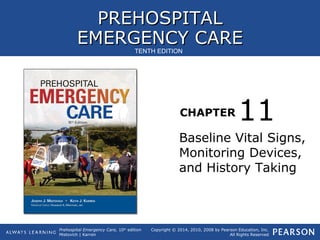
Baseline Vital Signs,
Monitoring Devices,
and History Taking
11
Prehospital Emergency Care, 10th
edition
Mistovich | Karren
Copyright © 2014, 2010, 2008 by Pearson Education, Inc.
All Rights Reserved
Learning ReadinessLearning Readiness
• EMS Education Standards, text p. 266.
Prehospital Emergency Care, 10th
edition
Mistovich | Karren
Copyright © 2014, 2010, 2008 by Pearson Education, Inc.
All Rights Reserved
Learning ReadinessLearning Readiness
ObjectivesObjectives
• Please refer to pages 266 of your text
to view the objectives for this chapter.
Prehospital Emergency Care, 10th
edition
Mistovich | Karren
Copyright © 2014, 2010, 2008 by Pearson Education, Inc.
All Rights Reserved
Learning ReadinessLearning Readiness
Key TermsKey Terms
• Please refer to page 267 of your text to
view the key terms for this chapter.
Prehospital Emergency Care, 10th
edition
Mistovich | Karren
Copyright © 2014, 2010, 2008 by Pearson Education, Inc.
All Rights Reserved
Setting the StageSetting the Stage
• Overview of Lesson Topics
 Gathering Patient Information
 Baseline Vital Signs
 Monitoring Equipment
 Preparing to Take the History
 Taking the History
Prehospital Emergency Care, 10th
edition
Mistovich | Karren
Copyright © 2014, 2010, 2008 by Pearson Education, Inc.
All Rights Reserved
Case Study IntroductionCase Study Introduction
Chuck Mahon rubs his chest, trying to
relieve the discomfort he feels there as
two EMTs walk toward him. "Hi, I'm Bill,"
says the taller of the two, "and this is
Yolanda. We are EMTs, and we are here
to help. What seems to be the problem
today?"
Prehospital Emergency Care, 10th
edition
Mistovich | Karren
Copyright © 2014, 2010, 2008 by Pearson Education, Inc.
All Rights Reserved
Case StudyCase Study
• What information will be important to
Bill and Yolanda in deciding what is
wrong with Mr. Mahon?
• What procedures and equipment will
the EMTs use to obtain this
information?
Prehospital Emergency Care, 10th
edition
Mistovich | Karren
Copyright © 2014, 2010, 2008 by Pearson Education, Inc.
All Rights Reserved
IntroductionIntroduction
• Patient assessment helps you find out
what is wrong with the patient and
decide what care should be provided.
• Measuring vital signs over time reveals
trends in the patient's condition.
• The patient's history helps you
understand his underlying problems.
Prehospital Emergency Care, 10th
edition
Mistovich | Karren
Copyright © 2014, 2010, 2008 by Pearson Education, Inc.
All Rights Reserved
Gathering Patient InformationGathering Patient Information
• When you arrive at the scene of an
emergency call, you must gather
information about the patient's
condition.
• Some information is readily available;
other information takes "detective
work."
• Always respect the patient's dignity.
Prehospital Emergency Care, 10th
edition
Mistovich | Karren
Copyright © 2014, 2010, 2008 by Pearson Education, Inc.
All Rights Reserved
Baseline Vital SignsBaseline Vital Signs
• Vital signs are outward clues about
what is happening in the body. They
include:
 Respiration
 Pulse
 Skin
 Pupils
 Blood pressure
 Pulse oximetry
continued on next slide
Prehospital Emergency Care, 10th
edition
Mistovich | Karren
Copyright © 2014, 2010, 2008 by Pearson Education, Inc.
All Rights Reserved
Baseline Vital SignsBaseline Vital Signs
• Baseline vital signs are the first set of
measurements taken.
• Later findings are compared to the
baseline to detect trends.
continued on next slide
Prehospital Emergency Care, 10th
edition
Mistovich | Karren
Copyright © 2014, 2010, 2008 by Pearson Education, Inc.
All Rights Reserved
Baseline Vital SignsBaseline Vital Signs
• Some vitals signs are detected by
looking, listening, and feeling.
• Other vital signs are measured using
special equipment.
continued on next slide
Prehospital Emergency Care, 10th
edition
Mistovich | Karren
Copyright © 2014, 2010, 2008 by Pearson Education, Inc.
All Rights Reserved
Baseline Vital SignsBaseline Vital Signs
• Respiratory rate
 For adults, the range is 12 to 20 breaths
per minute.
 Respiratory rates that are less than 8 or
greater than 24 are of concern.
 Interpret findings based on the patient's
overall presentation.
continued on next slide
Prehospital Emergency Care, 10th
edition
Mistovich | Karren
Copyright © 2014, 2010, 2008 by Pearson Education, Inc.
All Rights Reserved
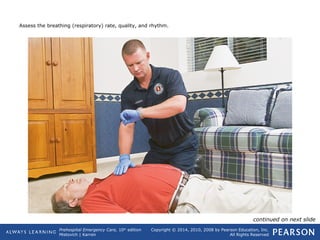
Assess the breathing (respiratory) rate, quality, and rhythm.
continued on next slide
Prehospital Emergency Care, 10th
edition
Mistovich | Karren
Copyright © 2014, 2010, 2008 by Pearson Education, Inc.
All Rights Reserved
Baseline Vital SignsBaseline Vital Signs
• Count the breaths in 30 seconds and
multiply by 2.
• A breath is one inhalation + one
exhalation.
continued on next slide
Prehospital Emergency Care, 10th
edition
Mistovich | Karren
Copyright © 2014, 2010, 2008 by Pearson Education, Inc.
All Rights Reserved
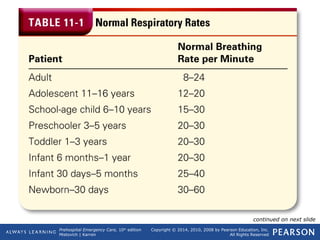
Table 11-1 Normal Respiratory Rates
continued on next slide
Prehospital Emergency Care, 10th
edition
Mistovich | Karren
Copyright © 2014, 2010, 2008 by Pearson Education, Inc.
All Rights Reserved
Baseline Vital SignsBaseline Vital Signs
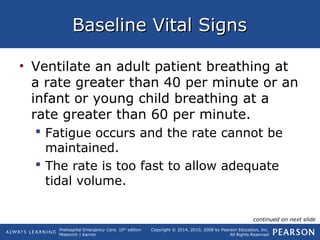
• Ventilate an adult patient breathing at
a rate greater than 40 per minute or an
infant or young child breathing at a
rate greater than 60 per minute.
 Fatigue occurs and the rate cannot be
maintained.
 The rate is too fast to allow adequate
tidal volume.
continued on next slide
Prehospital Emergency Care, 10th
edition
Mistovich | Karren
Copyright © 2014, 2010, 2008 by Pearson Education, Inc.
All Rights Reserved
Baseline Vital SignsBaseline Vital Signs
• Respiratory quality
 Normal
 Shallow
 Labored
 Noisy
continued on next slide
Prehospital Emergency Care, 10th
edition
Mistovich | Karren
Copyright © 2014, 2010, 2008 by Pearson Education, Inc.
All Rights Reserved
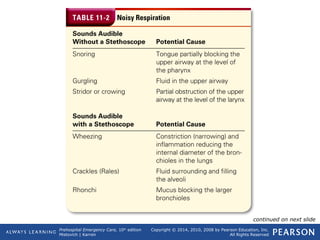
Table 11-2 Noisy Respiration
continued on next slide
Prehospital Emergency Care, 10th
edition
Mistovich | Karren
Copyright © 2014, 2010, 2008 by Pearson Education, Inc.
All Rights Reserved
Baseline Vital SignsBaseline Vital Signs
• Respiratory rhythm is the regularity or
irregularity of respirations.
• An abnormal pattern in a patient with
an altered mental status is a serious
concern.
continued on next slide
Prehospital Emergency Care, 10th
edition
Mistovich | Karren
Copyright © 2014, 2010, 2008 by Pearson Education, Inc.
All Rights Reserved
Baseline Vital SignsBaseline Vital Signs
• Pulse
 Pressure wave generated by the
contraction of the left ventricle
 Directly reflects heart function
continued on next slide
Prehospital Emergency Care, 10th
edition
Mistovich | Karren
Copyright © 2014, 2010, 2008 by Pearson Education, Inc.
All Rights Reserved
Baseline Vital SignsBaseline Vital Signs
• Pulse locations
 Carotid
 Femoral
 Brachial
 Popliteal
 Posterior tibial
 Dorsalis pedis
continued on next slide
Prehospital Emergency Care, 10th
edition
Mistovich | Karren
Copyright © 2014, 2010, 2008 by Pearson Education, Inc.
All Rights Reserved
Baseline Vital SignsBaseline Vital Signs
• If a patient is:
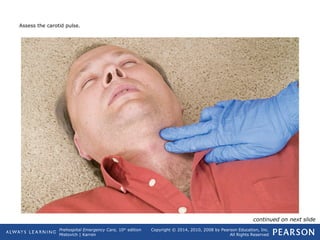
 1 year or older, check the radial pulse
 1 year or older without a peripheral
pulse, check the carotid pulse
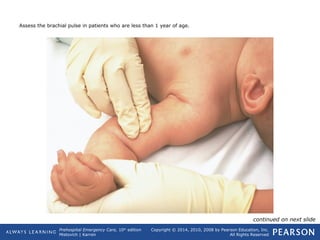
 Less than 1 year, check the brachial
pulse
continued on next slide
Prehospital Emergency Care, 10th
edition
Mistovich | Karren
Copyright © 2014, 2010, 2008 by Pearson Education, Inc.
All Rights Reserved
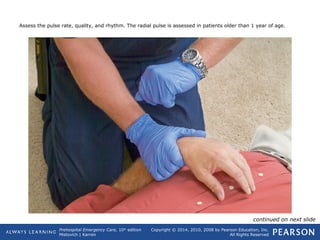
Assess the pulse rate, quality, and rhythm. The radial pulse is assessed in patients older than 1 year of age.
continued on next slide
Prehospital Emergency Care, 10th
edition
Mistovich | Karren
Copyright © 2014, 2010, 2008 by Pearson Education, Inc.
All Rights Reserved
Assess the brachial pulse in patients who are less than 1 year of age.
continued on next slide
Prehospital Emergency Care, 10th
edition
Mistovich | Karren
Copyright © 2014, 2010, 2008 by Pearson Education, Inc.
All Rights Reserved
Assess the carotid pulse.
continued on next slide
Prehospital Emergency Care, 10th
edition
Mistovich | Karren
Copyright © 2014, 2010, 2008 by Pearson Education, Inc.
All Rights Reserved
Baseline Vital SignsBaseline Vital Signs
• Pulse rate
 For adults, the average range is 60 to
80 beats per minute (resting).
 Infants' and children's heart rates are
faster.
continued on next slide
Prehospital Emergency Care, 10th
edition
Mistovich | Karren
Copyright © 2014, 2010, 2008 by Pearson Education, Inc.
All Rights Reserved
Baseline Vital SignsBaseline Vital Signs
• Pulse rate
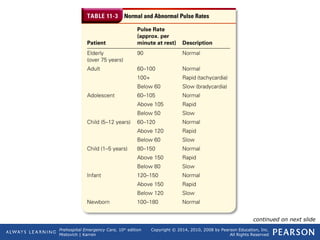
 Tachycardia is a heart rate >100 bpm.
 Bradycardia is a heart rate <60 bpm.
 Interpret findings based on the patient's
overall presentation.
continued on next slide
Prehospital Emergency Care, 10th
edition
Mistovich | Karren
Copyright © 2014, 2010, 2008 by Pearson Education, Inc.
All Rights Reserved
Table 11-3 Normal and Abnormal Pulse Rates
continued on next slide
Prehospital Emergency Care, 10th
edition
Mistovich | Karren
Copyright © 2014, 2010, 2008 by Pearson Education, Inc.
All Rights Reserved
Baseline Vital SignsBaseline Vital Signs
• To obtain the rate
 Palpate the pulse with the tips of two or
three fingers.
 Count the beats in 30 seconds and
multiply by 2.
continued on next slide
Prehospital Emergency Care, 10th
edition
Mistovich | Karren
Copyright © 2014, 2010, 2008 by Pearson Education, Inc.
All Rights Reserved
Baseline Vital SignsBaseline Vital Signs
• Pulse quality and rhythm
 Strong
 Weak
 Regular
 Irregular
continued on next slide
Prehospital Emergency Care, 10th
edition
Mistovich | Karren
Copyright © 2014, 2010, 2008 by Pearson Education, Inc.
All Rights Reserved
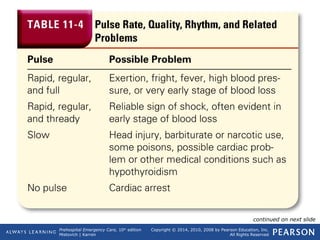
Table 11-4 Pulse Rate, Quality, Rhythm, and Related
Problems
continued on next slide
Prehospital Emergency Care, 10th
edition
Mistovich | Karren
Copyright © 2014, 2010, 2008 by Pearson Education, Inc.
All Rights Reserved
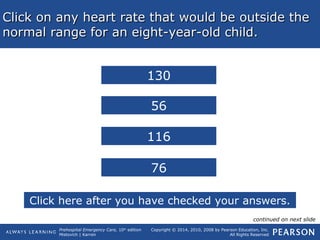
Click on any heart rate that would be outside theClick on any heart rate that would be outside the
normal range for an eight-year-old child.normal range for an eight-year-old child.
56
116
130
76
Click here after you have checked your answers.
continued on next slide
Prehospital Emergency Care, 10th
edition
Mistovich | Karren
Copyright © 2014, 2010, 2008 by Pearson Education, Inc.
All Rights Reserved
Baseline Vital SignsBaseline Vital Signs
• Assess the appearance and condition of
the skin, looking for:
 Color
 Temperature
 Condition
 Capillary refill
continued on next slide
Prehospital Emergency Care, 10th
edition
Mistovich | Karren
Copyright © 2014, 2010, 2008 by Pearson Education, Inc.
All Rights Reserved
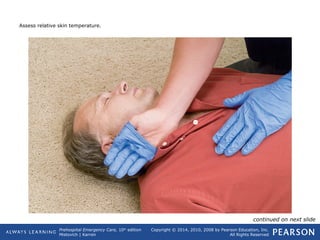
Assess relative skin temperature.
continued on next slide
Prehospital Emergency Care, 10th
edition
Mistovich | Karren
Copyright © 2014, 2010, 2008 by Pearson Education, Inc.
All Rights Reserved
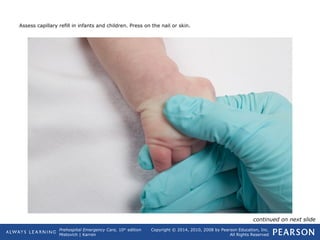
Assess capillary refill in infants and children. Press on the nail or skin.
continued on next slide
Prehospital Emergency Care, 10th
edition
Mistovich | Karren
Copyright © 2014, 2010, 2008 by Pearson Education, Inc.
All Rights Reserved
Baseline Vital SignsBaseline Vital Signs
• Normal skin characteristics
 Pink
 Warm
 Dry
 Capillary refill time
• <2 seconds in infants, children, and adult
males
• <3 seconds in females
• <4 seconds in the elderly
continued on next slide
Prehospital Emergency Care, 10th
edition
Mistovich | Karren
Copyright © 2014, 2010, 2008 by Pearson Education, Inc.
All Rights Reserved
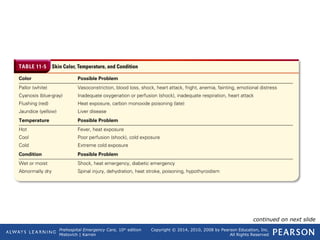
Table 11-5 Skin Color, Temperature, and Condition
continued on next slide
Prehospital Emergency Care, 10th
edition
Mistovich | Karren
Copyright © 2014, 2010, 2008 by Pearson Education, Inc.
All Rights Reserved
Baseline Vital SignsBaseline Vital Signs
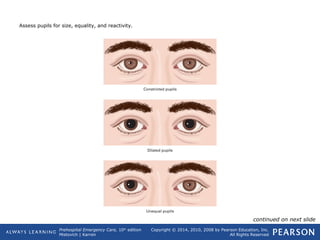
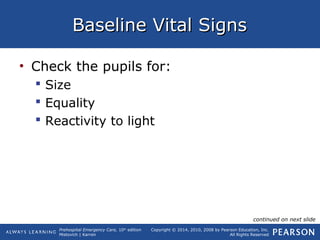
• Check the pupils for:
 Size
 Equality
 Reactivity to light
continued on next slide
Prehospital Emergency Care, 10th
edition
Mistovich | Karren
Copyright © 2014, 2010, 2008 by Pearson Education, Inc.
All Rights Reserved
Assess pupils for size, equality, and reactivity.
continued on next slide
Prehospital Emergency Care, 10th
edition
Mistovich | Karren
Copyright © 2014, 2010, 2008 by Pearson Education, Inc.
All Rights Reserved
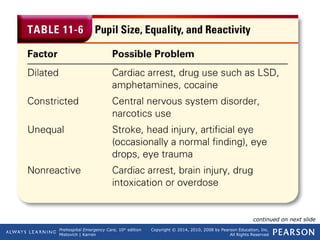
Table 11-6 Pupil Size, Equality, and Reactivity
continued on next slide
Prehospital Emergency Care, 10th
edition
Mistovich | Karren
Copyright © 2014, 2010, 2008 by Pearson Education, Inc.
All Rights Reserved
Baseline Vital SignsBaseline Vital Signs
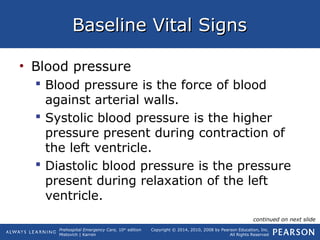
• Blood pressure
 Blood pressure is the force of blood
against arterial walls.
 Systolic blood pressure is the higher
pressure present during contraction of
the left ventricle.
 Diastolic blood pressure is the pressure
present during relaxation of the left
ventricle.
continued on next slide
Prehospital Emergency Care, 10th
edition
Mistovich | Karren
Copyright © 2014, 2010, 2008 by Pearson Education, Inc.
All Rights Reserved
Baseline Vital SignsBaseline Vital Signs
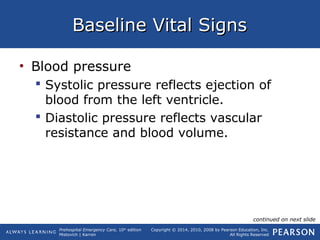
• Blood pressure
 Systolic pressure reflects ejection of
blood from the left ventricle.
 Diastolic pressure reflects vascular
resistance and blood volume.
continued on next slide
Prehospital Emergency Care, 10th
edition
Mistovich | Karren
Copyright © 2014, 2010, 2008 by Pearson Education, Inc.
All Rights Reserved
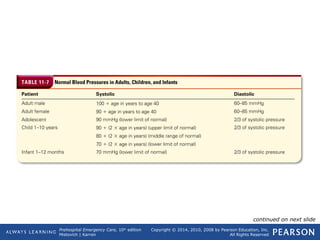
Table 11-7 Normal Blood Pressures in Adults,
Children, and Infants
continued on next slide
Prehospital Emergency Care, 10th
edition
Mistovich | Karren
Copyright © 2014, 2010, 2008 by Pearson Education, Inc.
All Rights Reserved
Baseline Vital SignsBaseline Vital Signs
• The difference between systolic blood
pressure and diastolic blood pressure is
the pulse pressure.
• Pulse pressure should be between 25%
and 50% of the systolic blood pressure.
continued on next slide
Prehospital Emergency Care, 10th
edition
Mistovich | Karren
Copyright © 2014, 2010, 2008 by Pearson Education, Inc.
All Rights Reserved
Baseline Vital SignsBaseline Vital Signs
• Take a blood pressure in all patients 3
years and older.
• Low blood pressure is an indicator of
hypoperfusion.
• High blood pressure can damage the
heart and vessels.
continued on next slide
Prehospital Emergency Care, 10th
edition
Mistovich | Karren
Copyright © 2014, 2010, 2008 by Pearson Education, Inc.
All Rights Reserved
EMT SKILLS 11-1
Taking Blood Pressure by Auscultation
continued on next slide
Prehospital Emergency Care, 10th
edition
Mistovich | Karren
Copyright © 2014, 2010, 2008 by Pearson Education, Inc.
All Rights Reserved
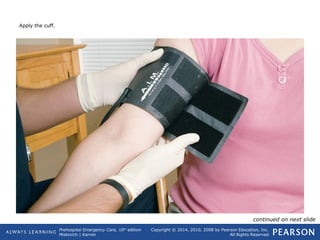
Apply the cuff.
continued on next slide
Prehospital Emergency Care, 10th
edition
Mistovich | Karren
Copyright © 2014, 2010, 2008 by Pearson Education, Inc.
All Rights Reserved
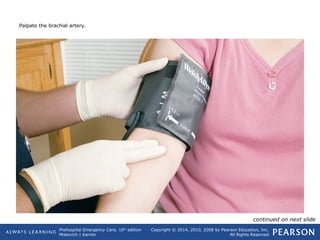
Palpate the brachial artery.
continued on next slide
Prehospital Emergency Care, 10th
edition
Mistovich | Karren
Copyright © 2014, 2010, 2008 by Pearson Education, Inc.
All Rights Reserved
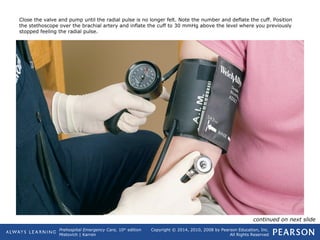
Close the valve and pump until the radial pulse is no longer felt. Note the number and deflate the cuff. Position
the stethoscope over the brachial artery and inflate the cuff to 30 mmHg above the level where you previously
stopped feeling the radial pulse.
continued on next slide
Prehospital Emergency Care, 10th
edition
Mistovich | Karren
Copyright © 2014, 2010, 2008 by Pearson Education, Inc.
All Rights Reserved
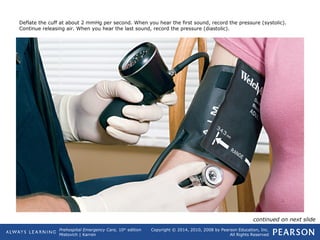
Deflate the cuff at about 2 mmHg per second. When you hear the first sound, record the pressure (systolic).
Continue releasing air. When you hear the last sound, record the pressure (diastolic).
continued on next slide
Prehospital Emergency Care, 10th
edition
Mistovich | Karren
Copyright © 2014, 2010, 2008 by Pearson Education, Inc.
All Rights Reserved
EMT SKILLS 11-2
Taking Blood Pressure by Palpation
continued on next slide
Prehospital Emergency Care, 10th
edition
Mistovich | Karren
Copyright © 2014, 2010, 2008 by Pearson Education, Inc.
All Rights Reserved
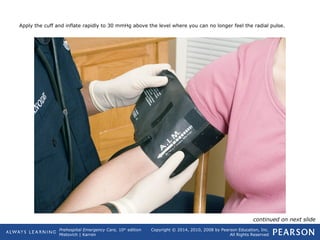
Apply the cuff and inflate rapidly to 30 mmHg above the level where you can no longer feel the radial pulse.
continued on next slide
Prehospital Emergency Care, 10th
edition
Mistovich | Karren
Copyright © 2014, 2010, 2008 by Pearson Education, Inc.
All Rights Reserved
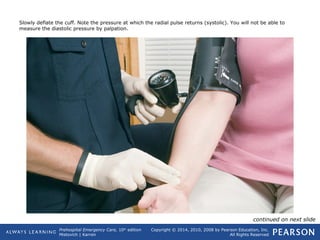
Slowly deflate the cuff. Note the pressure at which the radial pulse returns (systolic). You will not be able to
measure the diastolic pressure by palpation.
continued on next slide
Prehospital Emergency Care, 10th
edition
Mistovich | Karren
Copyright © 2014, 2010, 2008 by Pearson Education, Inc.
All Rights Reserved
Baseline Vital SignsBaseline Vital Signs
• Orthostatic vital signs are assessed in
patients with suspected volume loss.
• Obtain the blood pressure first with the
patient supine, and then 2 minutes
after he stands up.
continued on next slide
Prehospital Emergency Care, 10th
edition
Mistovich | Karren
Copyright © 2014, 2010, 2008 by Pearson Education, Inc.
All Rights Reserved
Baseline Vital SignsBaseline Vital Signs
• Positive orthostatic changes are:
 A drop in systolic BP of 10 to 20 mmHg
 An increase in heart rate greater than
10 to 20 bpm
• Consider the patient's age and
medication when interpreting the
results.
continued on next slide
Prehospital Emergency Care, 10th
edition
Mistovich | Karren
Copyright © 2014, 2010, 2008 by Pearson Education, Inc.
All Rights Reserved
EMT SKILLS 11-3
Taking Orthostatic Vital Signs
continued on next slide
Prehospital Emergency Care, 10th
edition
Mistovich | Karren
Copyright © 2014, 2010, 2008 by Pearson Education, Inc.
All Rights Reserved
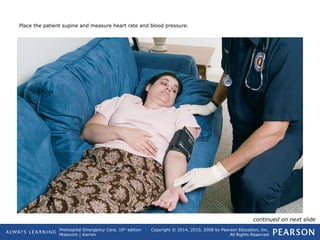
Place the patient supine and measure heart rate and blood pressure.
continued on next slide
Prehospital Emergency Care, 10th
edition
Mistovich | Karren
Copyright © 2014, 2010, 2008 by Pearson Education, Inc.
All Rights Reserved
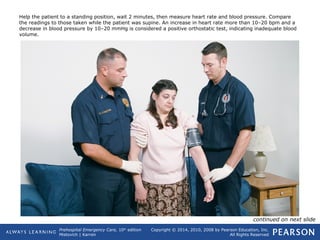
Help the patient to a standing position, wait 2 minutes, then measure heart rate and blood pressure. Compare
the readings to those taken while the patient was supine. An increase in heart rate more than 10–20 bpm and a
decrease in blood pressure by 10–20 mmHg is considered a positive orthostatic test, indicating inadequate blood
volume.
continued on next slide
Prehospital Emergency Care, 10th
edition
Mistovich | Karren
Copyright © 2014, 2010, 2008 by Pearson Education, Inc.
All Rights Reserved
Baseline Vital SignsBaseline Vital Signs
• Reassessing vital signs
 Every 15 minutes for stable patients
 Every 5 minutes for unstable patients
 Reassess after every intervention.
Prehospital Emergency Care, 10th
edition
Mistovich | Karren
Copyright © 2014, 2010, 2008 by Pearson Education, Inc.
All Rights Reserved
Monitoring EquipmentMonitoring Equipment
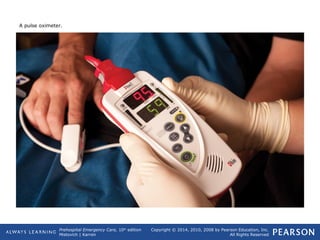
• Pulse oximetry detects hypoxia by
measuring oxygen saturation levels in
the blood.
• A pulse oximeter measures the level of
hemoglobin saturated with oxygen.
continued on next slide
Prehospital Emergency Care, 10th
edition
Mistovich | Karren
Copyright © 2014, 2010, 2008 by Pearson Education, Inc.
All Rights Reserved
EMT SKILLS 11-4
Pulse Oximetry
continued on next slide
Prehospital Emergency Care, 10th
edition
Mistovich | Karren
Copyright © 2014, 2010, 2008 by Pearson Education, Inc.
All Rights Reserved
A pulse oximeter.
Prehospital Emergency Care, 10th
edition
Mistovich | Karren
Copyright © 2014, 2010, 2008 by Pearson Education, Inc.
All Rights Reserved
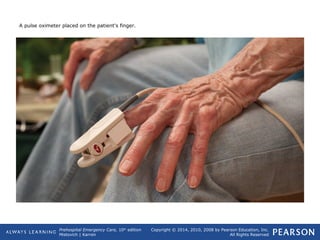
A pulse oximeter placed on the patient's finger.
Prehospital Emergency Care, 10th
edition
Mistovich | Karren
Copyright © 2014, 2010, 2008 by Pearson Education, Inc.
All Rights Reserved
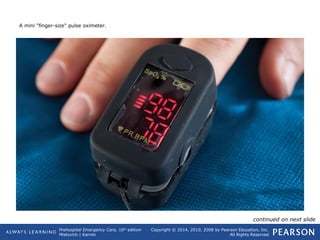
A mini "finger-size" pulse oximeter.
continued on next slide
Prehospital Emergency Care, 10th
edition
Mistovich | Karren
Copyright © 2014, 2010, 2008 by Pearson Education, Inc.
All Rights Reserved
Monitoring EquipmentMonitoring Equipment
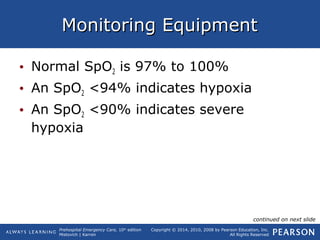
• Normal SpO2 is 97% to 100%
• An SpO2 <94% indicates hypoxia
• An SpO2 <90% indicates severe
hypoxia
continued on next slide
Prehospital Emergency Care, 10th
edition
Mistovich | Karren
Copyright © 2014, 2010, 2008 by Pearson Education, Inc.
All Rights Reserved
Monitoring EquipmentMonitoring Equipment
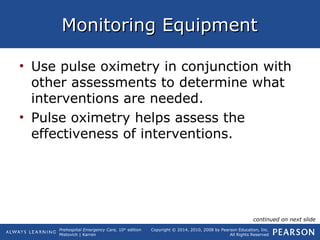
• Use pulse oximetry in conjunction with
other assessments to determine what
interventions are needed.
• Pulse oximetry helps assess the
effectiveness of interventions.
continued on next slide
Prehospital Emergency Care, 10th
edition
Mistovich | Karren
Copyright © 2014, 2010, 2008 by Pearson Education, Inc.
All Rights Reserved
Monitoring EquipmentMonitoring Equipment
• Pulse oximetry may be inaccurate in
these instances:
 Shock
 Hypothermia
 Excessive patient movement
 Nail polish
 Carbon monoxide exposure, including
from cigarette smoking
 Anemia
continued on next slide
Prehospital Emergency Care, 10th
edition
Mistovich | Karren
Copyright © 2014, 2010, 2008 by Pearson Education, Inc.
All Rights Reserved
Monitoring EquipmentMonitoring Equipment
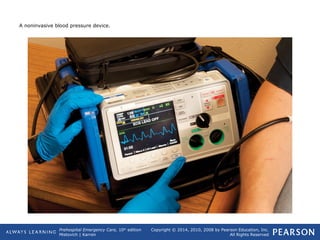
• Noninvasive blood pressure monitor
 Can be set to reassess the blood
pressure at selected intervals, or can be
activated manually
 Alarms can be set to signal pressures
that exceed or fall below set upper and
lower limits.
continued on next slide
Prehospital Emergency Care, 10th
edition
Mistovich | Karren
Copyright © 2014, 2010, 2008 by Pearson Education, Inc.
All Rights Reserved
A noninvasive blood pressure device.
Prehospital Emergency Care, 10th
edition
Mistovich | Karren
Copyright © 2014, 2010, 2008 by Pearson Education, Inc.
All Rights Reserved
Case StudyCase Study
Mr. Mahon reports that he began feeling
some pressure in his chest about 15
minutes ago. Bill organizes several
questions in his mind, as Yolanda obtains
respiratory and pulse rates, a blood
pressure, and a pulse oximetry reading.
Meanwhile, Bill can see that Mr. Mahon's
skin is slightly pale, and cool and moist
to the touch.
Prehospital Emergency Care, 10th
edition
Mistovich | Karren
Copyright © 2014, 2010, 2008 by Pearson Education, Inc.
All Rights Reserved
Case StudyCase Study
• What are the normal ranges of vital
signs for this patient?
• Given the patient's complaint, what
questions should Bill be prepared to
ask?
Prehospital Emergency Care, 10th
edition
Mistovich | Karren
Copyright © 2014, 2010, 2008 by Pearson Education, Inc.
All Rights Reserved
Preparing to Take the HistoryPreparing to Take the History
• Gain control of the scene.
• Display competence, confidence, and
compassion.
continued on next slide
Prehospital Emergency Care, 10th
edition
Mistovich | Karren
Copyright © 2014, 2010, 2008 by Pearson Education, Inc.
All Rights Reserved
Preparing to Take the HistoryPreparing to Take the History
• Achieve a smooth transition of care.
• Obtain information from the person
providing care before your arrival.
continued on next slide
Prehospital Emergency Care, 10th
edition
Mistovich | Karren
Copyright © 2014, 2010, 2008 by Pearson Education, Inc.
All Rights Reserved
Preparing to Take the HistoryPreparing to Take the History
• Reduce the patient's anxiety by doing
the following:
 Bring order to the environment.
 Introduce yourself.
 Gain patient consent.
 Position yourself.
continued on next slide
Prehospital Emergency Care, 10th
edition
Mistovich | Karren
Copyright © 2014, 2010, 2008 by Pearson Education, Inc.
All Rights Reserved
Preparing to Take the HistoryPreparing to Take the History
• Reduce the patient's anxiety by doing
the following:
 Use communication skills.
 Be courteous.
 Use touch when appropriate.
continued on next slide
Prehospital Emergency Care, 10th
edition
Mistovich | Karren
Copyright © 2014, 2010, 2008 by Pearson Education, Inc.
All Rights Reserved
Preparing to Take the HistoryPreparing to Take the History
• Maintain control of the scene.
• Recognize when a scene cannot be
controlled, and do not jeopardize your
own safety.
Prehospital Emergency Care, 10th
edition
Mistovich | Karren
Copyright © 2014, 2010, 2008 by Pearson Education, Inc.
All Rights Reserved
Taking the HistoryTaking the History
• The history begins with the reason why
EMS was called, which is the chief
complaint.
• The history helps guide the physical
examination.
• The process must be dynamic to
accommodate the situation.
continued on next slide
Prehospital Emergency Care, 10th
edition
Mistovich | Karren
Copyright © 2014, 2010, 2008 by Pearson Education, Inc.
All Rights Reserved
Taking the HistoryTaking the History
• The best person to get the history from
is the patient.
• After the chief complaint, determine
the history of the present illness.
continued on next slide
Prehospital Emergency Care, 10th
edition
Mistovich | Karren
Copyright © 2014, 2010, 2008 by Pearson Education, Inc.
All Rights Reserved
Taking the HistoryTaking the History
• Statistical and demographic information
 Date
 Time
 Patient's identifying data
continued on next slide
Prehospital Emergency Care, 10th
edition
Mistovich | Karren
Copyright © 2014, 2010, 2008 by Pearson Education, Inc.
All Rights Reserved
Taking the HistoryTaking the History
• Current health status
 Current medications
 Allergies to medications or other
substances
 Tobacco use
 Alcohol, drugs, and related substances
continued on next slide
Prehospital Emergency Care, 10th
edition
Mistovich | Karren
Copyright © 2014, 2010, 2008 by Pearson Education, Inc.
All Rights Reserved
Taking the HistoryTaking the History
• Current health status
 Diet
 Screening tests that may have been
done recently
 Immunizations
continued on next slide
Prehospital Emergency Care, 10th
edition
Mistovich | Karren
Copyright © 2014, 2010, 2008 by Pearson Education, Inc.
All Rights Reserved
Taking the HistoryTaking the History
• Current health status
 Environmental hazards
 Use of safety equipment
 Family history
continued on next slide
Prehospital Emergency Care, 10th
edition
Mistovich | Karren
Copyright © 2014, 2010, 2008 by Pearson Education, Inc.
All Rights Reserved
Taking the HistoryTaking the History
• Techniques that assist in obtaining the
history include:
 Note taking
 Types of questions asked
 Active listening
continued on next slide
Prehospital Emergency Care, 10th
edition
Mistovich | Karren
Copyright © 2014, 2010, 2008 by Pearson Education, Inc.
All Rights Reserved
Taking the HistoryTaking the History
• Take notes to document important
information.
• Open-ended questions can yield more
information, but closed-ended
questions also are useful.
continued on next slide
Prehospital Emergency Care, 10th
edition
Mistovich | Karren
Copyright © 2014, 2010, 2008 by Pearson Education, Inc.
All Rights Reserved
Taking the HistoryTaking the History
• Active listening techniques include:
 Facilitation
 Reflection
 Clarification
 Empathetic response
 Confrontation
 Interpretation
continued on next slide
Prehospital Emergency Care, 10th
edition
Mistovich | Karren
Copyright © 2014, 2010, 2008 by Pearson Education, Inc.
All Rights Reserved
Taking the HistoryTaking the History
• SAMPLE is a mnemonic to help you
remember what information to gather.
continued on next slide
Prehospital Emergency Care, 10th
edition
Mistovich | Karren
Copyright © 2014, 2010, 2008 by Pearson Education, Inc.
All Rights Reserved
Taking the HistoryTaking the History
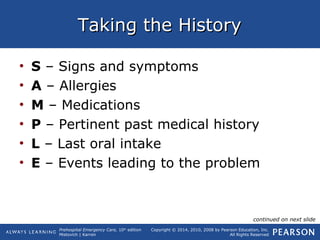
• S – Signs and symptoms
• A – Allergies
• M – Medications
• P – Pertinent past medical history
• L – Last oral intake
• E – Events leading to the problem
continued on next slide
Prehospital Emergency Care, 10th
edition
Mistovich | Karren
Copyright © 2014, 2010, 2008 by Pearson Education, Inc.
All Rights Reserved
Taking the HistoryTaking the History
• Signs are observable physical signs of
illness or injury.
• Symptoms cannot be observed and
must be described by the patient.
• The mnemonic OPQRST helps you
evaluate the signs and symptoms.
continued on next slide
Prehospital Emergency Care, 10th
edition
Mistovich | Karren
Copyright © 2014, 2010, 2008 by Pearson Education, Inc.
All Rights Reserved
Taking the HistoryTaking the History
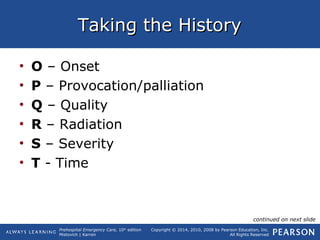
• O – Onset
• P – Provocation/palliation
• Q – Quality
• R – Radiation
• S – Severity
• T - Time
continued on next slide
Prehospital Emergency Care, 10th
edition
Mistovich | Karren
Copyright © 2014, 2010, 2008 by Pearson Education, Inc.
All Rights Reserved
Taking the HistoryTaking the History
• Ask about the following medications:
 Prescription
 Over-the-counter
 Birth control pills
 Illicit drugs
 Herbal medications
 Erectile dysfunction drugs
 Use of another person's medications
 Vitamins continued on next slide
Prehospital Emergency Care, 10th
edition
Mistovich | Karren
Copyright © 2014, 2010, 2008 by Pearson Education, Inc.
All Rights Reserved
Taking the HistoryTaking the History
• Sensitive topics
 You may need to ask about alcohol or
drug use, physical or sexual abuse, or
sexual history.
 Ask only pertinent, necessary questions.
 Be sensitive and nonjudgmental.
 Respect the patient's privacy.
continued on next slide
Prehospital Emergency Care, 10th
edition
Mistovich | Karren
Copyright © 2014, 2010, 2008 by Pearson Education, Inc.
All Rights Reserved
Taking the HistoryTaking the History
• Special challenges
 Silence
 Overly talkative patients
 Patients with multiple symptoms
 Anxious patients
continued on next slide
Prehospital Emergency Care, 10th
edition
Mistovich | Karren
Copyright © 2014, 2010, 2008 by Pearson Education, Inc.
All Rights Reserved
Taking the HistoryTaking the History
• Special challenges
 Angry or hostile patient
 Intoxicated patient
 Crying patient
 Depressed patient
continued on next slide
Prehospital Emergency Care, 10th
edition
Mistovich | Karren
Copyright © 2014, 2010, 2008 by Pearson Education, Inc.
All Rights Reserved
Taking the HistoryTaking the History
• Special challenges
 Confusing behavior or history
 Patients with limited intelligence
 Language barrier
 Hearing impairment
continued on next slide
Prehospital Emergency Care, 10th
edition
Mistovich | Karren
Copyright © 2014, 2010, 2008 by Pearson Education, Inc.
All Rights Reserved
Taking the HistoryTaking the History
• Special challenges
 Visual impairment
 Talking with friends or family
 Pediatric patient
 Elderly patient
Prehospital Emergency Care, 10th
edition
Mistovich | Karren
Copyright © 2014, 2010, 2008 by Pearson Education, Inc.
All Rights Reserved
Case Study Wrap-UpCase Study Wrap-Up
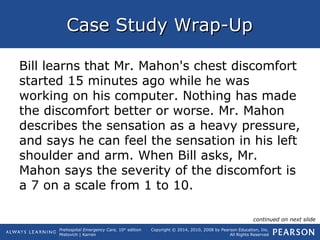
Bill learns that Mr. Mahon's chest discomfort
started 15 minutes ago while he was
working on his computer. Nothing has made
the discomfort better or worse. Mr. Mahon
describes the sensation as a heavy pressure,
and says he can feel the sensation in his left
shoulder and arm. When Bill asks, Mr.
Mahon says the severity of the discomfort is
a 7 on a scale from 1 to 10.
continued on next slide
Prehospital Emergency Care, 10th
edition
Mistovich | Karren
Copyright © 2014, 2010, 2008 by Pearson Education, Inc.
All Rights Reserved
Case Study Wrap-UpCase Study Wrap-Up
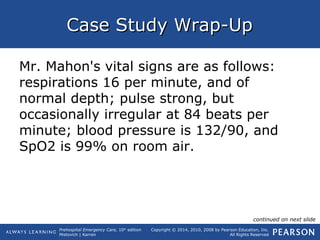
Mr. Mahon's vital signs are as follows:
respirations 16 per minute, and of
normal depth; pulse strong, but
occasionally irregular at 84 beats per
minute; blood pressure is 132/90, and
SpO2 is 99% on room air.
continued on next slide
Prehospital Emergency Care, 10th
edition
Mistovich | Karren
Copyright © 2014, 2010, 2008 by Pearson Education, Inc.
All Rights Reserved
Case Study Wrap-UpCase Study Wrap-Up
Based on the history, Bill suspects acute
coronary syndrome. He administers
aspirin and nitroglycerin to Mr. Mahon,
according to protocol, as they prepare to
transport him to the hospital.
Prehospital Emergency Care, 10th
edition
Mistovich | Karren
Copyright © 2014, 2010, 2008 by Pearson Education, Inc.
All Rights Reserved
Lesson SummaryLesson Summary
• You will take vital signs on every
patient you encounter.
• Baseline vital signs allow comparison
with later vital signs to detect trends.
• Vital signs include respirations, pulse,
blood pressure, skin, pupils, and pulse
oximetry.
continued on next slide
Prehospital Emergency Care, 10th
edition
Mistovich | Karren
Copyright © 2014, 2010, 2008 by Pearson Education, Inc.
All Rights Reserved
Lesson SummaryLesson Summary
• A medical history is important in
determining the patient's condition and
the care needed.
• You must be prepared to overcome
many challenges in history-taking.

DMACC EMT Chapter 11

  • 1.
    PREHOSPITALPREHOSPITAL EMERGENCY CAREEMERGENCY CARE CHAPTER Copyright© 2014, 2010, 2008 by Pearson Education, Inc. All Rights Reserved Prehospital Emergency Care, 10th edition Mistovich | Karren TENTH EDITION Baseline Vital Signs, Monitoring Devices, and History Taking 11
  • 2.
    Prehospital Emergency Care,10th edition Mistovich | Karren Copyright © 2014, 2010, 2008 by Pearson Education, Inc. All Rights Reserved Learning ReadinessLearning Readiness • EMS Education Standards, text p. 266.
  • 3.
    Prehospital Emergency Care,10th edition Mistovich | Karren Copyright © 2014, 2010, 2008 by Pearson Education, Inc. All Rights Reserved Learning ReadinessLearning Readiness ObjectivesObjectives • Please refer to pages 266 of your text to view the objectives for this chapter.
  • 4.
    Prehospital Emergency Care,10th edition Mistovich | Karren Copyright © 2014, 2010, 2008 by Pearson Education, Inc. All Rights Reserved Learning ReadinessLearning Readiness Key TermsKey Terms • Please refer to page 267 of your text to view the key terms for this chapter.
  • 5.
    Prehospital Emergency Care,10th edition Mistovich | Karren Copyright © 2014, 2010, 2008 by Pearson Education, Inc. All Rights Reserved Setting the StageSetting the Stage • Overview of Lesson Topics  Gathering Patient Information  Baseline Vital Signs  Monitoring Equipment  Preparing to Take the History  Taking the History
  • 6.
    Prehospital Emergency Care,10th edition Mistovich | Karren Copyright © 2014, 2010, 2008 by Pearson Education, Inc. All Rights Reserved Case Study IntroductionCase Study Introduction Chuck Mahon rubs his chest, trying to relieve the discomfort he feels there as two EMTs walk toward him. "Hi, I'm Bill," says the taller of the two, "and this is Yolanda. We are EMTs, and we are here to help. What seems to be the problem today?"
  • 7.
    Prehospital Emergency Care,10th edition Mistovich | Karren Copyright © 2014, 2010, 2008 by Pearson Education, Inc. All Rights Reserved Case StudyCase Study • What information will be important to Bill and Yolanda in deciding what is wrong with Mr. Mahon? • What procedures and equipment will the EMTs use to obtain this information?
  • 8.
    Prehospital Emergency Care,10th edition Mistovich | Karren Copyright © 2014, 2010, 2008 by Pearson Education, Inc. All Rights Reserved IntroductionIntroduction • Patient assessment helps you find out what is wrong with the patient and decide what care should be provided. • Measuring vital signs over time reveals trends in the patient's condition. • The patient's history helps you understand his underlying problems.
  • 9.
    Prehospital Emergency Care,10th edition Mistovich | Karren Copyright © 2014, 2010, 2008 by Pearson Education, Inc. All Rights Reserved Gathering Patient InformationGathering Patient Information • When you arrive at the scene of an emergency call, you must gather information about the patient's condition. • Some information is readily available; other information takes "detective work." • Always respect the patient's dignity.
  • 10.
    Prehospital Emergency Care,10th edition Mistovich | Karren Copyright © 2014, 2010, 2008 by Pearson Education, Inc. All Rights Reserved Baseline Vital SignsBaseline Vital Signs • Vital signs are outward clues about what is happening in the body. They include:  Respiration  Pulse  Skin  Pupils  Blood pressure  Pulse oximetry continued on next slide
  • 11.
    Prehospital Emergency Care,10th edition Mistovich | Karren Copyright © 2014, 2010, 2008 by Pearson Education, Inc. All Rights Reserved Baseline Vital SignsBaseline Vital Signs • Baseline vital signs are the first set of measurements taken. • Later findings are compared to the baseline to detect trends. continued on next slide
  • 12.
    Prehospital Emergency Care,10th edition Mistovich | Karren Copyright © 2014, 2010, 2008 by Pearson Education, Inc. All Rights Reserved Baseline Vital SignsBaseline Vital Signs • Some vitals signs are detected by looking, listening, and feeling. • Other vital signs are measured using special equipment. continued on next slide
  • 13.
    Prehospital Emergency Care,10th edition Mistovich | Karren Copyright © 2014, 2010, 2008 by Pearson Education, Inc. All Rights Reserved Baseline Vital SignsBaseline Vital Signs • Respiratory rate  For adults, the range is 12 to 20 breaths per minute.  Respiratory rates that are less than 8 or greater than 24 are of concern.  Interpret findings based on the patient's overall presentation. continued on next slide
  • 14.
    Prehospital Emergency Care,10th edition Mistovich | Karren Copyright © 2014, 2010, 2008 by Pearson Education, Inc. All Rights Reserved Assess the breathing (respiratory) rate, quality, and rhythm. continued on next slide
  • 15.
    Prehospital Emergency Care,10th edition Mistovich | Karren Copyright © 2014, 2010, 2008 by Pearson Education, Inc. All Rights Reserved Baseline Vital SignsBaseline Vital Signs • Count the breaths in 30 seconds and multiply by 2. • A breath is one inhalation + one exhalation. continued on next slide
  • 16.
    Prehospital Emergency Care,10th edition Mistovich | Karren Copyright © 2014, 2010, 2008 by Pearson Education, Inc. All Rights Reserved Table 11-1 Normal Respiratory Rates continued on next slide
  • 17.
    Prehospital Emergency Care,10th edition Mistovich | Karren Copyright © 2014, 2010, 2008 by Pearson Education, Inc. All Rights Reserved Baseline Vital SignsBaseline Vital Signs • Ventilate an adult patient breathing at a rate greater than 40 per minute or an infant or young child breathing at a rate greater than 60 per minute.  Fatigue occurs and the rate cannot be maintained.  The rate is too fast to allow adequate tidal volume. continued on next slide
  • 18.
    Prehospital Emergency Care,10th edition Mistovich | Karren Copyright © 2014, 2010, 2008 by Pearson Education, Inc. All Rights Reserved Baseline Vital SignsBaseline Vital Signs • Respiratory quality  Normal  Shallow  Labored  Noisy continued on next slide
  • 19.
    Prehospital Emergency Care,10th edition Mistovich | Karren Copyright © 2014, 2010, 2008 by Pearson Education, Inc. All Rights Reserved Table 11-2 Noisy Respiration continued on next slide
  • 20.
    Prehospital Emergency Care,10th edition Mistovich | Karren Copyright © 2014, 2010, 2008 by Pearson Education, Inc. All Rights Reserved Baseline Vital SignsBaseline Vital Signs • Respiratory rhythm is the regularity or irregularity of respirations. • An abnormal pattern in a patient with an altered mental status is a serious concern. continued on next slide
  • 21.
    Prehospital Emergency Care,10th edition Mistovich | Karren Copyright © 2014, 2010, 2008 by Pearson Education, Inc. All Rights Reserved Baseline Vital SignsBaseline Vital Signs • Pulse  Pressure wave generated by the contraction of the left ventricle  Directly reflects heart function continued on next slide
  • 22.
    Prehospital Emergency Care,10th edition Mistovich | Karren Copyright © 2014, 2010, 2008 by Pearson Education, Inc. All Rights Reserved Baseline Vital SignsBaseline Vital Signs • Pulse locations  Carotid  Femoral  Brachial  Popliteal  Posterior tibial  Dorsalis pedis continued on next slide
  • 23.
    Prehospital Emergency Care,10th edition Mistovich | Karren Copyright © 2014, 2010, 2008 by Pearson Education, Inc. All Rights Reserved Baseline Vital SignsBaseline Vital Signs • If a patient is:  1 year or older, check the radial pulse  1 year or older without a peripheral pulse, check the carotid pulse  Less than 1 year, check the brachial pulse continued on next slide
  • 24.
    Prehospital Emergency Care,10th edition Mistovich | Karren Copyright © 2014, 2010, 2008 by Pearson Education, Inc. All Rights Reserved Assess the pulse rate, quality, and rhythm. The radial pulse is assessed in patients older than 1 year of age. continued on next slide
  • 25.
    Prehospital Emergency Care,10th edition Mistovich | Karren Copyright © 2014, 2010, 2008 by Pearson Education, Inc. All Rights Reserved Assess the brachial pulse in patients who are less than 1 year of age. continued on next slide
  • 26.
    Prehospital Emergency Care,10th edition Mistovich | Karren Copyright © 2014, 2010, 2008 by Pearson Education, Inc. All Rights Reserved Assess the carotid pulse. continued on next slide
  • 27.
    Prehospital Emergency Care,10th edition Mistovich | Karren Copyright © 2014, 2010, 2008 by Pearson Education, Inc. All Rights Reserved Baseline Vital SignsBaseline Vital Signs • Pulse rate  For adults, the average range is 60 to 80 beats per minute (resting).  Infants' and children's heart rates are faster. continued on next slide
  • 28.
    Prehospital Emergency Care,10th edition Mistovich | Karren Copyright © 2014, 2010, 2008 by Pearson Education, Inc. All Rights Reserved Baseline Vital SignsBaseline Vital Signs • Pulse rate  Tachycardia is a heart rate >100 bpm.  Bradycardia is a heart rate <60 bpm.  Interpret findings based on the patient's overall presentation. continued on next slide
  • 29.
    Prehospital Emergency Care,10th edition Mistovich | Karren Copyright © 2014, 2010, 2008 by Pearson Education, Inc. All Rights Reserved Table 11-3 Normal and Abnormal Pulse Rates continued on next slide
  • 30.
    Prehospital Emergency Care,10th edition Mistovich | Karren Copyright © 2014, 2010, 2008 by Pearson Education, Inc. All Rights Reserved Baseline Vital SignsBaseline Vital Signs • To obtain the rate  Palpate the pulse with the tips of two or three fingers.  Count the beats in 30 seconds and multiply by 2. continued on next slide
  • 31.
    Prehospital Emergency Care,10th edition Mistovich | Karren Copyright © 2014, 2010, 2008 by Pearson Education, Inc. All Rights Reserved Baseline Vital SignsBaseline Vital Signs • Pulse quality and rhythm  Strong  Weak  Regular  Irregular continued on next slide
  • 32.
    Prehospital Emergency Care,10th edition Mistovich | Karren Copyright © 2014, 2010, 2008 by Pearson Education, Inc. All Rights Reserved Table 11-4 Pulse Rate, Quality, Rhythm, and Related Problems continued on next slide
  • 33.
    Prehospital Emergency Care,10th edition Mistovich | Karren Copyright © 2014, 2010, 2008 by Pearson Education, Inc. All Rights Reserved Click on any heart rate that would be outside theClick on any heart rate that would be outside the normal range for an eight-year-old child.normal range for an eight-year-old child. 56 116 130 76 Click here after you have checked your answers. continued on next slide
  • 34.
    Prehospital Emergency Care,10th edition Mistovich | Karren Copyright © 2014, 2010, 2008 by Pearson Education, Inc. All Rights Reserved Baseline Vital SignsBaseline Vital Signs • Assess the appearance and condition of the skin, looking for:  Color  Temperature  Condition  Capillary refill continued on next slide
  • 35.
    Prehospital Emergency Care,10th edition Mistovich | Karren Copyright © 2014, 2010, 2008 by Pearson Education, Inc. All Rights Reserved Assess relative skin temperature. continued on next slide
  • 36.
    Prehospital Emergency Care,10th edition Mistovich | Karren Copyright © 2014, 2010, 2008 by Pearson Education, Inc. All Rights Reserved Assess capillary refill in infants and children. Press on the nail or skin. continued on next slide
  • 37.
    Prehospital Emergency Care,10th edition Mistovich | Karren Copyright © 2014, 2010, 2008 by Pearson Education, Inc. All Rights Reserved Baseline Vital SignsBaseline Vital Signs • Normal skin characteristics  Pink  Warm  Dry  Capillary refill time • <2 seconds in infants, children, and adult males • <3 seconds in females • <4 seconds in the elderly continued on next slide
  • 38.
    Prehospital Emergency Care,10th edition Mistovich | Karren Copyright © 2014, 2010, 2008 by Pearson Education, Inc. All Rights Reserved Table 11-5 Skin Color, Temperature, and Condition continued on next slide
  • 39.
    Prehospital Emergency Care,10th edition Mistovich | Karren Copyright © 2014, 2010, 2008 by Pearson Education, Inc. All Rights Reserved Baseline Vital SignsBaseline Vital Signs • Check the pupils for:  Size  Equality  Reactivity to light continued on next slide
  • 40.
    Prehospital Emergency Care,10th edition Mistovich | Karren Copyright © 2014, 2010, 2008 by Pearson Education, Inc. All Rights Reserved Assess pupils for size, equality, and reactivity. continued on next slide
  • 41.
    Prehospital Emergency Care,10th edition Mistovich | Karren Copyright © 2014, 2010, 2008 by Pearson Education, Inc. All Rights Reserved Table 11-6 Pupil Size, Equality, and Reactivity continued on next slide
  • 42.
    Prehospital Emergency Care,10th edition Mistovich | Karren Copyright © 2014, 2010, 2008 by Pearson Education, Inc. All Rights Reserved Baseline Vital SignsBaseline Vital Signs • Blood pressure  Blood pressure is the force of blood against arterial walls.  Systolic blood pressure is the higher pressure present during contraction of the left ventricle.  Diastolic blood pressure is the pressure present during relaxation of the left ventricle. continued on next slide
  • 43.
    Prehospital Emergency Care,10th edition Mistovich | Karren Copyright © 2014, 2010, 2008 by Pearson Education, Inc. All Rights Reserved Baseline Vital SignsBaseline Vital Signs • Blood pressure  Systolic pressure reflects ejection of blood from the left ventricle.  Diastolic pressure reflects vascular resistance and blood volume. continued on next slide
  • 44.
    Prehospital Emergency Care,10th edition Mistovich | Karren Copyright © 2014, 2010, 2008 by Pearson Education, Inc. All Rights Reserved Table 11-7 Normal Blood Pressures in Adults, Children, and Infants continued on next slide
  • 45.
    Prehospital Emergency Care,10th edition Mistovich | Karren Copyright © 2014, 2010, 2008 by Pearson Education, Inc. All Rights Reserved Baseline Vital SignsBaseline Vital Signs • The difference between systolic blood pressure and diastolic blood pressure is the pulse pressure. • Pulse pressure should be between 25% and 50% of the systolic blood pressure. continued on next slide
  • 46.
    Prehospital Emergency Care,10th edition Mistovich | Karren Copyright © 2014, 2010, 2008 by Pearson Education, Inc. All Rights Reserved Baseline Vital SignsBaseline Vital Signs • Take a blood pressure in all patients 3 years and older. • Low blood pressure is an indicator of hypoperfusion. • High blood pressure can damage the heart and vessels. continued on next slide
  • 47.
    Prehospital Emergency Care,10th edition Mistovich | Karren Copyright © 2014, 2010, 2008 by Pearson Education, Inc. All Rights Reserved EMT SKILLS 11-1 Taking Blood Pressure by Auscultation continued on next slide
  • 48.
    Prehospital Emergency Care,10th edition Mistovich | Karren Copyright © 2014, 2010, 2008 by Pearson Education, Inc. All Rights Reserved Apply the cuff. continued on next slide
  • 49.
    Prehospital Emergency Care,10th edition Mistovich | Karren Copyright © 2014, 2010, 2008 by Pearson Education, Inc. All Rights Reserved Palpate the brachial artery. continued on next slide
  • 50.
    Prehospital Emergency Care,10th edition Mistovich | Karren Copyright © 2014, 2010, 2008 by Pearson Education, Inc. All Rights Reserved Close the valve and pump until the radial pulse is no longer felt. Note the number and deflate the cuff. Position the stethoscope over the brachial artery and inflate the cuff to 30 mmHg above the level where you previously stopped feeling the radial pulse. continued on next slide
  • 51.
    Prehospital Emergency Care,10th edition Mistovich | Karren Copyright © 2014, 2010, 2008 by Pearson Education, Inc. All Rights Reserved Deflate the cuff at about 2 mmHg per second. When you hear the first sound, record the pressure (systolic). Continue releasing air. When you hear the last sound, record the pressure (diastolic). continued on next slide
  • 52.
    Prehospital Emergency Care,10th edition Mistovich | Karren Copyright © 2014, 2010, 2008 by Pearson Education, Inc. All Rights Reserved EMT SKILLS 11-2 Taking Blood Pressure by Palpation continued on next slide
  • 53.
    Prehospital Emergency Care,10th edition Mistovich | Karren Copyright © 2014, 2010, 2008 by Pearson Education, Inc. All Rights Reserved Apply the cuff and inflate rapidly to 30 mmHg above the level where you can no longer feel the radial pulse. continued on next slide
  • 54.
    Prehospital Emergency Care,10th edition Mistovich | Karren Copyright © 2014, 2010, 2008 by Pearson Education, Inc. All Rights Reserved Slowly deflate the cuff. Note the pressure at which the radial pulse returns (systolic). You will not be able to measure the diastolic pressure by palpation. continued on next slide
  • 55.
    Prehospital Emergency Care,10th edition Mistovich | Karren Copyright © 2014, 2010, 2008 by Pearson Education, Inc. All Rights Reserved Baseline Vital SignsBaseline Vital Signs • Orthostatic vital signs are assessed in patients with suspected volume loss. • Obtain the blood pressure first with the patient supine, and then 2 minutes after he stands up. continued on next slide
  • 56.
    Prehospital Emergency Care,10th edition Mistovich | Karren Copyright © 2014, 2010, 2008 by Pearson Education, Inc. All Rights Reserved Baseline Vital SignsBaseline Vital Signs • Positive orthostatic changes are:  A drop in systolic BP of 10 to 20 mmHg  An increase in heart rate greater than 10 to 20 bpm • Consider the patient's age and medication when interpreting the results. continued on next slide
  • 57.
    Prehospital Emergency Care,10th edition Mistovich | Karren Copyright © 2014, 2010, 2008 by Pearson Education, Inc. All Rights Reserved EMT SKILLS 11-3 Taking Orthostatic Vital Signs continued on next slide
  • 58.
    Prehospital Emergency Care,10th edition Mistovich | Karren Copyright © 2014, 2010, 2008 by Pearson Education, Inc. All Rights Reserved Place the patient supine and measure heart rate and blood pressure. continued on next slide
  • 59.
    Prehospital Emergency Care,10th edition Mistovich | Karren Copyright © 2014, 2010, 2008 by Pearson Education, Inc. All Rights Reserved Help the patient to a standing position, wait 2 minutes, then measure heart rate and blood pressure. Compare the readings to those taken while the patient was supine. An increase in heart rate more than 10–20 bpm and a decrease in blood pressure by 10–20 mmHg is considered a positive orthostatic test, indicating inadequate blood volume. continued on next slide
  • 60.
    Prehospital Emergency Care,10th edition Mistovich | Karren Copyright © 2014, 2010, 2008 by Pearson Education, Inc. All Rights Reserved Baseline Vital SignsBaseline Vital Signs • Reassessing vital signs  Every 15 minutes for stable patients  Every 5 minutes for unstable patients  Reassess after every intervention.
  • 61.
    Prehospital Emergency Care,10th edition Mistovich | Karren Copyright © 2014, 2010, 2008 by Pearson Education, Inc. All Rights Reserved Monitoring EquipmentMonitoring Equipment • Pulse oximetry detects hypoxia by measuring oxygen saturation levels in the blood. • A pulse oximeter measures the level of hemoglobin saturated with oxygen. continued on next slide
  • 62.
    Prehospital Emergency Care,10th edition Mistovich | Karren Copyright © 2014, 2010, 2008 by Pearson Education, Inc. All Rights Reserved EMT SKILLS 11-4 Pulse Oximetry continued on next slide
  • 63.
    Prehospital Emergency Care,10th edition Mistovich | Karren Copyright © 2014, 2010, 2008 by Pearson Education, Inc. All Rights Reserved A pulse oximeter.
  • 64.
    Prehospital Emergency Care,10th edition Mistovich | Karren Copyright © 2014, 2010, 2008 by Pearson Education, Inc. All Rights Reserved A pulse oximeter placed on the patient's finger.
  • 65.
    Prehospital Emergency Care,10th edition Mistovich | Karren Copyright © 2014, 2010, 2008 by Pearson Education, Inc. All Rights Reserved A mini "finger-size" pulse oximeter. continued on next slide
  • 66.
    Prehospital Emergency Care,10th edition Mistovich | Karren Copyright © 2014, 2010, 2008 by Pearson Education, Inc. All Rights Reserved Monitoring EquipmentMonitoring Equipment • Normal SpO2 is 97% to 100% • An SpO2 <94% indicates hypoxia • An SpO2 <90% indicates severe hypoxia continued on next slide
  • 67.
    Prehospital Emergency Care,10th edition Mistovich | Karren Copyright © 2014, 2010, 2008 by Pearson Education, Inc. All Rights Reserved Monitoring EquipmentMonitoring Equipment • Use pulse oximetry in conjunction with other assessments to determine what interventions are needed. • Pulse oximetry helps assess the effectiveness of interventions. continued on next slide
  • 68.
    Prehospital Emergency Care,10th edition Mistovich | Karren Copyright © 2014, 2010, 2008 by Pearson Education, Inc. All Rights Reserved Monitoring EquipmentMonitoring Equipment • Pulse oximetry may be inaccurate in these instances:  Shock  Hypothermia  Excessive patient movement  Nail polish  Carbon monoxide exposure, including from cigarette smoking  Anemia continued on next slide
  • 69.
    Prehospital Emergency Care,10th edition Mistovich | Karren Copyright © 2014, 2010, 2008 by Pearson Education, Inc. All Rights Reserved Monitoring EquipmentMonitoring Equipment • Noninvasive blood pressure monitor  Can be set to reassess the blood pressure at selected intervals, or can be activated manually  Alarms can be set to signal pressures that exceed or fall below set upper and lower limits. continued on next slide
  • 70.
    Prehospital Emergency Care,10th edition Mistovich | Karren Copyright © 2014, 2010, 2008 by Pearson Education, Inc. All Rights Reserved A noninvasive blood pressure device.
  • 71.
    Prehospital Emergency Care,10th edition Mistovich | Karren Copyright © 2014, 2010, 2008 by Pearson Education, Inc. All Rights Reserved Case StudyCase Study Mr. Mahon reports that he began feeling some pressure in his chest about 15 minutes ago. Bill organizes several questions in his mind, as Yolanda obtains respiratory and pulse rates, a blood pressure, and a pulse oximetry reading. Meanwhile, Bill can see that Mr. Mahon's skin is slightly pale, and cool and moist to the touch.
  • 72.
    Prehospital Emergency Care,10th edition Mistovich | Karren Copyright © 2014, 2010, 2008 by Pearson Education, Inc. All Rights Reserved Case StudyCase Study • What are the normal ranges of vital signs for this patient? • Given the patient's complaint, what questions should Bill be prepared to ask?
  • 73.
    Prehospital Emergency Care,10th edition Mistovich | Karren Copyright © 2014, 2010, 2008 by Pearson Education, Inc. All Rights Reserved Preparing to Take the HistoryPreparing to Take the History • Gain control of the scene. • Display competence, confidence, and compassion. continued on next slide
  • 74.
    Prehospital Emergency Care,10th edition Mistovich | Karren Copyright © 2014, 2010, 2008 by Pearson Education, Inc. All Rights Reserved Preparing to Take the HistoryPreparing to Take the History • Achieve a smooth transition of care. • Obtain information from the person providing care before your arrival. continued on next slide
  • 75.
    Prehospital Emergency Care,10th edition Mistovich | Karren Copyright © 2014, 2010, 2008 by Pearson Education, Inc. All Rights Reserved Preparing to Take the HistoryPreparing to Take the History • Reduce the patient's anxiety by doing the following:  Bring order to the environment.  Introduce yourself.  Gain patient consent.  Position yourself. continued on next slide
  • 76.
    Prehospital Emergency Care,10th edition Mistovich | Karren Copyright © 2014, 2010, 2008 by Pearson Education, Inc. All Rights Reserved Preparing to Take the HistoryPreparing to Take the History • Reduce the patient's anxiety by doing the following:  Use communication skills.  Be courteous.  Use touch when appropriate. continued on next slide
  • 77.
    Prehospital Emergency Care,10th edition Mistovich | Karren Copyright © 2014, 2010, 2008 by Pearson Education, Inc. All Rights Reserved Preparing to Take the HistoryPreparing to Take the History • Maintain control of the scene. • Recognize when a scene cannot be controlled, and do not jeopardize your own safety.
  • 78.
    Prehospital Emergency Care,10th edition Mistovich | Karren Copyright © 2014, 2010, 2008 by Pearson Education, Inc. All Rights Reserved Taking the HistoryTaking the History • The history begins with the reason why EMS was called, which is the chief complaint. • The history helps guide the physical examination. • The process must be dynamic to accommodate the situation. continued on next slide
  • 79.
    Prehospital Emergency Care,10th edition Mistovich | Karren Copyright © 2014, 2010, 2008 by Pearson Education, Inc. All Rights Reserved Taking the HistoryTaking the History • The best person to get the history from is the patient. • After the chief complaint, determine the history of the present illness. continued on next slide
  • 80.
    Prehospital Emergency Care,10th edition Mistovich | Karren Copyright © 2014, 2010, 2008 by Pearson Education, Inc. All Rights Reserved Taking the HistoryTaking the History • Statistical and demographic information  Date  Time  Patient's identifying data continued on next slide
  • 81.
    Prehospital Emergency Care,10th edition Mistovich | Karren Copyright © 2014, 2010, 2008 by Pearson Education, Inc. All Rights Reserved Taking the HistoryTaking the History • Current health status  Current medications  Allergies to medications or other substances  Tobacco use  Alcohol, drugs, and related substances continued on next slide
  • 82.
    Prehospital Emergency Care,10th edition Mistovich | Karren Copyright © 2014, 2010, 2008 by Pearson Education, Inc. All Rights Reserved Taking the HistoryTaking the History • Current health status  Diet  Screening tests that may have been done recently  Immunizations continued on next slide
  • 83.
    Prehospital Emergency Care,10th edition Mistovich | Karren Copyright © 2014, 2010, 2008 by Pearson Education, Inc. All Rights Reserved Taking the HistoryTaking the History • Current health status  Environmental hazards  Use of safety equipment  Family history continued on next slide
  • 84.
    Prehospital Emergency Care,10th edition Mistovich | Karren Copyright © 2014, 2010, 2008 by Pearson Education, Inc. All Rights Reserved Taking the HistoryTaking the History • Techniques that assist in obtaining the history include:  Note taking  Types of questions asked  Active listening continued on next slide
  • 85.
    Prehospital Emergency Care,10th edition Mistovich | Karren Copyright © 2014, 2010, 2008 by Pearson Education, Inc. All Rights Reserved Taking the HistoryTaking the History • Take notes to document important information. • Open-ended questions can yield more information, but closed-ended questions also are useful. continued on next slide
  • 86.
    Prehospital Emergency Care,10th edition Mistovich | Karren Copyright © 2014, 2010, 2008 by Pearson Education, Inc. All Rights Reserved Taking the HistoryTaking the History • Active listening techniques include:  Facilitation  Reflection  Clarification  Empathetic response  Confrontation  Interpretation continued on next slide
  • 87.
    Prehospital Emergency Care,10th edition Mistovich | Karren Copyright © 2014, 2010, 2008 by Pearson Education, Inc. All Rights Reserved Taking the HistoryTaking the History • SAMPLE is a mnemonic to help you remember what information to gather. continued on next slide
  • 88.
    Prehospital Emergency Care,10th edition Mistovich | Karren Copyright © 2014, 2010, 2008 by Pearson Education, Inc. All Rights Reserved Taking the HistoryTaking the History • S – Signs and symptoms • A – Allergies • M – Medications • P – Pertinent past medical history • L – Last oral intake • E – Events leading to the problem continued on next slide
  • 89.
    Prehospital Emergency Care,10th edition Mistovich | Karren Copyright © 2014, 2010, 2008 by Pearson Education, Inc. All Rights Reserved Taking the HistoryTaking the History • Signs are observable physical signs of illness or injury. • Symptoms cannot be observed and must be described by the patient. • The mnemonic OPQRST helps you evaluate the signs and symptoms. continued on next slide
  • 90.
    Prehospital Emergency Care,10th edition Mistovich | Karren Copyright © 2014, 2010, 2008 by Pearson Education, Inc. All Rights Reserved Taking the HistoryTaking the History • O – Onset • P – Provocation/palliation • Q – Quality • R – Radiation • S – Severity • T - Time continued on next slide
  • 91.
    Prehospital Emergency Care,10th edition Mistovich | Karren Copyright © 2014, 2010, 2008 by Pearson Education, Inc. All Rights Reserved Taking the HistoryTaking the History • Ask about the following medications:  Prescription  Over-the-counter  Birth control pills  Illicit drugs  Herbal medications  Erectile dysfunction drugs  Use of another person's medications  Vitamins continued on next slide
  • 92.
    Prehospital Emergency Care,10th edition Mistovich | Karren Copyright © 2014, 2010, 2008 by Pearson Education, Inc. All Rights Reserved Taking the HistoryTaking the History • Sensitive topics  You may need to ask about alcohol or drug use, physical or sexual abuse, or sexual history.  Ask only pertinent, necessary questions.  Be sensitive and nonjudgmental.  Respect the patient's privacy. continued on next slide
  • 93.
    Prehospital Emergency Care,10th edition Mistovich | Karren Copyright © 2014, 2010, 2008 by Pearson Education, Inc. All Rights Reserved Taking the HistoryTaking the History • Special challenges  Silence  Overly talkative patients  Patients with multiple symptoms  Anxious patients continued on next slide
  • 94.
    Prehospital Emergency Care,10th edition Mistovich | Karren Copyright © 2014, 2010, 2008 by Pearson Education, Inc. All Rights Reserved Taking the HistoryTaking the History • Special challenges  Angry or hostile patient  Intoxicated patient  Crying patient  Depressed patient continued on next slide
  • 95.
    Prehospital Emergency Care,10th edition Mistovich | Karren Copyright © 2014, 2010, 2008 by Pearson Education, Inc. All Rights Reserved Taking the HistoryTaking the History • Special challenges  Confusing behavior or history  Patients with limited intelligence  Language barrier  Hearing impairment continued on next slide
  • 96.
    Prehospital Emergency Care,10th edition Mistovich | Karren Copyright © 2014, 2010, 2008 by Pearson Education, Inc. All Rights Reserved Taking the HistoryTaking the History • Special challenges  Visual impairment  Talking with friends or family  Pediatric patient  Elderly patient
  • 97.
    Prehospital Emergency Care,10th edition Mistovich | Karren Copyright © 2014, 2010, 2008 by Pearson Education, Inc. All Rights Reserved Case Study Wrap-UpCase Study Wrap-Up Bill learns that Mr. Mahon's chest discomfort started 15 minutes ago while he was working on his computer. Nothing has made the discomfort better or worse. Mr. Mahon describes the sensation as a heavy pressure, and says he can feel the sensation in his left shoulder and arm. When Bill asks, Mr. Mahon says the severity of the discomfort is a 7 on a scale from 1 to 10. continued on next slide
  • 98.
    Prehospital Emergency Care,10th edition Mistovich | Karren Copyright © 2014, 2010, 2008 by Pearson Education, Inc. All Rights Reserved Case Study Wrap-UpCase Study Wrap-Up Mr. Mahon's vital signs are as follows: respirations 16 per minute, and of normal depth; pulse strong, but occasionally irregular at 84 beats per minute; blood pressure is 132/90, and SpO2 is 99% on room air. continued on next slide
  • 99.
    Prehospital Emergency Care,10th edition Mistovich | Karren Copyright © 2014, 2010, 2008 by Pearson Education, Inc. All Rights Reserved Case Study Wrap-UpCase Study Wrap-Up Based on the history, Bill suspects acute coronary syndrome. He administers aspirin and nitroglycerin to Mr. Mahon, according to protocol, as they prepare to transport him to the hospital.
  • 100.
    Prehospital Emergency Care,10th edition Mistovich | Karren Copyright © 2014, 2010, 2008 by Pearson Education, Inc. All Rights Reserved Lesson SummaryLesson Summary • You will take vital signs on every patient you encounter. • Baseline vital signs allow comparison with later vital signs to detect trends. • Vital signs include respirations, pulse, blood pressure, skin, pupils, and pulse oximetry. continued on next slide
  • 101.
    Prehospital Emergency Care,10th edition Mistovich | Karren Copyright © 2014, 2010, 2008 by Pearson Education, Inc. All Rights Reserved Lesson SummaryLesson Summary • A medical history is important in determining the patient's condition and the care needed. • You must be prepared to overcome many challenges in history-taking.

Editor's Notes

  • #2 Advance Preparation Student Readiness Assign the associated section of MyBRADYLab and review student scores. Review the chapter material in the Instructor Resources, which includes Student Handouts, PowerPoint slides and the MyTest Program. Prepare Make copies of handouts from the Instructor Resources, and other materials for distribution or post them in your learning management system. Preview the media resources and Master Teaching Notes in this lesson. Preview the case study presented in the PowerPoint slides. Contact a law firm to arrange for a guest speaker on medical-legal issues. Contact an organ procurement service to arrange for a guest speaker on organ donation. Research state laws and regulations on EMT scope of practice and patient consent. Bring a copy of refusal of treatment forms from one or more EMS services. Research high-profile end-of-life cases for class discussion. Plan 100 to 120 minutes for this class as follows: The Scope of Practice: 30 minutes Focuses on EMTs&amp;apos; legal and ethical duties and expectations for patient care according to scopes of practice and standards of care; defines the duty to act and legal protections provided to EMTs Issues of Patient Consent and Refusal: 40 minutes Describes the different types of legal consent for medical care, patients&amp;apos; rights in accepting and refusing care, and the use of advance directives Other Legal Aspects of Emergency Care: 30 minutes Describes the concept of evidence-based medicine and the use of research data to improve patient outcomes The total teaching time recommended is only a guideline. Take into consideration factors such as the pace at which students learn, the size of the class, breaks, and classroom activities. The actual time devoted to teaching objectives is the responsibility of the instructor.
  • #3 Explain to students what the National EMS Education Standards are. The National EMS Education Standards communicate the expectations of entry-level EMS providers. As EMTs, students will be expected to be competent in these areas. Acknowledge that the Standards are broad, general statements. Although this lesson addresses the listed competencies, the competencies are often complex and require completion of more than one lesson to accomplish.
  • #4 Objectives are more specific statements of what students should be able to do after completing all reading and activities related to a specific chapter. Remind students they are responsible for the learning objectives and key terms for this chapter.
  • #5 Assess and reinforce the objectives and key terms using quizzes, handouts from the electronic instructor resources, and workbook pages.
  • #7 Case Study Present the Case Study Introduction provided in the PowerPoint slide set. Lead a discussion using the case study questions provided on the subsequent slide(s). The Case Study with discussion questions continues throughout the PowerPoint presentation. Case Study Discussion Use the case study content and questions to foreshadow the upcoming lesson content
  • #9 Introduction During this lesson, students will learn about taking vital signs, monitoring devices, and gathering patient history.
  • #10 Teaching Tips Ask how students feel when asked medical questions by a health care provider   Critical Thinking Discussion What are actions that show a health care provider respects a patient&amp;apos;s dignity?
  • #11 Points to Emphasize Vital signs are a noninvasive way of finding out what is going on in the patient&amp;apos;s body.
  • #23 Teaching Tips Have students locate their radial, brachial, carotid, and dorsalis pedis pulses.
  • #24 Discussion Question When should the carotid pulse be assessed?
  • #46 Discussion Question What are the expected vital signs for adults?   Class Activity Have pairs of students assess each others&amp;apos; pulse, breathing, blood pressure, and pupils and record the values on a piece of paper.
  • #56 Knowledge Application Give several sets of vital signs and have students determine if they are within expected ranges for the patient&amp;apos;s age. For abnormal values, ask students what the findings might indicate.
  • #62 Discussion Questions How does pulse oximetry work? What are some reasons pulse oximetry readings may be inaccurate? Points to Emphasize A pulse oximeter determines the saturation of hemoglobin in a patient&amp;apos;s red blood cells by measuring the light absorbed as it passes through the patient&amp;apos;s finger or earlobe. A pulse oximeter reading less than 95 percent must be further investigated. Pulse oximetry is a good tool for determining the effectiveness of airway management and oxygen therapy. A number of factors can make pulse oximetry readings inaccurate.
  • #70 Points to Emphasize Always obtain a blood pressure by auscultation before relying on non-invasive blood pressure monitor readings.   Class Activity Give students the opportunity for guided practice using pulse oximetry and noninvasive blood pressure monitors.   Critical Thinking Discussion Why should you first obtain a blood pressure by auscultation before relying on noninvasive blood pressure monitor values?
  • #74 Points to Emphasize You must control the scene and establish rapport with the patient prior to taking the history.  Being courteous and maintaining control are essential actions.   Teaching Tips Give examples from your experience of how you have gained control of scenes.
  • #80 Critical Thinking Discussion What are some things that could alienate a patient during your initial approach to him?
  • #81 Teaching Tips Take the history of a preprogrammed assistant instructor to demonstrate the technique to students.
  • #88 Teaching Tips Remind students that SAMPLE and OPQRST are only memory aids. Have students give you examples of actual questions that would be used to obtain the information represented by the mnemonics. Hold students to this concept throughout the class. Do not allow students to simply say, &amp;quot;I would get a SAMPLE history,&amp;quot; when discussing case studies and scenarios.
  • #97 Discussion Questions What are some ways to get information from a silent patient? How should you approach history taking with elderly patients?   Class Activity Have students divide into groups of three or four. Each student should practice taking the history of another student while the remaining student or students observe the process, then give constructive feedback. Debrief the class at the end of the activity and record important learning points on the white board.
  • #101 Follow-Up Answer student questions. Follow-Up Assignments Review Chapter 11 Summary. Complete Chapter 11 In Review questions. Complete Chapter 11 Critical Thinking questions. Assessments Handouts Chapter 11 quiz
  • #102 Class Activity As an alternative to assigning the follow-up exercises in the lesson plan as homework, assign each question to a small group of students for in-class discussion.   Teaching Tips Answers to In Review questions are in the appendix of the text. Advise students to review the questions again as they study the chapter.