Prof. Pier Luca Lanzi
Classification: DecisionTrees!
Data Mining andText Mining (UIC 583 @ Politecnico di Milano)
Prof. Pier Luca Lanzi
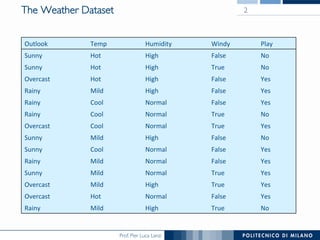
The Weather Dataset
Outlook' Temp' Humidity' Windy' Play'
Sunny' Hot' High' False' No'
Sunny' Hot'' High'' True' No'
Overcast'' Hot''' High' False' Yes'
Rainy' Mild' High' False' Yes'
Rainy' Cool' Normal' False' Yes'
Rainy' Cool' Normal' True' No'
Overcast' Cool' Normal' True' Yes'
Sunny' Mild' High' False' No'
Sunny' Cool' Normal' False' Yes'
Rainy' Mild' Normal' False' Yes'
Sunny' Mild' Normal' True' Yes'
Overcast' Mild' High' True' Yes'
Overcast' Hot' Normal' False' Yes'
Rainy' Mild' High' True' No'
2
Prof. Pier Luca Lanzi
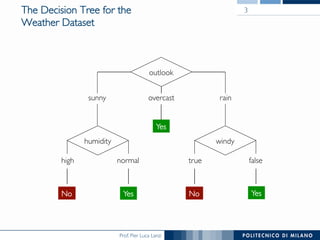
The Decision Tree for the !
Weather Dataset
3
humidity
overcast
No NoYes Yes
Yes
outlook
windy
sunny rain
falsetruenormalhigh
Prof. Pier Luca Lanzi
What is a Decision Tree?
•  An internal node is a test on an attribute
•  A branch represents an outcome of the test, e.g., outlook=windy
•  A leaf node represents a class label or class label distribution
•  At each node, one attribute is chosen to split training examples
into distinct classes as much as possible
•  A new case is classified by following a matching path to a leaf
node
4
Prof. Pier Luca Lanzi
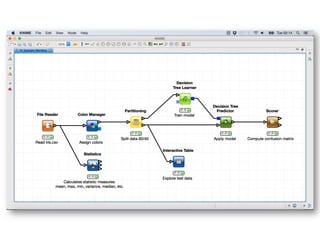
Building a DecisionTree with KNIME
Prof. Pier Luca Lanzi
Decision Tree Representations (Graphical) 8
Prof. Pier Luca Lanzi
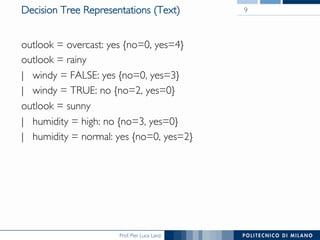
Decision Tree Representations (Text)
outlook = overcast: yes {no=0, yes=4}
outlook = rainy
| windy = FALSE: yes {no=0, yes=3}
| windy = TRUE: no {no=2, yes=0}
outlook = sunny
| humidity = high: no {no=3, yes=0}
| humidity = normal: yes {no=0, yes=2}
9
Prof. Pier Luca Lanzi
Computing DecisionTrees
Prof. Pier Luca Lanzi
Computing Decision Trees
•  Top-down Tree Construction
! Initially, all the training examples are at the root
! Then, the examples are recursively partitioned, !
by choosing one attribute at a time
•  Bottom-up Tree Pruning
! Remove subtrees or branches, in a bottom-up manner, to
improve the estimated accuracy on new cases.
11
Prof. Pier Luca Lanzi
Top Down Induction of Decision Trees
function TDIDT(S) // S, a set of labeled examples
Tree = new empty node
if (all examples have the same class c
or no further splitting is possible)
then // new leaf labeled with the majority class c
Label(Tree) = c
else // new decision node
(A,T) = FindBestSplit(S)
foreach test t in T do
St = all examples that satisfy t
Nodet = TDIDT(St)
AddEdge(Tree -> Nodet)
endfor
endif
return Tree
12
Prof. Pier Luca Lanzi
When Should Building Stop?
•  There are several possible stopping criteria
•  All samples for a given node belong to the same class
•  If there are no remaining attributes for further partitioning,
majority voting is employed
•  There are no samples left
•  Or there is nothing to gain in splitting
13
Prof. Pier Luca Lanzi
How is the Splitting Attribute Determined?
Prof. Pier Luca Lanzi
What Do We Need? 15
k
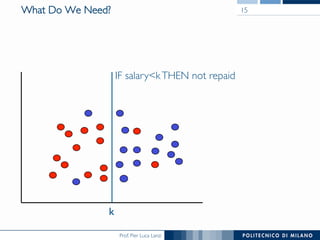
IF salary<kTHEN not repaid
Prof. Pier Luca Lanzi
Which Attribute for Splitting?
•  At each node, available attributes are evaluated on the basis of
separating the classes of the training examples
•  A purity or impurity measure is used for this purpose
•  Information Gain: increases with the average purity of the subsets
that an attribute produces
•  Splitting Strategy: choose the attribute that results in greatest
information gain
•  Typical goodness functions: information gain (ID3), information
gain ratio (C4.5), gini index (CART)
16
Prof. Pier Luca Lanzi
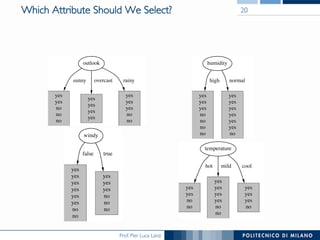
Which Attribute Should We Select? 17
Prof. Pier Luca Lanzi
Computing Information
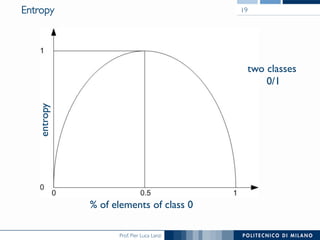
•  Information is measured in bits
! Given a probability distribution, the info required to predict an
event is the distribution’s entropy
! Entropy gives the information required in bits (this can involve
fractions of bits!)
•  Formula for computing the entropy
18
Prof. Pier Luca Lanzi
Entropy 19
two classes
0/1
% of elements of class 0
entropy
Prof. Pier Luca Lanzi
Which Attribute Should We Select? 20
Prof. Pier Luca Lanzi
The Attribute “outlook”
•  outlook” = “sunny”
•  “outlook” = “overcast”
•  “outlook” = “rainy”
•  Expected information for attribute
21
Prof. Pier Luca Lanzi
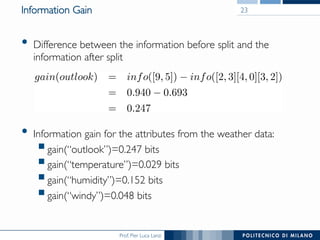
Information Gain
•  Difference between the information before split and the
information after split
•  The information before the split, info(D), is the entropy,
•  The information after the split using attribute A is computed as
the weighted sum of the entropies on each split, given n splits,
22
Prof. Pier Luca Lanzi
Information Gain
•  Difference between the information before split and the
information after split
•  Information gain for the attributes from the weather data:
! gain(“outlook”)=0.247 bits
! gain(“temperature”)=0.029 bits
! gain(“humidity”)=0.152 bits
! gain(“windy”)=0.048 bits
23
Prof. Pier Luca Lanzi
You can check the math using KNIME
Prof. Pier Luca Lanzi
Going Further 26
Prof. Pier Luca Lanzi
The Final Decision Tree
•  Not all the leaves need to be pure
•  Splitting stops when data can not be split any further
27
Prof. Pier Luca Lanzi
We Can Always Build a 100% AccurateTree…
Prof. Pier Luca Lanzi
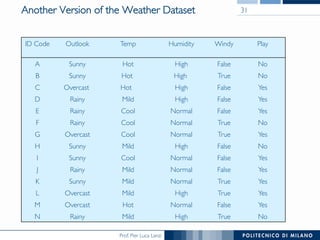
Another Version of the Weather Dataset
ID Code Outlook Temp Humidity Windy Play
A Sunny Hot High False No
B Sunny Hot High True No
C Overcast Hot High False Yes
D Rainy Mild High False Yes
E Rainy Cool Normal False Yes
F Rainy Cool Normal True No
G Overcast Cool Normal True Yes
H Sunny Mild High False No
I Sunny Cool Normal False Yes
J Rainy Mild Normal False Yes
K Sunny Mild Normal True Yes
L Overcast Mild High True Yes
M Overcast Hot Normal False Yes
N Rainy Mild High True No
31
Prof. Pier Luca Lanzi
Decision Tree for the New Dataset
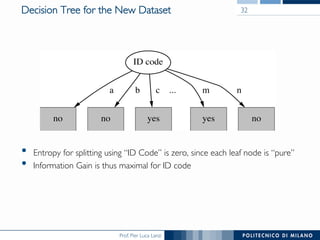
•  Entropy for splitting using “ID Code” is zero, since each leaf node is “pure”
•  Information Gain is thus maximal for ID code
32
Prof. Pier Luca Lanzi
Highly-Branching Attributes
•  Attributes with a large number of values are usually problematic
•  Examples: id, primary keys, or almost primary key attributes
•  Subsets are likely to be pure if there is a large number of values
•  Information Gain is biased towards choosing attributes with a
large number of values
•  This may result in overfitting (selection of an attribute that is non-
optimal for prediction)
33
Prof. Pier Luca Lanzi
Information Gain Ratio
Prof. Pier Luca Lanzi
Information Gain Ratio
•  Modification of the Information Gain that reduces the bias
toward highly-branching attributes
•  Information Gain Ratio should be
! Large when data is evenly spread
! Small when all data belong to one branch
•  Information Gain Ratio takes number and size of branches into
account when choosing an attribute
•  It corrects the information gain by taking the intrinsic information
of a split into account
35
Prof. Pier Luca Lanzi
Information Gain Ratio and !
Intrinsic information
•  Intrinsic information!
!
!
!
!
computes the entropy of distribution of instances into branches
•  Information Gain Ratio normalizes Information Gain by
36
Prof. Pier Luca Lanzi
Computing the Information Gain Ratio
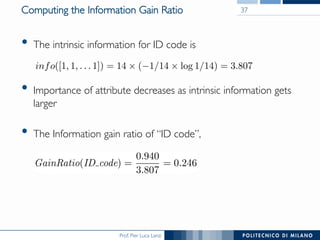
•  The intrinsic information for ID code is
•  Importance of attribute decreases as intrinsic information gets
larger
•  The Information gain ratio of “ID code”,
37
Prof. Pier Luca Lanzi
Information Gain Ratio for Weather Data 38
Outlook Temperature
Info: 0.693 Info: 0.911
Gain: 0.940-0.693 0.247 Gain: 0.940-0.911 0.029
Split info: info([5,4,5]) 1.577 Split info: info([4,6,4]) 1.362
Gain ratio: 0.247/1.577 0.156 Gain ratio: 0.029/1.362 0.021
Humidity Windy
Info: 0.788 Info: 0.892
Gain: 0.940-0.788 0.152 Gain: 0.940-0.892 0.048
Split info: info([7,7]) 1.000 Split info: info([8,6]) 0.985
Gain ratio: 0.152/1 0.152 Gain ratio: 0.048/0.985 0.049
Prof. Pier Luca Lanzi
More on Information Gain Ratio
•  “outlook” still comes out top, however “ID code” has greater
Information Gain Ratio
•  The standard fix is an ad-hoc test to prevent splitting on that type
of attribute
•  First, only consider attributes with greater than average
Information Gain; Then, compare them using the Information
Gain Ratio
•  Information Gain Ratio may overcompensate and choose an
attribute just because its intrinsic information is very low
39
Prof. Pier Luca Lanzi
What if Attributes are Numerical?
Prof. Pier Luca Lanzi
The Weather Dataset (Numerical)
Outlook Temp Humidity Windy Play
Sunny 85 85 False No
Sunny 80 90 True No
Overcast 83 78 False Yes
Rainy 70 96 False Yes
Rainy 68 80 False Yes
Rainy 65 70 True No
Overcast 64 65 True Yes
Sunny 72 95 False No
Sunny 69 70 False Yes
Rainy 75 80 False Yes
Sunny 75 70 True Yes
Overcast 72 90 True Yes
Overcast 81 75 False Yes
Rainy 71 80 True No
41
Prof. Pier Luca Lanzi
The Temperature Attribute
•  First, sort the temperature values, including the class labels
•  Then, check all the cut points and choose the one with the best
information gain
•  E.g. temperature < 71.5: yes/4, no/2!
temperature ≥ 71.5: yes/5, no/3
•  Info([4,2],[5,3]) = 6/14 info([4,2]) + 8/14 info([5,3]) = 0.939
•  Place split points halfway between values
•  Can evaluate all split points in one pass!
64 65 68 69 70 71 72 72 75 75 80 81 83 85
Yes No Yes Yes Yes No No Yes Yes Yes No Yes Yes No
Prof. Pier Luca Lanzi
The Information Gain for Humidity
Humidity' Play'
65 Yes'
70 No'
70 Yes'
70 Yes'
75 Yes'
78 Yes'
80 Yes'
80 Yes'
80 No'
85 No'
90 No'
90 Yes'
95 No'
96 Yes'
43
Humidity' Play'
65 Yes'
70 No'
70 Yes'
70 Yes'
75 Yes'
78 Yes'
80 Yes'
80 Yes'
80 No'
85 No'
90 No'
90 Yes'
95 No'
96 Yes'
sort the
attribute
values
compute the gain for
every possible split
what is the information
gain if we split here?
Prof. Pier Luca Lanzi
Information Gain for Humidity
Humidity Play # ofYes % ofYes
# of
No
% of No Weight
Entropy
Left
# of
Yes
% ofYes
# of
No
% of
No
Weight
Entropy
Right
Information
Gain
65 Yes 1 100.00% 0 0.00% 7.14% 0.00 8.00 0.62 5.00 0.38 92.86% 0.96 0.0477
70 No 1 50.00% 1 50.00% 14.29% 1.00 8.00 0.67 4.00 0.33 85.71% 0.92 0.0103
70 Yes 2 66.67% 1 33.33% 21.43% 0.92 7.00 0.64 4.00 0.36 78.57% 0.95 0.0005
70 Yes 3 75.00% 1 25.00% 28.57% 0.81 6.00 0.60 4.00 0.40 71.43% 0.97 0.0150
75 Yes 4 80.00% 1 20.00% 35.71% 0.72 5.00 0.56 4.00 0.44 64.29% 0.99 0.0453
78 Yes 5 83.33% 1 16.67% 42.86% 0.65 4.00 0.50 4.00 0.50 57.14% 1.00 0.0903
80 Yes 6 85.71% 1 14.29% 50.00% 0.59 3.00 0.43 4.00 0.57 50.00% 0.99 0.1518
80 Yes 7 87.50% 1 12.50% 57.14% 0.54 2.00 0.33 4.00 0.67 42.86% 0.92 0.2361
80 No 7 77.78% 2 22.22% 64.29% 0.76 2.00 0.40 3.00 0.60 35.71% 0.97 0.1022
85 No 7 70.00% 3 30.00% 71.43% 0.88 2.00 0.50 2.00 0.50 28.57% 1.00 0.0251
90 No 7 63.64% 4 36.36% 78.57% 0.95 2.00 0.67 1.00 0.33 21.43% 0.92 0.0005
90 Yes 8 66.67% 4 33.33% 85.71% 0.92 1.00 0.50 1.00 0.50 14.29% 1.00 0.0103
95 No 8 61.54% 5 38.46% 92.86% 0.96 1.00 1.00 0.00 0.00 7.14% 0.00 0.0477
96 Yes 9 64.29% 5 35.71% 100.00% 0.94 0.00 0.00 0.00 0.00 0.00% 0.00 0.0000
44
Prof. Pier Luca Lanzi
Otherwise, we can discretize…
Prof. Pier Luca Lanzi
Discretization
•  Processing for converting an interval/numerical variable into a a finite
(discrete) set of elements (labels)
•  A discretization algorithm computes a series of cut-points which defines
a set of intervals that are mapped into labels
•  Motivations: many methods (also in mathematics and computer
science) cannot deal with numerical variables. In these cases,
discretization is required to be able to use them, despite the loss of
information
•  Several approaches
! Supervised vs unsupervised
! Static vs dynamic
46
Prof. Pier Luca Lanzi
Unsupervised vs Supervised Discretization
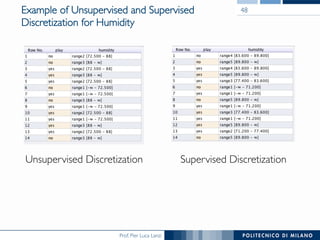
•  Unsupervised discretization just uses the attribute values, for instance,
discretize humidity as <70, 70-79, >=80)
•  Supervised discretization also uses the class attribute to generate interval with
lower entropy
•  Example using humidity
! Values alone may suggest <60, 60-70
! Considering the class value might suggest different intervals!
!
!
!
by grouping values to maintain information about the class attribute
47
64 65 68 69 70 71 72 72 75 75 80 81 83 85
64 65 68 69 70 71 72 72 75 75 80 81 83 85
Yes | No | Yes Yes Yes | No No | Yes | Yes Yes | No | Yes Yes | No
Prof. Pier Luca Lanzi
Example of Unsupervised and Supervised
Discretization for Humidity
48
Unsupervised Discretization Supervised Discretization
Prof. Pier Luca Lanzi
The Gini Index
Prof. Pier Luca Lanzi
Another Splitting Criteria: !
The Gini Index
•  The gini index, for a data set T contains examples from n classes,
is defined as!
!
!
!
!
where pj is the relative frequency of class j in T
•  gini(T) is minimized if the classes in T are skewed.
50
Prof. Pier Luca Lanzi
The Gini Index vs Entropy 51
Prof. Pier Luca Lanzi
The Gini Index
•  If a data set D is split on A into two subsets D1 and D2, then,
•  The reduction of impurity is defined as,
•  The attribute provides the smallest gini splitting D over A (or the
largest reduction in impurity) is chosen to split the node (need to
enumerate all the possible splitting points for each attribute)
52
Prof. Pier Luca Lanzi
The Gini Index: Example
•  D has 9 tuples labeled “yes” and 5 labeled “no”
•  Suppose the attribute income partitions D into 10 in D1
branching on low and medium and 4 in D2
•  but gini{medium,high} is 0.30 and thus the best since it is the
lowest
53
Prof. Pier Luca Lanzi
Generalization and Overfitting in DecisionTrees
Prof. Pier Luca Lanzi
Avoiding Overfitting in Decision Trees
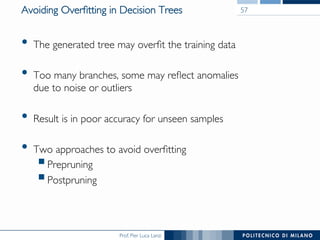
•  The generated tree may overfit the training data
•  Too many branches, some may reflect anomalies!
due to noise or outliers
•  Result is in poor accuracy for unseen samples
•  Two approaches to avoid overfitting
! Prepruning
! Postpruning
57
Prof. Pier Luca Lanzi
Pre-pruning vs Post-pruning
•  Prepruning
! Halt tree construction early
! Do not split a node if this would result in the goodness
measure falling below a threshold
! Difficult to choose an appropriate threshold
•  Postpruning
! Remove branches from a “fully grown” tree
! Get a sequence of progressively pruned trees
! Use a set of data different from the training data to decide
which is the “best pruned tree”
58
Prof. Pier Luca Lanzi
Pre-Pruning
•  Based on statistical significance test
•  Stop growing the tree when there is no statistically significant
association between any attribute and the class at a particular
node
•  Early stopping and halting
! No individual attribute exhibits any interesting information
about the class
! The structure is only visible in fully expanded tree
! Pre-pruning won’t expand the root node
59
Prof. Pier Luca Lanzi
Post-Pruning
•  First, build full tree, then prune it
•  Fully-grown tree shows all attribute interactions
•  Problem: some subtrees might be due to chance effects
•  Two pruning operations
! Subtree raising
! Subtree replacement
•  Possible strategies
! Error estimation
! Significance testing
! MDL principle
60
Prof. Pier Luca Lanzi
Subtree Raising
•  Delete node
•  Redistribute instances
•  Slower than subtree replacement
61
X
Prof. Pier Luca Lanzi
Subtree Replacement
•  Works bottom-up
•  Consider replacing a tree!
only after considering !
all its subtrees
62
Prof. Pier Luca Lanzi
Estimating Error Rates
•  Prune only if it reduces the estimated error
•  Error on the training data is NOT a useful estimator!
(Why it would result in very little pruning?)
•  A hold-out set might be kept for pruning!
(“reduced-error pruning”)
•  Example (C4.5’s method)
! Derive confidence interval from training data
! Use a heuristic limit, derived from this, for pruning
! Standard Bernoulli-process-based method
! Shaky statistical assumptions (based on training data)
63
Prof. Pier Luca Lanzi
Mean and Variance
•  Mean and variance for a Bernoulli trial: p, p (1–p)
•  Expected error rate f=S/N has mean p and variance p(1–p)/N
•  For large enough N, f follows a Normal distribution
•  c% confidence interval [–z ≤ X ≤ z] for random variable with 0
mean is given by:
•  With a symmetric distribution,
64
Prof. Pier Luca Lanzi
Confidence Limits
• Confidence limits for the
normal distribution with 0
mean and a variance of 1,
• Thus,
• To use this we have to
reduce our random
variable f to have 0 mean
and unit variance
65
Pr[X ≥ z] z
0.1% 3.09
0.5% 2.58
1% 2.33
5% 1.65
10% 1.28
20% 0.84
25% 0.69
40% 0.25
Prof. Pier Luca Lanzi
C4.5’s Pruning Method
•  Given the error f on the training data, the upper bound for the
error estimate for a node is computed as
•  If c = 25% then z = 0.69 (from normal distribution)
! f is the error on the training data
! N is the number of instances covered by the leaf
66
!
"
#
$
%
&
+
!
!
"
#
$
$
%
&
+−++=
N
z
N
z
N
f
N
f
z
N
z
fe
2
2
222
1
42
Prof. Pier Luca Lanzi
f=0.33
e=0.47
f=0.5
e=0.72
f=0.33
e=0.47
f = 5/14
e = 0.46
e < 0.51
so prune!
Combined using ratios 6:2:6 gives 0.51
Prof. Pier Luca Lanzi
Examples Using KNIME
Prof. Pier Luca Lanzi
pruned tree (Gain ratio)
Prof. Pier Luca Lanzi
pruned tree (Gini index)
Prof. Pier Luca Lanzi
RegressionTrees
Prof. Pier Luca Lanzi
Regression Trees for Prediction
•  Decision trees can also be used to predict the value of a
numerical target variable
•  Regression trees work similarly to decision trees, by analyzing
several splits attempted, choosing the one that minimizes impurity
•  Differences from Decision Trees
! Prediction is computed as the average of numerical target
variable in the subspace (instead of the majority vote)
! Impurity is measured by sum of squared deviations from leaf
mean (instead of information-based measures)
! Find split that produces greatest separation in 	
[y – E(y)]2
! Find nodes with minimal within variance and therefore
! Performance is measured by RMSE (root mean squared error)
72
Prof. Pier Luca Lanzi
0
0
32
128
CHMAX
0
0
8
16
CHMIN
Channels PerformanceCache
(Kb)
Main memory
(Kb)
Cycle time
(ns)
45040001000480209
67328000512480208
…
26932320008000292
19825660002561251
PRPCACHMMAXMMINMYCT
PRP = -55.9 + 0.0489 MYCT + 0.0153 MMIN + 0.0056 MMAX
+ 0.6410 CACH - 0.2700 CHMIN + 1.480 CHMAX
Prof. Pier Luca Lanzi
Mining Regression Trees in R
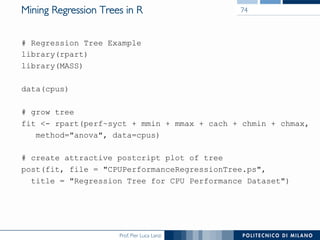
# Regression Tree Example
library(rpart)
library(MASS)
data(cpus)
# grow tree
fit <- rpart(perf~syct + mmin + mmax + cach + chmin + chmax,
method="anova", data=cpus)
# create attractive postcript plot of tree
post(fit, file = "CPUPerformanceRegressionTree.ps",
title = "Regression Tree for CPU Performance Dataset")
74
Prof. Pier Luca Lanzi
|
mmax< 2.8e+04
cach< 27
cach< 96.5
cach< 80
mmax>=2.8e+04
cach>=27
cach>=96.5
cach>=80
105.62
n=209
60.72
n=182
39.638
n=141
133.22
n=41
114.44
n=34
224.43
n=7
408.26
n=27
299.21
n=19
667.25
n=8
Regression Tree for CPU Performance Dataset
Prof. Pier Luca Lanzi
Summary
Prof. Pier Luca Lanzi
Summary
•  Decision tree construction is a recursive procedure involving
! The selection of the best splitting attribute
! (and thus) a selection of an adequate purity measure
(Information Gain, Information Gain Ratio, Gini Index)
! Pruning to avoid overfitting
•  Information Gain is biased toward highly splitting attributes
•  Information Gain Ratio takes the number of splits that an
attribute induces into the picture but might not be enough
77
Prof. Pier Luca Lanzi
Suggested Homework
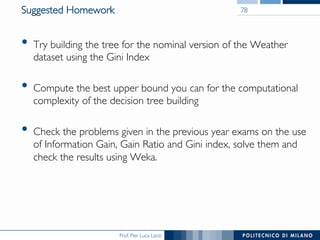
•  Try building the tree for the nominal version of the Weather
dataset using the Gini Index
•  Compute the best upper bound you can for the computational
complexity of the decision tree building
•  Check the problems given in the previous year exams on the use
of Information Gain, Gain Ratio and Gini index, solve them and
check the results using Weka.
78

DMTM 2015 - 11 Decision Trees

  • 1.
    Prof. Pier LucaLanzi Classification: DecisionTrees! Data Mining andText Mining (UIC 583 @ Politecnico di Milano)
  • 2.
    Prof. Pier LucaLanzi The Weather Dataset Outlook' Temp' Humidity' Windy' Play' Sunny' Hot' High' False' No' Sunny' Hot'' High'' True' No' Overcast'' Hot''' High' False' Yes' Rainy' Mild' High' False' Yes' Rainy' Cool' Normal' False' Yes' Rainy' Cool' Normal' True' No' Overcast' Cool' Normal' True' Yes' Sunny' Mild' High' False' No' Sunny' Cool' Normal' False' Yes' Rainy' Mild' Normal' False' Yes' Sunny' Mild' Normal' True' Yes' Overcast' Mild' High' True' Yes' Overcast' Hot' Normal' False' Yes' Rainy' Mild' High' True' No' 2
  • 3.
    Prof. Pier LucaLanzi The Decision Tree for the ! Weather Dataset 3 humidity overcast No NoYes Yes Yes outlook windy sunny rain falsetruenormalhigh
  • 4.
    Prof. Pier LucaLanzi What is a Decision Tree? •  An internal node is a test on an attribute •  A branch represents an outcome of the test, e.g., outlook=windy •  A leaf node represents a class label or class label distribution •  At each node, one attribute is chosen to split training examples into distinct classes as much as possible •  A new case is classified by following a matching path to a leaf node 4
  • 5.
    Prof. Pier LucaLanzi Building a DecisionTree with KNIME
  • 6.
  • 7.
  • 8.
    Prof. Pier LucaLanzi Decision Tree Representations (Graphical) 8
  • 9.
    Prof. Pier LucaLanzi Decision Tree Representations (Text) outlook = overcast: yes {no=0, yes=4} outlook = rainy | windy = FALSE: yes {no=0, yes=3} | windy = TRUE: no {no=2, yes=0} outlook = sunny | humidity = high: no {no=3, yes=0} | humidity = normal: yes {no=0, yes=2} 9
  • 10.
    Prof. Pier LucaLanzi Computing DecisionTrees
  • 11.
    Prof. Pier LucaLanzi Computing Decision Trees •  Top-down Tree Construction ! Initially, all the training examples are at the root ! Then, the examples are recursively partitioned, ! by choosing one attribute at a time •  Bottom-up Tree Pruning ! Remove subtrees or branches, in a bottom-up manner, to improve the estimated accuracy on new cases. 11
  • 12.
    Prof. Pier LucaLanzi Top Down Induction of Decision Trees function TDIDT(S) // S, a set of labeled examples Tree = new empty node if (all examples have the same class c or no further splitting is possible) then // new leaf labeled with the majority class c Label(Tree) = c else // new decision node (A,T) = FindBestSplit(S) foreach test t in T do St = all examples that satisfy t Nodet = TDIDT(St) AddEdge(Tree -> Nodet) endfor endif return Tree 12
  • 13.
    Prof. Pier LucaLanzi When Should Building Stop? •  There are several possible stopping criteria •  All samples for a given node belong to the same class •  If there are no remaining attributes for further partitioning, majority voting is employed •  There are no samples left •  Or there is nothing to gain in splitting 13
  • 14.
    Prof. Pier LucaLanzi How is the Splitting Attribute Determined?
  • 15.
    Prof. Pier LucaLanzi What Do We Need? 15 k IF salary<kTHEN not repaid
  • 16.
    Prof. Pier LucaLanzi Which Attribute for Splitting? •  At each node, available attributes are evaluated on the basis of separating the classes of the training examples •  A purity or impurity measure is used for this purpose •  Information Gain: increases with the average purity of the subsets that an attribute produces •  Splitting Strategy: choose the attribute that results in greatest information gain •  Typical goodness functions: information gain (ID3), information gain ratio (C4.5), gini index (CART) 16
  • 17.
    Prof. Pier LucaLanzi Which Attribute Should We Select? 17
  • 18.
    Prof. Pier LucaLanzi Computing Information •  Information is measured in bits ! Given a probability distribution, the info required to predict an event is the distribution’s entropy ! Entropy gives the information required in bits (this can involve fractions of bits!) •  Formula for computing the entropy 18
  • 19.
    Prof. Pier LucaLanzi Entropy 19 two classes 0/1 % of elements of class 0 entropy
  • 20.
    Prof. Pier LucaLanzi Which Attribute Should We Select? 20
  • 21.
    Prof. Pier LucaLanzi The Attribute “outlook” •  outlook” = “sunny” •  “outlook” = “overcast” •  “outlook” = “rainy” •  Expected information for attribute 21
  • 22.
    Prof. Pier LucaLanzi Information Gain •  Difference between the information before split and the information after split •  The information before the split, info(D), is the entropy, •  The information after the split using attribute A is computed as the weighted sum of the entropies on each split, given n splits, 22
  • 23.
    Prof. Pier LucaLanzi Information Gain •  Difference between the information before split and the information after split •  Information gain for the attributes from the weather data: ! gain(“outlook”)=0.247 bits ! gain(“temperature”)=0.029 bits ! gain(“humidity”)=0.152 bits ! gain(“windy”)=0.048 bits 23
  • 24.
    Prof. Pier LucaLanzi You can check the math using KNIME
  • 25.
  • 26.
    Prof. Pier LucaLanzi Going Further 26
  • 27.
    Prof. Pier LucaLanzi The Final Decision Tree •  Not all the leaves need to be pure •  Splitting stops when data can not be split any further 27
  • 28.
  • 29.
    Prof. Pier LucaLanzi We Can Always Build a 100% AccurateTree…
  • 30.
  • 31.
    Prof. Pier LucaLanzi Another Version of the Weather Dataset ID Code Outlook Temp Humidity Windy Play A Sunny Hot High False No B Sunny Hot High True No C Overcast Hot High False Yes D Rainy Mild High False Yes E Rainy Cool Normal False Yes F Rainy Cool Normal True No G Overcast Cool Normal True Yes H Sunny Mild High False No I Sunny Cool Normal False Yes J Rainy Mild Normal False Yes K Sunny Mild Normal True Yes L Overcast Mild High True Yes M Overcast Hot Normal False Yes N Rainy Mild High True No 31
  • 32.
    Prof. Pier LucaLanzi Decision Tree for the New Dataset •  Entropy for splitting using “ID Code” is zero, since each leaf node is “pure” •  Information Gain is thus maximal for ID code 32
  • 33.
    Prof. Pier LucaLanzi Highly-Branching Attributes •  Attributes with a large number of values are usually problematic •  Examples: id, primary keys, or almost primary key attributes •  Subsets are likely to be pure if there is a large number of values •  Information Gain is biased towards choosing attributes with a large number of values •  This may result in overfitting (selection of an attribute that is non- optimal for prediction) 33
  • 34.
    Prof. Pier LucaLanzi Information Gain Ratio
  • 35.
    Prof. Pier LucaLanzi Information Gain Ratio •  Modification of the Information Gain that reduces the bias toward highly-branching attributes •  Information Gain Ratio should be ! Large when data is evenly spread ! Small when all data belong to one branch •  Information Gain Ratio takes number and size of branches into account when choosing an attribute •  It corrects the information gain by taking the intrinsic information of a split into account 35
  • 36.
    Prof. Pier LucaLanzi Information Gain Ratio and ! Intrinsic information •  Intrinsic information! ! ! ! ! computes the entropy of distribution of instances into branches •  Information Gain Ratio normalizes Information Gain by 36
  • 37.
    Prof. Pier LucaLanzi Computing the Information Gain Ratio •  The intrinsic information for ID code is •  Importance of attribute decreases as intrinsic information gets larger •  The Information gain ratio of “ID code”, 37
  • 38.
    Prof. Pier LucaLanzi Information Gain Ratio for Weather Data 38 Outlook Temperature Info: 0.693 Info: 0.911 Gain: 0.940-0.693 0.247 Gain: 0.940-0.911 0.029 Split info: info([5,4,5]) 1.577 Split info: info([4,6,4]) 1.362 Gain ratio: 0.247/1.577 0.156 Gain ratio: 0.029/1.362 0.021 Humidity Windy Info: 0.788 Info: 0.892 Gain: 0.940-0.788 0.152 Gain: 0.940-0.892 0.048 Split info: info([7,7]) 1.000 Split info: info([8,6]) 0.985 Gain ratio: 0.152/1 0.152 Gain ratio: 0.048/0.985 0.049
  • 39.
    Prof. Pier LucaLanzi More on Information Gain Ratio •  “outlook” still comes out top, however “ID code” has greater Information Gain Ratio •  The standard fix is an ad-hoc test to prevent splitting on that type of attribute •  First, only consider attributes with greater than average Information Gain; Then, compare them using the Information Gain Ratio •  Information Gain Ratio may overcompensate and choose an attribute just because its intrinsic information is very low 39
  • 40.
    Prof. Pier LucaLanzi What if Attributes are Numerical?
  • 41.
    Prof. Pier LucaLanzi The Weather Dataset (Numerical) Outlook Temp Humidity Windy Play Sunny 85 85 False No Sunny 80 90 True No Overcast 83 78 False Yes Rainy 70 96 False Yes Rainy 68 80 False Yes Rainy 65 70 True No Overcast 64 65 True Yes Sunny 72 95 False No Sunny 69 70 False Yes Rainy 75 80 False Yes Sunny 75 70 True Yes Overcast 72 90 True Yes Overcast 81 75 False Yes Rainy 71 80 True No 41
  • 42.
    Prof. Pier LucaLanzi The Temperature Attribute •  First, sort the temperature values, including the class labels •  Then, check all the cut points and choose the one with the best information gain •  E.g. temperature < 71.5: yes/4, no/2! temperature ≥ 71.5: yes/5, no/3 •  Info([4,2],[5,3]) = 6/14 info([4,2]) + 8/14 info([5,3]) = 0.939 •  Place split points halfway between values •  Can evaluate all split points in one pass! 64 65 68 69 70 71 72 72 75 75 80 81 83 85 Yes No Yes Yes Yes No No Yes Yes Yes No Yes Yes No
  • 43.
    Prof. Pier LucaLanzi The Information Gain for Humidity Humidity' Play' 65 Yes' 70 No' 70 Yes' 70 Yes' 75 Yes' 78 Yes' 80 Yes' 80 Yes' 80 No' 85 No' 90 No' 90 Yes' 95 No' 96 Yes' 43 Humidity' Play' 65 Yes' 70 No' 70 Yes' 70 Yes' 75 Yes' 78 Yes' 80 Yes' 80 Yes' 80 No' 85 No' 90 No' 90 Yes' 95 No' 96 Yes' sort the attribute values compute the gain for every possible split what is the information gain if we split here?
  • 44.
    Prof. Pier LucaLanzi Information Gain for Humidity Humidity Play # ofYes % ofYes # of No % of No Weight Entropy Left # of Yes % ofYes # of No % of No Weight Entropy Right Information Gain 65 Yes 1 100.00% 0 0.00% 7.14% 0.00 8.00 0.62 5.00 0.38 92.86% 0.96 0.0477 70 No 1 50.00% 1 50.00% 14.29% 1.00 8.00 0.67 4.00 0.33 85.71% 0.92 0.0103 70 Yes 2 66.67% 1 33.33% 21.43% 0.92 7.00 0.64 4.00 0.36 78.57% 0.95 0.0005 70 Yes 3 75.00% 1 25.00% 28.57% 0.81 6.00 0.60 4.00 0.40 71.43% 0.97 0.0150 75 Yes 4 80.00% 1 20.00% 35.71% 0.72 5.00 0.56 4.00 0.44 64.29% 0.99 0.0453 78 Yes 5 83.33% 1 16.67% 42.86% 0.65 4.00 0.50 4.00 0.50 57.14% 1.00 0.0903 80 Yes 6 85.71% 1 14.29% 50.00% 0.59 3.00 0.43 4.00 0.57 50.00% 0.99 0.1518 80 Yes 7 87.50% 1 12.50% 57.14% 0.54 2.00 0.33 4.00 0.67 42.86% 0.92 0.2361 80 No 7 77.78% 2 22.22% 64.29% 0.76 2.00 0.40 3.00 0.60 35.71% 0.97 0.1022 85 No 7 70.00% 3 30.00% 71.43% 0.88 2.00 0.50 2.00 0.50 28.57% 1.00 0.0251 90 No 7 63.64% 4 36.36% 78.57% 0.95 2.00 0.67 1.00 0.33 21.43% 0.92 0.0005 90 Yes 8 66.67% 4 33.33% 85.71% 0.92 1.00 0.50 1.00 0.50 14.29% 1.00 0.0103 95 No 8 61.54% 5 38.46% 92.86% 0.96 1.00 1.00 0.00 0.00 7.14% 0.00 0.0477 96 Yes 9 64.29% 5 35.71% 100.00% 0.94 0.00 0.00 0.00 0.00 0.00% 0.00 0.0000 44
  • 45.
    Prof. Pier LucaLanzi Otherwise, we can discretize…
  • 46.
    Prof. Pier LucaLanzi Discretization •  Processing for converting an interval/numerical variable into a a finite (discrete) set of elements (labels) •  A discretization algorithm computes a series of cut-points which defines a set of intervals that are mapped into labels •  Motivations: many methods (also in mathematics and computer science) cannot deal with numerical variables. In these cases, discretization is required to be able to use them, despite the loss of information •  Several approaches ! Supervised vs unsupervised ! Static vs dynamic 46
  • 47.
    Prof. Pier LucaLanzi Unsupervised vs Supervised Discretization •  Unsupervised discretization just uses the attribute values, for instance, discretize humidity as <70, 70-79, >=80) •  Supervised discretization also uses the class attribute to generate interval with lower entropy •  Example using humidity ! Values alone may suggest <60, 60-70 ! Considering the class value might suggest different intervals! ! ! ! by grouping values to maintain information about the class attribute 47 64 65 68 69 70 71 72 72 75 75 80 81 83 85 64 65 68 69 70 71 72 72 75 75 80 81 83 85 Yes | No | Yes Yes Yes | No No | Yes | Yes Yes | No | Yes Yes | No
  • 48.
    Prof. Pier LucaLanzi Example of Unsupervised and Supervised Discretization for Humidity 48 Unsupervised Discretization Supervised Discretization
  • 49.
    Prof. Pier LucaLanzi The Gini Index
  • 50.
    Prof. Pier LucaLanzi Another Splitting Criteria: ! The Gini Index •  The gini index, for a data set T contains examples from n classes, is defined as! ! ! ! ! where pj is the relative frequency of class j in T •  gini(T) is minimized if the classes in T are skewed. 50
  • 51.
    Prof. Pier LucaLanzi The Gini Index vs Entropy 51
  • 52.
    Prof. Pier LucaLanzi The Gini Index •  If a data set D is split on A into two subsets D1 and D2, then, •  The reduction of impurity is defined as, •  The attribute provides the smallest gini splitting D over A (or the largest reduction in impurity) is chosen to split the node (need to enumerate all the possible splitting points for each attribute) 52
  • 53.
    Prof. Pier LucaLanzi The Gini Index: Example •  D has 9 tuples labeled “yes” and 5 labeled “no” •  Suppose the attribute income partitions D into 10 in D1 branching on low and medium and 4 in D2 •  but gini{medium,high} is 0.30 and thus the best since it is the lowest 53
  • 54.
  • 55.
    Prof. Pier LucaLanzi Generalization and Overfitting in DecisionTrees
  • 56.
  • 57.
    Prof. Pier LucaLanzi Avoiding Overfitting in Decision Trees •  The generated tree may overfit the training data •  Too many branches, some may reflect anomalies! due to noise or outliers •  Result is in poor accuracy for unseen samples •  Two approaches to avoid overfitting ! Prepruning ! Postpruning 57
  • 58.
    Prof. Pier LucaLanzi Pre-pruning vs Post-pruning •  Prepruning ! Halt tree construction early ! Do not split a node if this would result in the goodness measure falling below a threshold ! Difficult to choose an appropriate threshold •  Postpruning ! Remove branches from a “fully grown” tree ! Get a sequence of progressively pruned trees ! Use a set of data different from the training data to decide which is the “best pruned tree” 58
  • 59.
    Prof. Pier LucaLanzi Pre-Pruning •  Based on statistical significance test •  Stop growing the tree when there is no statistically significant association between any attribute and the class at a particular node •  Early stopping and halting ! No individual attribute exhibits any interesting information about the class ! The structure is only visible in fully expanded tree ! Pre-pruning won’t expand the root node 59
  • 60.
    Prof. Pier LucaLanzi Post-Pruning •  First, build full tree, then prune it •  Fully-grown tree shows all attribute interactions •  Problem: some subtrees might be due to chance effects •  Two pruning operations ! Subtree raising ! Subtree replacement •  Possible strategies ! Error estimation ! Significance testing ! MDL principle 60
  • 61.
    Prof. Pier LucaLanzi Subtree Raising •  Delete node •  Redistribute instances •  Slower than subtree replacement 61 X
  • 62.
    Prof. Pier LucaLanzi Subtree Replacement •  Works bottom-up •  Consider replacing a tree! only after considering ! all its subtrees 62
  • 63.
    Prof. Pier LucaLanzi Estimating Error Rates •  Prune only if it reduces the estimated error •  Error on the training data is NOT a useful estimator! (Why it would result in very little pruning?) •  A hold-out set might be kept for pruning! (“reduced-error pruning”) •  Example (C4.5’s method) ! Derive confidence interval from training data ! Use a heuristic limit, derived from this, for pruning ! Standard Bernoulli-process-based method ! Shaky statistical assumptions (based on training data) 63
  • 64.
    Prof. Pier LucaLanzi Mean and Variance •  Mean and variance for a Bernoulli trial: p, p (1–p) •  Expected error rate f=S/N has mean p and variance p(1–p)/N •  For large enough N, f follows a Normal distribution •  c% confidence interval [–z ≤ X ≤ z] for random variable with 0 mean is given by: •  With a symmetric distribution, 64
  • 65.
    Prof. Pier LucaLanzi Confidence Limits • Confidence limits for the normal distribution with 0 mean and a variance of 1, • Thus, • To use this we have to reduce our random variable f to have 0 mean and unit variance 65 Pr[X ≥ z] z 0.1% 3.09 0.5% 2.58 1% 2.33 5% 1.65 10% 1.28 20% 0.84 25% 0.69 40% 0.25
  • 66.
    Prof. Pier LucaLanzi C4.5’s Pruning Method •  Given the error f on the training data, the upper bound for the error estimate for a node is computed as •  If c = 25% then z = 0.69 (from normal distribution) ! f is the error on the training data ! N is the number of instances covered by the leaf 66 ! " # $ % & + ! ! " # $ $ % & +−++= N z N z N f N f z N z fe 2 2 222 1 42
  • 67.
    Prof. Pier LucaLanzi f=0.33 e=0.47 f=0.5 e=0.72 f=0.33 e=0.47 f = 5/14 e = 0.46 e < 0.51 so prune! Combined using ratios 6:2:6 gives 0.51
  • 68.
    Prof. Pier LucaLanzi Examples Using KNIME
  • 69.
    Prof. Pier LucaLanzi pruned tree (Gain ratio)
  • 70.
    Prof. Pier LucaLanzi pruned tree (Gini index)
  • 71.
    Prof. Pier LucaLanzi RegressionTrees
  • 72.
    Prof. Pier LucaLanzi Regression Trees for Prediction •  Decision trees can also be used to predict the value of a numerical target variable •  Regression trees work similarly to decision trees, by analyzing several splits attempted, choosing the one that minimizes impurity •  Differences from Decision Trees ! Prediction is computed as the average of numerical target variable in the subspace (instead of the majority vote) ! Impurity is measured by sum of squared deviations from leaf mean (instead of information-based measures) ! Find split that produces greatest separation in [y – E(y)]2 ! Find nodes with minimal within variance and therefore ! Performance is measured by RMSE (root mean squared error) 72
  • 73.
    Prof. Pier LucaLanzi 0 0 32 128 CHMAX 0 0 8 16 CHMIN Channels PerformanceCache (Kb) Main memory (Kb) Cycle time (ns) 45040001000480209 67328000512480208 … 26932320008000292 19825660002561251 PRPCACHMMAXMMINMYCT PRP = -55.9 + 0.0489 MYCT + 0.0153 MMIN + 0.0056 MMAX + 0.6410 CACH - 0.2700 CHMIN + 1.480 CHMAX
  • 74.
    Prof. Pier LucaLanzi Mining Regression Trees in R # Regression Tree Example library(rpart) library(MASS) data(cpus) # grow tree fit <- rpart(perf~syct + mmin + mmax + cach + chmin + chmax, method="anova", data=cpus) # create attractive postcript plot of tree post(fit, file = "CPUPerformanceRegressionTree.ps", title = "Regression Tree for CPU Performance Dataset") 74
  • 75.
    Prof. Pier LucaLanzi | mmax< 2.8e+04 cach< 27 cach< 96.5 cach< 80 mmax>=2.8e+04 cach>=27 cach>=96.5 cach>=80 105.62 n=209 60.72 n=182 39.638 n=141 133.22 n=41 114.44 n=34 224.43 n=7 408.26 n=27 299.21 n=19 667.25 n=8 Regression Tree for CPU Performance Dataset
  • 76.
    Prof. Pier LucaLanzi Summary
  • 77.
    Prof. Pier LucaLanzi Summary •  Decision tree construction is a recursive procedure involving ! The selection of the best splitting attribute ! (and thus) a selection of an adequate purity measure (Information Gain, Information Gain Ratio, Gini Index) ! Pruning to avoid overfitting •  Information Gain is biased toward highly splitting attributes •  Information Gain Ratio takes the number of splits that an attribute induces into the picture but might not be enough 77
  • 78.
    Prof. Pier LucaLanzi Suggested Homework •  Try building the tree for the nominal version of the Weather dataset using the Gini Index •  Compute the best upper bound you can for the computational complexity of the decision tree building •  Check the problems given in the previous year exams on the use of Information Gain, Gain Ratio and Gini index, solve them and check the results using Weka. 78