Prof. Pier Luca Lanzi
Classification: Rule Induction
Data Mining andText Mining (UIC 583 @ Politecnico di Milano)
Prof. Pier Luca Lanzi
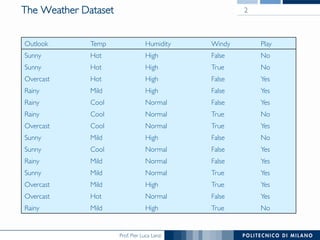
The Weather Dataset
Outlook Temp Humidity Windy Play
Sunny Hot High False No
Sunny Hot High True No
Overcast Hot High False Yes
Rainy Mild High False Yes
Rainy Cool Normal False Yes
Rainy Cool Normal True No
Overcast Cool Normal True Yes
Sunny Mild High False No
Sunny Cool Normal False Yes
Rainy Mild Normal False Yes
Sunny Mild Normal True Yes
Overcast Mild High True Yes
Overcast Hot Normal False Yes
Rainy Mild High True No
2
Prof. Pier Luca Lanzi
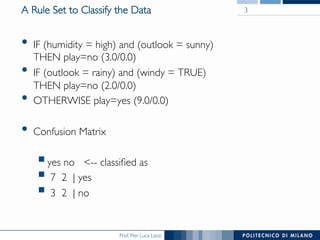
A Rule Set to Classify the Data
•  IF (humidity = high) and (outlook = sunny) 
THEN play=no (3.0/0.0)
•  IF (outlook = rainy) and (windy = TRUE)
THEN play=no (2.0/0.0)
•  OTHERWISE play=yes (9.0/0.0)
•  Confusion Matrix
§ yes no -- classified as
§ 7 2 | yes
§ 3 2 | no
3
Prof. Pier Luca Lanzi
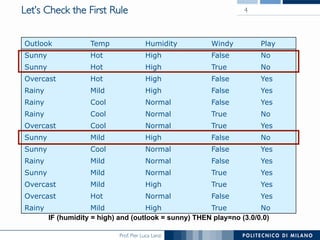
Let’s Check the First Rule
Outlook Temp Humidity Windy Play
Sunny Hot High False No
Sunny Hot High True No
Overcast Hot High False Yes
Rainy Mild High False Yes
Rainy Cool Normal False Yes
Rainy Cool Normal True No
Overcast Cool Normal True Yes
Sunny Mild High False No
Sunny Cool Normal False Yes
Rainy Mild Normal False Yes
Sunny Mild Normal True Yes
Overcast Mild High True Yes
Overcast Hot Normal False Yes
Rainy Mild High True No
4
IF (humidity = high) and (outlook = sunny) THEN play=no (3.0/0.0)
Prof. Pier Luca Lanzi
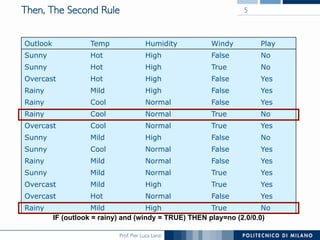
Then, The Second Rule
Outlook Temp Humidity Windy Play
Sunny Hot High False No
Sunny Hot High True No
Overcast Hot High False Yes
Rainy Mild High False Yes
Rainy Cool Normal False Yes
Rainy Cool Normal True No
Overcast Cool Normal True Yes
Sunny Mild High False No
Sunny Cool Normal False Yes
Rainy Mild Normal False Yes
Sunny Mild Normal True Yes
Overcast Mild High True Yes
Overcast Hot Normal False Yes
Rainy Mild High True No
5
IF (outlook = rainy) and (windy = TRUE) THEN play=no (2.0/0.0)
Prof. Pier Luca Lanzi
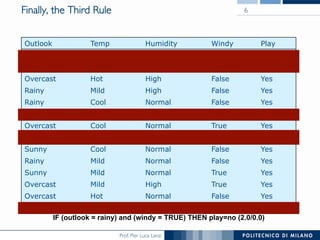
Finally, the Third Rule
Outlook Temp Humidity Windy Play
Sunny Hot High False No
Sunny Hot High True No
Overcast Hot High False Yes
Rainy Mild High False Yes
Rainy Cool Normal False Yes
Rainy Cool Normal True No
Overcast Cool Normal True Yes
Sunny Mild High False No
Sunny Cool Normal False Yes
Rainy Mild Normal False Yes
Sunny Mild Normal True Yes
Overcast Mild High True Yes
Overcast Hot Normal False Yes
Rainy Mild High True No
6
IF (outlook = rainy) and (windy = TRUE) THEN play=no (2.0/0.0)
Prof. Pier Luca Lanzi
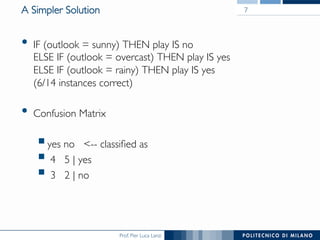
A Simpler Solution
•  IF (outlook = sunny) THEN play IS no
ELSE IF (outlook = overcast) THEN play IS yes
ELSE IF (outlook = rainy) THEN play IS yes
(6/14 instances correct)
•  Confusion Matrix
§ yes no -- classified as
§ 4 5 | yes
§ 3 2 | no
7
Prof. Pier Luca Lanzi
What is a Classification Rule?
Prof. Pier Luca Lanzi
What Is A Classification Rules?
Why Rules?
•  They are IF-THEN rules
§ The IF part states a condition over the data
§ The THEN part includes a class label
•  What types of conditions?
§ Propositional, with attribute-value comparisons
§ First order Horn clauses, with variables
•  Why rules? Because they are one of the most expressive and
most human readable representation for hypotheses is sets of IF-
THEN rules
9
Prof. Pier Luca Lanzi
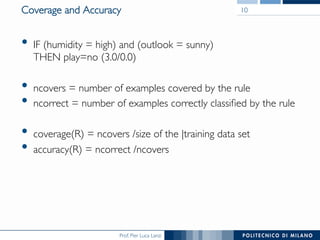
Coverage and Accuracy
•  IF (humidity = high) and (outlook = sunny) 
THEN play=no (3.0/0.0)
•  ncovers = number of examples covered by the rule
•  ncorrect = number of examples correctly classified by the rule
•  coverage(R) = ncovers /size of the |training data set
•  accuracy(R) = ncorrect /ncovers
10
Prof. Pier Luca Lanzi
Conflict Resolution
•  If more than one rule is triggered, we need conflict resolution
•  Size ordering: assign the highest priority to the triggering rules
that has the “toughest” requirement (i.e., with the most attribute
test)
•  Class-based ordering: decreasing order of prevalence or
misclassification cost per class
•  Rule-based ordering (decision list): rules are organized into one
long priority list, according to some measure of rule quality or by
experts
11
Prof. Pier Luca Lanzi
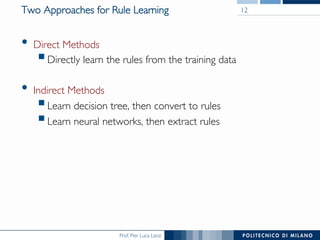
Two Approaches for Rule Learning
•  Direct Methods
§ Directly learn the rules from the training data
•  Indirect Methods
§ Learn decision tree, then convert to rules
§ Learn neural networks, then extract rules
12
Prof. Pier Luca Lanzi
One Rule
Prof. Pier Luca Lanzi
Inferring Rudimentary Rules
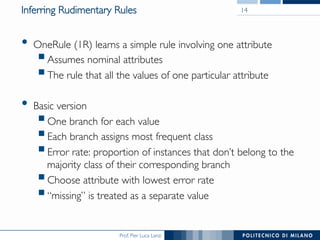
•  OneRule (1R) learns a simple rule involving one attribute
§ Assumes nominal attributes
§ The rule that all the values of one particular attribute
•  Basic version
§ One branch for each value
§ Each branch assigns most frequent class
§ Error rate: proportion of instances that don’t belong to the
majority class of their corresponding branch
§ Choose attribute with lowest error rate
§ “missing” is treated as a separate value
14
Prof. Pier Luca Lanzi
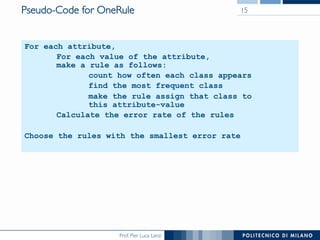
For each attribute,
For each value of the attribute,
make a rule as follows:
count how often each class appears
find the most frequent class
make the rule assign that class to
this attribute-value
Calculate the error rate of the rules
Choose the rules with the smallest error rate
Pseudo-Code for OneRule 15
Prof. Pier Luca Lanzi
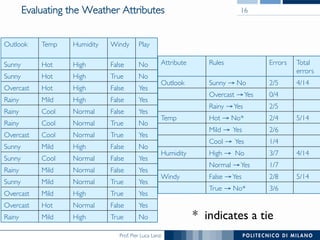
Evaluating the Weather Attributes 16
3/6True → No*
5/142/8False →YesWindy
1/7Normal →Yes
4/143/7High → NoHumidity
5/14
4/14
Total
errors
1/4Cool → Yes
2/6Mild → Yes
2/4Hot → No*Temp
2/5Rainy →Yes
0/4Overcast →Yes
2/5Sunny → NoOutlook
ErrorsRulesAttribute
NoTrueHighMildRainy
YesFalseNormalHotOvercast
YesTrueHighMildOvercast
YesTrueNormalMildSunny
YesFalseNormalMildRainy
YesFalseNormalCoolSunny
NoFalseHighMildSunny
YesTrueNormalCoolOvercast
NoTrueNormalCoolRainy
YesFalseNormalCoolRainy
YesFalseHighMildRainy
YesFalseHighHotOvercast
NoTrueHighHotSunny
NoFalseHighHotSunny
PlayWindyHumidityTempOutlook
* indicates a tie
Prof. Pier Luca Lanzi
OneRule and Numerical Attributes
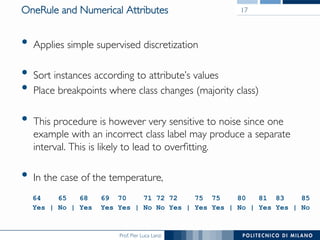
•  Applies simple supervised discretization
•  Sort instances according to attribute’s values
•  Place breakpoints where class changes (majority class)
•  This procedure is however very sensitive to noise since one
example with an incorrect class label may produce a separate
interval. This is likely to lead to overfitting.
•  In the case of the temperature, 
17
64 65 68 69 70 71 72 72 75 75 80 81 83 85
Yes | No | Yes Yes Yes | No No Yes | Yes Yes | No | Yes Yes | No
Prof. Pier Luca Lanzi
OneRule and Numerical Attributes
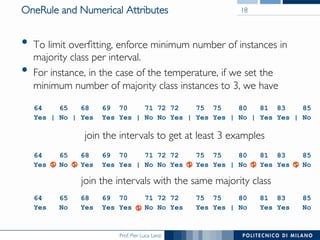
•  To limit overfitting, enforce minimum number of instances in
majority class per interval.
•  For instance, in the case of the temperature, if we set the
minimum number of majority class instances to 3, we have
18
64 65 68 69 70 71 72 72 75 75 80 81 83 85
Yes | No | Yes Yes Yes | No No Yes | Yes Yes | No | Yes Yes | No
64 65 68 69 70 71 72 72 75 75 80 81 83 85
Yes | No | Yes Yes Yes | No No Yes | Yes Yes | No | Yes Yes | No
64 65 68 69 70 71 72 72 75 75 80 81 83 85
Yes No Yes Yes Yes | No No Yes Yes Yes | No Yes Yes No
join the intervals to get at least 3 examples
join the intervals with the same majority class
Prof. Pier Luca Lanzi
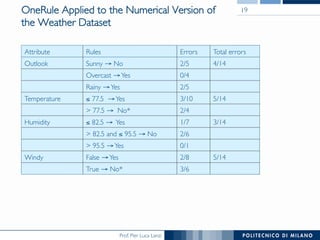
OneRule Applied to the Numerical Version of
the Weather Dataset
19
0/1 95.5 →Yes
3/6True → No*
5/142/8False →YesWindy
2/6 82.5 and ≤ 95.5 → No
3/141/7≤ 82.5 → YesHumidity
5/14
4/14
Total errors
2/4 77.5 → No*
3/10≤ 77.5 →YesTemperature
2/5Rainy →Yes
0/4Overcast →Yes
2/5Sunny → NoOutlook
ErrorsRulesAttribute
Prof. Pier Luca Lanzi
Sequential Covering
Prof. Pier Luca Lanzi
Sequential Covering Algorithms
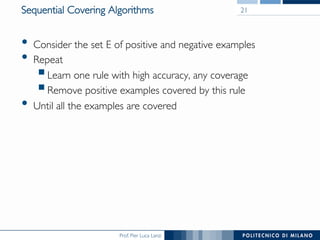
•  Consider the set E of positive and negative examples
•  Repeat
§ Learn one rule with high accuracy, any coverage
§ Remove positive examples covered by this rule
•  Until all the examples are covered
21
Prof. Pier Luca Lanzi
Basic Sequential Covering Algorithm
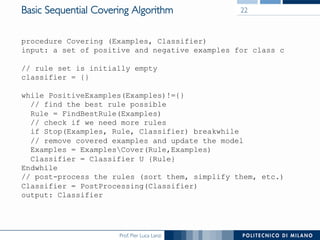
procedure Covering (Examples, Classifier)
input: a set of positive and negative examples for class c
// rule set is initially empty
classifier = {}
while PositiveExamples(Examples)!={}
// find the best rule possible
Rule = FindBestRule(Examples)
// check if we need more rules
if Stop(Examples, Rule, Classifier) breakwhile
// remove covered examples and update the model
Examples = ExamplesCover(Rule,Examples)
Classifier = Classifier U {Rule}
Endwhile
// post-process the rules (sort them, simplify them, etc.)
Classifier = PostProcessing(Classifier)
output: Classifier
22
Prof. Pier Luca Lanzi
Finding the Best Rule Possible 23
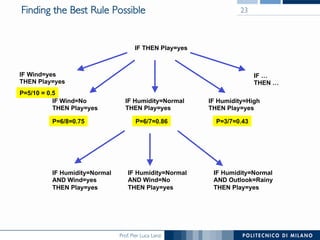
IF THEN Play=yes
IF Wind=No
THEN Play=yes
IF Humidity=Normal
THEN Play=yes
IF Humidity=High
THEN Play=yes
IF …
THEN …
IF Wind=yes
THEN Play=yes
IF Humidity=Normal
AND Wind=yes
THEN Play=yes
IF Humidity=Normal
AND Wind=No
THEN Play=yes
IF Humidity=Normal
AND Outlook=Rainy
THEN Play=yes
P=5/10 = 0.5
P=6/8=0.75 P=6/7=0.86 P=3/7=0.43
Prof. Pier Luca Lanzi
Another Viewpoint 24
y
x
a
b b
b
b
b
b
b
b
b b b
b
b
b
a
a
a
a
a
y
a
b b
b
b
b
b
b
b
b b
b
b
b
b
a
a
aa
a
x
1đ2
y
a
b b
b
b
b
b
b
b
b b
b
b
b
b
a
a
aa
a
x
1đ2
2đ6
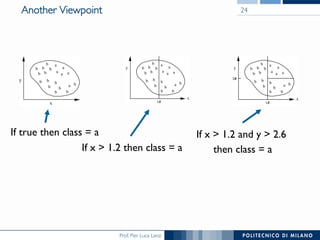
If x  1.2 then class = a
If x  1.2 and y  2.6
then class = a
If true then class = a
Prof. Pier Luca Lanzi
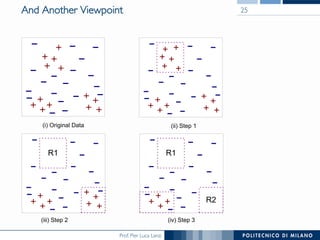
And Another Viewpoint 25
(i) Original Data (ii) Step 1
(iii) Step 2
R1
(iv) Step 3
R1
R2
Prof. Pier Luca Lanzi
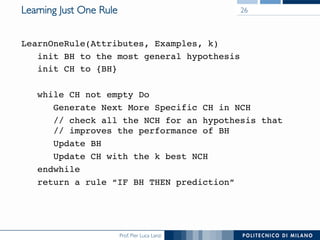
Learning Just One Rule
LearnOneRule(Attributes, Examples, k)
init BH to the most general hypothesis
init CH to {BH}
while CH not empty Do
Generate Next More Specific CH in NCH
// check all the NCH for an hypothesis that

// improves the performance of BH
Update BH
Update CH with the k best NCH
endwhile
return a rule “IF BH THEN prediction”
26
Prof. Pier Luca Lanzi
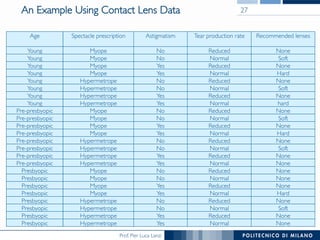
An Example Using Contact Lens Data 27
NoneReducedYesHypermetropePre-presbyopic
NoneNormalYesHypermetropePre-presbyopic
NoneReducedNoMyopePresbyopic
NoneNormalNoMyopePresbyopic
NoneReducedYesMyopePresbyopic
HardNormalYesMyopePresbyopic
NoneReducedNoHypermetropePresbyopic
SoftNormalNoHypermetropePresbyopic
NoneReducedYesHypermetropePresbyopic
NoneNormalYesHypermetropePresbyopic
SoftNormalNoHypermetropePre-presbyopic
NoneReducedNoHypermetropePre-presbyopic
HardNormalYesMyopePre-presbyopic
NoneReducedYesMyopePre-presbyopic
SoftNormalNoMyopePre-presbyopic
NoneReducedNoMyopePre-presbyopic
hardNormalYesHypermetropeYoung
NoneReducedYesHypermetropeYoung
SoftNormalNoHypermetropeYoung
NoneReducedNoHypermetropeYoung
HardNormalYesMyopeYoung
NoneReducedYesMyopeYoung
SoftNormalNoMyopeYoung
NoneReducedNoMyopeYoung
Recommended lensesTear production rateAstigmatismSpectacle prescriptionAge
Prof. Pier Luca Lanzi
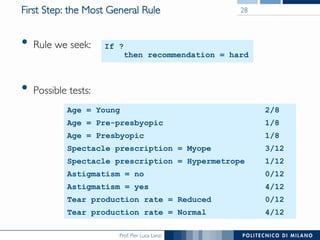
First Step: the Most General Rule
•  Rule we seek:
•  Possible tests:
28
4/12Tear production rate = Normal
0/12Tear production rate = Reduced
4/12Astigmatism = yes
0/12Astigmatism = no
1/12Spectacle prescription = Hypermetrope
3/12Spectacle prescription = Myope
1/8Age = Presbyopic
1/8Age = Pre-presbyopic
2/8Age = Young
If ?
then recommendation = hard
Prof. Pier Luca Lanzi
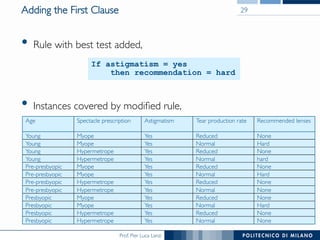
Adding the First Clause
•  Rule with best test added,
•  Instances covered by modified rule,
29
NoneReducedYesHypermetropePre-presbyopic
NoneNormalYesHypermetropePre-presbyopic
NoneReducedYesMyopePresbyopic
HardNormalYesMyopePresbyopic
NoneReducedYesHypermetropePresbyopic
NoneNormalYesHypermetropePresbyopic
HardNormalYesMyopePre-presbyopic
NoneReducedYesMyopePre-presbyopic
hardNormalYesHypermetropeYoung
NoneReducedYesHypermetropeYoung
HardNormalYesMyopeYoung
NoneReducedYesMyopeYoung
Recommended lensesTear production rateAstigmatismSpectacle prescriptionAge
If astigmatism = yes
then recommendation = hard
Prof. Pier Luca Lanzi
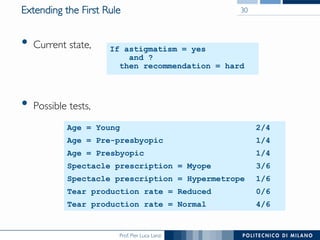
Extending the First Rule
•  Current state,
•  Possible tests,
30
4/6Tear production rate = Normal
0/6Tear production rate = Reduced
1/6Spectacle prescription = Hypermetrope
3/6Spectacle prescription = Myope
1/4Age = Presbyopic
1/4Age = Pre-presbyopic
2/4Age = Young
If astigmatism = yes
and ?
then recommendation = hard
Prof. Pier Luca Lanzi
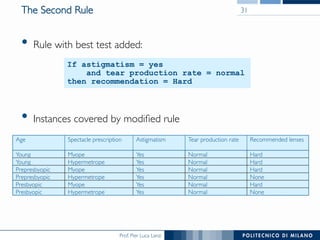
The Second Rule
•  Rule with best test added:
•  Instances covered by modified rule
31
NoneNormalYesHypermetropePrepresbyopic
HardNormalYesMyopePresbyopic
NoneNormalYesHypermetropePresbyopic
HardNormalYesMyopePrepresbyopic
HardNormalYesHypermetropeYoung
HardNormalYesMyopeYoung
Recommended lensesTear production rateAstigmatismSpectacle prescriptionAge
If astigmatism = yes
and tear production rate = normal
then recommendation = Hard
Prof. Pier Luca Lanzi
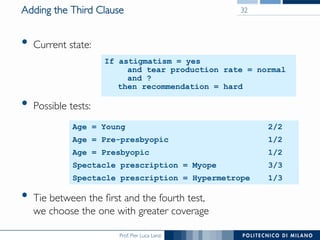
Adding the Third Clause
•  Current state:
•  Possible tests:
•  Tie between the first and the fourth test, 
we choose the one with greater coverage
32
1/3Spectacle prescription = Hypermetrope
3/3Spectacle prescription = Myope
1/2Age = Presbyopic
1/2Age = Pre-presbyopic
2/2Age = Young
If astigmatism = yes
and tear production rate = normal
and ?
then recommendation = hard
Prof. Pier Luca Lanzi
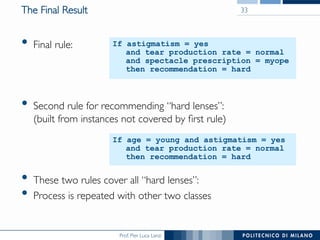
The Final Result
•  Final rule:
•  Second rule for recommending “hard lenses”:
(built from instances not covered by first rule)
•  These two rules cover all “hard lenses”:
•  Process is repeated with other two classes
33
If astigmatism = yes
and tear production rate = normal
and spectacle prescription = myope
then recommendation = hard
If age = young and astigmatism = yes
and tear production rate = normal
then recommendation = hard
Prof. Pier Luca Lanzi
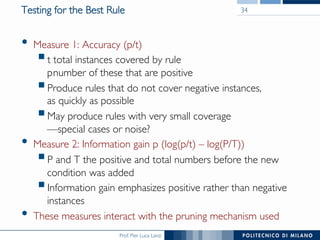
Testing for the Best Rule
•  Measure 1: Accuracy (p/t)
§ t total instances covered by rule
pnumber of these that are positive
§ Produce rules that do not cover negative instances,
as quickly as possible
§ May produce rules with very small coverage
—special cases or noise?
•  Measure 2: Information gain p (log(p/t) – log(P/T))
§ P and T the positive and total numbers before the new
condition was added
§ Information gain emphasizes positive rather than negative
instances
•  These measures interact with the pruning mechanism used
34
Prof. Pier Luca Lanzi
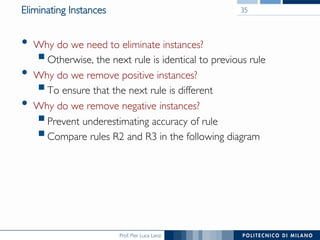
Eliminating Instances
•  Why do we need to eliminate instances?
§ Otherwise, the next rule is identical to previous rule
•  Why do we remove positive instances?
§ To ensure that the next rule is different
•  Why do we remove negative instances?
§ Prevent underestimating accuracy of rule
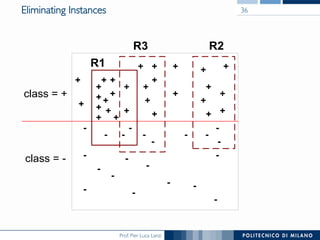
§ Compare rules R2 and R3 in the following diagram
35
Prof. Pier Luca Lanzi
Eliminating Instances 36
class = +
class = -
+
+ +
+
+
+
+
+
+
+
+
+
+
+
+
+
++
+
+
-
-
-
-
- -
-
-
-
- -
-
-
-
-
-
-
-
-
-
-
+
+
++
+
+
+
R1
R3 R2
+
+
Prof. Pier Luca Lanzi
Missing Values and Numeric Attributes
•  Missing values usually fail the test
•  Covering algorithm must either
§ Use other tests to separate out positive instances
§ Leave them uncovered until later in the process
•  In some cases it is better to treat “missing” as a separate value
•  Numeric attributes are treated as in decision trees
37
Prof. Pier Luca Lanzi
Stopping Criterion and Rule Pruning
•  The process usually stops when there is no significant
improvement by adding the new rule
•  Rule pruning is similar to post-pruning of decision trees
•  Reduced Error Pruning:
§ Remove one of the conjuncts in the rule
§ Compare error rate on validation set
§ If error improves, prune the conjunct
38
Prof. Pier Luca Lanzi
Rules vs. Trees
•  Rule sets can be more readable
•  Decision trees suffer from replicated subtrees
•  Rule sets are collections of local models, trees represent models
over the whole domain
•  The covering algorithm concentrates on one class at a time
whereas decision tree learner takes all classes into account
39
Prof. Pier Luca Lanzi
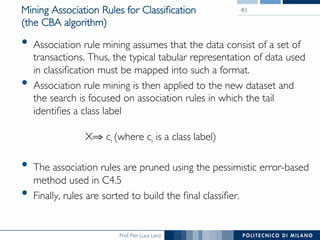
Mining Association Rules for Classification
Prof. Pier Luca Lanzi
Mining Association Rules for Classification
(the CBA algorithm)
•  Association rule mining assumes that the data consist of a set of
transactions. Thus, the typical tabular representation of data used
in classification must be mapped into such a format.
•  Association rule mining is then applied to the new dataset and
the search is focused on association rules in which the tail
identifies a class label

X⇒ ci (where ci is a class label)
•  The association rules are pruned using the pessimistic error-based
method used in C4.5
•  Finally, rules are sorted to build the final classifier.
41
Prof. Pier Luca Lanzi
Indirect Methods
Prof. Pier Luca Lanzi
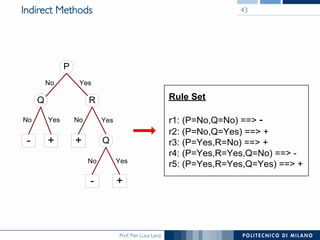
Indirect Methods
Rule Set
r1: (P=No,Q=No) == -
r2: (P=No,Q=Yes) == +
r3: (P=Yes,R=No) == +
r4: (P=Yes,R=Yes,Q=No) == -
r5: (P=Yes,R=Yes,Q=Yes) == +
P
Q R
Q- + +
- +
No No
No
Yes Yes
Yes
No Yes
43
Prof. Pier Luca Lanzi
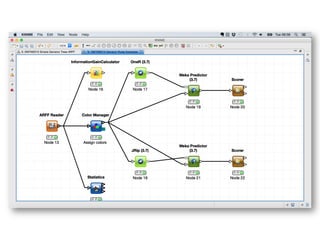
Example
Prof. Pier Luca Lanzi
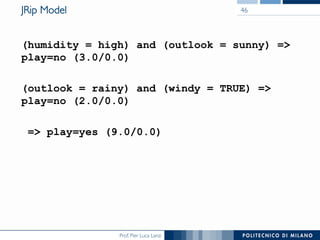
JRip Model
(humidity = high) and (outlook = sunny) =
play=no (3.0/0.0)
(outlook = rainy) and (windy = TRUE) =
play=no (2.0/0.0)
= play=yes (9.0/0.0)
46
Prof. Pier Luca Lanzi
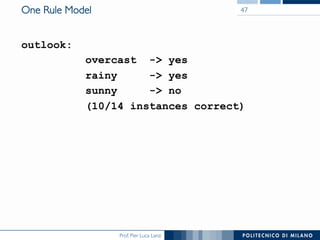
One Rule Model
outlook:
overcast - yes
rainy - yes
sunny - no
(10/14 instances correct)
47
Prof. Pier Luca Lanzi
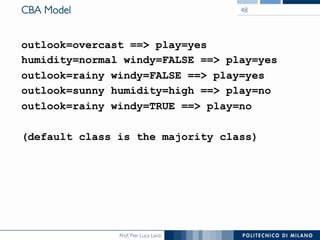
CBA Model
outlook=overcast == play=yes
humidity=normal windy=FALSE == play=yes
outlook=rainy windy=FALSE == play=yes
outlook=sunny humidity=high == play=no
outlook=rainy windy=TRUE == play=no
(default class is the majority class)
48
Prof. Pier Luca Lanzi
Summary
Prof. Pier Luca Lanzi
Summary
•  Advantages of Rule-Based Classifiers
§ As highly expressive as decision trees
§ Easy to interpret
§ Easy to generate
§ Can classify new instances rapidly
§ Performance comparable to decision trees
•  Two approaches: direct and indirect methods
50
Prof. Pier Luca Lanzi
Summary
•  Direct Methods, typically apply sequential covering approach
§ Grow a single rule
§ Remove Instances from rule
§ Prune the rule (if necessary)
§ Add rule to Current Rule Set
§ Repeat
•  Other approaches exist
§ Specific to general exploration (RISE)
§ Post processing of neural networks, 
association rules, decision trees, etc.
51
Prof. Pier Luca Lanzi
Homework
•  Generate the rule set for the Weather dataset by repeatedly
applying the procedure to learn one rule until no improvement
can be produced or the covered examples are too few
•  Check the problems provided in the previous exams and apply
both OneRule and Sequential Covering to generate the first rule.
Then, check the result with one of the implementations available
in Weka
52

DMTM 2015 - 12 Classification Rules

  • 1.
    Prof. Pier LucaLanzi Classification: Rule Induction Data Mining andText Mining (UIC 583 @ Politecnico di Milano)
  • 2.
    Prof. Pier LucaLanzi The Weather Dataset Outlook Temp Humidity Windy Play Sunny Hot High False No Sunny Hot High True No Overcast Hot High False Yes Rainy Mild High False Yes Rainy Cool Normal False Yes Rainy Cool Normal True No Overcast Cool Normal True Yes Sunny Mild High False No Sunny Cool Normal False Yes Rainy Mild Normal False Yes Sunny Mild Normal True Yes Overcast Mild High True Yes Overcast Hot Normal False Yes Rainy Mild High True No 2
  • 3.
    Prof. Pier LucaLanzi A Rule Set to Classify the Data •  IF (humidity = high) and (outlook = sunny) THEN play=no (3.0/0.0) •  IF (outlook = rainy) and (windy = TRUE) THEN play=no (2.0/0.0) •  OTHERWISE play=yes (9.0/0.0) •  Confusion Matrix § yes no -- classified as § 7 2 | yes § 3 2 | no 3
  • 4.
    Prof. Pier LucaLanzi Let’s Check the First Rule Outlook Temp Humidity Windy Play Sunny Hot High False No Sunny Hot High True No Overcast Hot High False Yes Rainy Mild High False Yes Rainy Cool Normal False Yes Rainy Cool Normal True No Overcast Cool Normal True Yes Sunny Mild High False No Sunny Cool Normal False Yes Rainy Mild Normal False Yes Sunny Mild Normal True Yes Overcast Mild High True Yes Overcast Hot Normal False Yes Rainy Mild High True No 4 IF (humidity = high) and (outlook = sunny) THEN play=no (3.0/0.0)
  • 5.
    Prof. Pier LucaLanzi Then, The Second Rule Outlook Temp Humidity Windy Play Sunny Hot High False No Sunny Hot High True No Overcast Hot High False Yes Rainy Mild High False Yes Rainy Cool Normal False Yes Rainy Cool Normal True No Overcast Cool Normal True Yes Sunny Mild High False No Sunny Cool Normal False Yes Rainy Mild Normal False Yes Sunny Mild Normal True Yes Overcast Mild High True Yes Overcast Hot Normal False Yes Rainy Mild High True No 5 IF (outlook = rainy) and (windy = TRUE) THEN play=no (2.0/0.0)
  • 6.
    Prof. Pier LucaLanzi Finally, the Third Rule Outlook Temp Humidity Windy Play Sunny Hot High False No Sunny Hot High True No Overcast Hot High False Yes Rainy Mild High False Yes Rainy Cool Normal False Yes Rainy Cool Normal True No Overcast Cool Normal True Yes Sunny Mild High False No Sunny Cool Normal False Yes Rainy Mild Normal False Yes Sunny Mild Normal True Yes Overcast Mild High True Yes Overcast Hot Normal False Yes Rainy Mild High True No 6 IF (outlook = rainy) and (windy = TRUE) THEN play=no (2.0/0.0)
  • 7.
    Prof. Pier LucaLanzi A Simpler Solution •  IF (outlook = sunny) THEN play IS no ELSE IF (outlook = overcast) THEN play IS yes ELSE IF (outlook = rainy) THEN play IS yes (6/14 instances correct) •  Confusion Matrix § yes no -- classified as § 4 5 | yes § 3 2 | no 7
  • 8.
    Prof. Pier LucaLanzi What is a Classification Rule?
  • 9.
    Prof. Pier LucaLanzi What Is A Classification Rules? Why Rules? •  They are IF-THEN rules § The IF part states a condition over the data § The THEN part includes a class label •  What types of conditions? § Propositional, with attribute-value comparisons § First order Horn clauses, with variables •  Why rules? Because they are one of the most expressive and most human readable representation for hypotheses is sets of IF- THEN rules 9
  • 10.
    Prof. Pier LucaLanzi Coverage and Accuracy •  IF (humidity = high) and (outlook = sunny) THEN play=no (3.0/0.0) •  ncovers = number of examples covered by the rule •  ncorrect = number of examples correctly classified by the rule •  coverage(R) = ncovers /size of the |training data set •  accuracy(R) = ncorrect /ncovers 10
  • 11.
    Prof. Pier LucaLanzi Conflict Resolution •  If more than one rule is triggered, we need conflict resolution •  Size ordering: assign the highest priority to the triggering rules that has the “toughest” requirement (i.e., with the most attribute test) •  Class-based ordering: decreasing order of prevalence or misclassification cost per class •  Rule-based ordering (decision list): rules are organized into one long priority list, according to some measure of rule quality or by experts 11
  • 12.
    Prof. Pier LucaLanzi Two Approaches for Rule Learning •  Direct Methods § Directly learn the rules from the training data •  Indirect Methods § Learn decision tree, then convert to rules § Learn neural networks, then extract rules 12
  • 13.
    Prof. Pier LucaLanzi One Rule
  • 14.
    Prof. Pier LucaLanzi Inferring Rudimentary Rules •  OneRule (1R) learns a simple rule involving one attribute § Assumes nominal attributes § The rule that all the values of one particular attribute •  Basic version § One branch for each value § Each branch assigns most frequent class § Error rate: proportion of instances that don’t belong to the majority class of their corresponding branch § Choose attribute with lowest error rate § “missing” is treated as a separate value 14
  • 15.
    Prof. Pier LucaLanzi For each attribute, For each value of the attribute, make a rule as follows: count how often each class appears find the most frequent class make the rule assign that class to this attribute-value Calculate the error rate of the rules Choose the rules with the smallest error rate Pseudo-Code for OneRule 15
  • 16.
    Prof. Pier LucaLanzi Evaluating the Weather Attributes 16 3/6True → No* 5/142/8False →YesWindy 1/7Normal →Yes 4/143/7High → NoHumidity 5/14 4/14 Total errors 1/4Cool → Yes 2/6Mild → Yes 2/4Hot → No*Temp 2/5Rainy →Yes 0/4Overcast →Yes 2/5Sunny → NoOutlook ErrorsRulesAttribute NoTrueHighMildRainy YesFalseNormalHotOvercast YesTrueHighMildOvercast YesTrueNormalMildSunny YesFalseNormalMildRainy YesFalseNormalCoolSunny NoFalseHighMildSunny YesTrueNormalCoolOvercast NoTrueNormalCoolRainy YesFalseNormalCoolRainy YesFalseHighMildRainy YesFalseHighHotOvercast NoTrueHighHotSunny NoFalseHighHotSunny PlayWindyHumidityTempOutlook * indicates a tie
  • 17.
    Prof. Pier LucaLanzi OneRule and Numerical Attributes •  Applies simple supervised discretization •  Sort instances according to attribute’s values •  Place breakpoints where class changes (majority class) •  This procedure is however very sensitive to noise since one example with an incorrect class label may produce a separate interval. This is likely to lead to overfitting. •  In the case of the temperature, 17 64 65 68 69 70 71 72 72 75 75 80 81 83 85 Yes | No | Yes Yes Yes | No No Yes | Yes Yes | No | Yes Yes | No
  • 18.
    Prof. Pier LucaLanzi OneRule and Numerical Attributes •  To limit overfitting, enforce minimum number of instances in majority class per interval. •  For instance, in the case of the temperature, if we set the minimum number of majority class instances to 3, we have 18 64 65 68 69 70 71 72 72 75 75 80 81 83 85 Yes | No | Yes Yes Yes | No No Yes | Yes Yes | No | Yes Yes | No 64 65 68 69 70 71 72 72 75 75 80 81 83 85 Yes | No | Yes Yes Yes | No No Yes | Yes Yes | No | Yes Yes | No 64 65 68 69 70 71 72 72 75 75 80 81 83 85 Yes No Yes Yes Yes | No No Yes Yes Yes | No Yes Yes No join the intervals to get at least 3 examples join the intervals with the same majority class
  • 19.
    Prof. Pier LucaLanzi OneRule Applied to the Numerical Version of the Weather Dataset 19 0/1 95.5 →Yes 3/6True → No* 5/142/8False →YesWindy 2/6 82.5 and ≤ 95.5 → No 3/141/7≤ 82.5 → YesHumidity 5/14 4/14 Total errors 2/4 77.5 → No* 3/10≤ 77.5 →YesTemperature 2/5Rainy →Yes 0/4Overcast →Yes 2/5Sunny → NoOutlook ErrorsRulesAttribute
  • 20.
    Prof. Pier LucaLanzi Sequential Covering
  • 21.
    Prof. Pier LucaLanzi Sequential Covering Algorithms •  Consider the set E of positive and negative examples •  Repeat § Learn one rule with high accuracy, any coverage § Remove positive examples covered by this rule •  Until all the examples are covered 21
  • 22.
    Prof. Pier LucaLanzi Basic Sequential Covering Algorithm procedure Covering (Examples, Classifier) input: a set of positive and negative examples for class c // rule set is initially empty classifier = {} while PositiveExamples(Examples)!={} // find the best rule possible Rule = FindBestRule(Examples) // check if we need more rules if Stop(Examples, Rule, Classifier) breakwhile // remove covered examples and update the model Examples = ExamplesCover(Rule,Examples) Classifier = Classifier U {Rule} Endwhile // post-process the rules (sort them, simplify them, etc.) Classifier = PostProcessing(Classifier) output: Classifier 22
  • 23.
    Prof. Pier LucaLanzi Finding the Best Rule Possible 23 IF THEN Play=yes IF Wind=No THEN Play=yes IF Humidity=Normal THEN Play=yes IF Humidity=High THEN Play=yes IF … THEN … IF Wind=yes THEN Play=yes IF Humidity=Normal AND Wind=yes THEN Play=yes IF Humidity=Normal AND Wind=No THEN Play=yes IF Humidity=Normal AND Outlook=Rainy THEN Play=yes P=5/10 = 0.5 P=6/8=0.75 P=6/7=0.86 P=3/7=0.43
  • 24.
    Prof. Pier LucaLanzi Another Viewpoint 24 y x a b b b b b b b b b b b b b b a a a a a y a b b b b b b b b b b b b b b a a aa a x 1đ2 y a b b b b b b b b b b b b b b a a aa a x 1đ2 2đ6 If x 1.2 then class = a If x 1.2 and y 2.6 then class = a If true then class = a
  • 25.
    Prof. Pier LucaLanzi And Another Viewpoint 25 (i) Original Data (ii) Step 1 (iii) Step 2 R1 (iv) Step 3 R1 R2
  • 26.
    Prof. Pier LucaLanzi Learning Just One Rule LearnOneRule(Attributes, Examples, k) init BH to the most general hypothesis init CH to {BH} while CH not empty Do Generate Next More Specific CH in NCH // check all the NCH for an hypothesis that
 // improves the performance of BH Update BH Update CH with the k best NCH endwhile return a rule “IF BH THEN prediction” 26
  • 27.
    Prof. Pier LucaLanzi An Example Using Contact Lens Data 27 NoneReducedYesHypermetropePre-presbyopic NoneNormalYesHypermetropePre-presbyopic NoneReducedNoMyopePresbyopic NoneNormalNoMyopePresbyopic NoneReducedYesMyopePresbyopic HardNormalYesMyopePresbyopic NoneReducedNoHypermetropePresbyopic SoftNormalNoHypermetropePresbyopic NoneReducedYesHypermetropePresbyopic NoneNormalYesHypermetropePresbyopic SoftNormalNoHypermetropePre-presbyopic NoneReducedNoHypermetropePre-presbyopic HardNormalYesMyopePre-presbyopic NoneReducedYesMyopePre-presbyopic SoftNormalNoMyopePre-presbyopic NoneReducedNoMyopePre-presbyopic hardNormalYesHypermetropeYoung NoneReducedYesHypermetropeYoung SoftNormalNoHypermetropeYoung NoneReducedNoHypermetropeYoung HardNormalYesMyopeYoung NoneReducedYesMyopeYoung SoftNormalNoMyopeYoung NoneReducedNoMyopeYoung Recommended lensesTear production rateAstigmatismSpectacle prescriptionAge
  • 28.
    Prof. Pier LucaLanzi First Step: the Most General Rule •  Rule we seek: •  Possible tests: 28 4/12Tear production rate = Normal 0/12Tear production rate = Reduced 4/12Astigmatism = yes 0/12Astigmatism = no 1/12Spectacle prescription = Hypermetrope 3/12Spectacle prescription = Myope 1/8Age = Presbyopic 1/8Age = Pre-presbyopic 2/8Age = Young If ? then recommendation = hard
  • 29.
    Prof. Pier LucaLanzi Adding the First Clause •  Rule with best test added, •  Instances covered by modified rule, 29 NoneReducedYesHypermetropePre-presbyopic NoneNormalYesHypermetropePre-presbyopic NoneReducedYesMyopePresbyopic HardNormalYesMyopePresbyopic NoneReducedYesHypermetropePresbyopic NoneNormalYesHypermetropePresbyopic HardNormalYesMyopePre-presbyopic NoneReducedYesMyopePre-presbyopic hardNormalYesHypermetropeYoung NoneReducedYesHypermetropeYoung HardNormalYesMyopeYoung NoneReducedYesMyopeYoung Recommended lensesTear production rateAstigmatismSpectacle prescriptionAge If astigmatism = yes then recommendation = hard
  • 30.
    Prof. Pier LucaLanzi Extending the First Rule •  Current state, •  Possible tests, 30 4/6Tear production rate = Normal 0/6Tear production rate = Reduced 1/6Spectacle prescription = Hypermetrope 3/6Spectacle prescription = Myope 1/4Age = Presbyopic 1/4Age = Pre-presbyopic 2/4Age = Young If astigmatism = yes and ? then recommendation = hard
  • 31.
    Prof. Pier LucaLanzi The Second Rule •  Rule with best test added: •  Instances covered by modified rule 31 NoneNormalYesHypermetropePrepresbyopic HardNormalYesMyopePresbyopic NoneNormalYesHypermetropePresbyopic HardNormalYesMyopePrepresbyopic HardNormalYesHypermetropeYoung HardNormalYesMyopeYoung Recommended lensesTear production rateAstigmatismSpectacle prescriptionAge If astigmatism = yes and tear production rate = normal then recommendation = Hard
  • 32.
    Prof. Pier LucaLanzi Adding the Third Clause •  Current state: •  Possible tests: •  Tie between the first and the fourth test, we choose the one with greater coverage 32 1/3Spectacle prescription = Hypermetrope 3/3Spectacle prescription = Myope 1/2Age = Presbyopic 1/2Age = Pre-presbyopic 2/2Age = Young If astigmatism = yes and tear production rate = normal and ? then recommendation = hard
  • 33.
    Prof. Pier LucaLanzi The Final Result •  Final rule: •  Second rule for recommending “hard lenses”: (built from instances not covered by first rule) •  These two rules cover all “hard lenses”: •  Process is repeated with other two classes 33 If astigmatism = yes and tear production rate = normal and spectacle prescription = myope then recommendation = hard If age = young and astigmatism = yes and tear production rate = normal then recommendation = hard
  • 34.
    Prof. Pier LucaLanzi Testing for the Best Rule •  Measure 1: Accuracy (p/t) § t total instances covered by rule pnumber of these that are positive § Produce rules that do not cover negative instances, as quickly as possible § May produce rules with very small coverage —special cases or noise? •  Measure 2: Information gain p (log(p/t) – log(P/T)) § P and T the positive and total numbers before the new condition was added § Information gain emphasizes positive rather than negative instances •  These measures interact with the pruning mechanism used 34
  • 35.
    Prof. Pier LucaLanzi Eliminating Instances •  Why do we need to eliminate instances? § Otherwise, the next rule is identical to previous rule •  Why do we remove positive instances? § To ensure that the next rule is different •  Why do we remove negative instances? § Prevent underestimating accuracy of rule § Compare rules R2 and R3 in the following diagram 35
  • 36.
    Prof. Pier LucaLanzi Eliminating Instances 36 class = + class = - + + + + + + + + + + + + + + + + ++ + + - - - - - - - - - - - - - - - - - - - - - + + ++ + + + R1 R3 R2 + +
  • 37.
    Prof. Pier LucaLanzi Missing Values and Numeric Attributes •  Missing values usually fail the test •  Covering algorithm must either § Use other tests to separate out positive instances § Leave them uncovered until later in the process •  In some cases it is better to treat “missing” as a separate value •  Numeric attributes are treated as in decision trees 37
  • 38.
    Prof. Pier LucaLanzi Stopping Criterion and Rule Pruning •  The process usually stops when there is no significant improvement by adding the new rule •  Rule pruning is similar to post-pruning of decision trees •  Reduced Error Pruning: § Remove one of the conjuncts in the rule § Compare error rate on validation set § If error improves, prune the conjunct 38
  • 39.
    Prof. Pier LucaLanzi Rules vs. Trees •  Rule sets can be more readable •  Decision trees suffer from replicated subtrees •  Rule sets are collections of local models, trees represent models over the whole domain •  The covering algorithm concentrates on one class at a time whereas decision tree learner takes all classes into account 39
  • 40.
    Prof. Pier LucaLanzi Mining Association Rules for Classification
  • 41.
    Prof. Pier LucaLanzi Mining Association Rules for Classification (the CBA algorithm) •  Association rule mining assumes that the data consist of a set of transactions. Thus, the typical tabular representation of data used in classification must be mapped into such a format. •  Association rule mining is then applied to the new dataset and the search is focused on association rules in which the tail identifies a class label X⇒ ci (where ci is a class label) •  The association rules are pruned using the pessimistic error-based method used in C4.5 •  Finally, rules are sorted to build the final classifier. 41
  • 42.
    Prof. Pier LucaLanzi Indirect Methods
  • 43.
    Prof. Pier LucaLanzi Indirect Methods Rule Set r1: (P=No,Q=No) == - r2: (P=No,Q=Yes) == + r3: (P=Yes,R=No) == + r4: (P=Yes,R=Yes,Q=No) == - r5: (P=Yes,R=Yes,Q=Yes) == + P Q R Q- + + - + No No No Yes Yes Yes No Yes 43
  • 44.
    Prof. Pier LucaLanzi Example
  • 45.
  • 46.
    Prof. Pier LucaLanzi JRip Model (humidity = high) and (outlook = sunny) = play=no (3.0/0.0) (outlook = rainy) and (windy = TRUE) = play=no (2.0/0.0) = play=yes (9.0/0.0) 46
  • 47.
    Prof. Pier LucaLanzi One Rule Model outlook: overcast - yes rainy - yes sunny - no (10/14 instances correct) 47
  • 48.
    Prof. Pier LucaLanzi CBA Model outlook=overcast == play=yes humidity=normal windy=FALSE == play=yes outlook=rainy windy=FALSE == play=yes outlook=sunny humidity=high == play=no outlook=rainy windy=TRUE == play=no (default class is the majority class) 48
  • 49.
    Prof. Pier LucaLanzi Summary
  • 50.
    Prof. Pier LucaLanzi Summary •  Advantages of Rule-Based Classifiers § As highly expressive as decision trees § Easy to interpret § Easy to generate § Can classify new instances rapidly § Performance comparable to decision trees •  Two approaches: direct and indirect methods 50
  • 51.
    Prof. Pier LucaLanzi Summary •  Direct Methods, typically apply sequential covering approach § Grow a single rule § Remove Instances from rule § Prune the rule (if necessary) § Add rule to Current Rule Set § Repeat •  Other approaches exist § Specific to general exploration (RISE) § Post processing of neural networks, association rules, decision trees, etc. 51
  • 52.
    Prof. Pier LucaLanzi Homework •  Generate the rule set for the Weather dataset by repeatedly applying the procedure to learn one rule until no improvement can be produced or the covered examples are too few •  Check the problems provided in the previous exams and apply both OneRule and Sequential Covering to generate the first rule. Then, check the result with one of the implementations available in Weka 52