





Prof. Pier Luca Lanzi
Classification
Data Mining andText Mining (UIC 583 @ Politecnico di Milano)
Prof. Pier Luca Lanzi
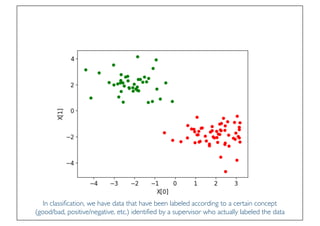
In classification, we have data that have been labeled according to a certain concept
(good/bad, positive/negative, etc.) identified by a supervisor who actually labeled the data
Prof. Pier Luca Lanzi
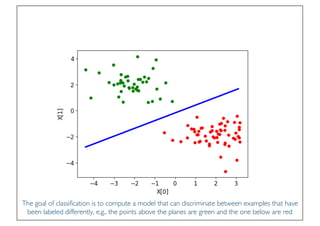
The goal of classification is to compute a model that can discriminate between examples that have
been labeled differently, e.g., the points above the planes are green and the one below are red
Prof. Pier Luca Lanzi
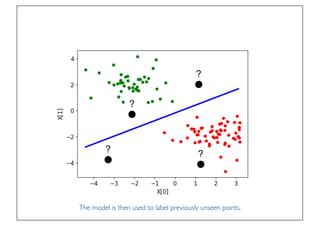
The model is then used to label previously unseen points.
?
?
?
?
Prof. Pier Luca Lanzi
As for regression, we have to compute a
model using known data that will perform
well on unknown data.
Prof. Pier Luca Lanzi
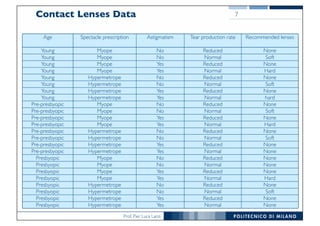
Contact Lenses Data 7
NoneReducedYesHypermetropePre-presbyopic
NoneNormalYesHypermetropePre-presbyopic
NoneReducedNoMyopePresbyopic
NoneNormalNoMyopePresbyopic
NoneReducedYesMyopePresbyopic
HardNormalYesMyopePresbyopic
NoneReducedNoHypermetropePresbyopic
SoftNormalNoHypermetropePresbyopic
NoneReducedYesHypermetropePresbyopic
NoneNormalYesHypermetropePresbyopic
SoftNormalNoHypermetropePre-presbyopic
NoneReducedNoHypermetropePre-presbyopic
HardNormalYesMyopePre-presbyopic
NoneReducedYesMyopePre-presbyopic
SoftNormalNoMyopePre-presbyopic
NoneReducedNoMyopePre-presbyopic
hardNormalYesHypermetropeYoung
NoneReducedYesHypermetropeYoung
SoftNormalNoHypermetropeYoung
NoneReducedNoHypermetropeYoung
HardNormalYesMyopeYoung
NoneReducedYesMyopeYoung
SoftNormalNoMyopeYoung
NoneReducedNoMyopeYoung
Recommended lensesTear production rateAstigmatismSpectacle prescriptionAge
Prof. Pier Luca Lanzi
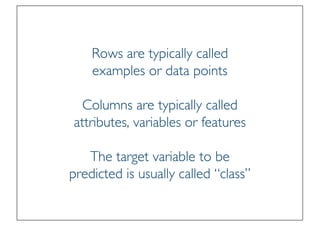
Rows are typically called
examples or data points
Columns are typically called
attributes, variables or features
The target variable to be
predicted is usually called “class”
Prof. Pier Luca Lanzi
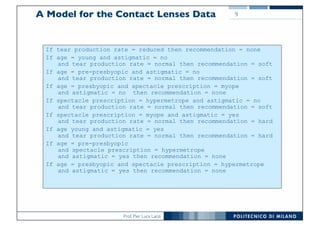
A Model for the Contact Lenses Data 9
If tear production rate = reduced then recommendation = none
If age = young and astigmatic = no
and tear production rate = normal then recommendation = soft
If age = pre-presbyopic and astigmatic = no
and tear production rate = normal then recommendation = soft
If age = presbyopic and spectacle prescription = myope
and astigmatic = no then recommendation = none
If spectacle prescription = hypermetrope and astigmatic = no
and tear production rate = normal then recommendation = soft
If spectacle prescription = myope and astigmatic = yes
and tear production rate = normal then recommendation = hard
If age young and astigmatic = yes
and tear production rate = normal then recommendation = hard
If age = pre-presbyopic
and spectacle prescription = hypermetrope
and astigmatic = yes then recommendation = none
If age = presbyopic and spectacle prescription = hypermetrope
and astigmatic = yes then recommendation = none
Prof. Pier Luca Lanzi
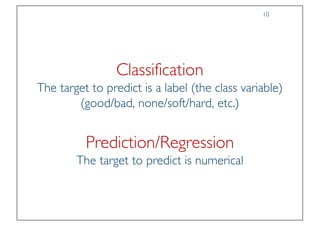
Classification
The target to predict is a label (the class variable)
(good/bad, none/soft/hard, etc.)
Prediction/Regression
The target to predict is numerical
10
Prof. Pier Luca Lanzi
classification = model building + model usage
Prof. Pier Luca Lanzi
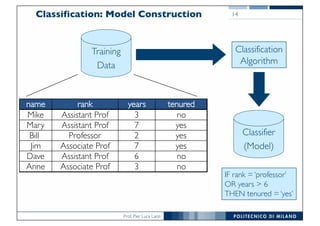
Classification: Model Construction 14
Classification
Algorithm
IF rank = ‘professor’
OR years > 6
THEN tenured = ‘yes’
name rank years tenured
Mike Assistant Prof 3 no
Mary Assistant Prof 7 yes
Bill Professor 2 yes
Jim Associate Prof 7 yes
Dave Assistant Prof 6 no
Anne Associate Prof 3 no
Training
Data
Classifier
(Model)
Prof. Pier Luca Lanzi
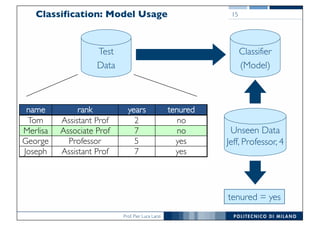
Classification: Model Usage 15
tenured = yes
name rank years tenured
Tom Assistant Prof 2 no
Merlisa Associate Prof 7 no
George Professor 5 yes
Joseph Assistant Prof 7 yes
Test
Data
Classifier
(Model)
Unseen Data
Jeff, Professor, 4
Prof. Pier Luca Lanzi
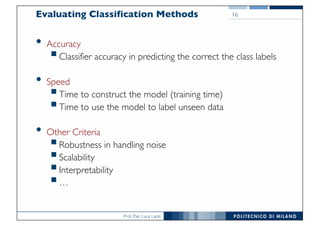
Evaluating Classification Methods
• Accuracy
§Classifier accuracy in predicting the correct the class labels
• Speed
§Time to construct the model (training time)
§Time to use the model to label unseen data
• Other Criteria
§Robustness in handling noise
§Scalability
§Interpretability
§…
16
Prof. Pier Luca Lanzi
Logistic Regression
20
Prof. Pier Luca Lanzi
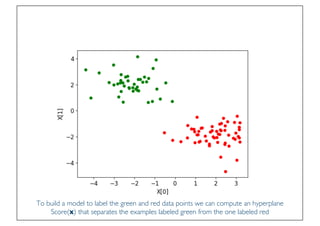
To build a model to label the green and red data points we can compute an hyperplane
Score(x) that separates the examples labeled green from the one labeled red
Prof. Pier Luca Lanzi
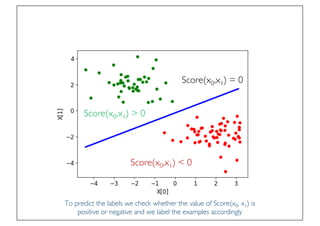
To predict the labels we check whether the value of Score(x0, x1) is
positive or negative and we label the examples accordingly
Score(x0,x1) = 0
Score(x0,x1) > 0
Score(x0,x1) < 0
Prof. Pier Luca Lanzi
Intuition Behind Linear Classifiers
(Two Classes)
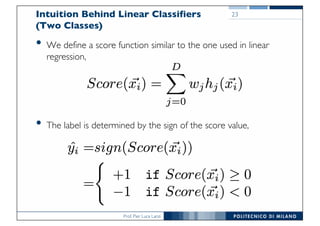
• We define a score function similar to the one used in linear
regression,
• The label is determined by the sign of the score value,
23
Prof. Pier Luca Lanzi
Logistic Regression
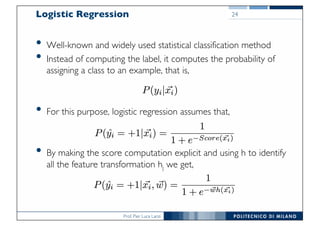
• Well-known and widely used statistical classification method
• Instead of computing the label, it computes the probability of
assigning a class to an example, that is,
• For this purpose, logistic regression assumes that,
• By making the score computation explicit and using h to identify
all the feature transformation hj we get,
24
Prof. Pier Luca Lanzi
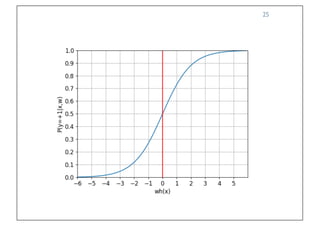
25
Prof. Pier Luca Lanzi
Logistic Regression
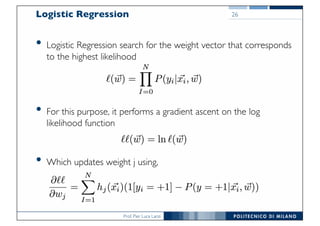
• Logistic Regression search for the weight vector that corresponds
to the highest likelihood
• For this purpose, it performs a gradient ascent on the log
likelihood function
• Which updates weight j using,
26
Prof. Pier Luca Lanzi
Classification using Logistic
Regression
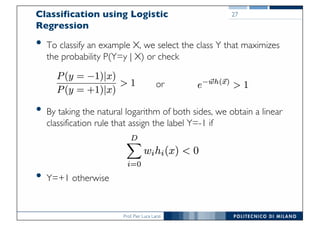
• To classify an example X, we select the class Y that maximizes
the probability P(Y=y | X) or check
or
• By taking the natural logarithm of both sides, we obtain a linear
classification rule that assign the label Y=-1 if
• Y=+1 otherwise
27
Prof. Pier Luca Lanzi
Overfitting & Regularization
28
Prof. Pier Luca Lanzi
L1 & L2 Regularization
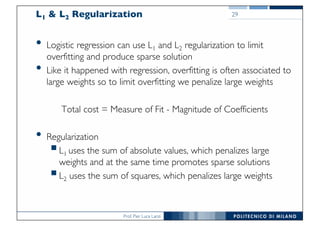
• Logistic regression can use L1 and L2 regularization to limit
overfitting and produce sparse solution
• Like it happened with regression, overfitting is often associated to
large weights so to limit overfitting we penalize large weights
Total cost = Measure of Fit - Magnitude of Coefficients
• Regularization
§L1 uses the sum of absolute values, which penalizes large
weights and at the same time promotes sparse solutions
§L2 uses the sum of squares, which penalizes large weights
29
Prof. Pier Luca Lanzi
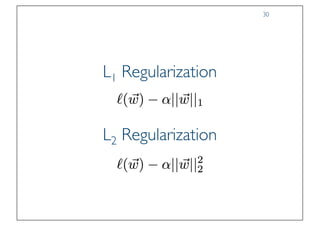
L1 Regularization
L2 Regularization
30
Prof. Pier Luca Lanzi
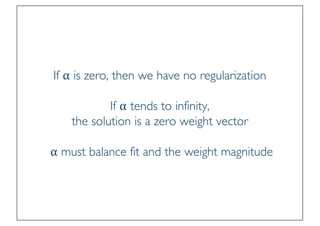
If ⍺ is zero, then we have no regularization
If ⍺ tends to infinity,
the solution is a zero weight vector
⍺ must balance fit and the weight magnitude
Prof. Pier Luca Lanzi
Example
32
Prof. Pier Luca Lanzi
Run the Logistic Regression Python
notebooks provided on Beep
Prof. Pier Luca Lanzi
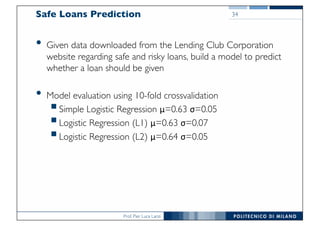
Safe Loans Prediction
• Given data downloaded from the Lending Club Corporation
website regarding safe and risky loans, build a model to predict
whether a loan should be given
• Model evaluation using 10-fold crossvalidation
§Simple Logistic Regression μ=0.63 σ=0.05
§Logistic Regression (L1) μ=0.63 σ=0.07
§Logistic Regression (L2) μ=0.64 σ=0.05
34
Prof. Pier Luca Lanzi
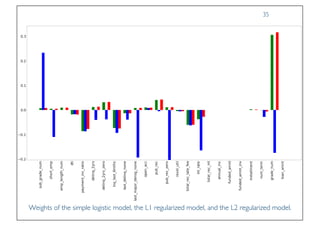
Weights of the simple logistic model, the L1 regularized model, and the L2 regularized model.
35
Prof. Pier Luca Lanzi
From now on we are going to use k-fold
crossvalidation a lot to score models
k-fold crossvalidation generates
k separate models
Which one should be deployed?
Prof. Pier Luca Lanzi
K-fold crossvalidation provides an evaluation
of model performance on unknown data
Its output it’s the evaluation, not the model!
The model should be obtained by running
the algorithm on the entire dataset!
Prof. Pier Luca Lanzi
Multiclass Classification
38
Prof. Pier Luca Lanzi
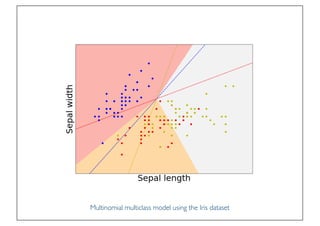
Logistic regression assumes that
there are only two class values (e.g., +1/-1)
What if we have more?
(e.g., none, soft, hard or Setosa/Versicolour/Virginica)
39
Prof. Pier Luca Lanzi
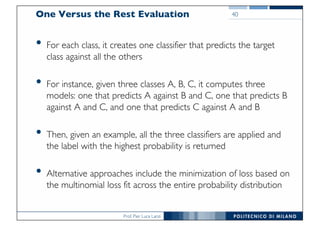
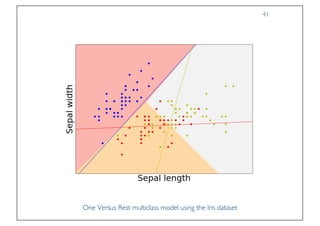
One Versus the Rest Evaluation
• For each class, it creates one classifier that predicts the target
class against all the others
• For instance, given three classes A, B, C, it computes three
models: one that predicts A against B and C, one that predicts B
against A and C, and one that predicts C against A and B
• Then, given an example, all the three classifiers are applied and
the label with the highest probability is returned
• Alternative approaches include the minimization of loss based on
the multinomial loss fit across the entire probability distribution
40
Prof. Pier Luca Lanzi
One Versus Rest multiclass model using the Iris dataset
41
Prof. Pier Luca Lanzi
Multinomial multiclass model using the Iris dataset
Prof. Pier Luca Lanzi
Run the Logistic Regression Python notebooks
on multiclass classification available on Beep
Prof. Pier Luca Lanzi
Categorical Attributes
44
Prof. Pier Luca Lanzi
So far we applied Logistic Regression
(and regression) to numerical variables
What if the variables are categorical?
Prof. Pier Luca Lanzi
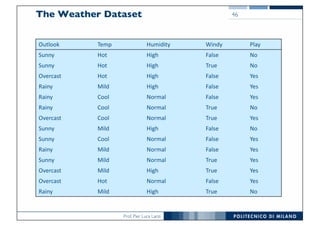
The Weather Dataset
Outlook Temp Humidity Windy Play
Sunny Hot High False No
Sunny Hot	 High	 True No
Overcast	 Hot		 High False Yes
Rainy Mild High False Yes
Rainy Cool Normal False Yes
Rainy Cool Normal True No
Overcast Cool Normal True Yes
Sunny Mild High False No
Sunny Cool Normal False Yes
Rainy Mild Normal False Yes
Sunny Mild Normal True Yes
Overcast Mild High True Yes
Overcast Hot Normal False Yes
Rainy Mild High True No
46
Prof. Pier Luca Lanzi
One Hot Encoding
Map each categorical attribute with
n values into n binary 0/1 variables
Each one describing one
specific attribute values
For example, attribute Outlook is replaced by three
binary variables Sunny, Overcast, and Rainy
Prof. Pier Luca Lanzi
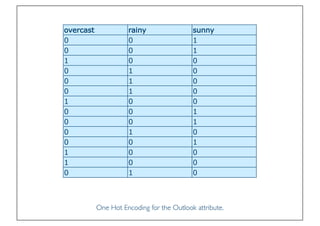
One Hot Encoding for the Outlook attribute.
overcast rainy sunny
0 0 1
0 0 1
1 0 0
0 1 0
0 1 0
0 1 0
1 0 0
0 0 1
0 0 1
0 1 0
0 0 1
1 0 0
1 0 0
0 1 0
Prof. Pier Luca Lanzi
Run the Logistic Regression Python notebooks
on one hot encoding available on Beep
Prof. Pier Luca Lanzi
Summary
50
Prof. Pier Luca Lanzi
Classification
• The goal of classification is to build a model of a target concept (the class
attribute) available in the data
• The target concept is typically a symbolic label (good/bad, yes/no,
none/soft/hard, etc.)
• Linear classifiers are one of the simplest of classification algorithm that
computes a model represented as a hyperplane that separates examples of the
two classes
• Logistic regression is a classification algorithm that computes the probability to
classify an example with a certain label
• It works similarly to linear regression and can be coupled with L1 and L2
regularization to limit overfitting
• It assumes that the class has only two values but it can be extended to
problems involving more than two classes
• Like linear regression it assumes that the variables are numerical, if they are
not, categorical variables must be mapped into numerical values
• One of the typical approaches is to use one-hot-encoding
51

DMTM Lecture 04 Classification

  • 1.
    Prof. Pier LucaLanzi Classification Data Mining andText Mining (UIC 583 @ Politecnico di Milano)
  • 2.
    Prof. Pier LucaLanzi In classification, we have data that have been labeled according to a certain concept (good/bad, positive/negative, etc.) identified by a supervisor who actually labeled the data
  • 3.
    Prof. Pier LucaLanzi The goal of classification is to compute a model that can discriminate between examples that have been labeled differently, e.g., the points above the planes are green and the one below are red
  • 4.
    Prof. Pier LucaLanzi The model is then used to label previously unseen points. ? ? ? ?
  • 5.
    Prof. Pier LucaLanzi As for regression, we have to compute a model using known data that will perform well on unknown data.
  • 6.
  • 7.
    Prof. Pier LucaLanzi Contact Lenses Data 7 NoneReducedYesHypermetropePre-presbyopic NoneNormalYesHypermetropePre-presbyopic NoneReducedNoMyopePresbyopic NoneNormalNoMyopePresbyopic NoneReducedYesMyopePresbyopic HardNormalYesMyopePresbyopic NoneReducedNoHypermetropePresbyopic SoftNormalNoHypermetropePresbyopic NoneReducedYesHypermetropePresbyopic NoneNormalYesHypermetropePresbyopic SoftNormalNoHypermetropePre-presbyopic NoneReducedNoHypermetropePre-presbyopic HardNormalYesMyopePre-presbyopic NoneReducedYesMyopePre-presbyopic SoftNormalNoMyopePre-presbyopic NoneReducedNoMyopePre-presbyopic hardNormalYesHypermetropeYoung NoneReducedYesHypermetropeYoung SoftNormalNoHypermetropeYoung NoneReducedNoHypermetropeYoung HardNormalYesMyopeYoung NoneReducedYesMyopeYoung SoftNormalNoMyopeYoung NoneReducedNoMyopeYoung Recommended lensesTear production rateAstigmatismSpectacle prescriptionAge
  • 8.
    Prof. Pier LucaLanzi Rows are typically called examples or data points Columns are typically called attributes, variables or features The target variable to be predicted is usually called “class”
  • 9.
    Prof. Pier LucaLanzi A Model for the Contact Lenses Data 9 If tear production rate = reduced then recommendation = none If age = young and astigmatic = no and tear production rate = normal then recommendation = soft If age = pre-presbyopic and astigmatic = no and tear production rate = normal then recommendation = soft If age = presbyopic and spectacle prescription = myope and astigmatic = no then recommendation = none If spectacle prescription = hypermetrope and astigmatic = no and tear production rate = normal then recommendation = soft If spectacle prescription = myope and astigmatic = yes and tear production rate = normal then recommendation = hard If age young and astigmatic = yes and tear production rate = normal then recommendation = hard If age = pre-presbyopic and spectacle prescription = hypermetrope and astigmatic = yes then recommendation = none If age = presbyopic and spectacle prescription = hypermetrope and astigmatic = yes then recommendation = none
  • 10.
    Prof. Pier LucaLanzi Classification The target to predict is a label (the class variable) (good/bad, none/soft/hard, etc.) Prediction/Regression The target to predict is numerical 10
  • 11.
    Prof. Pier LucaLanzi classification = model building + model usage
  • 12.
    Prof. Pier LucaLanzi Classification: Model Construction 14 Classification Algorithm IF rank = ‘professor’ OR years > 6 THEN tenured = ‘yes’ name rank years tenured Mike Assistant Prof 3 no Mary Assistant Prof 7 yes Bill Professor 2 yes Jim Associate Prof 7 yes Dave Assistant Prof 6 no Anne Associate Prof 3 no Training Data Classifier (Model)
  • 13.
    Prof. Pier LucaLanzi Classification: Model Usage 15 tenured = yes name rank years tenured Tom Assistant Prof 2 no Merlisa Associate Prof 7 no George Professor 5 yes Joseph Assistant Prof 7 yes Test Data Classifier (Model) Unseen Data Jeff, Professor, 4
  • 14.
    Prof. Pier LucaLanzi Evaluating Classification Methods • Accuracy §Classifier accuracy in predicting the correct the class labels • Speed §Time to construct the model (training time) §Time to use the model to label unseen data • Other Criteria §Robustness in handling noise §Scalability §Interpretability §… 16
  • 15.
    Prof. Pier LucaLanzi Logistic Regression 20
  • 16.
    Prof. Pier LucaLanzi To build a model to label the green and red data points we can compute an hyperplane Score(x) that separates the examples labeled green from the one labeled red
  • 17.
    Prof. Pier LucaLanzi To predict the labels we check whether the value of Score(x0, x1) is positive or negative and we label the examples accordingly Score(x0,x1) = 0 Score(x0,x1) > 0 Score(x0,x1) < 0
  • 18.
    Prof. Pier LucaLanzi Intuition Behind Linear Classifiers (Two Classes) • We define a score function similar to the one used in linear regression, • The label is determined by the sign of the score value, 23
  • 19.
    Prof. Pier LucaLanzi Logistic Regression • Well-known and widely used statistical classification method • Instead of computing the label, it computes the probability of assigning a class to an example, that is, • For this purpose, logistic regression assumes that, • By making the score computation explicit and using h to identify all the feature transformation hj we get, 24
  • 20.
  • 21.
    Prof. Pier LucaLanzi Logistic Regression • Logistic Regression search for the weight vector that corresponds to the highest likelihood • For this purpose, it performs a gradient ascent on the log likelihood function • Which updates weight j using, 26
  • 22.
    Prof. Pier LucaLanzi Classification using Logistic Regression • To classify an example X, we select the class Y that maximizes the probability P(Y=y | X) or check or • By taking the natural logarithm of both sides, we obtain a linear classification rule that assign the label Y=-1 if • Y=+1 otherwise 27
  • 23.
    Prof. Pier LucaLanzi Overfitting & Regularization 28
  • 24.
    Prof. Pier LucaLanzi L1 & L2 Regularization • Logistic regression can use L1 and L2 regularization to limit overfitting and produce sparse solution • Like it happened with regression, overfitting is often associated to large weights so to limit overfitting we penalize large weights Total cost = Measure of Fit - Magnitude of Coefficients • Regularization §L1 uses the sum of absolute values, which penalizes large weights and at the same time promotes sparse solutions §L2 uses the sum of squares, which penalizes large weights 29
  • 25.
    Prof. Pier LucaLanzi L1 Regularization L2 Regularization 30
  • 26.
    Prof. Pier LucaLanzi If ⍺ is zero, then we have no regularization If ⍺ tends to infinity, the solution is a zero weight vector ⍺ must balance fit and the weight magnitude
  • 27.
    Prof. Pier LucaLanzi Example 32
  • 28.
    Prof. Pier LucaLanzi Run the Logistic Regression Python notebooks provided on Beep
  • 29.
    Prof. Pier LucaLanzi Safe Loans Prediction • Given data downloaded from the Lending Club Corporation website regarding safe and risky loans, build a model to predict whether a loan should be given • Model evaluation using 10-fold crossvalidation §Simple Logistic Regression μ=0.63 σ=0.05 §Logistic Regression (L1) μ=0.63 σ=0.07 §Logistic Regression (L2) μ=0.64 σ=0.05 34
  • 30.
    Prof. Pier LucaLanzi Weights of the simple logistic model, the L1 regularized model, and the L2 regularized model. 35
  • 31.
    Prof. Pier LucaLanzi From now on we are going to use k-fold crossvalidation a lot to score models k-fold crossvalidation generates k separate models Which one should be deployed?
  • 32.
    Prof. Pier LucaLanzi K-fold crossvalidation provides an evaluation of model performance on unknown data Its output it’s the evaluation, not the model! The model should be obtained by running the algorithm on the entire dataset!
  • 33.
    Prof. Pier LucaLanzi Multiclass Classification 38
  • 34.
    Prof. Pier LucaLanzi Logistic regression assumes that there are only two class values (e.g., +1/-1) What if we have more? (e.g., none, soft, hard or Setosa/Versicolour/Virginica) 39
  • 35.
    Prof. Pier LucaLanzi One Versus the Rest Evaluation • For each class, it creates one classifier that predicts the target class against all the others • For instance, given three classes A, B, C, it computes three models: one that predicts A against B and C, one that predicts B against A and C, and one that predicts C against A and B • Then, given an example, all the three classifiers are applied and the label with the highest probability is returned • Alternative approaches include the minimization of loss based on the multinomial loss fit across the entire probability distribution 40
  • 36.
    Prof. Pier LucaLanzi One Versus Rest multiclass model using the Iris dataset 41
  • 37.
    Prof. Pier LucaLanzi Multinomial multiclass model using the Iris dataset
  • 38.
    Prof. Pier LucaLanzi Run the Logistic Regression Python notebooks on multiclass classification available on Beep
  • 39.
    Prof. Pier LucaLanzi Categorical Attributes 44
  • 40.
    Prof. Pier LucaLanzi So far we applied Logistic Regression (and regression) to numerical variables What if the variables are categorical?
  • 41.
    Prof. Pier LucaLanzi The Weather Dataset Outlook Temp Humidity Windy Play Sunny Hot High False No Sunny Hot High True No Overcast Hot High False Yes Rainy Mild High False Yes Rainy Cool Normal False Yes Rainy Cool Normal True No Overcast Cool Normal True Yes Sunny Mild High False No Sunny Cool Normal False Yes Rainy Mild Normal False Yes Sunny Mild Normal True Yes Overcast Mild High True Yes Overcast Hot Normal False Yes Rainy Mild High True No 46
  • 42.
    Prof. Pier LucaLanzi One Hot Encoding Map each categorical attribute with n values into n binary 0/1 variables Each one describing one specific attribute values For example, attribute Outlook is replaced by three binary variables Sunny, Overcast, and Rainy
  • 43.
    Prof. Pier LucaLanzi One Hot Encoding for the Outlook attribute. overcast rainy sunny 0 0 1 0 0 1 1 0 0 0 1 0 0 1 0 0 1 0 1 0 0 0 0 1 0 0 1 0 1 0 0 0 1 1 0 0 1 0 0 0 1 0
  • 44.
    Prof. Pier LucaLanzi Run the Logistic Regression Python notebooks on one hot encoding available on Beep
  • 45.
    Prof. Pier LucaLanzi Summary 50
  • 46.
    Prof. Pier LucaLanzi Classification • The goal of classification is to build a model of a target concept (the class attribute) available in the data • The target concept is typically a symbolic label (good/bad, yes/no, none/soft/hard, etc.) • Linear classifiers are one of the simplest of classification algorithm that computes a model represented as a hyperplane that separates examples of the two classes • Logistic regression is a classification algorithm that computes the probability to classify an example with a certain label • It works similarly to linear regression and can be coupled with L1 and L2 regularization to limit overfitting • It assumes that the class has only two values but it can be extended to problems involving more than two classes • Like linear regression it assumes that the variables are numerical, if they are not, categorical variables must be mapped into numerical values • One of the typical approaches is to use one-hot-encoding 51