Prof. Pier Luca Lanzi
Ensemble Classifiers
Data Mining andText Mining (UIC 583 @ Politecnico di Milano)
Prof. Pier Luca Lanzi
Syllabus
• “The Elements of Statistical Learning: Data Mining, Inference, and
Prediction,” Second Edition, February 2009, Trevor Hastie,
Robert Tibshirani, Jerome Friedman
(http://statweb.stanford.edu/~tibs/ElemStatLearn/)
§Section 8.7
§Chapter 10
§Chapter 15
§Chapter 16
• Scikit-Learn
§http://scikit-learn.org/stable/modules/ensemble.html
2
Prof. Pier Luca Lanzi
What are Ensemble Methods?
Prof. Pier Luca Lanzi
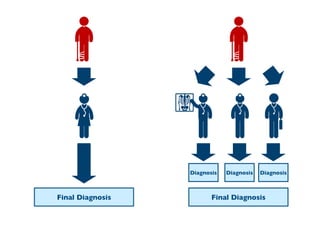
Diagnosis Diagnosis Diagnosis
Final DiagnosisFinal Diagnosis
Prof. Pier Luca Lanzi
Ensemble Methods
Generate a set of classifiers from the training data
Predict class label of previously unseen cases by
aggregating predictions made by multiple classifiers
Prof. Pier Luca Lanzi
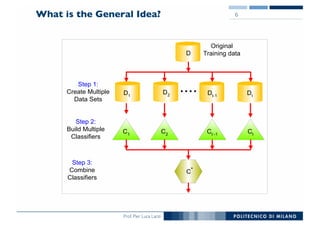
What is the General Idea?
Original
Training data
....D1
D2 Dt-1 Dt
D
Step 1:
Create Multiple
Data Sets
C1 C2 Ct -1 Ct
Step 2:
Build Multiple
Classifiers
C*
Step 3:
Combine
Classifiers
6
Prof. Pier Luca Lanzi
Building models ensembles
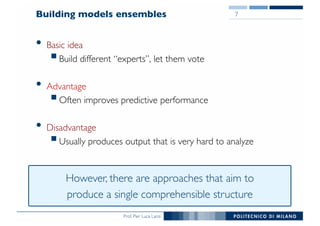
• Basic idea
§Build different “experts”, let them vote
• Advantage
§Often improves predictive performance
• Disadvantage
§Usually produces output that is very hard to analyze
7
However, there are approaches that aim to
produce a single comprehensible structure
Prof. Pier Luca Lanzi
Why does it work?
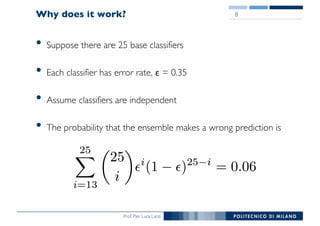
• Suppose there are 25 base classifiers
• Each classifier has error rate, ε = 0.35
• Assume classifiers are independent
• The probability that the ensemble makes a wrong prediction is
8
Prof. Pier Luca Lanzi
how can we generate several models using
the same data and the same approach (e.g.,Trees)?
Prof. Pier Luca Lanzi
we might …
randomize the selection of training data?
randomize the approach?
…
Prof. Pier Luca Lanzi
Bagging
Prof. Pier Luca Lanzi
What is Bagging?
(Bootstrap Aggregation)
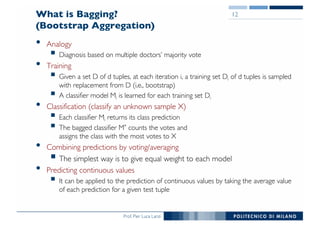
• Analogy
§ Diagnosis based on multiple doctors’ majority vote
• Training
§ Given a set D of d tuples, at each iteration i, a training set Di of d tuples is sampled
with replacement from D (i.e., bootstrap)
§ A classifier model Mi is learned for each training set Di
• Classification (classify an unknown sample X)
§ Each classifier Mi returns its class prediction
§ The bagged classifier M* counts the votes and
assigns the class with the most votes to X
• Combining predictions by voting/averaging
§ The simplest way is to give equal weight to each model
• Predicting continuous values
§ It can be applied to the prediction of continuous values by taking the average value
of each prediction for a given test tuple
12
Prof. Pier Luca Lanzi
Bagging Algorithm 13
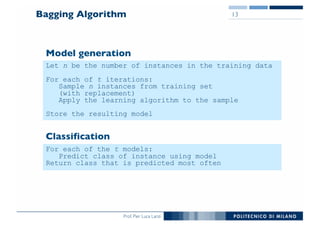
Let n be the number of instances in the training data
For each of t iterations:
Sample n instances from training set
(with replacement)
Apply the learning algorithm to the sample
Store the resulting model
For each of the t models:
Predict class of instance using model
Return class that is predicted most often
Model generation
Classification
Prof. Pier Luca Lanzi
Bagging works because it reduces
variance by voting/averaging
usually, the more classifiers the better
it can help a lot if data are noisy
however, in some pathological hypothetical
situations the overall error might increase
Prof. Pier Luca Lanzi
When Does Bagging Work?
Stable vs Unstable Classifiers
• A learning algorithm is unstable, if small changes to the training
set cause large changes in the learned classifier
• If the learning algorithm is unstable, then
bagging almost always improves performance
• Bagging stable classifiers is not a good idea
• Decision trees, regression trees, linear regression, neural networks
are examples of unstable classifiers
• K-nearest neighbors is a stable classifier
15
Prof. Pier Luca Lanzi
Randomize the Algorithm?
• We could randomize the learning algorithm instead of the data
• Some algorithms already have a random component,
e.g. initial weights in neural net
• Most algorithms can be randomized (e.g., attribute selection in
decision trees)
• More generally applicable than bagging, e.g. random subsets in
nearest-neighbor scheme
• It can be combined with bagging
16
Prof. Pier Luca Lanzi
the more uncorrelated the trees,
the better the variance reduction
Prof. Pier Luca Lanzi
Random ForestsRandom Forests
Prof. Pier Luca Lanzi
learning ensemble consisting of a bagging
of unpruned decision tree learners with
randomized selection of features at each split
Prof. Pier Luca Lanzi
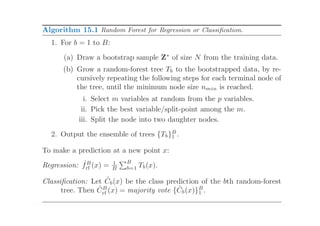
What is a Random Forest?
• Random forests (RF) are a combination of tree predictors
• Each tree depends on the values of a random vector sampled
independently and with the same distribution for all trees in the
forest
• The generalization error of a forest of tree classifiers depends on
the strength of the individual trees in the forest and the
correlation between them
• Using a random selection of features to split each node yields
error rates that compare favorably to Adaboost, and are more
robust with respect to noise
20
Prof. Pier Luca Lanzi
How do Random Forests Work?
• D = training set F = set of variables to test for split
• k = number of trees in forest n = number of variables
• for i = 1 to k do
§ build data set Di by sampling with replacement from D
§ learn tree Ti from Di using at each node only a subset F of the n variables
§ save tree Ti as it is, do not perform any pruning
• Output is computed as the majority voting (for classification) or average (for
prediction) of the set of k generated trees
21
Prof. Pier Luca Lanzi
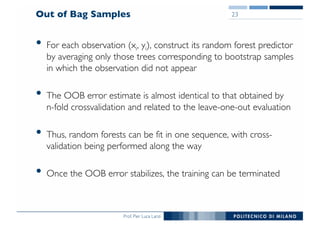
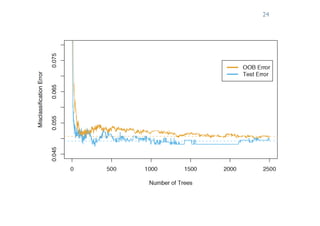
Out of Bag Samples
• For each observation (xi, yi), construct its random forest predictor
by averaging only those trees corresponding to bootstrap samples
in which the observation did not appear
• The OOB error estimate is almost identical to that obtained by
n-fold crossvalidation and related to the leave-one-out evaluation
• Thus, random forests can be fit in one sequence, with cross-
validation being performed along the way
• Once the OOB error stabilizes, the training can be terminated
23
Prof. Pier Luca Lanzi
24
Prof. Pier Luca Lanzi
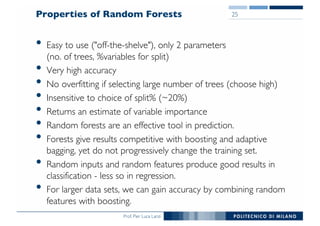
Properties of Random Forests
• Easy to use ("off-the-shelve"), only 2 parameters
(no. of trees, %variables for split)
• Very high accuracy
• No overfitting if selecting large number of trees (choose high)
• Insensitive to choice of split% (~20%)
• Returns an estimate of variable importance
• Random forests are an effective tool in prediction.
• Forests give results competitive with boosting and adaptive
bagging, yet do not progressively change the training set.
• Random inputs and random features produce good results in
classification - less so in regression.
• For larger data sets, we can gain accuracy by combining random
features with boosting.
25
Prof. Pier Luca Lanzi
Boosting
26
Prof. Pier Luca Lanzi
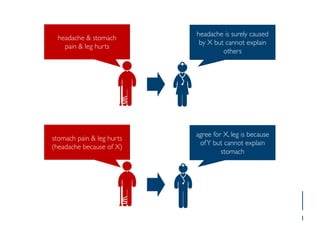
Diagn
stomach pain & leg hurts
(headache because of X)
agree for X, leg is because
ofY but cannot explain
stomach
headache & stomach
pain & leg hurts
headache is surely caused
by X but cannot explain
others
Prof. Pier Luca Lanzi
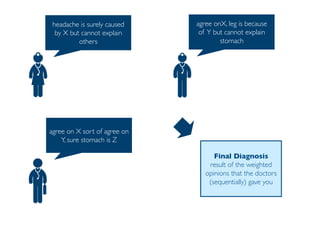
headache is surely caused
by X but cannot explain
others
agree onX, leg is because
of Y but cannot explain
stomach
agree on X sort of agree on
Y, sure stomach is Z
Final Diagnosis
result of the weighted
opinions that the doctors
(sequentially) gave you
Prof. Pier Luca Lanzi
AdaBoost
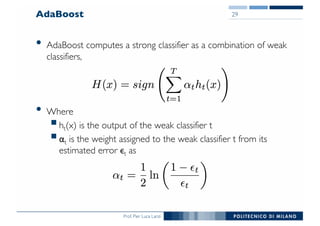
• AdaBoost computes a strong classifier as a combination of weak
classifiers,
• Where
§ht(x) is the output of the weak classifier t
§αt is the weight assigned to the weak classifier t from its
estimated error ϵt as
29
Prof. Pier Luca Lanzi
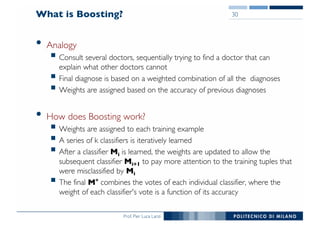
What is Boosting?
• Analogy
§ Consult several doctors, sequentially trying to find a doctor that can
explain what other doctors cannot
§ Final diagnose is based on a weighted combination of all the diagnoses
§ Weights are assigned based on the accuracy of previous diagnoses
• How does Boosting work?
§ Weights are assigned to each training example
§ A series of k classifiers is iteratively learned
§ After a classifier Mi is learned, the weights are updated to allow the
subsequent classifier Mi+1 to pay more attention to the training tuples that
were misclassified by Mi
§ The final M* combines the votes of each individual classifier, where the
weight of each classifier's vote is a function of its accuracy
30
Prof. Pier Luca Lanzi
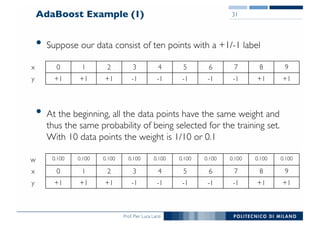
AdaBoost Example (1)
• Suppose our data consist of ten points with a +1/-1 label
• At the beginning, all the data points have the same weight and
thus the same probability of being selected for the training set.
With 10 data points the weight is 1/10 or 0.1
31
w 0.100 0.100 0.100 0.100 0.100 0.100 0.100 0.100 0.100 0.100
x 0 1 2 3 4 5 6 7 8 9
y +1 +1 +1 -1 -1 -1 -1 -1 +1 +1
x 0 1 2 3 4 5 6 7 8 9
y +1 +1 +1 -1 -1 -1 -1 -1 +1 +1
Prof. Pier Luca Lanzi
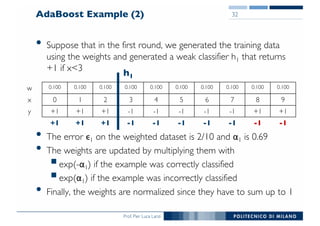
AdaBoost Example (2)
• Suppose that in the first round, we generated the training data
using the weights and generated a weak classifier h1 that returns
+1 if x<3
• The error ϵ1 on the weighted dataset is 2/10 and α1 is 0.69
• The weights are updated by multiplying them with
§exp(-α1) if the example was correctly classified
§exp(α1) if the example was incorrectly classified
• Finally, the weights are normalized since they have to sum up to 1
32
w 0.100 0.100 0.100 0.100 0.100 0.100 0.100 0.100 0.100 0.100
x 0 1 2 3 4 5 6 7 8 9
y +1 +1 +1 -1 -1 -1 -1 -1 +1 +1
+1 +1 +1 -1 -1 -1 -1 -1 -1 -1
h1
Prof. Pier Luca Lanzi
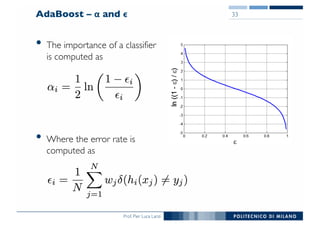
AdaBoost – α and ϵ
• The importance of a classifier
is computed as
• Where the error rate is
computed as
33
Prof. Pier Luca Lanzi
AdaBoost Example (3)
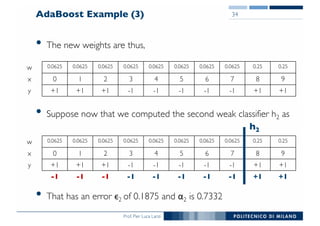
• The new weights are thus,
• Suppose now that we computed the second weak classifier h2 as
• That has an error ϵ2 of 0.1875 and α2 is 0.7332
34
w 0.0625 0.0625 0.0625 0.0625 0.0625 0.0625 0.0625 0.0625 0.25 0.25
x 0 1 2 3 4 5 6 7 8 9
y +1 +1 +1 -1 -1 -1 -1 -1 +1 +1
w 0.0625 0.0625 0.0625 0.0625 0.0625 0.0625 0.0625 0.0625 0.25 0.25
x 0 1 2 3 4 5 6 7 8 9
y +1 +1 +1 -1 -1 -1 -1 -1 +1 +1
-1 -1 -1 -1 -1 -1 -1 -1 +1 +1
h2
Prof. Pier Luca Lanzi
AdaBoost Example (4)
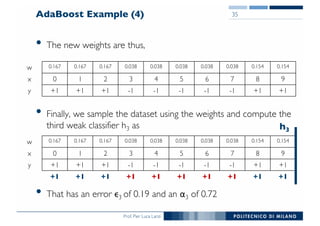
• The new weights are thus,
• Finally, we sample the dataset using the weights and compute the
third weak classifier h3 as
• That has an error ϵ3 of 0.19 and an α3 of 0.72
35
w 0.167 0.167 0.167 0.038 0.038 0.038 0.038 0.038 0.154 0.154
x 0 1 2 3 4 5 6 7 8 9
y +1 +1 +1 -1 -1 -1 -1 -1 +1 +1
w 0.167 0.167 0.167 0.038 0.038 0.038 0.038 0.038 0.154 0.154
x 0 1 2 3 4 5 6 7 8 9
y +1 +1 +1 -1 -1 -1 -1 -1 +1 +1
+1 +1 +1 +1 +1 +1 +1 +1 +1 +1
h3
Prof. Pier Luca Lanzi
AdaBoost Example (5)
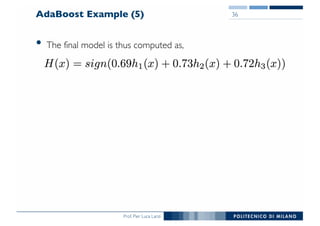
• The final model is thus computed as,
36
Prof. Pier Luca Lanzi
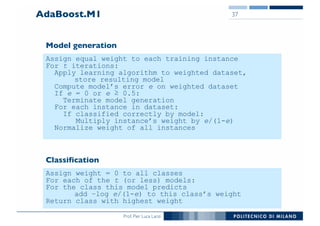
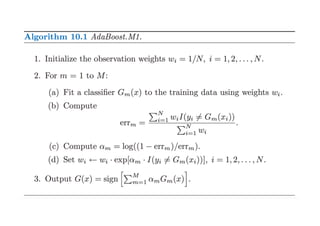
AdaBoost.M1 37
Assign equal weight to each training instance
For t iterations:
Apply learning algorithm to weighted dataset,
store resulting model
Compute model’s error e on weighted dataset
If e = 0 or e ≥ 0.5:
Terminate model generation
For each instance in dataset:
If classified correctly by model:
Multiply instance’s weight by e/(1-e)
Normalize weight of all instances
Model generation
Assign weight = 0 to all classes
For each of the t (or less) models:
For the class this model predicts
add –log e/(1-e) to this class’s weight
Return class with highest weight
Classification
Prof. Pier Luca Lanzi
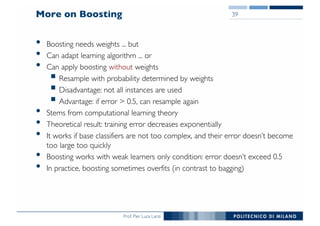
More on Boosting
• Boosting needs weights ... but
• Can adapt learning algorithm ... or
• Can apply boosting without weights
§ Resample with probability determined by weights
§ Disadvantage: not all instances are used
§ Advantage: if error > 0.5, can resample again
• Stems from computational learning theory
• Theoretical result: training error decreases exponentially
• It works if base classifiers are not too complex, and their error doesn’t become
too large too quickly
• Boosting works with weak learners only condition: error doesn’t exceed 0.5
• In practice, boosting sometimes overfits (in contrast to bagging)
39
Prof. Pier Luca Lanzi
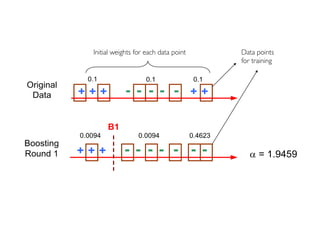
Boosting
Round 1 + + + -- - - - - -
0.0094 0.0094 0.4623
B1
a = 1.9459
Data points
for training
Initial weights for each data point
Original
Data + + + -- - - - + +
0.1 0.1 0.1
Prof. Pier Luca Lanzi
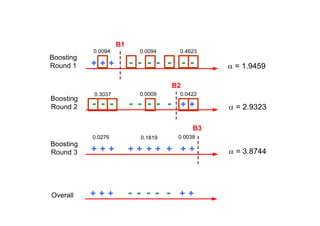
Boosting
Round 1 + + + -- - - - - -
Boosting
Round 2 - - - -- - - - + +
Boosting
Round 3 + + + ++ + + + + +
Overall + + + -- - - - + +
0.0094 0.0094 0.4623
0.3037 0.0009 0.0422
0.0276 0.1819 0.0038
B1
B2
B3
a = 1.9459
a = 2.9323
a = 3.8744
Prof. Pier Luca Lanzi
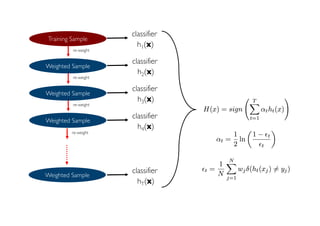
Training Sample
classifier
h1(x)
Weighted Sample
re-weight
classifier
h2(x)
Weighted Sample
re-weight
classifier
h3(x)
Weighted Sample
re-weight
Weighted Sample
re-weight
classifier
h4(x)
classifier
hT(x)
Prof. Pier Luca Lanzi
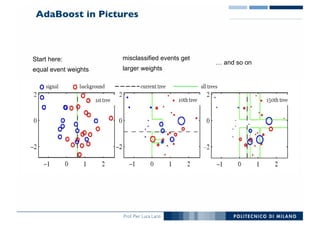
AdaBoost in Pictures
Start here:
equal event weights
misclassified events get
larger weights
… and so on
Prof. Pier Luca Lanzi
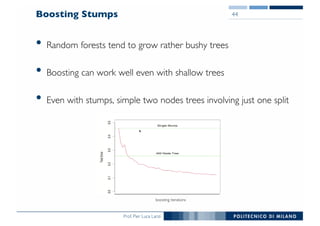
Boosting Stumps
• Random forests tend to grow rather bushy trees
• Boosting can work well even with shallow trees
• Even with stumps, simple two nodes trees involving just one split
44
boosting iterations
Prof. Pier Luca Lanzi
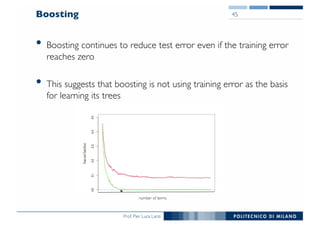
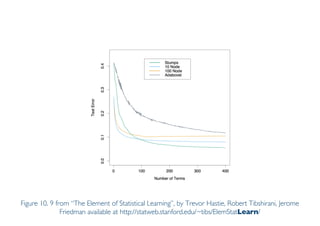
Boosting
• Boosting continues to reduce test error even if the training error
reaches zero
• This suggests that boosting is not using training error as the basis
for learning its trees
45
number of terms
Prof. Pier Luca Lanzi
Boosting
• Also uses voting/averaging
• Weights models according to performance
• Iterative: new models are influenced
by the performance of previously built ones
§Encourage new model to become an “expert” for instances
misclassified by earlier models
§Intuitive justification: models should be experts that
complement each other
• Several variants
§Boosting by sampling,
the weights are used to sample the data for training
§Boosting by weighting,
the weights are used by the learning algorithm
46
Prof. Pier Luca Lanzi
General Boosting Algorithms
47
Prof. Pier Luca Lanzi
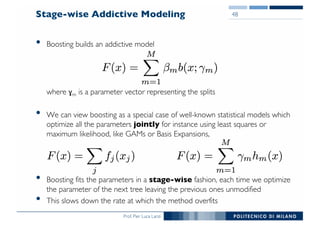
Stage-wise Addictive Modeling
• Boosting builds an addictive model
where ɣm is a parameter vector representing the splits
• We can view boosting as a special case of well-known statistical models which
optimize all the parameters jointly for instance using least squares or
maximum likelihood, like GAMs or Basis Expansions,
• Boosting fits the parameters in a stage-wise fashion, each time we optimize
the parameter of the next tree leaving the previous ones unmodified
• This slows down the rate at which the method overfits
48
Prof. Pier Luca Lanzi
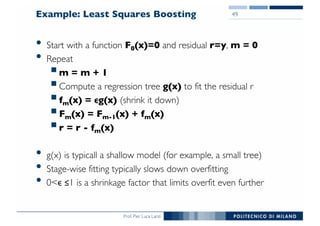
Example: Least Squares Boosting
• Start with a function F0(x)=0 and residual r=y, m = 0
• Repeat
§m = m + 1
§Compute a regression tree g(x) to fit the residual r
§fm(x) = ϵg(x) (shrink it down)
§Fm(x) = Fm-1(x) + fm(x)
§r = r - fm(x)
• g(x) is typicall a shallow model (for example, a small tree)
• Stage-wise fitting typically slows down overfitting
• 0<ϵ ≤1 is a shrinkage factor that limits overfit even further
49
Prof. Pier Luca Lanzi
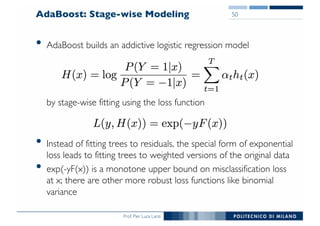
AdaBoost: Stage-wise Modeling
• AdaBoost builds an addictive logistic regression model
by stage-wise fitting using the loss function
• Instead of fitting trees to residuals, the special form of exponential
loss leads to fitting trees to weighted versions of the original data
• exp(-yF(x)) is a monotone upper bound on misclassification loss
at x; there are other more robust loss functions like binomial
variance
50
Prof. Pier Luca Lanzi
General Boosting Algorithms
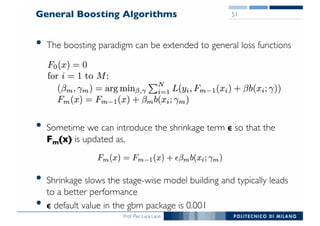
• The boosting paradigm can be extended to general loss functions
• Sometime we can introduce the shrinkage term ϵ so that the
Fm(x) is updated as,
• Shrinkage slows the stage-wise model building and typically leads
to a better performance
• ϵ default value in the gbm package is 0.001
51
Prof. Pier Luca Lanzi
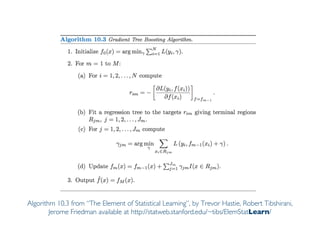
Gradient Tree Boosting
52
Prof. Pier Luca Lanzi
Gradient Boosting (Friedman, 2001)
• Extension of the general boosting algorithm that applies gradient
descent to minimize loss function during each step
• Inherits all the good features of trees (variable selection, missing
data, mixed predictors) and improves their predictive
performance
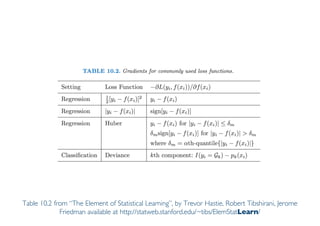
• Works with a variety of loss functions
• Tree size has an important role
53
Prof. Pier Luca Lanzi
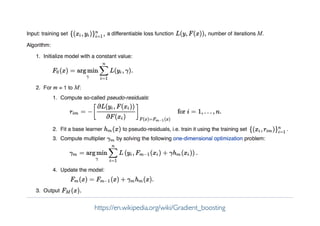
https://en.wikipedia.org/wiki/Gradient_boosting
Prof. Pier Luca Lanzi
Algorithm 10.3 from “The Element of Statistical Learning”, by Trevor Hastie, Robert Tibshirani,
Jerome Friedman available at http://statweb.stanford.edu/~tibs/ElemStatLearn/
Prof. Pier Luca Lanzi
Figure 10. 9 from “The Element of Statistical Learning”, by Trevor Hastie, Robert Tibshirani, Jerome
Friedman available at http://statweb.stanford.edu/~tibs/ElemStatLearn/
Prof. Pier Luca Lanzi
Table 10.2 from “The Element of Statistical Learning”, by Trevor Hastie, Robert Tibshirani, Jerome
Friedman available at http://statweb.stanford.edu/~tibs/ElemStatLearn/
Prof. Pier Luca Lanzi
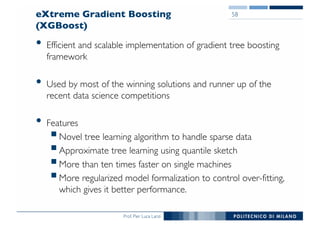
eXtreme Gradient Boosting
(XGBoost)
• Efficient and scalable implementation of gradient tree boosting
framework
• Used by most of the winning solutions and runner up of the
recent data science competitions
• Features
§Novel tree learning algorithm to handle sparse data
§Approximate tree learning using quantile sketch
§More than ten times faster on single machines
§More regularized model formalization to control over-fitting,
which gives it better performance.
58
Prof. Pier Luca Lanzi
Learning Ensembles
59
Prof. Pier Luca Lanzi
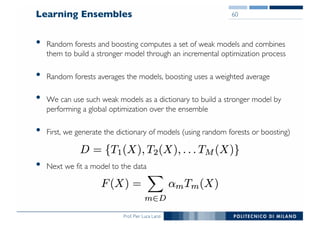
Learning Ensembles
• Random forests and boosting computes a set of weak models and combines
them to build a stronger model through an incremental optimization process
• Random forests averages the models, boosting uses a weighted average
• We can use such weak models as a dictionary to build a stronger model by
performing a global optimization over the ensemble
• First, we generate the dictionary of models (using random forests or boosting)
• Next we fit a model to the data
60
Prof. Pier Luca Lanzi
Stacked Generalization
(Stacking)
61
Prof. Pier Luca Lanzi
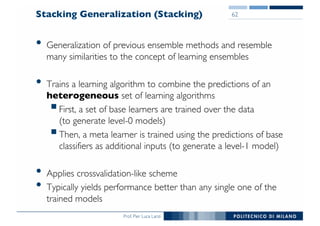
Stacking Generalization (Stacking)
• Generalization of previous ensemble methods and resemble
many similarities to the concept of learning ensembles
• Trains a learning algorithm to combine the predictions of an
heterogeneous set of learning algorithms
§First, a set of base learners are trained over the data
(to generate level-0 models)
§Then, a meta learner is trained using the predictions of base
classifiers as additional inputs (to generate a level-1 model)
• Applies crossvalidation-like scheme
• Typically yields performance better than any single one of the
trained models
62

DMTM Lecture 10 Classification ensembles

  • 1.
    Prof. Pier LucaLanzi Ensemble Classifiers Data Mining andText Mining (UIC 583 @ Politecnico di Milano)
  • 2.
    Prof. Pier LucaLanzi Syllabus • “The Elements of Statistical Learning: Data Mining, Inference, and Prediction,” Second Edition, February 2009, Trevor Hastie, Robert Tibshirani, Jerome Friedman (http://statweb.stanford.edu/~tibs/ElemStatLearn/) §Section 8.7 §Chapter 10 §Chapter 15 §Chapter 16 • Scikit-Learn §http://scikit-learn.org/stable/modules/ensemble.html 2
  • 3.
    Prof. Pier LucaLanzi What are Ensemble Methods?
  • 4.
    Prof. Pier LucaLanzi Diagnosis Diagnosis Diagnosis Final DiagnosisFinal Diagnosis
  • 5.
    Prof. Pier LucaLanzi Ensemble Methods Generate a set of classifiers from the training data Predict class label of previously unseen cases by aggregating predictions made by multiple classifiers
  • 6.
    Prof. Pier LucaLanzi What is the General Idea? Original Training data ....D1 D2 Dt-1 Dt D Step 1: Create Multiple Data Sets C1 C2 Ct -1 Ct Step 2: Build Multiple Classifiers C* Step 3: Combine Classifiers 6
  • 7.
    Prof. Pier LucaLanzi Building models ensembles • Basic idea §Build different “experts”, let them vote • Advantage §Often improves predictive performance • Disadvantage §Usually produces output that is very hard to analyze 7 However, there are approaches that aim to produce a single comprehensible structure
  • 8.
    Prof. Pier LucaLanzi Why does it work? • Suppose there are 25 base classifiers • Each classifier has error rate, ε = 0.35 • Assume classifiers are independent • The probability that the ensemble makes a wrong prediction is 8
  • 9.
    Prof. Pier LucaLanzi how can we generate several models using the same data and the same approach (e.g.,Trees)?
  • 10.
    Prof. Pier LucaLanzi we might … randomize the selection of training data? randomize the approach? …
  • 11.
    Prof. Pier LucaLanzi Bagging
  • 12.
    Prof. Pier LucaLanzi What is Bagging? (Bootstrap Aggregation) • Analogy § Diagnosis based on multiple doctors’ majority vote • Training § Given a set D of d tuples, at each iteration i, a training set Di of d tuples is sampled with replacement from D (i.e., bootstrap) § A classifier model Mi is learned for each training set Di • Classification (classify an unknown sample X) § Each classifier Mi returns its class prediction § The bagged classifier M* counts the votes and assigns the class with the most votes to X • Combining predictions by voting/averaging § The simplest way is to give equal weight to each model • Predicting continuous values § It can be applied to the prediction of continuous values by taking the average value of each prediction for a given test tuple 12
  • 13.
    Prof. Pier LucaLanzi Bagging Algorithm 13 Let n be the number of instances in the training data For each of t iterations: Sample n instances from training set (with replacement) Apply the learning algorithm to the sample Store the resulting model For each of the t models: Predict class of instance using model Return class that is predicted most often Model generation Classification
  • 14.
    Prof. Pier LucaLanzi Bagging works because it reduces variance by voting/averaging usually, the more classifiers the better it can help a lot if data are noisy however, in some pathological hypothetical situations the overall error might increase
  • 15.
    Prof. Pier LucaLanzi When Does Bagging Work? Stable vs Unstable Classifiers • A learning algorithm is unstable, if small changes to the training set cause large changes in the learned classifier • If the learning algorithm is unstable, then bagging almost always improves performance • Bagging stable classifiers is not a good idea • Decision trees, regression trees, linear regression, neural networks are examples of unstable classifiers • K-nearest neighbors is a stable classifier 15
  • 16.
    Prof. Pier LucaLanzi Randomize the Algorithm? • We could randomize the learning algorithm instead of the data • Some algorithms already have a random component, e.g. initial weights in neural net • Most algorithms can be randomized (e.g., attribute selection in decision trees) • More generally applicable than bagging, e.g. random subsets in nearest-neighbor scheme • It can be combined with bagging 16
  • 17.
    Prof. Pier LucaLanzi the more uncorrelated the trees, the better the variance reduction
  • 18.
    Prof. Pier LucaLanzi Random ForestsRandom Forests
  • 19.
    Prof. Pier LucaLanzi learning ensemble consisting of a bagging of unpruned decision tree learners with randomized selection of features at each split
  • 20.
    Prof. Pier LucaLanzi What is a Random Forest? • Random forests (RF) are a combination of tree predictors • Each tree depends on the values of a random vector sampled independently and with the same distribution for all trees in the forest • The generalization error of a forest of tree classifiers depends on the strength of the individual trees in the forest and the correlation between them • Using a random selection of features to split each node yields error rates that compare favorably to Adaboost, and are more robust with respect to noise 20
  • 21.
    Prof. Pier LucaLanzi How do Random Forests Work? • D = training set F = set of variables to test for split • k = number of trees in forest n = number of variables • for i = 1 to k do § build data set Di by sampling with replacement from D § learn tree Ti from Di using at each node only a subset F of the n variables § save tree Ti as it is, do not perform any pruning • Output is computed as the majority voting (for classification) or average (for prediction) of the set of k generated trees 21
  • 22.
  • 23.
    Prof. Pier LucaLanzi Out of Bag Samples • For each observation (xi, yi), construct its random forest predictor by averaging only those trees corresponding to bootstrap samples in which the observation did not appear • The OOB error estimate is almost identical to that obtained by n-fold crossvalidation and related to the leave-one-out evaluation • Thus, random forests can be fit in one sequence, with cross- validation being performed along the way • Once the OOB error stabilizes, the training can be terminated 23
  • 24.
  • 25.
    Prof. Pier LucaLanzi Properties of Random Forests • Easy to use ("off-the-shelve"), only 2 parameters (no. of trees, %variables for split) • Very high accuracy • No overfitting if selecting large number of trees (choose high) • Insensitive to choice of split% (~20%) • Returns an estimate of variable importance • Random forests are an effective tool in prediction. • Forests give results competitive with boosting and adaptive bagging, yet do not progressively change the training set. • Random inputs and random features produce good results in classification - less so in regression. • For larger data sets, we can gain accuracy by combining random features with boosting. 25
  • 26.
    Prof. Pier LucaLanzi Boosting 26
  • 27.
    Prof. Pier LucaLanzi Diagn stomach pain & leg hurts (headache because of X) agree for X, leg is because ofY but cannot explain stomach headache & stomach pain & leg hurts headache is surely caused by X but cannot explain others
  • 28.
    Prof. Pier LucaLanzi headache is surely caused by X but cannot explain others agree onX, leg is because of Y but cannot explain stomach agree on X sort of agree on Y, sure stomach is Z Final Diagnosis result of the weighted opinions that the doctors (sequentially) gave you
  • 29.
    Prof. Pier LucaLanzi AdaBoost • AdaBoost computes a strong classifier as a combination of weak classifiers, • Where §ht(x) is the output of the weak classifier t §αt is the weight assigned to the weak classifier t from its estimated error ϵt as 29
  • 30.
    Prof. Pier LucaLanzi What is Boosting? • Analogy § Consult several doctors, sequentially trying to find a doctor that can explain what other doctors cannot § Final diagnose is based on a weighted combination of all the diagnoses § Weights are assigned based on the accuracy of previous diagnoses • How does Boosting work? § Weights are assigned to each training example § A series of k classifiers is iteratively learned § After a classifier Mi is learned, the weights are updated to allow the subsequent classifier Mi+1 to pay more attention to the training tuples that were misclassified by Mi § The final M* combines the votes of each individual classifier, where the weight of each classifier's vote is a function of its accuracy 30
  • 31.
    Prof. Pier LucaLanzi AdaBoost Example (1) • Suppose our data consist of ten points with a +1/-1 label • At the beginning, all the data points have the same weight and thus the same probability of being selected for the training set. With 10 data points the weight is 1/10 or 0.1 31 w 0.100 0.100 0.100 0.100 0.100 0.100 0.100 0.100 0.100 0.100 x 0 1 2 3 4 5 6 7 8 9 y +1 +1 +1 -1 -1 -1 -1 -1 +1 +1 x 0 1 2 3 4 5 6 7 8 9 y +1 +1 +1 -1 -1 -1 -1 -1 +1 +1
  • 32.
    Prof. Pier LucaLanzi AdaBoost Example (2) • Suppose that in the first round, we generated the training data using the weights and generated a weak classifier h1 that returns +1 if x<3 • The error ϵ1 on the weighted dataset is 2/10 and α1 is 0.69 • The weights are updated by multiplying them with §exp(-α1) if the example was correctly classified §exp(α1) if the example was incorrectly classified • Finally, the weights are normalized since they have to sum up to 1 32 w 0.100 0.100 0.100 0.100 0.100 0.100 0.100 0.100 0.100 0.100 x 0 1 2 3 4 5 6 7 8 9 y +1 +1 +1 -1 -1 -1 -1 -1 +1 +1 +1 +1 +1 -1 -1 -1 -1 -1 -1 -1 h1
  • 33.
    Prof. Pier LucaLanzi AdaBoost – α and ϵ • The importance of a classifier is computed as • Where the error rate is computed as 33
  • 34.
    Prof. Pier LucaLanzi AdaBoost Example (3) • The new weights are thus, • Suppose now that we computed the second weak classifier h2 as • That has an error ϵ2 of 0.1875 and α2 is 0.7332 34 w 0.0625 0.0625 0.0625 0.0625 0.0625 0.0625 0.0625 0.0625 0.25 0.25 x 0 1 2 3 4 5 6 7 8 9 y +1 +1 +1 -1 -1 -1 -1 -1 +1 +1 w 0.0625 0.0625 0.0625 0.0625 0.0625 0.0625 0.0625 0.0625 0.25 0.25 x 0 1 2 3 4 5 6 7 8 9 y +1 +1 +1 -1 -1 -1 -1 -1 +1 +1 -1 -1 -1 -1 -1 -1 -1 -1 +1 +1 h2
  • 35.
    Prof. Pier LucaLanzi AdaBoost Example (4) • The new weights are thus, • Finally, we sample the dataset using the weights and compute the third weak classifier h3 as • That has an error ϵ3 of 0.19 and an α3 of 0.72 35 w 0.167 0.167 0.167 0.038 0.038 0.038 0.038 0.038 0.154 0.154 x 0 1 2 3 4 5 6 7 8 9 y +1 +1 +1 -1 -1 -1 -1 -1 +1 +1 w 0.167 0.167 0.167 0.038 0.038 0.038 0.038 0.038 0.154 0.154 x 0 1 2 3 4 5 6 7 8 9 y +1 +1 +1 -1 -1 -1 -1 -1 +1 +1 +1 +1 +1 +1 +1 +1 +1 +1 +1 +1 h3
  • 36.
    Prof. Pier LucaLanzi AdaBoost Example (5) • The final model is thus computed as, 36
  • 37.
    Prof. Pier LucaLanzi AdaBoost.M1 37 Assign equal weight to each training instance For t iterations: Apply learning algorithm to weighted dataset, store resulting model Compute model’s error e on weighted dataset If e = 0 or e ≥ 0.5: Terminate model generation For each instance in dataset: If classified correctly by model: Multiply instance’s weight by e/(1-e) Normalize weight of all instances Model generation Assign weight = 0 to all classes For each of the t (or less) models: For the class this model predicts add –log e/(1-e) to this class’s weight Return class with highest weight Classification
  • 38.
  • 39.
    Prof. Pier LucaLanzi More on Boosting • Boosting needs weights ... but • Can adapt learning algorithm ... or • Can apply boosting without weights § Resample with probability determined by weights § Disadvantage: not all instances are used § Advantage: if error > 0.5, can resample again • Stems from computational learning theory • Theoretical result: training error decreases exponentially • It works if base classifiers are not too complex, and their error doesn’t become too large too quickly • Boosting works with weak learners only condition: error doesn’t exceed 0.5 • In practice, boosting sometimes overfits (in contrast to bagging) 39
  • 40.
    Prof. Pier LucaLanzi Boosting Round 1 + + + -- - - - - - 0.0094 0.0094 0.4623 B1 a = 1.9459 Data points for training Initial weights for each data point Original Data + + + -- - - - + + 0.1 0.1 0.1
  • 41.
    Prof. Pier LucaLanzi Boosting Round 1 + + + -- - - - - - Boosting Round 2 - - - -- - - - + + Boosting Round 3 + + + ++ + + + + + Overall + + + -- - - - + + 0.0094 0.0094 0.4623 0.3037 0.0009 0.0422 0.0276 0.1819 0.0038 B1 B2 B3 a = 1.9459 a = 2.9323 a = 3.8744
  • 42.
    Prof. Pier LucaLanzi Training Sample classifier h1(x) Weighted Sample re-weight classifier h2(x) Weighted Sample re-weight classifier h3(x) Weighted Sample re-weight Weighted Sample re-weight classifier h4(x) classifier hT(x)
  • 43.
    Prof. Pier LucaLanzi AdaBoost in Pictures Start here: equal event weights misclassified events get larger weights … and so on
  • 44.
    Prof. Pier LucaLanzi Boosting Stumps • Random forests tend to grow rather bushy trees • Boosting can work well even with shallow trees • Even with stumps, simple two nodes trees involving just one split 44 boosting iterations
  • 45.
    Prof. Pier LucaLanzi Boosting • Boosting continues to reduce test error even if the training error reaches zero • This suggests that boosting is not using training error as the basis for learning its trees 45 number of terms
  • 46.
    Prof. Pier LucaLanzi Boosting • Also uses voting/averaging • Weights models according to performance • Iterative: new models are influenced by the performance of previously built ones §Encourage new model to become an “expert” for instances misclassified by earlier models §Intuitive justification: models should be experts that complement each other • Several variants §Boosting by sampling, the weights are used to sample the data for training §Boosting by weighting, the weights are used by the learning algorithm 46
  • 47.
    Prof. Pier LucaLanzi General Boosting Algorithms 47
  • 48.
    Prof. Pier LucaLanzi Stage-wise Addictive Modeling • Boosting builds an addictive model where ɣm is a parameter vector representing the splits • We can view boosting as a special case of well-known statistical models which optimize all the parameters jointly for instance using least squares or maximum likelihood, like GAMs or Basis Expansions, • Boosting fits the parameters in a stage-wise fashion, each time we optimize the parameter of the next tree leaving the previous ones unmodified • This slows down the rate at which the method overfits 48
  • 49.
    Prof. Pier LucaLanzi Example: Least Squares Boosting • Start with a function F0(x)=0 and residual r=y, m = 0 • Repeat §m = m + 1 §Compute a regression tree g(x) to fit the residual r §fm(x) = ϵg(x) (shrink it down) §Fm(x) = Fm-1(x) + fm(x) §r = r - fm(x) • g(x) is typicall a shallow model (for example, a small tree) • Stage-wise fitting typically slows down overfitting • 0<ϵ ≤1 is a shrinkage factor that limits overfit even further 49
  • 50.
    Prof. Pier LucaLanzi AdaBoost: Stage-wise Modeling • AdaBoost builds an addictive logistic regression model by stage-wise fitting using the loss function • Instead of fitting trees to residuals, the special form of exponential loss leads to fitting trees to weighted versions of the original data • exp(-yF(x)) is a monotone upper bound on misclassification loss at x; there are other more robust loss functions like binomial variance 50
  • 51.
    Prof. Pier LucaLanzi General Boosting Algorithms • The boosting paradigm can be extended to general loss functions • Sometime we can introduce the shrinkage term ϵ so that the Fm(x) is updated as, • Shrinkage slows the stage-wise model building and typically leads to a better performance • ϵ default value in the gbm package is 0.001 51
  • 52.
    Prof. Pier LucaLanzi Gradient Tree Boosting 52
  • 53.
    Prof. Pier LucaLanzi Gradient Boosting (Friedman, 2001) • Extension of the general boosting algorithm that applies gradient descent to minimize loss function during each step • Inherits all the good features of trees (variable selection, missing data, mixed predictors) and improves their predictive performance • Works with a variety of loss functions • Tree size has an important role 53
  • 54.
    Prof. Pier LucaLanzi https://en.wikipedia.org/wiki/Gradient_boosting
  • 55.
    Prof. Pier LucaLanzi Algorithm 10.3 from “The Element of Statistical Learning”, by Trevor Hastie, Robert Tibshirani, Jerome Friedman available at http://statweb.stanford.edu/~tibs/ElemStatLearn/
  • 56.
    Prof. Pier LucaLanzi Figure 10. 9 from “The Element of Statistical Learning”, by Trevor Hastie, Robert Tibshirani, Jerome Friedman available at http://statweb.stanford.edu/~tibs/ElemStatLearn/
  • 57.
    Prof. Pier LucaLanzi Table 10.2 from “The Element of Statistical Learning”, by Trevor Hastie, Robert Tibshirani, Jerome Friedman available at http://statweb.stanford.edu/~tibs/ElemStatLearn/
  • 58.
    Prof. Pier LucaLanzi eXtreme Gradient Boosting (XGBoost) • Efficient and scalable implementation of gradient tree boosting framework • Used by most of the winning solutions and runner up of the recent data science competitions • Features §Novel tree learning algorithm to handle sparse data §Approximate tree learning using quantile sketch §More than ten times faster on single machines §More regularized model formalization to control over-fitting, which gives it better performance. 58
  • 59.
    Prof. Pier LucaLanzi Learning Ensembles 59
  • 60.
    Prof. Pier LucaLanzi Learning Ensembles • Random forests and boosting computes a set of weak models and combines them to build a stronger model through an incremental optimization process • Random forests averages the models, boosting uses a weighted average • We can use such weak models as a dictionary to build a stronger model by performing a global optimization over the ensemble • First, we generate the dictionary of models (using random forests or boosting) • Next we fit a model to the data 60
  • 61.
    Prof. Pier LucaLanzi Stacked Generalization (Stacking) 61
  • 62.
    Prof. Pier LucaLanzi Stacking Generalization (Stacking) • Generalization of previous ensemble methods and resemble many similarities to the concept of learning ensembles • Trains a learning algorithm to combine the predictions of an heterogeneous set of learning algorithms §First, a set of base learners are trained over the data (to generate level-0 models) §Then, a meta learner is trained using the predictions of base classifiers as additional inputs (to generate a level-1 model) • Applies crossvalidation-like scheme • Typically yields performance better than any single one of the trained models 62