Synchronization
Chapter 5
Clock Synchronization
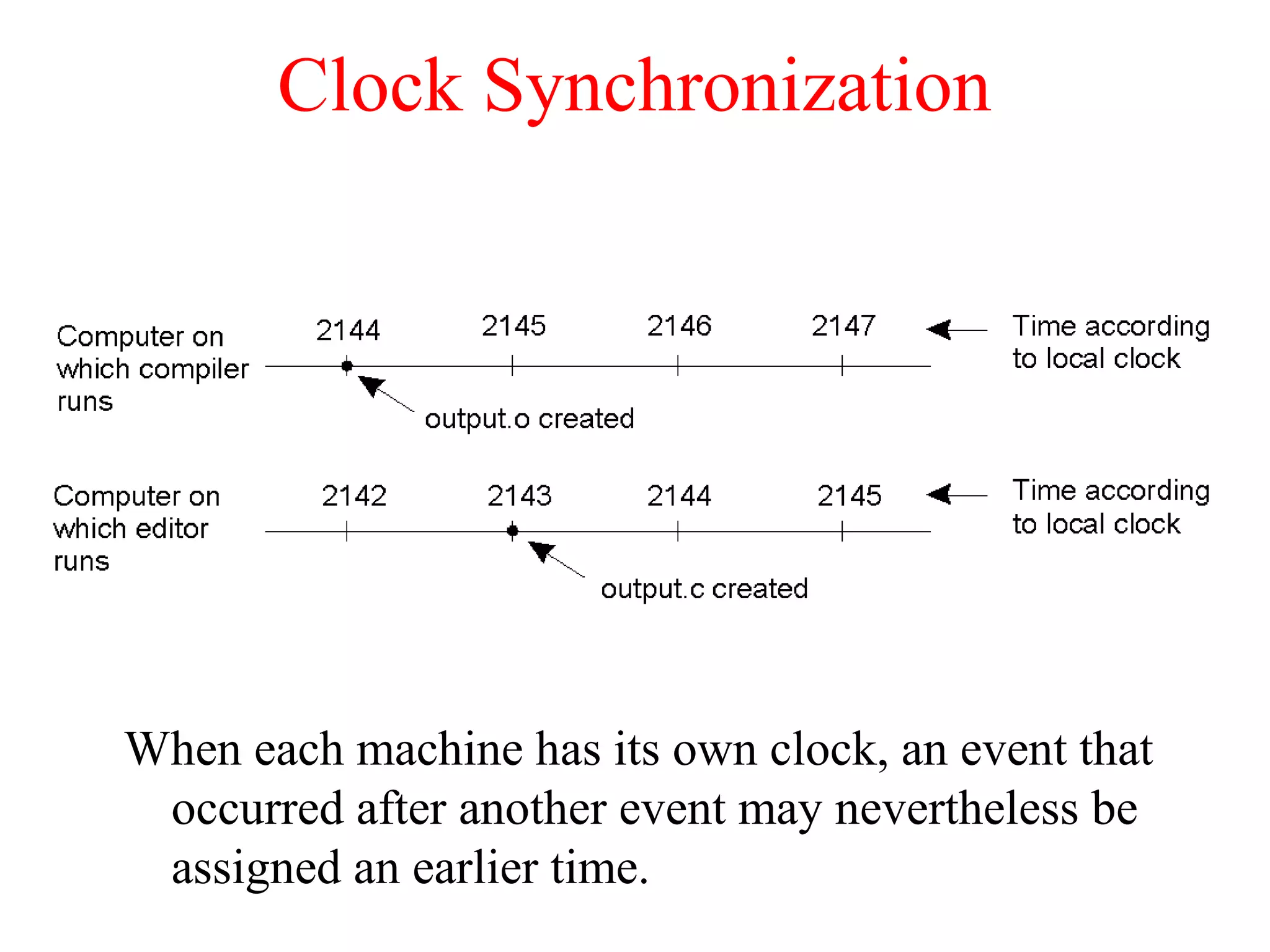
When each machine has its own clock, an event that
occurred after another event may nevertheless be
assigned an earlier time.
Physical Clocks (1)
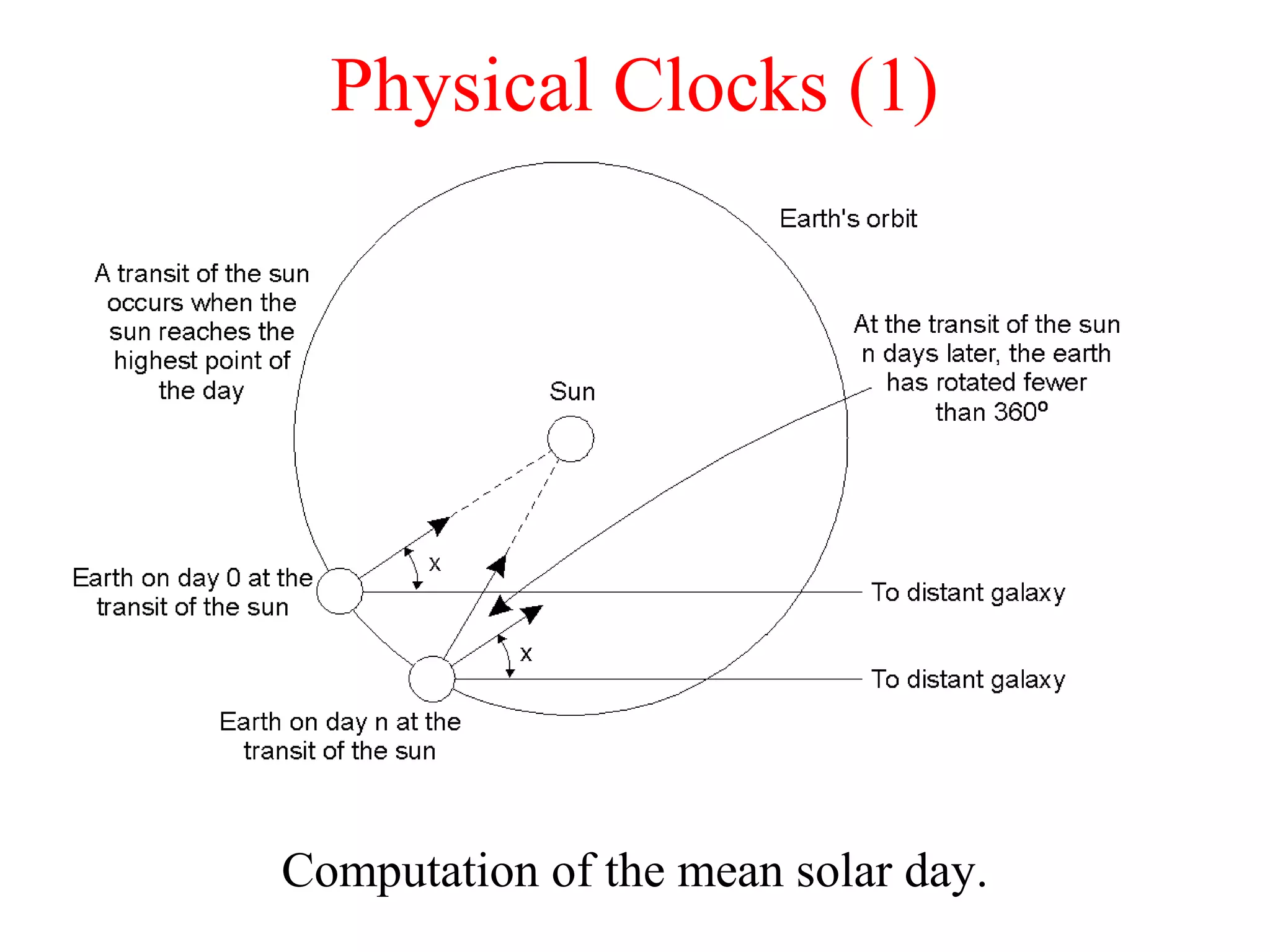
Computation of the mean solar day.
Physical Clocks (2)
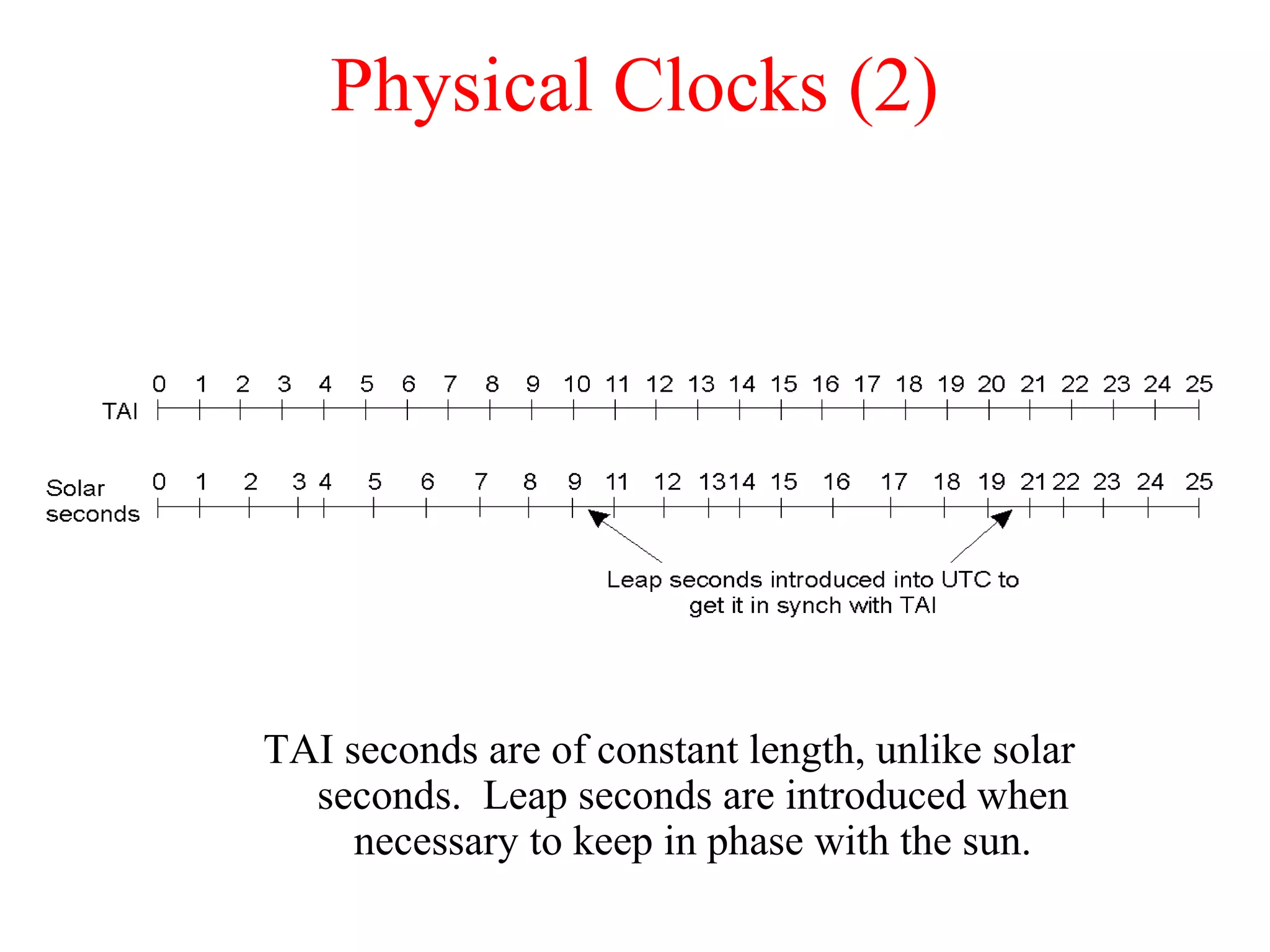
TAI seconds are of constant length, unlike solar
seconds. Leap seconds are introduced when
necessary to keep in phase with the sun.
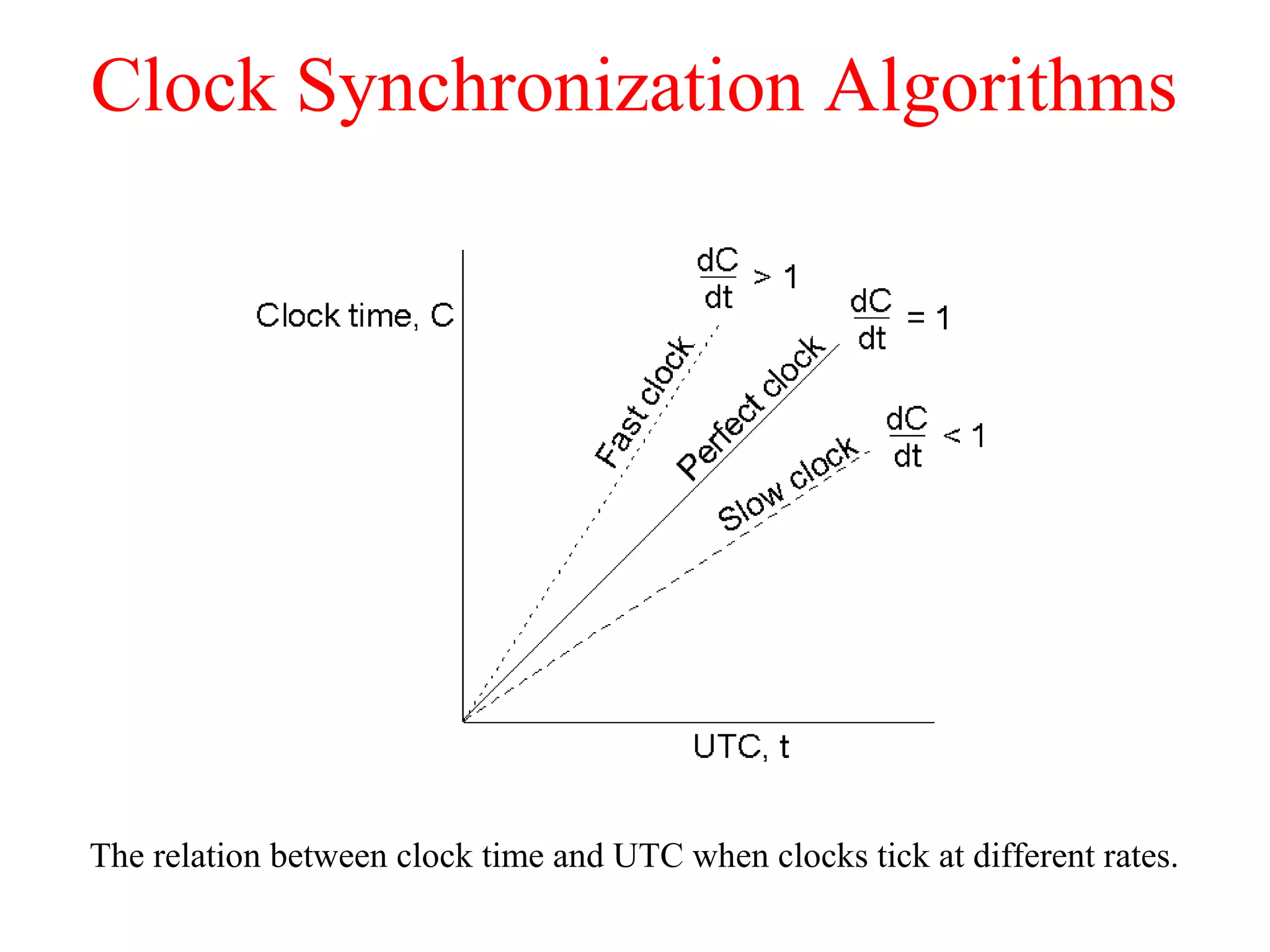
Clock Synchronization Algorithms
The relation between clock time and UTC when clocks tick at different rates.
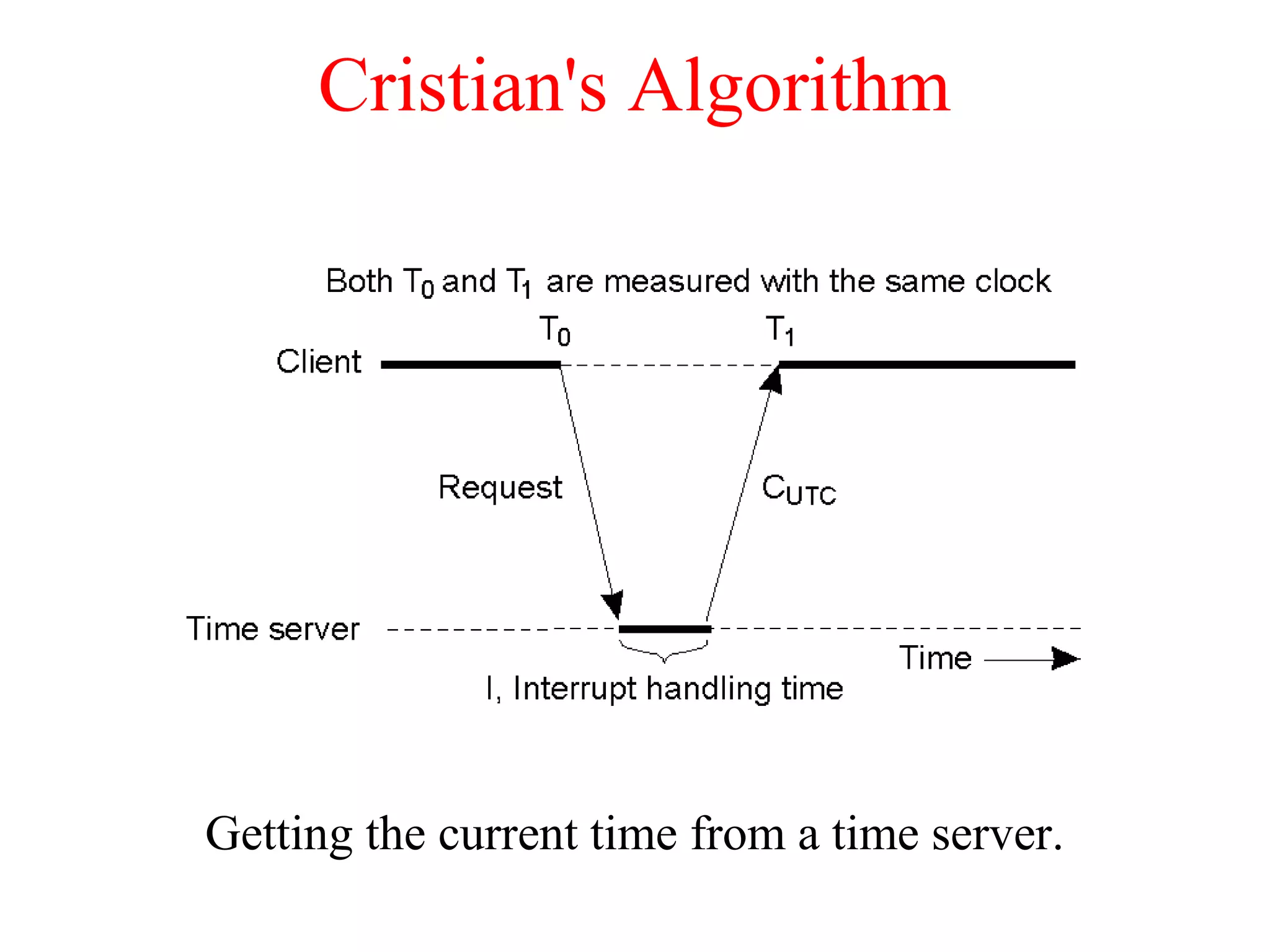
Cristian's Algorithm
Getting the current time from a time server.
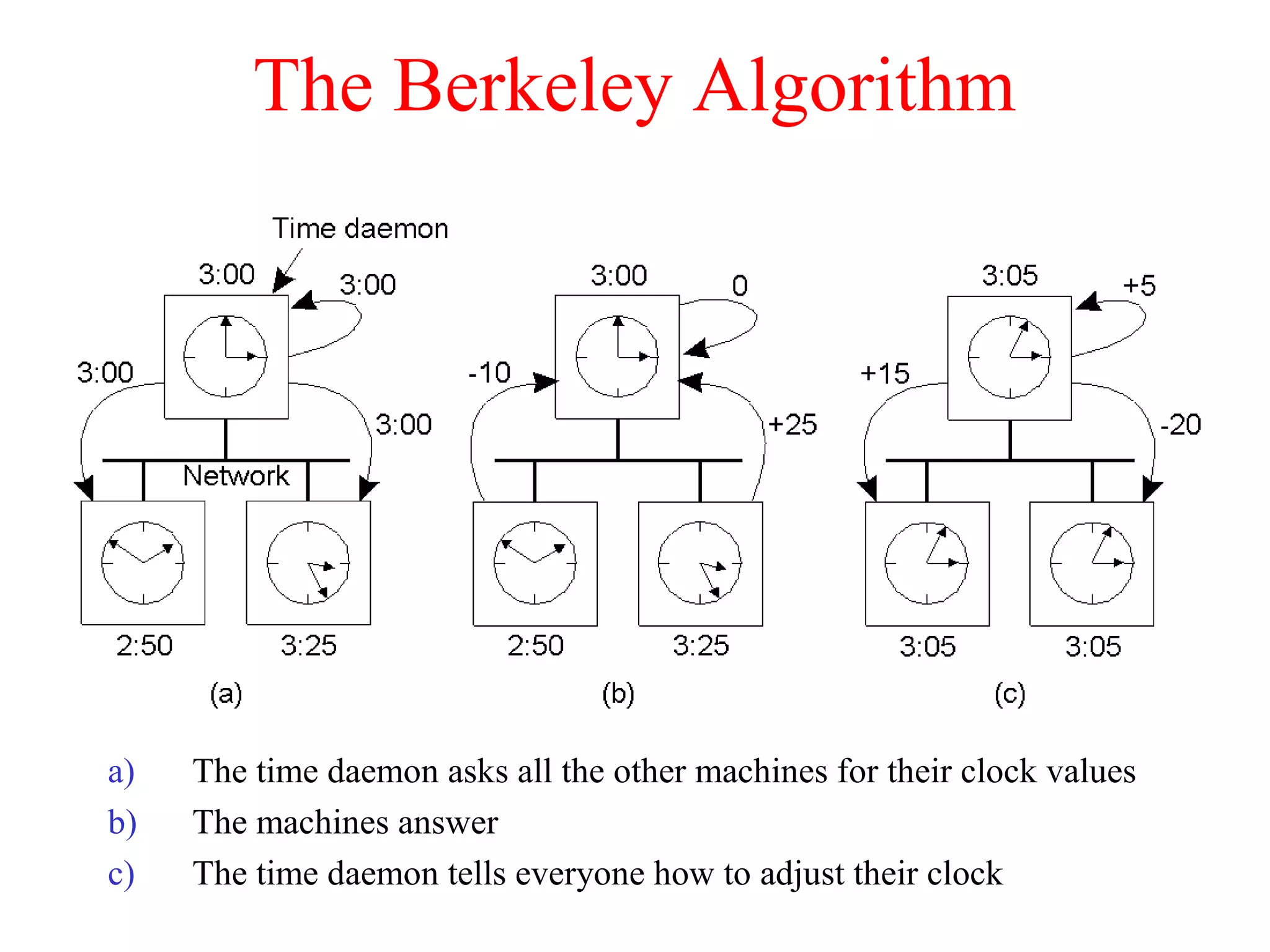
The Berkeley Algorithm
a) The time daemon asks all the other machines for their clock values
b) The machines answer
c) The time daemon tells everyone how to adjust their clock
Lamport Timestamps
a) Three processes, each with its own clock. The clocks run at
different rates.
b) Lamport's algorithm corrects the clocks.
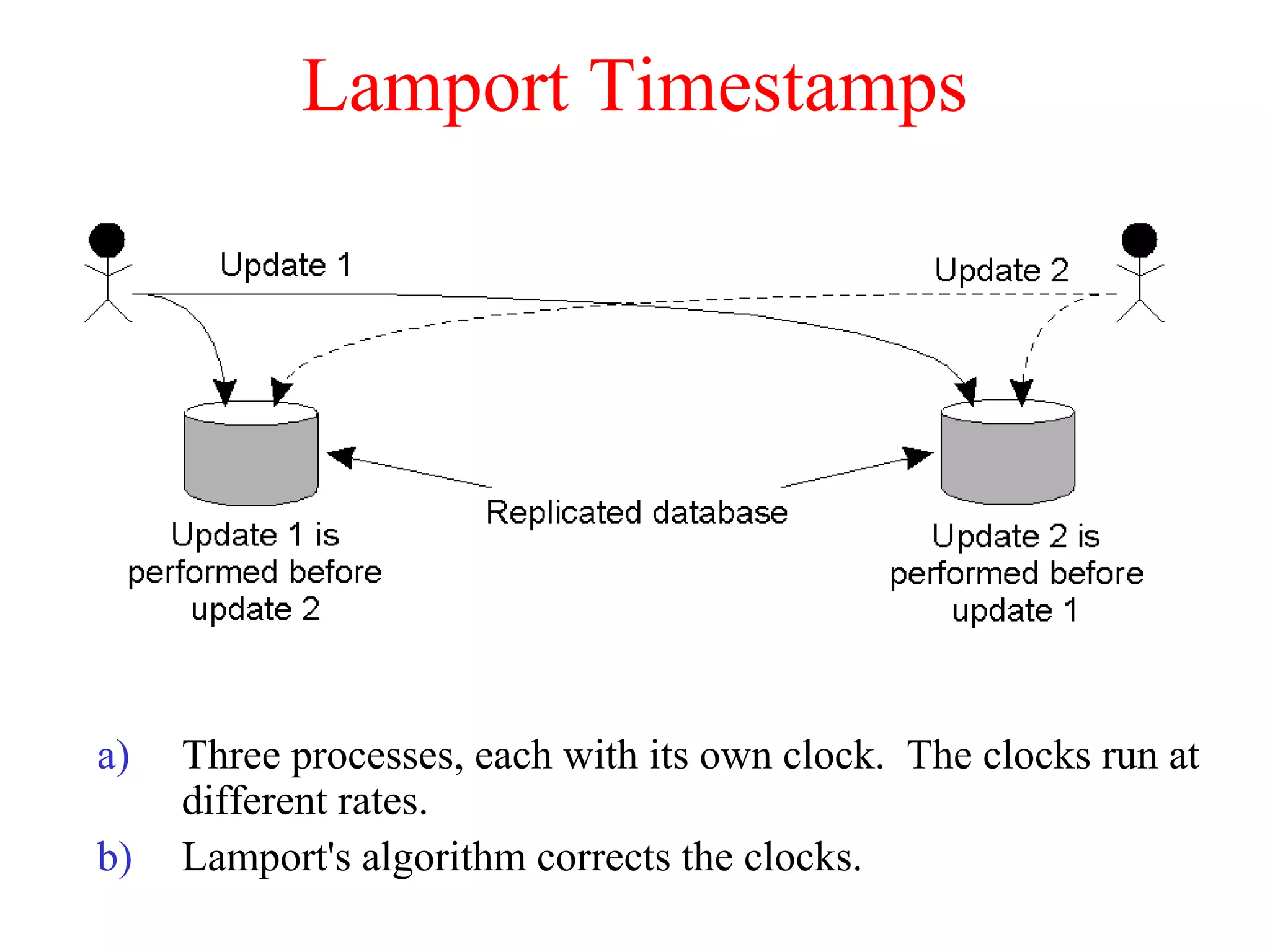
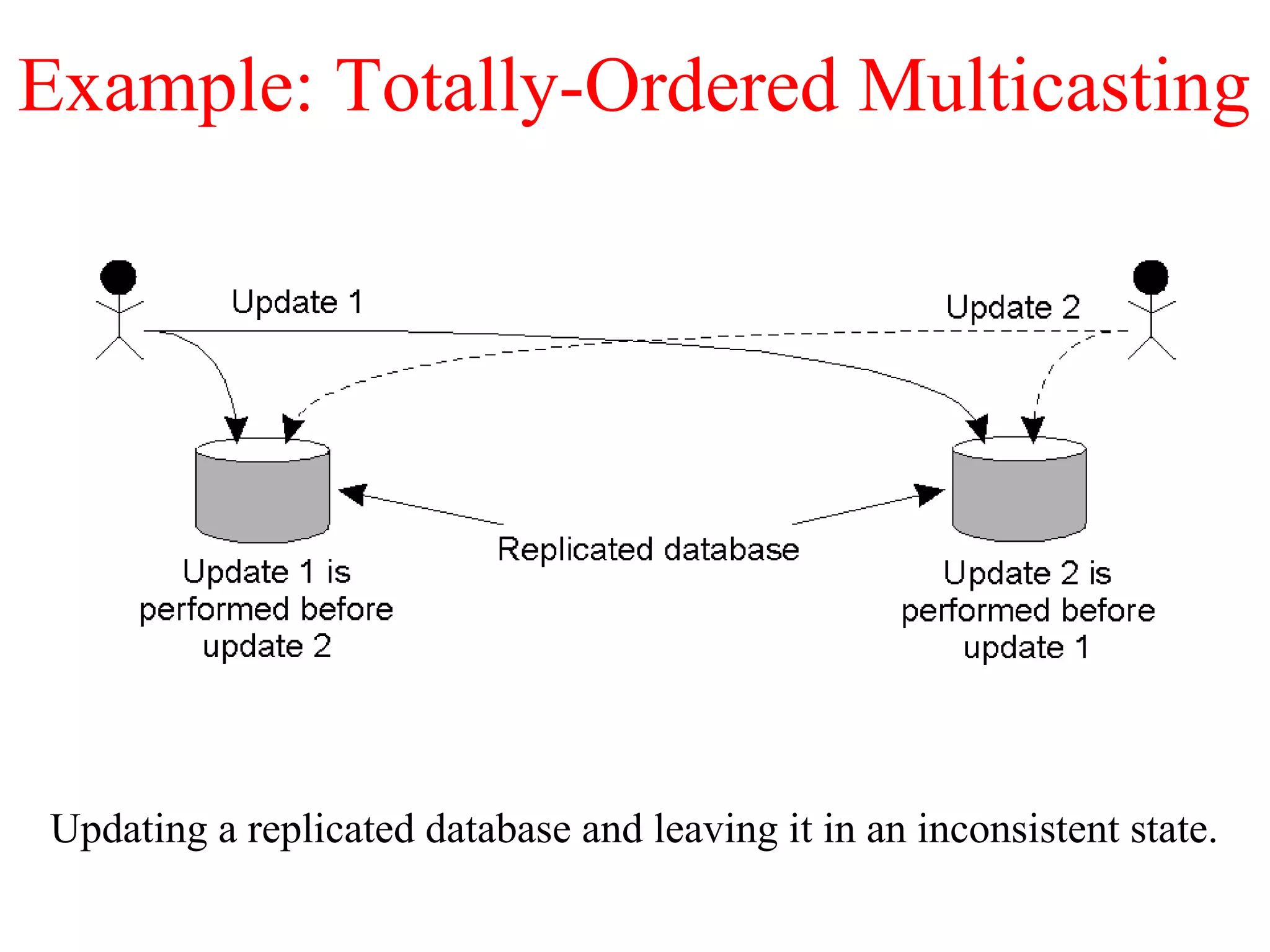
Example: Totally-Ordered Multicasting
Updating a replicated database and leaving it in an inconsistent state.
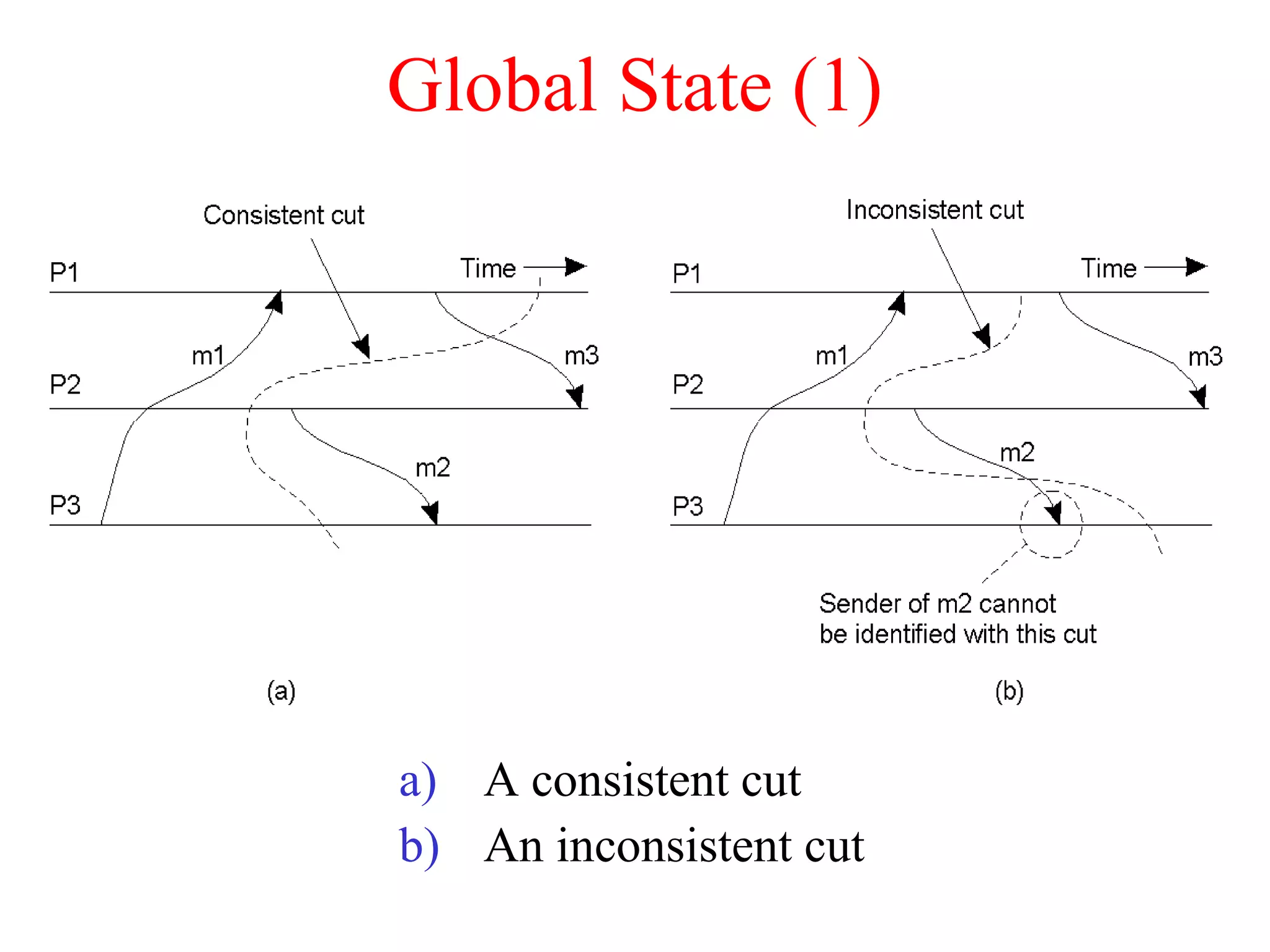
Global State (1)
a) A consistent cut
b) An inconsistent cut
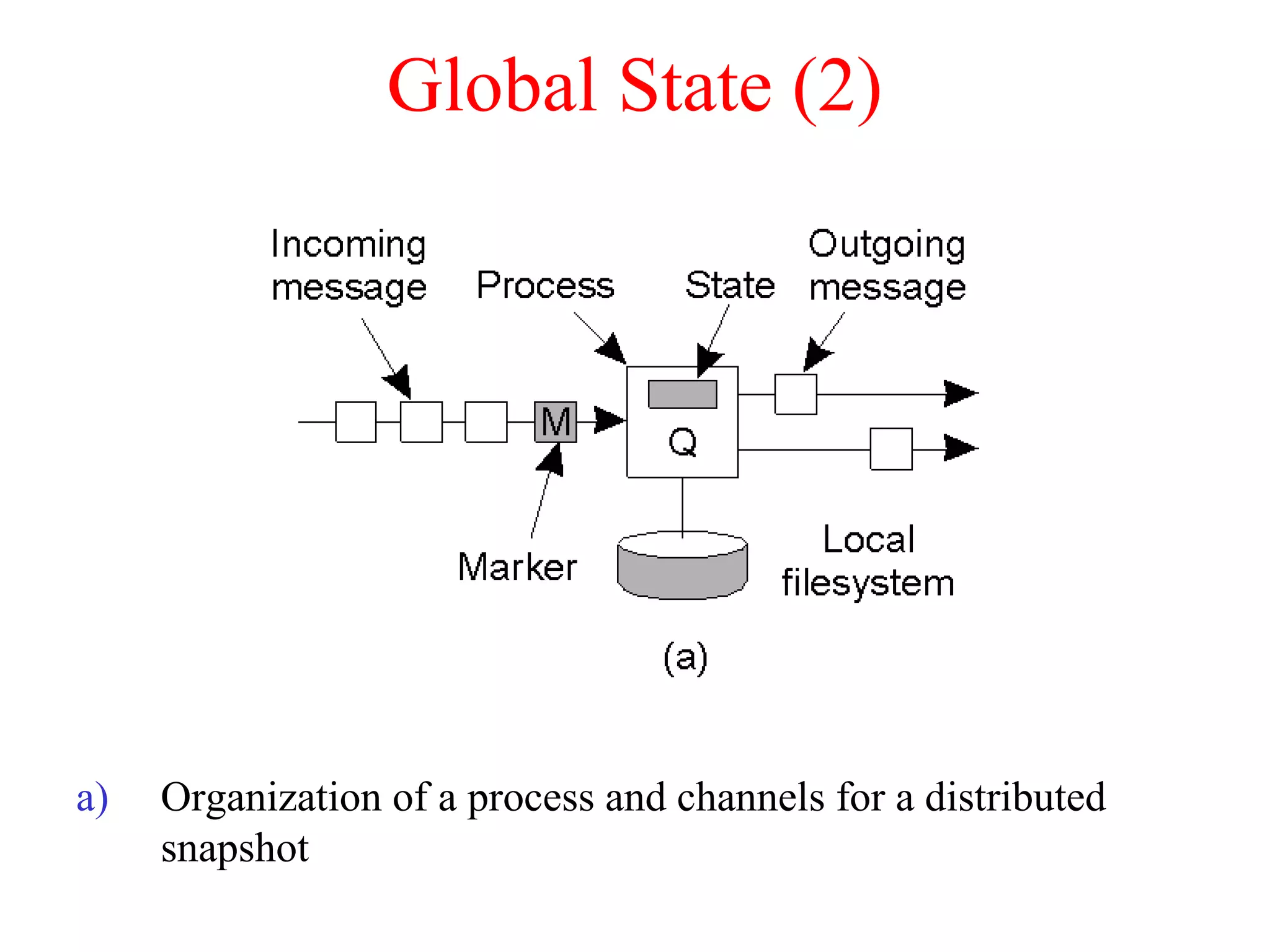
Global State (2)
a) Organization of a process and channels for a distributed
snapshot
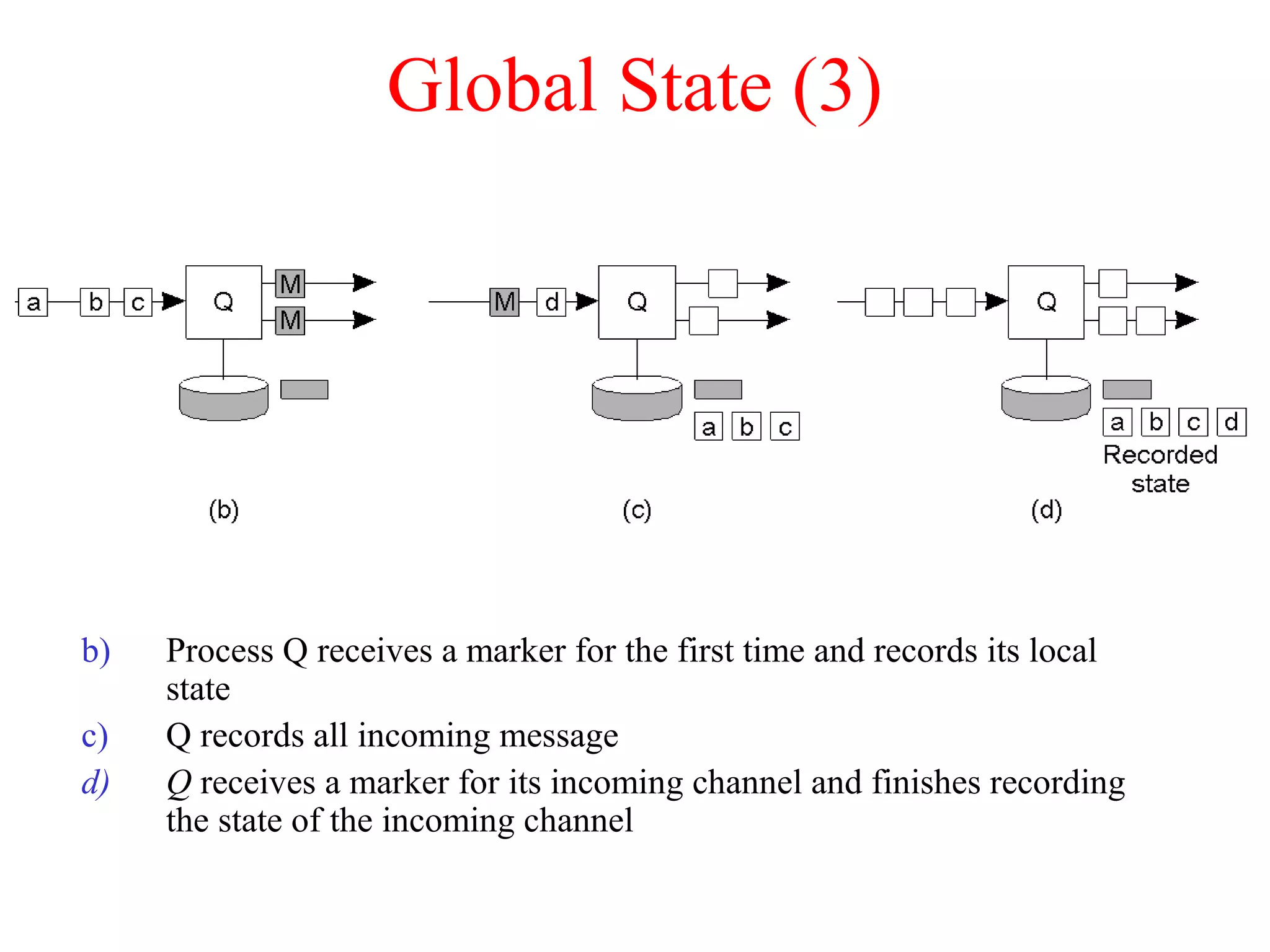
Global State (3)
b) Process Q receives a marker for the first time and records its local
state
c) Q records all incoming message
d) Q receives a marker for its incoming channel and finishes recording
the state of the incoming channel
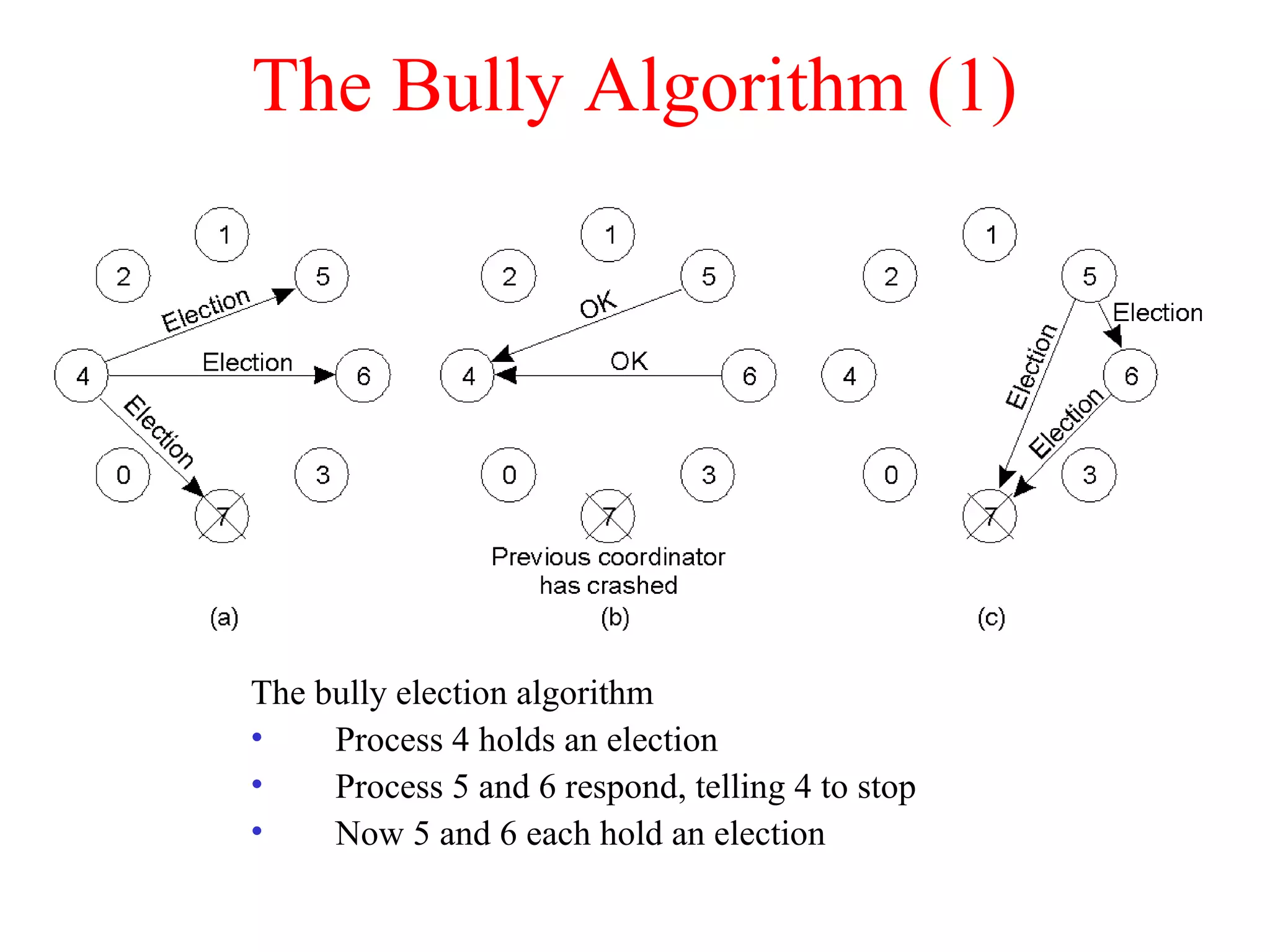
The Bully Algorithm (1)
The bully election algorithm
• Process 4 holds an election
• Process 5 and 6 respond, telling 4 to stop
• Now 5 and 6 each hold an election
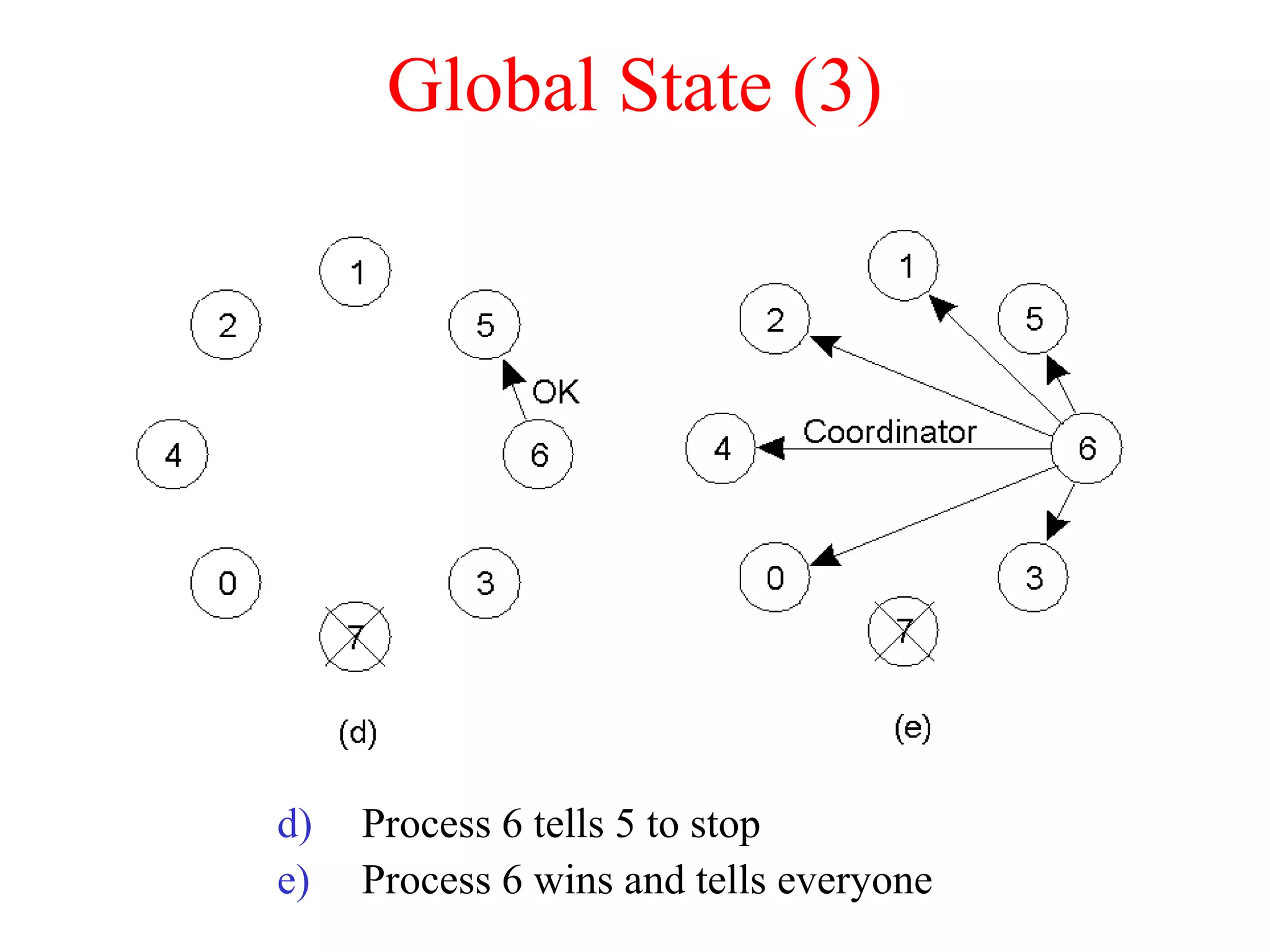
Global State (3)
d) Process 6 tells 5 to stop
e) Process 6 wins and tells everyone
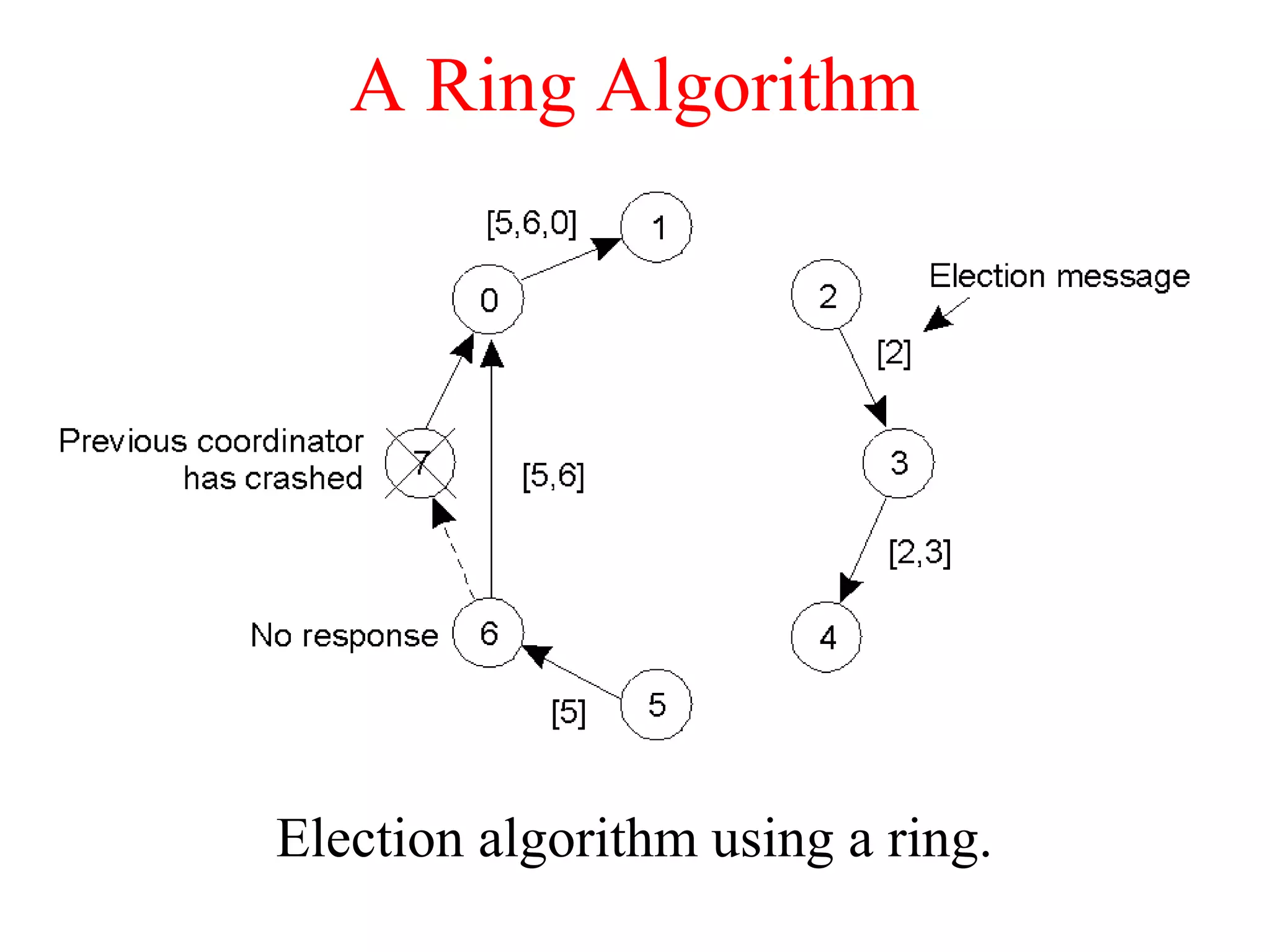
A Ring Algorithm
Election algorithm using a ring.
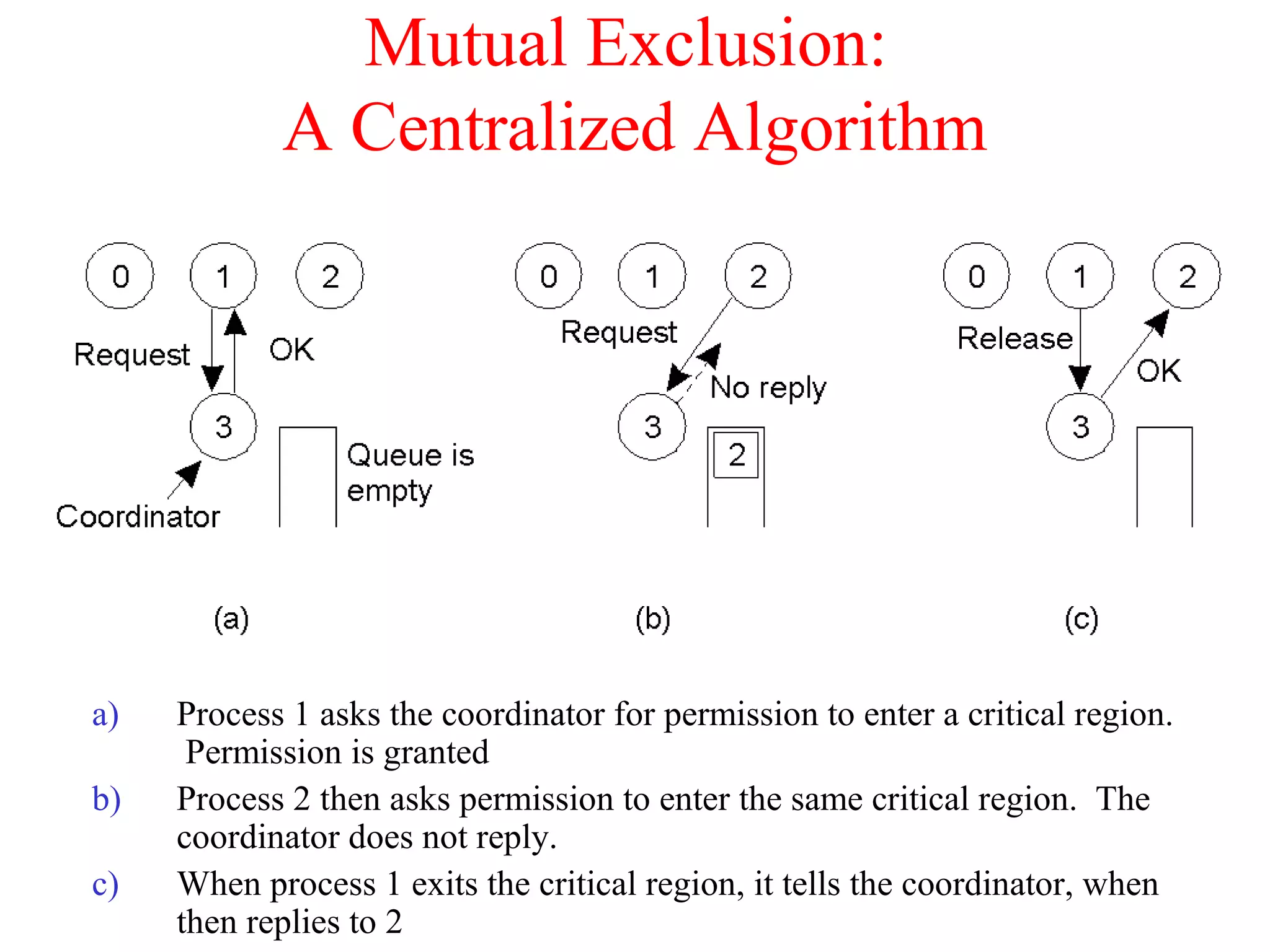
Mutual Exclusion:
A Centralized Algorithm
a) Process 1 asks the coordinator for permission to enter a critical region.
Permission is granted
b) Process 2 then asks permission to enter the same critical region. The
coordinator does not reply.
c) When process 1 exits the critical region, it tells the coordinator, when
then replies to 2
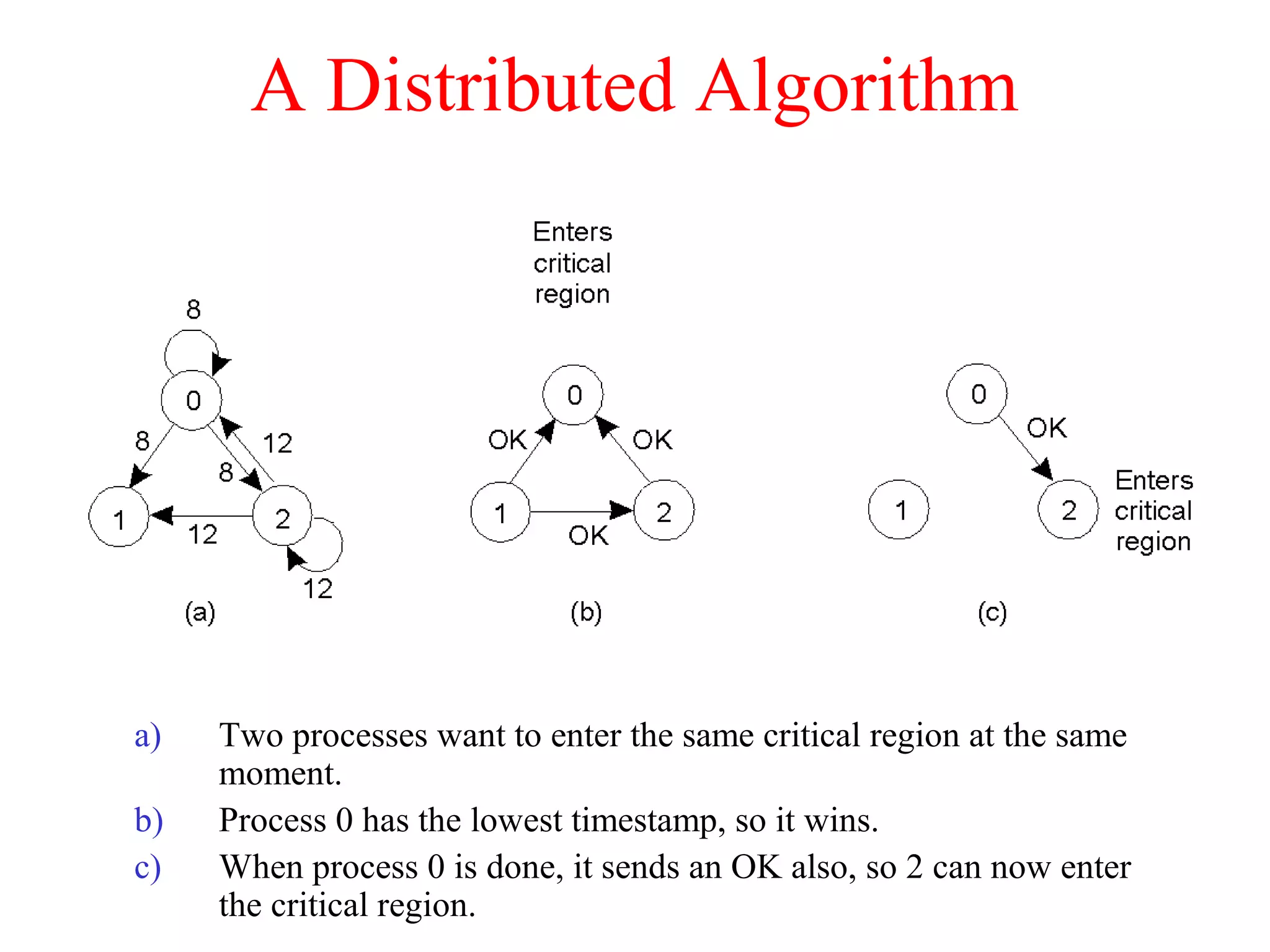
A Distributed Algorithm
a) Two processes want to enter the same critical region at the same
moment.
b) Process 0 has the lowest timestamp, so it wins.
c) When process 0 is done, it sends an OK also, so 2 can now enter
the critical region.
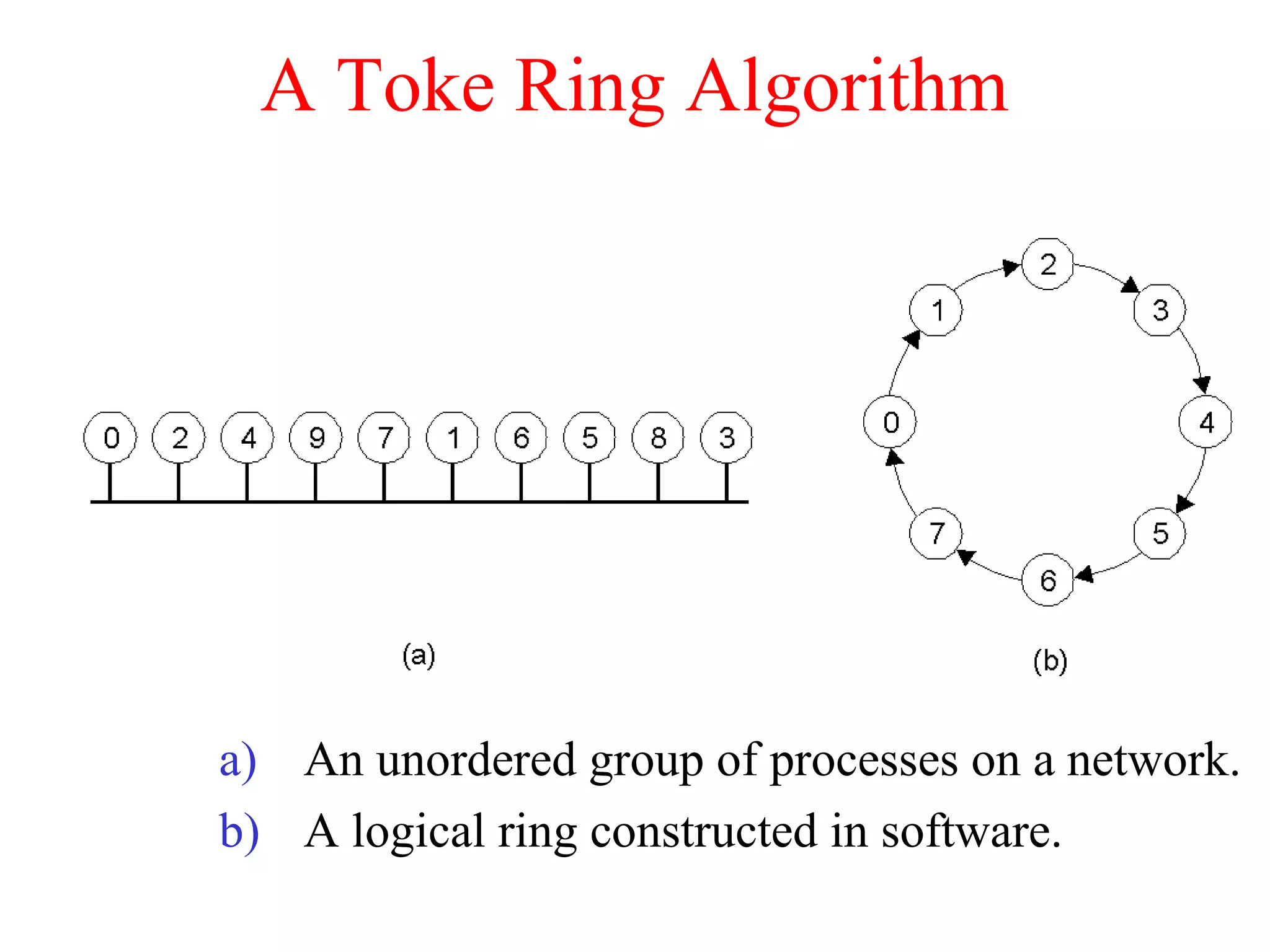
A Toke Ring Algorithm
a) An unordered group of processes on a network.
b) A logical ring constructed in software.
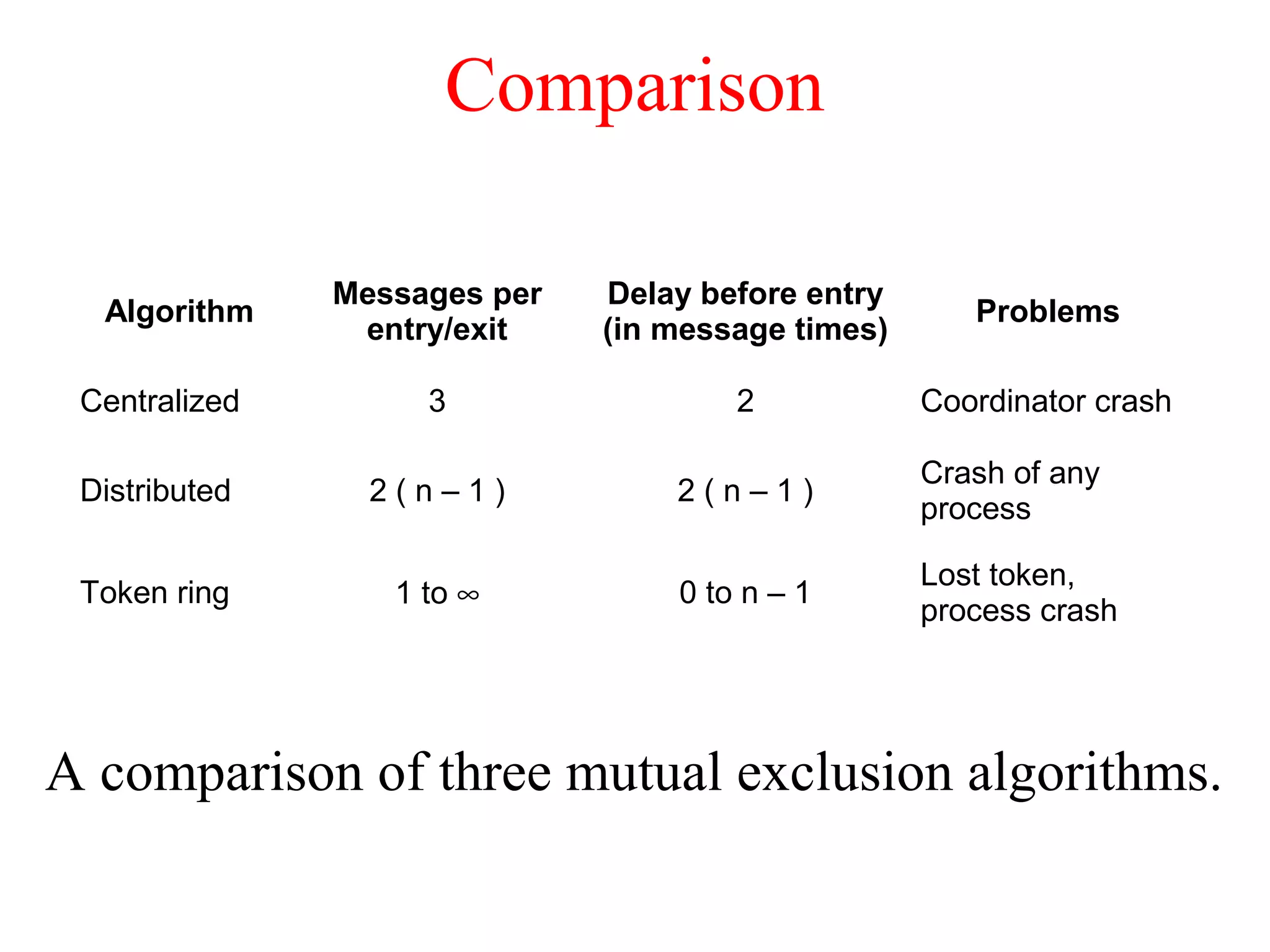
Comparison
A comparison of three mutual exclusion algorithms.
Algorithm
Messages per
entry/exit
Delay before entry
(in message times)
Problems
Centralized 3 2 Coordinator crash
Distributed 2 ( n – 1 ) 2 ( n – 1 )
Crash of any
process
Token ring 1 to ∞ 0 to n – 1
Lost token,
process crash
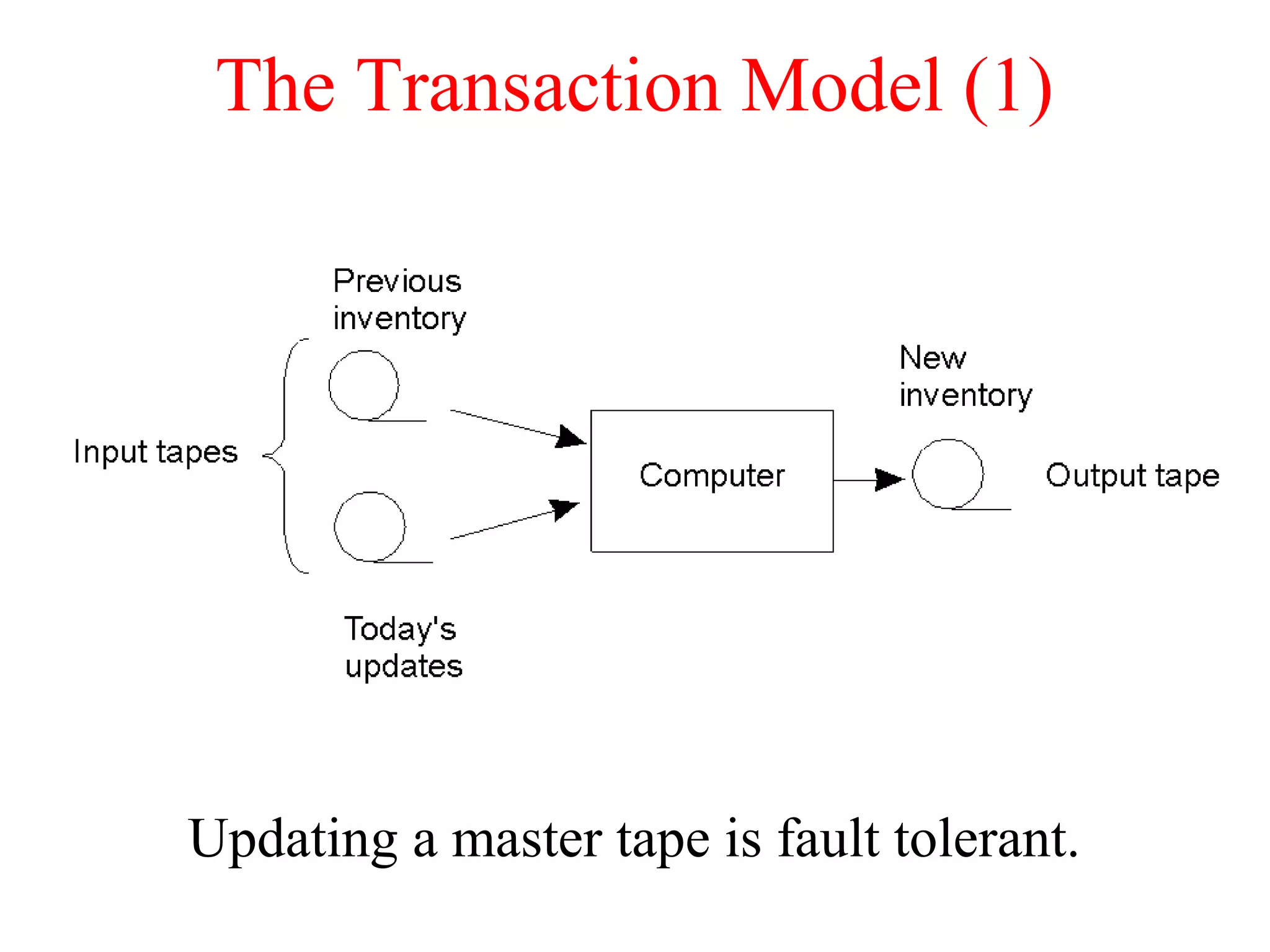
The Transaction Model (1)
Updating a master tape is fault tolerant.
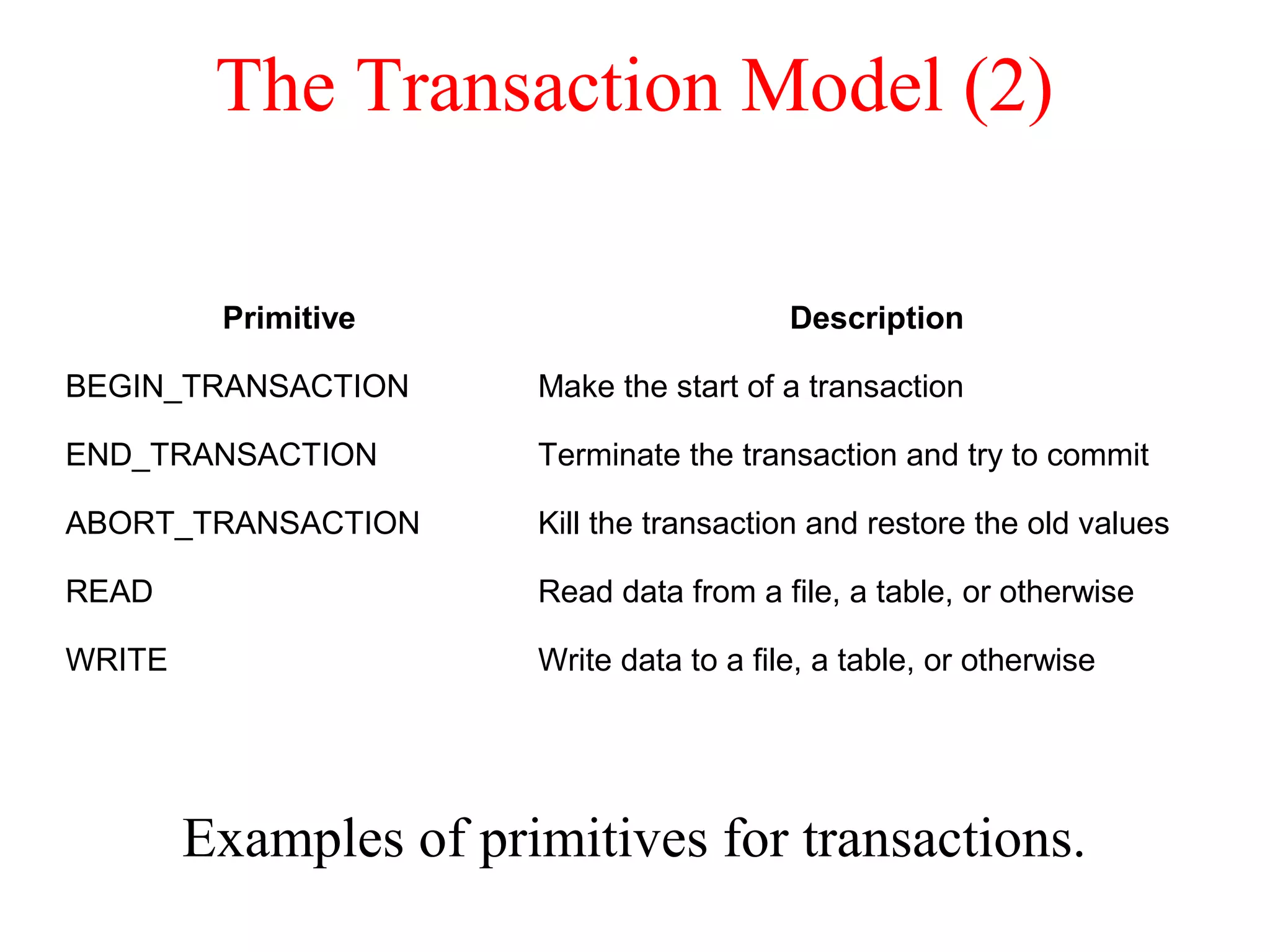
The Transaction Model (2)
Examples of primitives for transactions.
Primitive Description
BEGIN_TRANSACTION Make the start of a transaction
END_TRANSACTION Terminate the transaction and try to commit
ABORT_TRANSACTION Kill the transaction and restore the old values
READ Read data from a file, a table, or otherwise
WRITE Write data to a file, a table, or otherwise
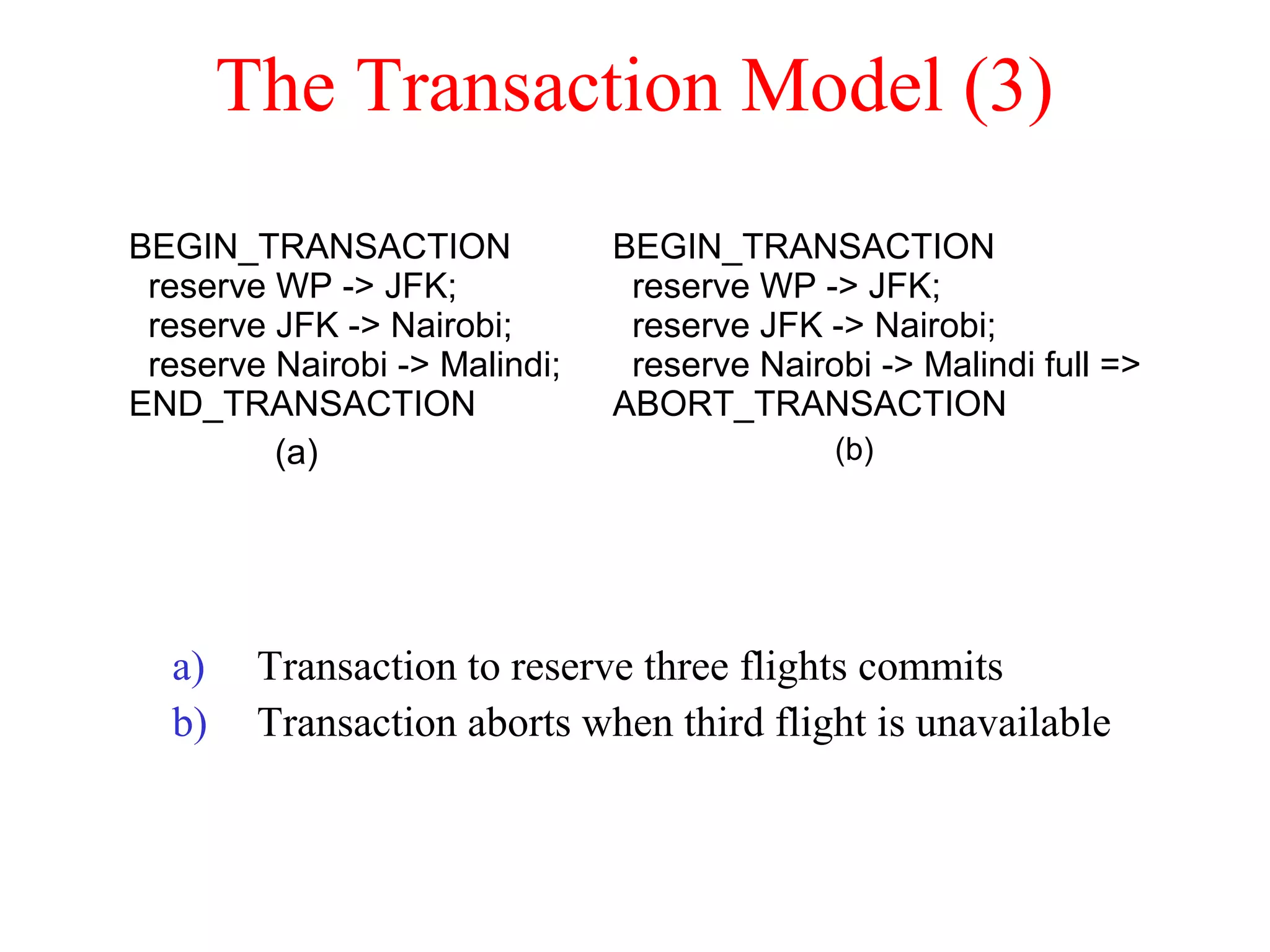
The Transaction Model (3)
a) Transaction to reserve three flights commits
b) Transaction aborts when third flight is unavailable
BEGIN_TRANSACTION
reserve WP -> JFK;
reserve JFK -> Nairobi;
reserve Nairobi -> Malindi;
END_TRANSACTION
(a)
BEGIN_TRANSACTION
reserve WP -> JFK;
reserve JFK -> Nairobi;
reserve Nairobi -> Malindi full =>
ABORT_TRANSACTION
(b)
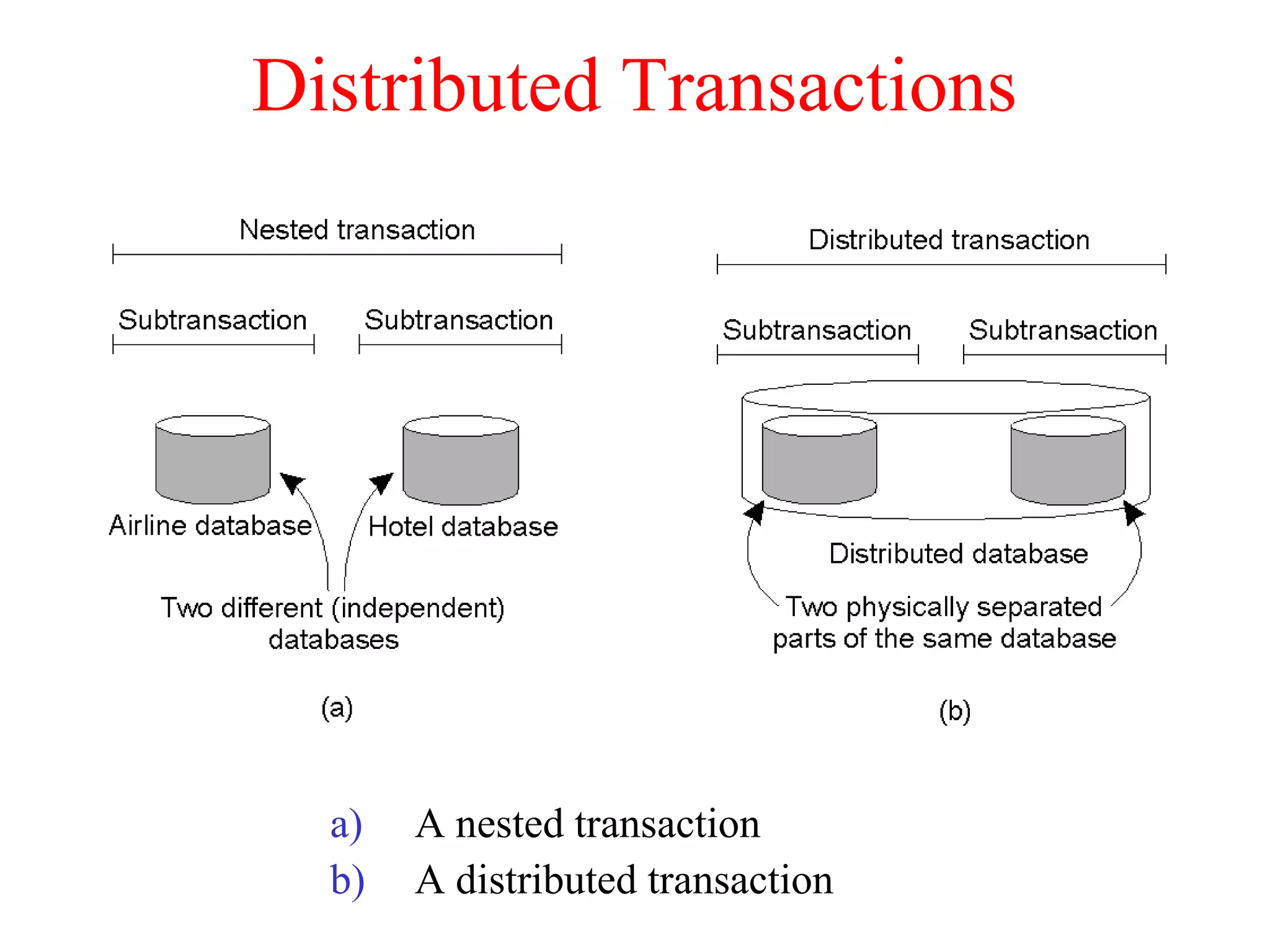
Distributed Transactions
a) A nested transaction
b) A distributed transaction
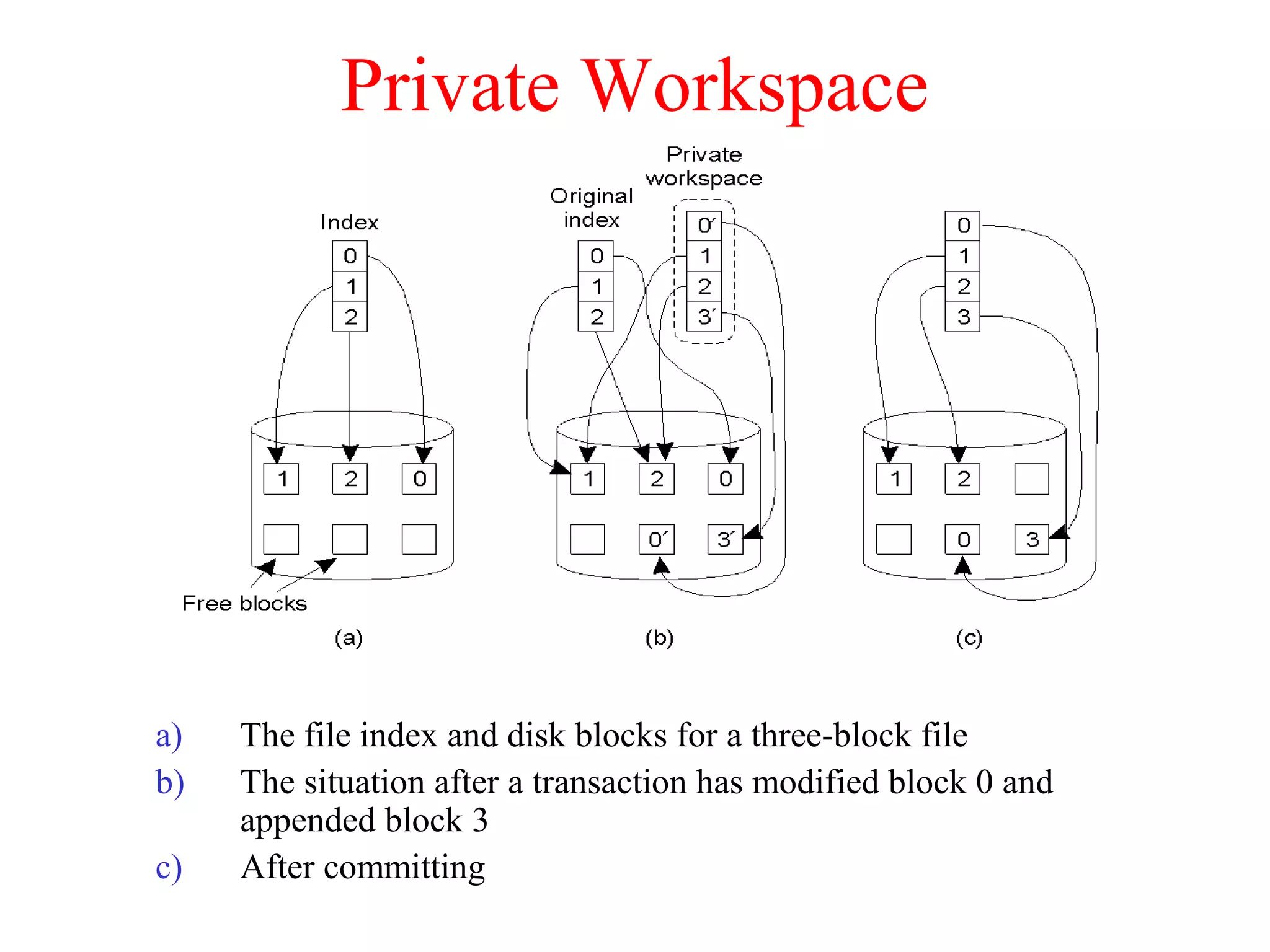
Private Workspace
a) The file index and disk blocks for a three-block file
b) The situation after a transaction has modified block 0 and
appended block 3
c) After committing
Writeahead Log
a) A transaction
b) – d) The log before each statement is executed
x = 0;
y = 0;
BEGIN_TRANSACTION;
x = x + 1;
y = y + 2
x = y * y;
END_TRANSACTION;
(a)
Log
[x = 0 / 1]
(b)
Log
[x = 0 / 1]
[y = 0/2]
(c)
Log
[x = 0 / 1]
[y = 0/2]
[x = 1/4]
(d)
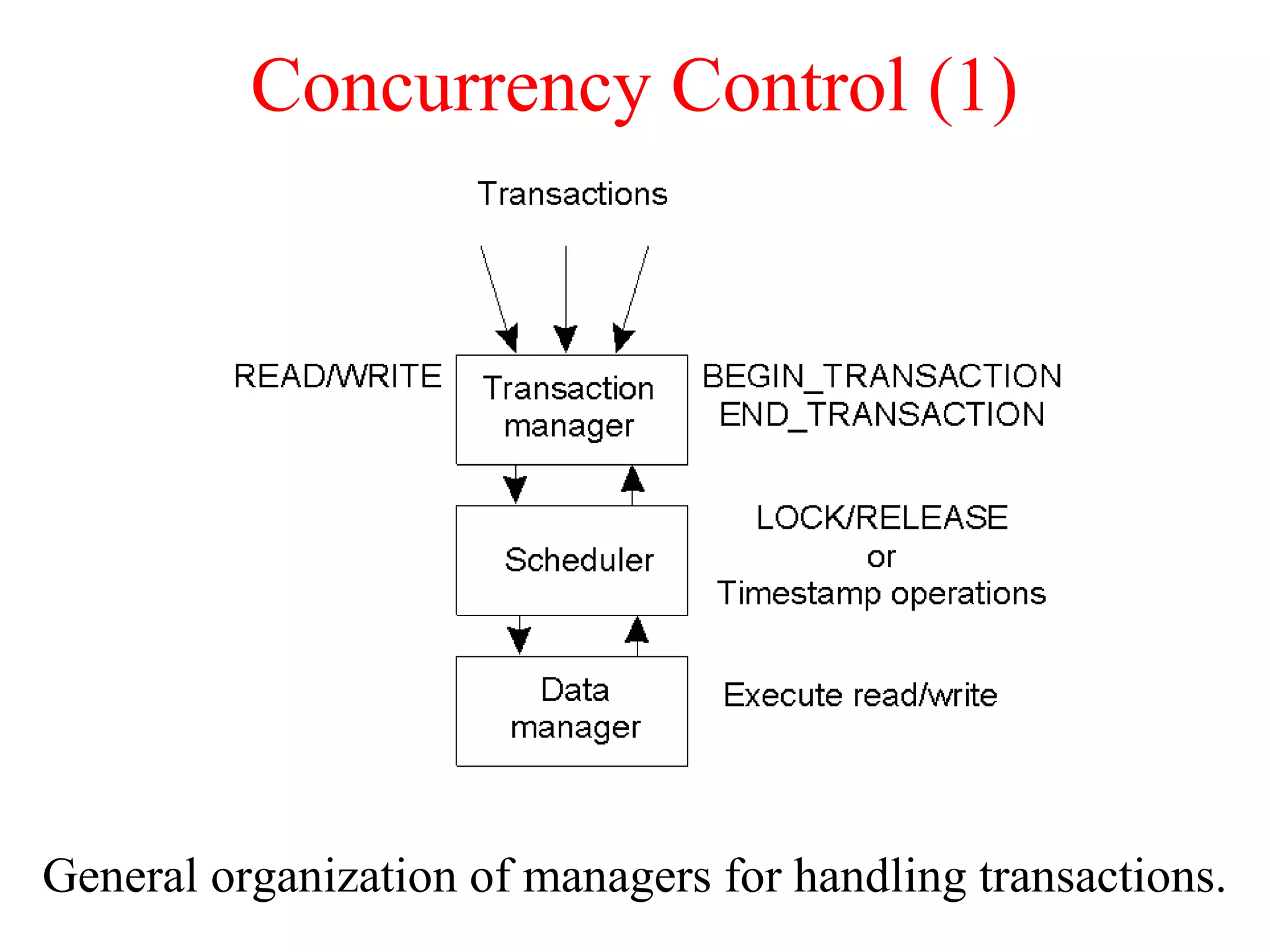
Concurrency Control (1)
General organization of managers for handling transactions.
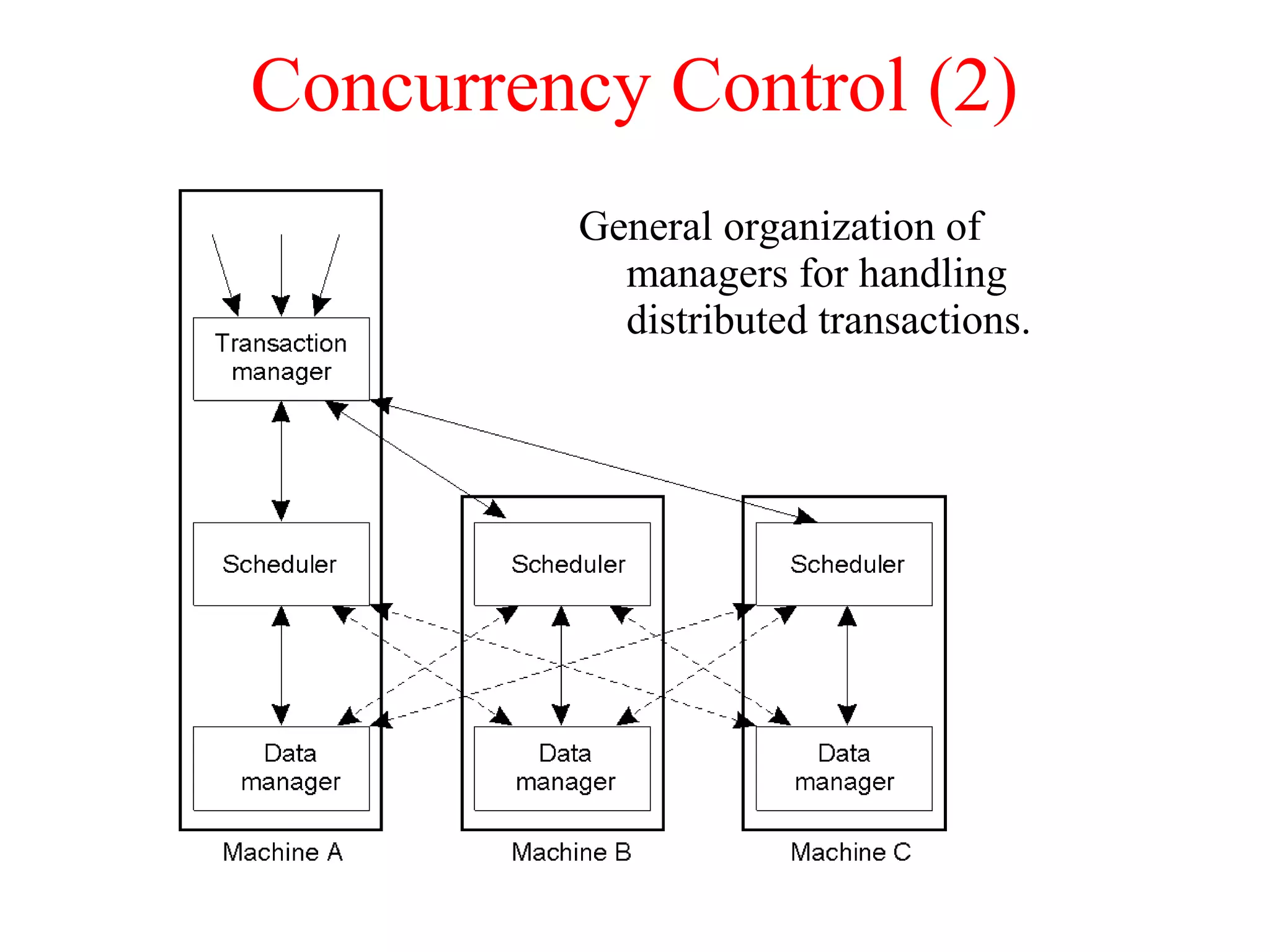
Concurrency Control (2)
General organization of
managers for handling
distributed transactions.
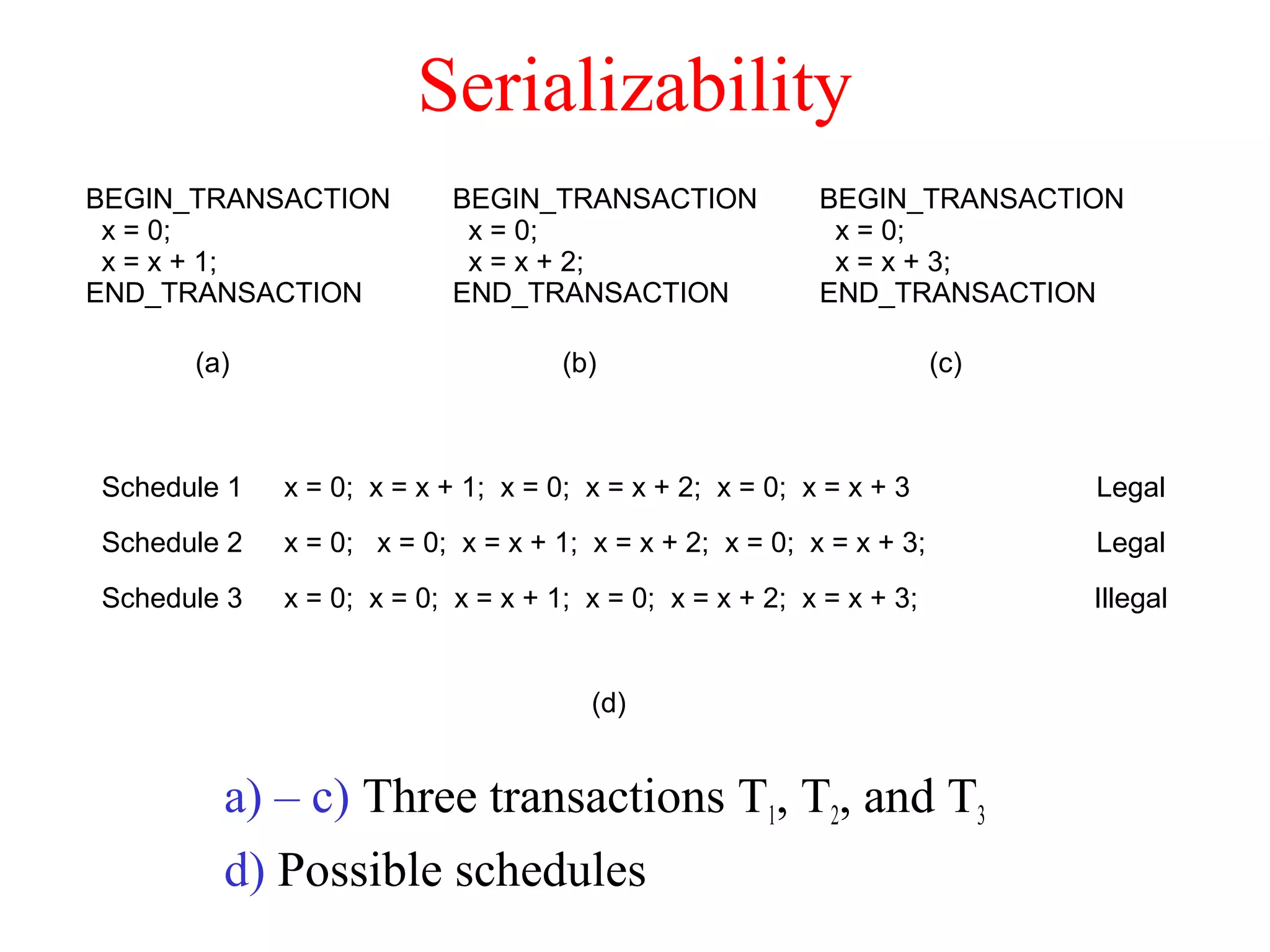
Serializability
a) – c) Three transactions T1, T2, and T3
d) Possible schedules
BEGIN_TRANSACTION
x = 0;
x = x + 1;
END_TRANSACTION
(a)
BEGIN_TRANSACTION
x = 0;
x = x + 2;
END_TRANSACTION
(b)
BEGIN_TRANSACTION
x = 0;
x = x + 3;
END_TRANSACTION
(c)
Schedule 1 x = 0; x = x + 1; x = 0; x = x + 2; x = 0; x = x + 3 Legal
Schedule 2 x = 0; x = 0; x = x + 1; x = x + 2; x = 0; x = x + 3; Legal
Schedule 3 x = 0; x = 0; x = x + 1; x = 0; x = x + 2; x = x + 3; Illegal
(d)
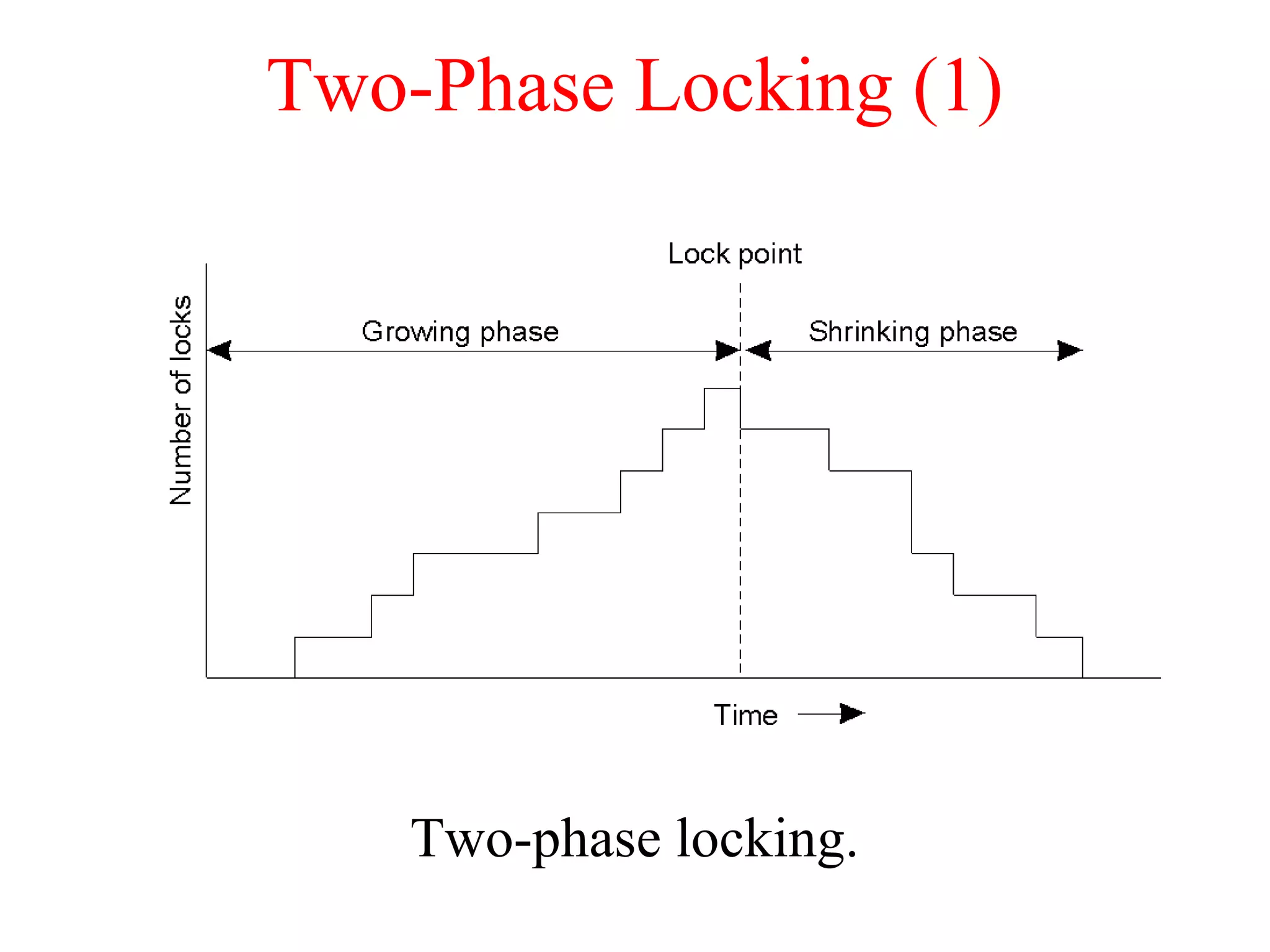
Two-Phase Locking (1)
Two-phase locking.
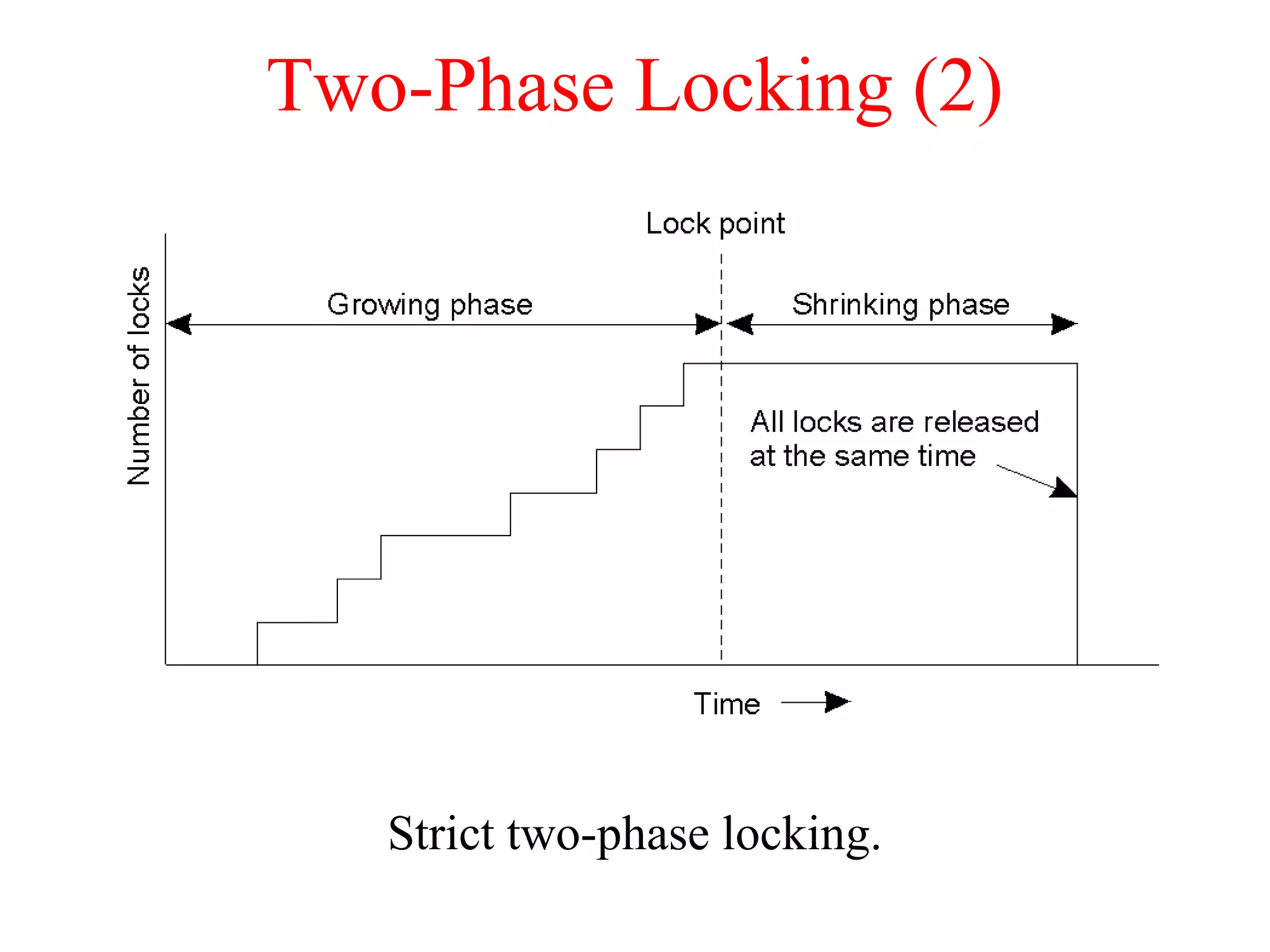
Two-Phase Locking (2)
Strict two-phase locking.
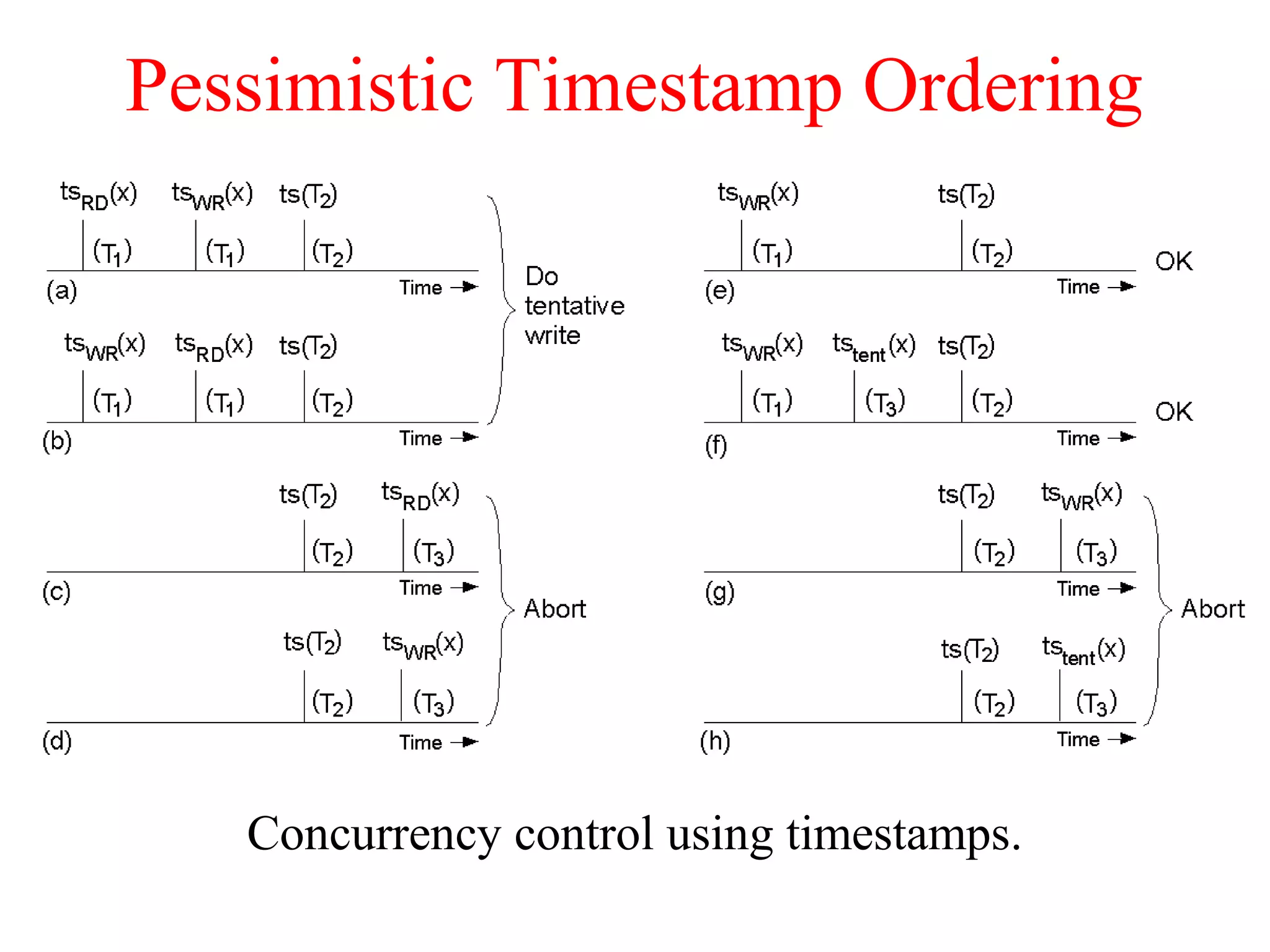
Pessimistic Timestamp Ordering
Concurrency control using timestamps.

Distributed System by Pratik Tambekar

  • 1.
  • 2.
    Clock Synchronization When eachmachine has its own clock, an event that occurred after another event may nevertheless be assigned an earlier time.
  • 3.
    Physical Clocks (1) Computationof the mean solar day.
  • 4.
    Physical Clocks (2) TAIseconds are of constant length, unlike solar seconds. Leap seconds are introduced when necessary to keep in phase with the sun.
  • 5.
    Clock Synchronization Algorithms Therelation between clock time and UTC when clocks tick at different rates.
  • 6.
    Cristian's Algorithm Getting thecurrent time from a time server.
  • 7.
    The Berkeley Algorithm a)The time daemon asks all the other machines for their clock values b) The machines answer c) The time daemon tells everyone how to adjust their clock
  • 8.
    Lamport Timestamps a) Threeprocesses, each with its own clock. The clocks run at different rates. b) Lamport's algorithm corrects the clocks.
  • 9.
    Example: Totally-Ordered Multicasting Updatinga replicated database and leaving it in an inconsistent state.
  • 10.
    Global State (1) a)A consistent cut b) An inconsistent cut
  • 11.
    Global State (2) a)Organization of a process and channels for a distributed snapshot
  • 12.
    Global State (3) b)Process Q receives a marker for the first time and records its local state c) Q records all incoming message d) Q receives a marker for its incoming channel and finishes recording the state of the incoming channel
  • 13.
    The Bully Algorithm(1) The bully election algorithm • Process 4 holds an election • Process 5 and 6 respond, telling 4 to stop • Now 5 and 6 each hold an election
  • 14.
    Global State (3) d)Process 6 tells 5 to stop e) Process 6 wins and tells everyone
  • 15.
    A Ring Algorithm Electionalgorithm using a ring.
  • 16.
    Mutual Exclusion: A CentralizedAlgorithm a) Process 1 asks the coordinator for permission to enter a critical region. Permission is granted b) Process 2 then asks permission to enter the same critical region. The coordinator does not reply. c) When process 1 exits the critical region, it tells the coordinator, when then replies to 2
  • 17.
    A Distributed Algorithm a)Two processes want to enter the same critical region at the same moment. b) Process 0 has the lowest timestamp, so it wins. c) When process 0 is done, it sends an OK also, so 2 can now enter the critical region.
  • 18.
    A Toke RingAlgorithm a) An unordered group of processes on a network. b) A logical ring constructed in software.
  • 19.
    Comparison A comparison ofthree mutual exclusion algorithms. Algorithm Messages per entry/exit Delay before entry (in message times) Problems Centralized 3 2 Coordinator crash Distributed 2 ( n – 1 ) 2 ( n – 1 ) Crash of any process Token ring 1 to ∞ 0 to n – 1 Lost token, process crash
  • 20.
    The Transaction Model(1) Updating a master tape is fault tolerant.
  • 21.
    The Transaction Model(2) Examples of primitives for transactions. Primitive Description BEGIN_TRANSACTION Make the start of a transaction END_TRANSACTION Terminate the transaction and try to commit ABORT_TRANSACTION Kill the transaction and restore the old values READ Read data from a file, a table, or otherwise WRITE Write data to a file, a table, or otherwise
  • 22.
    The Transaction Model(3) a) Transaction to reserve three flights commits b) Transaction aborts when third flight is unavailable BEGIN_TRANSACTION reserve WP -> JFK; reserve JFK -> Nairobi; reserve Nairobi -> Malindi; END_TRANSACTION (a) BEGIN_TRANSACTION reserve WP -> JFK; reserve JFK -> Nairobi; reserve Nairobi -> Malindi full => ABORT_TRANSACTION (b)
  • 23.
    Distributed Transactions a) Anested transaction b) A distributed transaction
  • 24.
    Private Workspace a) Thefile index and disk blocks for a three-block file b) The situation after a transaction has modified block 0 and appended block 3 c) After committing
  • 25.
    Writeahead Log a) Atransaction b) – d) The log before each statement is executed x = 0; y = 0; BEGIN_TRANSACTION; x = x + 1; y = y + 2 x = y * y; END_TRANSACTION; (a) Log [x = 0 / 1] (b) Log [x = 0 / 1] [y = 0/2] (c) Log [x = 0 / 1] [y = 0/2] [x = 1/4] (d)
  • 26.
    Concurrency Control (1) Generalorganization of managers for handling transactions.
  • 27.
    Concurrency Control (2) Generalorganization of managers for handling distributed transactions.
  • 28.
    Serializability a) – c)Three transactions T1, T2, and T3 d) Possible schedules BEGIN_TRANSACTION x = 0; x = x + 1; END_TRANSACTION (a) BEGIN_TRANSACTION x = 0; x = x + 2; END_TRANSACTION (b) BEGIN_TRANSACTION x = 0; x = x + 3; END_TRANSACTION (c) Schedule 1 x = 0; x = x + 1; x = 0; x = x + 2; x = 0; x = x + 3 Legal Schedule 2 x = 0; x = 0; x = x + 1; x = x + 2; x = 0; x = x + 3; Legal Schedule 3 x = 0; x = 0; x = x + 1; x = 0; x = x + 2; x = x + 3; Illegal (d)
  • 29.
  • 30.
    Two-Phase Locking (2) Stricttwo-phase locking.
  • 31.