Concurrency Control
Concurrency Control
 The problem of synchronizing concurrent
transactions such that the consistency of the
database is maintained while, at the same time,
maximum degree of concurrency is achieved.
 Anomalies:
◦ Lost updates
 The effects of some transactions are not reflected on the
database.
◦ Inconsistent retrievals
 A transaction, if it reads the same data item more than
once, should always read the same value.
Execution Schedule (or History)
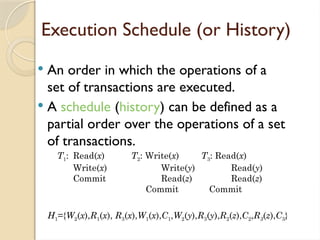
 An order in which the operations of a
set of transactions are executed.
 A schedule (history) can be defined as a
partial order over the operations of a set
of transactions.
H1={W2(x),R1(x), R3(x),W1(x),C1,W2(y),R3(y),R2(z),C2,R3(z),C3}
T1: Read(x) T2: Write(x) T3: Read(x)
Write(x) Write(y) Read(y)
Commit Read(z) Read(z)
Commit Commit
Formalization of Schedule
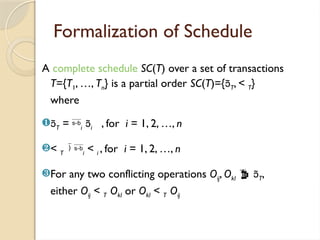
A complete schedule SC(T) over a set of transactions
T={T1, …, Tn} is a partial order SC(T)={T, < T}
where
T = i i , for i = 1, 2, …, n
< T i < i , for i = 1, 2, …, n
For any two conflicting operations Oij, Okl  T,
either Oij < T Okl or Okl < T Oij
Complete Schedule – Example
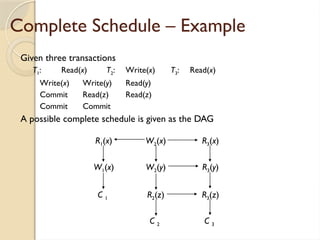
Given three transactions
T1: Read(x) T2: Write(x) T3: Read(x)
Write(x) Write(y) Read(y)
Commit Read(z) Read(z)
Commit Commit
A possible complete schedule is given as the DAG
C 1
R3(x)
R1(x) W2(x)
W1(x) W2(y) R3(y)
R3(z)
R2(z)
C 2 C 3
Schedule Definition
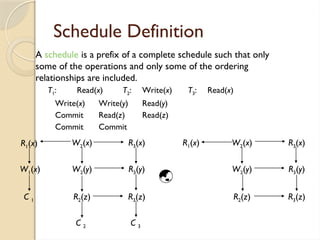
A schedule is a prefix of a complete schedule such that only
some of the operations and only some of the ordering
relationships are included.
T1: Read(x) T2: Write(x) T3: Read(x)
Write(x) Write(y) Read(y)
Commit Read(z) Read(z)
Commit Commit
R1(x)
C 1
R3(x)
R1(x) R3(x)
W2(x)
W2(x)
W1(x) W2(y)
W2(y) R3(y)
R3(y)
R3(z)
R3(z) R2(z)
R2(z)
C 2 C 3

Serial History
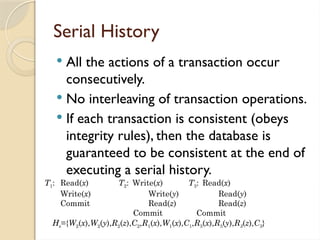
 All the actions of a transaction occur
consecutively.
 No interleaving of transaction operations.
 If each transaction is consistent (obeys
integrity rules), then the database is
guaranteed to be consistent at the end of
executing a serial history.
T1: Read(x) T2: Write(x) T3: Read(x)
Write(x) Write(y) Read(y)
Commit Read(z) Read(z)
Commit Commit
Hs={W2(x),W2(y),R2(z),C2,R1(x),W1(x),C1,R3(x),R3(y),R3(z),C3}
Serializable History
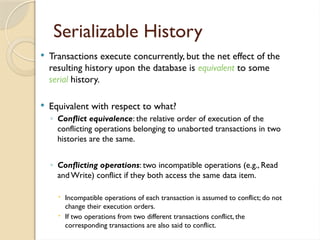
 Transactions execute concurrently, but the net effect of the
resulting history upon the database is equivalent to some
serial history.
 Equivalent with respect to what?
◦ Conflict equivalence: the relative order of execution of the
conflicting operations belonging to unaborted transactions in two
histories are the same.
◦ Conflicting operations: two incompatible operations (e.g., Read
and Write) conflict if they both access the same data item.
 Incompatible operations of each transaction is assumed to conflict; do not
change their execution orders.
 If two operations from two different transactions conflict, the
corresponding transactions are also said to conflict.
Serializable History
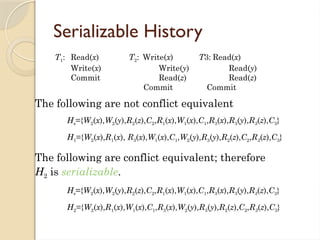
The following are not conflict equivalent
Hs={W2(x),W2(y),R2(z),C2,R1(x),W1(x),C1,R3(x),R3(y),R3(z),C3}
H1={W2(x),R1(x), R3(x),W1(x),C1,W2(y),R3(y),R2(z),C2,R3(z),C3}
The following are conflict equivalent; therefore
H2 is serializable.
Hs={W2(x),W2(y),R2(z),C2,R1(x),W1(x),C1,R3(x),R3(y),R3(z),C3}
H2={W2(x),R1(x),W1(x),C1,R3(x),W2(y),R3(y),R2(z),C2,R3(z),C3}
T1: Read(x) T2: Write(x) T3: Read(x)
Write(x) Write(y) Read(y)
Commit Read(z) Read(z)
Commit Commit
Serializability in Distributed DBMS
 Somewhat more involved.Two histories have to be considered:
◦ local histories
◦ global history
 For global transactions (i.e., global history) to be serializable, two
conditions are necessary:
◦ Each local history should be serializable.
◦ Two conflicting operations should be in the same relative order in all of
the local histories where they appear together.
Global Non-serializability
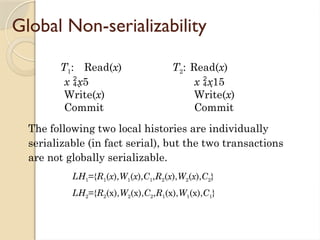
The following two local histories are individually
serializable (in fact serial), but the two transactions
are not globally serializable.
T1: Read(x) T2: Read(x)
x x5 x x15
Write(x) Write(x)
Commit Commit
LH1={R1(x),W1(x),C1,R2(x),W2(x),C2}
LH2={R2(x),W2(x),C2,R1(x),W1(x),C1}
Concurrency Control Algorithms
 Pessimistic
◦ Two-Phase Locking-based (2PL)
 Centralized (primary site) 2PL
 Primary copy 2PL
 Distributed 2PL
◦ Timestamp Ordering (TO)
 BasicTO
 MultiversionTO
 ConservativeTO
◦ Hybrid
 Optimistic
◦ Locking-based
◦ Timestamp ordering-based
Locking-Based Algorithms
 Transactions indicate their intentions by requesting
locks from the scheduler (called lock manager).
 Locks are either read lock (rl) [also called shared lock]
or write lock (wl) [also called exclusive lock]
 Read locks and write locks conflict (because Read and
Write operations are incompatible
rl wl
rl yes no
wl no no
 Locking works nicely to allow concurrent processing of
transactions.
Two-Phase Locking (2PL)
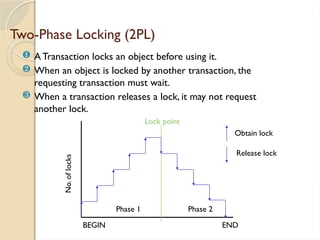
 A Transaction locks an object before using it.
 When an object is locked by another transaction, the
requesting transaction must wait.
 When a transaction releases a lock, it may not request
another lock.
Obtain lock
Release lock
Lock point
Phase 1 Phase 2
BEGIN END
No.
of
locks
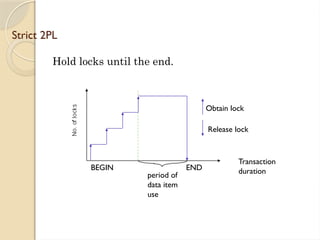
Strict 2PL
Hold locks until the end.
Obtain lock
Release lock
BEGIN END
Transaction
duration
period of
data item
use
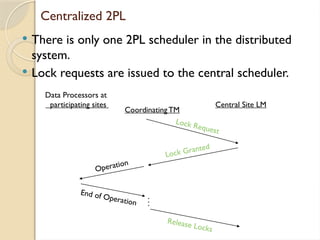
Centralized 2PL
 There is only one 2PL scheduler in the distributed
system.
 Lock requests are issued to the central scheduler.
Data Processors at
participating sites
Coordinating TM
Central Site LM
Lock Request
Lock Granted
Operation
End of Operation
Release Locks
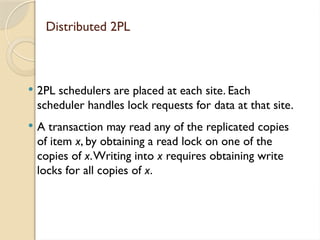
Distributed 2PL
 2PL schedulers are placed at each site. Each
scheduler handles lock requests for data at that site.
 A transaction may read any of the replicated copies
of item x, by obtaining a read lock on one of the
copies of x.Writing into x requires obtaining write
locks for all copies of x.
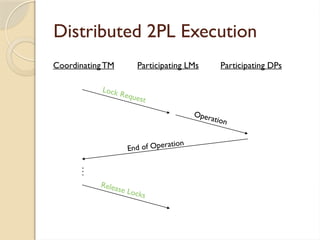
Distributed 2PL Execution
CoordinatingTM Participating LMs Participating DPs
Lock Request
Operation
End of Operation
Release Locks
Timestamp Ordering
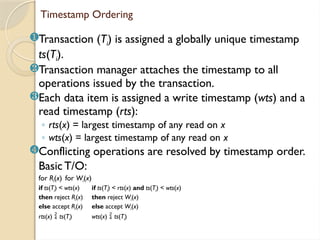
Transaction (Ti) is assigned a globally unique timestamp
ts(Ti).
Transaction manager attaches the timestamp to all
operations issued by the transaction.
Each data item is assigned a write timestamp (wts) and a
read timestamp (rts):
◦ rts(x) = largest timestamp of any read on x
◦ wts(x) = largest timestamp of any read on x
Conflicting operations are resolved by timestamp order.
Basic T/O:
for Ri(x) for Wi(x)
if ts(Ti) < wts(x) if ts(Ti) < rts(x) and ts(Ti) < wts(x)
then reject Ri(x) then reject Wi(x)
else accept Ri(x) else accept Wi(x)
rts(x) ts(Ti) wts(x) ts(Ti)
Conservative Timestamp Ordering
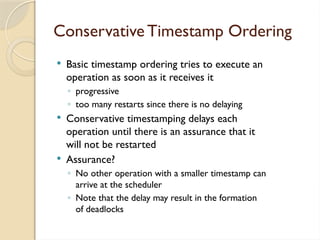
 Basic timestamp ordering tries to execute an
operation as soon as it receives it
◦ progressive
◦ too many restarts since there is no delaying
 Conservative timestamping delays each
operation until there is an assurance that it
will not be restarted
 Assurance?
◦ No other operation with a smaller timestamp can
arrive at the scheduler
◦ Note that the delay may result in the formation
of deadlocks
Multiversion Timestamp Ordering
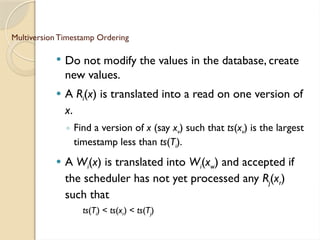
 Do not modify the values in the database, create
new values.
 A Ri(x) is translated into a read on one version of
x.
◦ Find a version of x (say xv) such that ts(xv) is the largest
timestamp less than ts(Ti).
 A Wi(x) is translated into Wi(xw) and accepted if
the scheduler has not yet processed any Rj(xr)
such that
ts(Ti) < ts(xr) < ts(Tj)
Optimistic Concurrency Control Algorithms
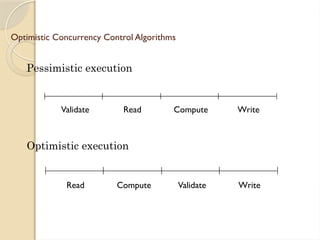
Pessimistic execution
Optimistic execution
Validate Read Compute Write
Validate
Read Compute Write
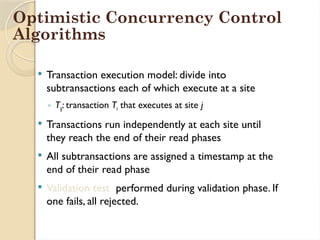
 Transaction execution model: divide into
subtransactions each of which execute at a site
◦ Tij: transaction Ti that executes at site j
 Transactions run independently at each site until
they reach the end of their read phases
 All subtransactions are assigned a timestamp at the
end of their read phase
 Validation test performed during validation phase. If
one fails, all rejected.
Optimistic Concurrency Control
Algorithms
Optimistic CCValidation Test
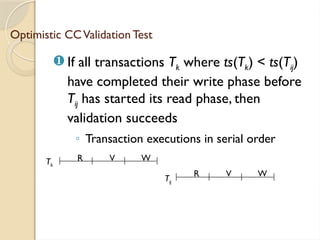
 If all transactions Tk where ts(Tk) < ts(Tij)
have completed their write phase before
Tij has started its read phase, then
validation succeeds
◦ Transaction executions in serial order
Tk
R V W
R V W
Tij
Optimistic CCValidation Test
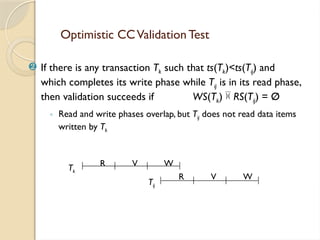
 If there is any transaction Tk such that ts(Tk)<ts(Tij) and
which completes its write phase while Tij is in its read phase,
then validation succeeds if WS(Tk)  RS(Tij) = Ø
◦ Read and write phases overlap, but Tij does not read data items
written by Tk
R V W
Tk
R V W
Tij
Optimistic CCValidation Test
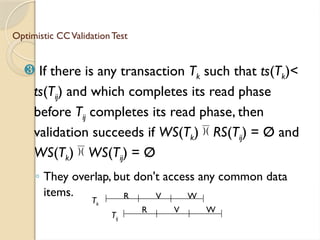
 If there is any transaction Tk such that ts(Tk)<
ts(Tij) and which completes its read phase
before Tij completes its read phase, then
validation succeeds if WS(Tk) RS(Tij) = Ø and
WS(Tk) WS(Tij) = Ø
◦ They overlap, but don't access any common data
items. R V W
Tk
R V W
Tij
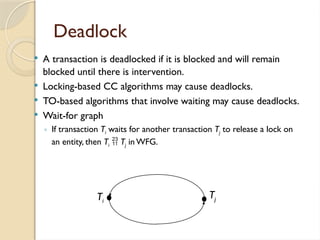
Deadlock
 A transaction is deadlocked if it is blocked and will remain
blocked until there is intervention.
 Locking-based CC algorithms may cause deadlocks.
 TO-based algorithms that involve waiting may cause deadlocks.
 Wait-for graph
◦ If transaction Ti waits for another transaction Tj to release a lock on
an entity, then Ti  Tj in WFG.
Ti
Tj
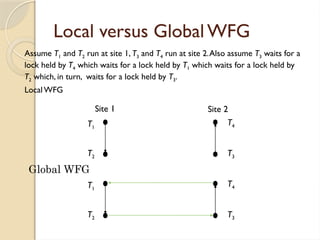
Local versus GlobalWFG
Assume T1 and T2 run at site 1, T3 and T4 run at site 2.Also assume T3 waits for a
lock held by T4 which waits for a lock held by T1 which waits for a lock held by
T2 which, in turn, waits for a lock held by T3.
Local WFG
Global WFG
T1
Site 1 Site 2
T2
T4
T3
T1
T2
T4
T3
Deadlock Management
 Ignore
◦ Let the application programmer deal with it, or restart the
system
 Prevention
◦ Guaranteeing that deadlocks can never occur in the first place.
Check transaction when it is initiated. Requires no run time
support.
 Avoidance
◦ Detecting potential deadlocks in advance and taking action to
insure that deadlock will not occur. Requires run time support.
 Detection and Recovery
◦ Allowing deadlocks to form and then finding and breaking
them.As in the avoidance scheme, this requires run time
support.
Deadlock Prevention
 All resources which may be needed by a transaction must be
predeclared.
◦ The system must guarantee that none of the resources will be
needed by an ongoing transaction.
◦ Resources must only be reserved, but not necessarily allocated a
priori
◦ Unsuitability of the scheme in database environment
◦ Suitable for systems that have no provisions for undoing
processes.
 Evaluation:
– Reduced concurrency due to preallocation
– Evaluating whether an allocation is safe leads to added overhead.
– Difficult to determine (partial order)
+ No transaction rollback or restart is involved.
Deadlock Avoidance
 Transactions are not required to request resources
a priori.
 Transactions are allowed to proceed unless a
requested resource is unavailable.
 In case of conflict, transactions may be allowed to
wait for a fixed time interval.
 Order either the data items or the sites and always
request locks in that order.
 More attractive than prevention in a database
environment.
Deadlock Avoidance –
Wait-Die & Wound-Wait Algorithms
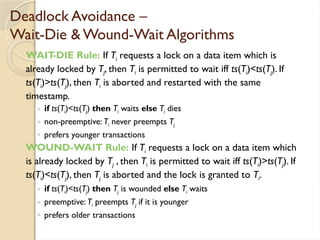
WAIT
-DIE Rule: If Ti requests a lock on a data item which is
already locked by Tj, then Ti is permitted to wait iff ts(Ti)<ts(Tj). If
ts(Ti)>ts(Tj), then Ti is aborted and restarted with the same
timestamp.
◦ if ts(Ti)<ts(Tj) then Ti waits else Ti dies
◦ non-preemptive: Ti never preempts Tj
◦ prefers younger transactions
WOUND-WAIT Rule: If Ti requests a lock on a data item which
is already locked by Tj , then Ti is permitted to wait iff ts(Ti)>ts(Tj). If
ts(Ti)<ts(Tj), then Tj is aborted and the lock is granted to Ti.
◦ if ts(Ti)<ts(Tj) then Tj is wounded else Ti waits
◦ preemptive: Ti preempts Tj if it is younger
◦ prefers older transactions
Deadlock Detection
 Transactions are allowed to wait freely.
 Wait-for graphs and cycles.
 Topologies for deadlock detection algorithms
◦ Centralized
◦ Distributed
◦ Hierarchical
Centralized Deadlock Detection
 One site is designated as the deadlock detector for the
system. Each scheduler periodically sends its local WFG to
the central site which merges them to a global WFG to
determine cycles.
 How often to transmit?
◦ Too often  higher communication cost but lower delays due to
undetected deadlocks
◦ Too late  higher delays due to deadlocks, but lower
communication cost
 Would be a reasonable choice if the concurrency control
algorithm is also centralized.
 Proposed for Distributed INGRES
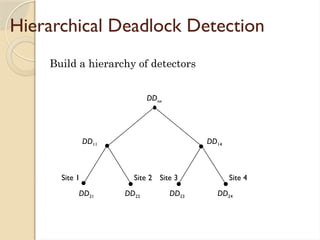
Build a hierarchy of detectors
Hierarchical Deadlock Detection
Site 1 Site 2 Site 3 Site 4
DD21 DD22 DD23 DD24
DD11 DD14
DDox
Distributed Deadlock Detection
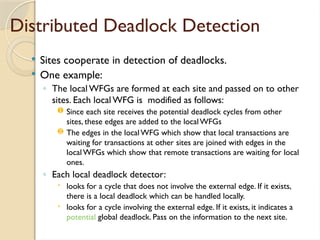
 Sites cooperate in detection of deadlocks.
 One example:
◦ The local WFGs are formed at each site and passed on to other
sites. Each local WFG is modified as follows:
 Since each site receives the potential deadlock cycles from other
sites, these edges are added to the localWFGs
 The edges in the localWFG which show that local transactions are
waiting for transactions at other sites are joined with edges in the
local WFGs which show that remote transactions are waiting for local
ones.
◦ Each local deadlock detector:
 looks for a cycle that does not involve the external edge. If it exists,
there is a local deadlock which can be handled locally.
 looks for a cycle involving the external edge. If it exists, it indicates a
potential global deadlock. Pass on the information to the next site.

Chapter_NINE_Concurrency_Control_DBMS.pptx

  • 1.
  • 2.
    Concurrency Control  Theproblem of synchronizing concurrent transactions such that the consistency of the database is maintained while, at the same time, maximum degree of concurrency is achieved.  Anomalies: ◦ Lost updates  The effects of some transactions are not reflected on the database. ◦ Inconsistent retrievals  A transaction, if it reads the same data item more than once, should always read the same value.
  • 3.
    Execution Schedule (orHistory)  An order in which the operations of a set of transactions are executed.  A schedule (history) can be defined as a partial order over the operations of a set of transactions. H1={W2(x),R1(x), R3(x),W1(x),C1,W2(y),R3(y),R2(z),C2,R3(z),C3} T1: Read(x) T2: Write(x) T3: Read(x) Write(x) Write(y) Read(y) Commit Read(z) Read(z) Commit Commit
  • 4.
    Formalization of Schedule Acomplete schedule SC(T) over a set of transactions T={T1, …, Tn} is a partial order SC(T)={T, < T} where T = i i , for i = 1, 2, …, n < T i < i , for i = 1, 2, …, n For any two conflicting operations Oij, Okl  T, either Oij < T Okl or Okl < T Oij
  • 5.
    Complete Schedule –Example Given three transactions T1: Read(x) T2: Write(x) T3: Read(x) Write(x) Write(y) Read(y) Commit Read(z) Read(z) Commit Commit A possible complete schedule is given as the DAG C 1 R3(x) R1(x) W2(x) W1(x) W2(y) R3(y) R3(z) R2(z) C 2 C 3
  • 6.
    Schedule Definition A scheduleis a prefix of a complete schedule such that only some of the operations and only some of the ordering relationships are included. T1: Read(x) T2: Write(x) T3: Read(x) Write(x) Write(y) Read(y) Commit Read(z) Read(z) Commit Commit R1(x) C 1 R3(x) R1(x) R3(x) W2(x) W2(x) W1(x) W2(y) W2(y) R3(y) R3(y) R3(z) R3(z) R2(z) R2(z) C 2 C 3 
  • 7.
    Serial History  Allthe actions of a transaction occur consecutively.  No interleaving of transaction operations.  If each transaction is consistent (obeys integrity rules), then the database is guaranteed to be consistent at the end of executing a serial history. T1: Read(x) T2: Write(x) T3: Read(x) Write(x) Write(y) Read(y) Commit Read(z) Read(z) Commit Commit Hs={W2(x),W2(y),R2(z),C2,R1(x),W1(x),C1,R3(x),R3(y),R3(z),C3}
  • 8.
    Serializable History  Transactionsexecute concurrently, but the net effect of the resulting history upon the database is equivalent to some serial history.  Equivalent with respect to what? ◦ Conflict equivalence: the relative order of execution of the conflicting operations belonging to unaborted transactions in two histories are the same. ◦ Conflicting operations: two incompatible operations (e.g., Read and Write) conflict if they both access the same data item.  Incompatible operations of each transaction is assumed to conflict; do not change their execution orders.  If two operations from two different transactions conflict, the corresponding transactions are also said to conflict.
  • 9.
    Serializable History The followingare not conflict equivalent Hs={W2(x),W2(y),R2(z),C2,R1(x),W1(x),C1,R3(x),R3(y),R3(z),C3} H1={W2(x),R1(x), R3(x),W1(x),C1,W2(y),R3(y),R2(z),C2,R3(z),C3} The following are conflict equivalent; therefore H2 is serializable. Hs={W2(x),W2(y),R2(z),C2,R1(x),W1(x),C1,R3(x),R3(y),R3(z),C3} H2={W2(x),R1(x),W1(x),C1,R3(x),W2(y),R3(y),R2(z),C2,R3(z),C3} T1: Read(x) T2: Write(x) T3: Read(x) Write(x) Write(y) Read(y) Commit Read(z) Read(z) Commit Commit
  • 10.
    Serializability in DistributedDBMS  Somewhat more involved.Two histories have to be considered: ◦ local histories ◦ global history  For global transactions (i.e., global history) to be serializable, two conditions are necessary: ◦ Each local history should be serializable. ◦ Two conflicting operations should be in the same relative order in all of the local histories where they appear together.
  • 11.
    Global Non-serializability The followingtwo local histories are individually serializable (in fact serial), but the two transactions are not globally serializable. T1: Read(x) T2: Read(x) x x5 x x15 Write(x) Write(x) Commit Commit LH1={R1(x),W1(x),C1,R2(x),W2(x),C2} LH2={R2(x),W2(x),C2,R1(x),W1(x),C1}
  • 12.
    Concurrency Control Algorithms Pessimistic ◦ Two-Phase Locking-based (2PL)  Centralized (primary site) 2PL  Primary copy 2PL  Distributed 2PL ◦ Timestamp Ordering (TO)  BasicTO  MultiversionTO  ConservativeTO ◦ Hybrid  Optimistic ◦ Locking-based ◦ Timestamp ordering-based
  • 13.
    Locking-Based Algorithms  Transactionsindicate their intentions by requesting locks from the scheduler (called lock manager).  Locks are either read lock (rl) [also called shared lock] or write lock (wl) [also called exclusive lock]  Read locks and write locks conflict (because Read and Write operations are incompatible rl wl rl yes no wl no no  Locking works nicely to allow concurrent processing of transactions.
  • 14.
    Two-Phase Locking (2PL) A Transaction locks an object before using it.  When an object is locked by another transaction, the requesting transaction must wait.  When a transaction releases a lock, it may not request another lock. Obtain lock Release lock Lock point Phase 1 Phase 2 BEGIN END No. of locks
  • 15.
    Strict 2PL Hold locksuntil the end. Obtain lock Release lock BEGIN END Transaction duration period of data item use
  • 16.
    Centralized 2PL  Thereis only one 2PL scheduler in the distributed system.  Lock requests are issued to the central scheduler. Data Processors at participating sites Coordinating TM Central Site LM Lock Request Lock Granted Operation End of Operation Release Locks
  • 17.
    Distributed 2PL  2PLschedulers are placed at each site. Each scheduler handles lock requests for data at that site.  A transaction may read any of the replicated copies of item x, by obtaining a read lock on one of the copies of x.Writing into x requires obtaining write locks for all copies of x.
  • 18.
    Distributed 2PL Execution CoordinatingTMParticipating LMs Participating DPs Lock Request Operation End of Operation Release Locks
  • 19.
    Timestamp Ordering Transaction (Ti)is assigned a globally unique timestamp ts(Ti). Transaction manager attaches the timestamp to all operations issued by the transaction. Each data item is assigned a write timestamp (wts) and a read timestamp (rts): ◦ rts(x) = largest timestamp of any read on x ◦ wts(x) = largest timestamp of any read on x Conflicting operations are resolved by timestamp order. Basic T/O: for Ri(x) for Wi(x) if ts(Ti) < wts(x) if ts(Ti) < rts(x) and ts(Ti) < wts(x) then reject Ri(x) then reject Wi(x) else accept Ri(x) else accept Wi(x) rts(x) ts(Ti) wts(x) ts(Ti)
  • 20.
    Conservative Timestamp Ordering Basic timestamp ordering tries to execute an operation as soon as it receives it ◦ progressive ◦ too many restarts since there is no delaying  Conservative timestamping delays each operation until there is an assurance that it will not be restarted  Assurance? ◦ No other operation with a smaller timestamp can arrive at the scheduler ◦ Note that the delay may result in the formation of deadlocks
  • 21.
    Multiversion Timestamp Ordering Do not modify the values in the database, create new values.  A Ri(x) is translated into a read on one version of x. ◦ Find a version of x (say xv) such that ts(xv) is the largest timestamp less than ts(Ti).  A Wi(x) is translated into Wi(xw) and accepted if the scheduler has not yet processed any Rj(xr) such that ts(Ti) < ts(xr) < ts(Tj)
  • 22.
    Optimistic Concurrency ControlAlgorithms Pessimistic execution Optimistic execution Validate Read Compute Write Validate Read Compute Write
  • 23.
     Transaction executionmodel: divide into subtransactions each of which execute at a site ◦ Tij: transaction Ti that executes at site j  Transactions run independently at each site until they reach the end of their read phases  All subtransactions are assigned a timestamp at the end of their read phase  Validation test performed during validation phase. If one fails, all rejected. Optimistic Concurrency Control Algorithms
  • 24.
    Optimistic CCValidation Test If all transactions Tk where ts(Tk) < ts(Tij) have completed their write phase before Tij has started its read phase, then validation succeeds ◦ Transaction executions in serial order Tk R V W R V W Tij
  • 25.
    Optimistic CCValidation Test If there is any transaction Tk such that ts(Tk)<ts(Tij) and which completes its write phase while Tij is in its read phase, then validation succeeds if WS(Tk)  RS(Tij) = Ø ◦ Read and write phases overlap, but Tij does not read data items written by Tk R V W Tk R V W Tij
  • 26.
    Optimistic CCValidation Test If there is any transaction Tk such that ts(Tk)< ts(Tij) and which completes its read phase before Tij completes its read phase, then validation succeeds if WS(Tk) RS(Tij) = Ø and WS(Tk) WS(Tij) = Ø ◦ They overlap, but don't access any common data items. R V W Tk R V W Tij
  • 27.
    Deadlock  A transactionis deadlocked if it is blocked and will remain blocked until there is intervention.  Locking-based CC algorithms may cause deadlocks.  TO-based algorithms that involve waiting may cause deadlocks.  Wait-for graph ◦ If transaction Ti waits for another transaction Tj to release a lock on an entity, then Ti  Tj in WFG. Ti Tj
  • 28.
    Local versus GlobalWFG AssumeT1 and T2 run at site 1, T3 and T4 run at site 2.Also assume T3 waits for a lock held by T4 which waits for a lock held by T1 which waits for a lock held by T2 which, in turn, waits for a lock held by T3. Local WFG Global WFG T1 Site 1 Site 2 T2 T4 T3 T1 T2 T4 T3
  • 29.
    Deadlock Management  Ignore ◦Let the application programmer deal with it, or restart the system  Prevention ◦ Guaranteeing that deadlocks can never occur in the first place. Check transaction when it is initiated. Requires no run time support.  Avoidance ◦ Detecting potential deadlocks in advance and taking action to insure that deadlock will not occur. Requires run time support.  Detection and Recovery ◦ Allowing deadlocks to form and then finding and breaking them.As in the avoidance scheme, this requires run time support.
  • 30.
    Deadlock Prevention  Allresources which may be needed by a transaction must be predeclared. ◦ The system must guarantee that none of the resources will be needed by an ongoing transaction. ◦ Resources must only be reserved, but not necessarily allocated a priori ◦ Unsuitability of the scheme in database environment ◦ Suitable for systems that have no provisions for undoing processes.  Evaluation: – Reduced concurrency due to preallocation – Evaluating whether an allocation is safe leads to added overhead. – Difficult to determine (partial order) + No transaction rollback or restart is involved.
  • 31.
    Deadlock Avoidance  Transactionsare not required to request resources a priori.  Transactions are allowed to proceed unless a requested resource is unavailable.  In case of conflict, transactions may be allowed to wait for a fixed time interval.  Order either the data items or the sites and always request locks in that order.  More attractive than prevention in a database environment.
  • 32.
    Deadlock Avoidance – Wait-Die& Wound-Wait Algorithms WAIT -DIE Rule: If Ti requests a lock on a data item which is already locked by Tj, then Ti is permitted to wait iff ts(Ti)<ts(Tj). If ts(Ti)>ts(Tj), then Ti is aborted and restarted with the same timestamp. ◦ if ts(Ti)<ts(Tj) then Ti waits else Ti dies ◦ non-preemptive: Ti never preempts Tj ◦ prefers younger transactions WOUND-WAIT Rule: If Ti requests a lock on a data item which is already locked by Tj , then Ti is permitted to wait iff ts(Ti)>ts(Tj). If ts(Ti)<ts(Tj), then Tj is aborted and the lock is granted to Ti. ◦ if ts(Ti)<ts(Tj) then Tj is wounded else Ti waits ◦ preemptive: Ti preempts Tj if it is younger ◦ prefers older transactions
  • 33.
    Deadlock Detection  Transactionsare allowed to wait freely.  Wait-for graphs and cycles.  Topologies for deadlock detection algorithms ◦ Centralized ◦ Distributed ◦ Hierarchical
  • 34.
    Centralized Deadlock Detection One site is designated as the deadlock detector for the system. Each scheduler periodically sends its local WFG to the central site which merges them to a global WFG to determine cycles.  How often to transmit? ◦ Too often  higher communication cost but lower delays due to undetected deadlocks ◦ Too late  higher delays due to deadlocks, but lower communication cost  Would be a reasonable choice if the concurrency control algorithm is also centralized.  Proposed for Distributed INGRES
  • 35.
    Build a hierarchyof detectors Hierarchical Deadlock Detection Site 1 Site 2 Site 3 Site 4 DD21 DD22 DD23 DD24 DD11 DD14 DDox
  • 36.
    Distributed Deadlock Detection Sites cooperate in detection of deadlocks.  One example: ◦ The local WFGs are formed at each site and passed on to other sites. Each local WFG is modified as follows:  Since each site receives the potential deadlock cycles from other sites, these edges are added to the localWFGs  The edges in the localWFG which show that local transactions are waiting for transactions at other sites are joined with edges in the local WFGs which show that remote transactions are waiting for local ones. ◦ Each local deadlock detector:  looks for a cycle that does not involve the external edge. If it exists, there is a local deadlock which can be handled locally.  looks for a cycle involving the external edge. If it exists, it indicates a potential global deadlock. Pass on the information to the next site.