Consistency and Replication
Chapter 6
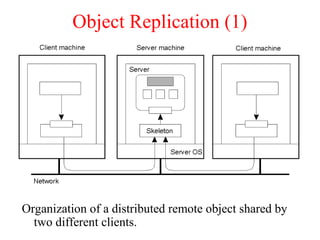
Object Replication (1)
Organization of a distributed remote object shared by
two different clients.
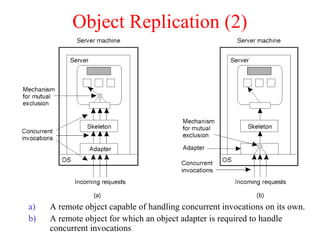
Object Replication (2)
a) A remote object capable of handling concurrent invocations on its own.
b) A remote object for which an object adapter is required to handle
concurrent invocations
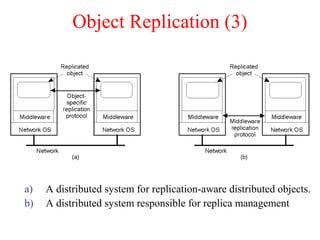
Object Replication (3)
a) A distributed system for replication-aware distributed objects.
b) A distributed system responsible for replica management
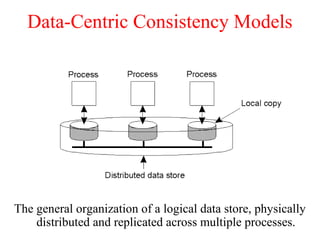
Data-Centric Consistency Models
The general organization of a logical data store, physically
distributed and replicated across multiple processes.
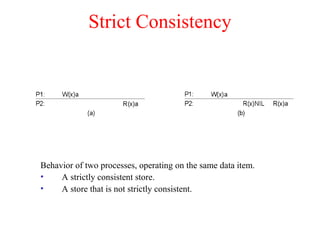
Strict Consistency
Behavior of two processes, operating on the same data item.
• A strictly consistent store.
• A store that is not strictly consistent.
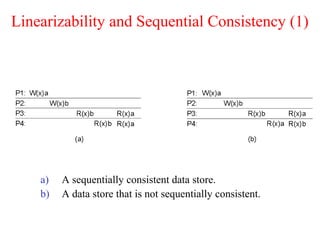
Linearizability and Sequential Consistency (1)
a) A sequentially consistent data store.
b) A data store that is not sequentially consistent.
Linearizability and Sequential Consistency (2)
Three concurrently executing processes.
Process P1 Process P2 Process P3
x = 1;
print ( y, z);
y = 1;
print (x, z);
z = 1;
print (x, y);
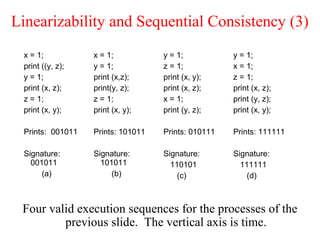
Linearizability and Sequential Consistency (3)
Four valid execution sequences for the processes of the
previous slide. The vertical axis is time.
x = 1;
print ((y, z);
y = 1;
print (x, z);
z = 1;
print (x, y);
Prints: 001011
Signature:
001011
(a)
x = 1;
y = 1;
print (x,z);
print(y, z);
z = 1;
print (x, y);
Prints: 101011
Signature:
101011
(b)
y = 1;
z = 1;
print (x, y);
print (x, z);
x = 1;
print (y, z);
Prints: 010111
Signature:
110101
(c)
y = 1;
x = 1;
z = 1;
print (x, z);
print (y, z);
print (x, y);
Prints: 111111
Signature:
111111
(d)
Casual Consistency (1)
Necessary condition:
Writes that are potentially casually
related must be seen by all processes
in the same order. Concurrent
writes may be seen in a different
order on different machines.
Casual Consistency (2)
This sequence is allowed with a casually-consistent store, but
not with sequentially or strictly consistent store.
Casual Consistency (3)
a) A violation of a casually-consistent store.
b) A correct sequence of events in a casually-consistent store.
FIFO Consistency (1)
Necessary Condition:
Writes done by a single process are seen
by all other processes in the order in
which they were issued, but writes from
different processes may be seen in a
different order by different processes.
FIFO Consistency (2)
A valid sequence of events of FIFO consistency
FIFO Consistency (3)
Statement execution as seen by the three processes from the
previous slide. The statements in bold are the ones that
generate the output shown.
x = 1;
print (y, z);
y = 1;
print(x, z);
z = 1;
print (x, y);
Prints: 00
(a)
x = 1;
y = 1;
print(x, z);
print ( y, z);
z = 1;
print (x, y);
Prints: 10
(b)
y = 1;
print (x, z);
z = 1;
print (x, y);
x = 1;
print (y, z);
Prints: 01
(c)
FIFO Consistency (4)
Two concurrent processes.
Process P1 Process P2
x = 1;
if (y == 0) kill (P2);
y = 1;
if (x == 0) kill (P1);
Weak Consistency (1)
Properties:
• Accesses to synchronization variables
associated with a data store are sequentially
consistent
• No operation on a synchronization variable is
allowed to be performed until all previous
writes have been completed everywhere
• No read or write operation on data items are
allowed to be performed until all previous
operations to synchronization variables have
been performed.
Weak Consistency (2)
A program fragment in which some variables may be
kept in registers.
int a, b, c, d, e, x, y; /* variables */
int *p, *q; /* pointers */
int f( int *p, int *q); /* function prototype */
a = x * x; /* a stored in register */
b = y * y; /* b as well */
c = a*a*a + b*b + a * b; /* used later */
d = a * a * c; /* used later */
p = &a; /* p gets address of a */
q = &b /* q gets address of b */
e = f(p, q) /* function call */
Weak Consistency (3)
a) A valid sequence of events for weak
consistency.
b) An invalid sequence for weak consistency.
Release Consistency (1)
A valid event sequence for release consistency.
Release Consistency (2)
Rules:
• Before a read or write operation on shared data
is performed, all previous acquires done by the
process must have completed successfully.
• Before a release is allowed to be performed, all
previous reads and writes by the process must
have completed
• Accesses to synchronization variables are FIFO
consistent (sequential consistency is not
required).
Entry Consistency (1)
Conditions:
• An acquire access of a synchronization variable is not allowed
to perform with respect to a process until all updates to the
guarded shared data have been performed with respect to that
process.
• Before an exclusive mode access to a synchronization variable
by a process is allowed to perform with respect to that process,
no other process may hold the synchronization variable, not
even in nonexclusive mode.
• After an exclusive mode access to a synchronization variable
has been performed, any other process's next nonexclusive
mode access to that synchronization variable may not be
performed until it has performed with respect to that variable's
owner.
Entry Consistency (1)
A valid event sequence for entry consistency.
Summary of Consistency Models
a) Consistency models not using synchronization operations.
b) Models with synchronization operations.
Consistency Description
Strict Absolute time ordering of all shared accesses matters.
Linearizability
All processes must see all shared accesses in the same order. Accesses are
furthermore ordered according to a (nonunique) global timestamp
Sequential
All processes see all shared accesses in the same order. Accesses are not ordered in
time
Causal All processes see causally-related shared accesses in the same order.
FIFO
All processes see writes from each other in the order they were used. Writes from
different processes may not always be seen in that order
(a)
Consistency Description
Weak Shared data can be counted on to be consistent only after a synchronization is done
Release Shared data are made consistent when a critical region is exited
Entry Shared data pertaining to a critical region are made consistent when a critical region is
entered.
(b)
Eventual Consistency
The principle of a mobile user accessing different
replicas of a distributed database.
Monotonic Reads
The read operations performed by a single process P at two
different local copies of the same data store.
a) A monotonic-read consistent data store
b) A data store that does not provide monotonic reads.
Monotonic Writes
The write operations performed by a single process P at two different local
copies of the same data store
a) A monotonic-write consistent data store.
b) A data store that does not provide monotonic-write consistency.
Read Your Writes
a) A data store that provides read-your-writes consistency.
b) A data store that does not.
Writes Follow Reads
a) A writes-follow-reads consistent data store
b) A data store that does not provide writes-follow-reads
consistency
Replica Placement
The logical organization of different kinds of
copies of a data store into three concentric rings.
Server-Initiated Replicas
Counting access requests from different clients.
Pull versus Push Protocols
A comparison between push-based and pull-based protocols
in the case of multiple client, single server systems.
Issue Push-based Pull-based
State of server List of client replicas and caches None
Messages sent Update (and possibly fetch update later) Poll and update
Response time at
client
Immediate (or fetch-update time) Fetch-update time
Remote-Write Protocols (1)
Primary-based remote-write protocol with a fixed server
to which all read and write operations are forwarded.
Remote-Write Protocols (2)
The principle of primary-
backup protocol.
Local-Write Protocols (1)
Primary-based local-write protocol in which a single copy is
migrated between processes.
Local-Write Protocols (2)
Primary-backup protocol in which the primary migrates
to the process wanting to perform an update.
Active Replication (1)
The problem of replicated invocations.
Active Replication (2)
a) Forwarding an invocation request from a replicated object.
b) Returning a reply to a replicated object.
Quorum-Based Protocols
Three examples of the voting algorithm:
a) A correct choice of read and write set
b) A choice that may lead to write-write conflicts
c) A correct choice, known as ROWA (read one, write all)
Orca
A simplified stack object in Orca, with internal
data and two operations.
OBJECT IMPLEMENTATION stack;
top: integer; # variable indicating the top
stack: ARRAY[integer 0..N-1] OF integer # storage for the stack
OPERATION push (item: integer) # function returning nothing
BEGIN
GUARD top < N DO
stack [top] := item; # push item onto the stack
top := top + 1; # increment the stack pointer
OD;
END;
OPERATION pop():integer; # function returning an integer
BEGIN
GUARD top > 0 DO # suspend if the stack is empty
top := top – 1; # decrement the stack pointer
RETURN stack [top]; # return the top item
OD;
END;
BEGIN
top := 0; # initialization
END;
Management of Shared Objects in Orca
Four cases of a process P performing an operation on
an object O in Orca.
Casually-Consistent Lazy Replication
The general organization of a distributed data store. Clients are
assumed to also handle consistency-related communication.
Processing Read Operations
Performing a read operation at a local copy.
Processing Write Operations
Performing a write operation at a local copy.

Distributed System by Pratik Tambekar

  • 1.
  • 2.
    Object Replication (1) Organizationof a distributed remote object shared by two different clients.
  • 3.
    Object Replication (2) a)A remote object capable of handling concurrent invocations on its own. b) A remote object for which an object adapter is required to handle concurrent invocations
  • 4.
    Object Replication (3) a)A distributed system for replication-aware distributed objects. b) A distributed system responsible for replica management
  • 5.
    Data-Centric Consistency Models Thegeneral organization of a logical data store, physically distributed and replicated across multiple processes.
  • 6.
    Strict Consistency Behavior oftwo processes, operating on the same data item. • A strictly consistent store. • A store that is not strictly consistent.
  • 7.
    Linearizability and SequentialConsistency (1) a) A sequentially consistent data store. b) A data store that is not sequentially consistent.
  • 8.
    Linearizability and SequentialConsistency (2) Three concurrently executing processes. Process P1 Process P2 Process P3 x = 1; print ( y, z); y = 1; print (x, z); z = 1; print (x, y);
  • 9.
    Linearizability and SequentialConsistency (3) Four valid execution sequences for the processes of the previous slide. The vertical axis is time. x = 1; print ((y, z); y = 1; print (x, z); z = 1; print (x, y); Prints: 001011 Signature: 001011 (a) x = 1; y = 1; print (x,z); print(y, z); z = 1; print (x, y); Prints: 101011 Signature: 101011 (b) y = 1; z = 1; print (x, y); print (x, z); x = 1; print (y, z); Prints: 010111 Signature: 110101 (c) y = 1; x = 1; z = 1; print (x, z); print (y, z); print (x, y); Prints: 111111 Signature: 111111 (d)
  • 10.
    Casual Consistency (1) Necessarycondition: Writes that are potentially casually related must be seen by all processes in the same order. Concurrent writes may be seen in a different order on different machines.
  • 11.
    Casual Consistency (2) Thissequence is allowed with a casually-consistent store, but not with sequentially or strictly consistent store.
  • 12.
    Casual Consistency (3) a)A violation of a casually-consistent store. b) A correct sequence of events in a casually-consistent store.
  • 13.
    FIFO Consistency (1) NecessaryCondition: Writes done by a single process are seen by all other processes in the order in which they were issued, but writes from different processes may be seen in a different order by different processes.
  • 14.
    FIFO Consistency (2) Avalid sequence of events of FIFO consistency
  • 15.
    FIFO Consistency (3) Statementexecution as seen by the three processes from the previous slide. The statements in bold are the ones that generate the output shown. x = 1; print (y, z); y = 1; print(x, z); z = 1; print (x, y); Prints: 00 (a) x = 1; y = 1; print(x, z); print ( y, z); z = 1; print (x, y); Prints: 10 (b) y = 1; print (x, z); z = 1; print (x, y); x = 1; print (y, z); Prints: 01 (c)
  • 16.
    FIFO Consistency (4) Twoconcurrent processes. Process P1 Process P2 x = 1; if (y == 0) kill (P2); y = 1; if (x == 0) kill (P1);
  • 17.
    Weak Consistency (1) Properties: •Accesses to synchronization variables associated with a data store are sequentially consistent • No operation on a synchronization variable is allowed to be performed until all previous writes have been completed everywhere • No read or write operation on data items are allowed to be performed until all previous operations to synchronization variables have been performed.
  • 18.
    Weak Consistency (2) Aprogram fragment in which some variables may be kept in registers. int a, b, c, d, e, x, y; /* variables */ int *p, *q; /* pointers */ int f( int *p, int *q); /* function prototype */ a = x * x; /* a stored in register */ b = y * y; /* b as well */ c = a*a*a + b*b + a * b; /* used later */ d = a * a * c; /* used later */ p = &a; /* p gets address of a */ q = &b /* q gets address of b */ e = f(p, q) /* function call */
  • 19.
    Weak Consistency (3) a)A valid sequence of events for weak consistency. b) An invalid sequence for weak consistency.
  • 20.
    Release Consistency (1) Avalid event sequence for release consistency.
  • 21.
    Release Consistency (2) Rules: •Before a read or write operation on shared data is performed, all previous acquires done by the process must have completed successfully. • Before a release is allowed to be performed, all previous reads and writes by the process must have completed • Accesses to synchronization variables are FIFO consistent (sequential consistency is not required).
  • 22.
    Entry Consistency (1) Conditions: •An acquire access of a synchronization variable is not allowed to perform with respect to a process until all updates to the guarded shared data have been performed with respect to that process. • Before an exclusive mode access to a synchronization variable by a process is allowed to perform with respect to that process, no other process may hold the synchronization variable, not even in nonexclusive mode. • After an exclusive mode access to a synchronization variable has been performed, any other process's next nonexclusive mode access to that synchronization variable may not be performed until it has performed with respect to that variable's owner.
  • 23.
    Entry Consistency (1) Avalid event sequence for entry consistency.
  • 24.
    Summary of ConsistencyModels a) Consistency models not using synchronization operations. b) Models with synchronization operations. Consistency Description Strict Absolute time ordering of all shared accesses matters. Linearizability All processes must see all shared accesses in the same order. Accesses are furthermore ordered according to a (nonunique) global timestamp Sequential All processes see all shared accesses in the same order. Accesses are not ordered in time Causal All processes see causally-related shared accesses in the same order. FIFO All processes see writes from each other in the order they were used. Writes from different processes may not always be seen in that order (a) Consistency Description Weak Shared data can be counted on to be consistent only after a synchronization is done Release Shared data are made consistent when a critical region is exited Entry Shared data pertaining to a critical region are made consistent when a critical region is entered. (b)
  • 25.
    Eventual Consistency The principleof a mobile user accessing different replicas of a distributed database.
  • 26.
    Monotonic Reads The readoperations performed by a single process P at two different local copies of the same data store. a) A monotonic-read consistent data store b) A data store that does not provide monotonic reads.
  • 27.
    Monotonic Writes The writeoperations performed by a single process P at two different local copies of the same data store a) A monotonic-write consistent data store. b) A data store that does not provide monotonic-write consistency.
  • 28.
    Read Your Writes a)A data store that provides read-your-writes consistency. b) A data store that does not.
  • 29.
    Writes Follow Reads a)A writes-follow-reads consistent data store b) A data store that does not provide writes-follow-reads consistency
  • 30.
    Replica Placement The logicalorganization of different kinds of copies of a data store into three concentric rings.
  • 31.
    Server-Initiated Replicas Counting accessrequests from different clients.
  • 32.
    Pull versus PushProtocols A comparison between push-based and pull-based protocols in the case of multiple client, single server systems. Issue Push-based Pull-based State of server List of client replicas and caches None Messages sent Update (and possibly fetch update later) Poll and update Response time at client Immediate (or fetch-update time) Fetch-update time
  • 33.
    Remote-Write Protocols (1) Primary-basedremote-write protocol with a fixed server to which all read and write operations are forwarded.
  • 34.
    Remote-Write Protocols (2) Theprinciple of primary- backup protocol.
  • 35.
    Local-Write Protocols (1) Primary-basedlocal-write protocol in which a single copy is migrated between processes.
  • 36.
    Local-Write Protocols (2) Primary-backupprotocol in which the primary migrates to the process wanting to perform an update.
  • 37.
    Active Replication (1) Theproblem of replicated invocations.
  • 38.
    Active Replication (2) a)Forwarding an invocation request from a replicated object. b) Returning a reply to a replicated object.
  • 39.
    Quorum-Based Protocols Three examplesof the voting algorithm: a) A correct choice of read and write set b) A choice that may lead to write-write conflicts c) A correct choice, known as ROWA (read one, write all)
  • 40.
    Orca A simplified stackobject in Orca, with internal data and two operations. OBJECT IMPLEMENTATION stack; top: integer; # variable indicating the top stack: ARRAY[integer 0..N-1] OF integer # storage for the stack OPERATION push (item: integer) # function returning nothing BEGIN GUARD top < N DO stack [top] := item; # push item onto the stack top := top + 1; # increment the stack pointer OD; END; OPERATION pop():integer; # function returning an integer BEGIN GUARD top > 0 DO # suspend if the stack is empty top := top – 1; # decrement the stack pointer RETURN stack [top]; # return the top item OD; END; BEGIN top := 0; # initialization END;
  • 41.
    Management of SharedObjects in Orca Four cases of a process P performing an operation on an object O in Orca.
  • 42.
    Casually-Consistent Lazy Replication Thegeneral organization of a distributed data store. Clients are assumed to also handle consistency-related communication.
  • 43.
    Processing Read Operations Performinga read operation at a local copy.
  • 44.
    Processing Write Operations Performinga write operation at a local copy.