Distributed Coordination-Based
Systems
Chapter 12
Introduction to Coordination Models
A taxonomy of coordination models (adapted from
[cabri.g2000])
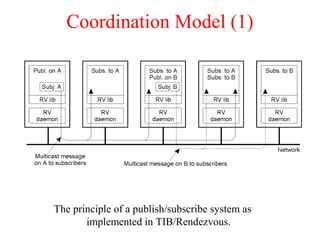
Coordination Model (1)
The principle of a publish/subscribe system as
implemented in TIB/Rendezvous.
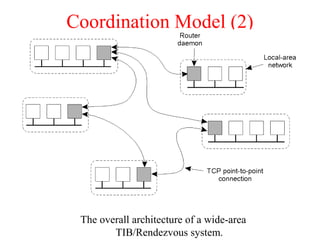
Coordination Model (2)
The overall architecture of a wide-area
TIB/Rendezvous system.
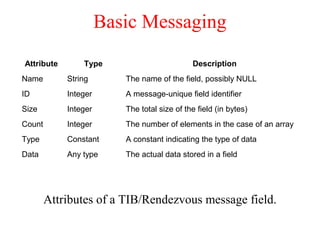
Basic Messaging
Attributes of a TIB/Rendezvous message field.
Attribute Type Description
Name String The name of the field, possibly NULL
ID Integer A message-unique field identifier
Size Integer The total size of the field (in bytes)
Count Integer The number of elements in the case of an array
Type Constant A constant indicating the type of data
Data Any type The actual data stored in a field
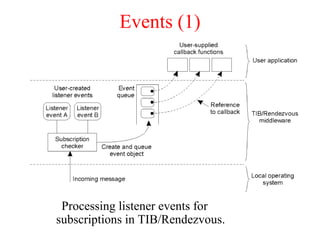
Events (1)
Processing listener events for
subscriptions in TIB/Rendezvous.
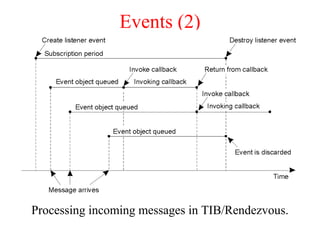
Events (2)
Processing incoming messages in TIB/Rendezvous.
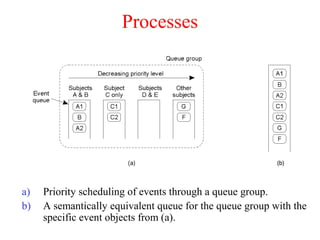
Processes
a) Priority scheduling of events through a queue group.
b) A semantically equivalent queue for the queue group with the
specific event objects from (a).
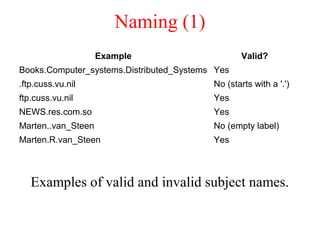
Naming (1)
Examples of valid and invalid subject names.
Example Valid?
Books.Computer_systems.Distributed_Systems Yes
.ftp.cuss.vu.nil No (starts with a '.')
ftp.cuss.vu.nil Yes
NEWS.res.com.so Yes
Marten..van_Steen No (empty label)
Marten.R.van_Steen Yes
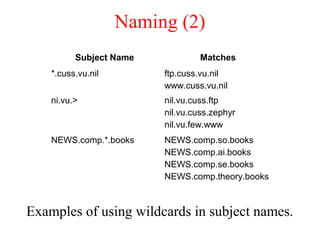
Naming (2)
Examples of using wildcards in subject names.
Subject Name Matches
*.cuss.vu.nil ftp.cuss.vu.nil
www.cuss.vu.nil
ni.vu.> nil.vu.cuss.ftp
nil.vu.cuss.zephyr
nil.vu.few.www
NEWS.comp.*.books NEWS.comp.so.books
NEWS.comp.ai.books
NEWS.comp.se.books
NEWS.comp.theory.books
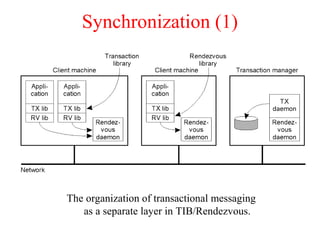
Synchronization (1)
The organization of transactional messaging
as a separate layer in TIB/Rendezvous.
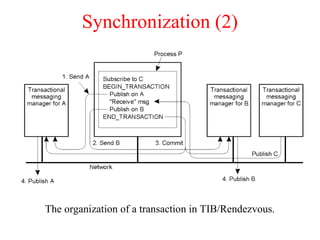
Synchronization (2)
The organization of a transaction in TIB/Rendezvous.
Reliable Communication
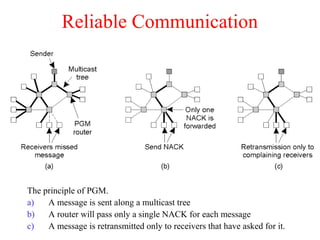
The principle of PGM.
a) A message is sent along a multicast tree
b) A router will pass only a single NACK for each message
c) A message is retransmitted only to receivers that have asked for it.
Security
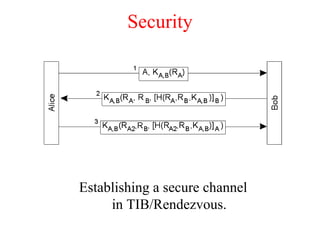
Establishing a secure channel
in TIB/Rendezvous.
Overview of Jini
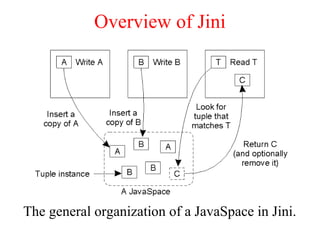
The general organization of a JavaSpace in Jini.
Architecture
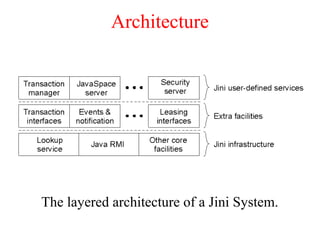
The layered architecture of a Jini System.
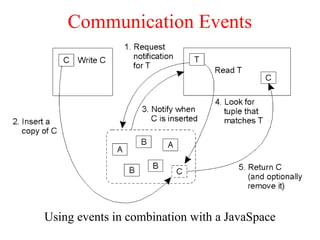
Communication Events
Using events in combination with a JavaSpace
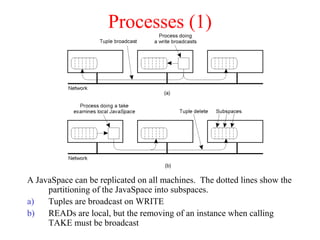
Processes (1)
A JavaSpace can be replicated on all machines. The dotted lines show the
partitioning of the JavaSpace into subspaces.
a) Tuples are broadcast on WRITE
b) READs are local, but the removing of an instance when calling
TAKE must be broadcast
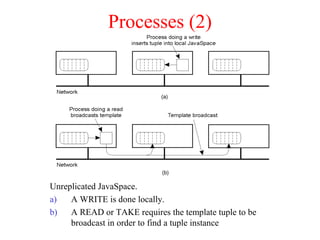
Processes (2)
Unreplicated JavaSpace.
a) A WRITE is done locally.
b) A READ or TAKE requires the template tuple to be
broadcast in order to find a tuple instance
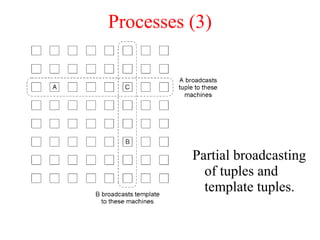
Processes (3)
Partial broadcasting
of tuples and
template tuples.
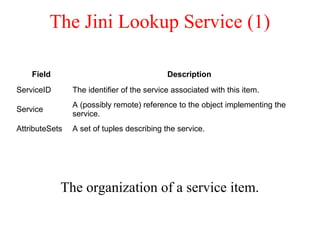
The Jini Lookup Service (1)
The organization of a service item.
Field Description
ServiceID The identifier of the service associated with this item.
Service
A (possibly remote) reference to the object implementing the
service.
AttributeSets A set of tuples describing the service.
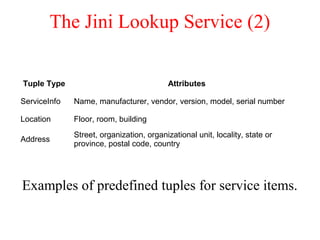
The Jini Lookup Service (2)
Examples of predefined tuples for service items.
Tuple Type Attributes
ServiceInfo Name, manufacturer, vendor, version, model, serial number
Location Floor, room, building
Address
Street, organization, organizational unit, locality, state or
province, postal code, country
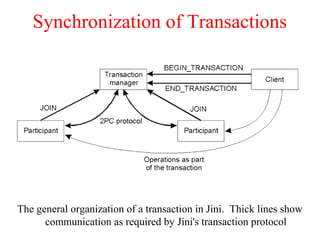
Synchronization of Transactions
The general organization of a transaction in Jini. Thick lines show
communication as required by Jini's transaction protocol
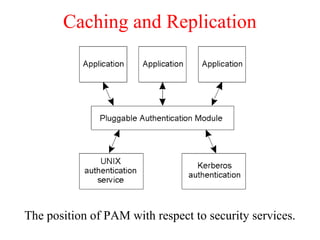
Caching and Replication
The position of PAM with respect to security services.
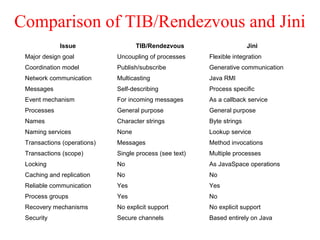
Comparison of TIB/Rendezvous and Jini
Issue TIB/Rendezvous Jini
Major design goal Uncoupling of processes Flexible integration
Coordination model Publish/subscribe Generative communication
Network communication Multicasting Java RMI
Messages Self-describing Process specific
Event mechanism For incoming messages As a callback service
Processes General purpose General purpose
Names Character strings Byte strings
Naming services None Lookup service
Transactions (operations) Messages Method invocations
Transactions (scope) Single process (see text) Multiple processes
Locking No As JavaSpace operations
Caching and replication No No
Reliable communication Yes Yes
Process groups Yes No
Recovery mechanisms No explicit support No explicit support
Security Secure channels Based entirely on Java

Distributed System by Pratik Tambekar

  • 1.
  • 2.
    Introduction to CoordinationModels A taxonomy of coordination models (adapted from [cabri.g2000])
  • 3.
    Coordination Model (1) Theprinciple of a publish/subscribe system as implemented in TIB/Rendezvous.
  • 4.
    Coordination Model (2) Theoverall architecture of a wide-area TIB/Rendezvous system.
  • 5.
    Basic Messaging Attributes ofa TIB/Rendezvous message field. Attribute Type Description Name String The name of the field, possibly NULL ID Integer A message-unique field identifier Size Integer The total size of the field (in bytes) Count Integer The number of elements in the case of an array Type Constant A constant indicating the type of data Data Any type The actual data stored in a field
  • 6.
    Events (1) Processing listenerevents for subscriptions in TIB/Rendezvous.
  • 7.
    Events (2) Processing incomingmessages in TIB/Rendezvous.
  • 8.
    Processes a) Priority schedulingof events through a queue group. b) A semantically equivalent queue for the queue group with the specific event objects from (a).
  • 9.
    Naming (1) Examples ofvalid and invalid subject names. Example Valid? Books.Computer_systems.Distributed_Systems Yes .ftp.cuss.vu.nil No (starts with a '.') ftp.cuss.vu.nil Yes NEWS.res.com.so Yes Marten..van_Steen No (empty label) Marten.R.van_Steen Yes
  • 10.
    Naming (2) Examples ofusing wildcards in subject names. Subject Name Matches *.cuss.vu.nil ftp.cuss.vu.nil www.cuss.vu.nil ni.vu.> nil.vu.cuss.ftp nil.vu.cuss.zephyr nil.vu.few.www NEWS.comp.*.books NEWS.comp.so.books NEWS.comp.ai.books NEWS.comp.se.books NEWS.comp.theory.books
  • 11.
    Synchronization (1) The organizationof transactional messaging as a separate layer in TIB/Rendezvous.
  • 12.
    Synchronization (2) The organizationof a transaction in TIB/Rendezvous.
  • 13.
    Reliable Communication The principleof PGM. a) A message is sent along a multicast tree b) A router will pass only a single NACK for each message c) A message is retransmitted only to receivers that have asked for it.
  • 14.
    Security Establishing a securechannel in TIB/Rendezvous.
  • 15.
    Overview of Jini Thegeneral organization of a JavaSpace in Jini.
  • 16.
  • 17.
    Communication Events Using eventsin combination with a JavaSpace
  • 18.
    Processes (1) A JavaSpacecan be replicated on all machines. The dotted lines show the partitioning of the JavaSpace into subspaces. a) Tuples are broadcast on WRITE b) READs are local, but the removing of an instance when calling TAKE must be broadcast
  • 19.
    Processes (2) Unreplicated JavaSpace. a)A WRITE is done locally. b) A READ or TAKE requires the template tuple to be broadcast in order to find a tuple instance
  • 20.
    Processes (3) Partial broadcasting oftuples and template tuples.
  • 21.
    The Jini LookupService (1) The organization of a service item. Field Description ServiceID The identifier of the service associated with this item. Service A (possibly remote) reference to the object implementing the service. AttributeSets A set of tuples describing the service.
  • 22.
    The Jini LookupService (2) Examples of predefined tuples for service items. Tuple Type Attributes ServiceInfo Name, manufacturer, vendor, version, model, serial number Location Floor, room, building Address Street, organization, organizational unit, locality, state or province, postal code, country
  • 23.
    Synchronization of Transactions Thegeneral organization of a transaction in Jini. Thick lines show communication as required by Jini's transaction protocol
  • 24.
    Caching and Replication Theposition of PAM with respect to security services.
  • 25.
    Comparison of TIB/Rendezvousand Jini Issue TIB/Rendezvous Jini Major design goal Uncoupling of processes Flexible integration Coordination model Publish/subscribe Generative communication Network communication Multicasting Java RMI Messages Self-describing Process specific Event mechanism For incoming messages As a callback service Processes General purpose General purpose Names Character strings Byte strings Naming services None Lookup service Transactions (operations) Messages Method invocations Transactions (scope) Single process (see text) Multiple processes Locking No As JavaSpace operations Caching and replication No No Reliable communication Yes Yes Process groups Yes No Recovery mechanisms No explicit support No explicit support Security Secure channels Based entirely on Java