Operating System 23
Process Synchronization
Prof Neeraj Bhargava
Vaibhav Khanna
Department of Computer Science
School of Engineering and Systems Sciences
Maharshi Dayanand Saraswati University Ajmer
Background
• Processes can execute concurrently
– May be interrupted at any time, partially completing
execution
• Concurrent access to shared data may result in data
inconsistency
• Maintaining data consistency requires mechanisms to
ensure the orderly execution of cooperating processes
• Illustration of the problem:
Suppose that we wanted to provide a solution to the
consumer-producer problem that fills all the buffers.
We can do so by having an integer counter that keeps
track of the number of full buffers. Initially, counter
is set to 0. It is incremented by the producer after it
produces a new buffer and is decremented by the
consumer after it consumes a buffer.
Producer
while (true) {
/* produce an item in next produced */
while (counter == BUFFER_SIZE) ;
/* do nothing */
buffer[in] = next_produced;
in = (in + 1) % BUFFER_SIZE;
counter++;
}
Consumer
while (true) {
while (counter == 0)
; /* do nothing */
next_consumed = buffer[out];
out = (out + 1) % BUFFER_SIZE;
counter--;
/* consume the item in next consumed */
}
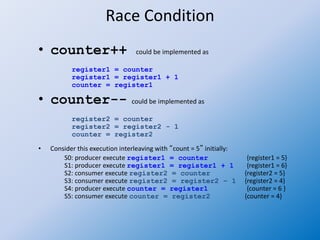
Race Condition
• counter++ could be implemented as
register1 = counter
register1 = register1 + 1
counter = register1
• counter-- could be implemented as
register2 = counter
register2 = register2 - 1
counter = register2
• Consider this execution interleaving with “count = 5” initially:
S0: producer execute register1 = counter {register1 = 5}
S1: producer execute register1 = register1 + 1 {register1 = 6}
S2: consumer execute register2 = counter {register2 = 5}
S3: consumer execute register2 = register2 – 1 {register2 = 4}
S4: producer execute counter = register1 {counter = 6 }
S5: consumer execute counter = register2 {counter = 4}
Process Synchronization
• Process Synchronization means sharing system resources by
processes in a such a way that, Concurrent access to shared
data is handled thereby minimizing the chance of inconsistent
data.
• Maintaining data consistency demands mechanisms to
ensure synchronized execution of cooperating processes.
• Process Synchronization was introduced to handle problems
that arose while multiple process executions.
Critical Section Problem
• A Critical Section is a code segment that accesses
shared variables and has to be executed as an atomic
action.
• It means that in a group of cooperating processes, at a
given point of time, only one process must be executing
its critical section.
• If any other process also wants to execute its critical
section, it must wait until the first one finishes.
Critical Section Problem
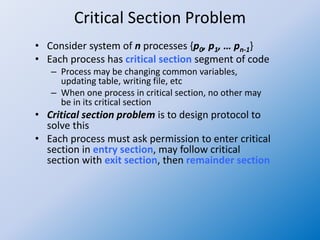
• Consider system of n processes {p0, p1, … pn-1}
• Each process has critical section segment of code
– Process may be changing common variables,
updating table, writing file, etc
– When one process in critical section, no other may
be in its critical section
• Critical section problem is to design protocol to
solve this
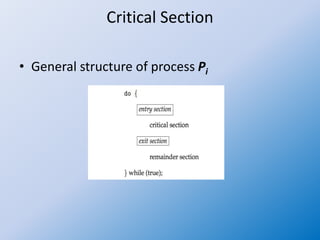
• Each process must ask permission to enter critical
section in entry section, may follow critical
section with exit section, then remainder section
Critical Section
• General structure of process Pi
Solution to Critical Section Problem
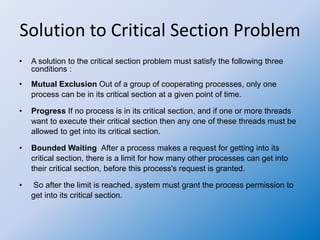
• A solution to the critical section problem must satisfy the following three
conditions :
• Mutual Exclusion Out of a group of cooperating processes, only one
process can be in its critical section at a given point of time.
• Progress If no process is in its critical section, and if one or more threads
want to execute their critical section then any one of these threads must be
allowed to get into its critical section.
• Bounded Waiting After a process makes a request for getting into its
critical section, there is a limit for how many other processes can get into
their critical section, before this process's request is granted.
• So after the limit is reached, system must grant the process permission to
get into its critical section.
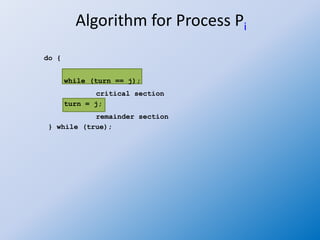
Algorithm for Process Pi
do {
while (turn == j);
critical section
turn = j;
remainder section
} while (true);
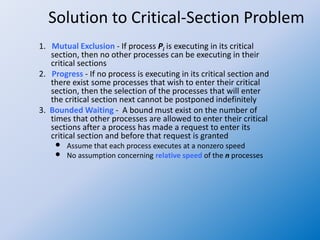
Solution to Critical-Section Problem
1. Mutual Exclusion - If process Pi is executing in its critical
section, then no other processes can be executing in their
critical sections
2. Progress - If no process is executing in its critical section and
there exist some processes that wish to enter their critical
section, then the selection of the processes that will enter
the critical section next cannot be postponed indefinitely
3. Bounded Waiting - A bound must exist on the number of
times that other processes are allowed to enter their critical
sections after a process has made a request to enter its
critical section and before that request is granted
 Assume that each process executes at a nonzero speed
 No assumption concerning relative speed of the n processes
Critical-Section Handling in OS
Two approaches depending on if
kernel is preemptive or non-
preemptive
– Preemptive– allows preemption of
process when running in kernel mode
– Non-preemptive – runs until exits kernel
mode, blocks, or voluntarily yields CPU
• Essentially free of race conditions in kernel
mode
Peterson’s Solution
• Good algorithmic description of solving the
problem
• Two process solution
• Assume that the load and store machine-language
instructions are atomic; that is, cannot be
interrupted
• The two processes share two variables:
– int turn;
– Boolean flag[2]
• The variable turn indicates whose turn it is to enter
the critical section
• The flag array is used to indicate if a process is
ready to enter the critical section. flag[i] = true
implies that process Pi is ready!
Algorithm for Process Pi
do {
flag[i] = true;
turn = j;
while (flag[j] && turn = = j);
critical section
flag[i] = false;
remainder section
} while (true);
Peterson’s Solution (Cont.)
• Provable that the three CS requirement
are met:
1. Mutual exclusion is preserved
Pi enters CS only if:
either flag[j] = false or
turn = i
2. Progress requirement is satisfied
3. Bounded-waiting requirement is met
Synchronization Hardware
• Many systems provide hardware support for
implementing the critical section code.
• All solutions below based on idea of locking
– Protecting critical regions via locks
• Uniprocessors – could disable interrupts
– Currently running code would execute without
preemption
– Generally too inefficient on multiprocessor systems
• Operating systems using this not broadly scalable
• Modern machines provide special atomic hardware
instructions
• Atomic = non-interruptible
– Either test memory word and set value
– Or swap contents of two memory words
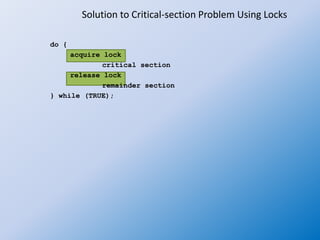
Solution to Critical-section Problem Using Locks
do {
acquire lock
critical section
release lock
remainder section
} while (TRUE);
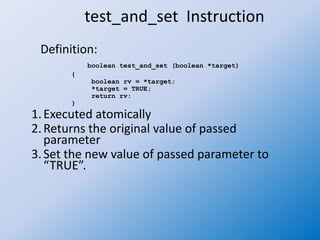
test_and_set Instruction
Definition:
boolean test_and_set (boolean *target)
{
boolean rv = *target;
*target = TRUE;
return rv:
}
1.Executed atomically
2.Returns the original value of passed
parameter
3.Set the new value of passed parameter to
“TRUE”.
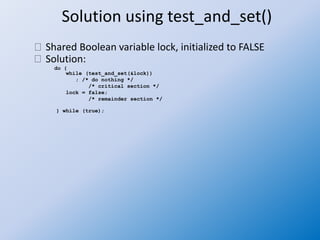
Solution using test_and_set()
Shared Boolean variable lock, initialized to FALSE
Solution:
do {
while (test_and_set(&lock))
; /* do nothing */
/* critical section */
lock = false;
/* remainder section */
} while (true);
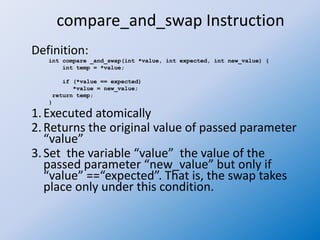
compare_and_swap Instruction
Definition:
int compare _and_swap(int *value, int expected, int new_value) {
int temp = *value;
if (*value == expected)
*value = new_value;
return temp;
}
1.Executed atomically
2.Returns the original value of passed parameter
“value”
3.Set the variable “value” the value of the
passed parameter “new_value” but only if
“value” ==“expected”. That is, the swap takes
place only under this condition.
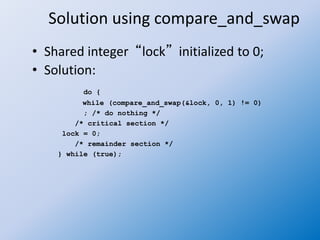
Solution using compare_and_swap
• Shared integer “lock” initialized to 0;
• Solution:
do {
while (compare_and_swap(&lock, 0, 1) != 0)
; /* do nothing */
/* critical section */
lock = 0;
/* remainder section */
} while (true);
Bounded-waiting Mutual Exclusion with test_and_set
do {
waiting[i] = true;
key = true;
while (waiting[i] && key)
key = test_and_set(&lock);
waiting[i] = false;
/* critical section */
j = (i + 1) % n;
while ((j != i) && !waiting[j])
j = (j + 1) % n;
if (j == i)
lock = false;
else
waiting[j] = false;
/* remainder section */
} while (true);
Assignment
• What is Critical Section Problem. Explain the
Solution to Critical-Section Problem.

Operating system 23 process synchronization

  • 1.
    Operating System 23 ProcessSynchronization Prof Neeraj Bhargava Vaibhav Khanna Department of Computer Science School of Engineering and Systems Sciences Maharshi Dayanand Saraswati University Ajmer
  • 2.
    Background • Processes canexecute concurrently – May be interrupted at any time, partially completing execution • Concurrent access to shared data may result in data inconsistency • Maintaining data consistency requires mechanisms to ensure the orderly execution of cooperating processes • Illustration of the problem: Suppose that we wanted to provide a solution to the consumer-producer problem that fills all the buffers. We can do so by having an integer counter that keeps track of the number of full buffers. Initially, counter is set to 0. It is incremented by the producer after it produces a new buffer and is decremented by the consumer after it consumes a buffer.
  • 3.
    Producer while (true) { /*produce an item in next produced */ while (counter == BUFFER_SIZE) ; /* do nothing */ buffer[in] = next_produced; in = (in + 1) % BUFFER_SIZE; counter++; }
  • 4.
    Consumer while (true) { while(counter == 0) ; /* do nothing */ next_consumed = buffer[out]; out = (out + 1) % BUFFER_SIZE; counter--; /* consume the item in next consumed */ }
  • 5.
    Race Condition • counter++could be implemented as register1 = counter register1 = register1 + 1 counter = register1 • counter-- could be implemented as register2 = counter register2 = register2 - 1 counter = register2 • Consider this execution interleaving with “count = 5” initially: S0: producer execute register1 = counter {register1 = 5} S1: producer execute register1 = register1 + 1 {register1 = 6} S2: consumer execute register2 = counter {register2 = 5} S3: consumer execute register2 = register2 – 1 {register2 = 4} S4: producer execute counter = register1 {counter = 6 } S5: consumer execute counter = register2 {counter = 4}
  • 6.
    Process Synchronization • ProcessSynchronization means sharing system resources by processes in a such a way that, Concurrent access to shared data is handled thereby minimizing the chance of inconsistent data. • Maintaining data consistency demands mechanisms to ensure synchronized execution of cooperating processes. • Process Synchronization was introduced to handle problems that arose while multiple process executions.
  • 7.
    Critical Section Problem •A Critical Section is a code segment that accesses shared variables and has to be executed as an atomic action. • It means that in a group of cooperating processes, at a given point of time, only one process must be executing its critical section. • If any other process also wants to execute its critical section, it must wait until the first one finishes.
  • 8.
  • 9.
    Critical Section Problem •Consider system of n processes {p0, p1, … pn-1} • Each process has critical section segment of code – Process may be changing common variables, updating table, writing file, etc – When one process in critical section, no other may be in its critical section • Critical section problem is to design protocol to solve this • Each process must ask permission to enter critical section in entry section, may follow critical section with exit section, then remainder section
  • 10.
    Critical Section • Generalstructure of process Pi
  • 11.
    Solution to CriticalSection Problem • A solution to the critical section problem must satisfy the following three conditions : • Mutual Exclusion Out of a group of cooperating processes, only one process can be in its critical section at a given point of time. • Progress If no process is in its critical section, and if one or more threads want to execute their critical section then any one of these threads must be allowed to get into its critical section. • Bounded Waiting After a process makes a request for getting into its critical section, there is a limit for how many other processes can get into their critical section, before this process's request is granted. • So after the limit is reached, system must grant the process permission to get into its critical section.
  • 12.
    Algorithm for ProcessPi do { while (turn == j); critical section turn = j; remainder section } while (true);
  • 13.
    Solution to Critical-SectionProblem 1. Mutual Exclusion - If process Pi is executing in its critical section, then no other processes can be executing in their critical sections 2. Progress - If no process is executing in its critical section and there exist some processes that wish to enter their critical section, then the selection of the processes that will enter the critical section next cannot be postponed indefinitely 3. Bounded Waiting - A bound must exist on the number of times that other processes are allowed to enter their critical sections after a process has made a request to enter its critical section and before that request is granted  Assume that each process executes at a nonzero speed  No assumption concerning relative speed of the n processes
  • 14.
    Critical-Section Handling inOS Two approaches depending on if kernel is preemptive or non- preemptive – Preemptive– allows preemption of process when running in kernel mode – Non-preemptive – runs until exits kernel mode, blocks, or voluntarily yields CPU • Essentially free of race conditions in kernel mode
  • 15.
    Peterson’s Solution • Goodalgorithmic description of solving the problem • Two process solution • Assume that the load and store machine-language instructions are atomic; that is, cannot be interrupted • The two processes share two variables: – int turn; – Boolean flag[2] • The variable turn indicates whose turn it is to enter the critical section • The flag array is used to indicate if a process is ready to enter the critical section. flag[i] = true implies that process Pi is ready!
  • 16.
    Algorithm for ProcessPi do { flag[i] = true; turn = j; while (flag[j] && turn = = j); critical section flag[i] = false; remainder section } while (true);
  • 17.
    Peterson’s Solution (Cont.) •Provable that the three CS requirement are met: 1. Mutual exclusion is preserved Pi enters CS only if: either flag[j] = false or turn = i 2. Progress requirement is satisfied 3. Bounded-waiting requirement is met
  • 18.
    Synchronization Hardware • Manysystems provide hardware support for implementing the critical section code. • All solutions below based on idea of locking – Protecting critical regions via locks • Uniprocessors – could disable interrupts – Currently running code would execute without preemption – Generally too inefficient on multiprocessor systems • Operating systems using this not broadly scalable • Modern machines provide special atomic hardware instructions • Atomic = non-interruptible – Either test memory word and set value – Or swap contents of two memory words
  • 19.
    Solution to Critical-sectionProblem Using Locks do { acquire lock critical section release lock remainder section } while (TRUE);
  • 20.
    test_and_set Instruction Definition: boolean test_and_set(boolean *target) { boolean rv = *target; *target = TRUE; return rv: } 1.Executed atomically 2.Returns the original value of passed parameter 3.Set the new value of passed parameter to “TRUE”.
  • 21.
    Solution using test_and_set() SharedBoolean variable lock, initialized to FALSE Solution: do { while (test_and_set(&lock)) ; /* do nothing */ /* critical section */ lock = false; /* remainder section */ } while (true);
  • 22.
    compare_and_swap Instruction Definition: int compare_and_swap(int *value, int expected, int new_value) { int temp = *value; if (*value == expected) *value = new_value; return temp; } 1.Executed atomically 2.Returns the original value of passed parameter “value” 3.Set the variable “value” the value of the passed parameter “new_value” but only if “value” ==“expected”. That is, the swap takes place only under this condition.
  • 23.
    Solution using compare_and_swap •Shared integer “lock” initialized to 0; • Solution: do { while (compare_and_swap(&lock, 0, 1) != 0) ; /* do nothing */ /* critical section */ lock = 0; /* remainder section */ } while (true);
  • 24.
    Bounded-waiting Mutual Exclusionwith test_and_set do { waiting[i] = true; key = true; while (waiting[i] && key) key = test_and_set(&lock); waiting[i] = false; /* critical section */ j = (i + 1) % n; while ((j != i) && !waiting[j]) j = (j + 1) % n; if (j == i) lock = false; else waiting[j] = false; /* remainder section */ } while (true);
  • 25.
    Assignment • What isCritical Section Problem. Explain the Solution to Critical-Section Problem.