COTENTS
 Introduction
 Problem description
 Objective
 Critical Section
 Centralized and decentralized mutual exclusion
 Algorithms for mutual exclusion
 Comparison of mutual exclusion algorithms
 Working
 Future scope
 Conclusion
INTRODUCTION
• If cooperating processes are not synchronized,
they may face unexpected timing errors.
• Mutual exclusion is a mechanism to avoid
data inconsistency. It ensure that only one
process (or person) is doing certain things at one
time.
• Mutual exclusion mechanisms are used to
solve Critical Section problems.
Problem description
• In operating systems the problem of mutual
exclusion is very often encountered because of
multiple processes that access, modify certain
shared resources such as data structures.
• The operating system need to ensure that these
shared data structures are not accessed and
modified by multiple processes at the same time
causing incorrect results for the processes
involved.
OBJECTIVE
• Comparison of different mutual exclusion
algorithms.
• Implementation of mutual exclusion problem
using an efficient algorithm.
CRITICAL SECTION
• Critical Section is a section of code or
collection of operations in which only one
process may be executing at a given time, which
we want to make atomic.
• Atomic operations are used to ensure that
cooperating processes execute correctly.
The general structure of a typical
process Pi is shown in figure below
do {
critical section
remainder section
} while (TRUE);
entry section
exit section
Contd..
Requirements for the solution to CS problem
• Mutual exclusion – no two processes will
simultaneously be inside the same CS
• Progress – processes wishing to enter critical
section will eventually do so in finite time
• Bounded waiting – processes will remain inside
its CS for a short time only, without blocking
Centralised and decentralised mutual
exclusion
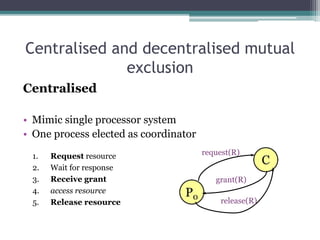
Centralised
• Mimic single processor system
• One process elected as coordinator
1. Request resource
2. Wait for response
3. Receive grant
4. access resource
5. Release resource release(R)
grant(R)
request(R)
Contd..
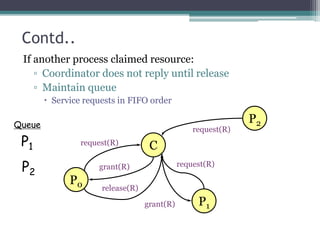
If another process claimed resource:
▫ Coordinator does not reply until release
▫ Maintain queue
 Service requests in FIFO order
P0
Crequest(R)
grant(R)
release(R)
P1
P2
request(R)
request(R)
grant(R)
Queue
P1
P2
Contd..
Benefits
• Fair
▫ All requests processed in order
• Easy to implement, understand, verify
Problems
• Process cannot distinguish being blocked from a
dead coordinator
• Centralized server can be a bottleneck
Decentralized Algorithm
• When a process P wants to enter its critical section, it
generates a new time stamp, TS, and sends the message
request (P,TS) to all other processes in the system.
• A process, which receives reply messages from all other
processes, can enter its critical section.
Contd..
• When a process receives a request message:
a) if it is in CS, defers its answer.
b) if it does not want to enter its CS, reply immediately.
c) if it also wants to enter its CS, it maintains a queue of
requests (including its own request) and sends a reply
to the request with the minimum time-stamp.
Example
• Two processes want to enter the same critical
region at the same moment.
• Process 0 has the lowest timestamp, so it wins.
• When process 0 is done, it sends an OK also; so,
2 can now enter the critical region.
1
0
2
OK
8
12
8
8 12
12
0
1 2
OK
OK
2
0
1
OK
Enters
critical
region
Enters
critical
region
(a) (b) (c)
ALGORITHMS FOR MUTUAL EXCLUSION
Dekker’s Algorithm:
 Dekker’s algorithm is the first known algorithm
that solves the mutual exclusion problem in
concurrent programming.
 It is credited to Th. J. Dekker, a Dutch
mathematician. Dekker's algorithm is used in
process queuing.
flag[i] = TRUE; /* claim the resource */
while (flag[j]=true) /* wait if the other process is using the
{ resource */
if (turn == j) /* if waiting for the resource, also wait
{ our turn */
flag [i] = false; /* but release the resource while waiting
wait until(turn=i)
flag [i] = TRUE;
}
}
//critical section
turn= j; /* pass the turn on, and release the resource */
flag [i] = FALSE;
//remainder section
}
The structure of process A in Dekker's algorithm
Limitations of Dekker’s algorithm
• It creates the problem known as lockstep
synchronization, in which each thread may only
execute in strict synchronization.
• It is also non-expandable as it only supports a
maximum of two processes for mutual exclusion.
Lamport’s Bakery Algorithm
• Lamport’s bakery algorithm is a computing
algorithm that ensures efficient use of shared
resources in a multithreaded environment.
• This algorithm was conceived by Leslie Lamport
and was inspired by the first-come-first-served,
or first-in-first-out (FIFO).
Lamport’s algorithm
1. Broadcast a timestamped request to all.
2. Request received  enqueue it in local Q. Not
in CS  send ack, else postpone sending
ack until exit from CS.
3. Enter CS, when
(i) You are at the “head” of your Q
(ii) You have received ack from all
4. To exit from the CS,
(i) Delete the request from your Q, and
(ii) Broadcast a timestamped release
5. When a process receives a release message,
it removes the sender from its Q.
0 1
2 3
Q0 Q1
Q2 Q3
Completely connected topology
Peterson’s Algorithm
• Peterson's algorithm is a concurrent
programming algorithm developed by Gary L.
Peterson in a 1981 paper.
• Peterson proved the algorithm using both the 2-
process case and the N-process case.
• It uses only shared memory for communication.
Solutions to the Critical Section Problem
through Peterson’s Algorithm:-
Assumption:
1.Assume that a variable (memory location) can
only have one value.
2.If processes A and B write a value to the same
memory location at the ``same time,'' either the
value from A or the value from B will be written
rather than some scrambling (means jumbled
up) of bits.
Fig: Two process handling
using Peterson’s algorithm
Contd..
Peterson's solution requires the two processes to share two
data items:
int turn;
boolean flag[2];
• The variable turn indicates whose turn it is to enter its
critical section
• That is, if turn == i, then process Pi is allowed to execute
in its critical section.
• The flag array is used to indicate if a process is ready to
enter its critical section.
• For example, if flag [i] is true, this value indicates that Pi
is ready to enter its critical section.
critical section
do {
remainder section
} while (TRUE);
Figure:-The structure of process A in Peterson's solution.
flag [i] = TRUE; /* claim the resource */
turn= j; /* give away the turn */
while (flag[j] && turn== j); /* wait while the other process is
using the resource *and* has the turn */
flag [i] = FALSE; /* release the resource */
Comparison of Mutual Exclusion Algorithms
Workings
In this implementation we will have two types of
improvements:
• Time stamped based
• Lock based
Time stamped
• Here only one process at a time is executing the
critical section. The process entering the critical
section depends on the counter for each process.
• When a counter for a process starts, the
particular process enters its critical section and
the other processes are blocked till the counter
for previous process ends.
Screenshots
Contd..
Initially no process
in critical section
Contd..
At counter
1
Process 1 in CS
Process 2 and 3
blocked
Contd..
At counter
2
Process 2 in CS
Process 1 and 3
blocked
Contd..
At counter
3
Process 3 in CS
1&2 blocked
Contd..
At counter
4
Critical
section has
no process
Lock based Mutual Exclusion
• Here two phase locking is used.
▫ Growing Phase (acquire)
▫ Shrinking Phase (release)
• All processes are in growing phase but only one
is allowed to execute the critical section. Process
leaving the critical section goes to shrinking
phase.
Contd..
No process is
executing the
critical section
Contd..
At counter 1, all processes in
growing phase
At counter 2, process 1 enters
the critical section. Process
2,3,4 blocked
Contd..
At counter 3, process 2
enters CS and process 1
enters shrinking phase
At counter 4, process 3
enters CS and process 2
enters shrinking phase
Contd..
At counter 5, process 4 in CS
and process 3 enters
shrinking phase
At counter 6, CS is idle and
process 4 releases the
resources
Discussion
• In time stamped based, processes enters the
critical section when their respective counters
are called. Here for a single counter the process
does only one work (i.e., executing the critical
section)
• In locked based approach for a single counter, a
process enters the critical section and at the
same time enters the shrinking phase so faster
execution of process is done without failure.
Future scope
• This implementation can be further extended in
distributed environment where number of
computers can be connected to show how a
process access a single resource at a time so that
data inconsistency is reduced.
• For example- a single process can only write a
file but cannot read it.
Conclusion
• Concurrent programs are extremely hard to design
and notorious for subtle errors. Slips are often
possible while characterizing, designing, and
proving the properties of concurrent programs.
• In this context, precise understanding of the
concepts and ideas are extremely important and
any misleading interpretations or references about
popular algorithms will only add further
complexity to the subject matter.
THANK YOU

Mutual Exclusion using Peterson's Algorithm

  • 1.
    COTENTS  Introduction  Problemdescription  Objective  Critical Section  Centralized and decentralized mutual exclusion  Algorithms for mutual exclusion  Comparison of mutual exclusion algorithms  Working  Future scope  Conclusion
  • 2.
    INTRODUCTION • If cooperatingprocesses are not synchronized, they may face unexpected timing errors. • Mutual exclusion is a mechanism to avoid data inconsistency. It ensure that only one process (or person) is doing certain things at one time. • Mutual exclusion mechanisms are used to solve Critical Section problems.
  • 3.
    Problem description • Inoperating systems the problem of mutual exclusion is very often encountered because of multiple processes that access, modify certain shared resources such as data structures. • The operating system need to ensure that these shared data structures are not accessed and modified by multiple processes at the same time causing incorrect results for the processes involved.
  • 4.
    OBJECTIVE • Comparison ofdifferent mutual exclusion algorithms. • Implementation of mutual exclusion problem using an efficient algorithm.
  • 5.
    CRITICAL SECTION • CriticalSection is a section of code or collection of operations in which only one process may be executing at a given time, which we want to make atomic. • Atomic operations are used to ensure that cooperating processes execute correctly.
  • 6.
    The general structureof a typical process Pi is shown in figure below do { critical section remainder section } while (TRUE); entry section exit section
  • 7.
    Contd.. Requirements for thesolution to CS problem • Mutual exclusion – no two processes will simultaneously be inside the same CS • Progress – processes wishing to enter critical section will eventually do so in finite time • Bounded waiting – processes will remain inside its CS for a short time only, without blocking
  • 8.
    Centralised and decentralisedmutual exclusion Centralised • Mimic single processor system • One process elected as coordinator 1. Request resource 2. Wait for response 3. Receive grant 4. access resource 5. Release resource release(R) grant(R) request(R)
  • 9.
    Contd.. If another processclaimed resource: ▫ Coordinator does not reply until release ▫ Maintain queue  Service requests in FIFO order P0 Crequest(R) grant(R) release(R) P1 P2 request(R) request(R) grant(R) Queue P1 P2
  • 10.
    Contd.. Benefits • Fair ▫ Allrequests processed in order • Easy to implement, understand, verify Problems • Process cannot distinguish being blocked from a dead coordinator • Centralized server can be a bottleneck
  • 11.
    Decentralized Algorithm • Whena process P wants to enter its critical section, it generates a new time stamp, TS, and sends the message request (P,TS) to all other processes in the system. • A process, which receives reply messages from all other processes, can enter its critical section.
  • 12.
    Contd.. • When aprocess receives a request message: a) if it is in CS, defers its answer. b) if it does not want to enter its CS, reply immediately. c) if it also wants to enter its CS, it maintains a queue of requests (including its own request) and sends a reply to the request with the minimum time-stamp.
  • 13.
    Example • Two processeswant to enter the same critical region at the same moment. • Process 0 has the lowest timestamp, so it wins. • When process 0 is done, it sends an OK also; so, 2 can now enter the critical region. 1 0 2 OK 8 12 8 8 12 12 0 1 2 OK OK 2 0 1 OK Enters critical region Enters critical region (a) (b) (c)
  • 14.
    ALGORITHMS FOR MUTUALEXCLUSION Dekker’s Algorithm:  Dekker’s algorithm is the first known algorithm that solves the mutual exclusion problem in concurrent programming.  It is credited to Th. J. Dekker, a Dutch mathematician. Dekker's algorithm is used in process queuing.
  • 15.
    flag[i] = TRUE;/* claim the resource */ while (flag[j]=true) /* wait if the other process is using the { resource */ if (turn == j) /* if waiting for the resource, also wait { our turn */ flag [i] = false; /* but release the resource while waiting wait until(turn=i) flag [i] = TRUE; } } //critical section turn= j; /* pass the turn on, and release the resource */ flag [i] = FALSE; //remainder section } The structure of process A in Dekker's algorithm
  • 16.
    Limitations of Dekker’salgorithm • It creates the problem known as lockstep synchronization, in which each thread may only execute in strict synchronization. • It is also non-expandable as it only supports a maximum of two processes for mutual exclusion.
  • 17.
    Lamport’s Bakery Algorithm •Lamport’s bakery algorithm is a computing algorithm that ensures efficient use of shared resources in a multithreaded environment. • This algorithm was conceived by Leslie Lamport and was inspired by the first-come-first-served, or first-in-first-out (FIFO).
  • 18.
    Lamport’s algorithm 1. Broadcasta timestamped request to all. 2. Request received  enqueue it in local Q. Not in CS  send ack, else postpone sending ack until exit from CS. 3. Enter CS, when (i) You are at the “head” of your Q (ii) You have received ack from all 4. To exit from the CS, (i) Delete the request from your Q, and (ii) Broadcast a timestamped release 5. When a process receives a release message, it removes the sender from its Q. 0 1 2 3 Q0 Q1 Q2 Q3 Completely connected topology
  • 19.
    Peterson’s Algorithm • Peterson'salgorithm is a concurrent programming algorithm developed by Gary L. Peterson in a 1981 paper. • Peterson proved the algorithm using both the 2- process case and the N-process case. • It uses only shared memory for communication.
  • 20.
    Solutions to theCritical Section Problem through Peterson’s Algorithm:- Assumption: 1.Assume that a variable (memory location) can only have one value. 2.If processes A and B write a value to the same memory location at the ``same time,'' either the value from A or the value from B will be written rather than some scrambling (means jumbled up) of bits.
  • 21.
    Fig: Two processhandling using Peterson’s algorithm
  • 22.
    Contd.. Peterson's solution requiresthe two processes to share two data items: int turn; boolean flag[2]; • The variable turn indicates whose turn it is to enter its critical section • That is, if turn == i, then process Pi is allowed to execute in its critical section. • The flag array is used to indicate if a process is ready to enter its critical section. • For example, if flag [i] is true, this value indicates that Pi is ready to enter its critical section.
  • 23.
    critical section do { remaindersection } while (TRUE); Figure:-The structure of process A in Peterson's solution. flag [i] = TRUE; /* claim the resource */ turn= j; /* give away the turn */ while (flag[j] && turn== j); /* wait while the other process is using the resource *and* has the turn */ flag [i] = FALSE; /* release the resource */
  • 24.
    Comparison of MutualExclusion Algorithms
  • 25.
    Workings In this implementationwe will have two types of improvements: • Time stamped based • Lock based
  • 26.
    Time stamped • Hereonly one process at a time is executing the critical section. The process entering the critical section depends on the counter for each process. • When a counter for a process starts, the particular process enters its critical section and the other processes are blocked till the counter for previous process ends.
  • 27.
  • 28.
  • 29.
    Contd.. At counter 1 Process 1in CS Process 2 and 3 blocked
  • 30.
    Contd.. At counter 2 Process 2in CS Process 1 and 3 blocked
  • 31.
  • 32.
  • 33.
    Lock based MutualExclusion • Here two phase locking is used. ▫ Growing Phase (acquire) ▫ Shrinking Phase (release) • All processes are in growing phase but only one is allowed to execute the critical section. Process leaving the critical section goes to shrinking phase.
  • 34.
    Contd.. No process is executingthe critical section
  • 35.
    Contd.. At counter 1,all processes in growing phase At counter 2, process 1 enters the critical section. Process 2,3,4 blocked
  • 36.
    Contd.. At counter 3,process 2 enters CS and process 1 enters shrinking phase At counter 4, process 3 enters CS and process 2 enters shrinking phase
  • 37.
    Contd.. At counter 5,process 4 in CS and process 3 enters shrinking phase At counter 6, CS is idle and process 4 releases the resources
  • 38.
    Discussion • In timestamped based, processes enters the critical section when their respective counters are called. Here for a single counter the process does only one work (i.e., executing the critical section) • In locked based approach for a single counter, a process enters the critical section and at the same time enters the shrinking phase so faster execution of process is done without failure.
  • 39.
    Future scope • Thisimplementation can be further extended in distributed environment where number of computers can be connected to show how a process access a single resource at a time so that data inconsistency is reduced. • For example- a single process can only write a file but cannot read it.
  • 40.
    Conclusion • Concurrent programsare extremely hard to design and notorious for subtle errors. Slips are often possible while characterizing, designing, and proving the properties of concurrent programs. • In this context, precise understanding of the concepts and ideas are extremely important and any misleading interpretations or references about popular algorithms will only add further complexity to the subject matter.
  • 41.