PRE-CONSOLIDATION
PRESSURE
5TH SEM CIVIL
SOIL MECHANICS (2150609)
GOVERNMENT ENGINEERING COLLEGE,
BHARUCH
Presentation Done By : MITHAIALA NACHIKETA R. 180143106010
PRECONSOLIDATION PRESSURE
2
 It is defined as the ratio of undisturbed peak undrained shear strength to totally
remolded undrained shear strength.
 Pre-consolidation pressure is the maximum effective vertical overburden stress
that a particular soil sample has sustained in the past.
 Pre-consolidation pressure cannot be measured directly, but can be estimated
using a number of different strategies.
 If the current vertical effective stress (σv′) is equal to or greater than σp′, the soil
is said to be normally consolidated.
METHODS
3
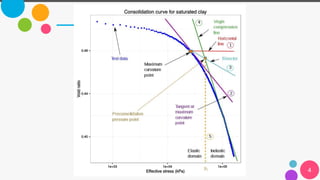
Using a consolidation curve:(Casagrande 1936):-
 Choose by eye the point of maximum curvature on the consolidation curve.
 Draw a horizontal line from this point.
 Draw a line tangent to the curve at the point found in part 1.
 Bisect the angle made from the horizontal line in part 2 and the tangent line in part 3.
 Extend the "straight portion" of the virgin compression curve (high effective stress,
low void ratio: almost vertical on the right of the graph) up to the bisector line in part
4.
 The point where the lines in part 4 and part 5 intersect is the pre-consolidation
pressure.
4
MECHANISMS CAUSING PRECONSOLIDATION
5
Various different factors can cause a soil to approach its pre-consolidation pressure:
 Change in total stress due to removal of overburden can cause pre-consolidation pressure
in a soil.
 Change in pore water pressure: A change in water table elevation, Artesian pressures, deep
pumping or flow into tunnels, and desiccation due to surface drying or plant life can bring soil
to its pre-consolidation pressure.
 Change in soil structure due to aging (secondary compression): Over time, soil will
consolidate even after high pressures from loading and pore water pressure have been
depleted.
 Environmental changes: Changes in pH, temperature, and salt concentration can cause a soil
to approach its pre-consolidation pressure.
 Chemical weathering: Different types of chemical weathering will cause pre-consolidation
pressure. Precipitation, cementing agents, and ion exchange are a few examples.
USES
6
Pre-consolidation pressure is used in many calculations of soil properties essential
for structural analysis and soil mechanics.
One of the primary uses is to predict settlement of a structure after loading. This is
required for any construction project such as new buildings, bridges, large roads and
railroad tracks. All of these require site evaluation before construction.
Preparing a site for construction requires an initial compression of the soil to prepare
for foundation to be added.
It is important to know the pre-consolidation pressure because it will help to determine
the amount of loading that is appropriate for the site. It will also help to determine
whether recompression (after excavation).
THANK YOU !
ANY QUESTIONS ?

pre consolidation pressure

  • 1.
    PRE-CONSOLIDATION PRESSURE 5TH SEM CIVIL SOILMECHANICS (2150609) GOVERNMENT ENGINEERING COLLEGE, BHARUCH Presentation Done By : MITHAIALA NACHIKETA R. 180143106010
  • 2.
    PRECONSOLIDATION PRESSURE 2  Itis defined as the ratio of undisturbed peak undrained shear strength to totally remolded undrained shear strength.  Pre-consolidation pressure is the maximum effective vertical overburden stress that a particular soil sample has sustained in the past.  Pre-consolidation pressure cannot be measured directly, but can be estimated using a number of different strategies.  If the current vertical effective stress (σv′) is equal to or greater than σp′, the soil is said to be normally consolidated.
  • 3.
    METHODS 3 Using a consolidationcurve:(Casagrande 1936):-  Choose by eye the point of maximum curvature on the consolidation curve.  Draw a horizontal line from this point.  Draw a line tangent to the curve at the point found in part 1.  Bisect the angle made from the horizontal line in part 2 and the tangent line in part 3.  Extend the "straight portion" of the virgin compression curve (high effective stress, low void ratio: almost vertical on the right of the graph) up to the bisector line in part 4.  The point where the lines in part 4 and part 5 intersect is the pre-consolidation pressure.
  • 4.
  • 5.
    MECHANISMS CAUSING PRECONSOLIDATION 5 Variousdifferent factors can cause a soil to approach its pre-consolidation pressure:  Change in total stress due to removal of overburden can cause pre-consolidation pressure in a soil.  Change in pore water pressure: A change in water table elevation, Artesian pressures, deep pumping or flow into tunnels, and desiccation due to surface drying or plant life can bring soil to its pre-consolidation pressure.  Change in soil structure due to aging (secondary compression): Over time, soil will consolidate even after high pressures from loading and pore water pressure have been depleted.  Environmental changes: Changes in pH, temperature, and salt concentration can cause a soil to approach its pre-consolidation pressure.  Chemical weathering: Different types of chemical weathering will cause pre-consolidation pressure. Precipitation, cementing agents, and ion exchange are a few examples.
  • 6.
    USES 6 Pre-consolidation pressure isused in many calculations of soil properties essential for structural analysis and soil mechanics. One of the primary uses is to predict settlement of a structure after loading. This is required for any construction project such as new buildings, bridges, large roads and railroad tracks. All of these require site evaluation before construction. Preparing a site for construction requires an initial compression of the soil to prepare for foundation to be added. It is important to know the pre-consolidation pressure because it will help to determine the amount of loading that is appropriate for the site. It will also help to determine whether recompression (after excavation).
  • 7.
    THANK YOU ! ANYQUESTIONS ?