Tahani Hafez                                                                                                  09/29/2010Distance Education
WHAT IS the definition of DISTANCE EDUCATION?
Distance of educationDefinitionDistance education is a field of education that focuses on the pedagogy, technology and instructional system design that aim to deliver education to students who are not physically “on site” in a traditional classroom or campus.
A process to create and provide access to learning when the source of information and the learners are separated by time and distance.
The main advantage of distance education is the students rather than attending courses individually can communicate through internet with the teacher s at their own time and can exchange the material over the net.(Wikipedia, 2010, para. 1)
The main factors for the success of distance education
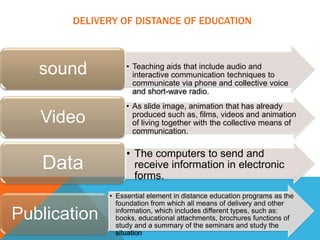
 delivery of Distance of education
Distance education modelsCorrespondence Model      The correspondence model includes very few group work activities or/and collaborative learning .Multimedia ModelThis model requires radio and television networks, therefore, it is necessary for               institutions to employ many specialists in instructional design, media pedagogy, testing and institutional research.Flexible Learning ModelThe significant advantage of this model is that it is the most flexible model and students   everywhere around the world would be able to access the system at the same time. This progress would be done through voice command, voice recognition, pointing and hand gestures to control programming, and artificial intelligence to enable computers to better interpret human commands and requirements .(M/Cyclopedia, 2005, para. 1-4)
Advantages & disadvantages of distance education
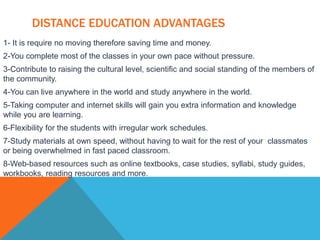
Distance education advantages1- It is require no moving therefore saving time and money.2-You complete most of the classes in your own pace without pressure.3-Contribute to raising the cultural level, scientific and social standing of the members of the community.4-You can live anywhere in the world and study anywhere in the world.5-Taking computer and internet skills will gain you extra information and knowledge while you are learning.6-Flexibility for the students with irregular work schedules.7-Study materials at own speed, without having to wait for the rest of your  classmates or being overwhelmed in fast paced classroom.8-Web-based resources such as online textbooks, case studies, syllabi, study guides, workbooks, reading resources and more.

Distance education

  • 1.
    Tahani Hafez 09/29/2010Distance Education
  • 2.
    WHAT IS thedefinition of DISTANCE EDUCATION?
  • 3.
    Distance of educationDefinitionDistanceeducation is a field of education that focuses on the pedagogy, technology and instructional system design that aim to deliver education to students who are not physically “on site” in a traditional classroom or campus.
  • 4.
    A process tocreate and provide access to learning when the source of information and the learners are separated by time and distance.
  • 5.
    The main advantageof distance education is the students rather than attending courses individually can communicate through internet with the teacher s at their own time and can exchange the material over the net.(Wikipedia, 2010, para. 1)
  • 6.
    The main factorsfor the success of distance education
  • 7.
    delivery ofDistance of education
  • 8.
    Distance education modelsCorrespondenceModel The correspondence model includes very few group work activities or/and collaborative learning .Multimedia ModelThis model requires radio and television networks, therefore, it is necessary for institutions to employ many specialists in instructional design, media pedagogy, testing and institutional research.Flexible Learning ModelThe significant advantage of this model is that it is the most flexible model and students everywhere around the world would be able to access the system at the same time. This progress would be done through voice command, voice recognition, pointing and hand gestures to control programming, and artificial intelligence to enable computers to better interpret human commands and requirements .(M/Cyclopedia, 2005, para. 1-4)
  • 9.
    Advantages & disadvantagesof distance education
  • 10.
    Distance education advantages1-It is require no moving therefore saving time and money.2-You complete most of the classes in your own pace without pressure.3-Contribute to raising the cultural level, scientific and social standing of the members of the community.4-You can live anywhere in the world and study anywhere in the world.5-Taking computer and internet skills will gain you extra information and knowledge while you are learning.6-Flexibility for the students with irregular work schedules.7-Study materials at own speed, without having to wait for the rest of your classmates or being overwhelmed in fast paced classroom.8-Web-based resources such as online textbooks, case studies, syllabi, study guides, workbooks, reading resources and more.

Editor's Notes

  • #4 (Wikipedia, 2010, para. 1)
  • #7 (M/Cyclopedia, 2005, para. 1-4)