Enterprise Application Integration
(EAI)
System Integration & Architecture
Inam Ul Haq
BSIT-6th
University of Education Okara
Lecture 3
Contents
• EAI?
• Architectures
• Middleware
• What is EAI
• A Typical EAI System
• EAI Benefits
• Conclusion
2/31
UniversityofEducationOkara
Defining EAI
3/31
• Why EAI?
– Wouldn’t it be great if everyone used the same servers with
the same operating system with the same clients.
• Reality is very diverse. We can expect a mix of mainframes,
Windows, UNIX, Linux, VMS, as well as many other systems
– Getting them to work/share data together is the issue!
– EAI is defined as “the unrestricted sharing of data and
business processes among any connected applications and
data sources in the enterprise.”
• Using EAI effectively will allow us to integrate without making
major changes to our current infrastructure.
UniversityofEducationOkara
Architectures
• 1 layer architecture
• monolithic Information Systems
• presentation, application logic, and resource
management were merged into a single tier
• 2 layer architecture
• separation of presentation layer from other 2 layers
(app + resource)
• became popular as 'server/client' systems
• 3 layer architecture
• can be achieved by separating RM (resource
management) from application logic layer 4/31
UniversityofEducationOkara
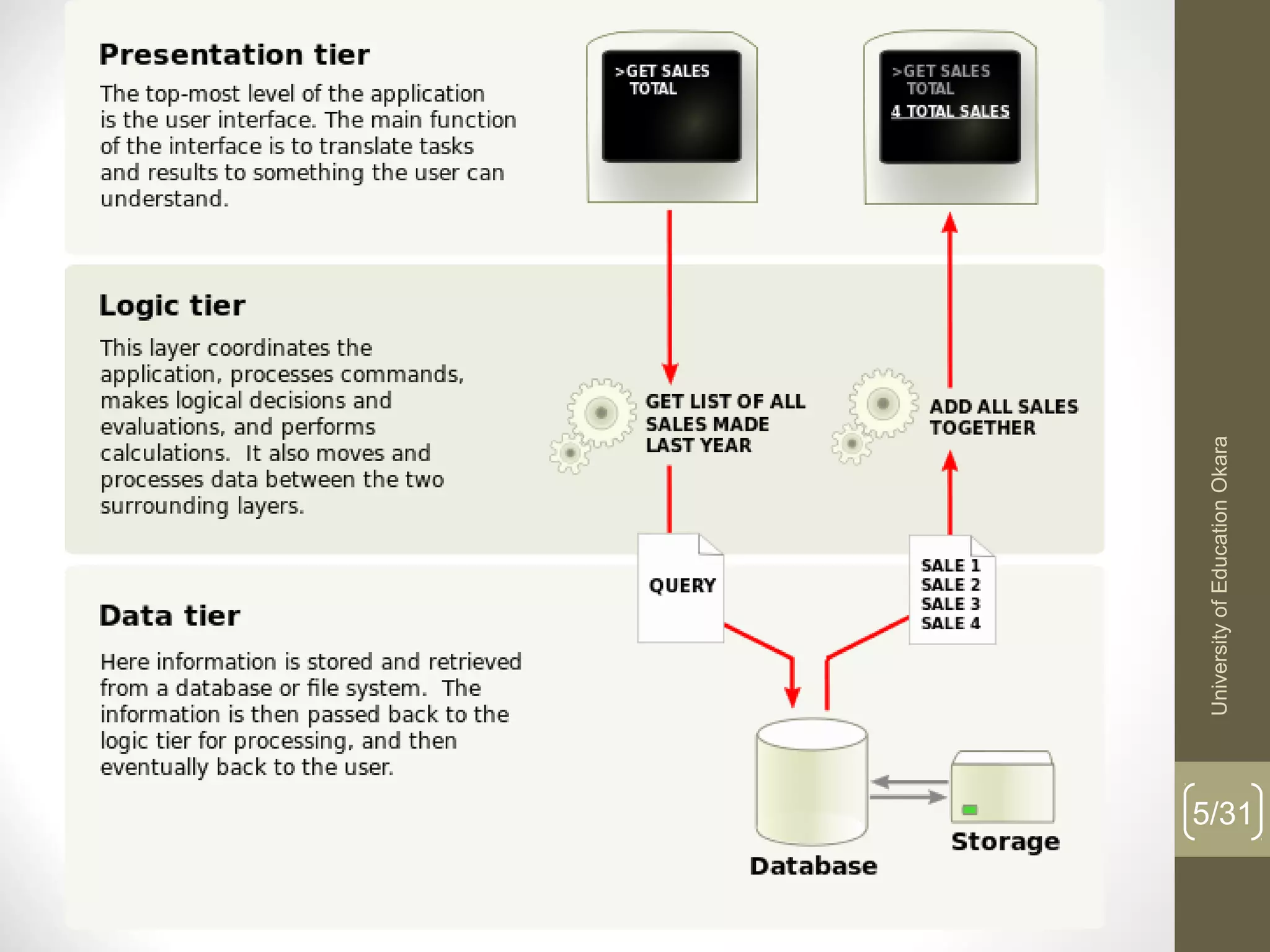
5/31
UniversityofEducationOkara
Multi-tier Architectures
In software engineering, multitier architecture (often referred to as n-
tier architecture) is a client–server architecture in which presentation, 
application processing, and data management functions are physically 
separated. 
The most widespread use of multitier architecture is the three-tier
architecture. (Wikipedia)
6/31
UniversityofEducationOkara
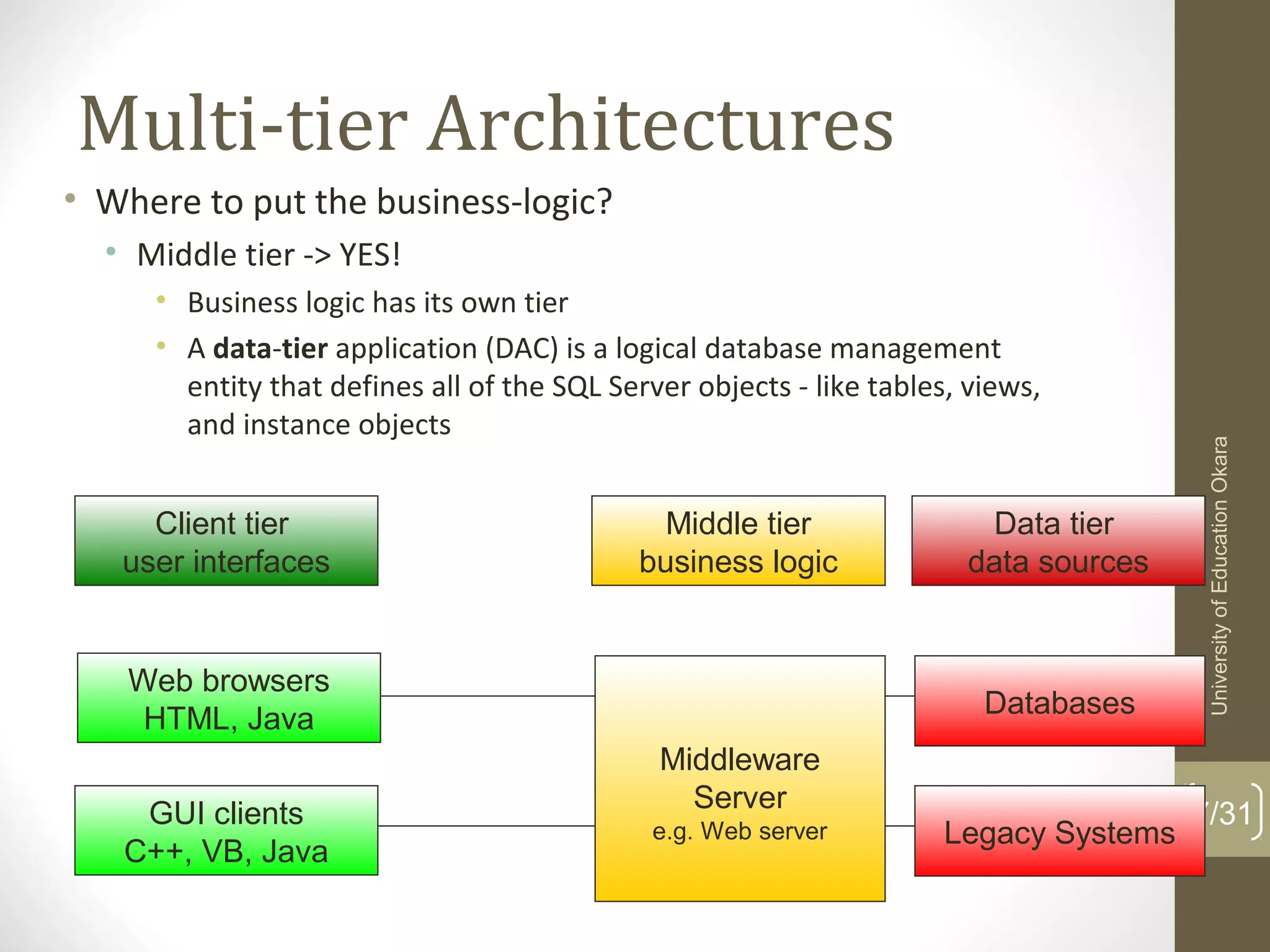
Multi-tier Architectures
• Where to put the business-logic?
• Middle tier -> YES!
• Business logic has its own tier
• A data-tier application (DAC) is a logical database management 
entity that defines all of the SQL Server objects - like tables, views, 
and instance objects
7/31
Web browsers
HTML, Java
GUI clients
C++, VB, Java
Client tier
user interfaces
Middleware
Server
e.g. Web server
Middle tier
business logic
Data tier
data sources
Databases
Legacy Systems
UniversityofEducationOkara
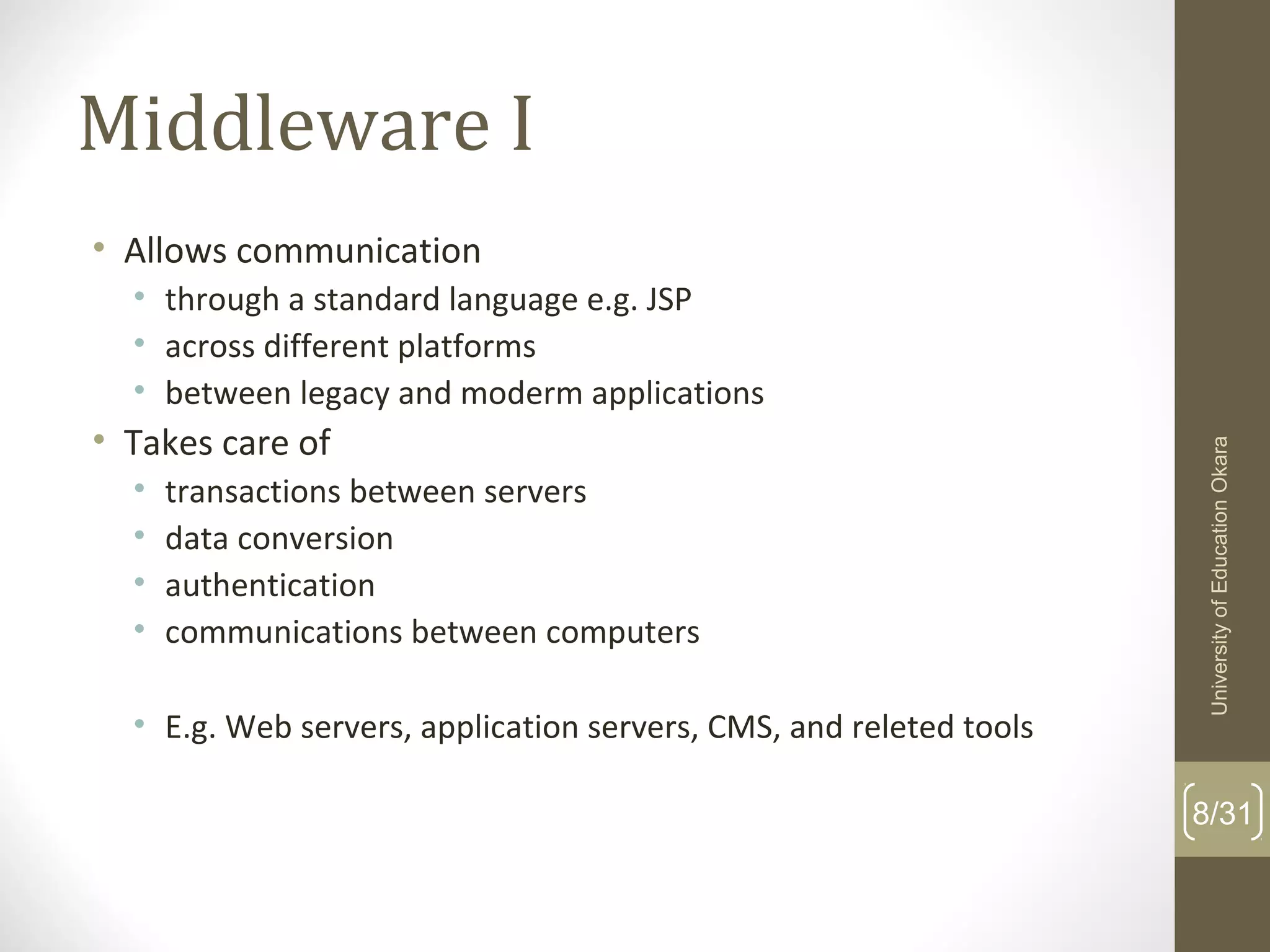
Middleware I
• Allows communication
• through a standard language e.g. JSP
• across different platforms
• between legacy and moderm applications
• Takes care of
• transactions between servers
• data conversion
• authentication
• communications between computers
• E.g. Web servers, application servers, CMS, and releted tools
8/31
UniversityofEducationOkara
Middleware III
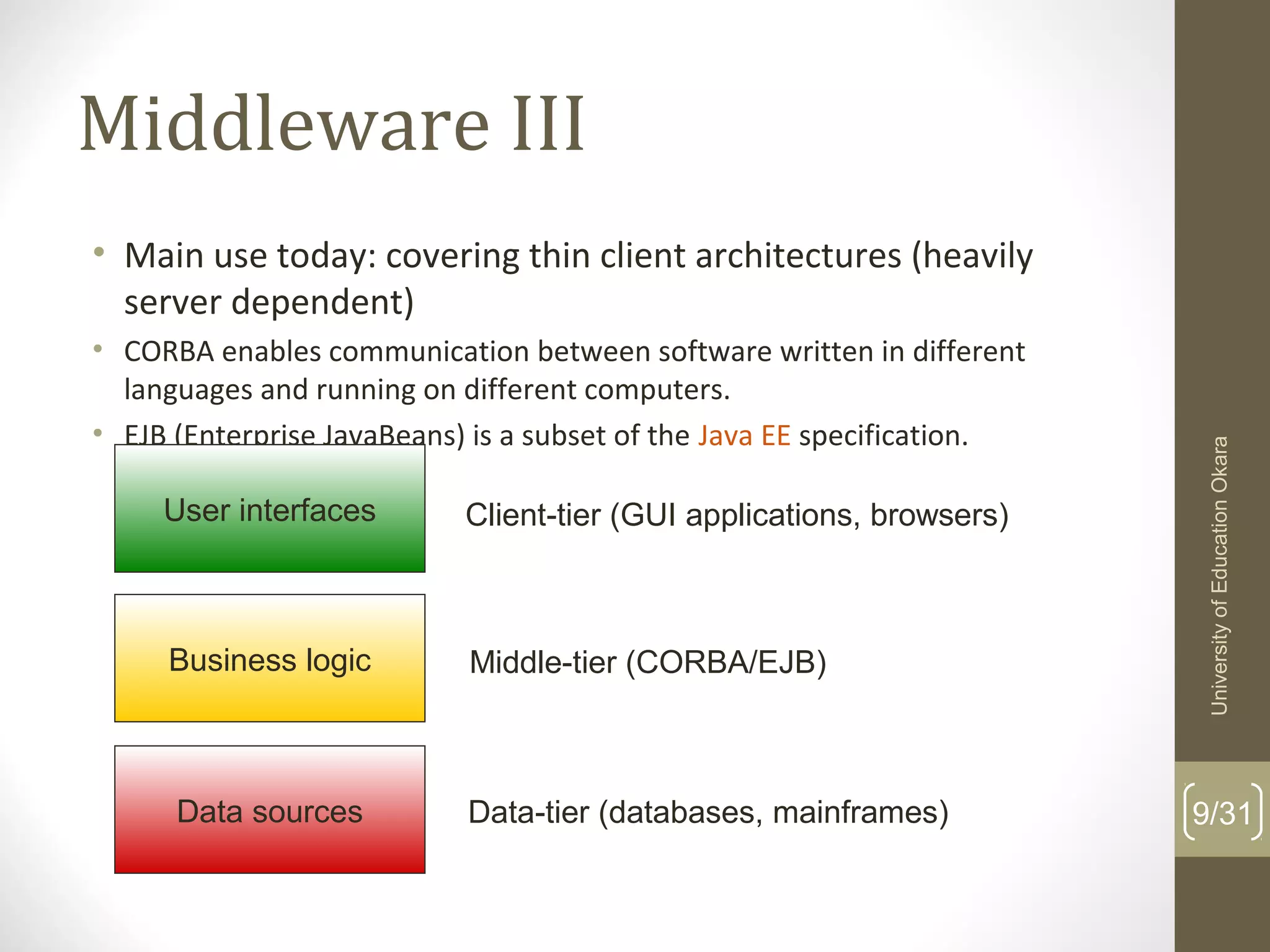
• Main use today: covering thin client architectures (heavily
server dependent)
• CORBA enables communication between software written in different
languages and running on different computers.
• EJB (Enterprise JavaBeans) is a subset of the Java EE specification.
9/31
User interfaces
Business logic
Data sources
Client-tier (GUI applications, browsers)
Middle-tier (CORBA/EJB)
Data-tier (databases, mainframes)
UniversityofEducationOkara
What is EAI
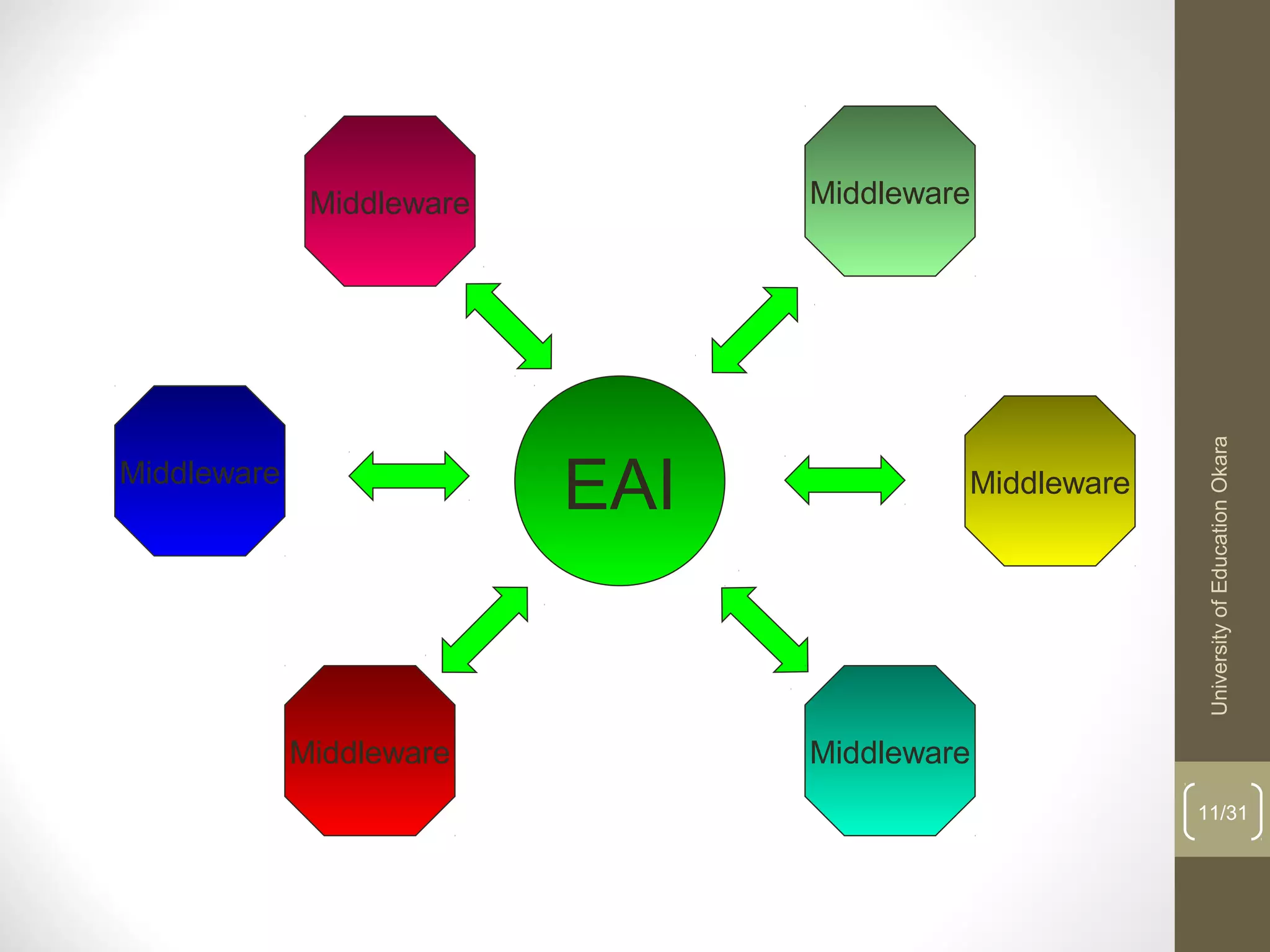
• Integrates applications and enterprise data sources so that
they can easily share business processes and data
• Integration is done without significant changes of applications
and data sources
10/31
UniversityofEducationOkara
11/31
Middleware
Middleware
Middleware
Middleware
Middleware
EAI
Middleware
UniversityofEducationOkara
12/31
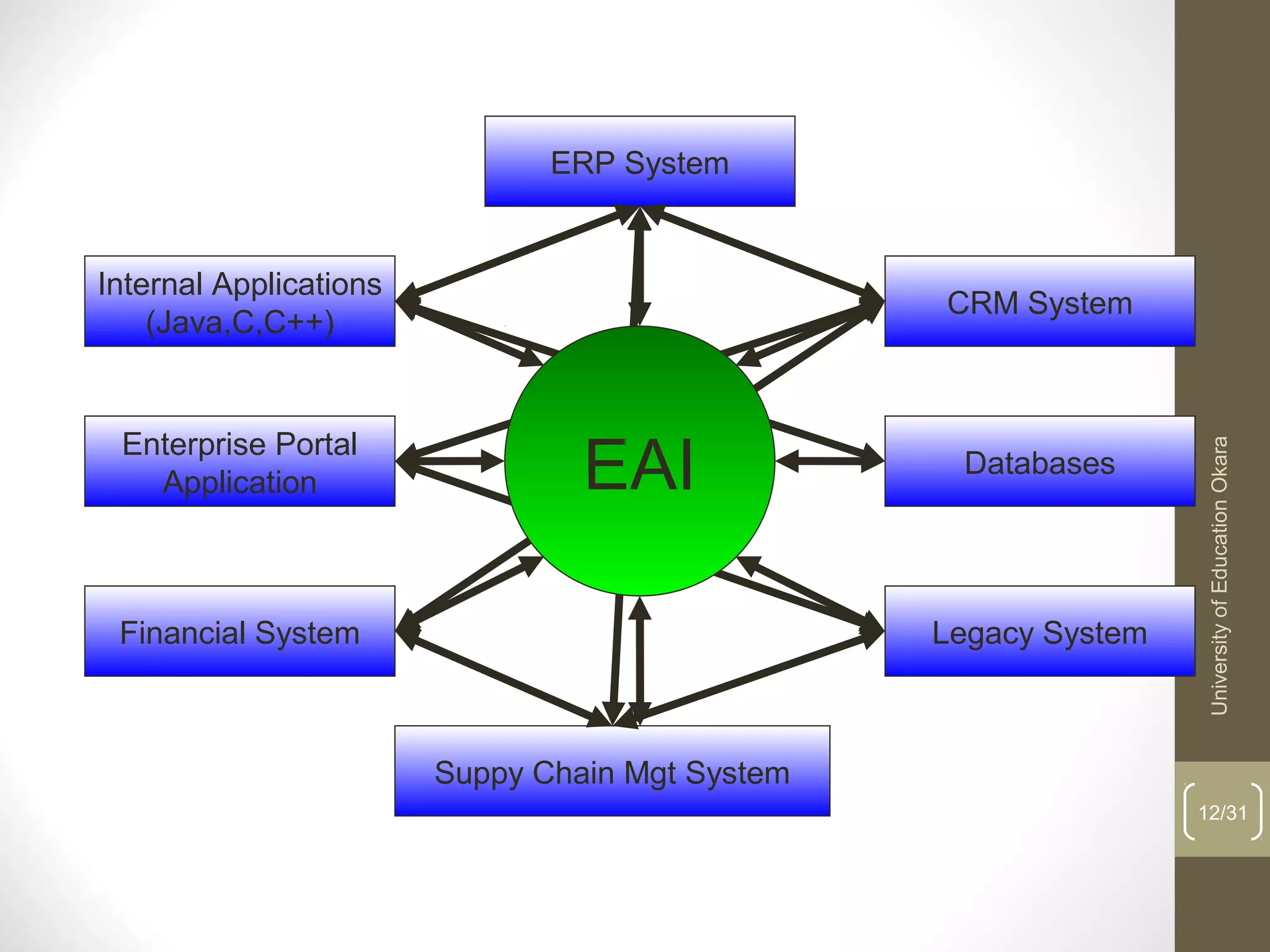
ERP System
Legacy System
Databases
CRM System
Enterprise Portal
Application
Financial System
Suppy Chain Mgt System
Internal Applications
(Java,C,C++)
EAI
UniversityofEducationOkara
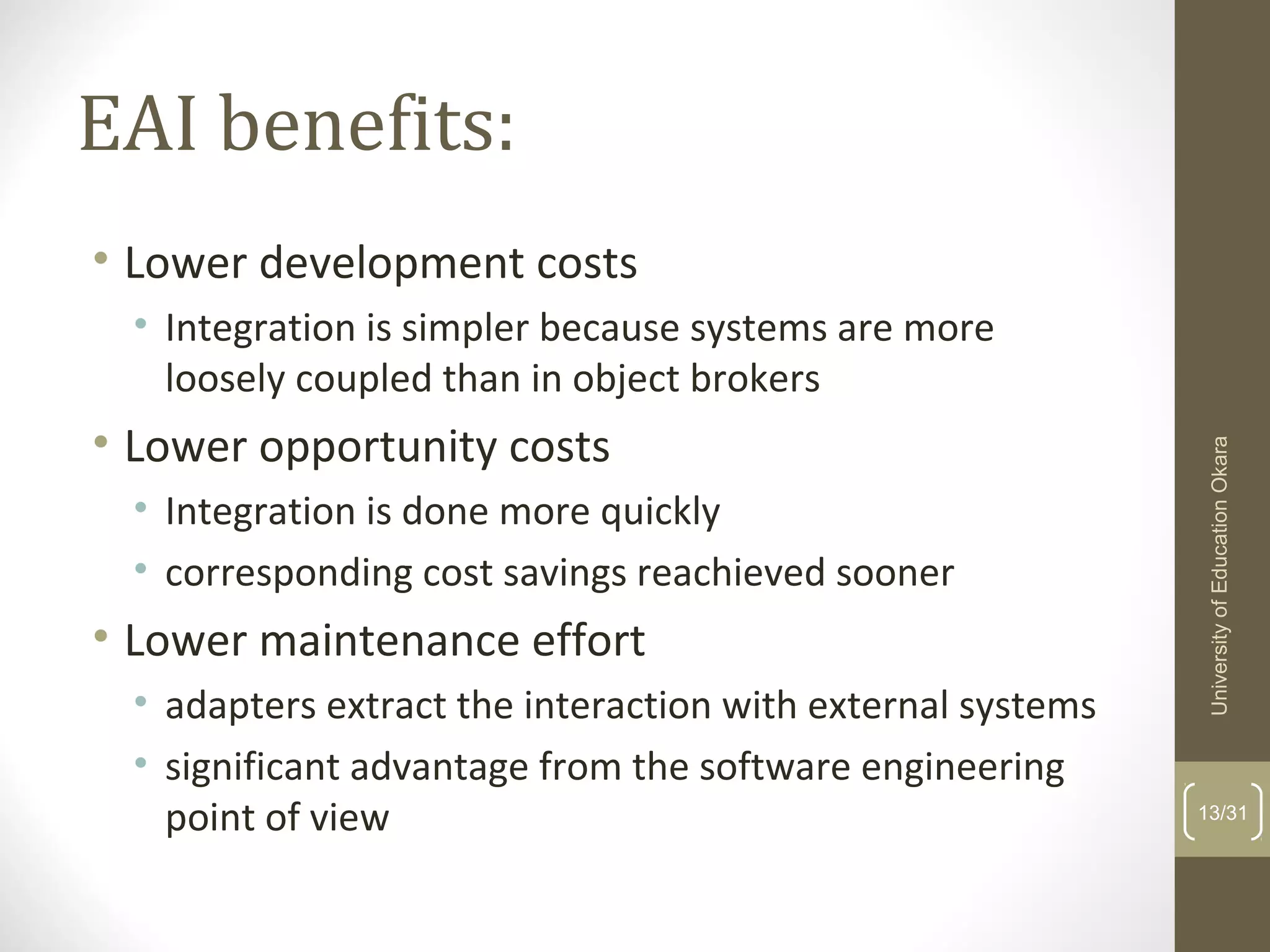
EAI benefits:
• Lower development costs
• Integration is simpler because systems are more
loosely coupled than in object brokers
• Lower opportunity costs
• Integration is done more quickly
• corresponding cost savings reachieved sooner
• Lower maintenance effort
• adapters extract the interaction with external systems
• significant advantage from the software engineering
point of view 13/31
UniversityofEducationOkara
Real World Example:
• 1875 Alexander Graham Bell invented the telephone
in the 19th century and AT&T became parent
company of the Bell System, the American telephone
monopoly
• The system broke up into eight companies in 1984.
14/31University of Education Okara
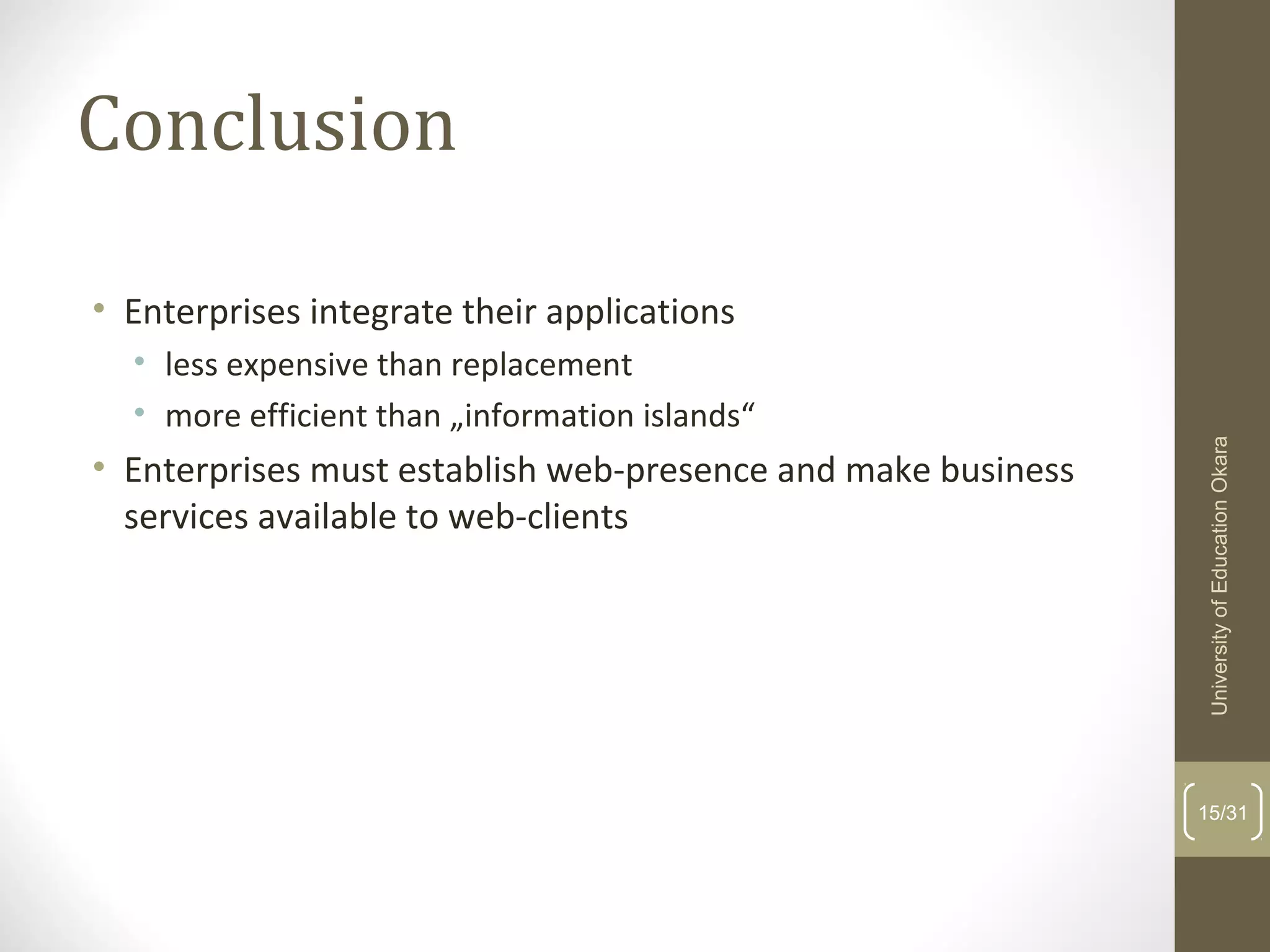
Conclusion
• Enterprises integrate their applications
• less expensive than replacement
• more efficient than „information islands“
• Enterprises must establish web-presence and make business
services available to web-clients
15/31
UniversityofEducationOkara
References
• http://www.ibm.com
• http://www.att.com
• http://www.eaipatterns.com/
• http://www.iwaysoftware.com/
• http://www.capterra.com/enterprise-application-integration-software
• http://www.infoworld.com/techindex/enterprise_application_integration_-
_eai.html
16/31
UniversityofEducationOkara

Enterprise Application Integration

  • 1.
    Enterprise Application Integration (EAI) SystemIntegration & Architecture Inam Ul Haq BSIT-6th University of Education Okara Lecture 3
  • 2.
    Contents • EAI? • Architectures •Middleware • What is EAI • A Typical EAI System • EAI Benefits • Conclusion 2/31 UniversityofEducationOkara
  • 3.
    Defining EAI 3/31 • WhyEAI? – Wouldn’t it be great if everyone used the same servers with the same operating system with the same clients. • Reality is very diverse. We can expect a mix of mainframes, Windows, UNIX, Linux, VMS, as well as many other systems – Getting them to work/share data together is the issue! – EAI is defined as “the unrestricted sharing of data and business processes among any connected applications and data sources in the enterprise.” • Using EAI effectively will allow us to integrate without making major changes to our current infrastructure. UniversityofEducationOkara
  • 4.
    Architectures • 1 layerarchitecture • monolithic Information Systems • presentation, application logic, and resource management were merged into a single tier • 2 layer architecture • separation of presentation layer from other 2 layers (app + resource) • became popular as 'server/client' systems • 3 layer architecture • can be achieved by separating RM (resource management) from application logic layer 4/31 UniversityofEducationOkara
  • 5.
  • 6.
    Multi-tier Architectures In software engineering, multitier architecture (often referred to as n- tierarchitecture) is a client–server architecture in which presentation,  application processing, and data management functions are physically  separated.  The most widespread use of multitier architecture is the three-tier architecture. (Wikipedia) 6/31 UniversityofEducationOkara
  • 7.
    Multi-tier Architectures • Where to put the business-logic? •Middle tier -> YES! • Business logic has its own tier • A data-tier application (DAC) is a logical database management  entity that defines all of the SQL Server objects - like tables, views,  and instance objects 7/31 Web browsers HTML, Java GUI clients C++, VB, Java Client tier user interfaces Middleware Server e.g. Web server Middle tier business logic Data tier data sources Databases Legacy Systems UniversityofEducationOkara
  • 8.
    Middleware I • Allows communication •through a standard language e.g. JSP • across different platforms • between legacy and moderm applications • Takes care of • transactions between servers • data conversion • authentication • communications between computers • E.g. Web servers, application servers, CMS, and releted tools 8/31 UniversityofEducationOkara
  • 9.
    Middleware III • Mainuse today: covering thin client architectures (heavily server dependent) • CORBA enables communication between software written in different languages and running on different computers. • EJB (Enterprise JavaBeans) is a subset of the Java EE specification. 9/31 User interfaces Business logic Data sources Client-tier (GUI applications, browsers) Middle-tier (CORBA/EJB) Data-tier (databases, mainframes) UniversityofEducationOkara
  • 10.
    What is EAI •Integrates applications and enterprise data sources so that they can easily share business processes and data • Integration is done without significant changes of applications and data sources 10/31 UniversityofEducationOkara
  • 11.
  • 12.
    12/31 ERP System Legacy System Databases CRMSystem Enterprise Portal Application Financial System Suppy Chain Mgt System Internal Applications (Java,C,C++) EAI UniversityofEducationOkara
  • 13.
    EAI benefits: • Lowerdevelopment costs • Integration is simpler because systems are more loosely coupled than in object brokers • Lower opportunity costs • Integration is done more quickly • corresponding cost savings reachieved sooner • Lower maintenance effort • adapters extract the interaction with external systems • significant advantage from the software engineering point of view 13/31 UniversityofEducationOkara
  • 14.
    Real World Example: •1875 Alexander Graham Bell invented the telephone in the 19th century and AT&T became parent company of the Bell System, the American telephone monopoly • The system broke up into eight companies in 1984. 14/31University of Education Okara
  • 15.
    Conclusion • Enterprises integratetheir applications • less expensive than replacement • more efficient than „information islands“ • Enterprises must establish web-presence and make business services available to web-clients 15/31 UniversityofEducationOkara
  • 16.
    References • http://www.ibm.com • http://www.att.com •http://www.eaipatterns.com/ • http://www.iwaysoftware.com/ • http://www.capterra.com/enterprise-application-integration-software • http://www.infoworld.com/techindex/enterprise_application_integration_- _eai.html 16/31 UniversityofEducationOkara