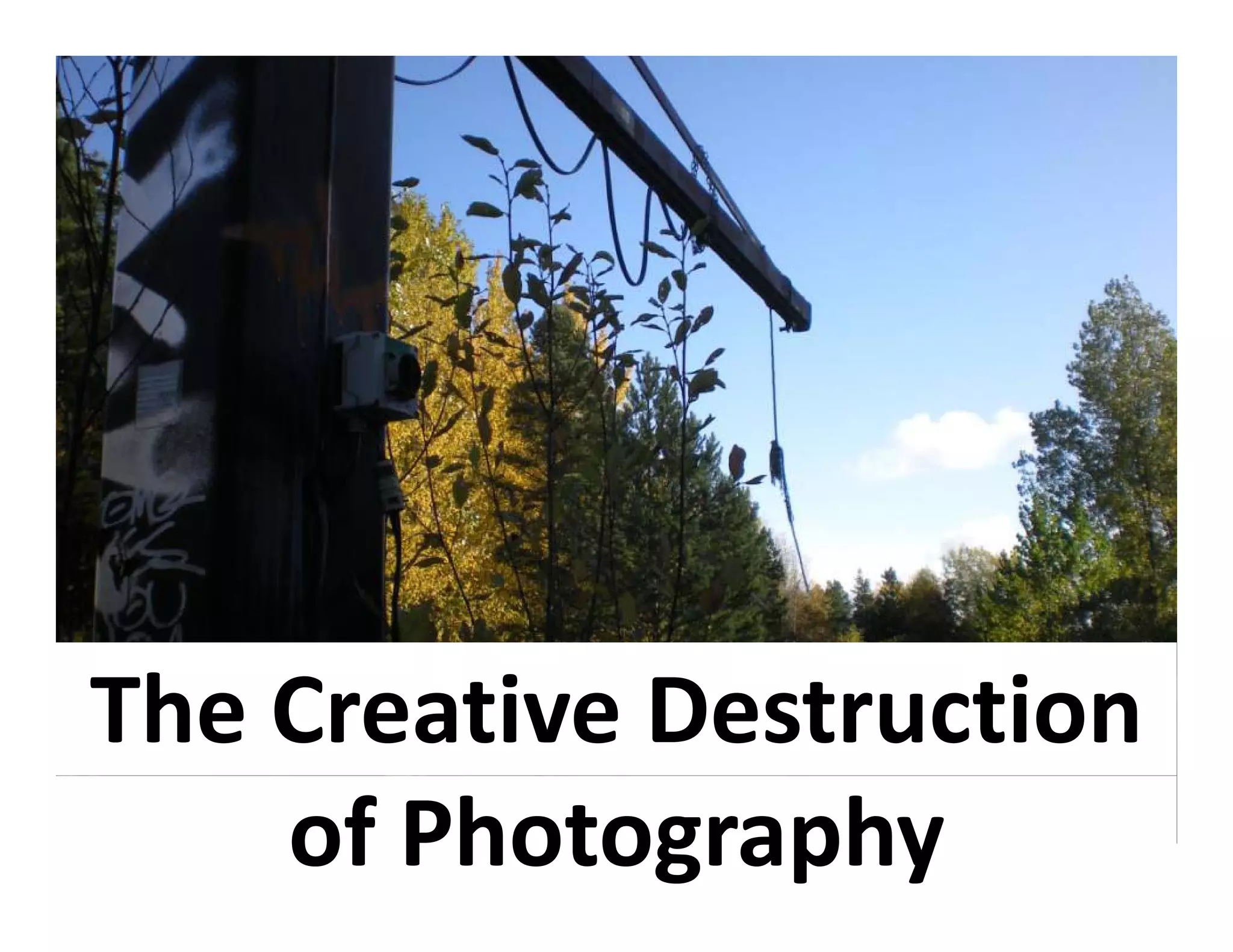
The Creative Destruction
    of Photography
The Austrian economist Joseph Schumpeter coined
          the term Creative Destruction.
The Austrian economist Joseph Schumpeter coined
          the term Creative Destruction.
   To Schumpeter, growth in a capitalist society 
happened through the introduction of innovations, 
which in turn create chaos and structural change in 
                      society.
The Austrian economist Joseph Schumpeter coined
           the term Creative Destruction.
   To Schumpeter, growth in a capitalist society 
happened through the introduction of innovations, 
which in turn create chaos and structural change in 
                      society.
The shift from analogue to digital photography is a 
   schoolbook example of creative destruction.
The Austrian economist Joseph Schumpeter coined
            the term Creative Destruction.
    To Schumpeter, growth in a capitalist society 
 happened through the introduction of innovations, 
 which in turn create chaos and structural change in 
                       society.
 The shift from analogue to digital photography is a 
    schoolbook example of creative destruction.
   This presentation combines some quotes f
    h                     b                  from 
Schumpeter with images of how the camera industry
                has been transformed.
                h b           f      d
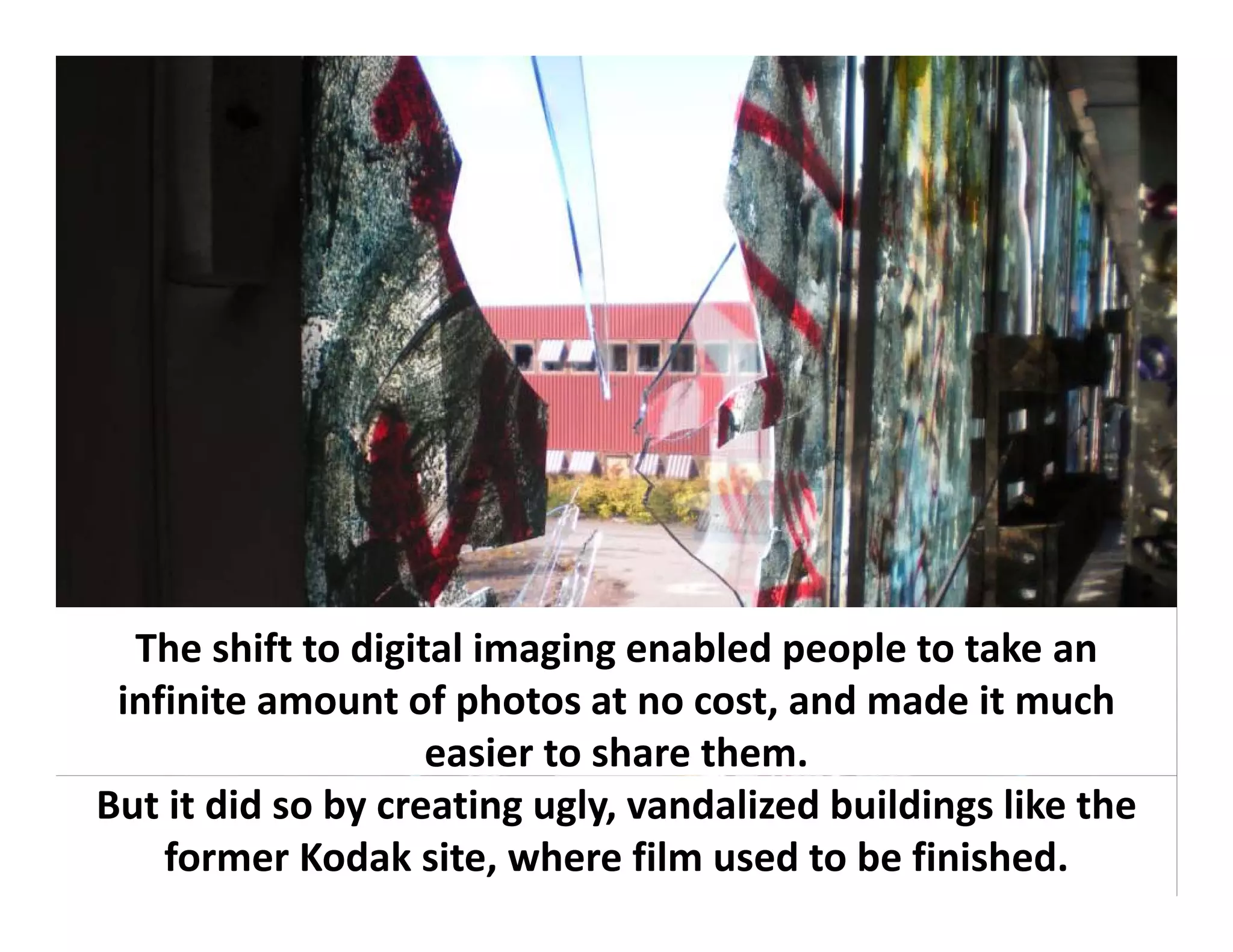
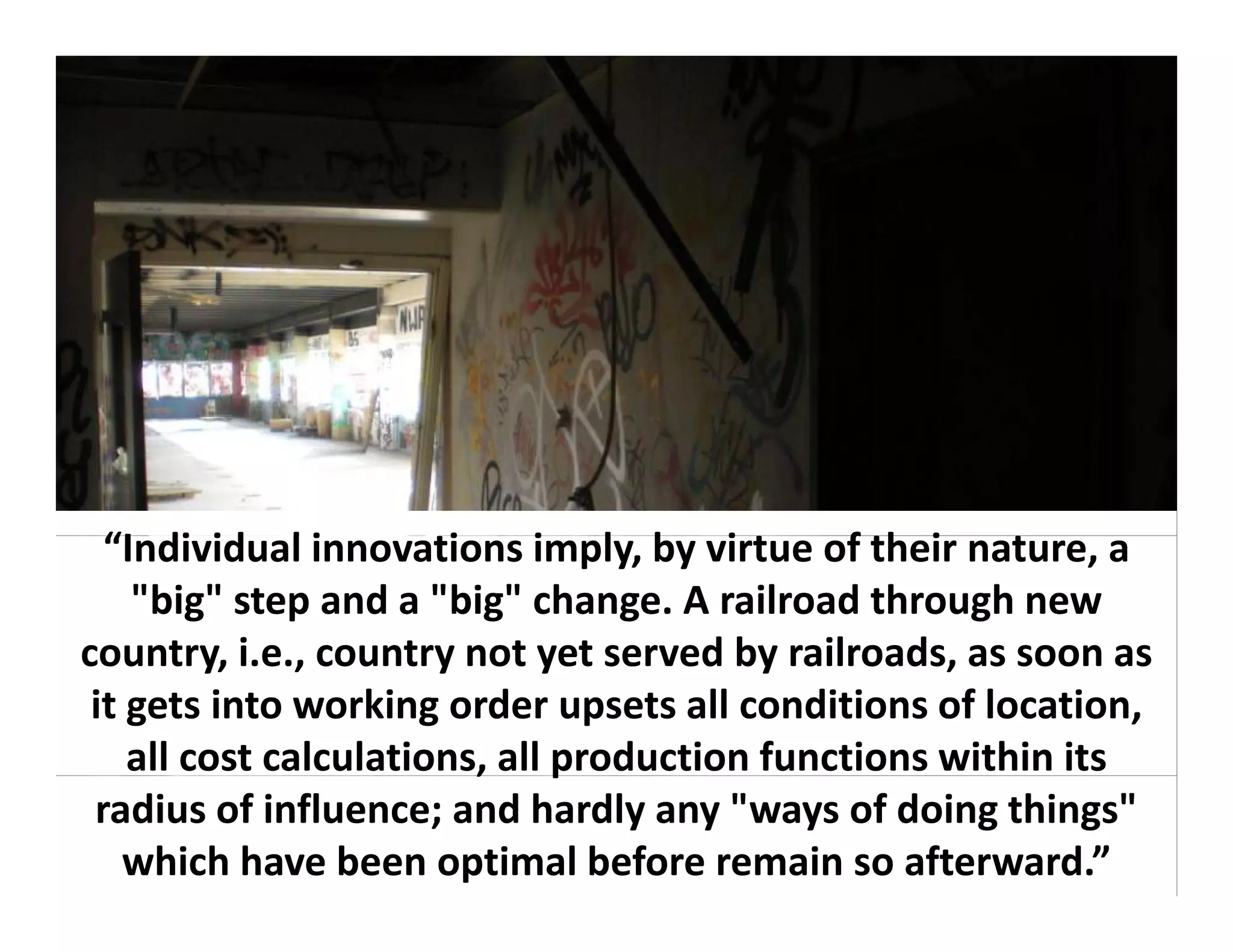
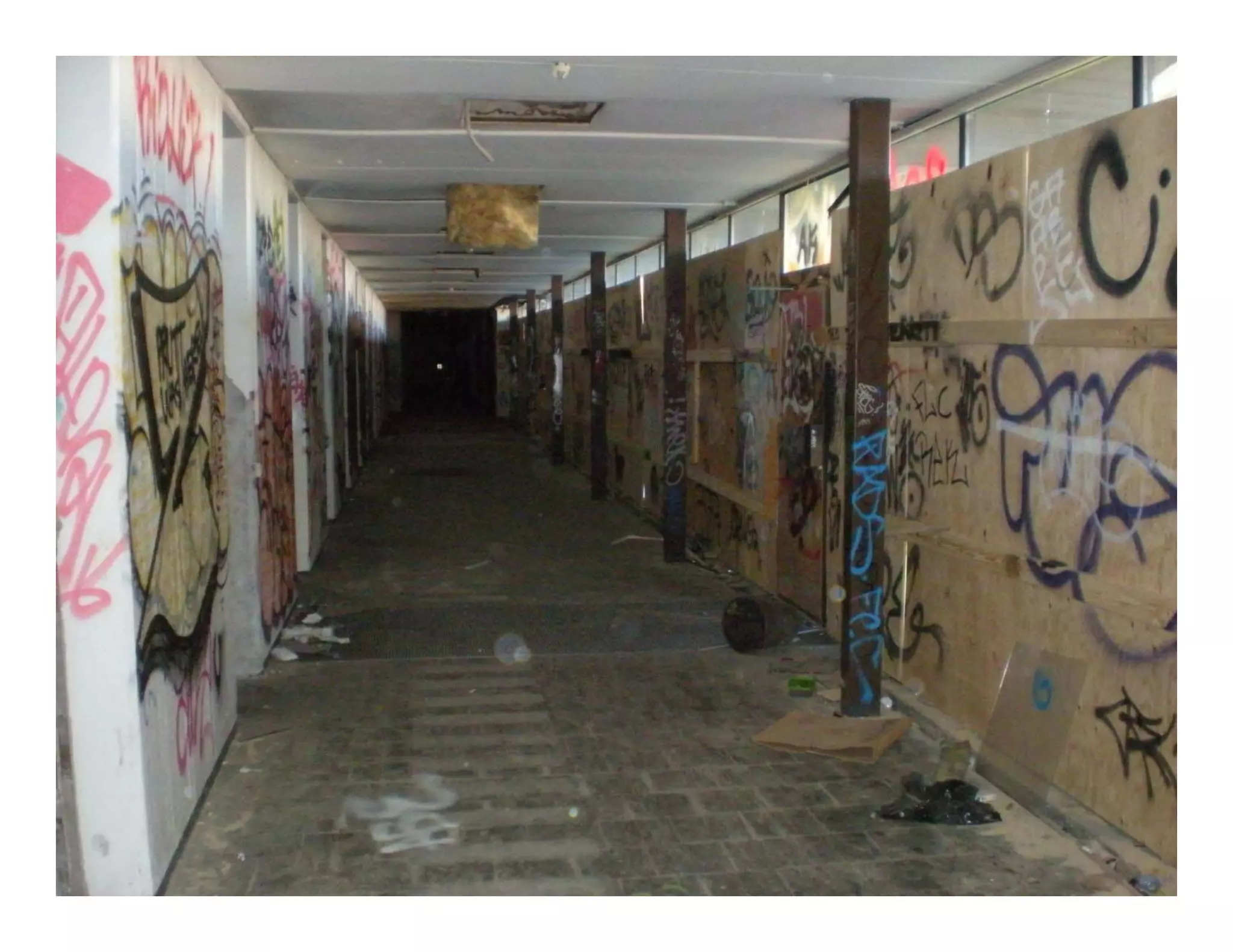
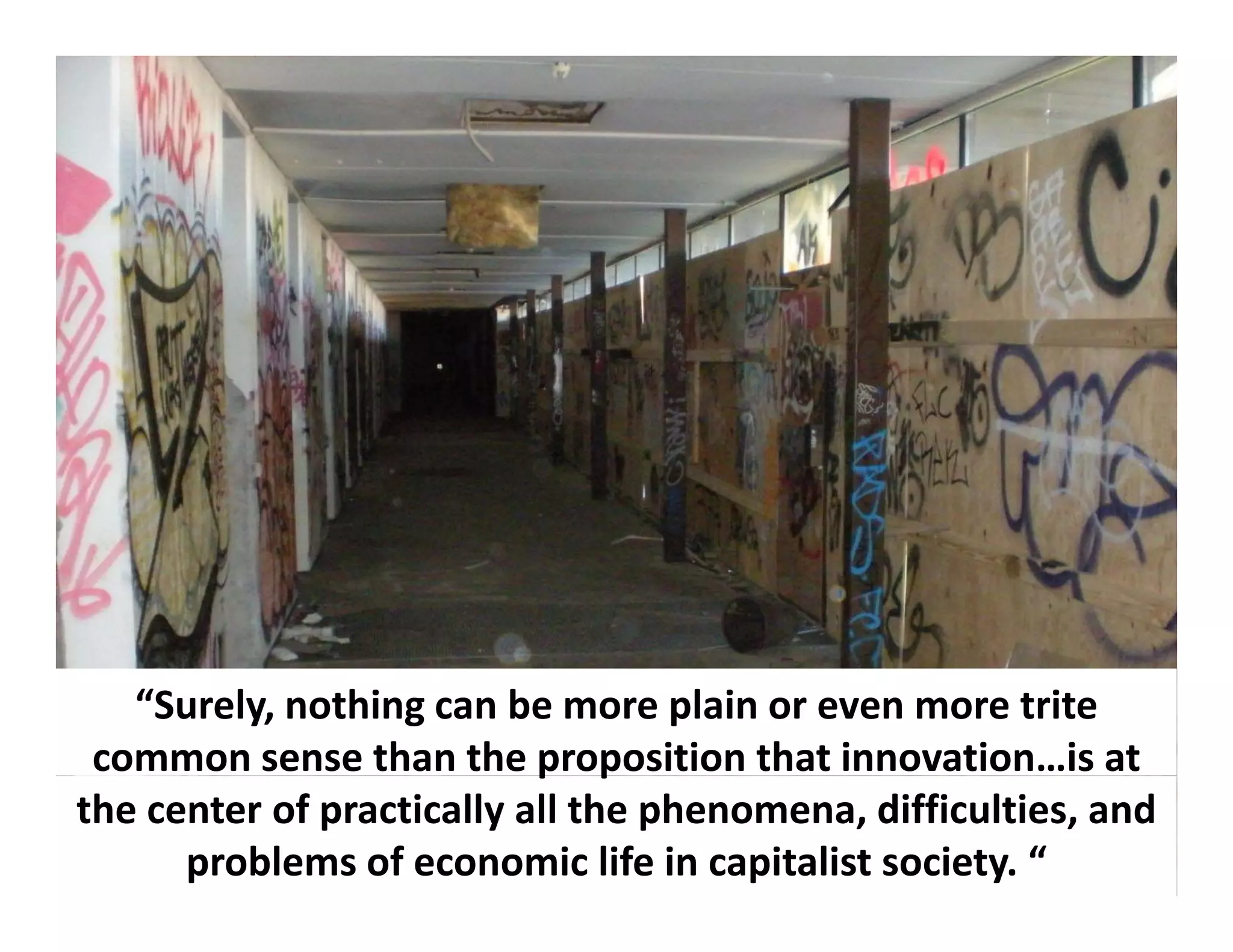
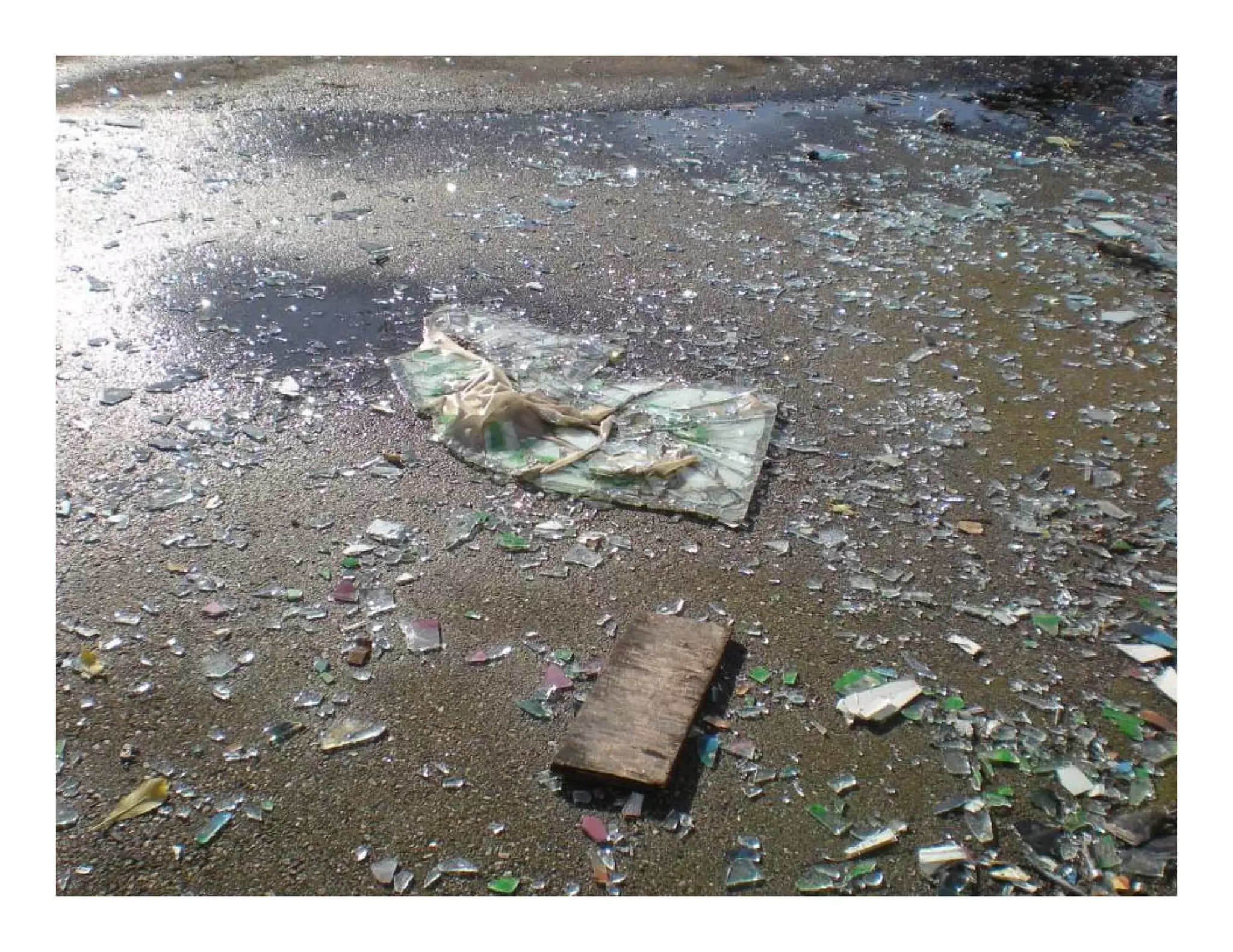
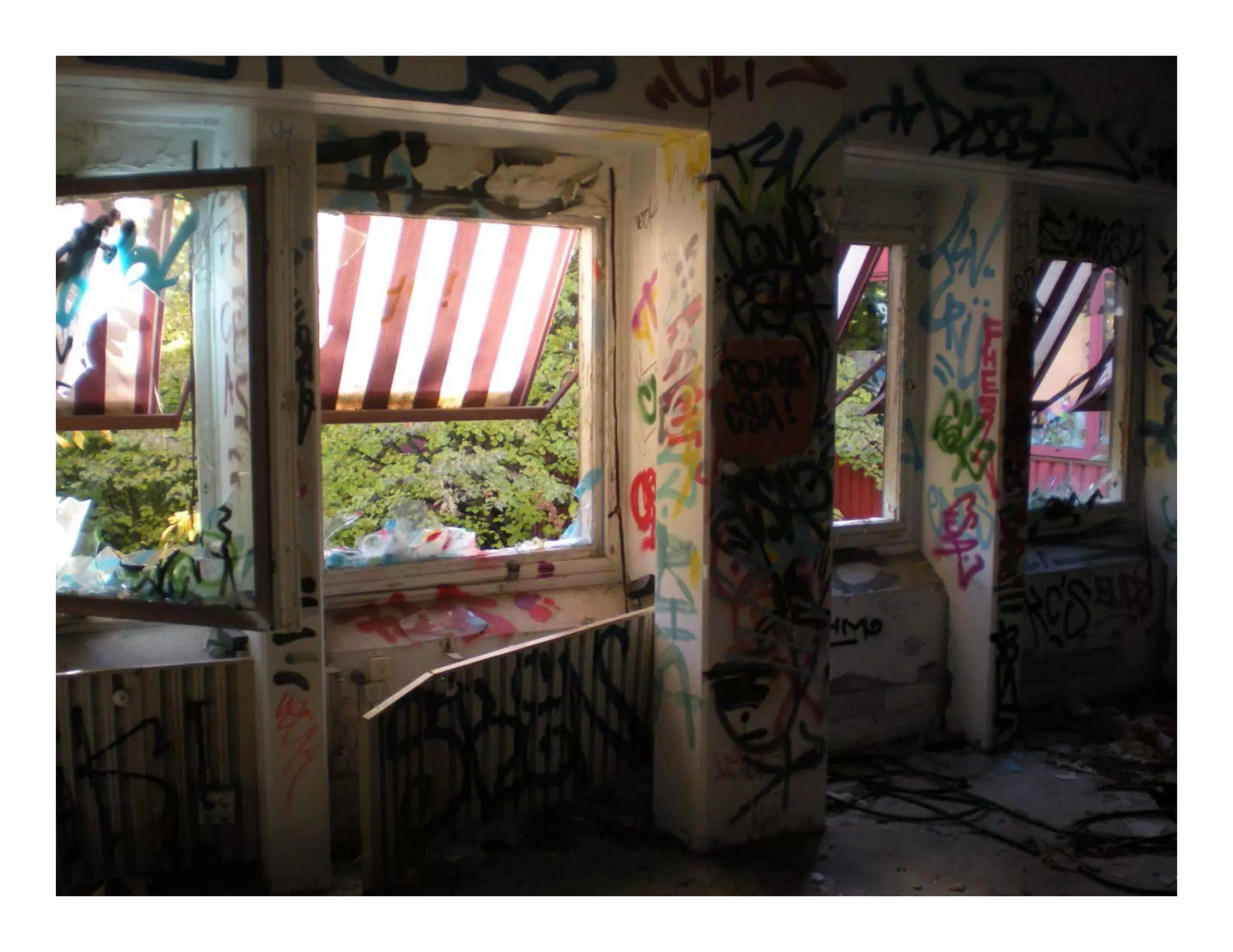
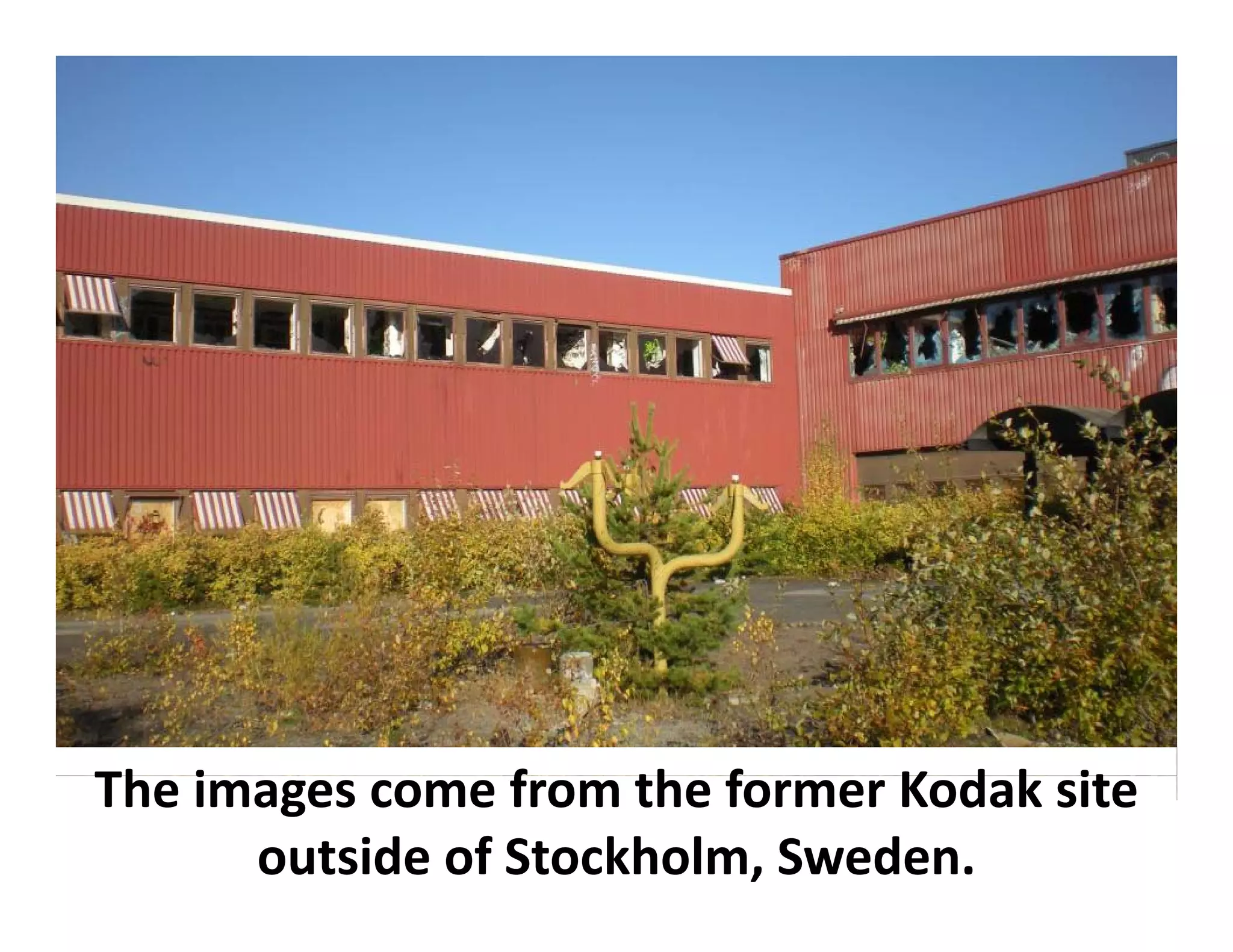
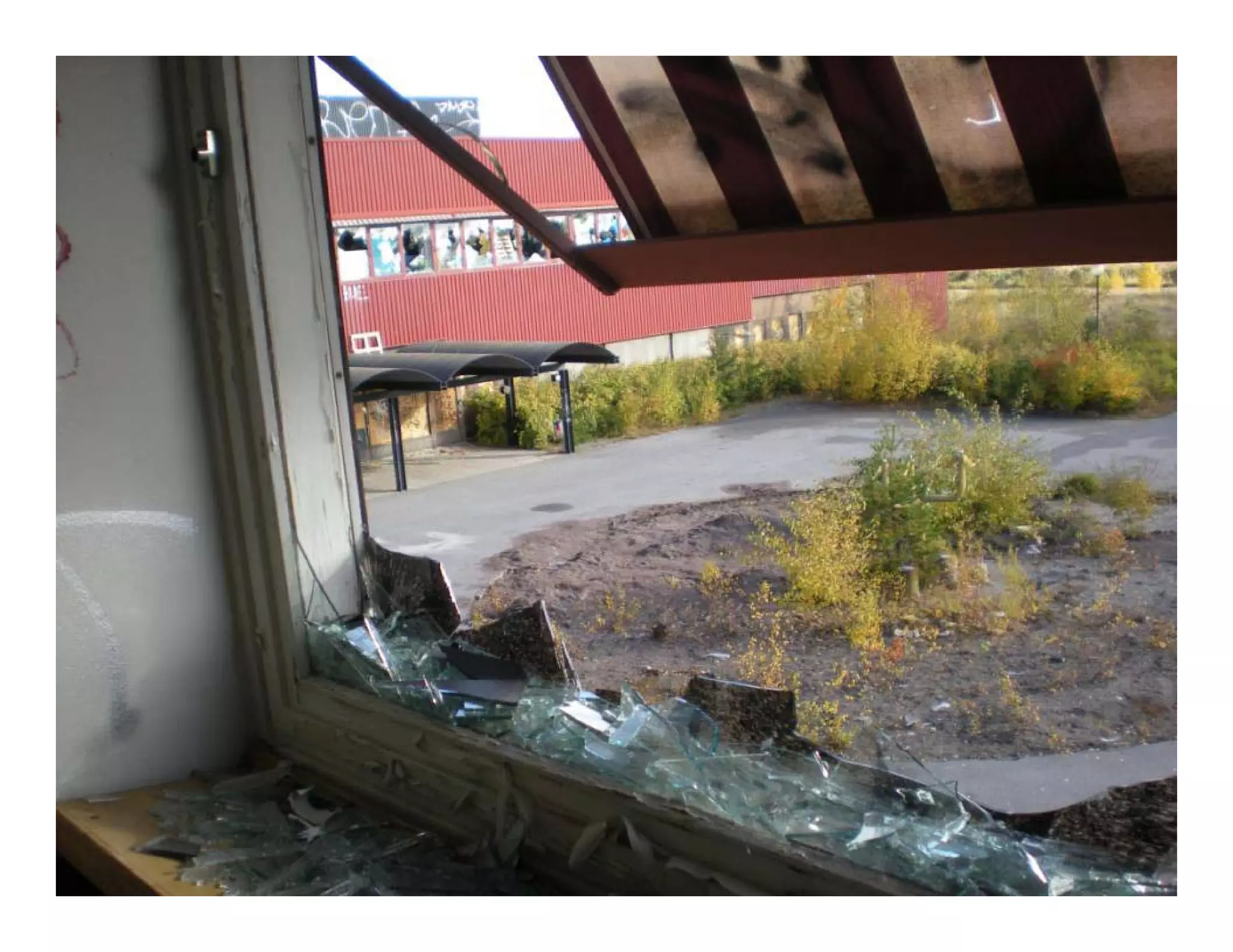
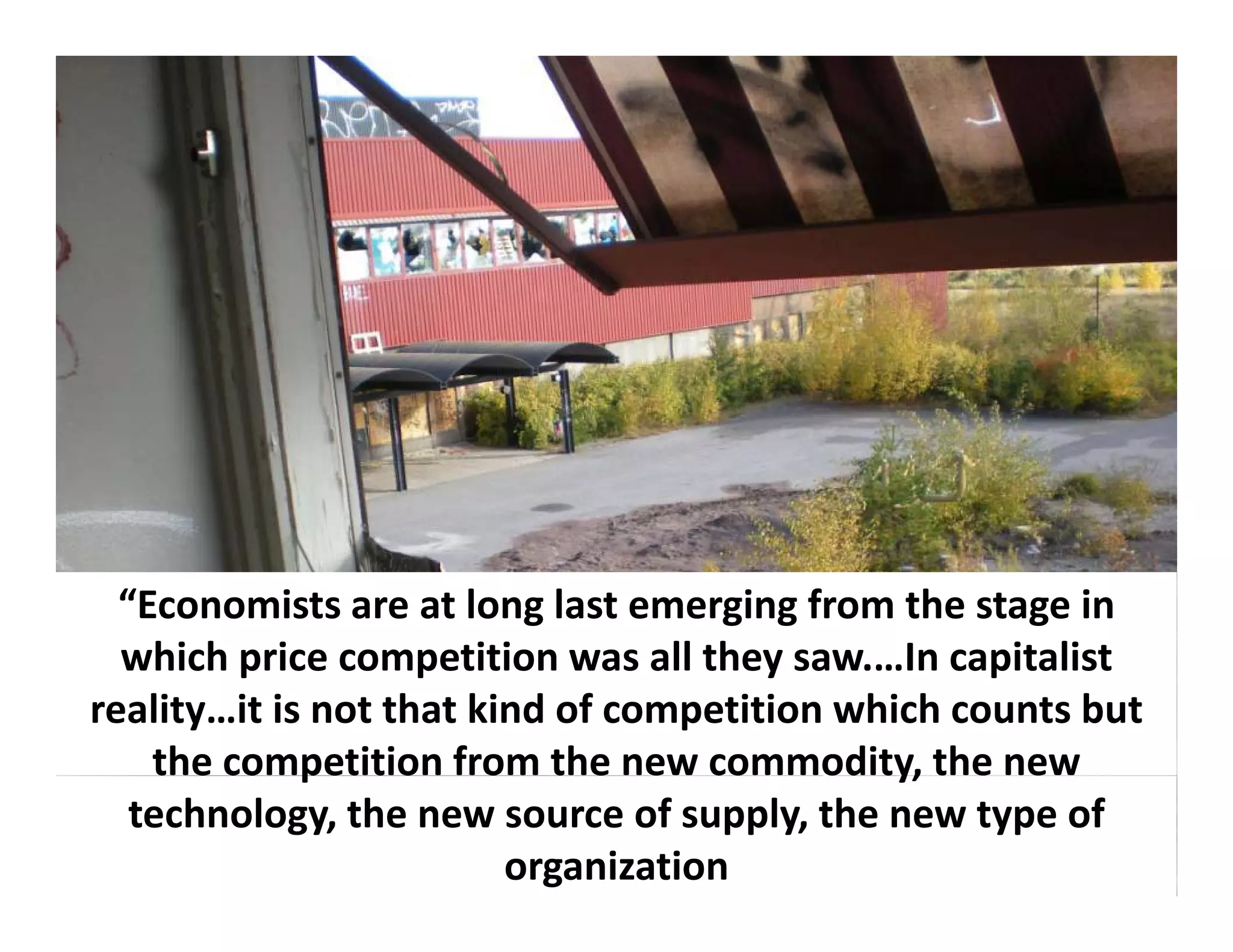
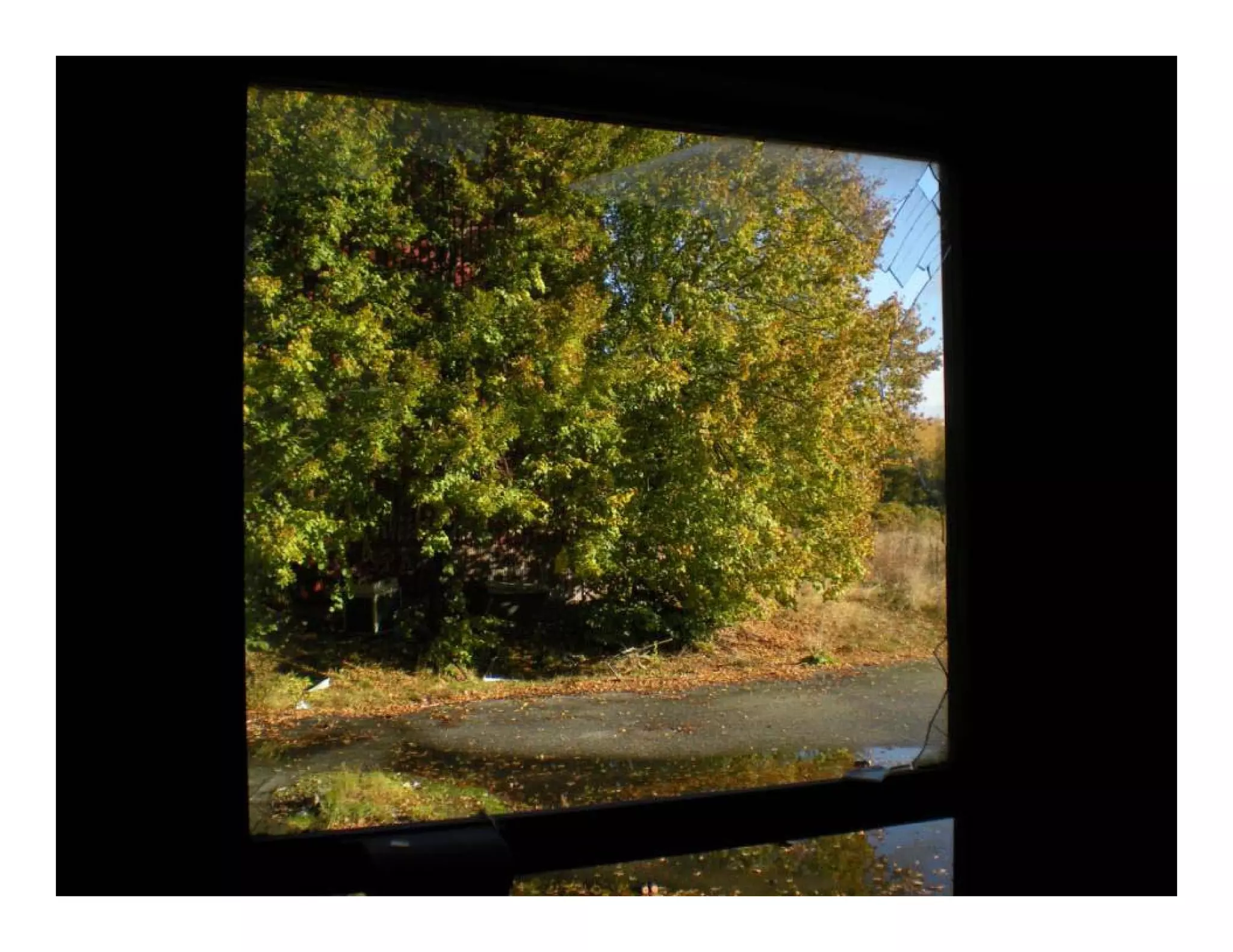
The images come from the former Kodak site
Th i             f    th f      K d k it
      outside of Stockholm, Sweden.
“Economists are at long last emerging from the stage in 
  which price competition was all they saw.…In capitalist 
  which price competition was all they saw In capitalist
reality…it is not that kind of competition which counts but 
    the competition from the new commodity, the new 
             p                               y,
   technology, the new source of supply, the new type of 
                         organization
…competition which…strikes…existing firms…at their 
foundations and their very lives. This kind of competition 
  is…much more effective than the other…and [is]…the 
   powerful lever that in the long run expands output.”
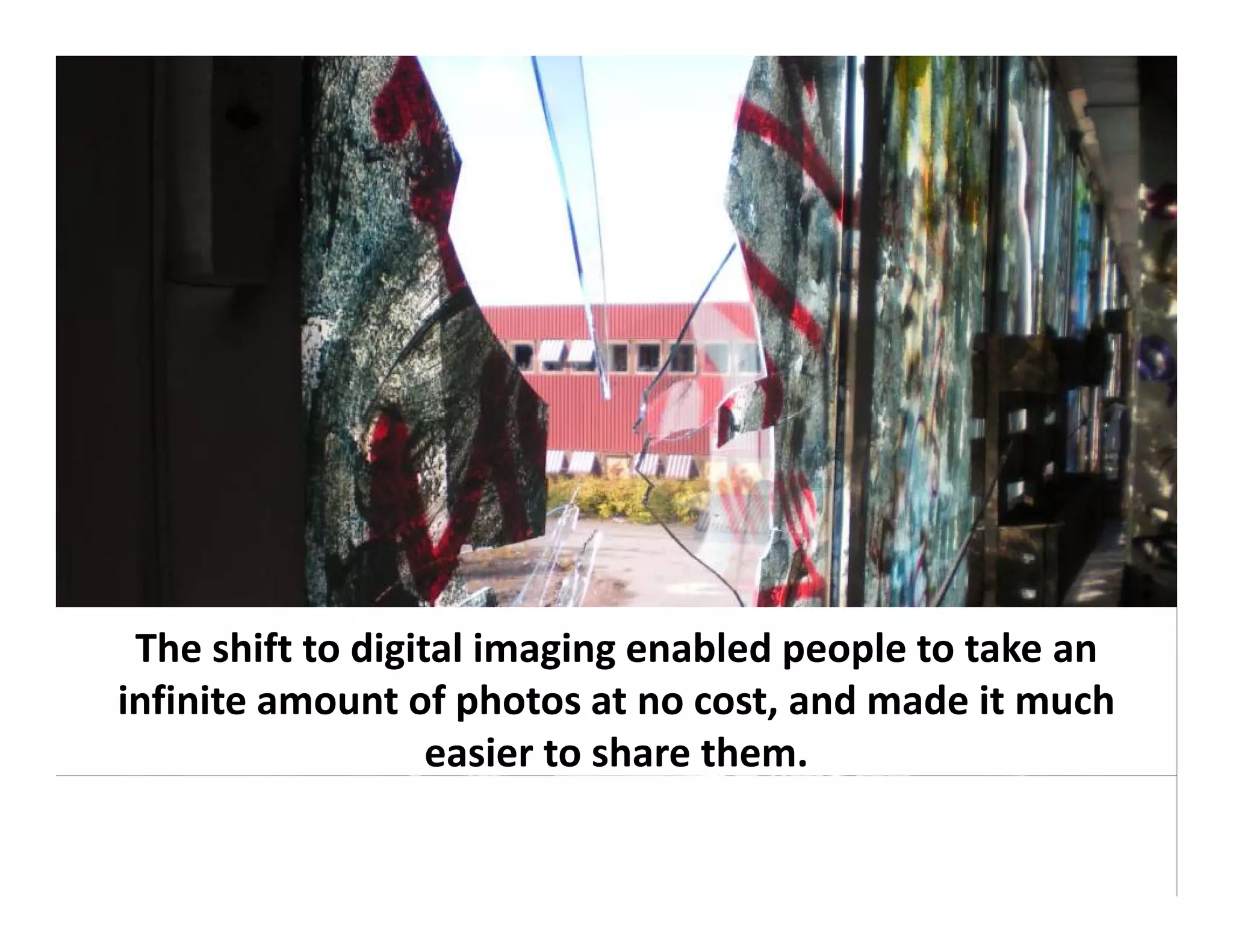
The shift to digital imaging enabled people to take an 
 The shift to digital imaging enabled people to take an
infinite amount of photos at no cost, and made it much 
                   easier to share them.
The shift to digital imaging enabled people to take an 
  The shift to digital imaging enabled people to take an
 infinite amount of photos at no cost, and made it much 
                    easier to share them.
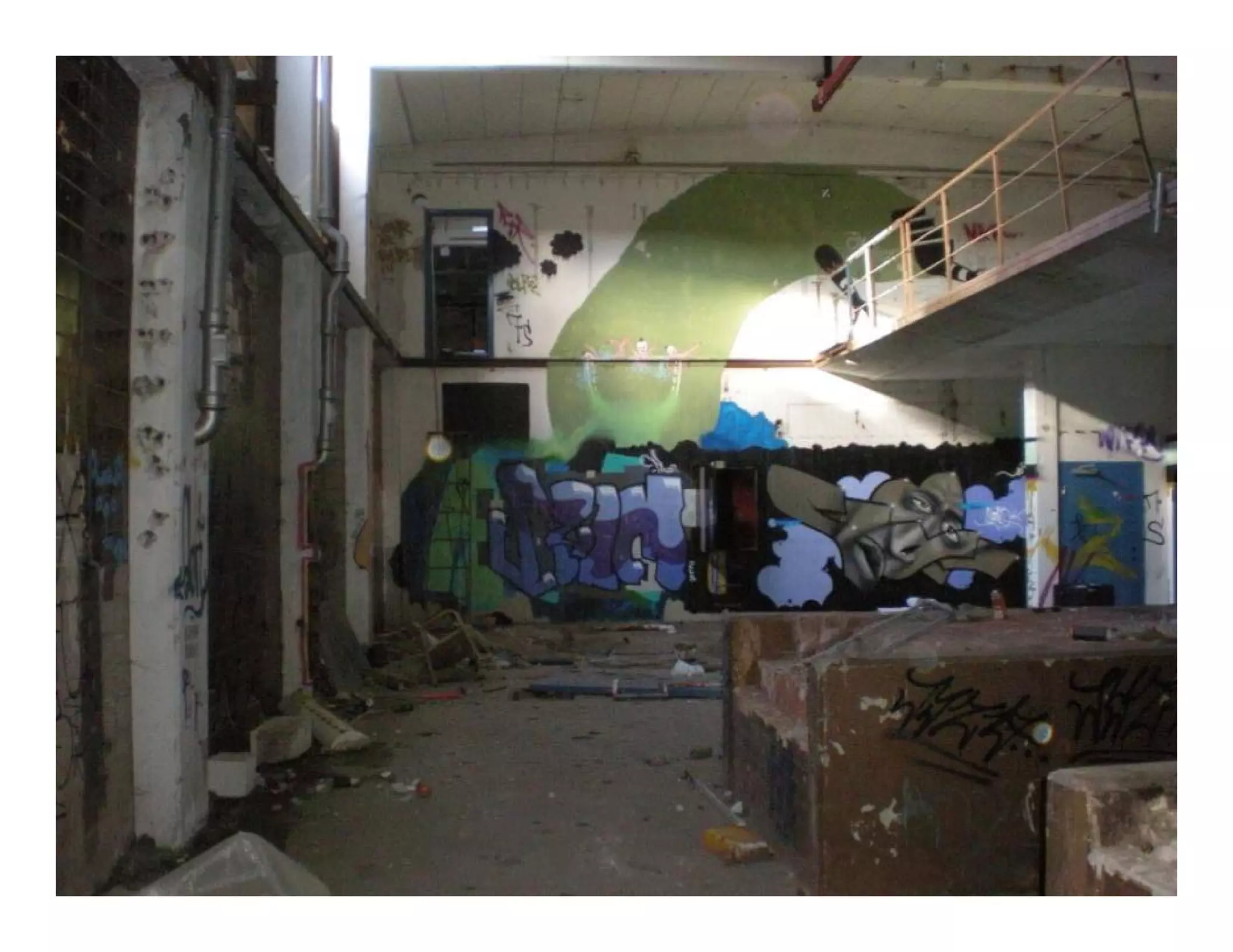
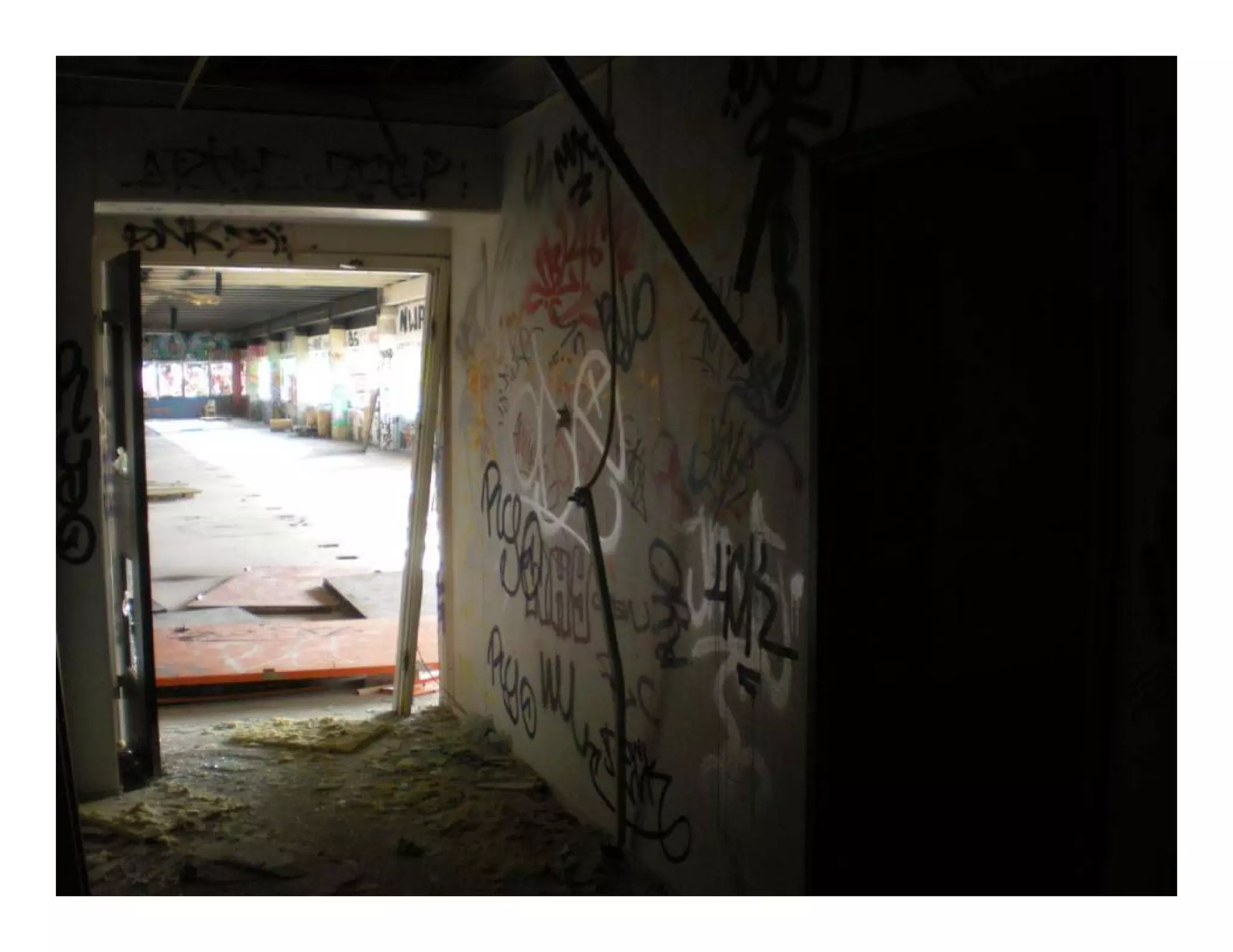
But it did so by creating ugly, vandalized buildings like the 
    former Kodak site, where film used to be finished.
“The capitalist process, not by coincidence but by
  The capitalist process, not by coincidence but by 
   virtue of its mechanism, progressively raises the 
 standard of life of the masses. It does so through a 
  sequence of vicissitudes, the severity of which is 
   proportional to the speed of the advance. But it 
  does so effectively. One problem after another of 
  d         ff ti l O          bl     ft      th    f
 the supply of commodities to the masses has been 
   successfully solved by being brought within the 
   successfully solved by being brought within the
    reach of the methods of capitalist production.”
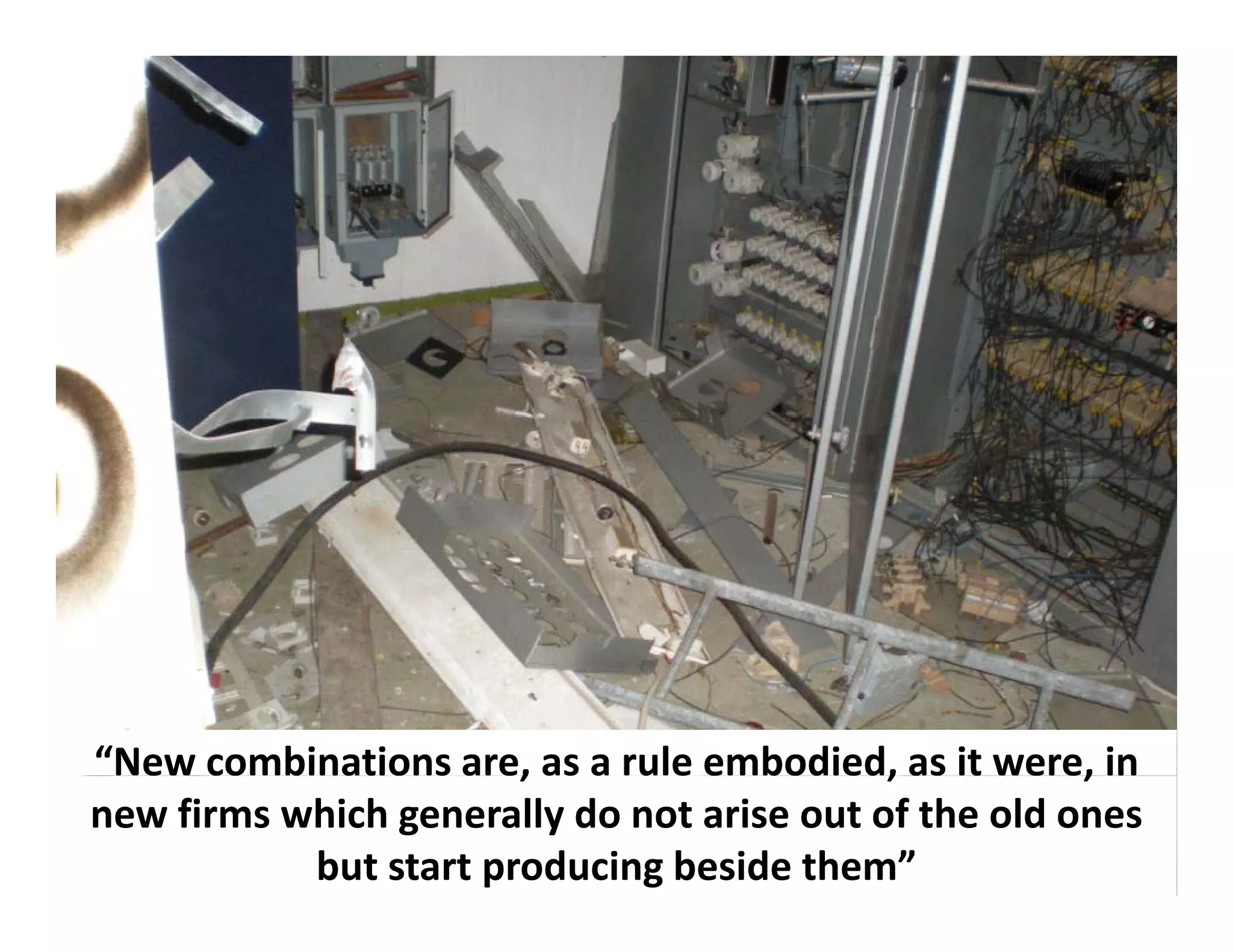
“New combinations are, as a rule embodied, as it were, in 
  e co b at o s a e, as a u e e bod ed, as t e e,
new firms which generally do not arise out of the old ones 
           but start producing beside them”
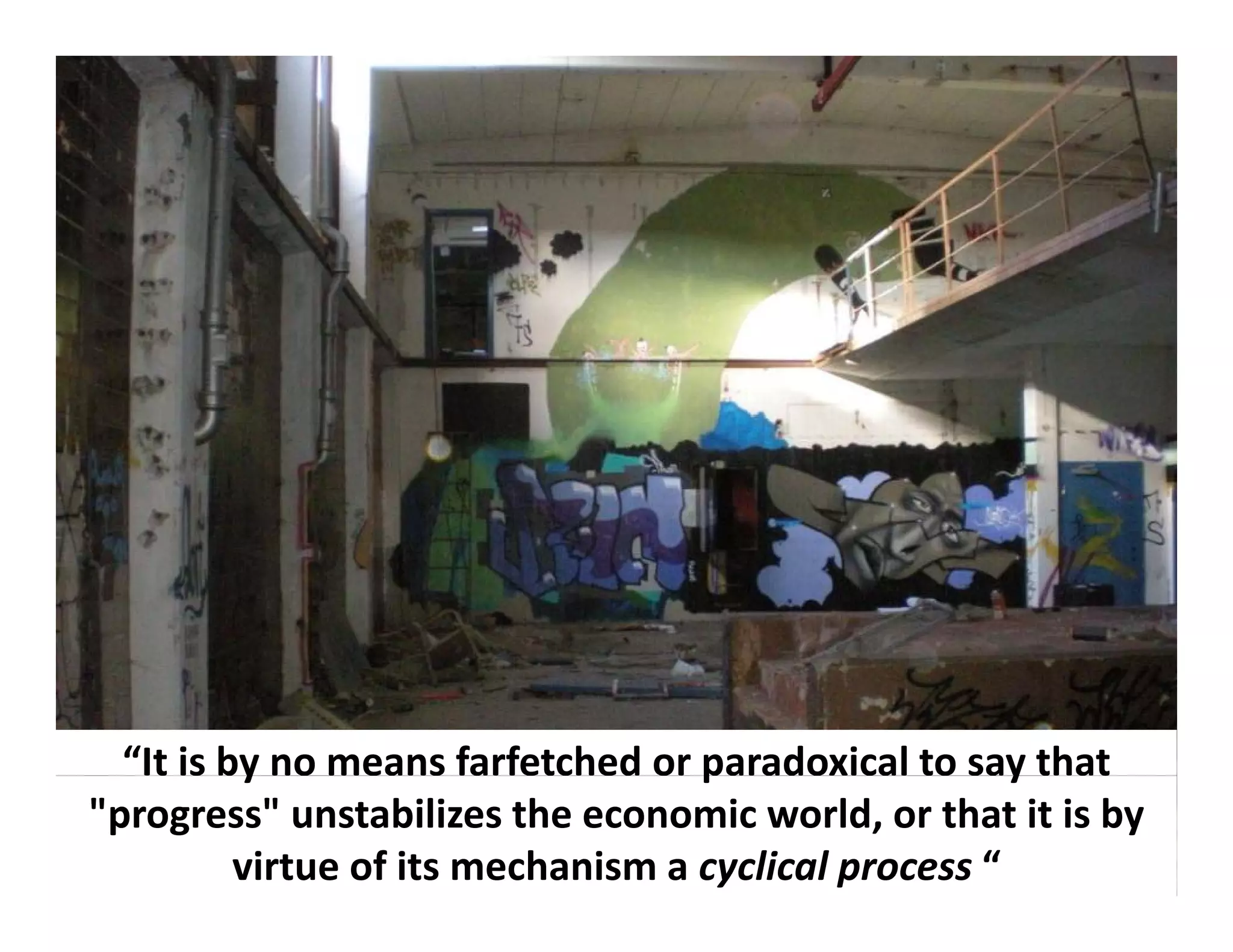
“It is by no means farfetched or paradoxical to say that 
    t s by o ea s a etc ed o pa ado ca to say t at
"progress" unstabilizes the economic world, or that it is by 
          virtue of its mechanism a cyclical process “
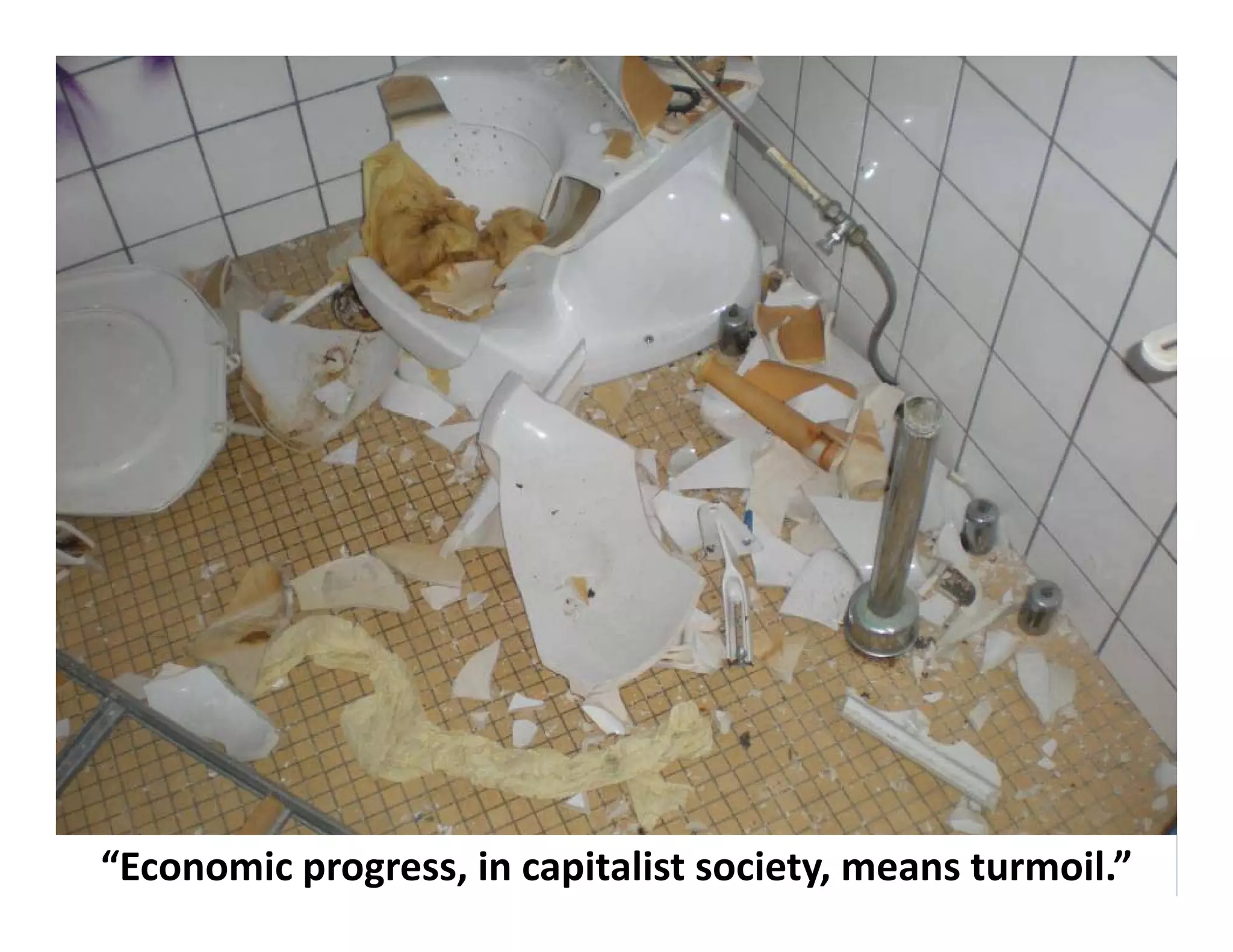
“Economic progress, in capitalist society, means turmoil.”
“Individual innovations imply, by virtue of their nature, a 
  “I di id l i          i    i l b i           f h i
    "big" step and a "big" change. A railroad through new 
country, i.e., country not yet served by railroads, as soon as 
country i e country not yet served by railroads as soon as
 it gets into working order upsets all conditions of location, 
    all cost calculations, all production functions within its 
                          , p
 radius of influence; and hardly any "ways of doing things" 
    which have been optimal before remain so afterward.”
“Surely, nothing can be more plain or even more trite 
 common sense than the proposition that innovation…is at 
                           p p
the center of practically all the phenomena, difficulties, and 
      problems of economic life in capitalist society. “
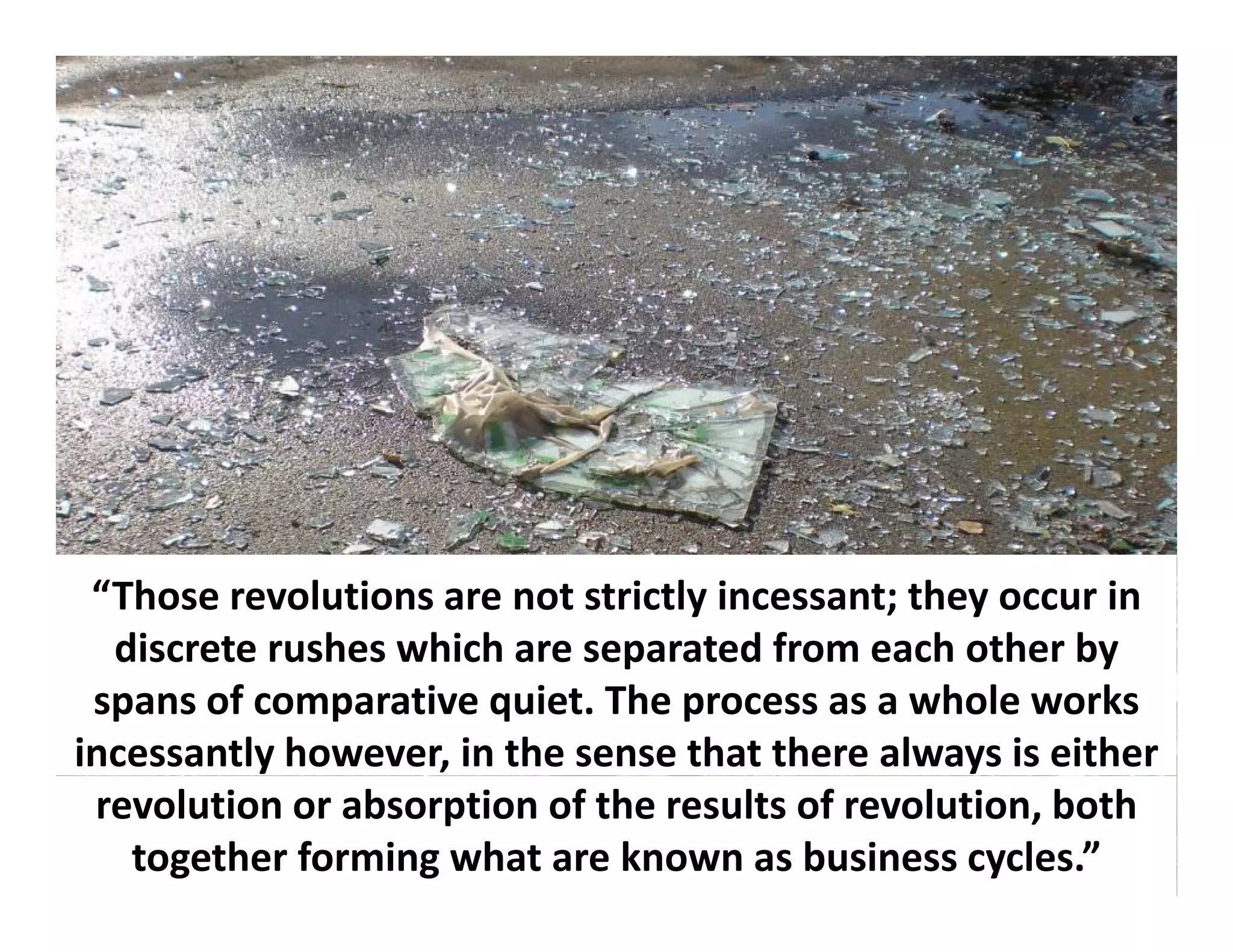
“Those revolutions are not strictly incessant; they occur in 
  discrete rushes which are separated from each other by 
  discrete rushes which are separated from each other by
 spans of comparative quiet. The process as a whole works 
incessantly however, in the sense that there always is either 
 revolution or absorption of the results of revolution, both 
   together forming what are known as business cycles.”
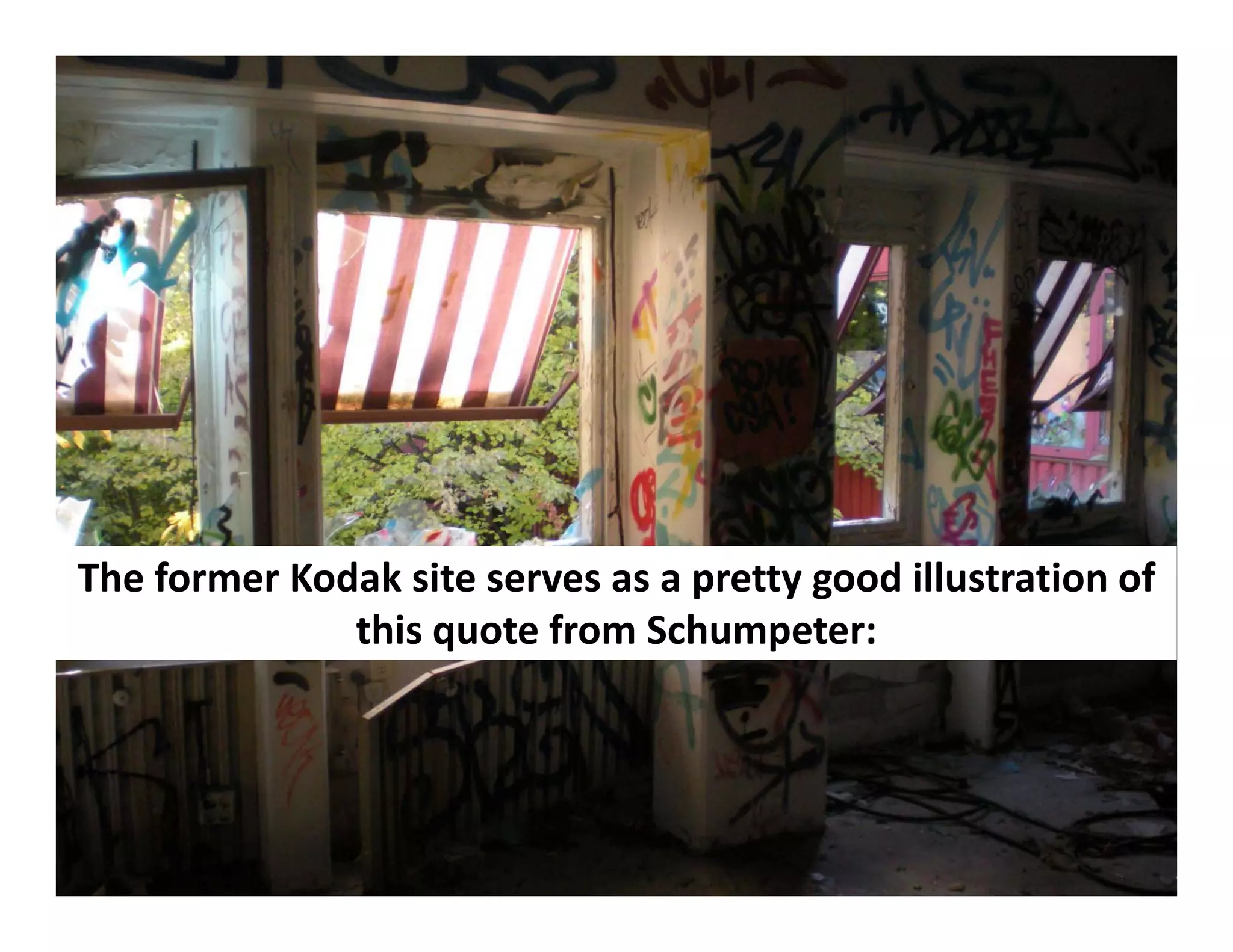
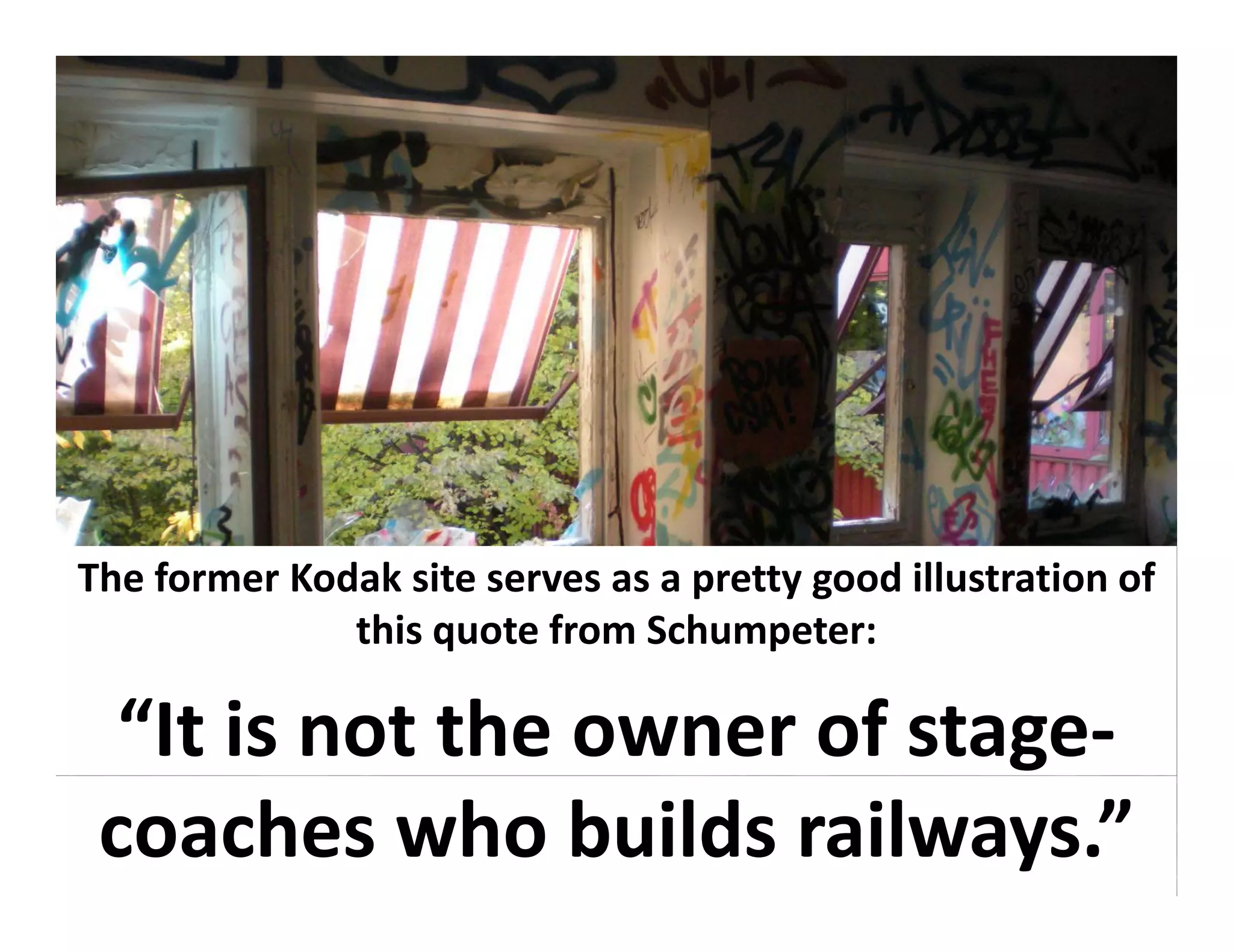
The former Kodak site serves as a pretty good illustration of 
              this quote from Schumpeter:
The former Kodak site serves as a pretty good illustration of 
              this quote from Schumpeter:

  “It is not the owner of stage‐
 coaches who builds railways.”
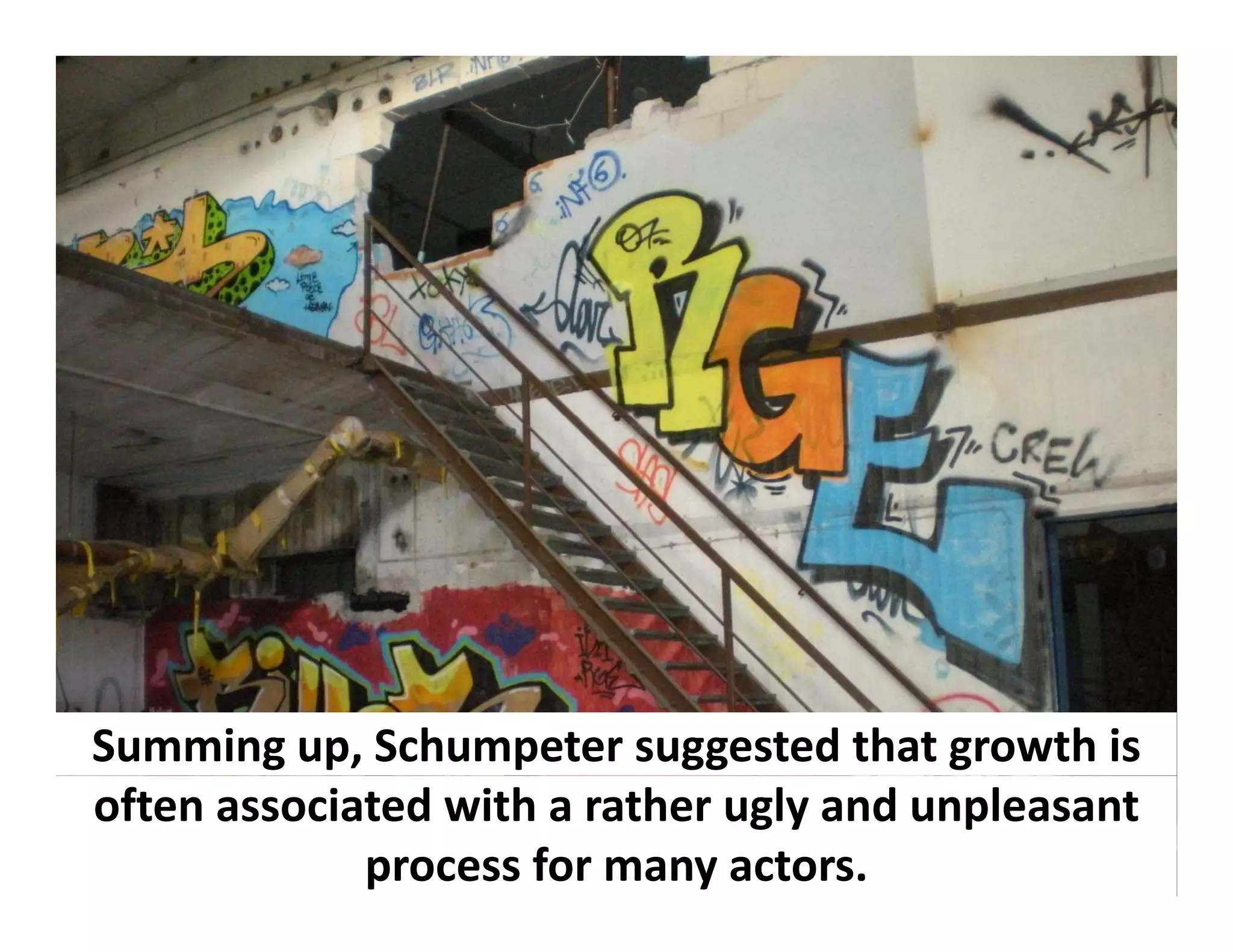
Summing up, Schumpeter suggested that growth is 
often associated with a rather ugly and unpleasant 
             process for many actors.
Put differently by a decoration inside the Kodak building:
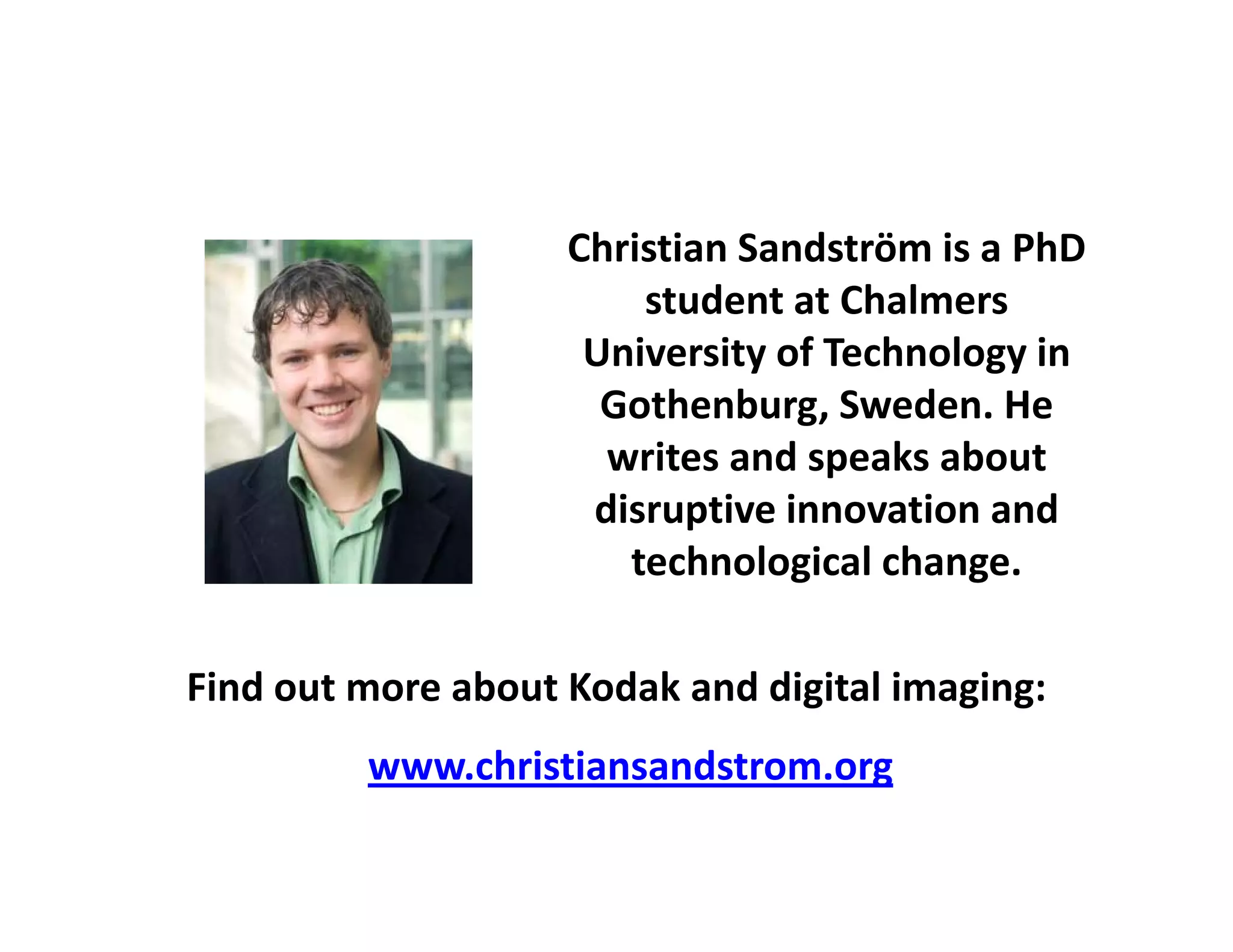
Christian Sandström is a PhD 
                        student at Chalmers 
                        student at Chalmers
                     University of Technology in 
                      Gothenburg, Sweden. He 
                      Gothenburg, Sweden. He
                      writes and speaks about 
                     disruptive innovation and 
                       technological change.

Find out more about Kodak and digital imaging:
         www.christiansandstrom.org

Schumpeter and the Creative Destruction of Photography