Engineering Support
      System
      Group 12
Project Vision
“The vision of this project is to provide a
better customer service through an
integrated enterprise application system
and enhance the efficiency of engineering
support teams.”
Project Goals
• integrate a set of existing and proposed systems
  in such a way that their collective functionality is
  directed towards achieving the above mentioned
  vision.
System’s Main Requirements
Functional Requirements
• Recording the email conversations with the clients.

• Engineers and clients should be able to access SLAs.

• Clients should be able to inform an issue and request patches.

• System should be able to create client accounts automatically.
Non Functional Requirements
• Security

• Availability

• Unified view of data

• Accuracy

• Availability
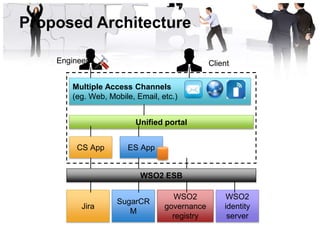
Proposed Architecture

    Engineer                                   Client

        Multiple Access Channels
        (eg. Web, Mobile, Email, etc.)


                          Unified portal


         CS App        ES App


                           WSO2 ESB

                                    WSO2           WSO2
                    SugarCR
          Jira                    governance       identity
                       M
                                    registry        server
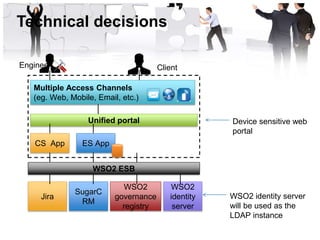
Technical decisions

Engineer                               Client

   Multiple Access Channels
   (eg. Web, Mobile, Email, etc.)

                  Unified portal                     Device sensitive web
                                                     portal
   CS App       ES App


                   WSO2 ESB

                            WSO2          WSO2
              SugarC
     Jira                 governance      identity   WSO2 identity server
               RM
                            registry       server    will be used as the
                                                     LDAP instance
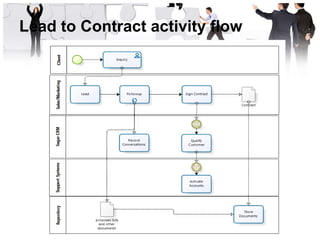
Lead to Contract activity flow
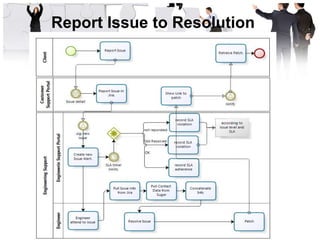
Report Issue to Resolution
Advantages of proposed architecture
•   New portals can be easily integrated to the existing system
•   Central authentication server can be added for security
•   No single point of failure
•   Unified view of data through portal
•   Less redundant data (Each system maintains data which are specific to
    that system)
•   Low latency and no blocking operations
•   High extendibility
•   Technology independent subsystems (Each subsystem can be
    implemented using different technologies)
•   Loosely coupled subsystems
•   Authentication and authorization support at every level
Advantages of proposed
               architecture
• Complexity of Jira is hidden from customer throu CS portal.
• Engineers get a unified view of data form ES portal.
• Data is not replicated in ES or CS.(They are in the base systems : Jira, Sugar,
  Registry)
Quality Attributes
•   Security
     o Authorization/authentication based on a central LDAP
     o Role based access control
•   Performance
     o Zero latency
     o Streamline processes
     o Minimum response time
•   Availability
     o 24/7 availability
•   Maintainability
Assumptions Made
•   support accounts are not activated until a contract
    with the client is signed.
•   There is a common mechanism relate data of a user
    account distributed in different servers.(E.g. user ID
    is similar for an user in every server)
•   Different subsystems used in this overall system
    support a web service interface. If not an adapter
    has to be developed.
Assumptions - Continued
•   All the authentication must happen through a
    centralized LDAP server
•   No monetary payments has to be considered as they
    have not mentioned.
•   New system to manage patches is not needed. It can
    be done through JIRA.
•   Users can directly interact with the existing
    subsystems as previously even in the new system
Ambiguities
•   User roles are not well defined (e.g. if a user is
    logged as an engineer he will have the access to
    data of all the engineers)
•   Disaster recovery and backups are not specified.
•   Security requirements other than role based
    security is not specified
Other Considered Architectures
•Client-Server Architecture


                      Presentation Layer
                                                                     Sugar
     Web browser


                                           Control Layer
                                                                      Jira

                                                            Document Repository

                                                                         Engineering
                                                           Support
                                                                           support
                                                            portal
                                                                            portal
                                                           backend
                                                                          backend
Other considered Approaches
                                    Drawbacks
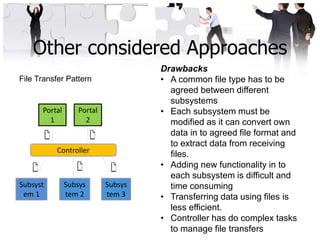
File Transfer Pattern               • A common file type has to be
                                      agreed between different
                                      subsystems
      Portal      Portal            • Each subsystem must be
        1           2                 modified as it can convert own
                                      data in to agreed file format and
                                      to extract data from receiving
          Controller
                                      files.
                                    • Adding new functionality in to
                                      each subsystem is difficult and
Subsyst        Subsys      Subsys     time consuming
 em 1          tem 2       tem 3    • Transferring data using files is
                                      less efficient.
                                    • Controller has do complex tasks
                                      to manage file transfers
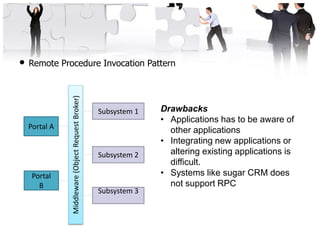
•   Remote Procedure Invocation Pattern
               Middleware (Object Request Broker)


                                                    Subsystem 1   Drawbacks
                                                                  • Applications has to be aware of
    Portal A                                                        other applications
                                                                  • Integrating new applications or
                                                    Subsystem 2     altering existing applications is
                                                                    difficult.
     Portal                                                       • Systems like sugar CRM does
       B                                                            not support RPC
                                                    Subsystem 3

EAI example

  • 1.
    Engineering Support System Group 12
  • 2.
    Project Vision “The visionof this project is to provide a better customer service through an integrated enterprise application system and enhance the efficiency of engineering support teams.”
  • 3.
    Project Goals • integratea set of existing and proposed systems in such a way that their collective functionality is directed towards achieving the above mentioned vision.
  • 4.
    System’s Main Requirements FunctionalRequirements • Recording the email conversations with the clients. • Engineers and clients should be able to access SLAs. • Clients should be able to inform an issue and request patches. • System should be able to create client accounts automatically.
  • 5.
    Non Functional Requirements •Security • Availability • Unified view of data • Accuracy • Availability
  • 6.
    Proposed Architecture Engineer Client Multiple Access Channels (eg. Web, Mobile, Email, etc.) Unified portal CS App ES App WSO2 ESB WSO2 WSO2 SugarCR Jira governance identity M registry server
  • 7.
    Technical decisions Engineer Client Multiple Access Channels (eg. Web, Mobile, Email, etc.) Unified portal Device sensitive web portal CS App ES App WSO2 ESB WSO2 WSO2 SugarC Jira governance identity WSO2 identity server RM registry server will be used as the LDAP instance
  • 8.
    Lead to Contractactivity flow
  • 9.
    Report Issue toResolution
  • 10.
    Advantages of proposedarchitecture • New portals can be easily integrated to the existing system • Central authentication server can be added for security • No single point of failure • Unified view of data through portal • Less redundant data (Each system maintains data which are specific to that system) • Low latency and no blocking operations • High extendibility • Technology independent subsystems (Each subsystem can be implemented using different technologies) • Loosely coupled subsystems • Authentication and authorization support at every level
  • 11.
    Advantages of proposed architecture • Complexity of Jira is hidden from customer throu CS portal. • Engineers get a unified view of data form ES portal. • Data is not replicated in ES or CS.(They are in the base systems : Jira, Sugar, Registry)
  • 12.
    Quality Attributes • Security o Authorization/authentication based on a central LDAP o Role based access control • Performance o Zero latency o Streamline processes o Minimum response time • Availability o 24/7 availability • Maintainability
  • 13.
    Assumptions Made • support accounts are not activated until a contract with the client is signed. • There is a common mechanism relate data of a user account distributed in different servers.(E.g. user ID is similar for an user in every server) • Different subsystems used in this overall system support a web service interface. If not an adapter has to be developed.
  • 14.
    Assumptions - Continued • All the authentication must happen through a centralized LDAP server • No monetary payments has to be considered as they have not mentioned. • New system to manage patches is not needed. It can be done through JIRA. • Users can directly interact with the existing subsystems as previously even in the new system
  • 15.
    Ambiguities • User roles are not well defined (e.g. if a user is logged as an engineer he will have the access to data of all the engineers) • Disaster recovery and backups are not specified. • Security requirements other than role based security is not specified
  • 16.
    Other Considered Architectures •Client-ServerArchitecture Presentation Layer Sugar Web browser Control Layer Jira Document Repository Engineering Support support portal portal backend backend
  • 17.
    Other considered Approaches Drawbacks File Transfer Pattern • A common file type has to be agreed between different subsystems Portal Portal • Each subsystem must be 1 2 modified as it can convert own data in to agreed file format and to extract data from receiving Controller files. • Adding new functionality in to each subsystem is difficult and Subsyst Subsys Subsys time consuming em 1 tem 2 tem 3 • Transferring data using files is less efficient. • Controller has do complex tasks to manage file transfers
  • 18.
    Remote Procedure Invocation Pattern Middleware (Object Request Broker) Subsystem 1 Drawbacks • Applications has to be aware of Portal A other applications • Integrating new applications or Subsystem 2 altering existing applications is difficult. Portal • Systems like sugar CRM does B not support RPC Subsystem 3