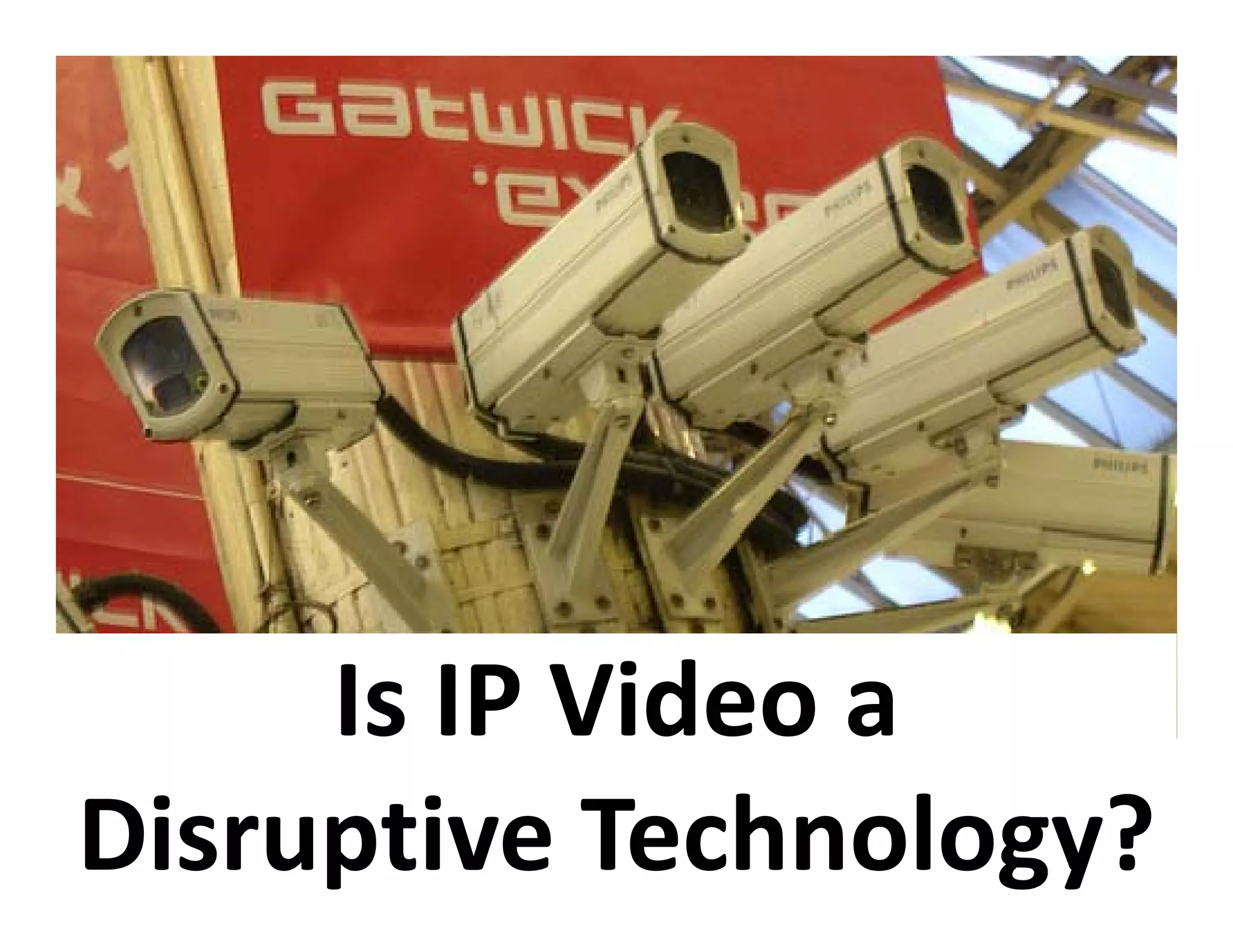







Is IP Video a 
Disruptive Technology?
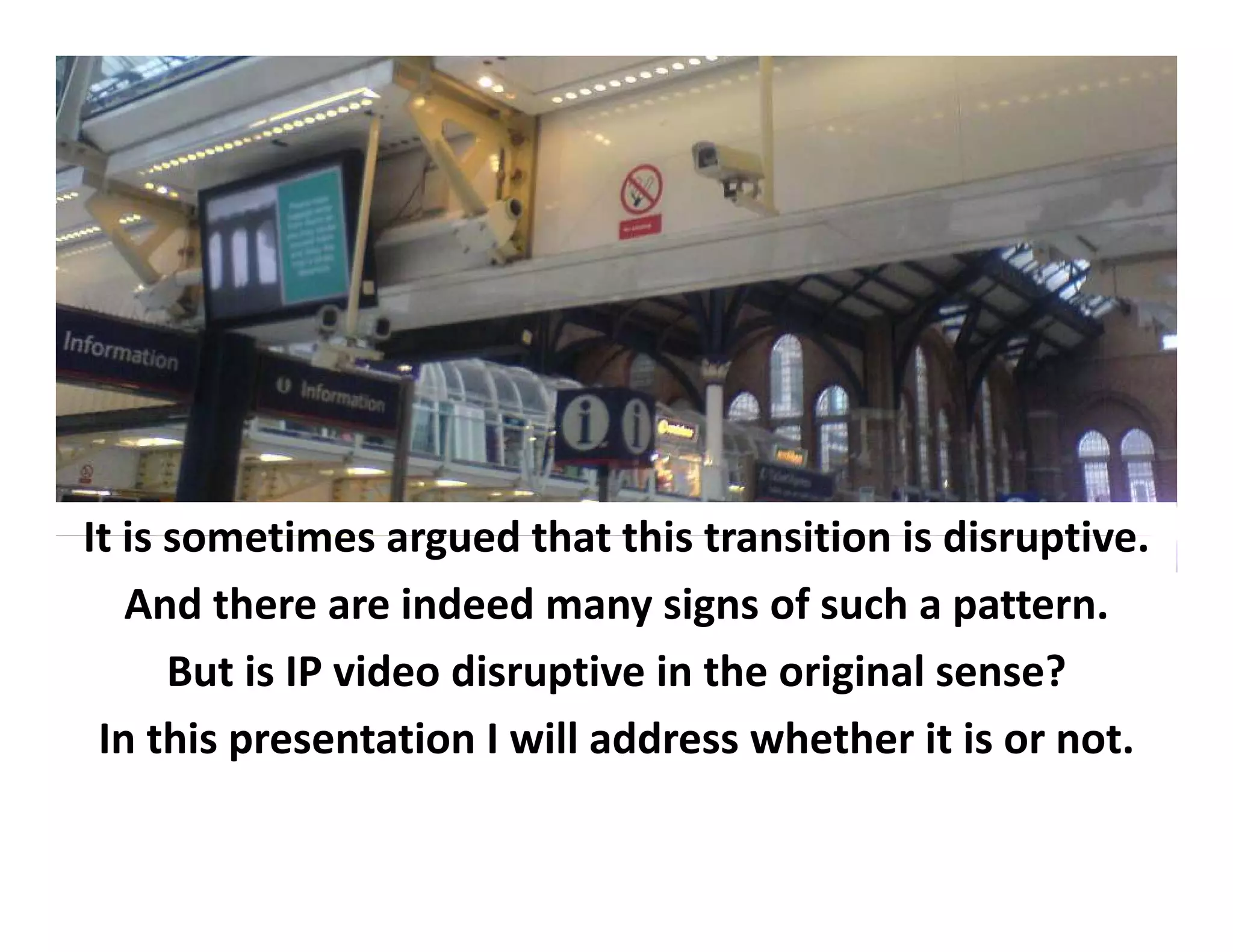
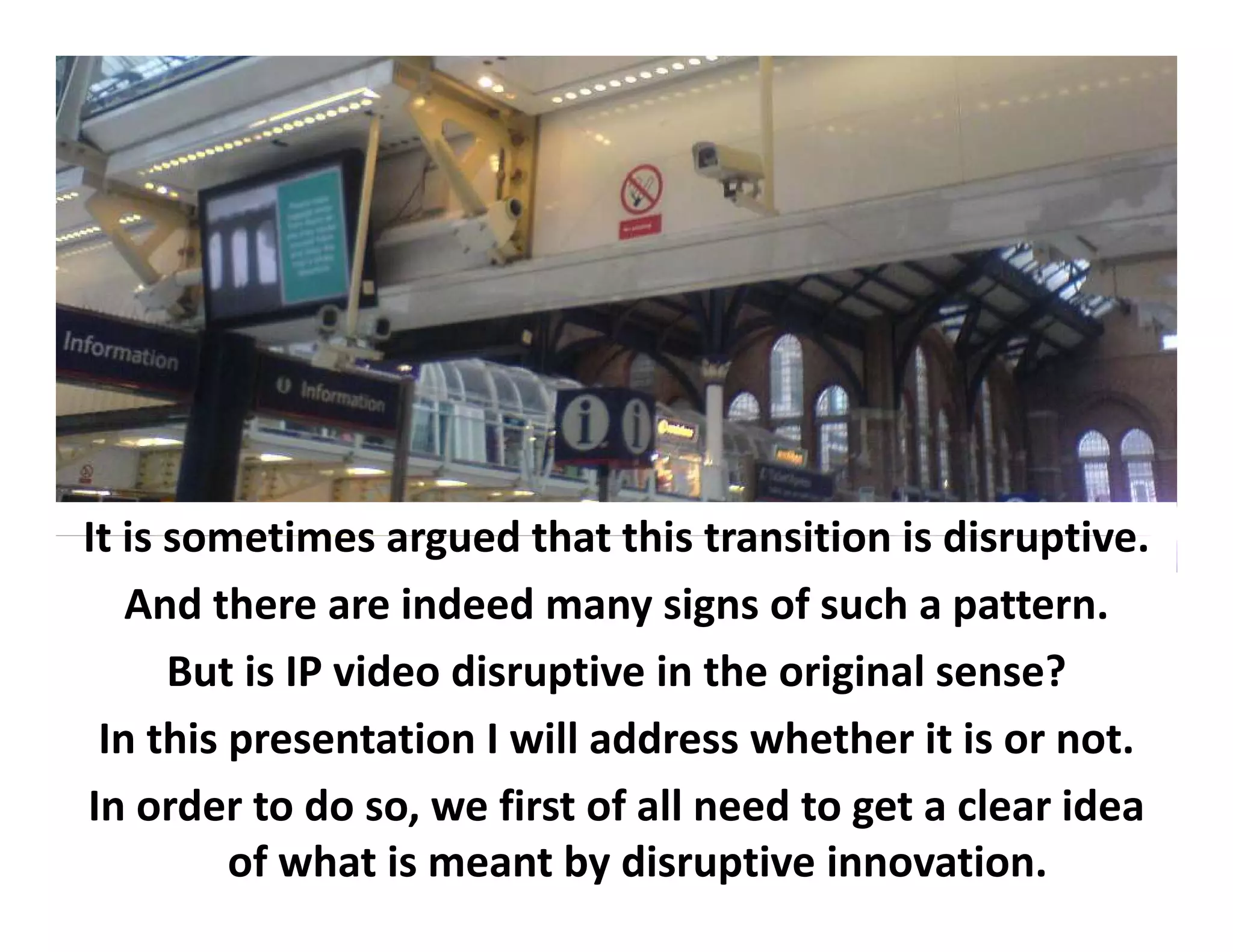
The security and surveillance industry is currently
    experiencing a shift from analogue to digital 
  cameras which are connected over the internet.
It is sometimes
It is sometimes argued that this transition is disruptive
                       that this transition is disruptive.
It is sometimes
It is sometimes argued that this transition is disruptive
                       that this transition is disruptive.
   And there are indeed many signs of such a pattern.
It is sometimes
It is sometimes argued that this transition is disruptive
                          that this transition is disruptive.
   And there are indeed many signs of such a pattern.
      But i
          is IP video disruptive i h
                 id di       i in the original sense?
                                          i i l        ?
It is sometimes
It is sometimes argued that this transition is disruptive
                          that this transition is disruptive.
   And there are indeed many signs of such a pattern.
      But i
          is IP video disruptive i h
                 id di       i in the original sense?
                                          i i l        ?
 In this presentation I will address whether it is or not.
It is sometimes
It is sometimes argued that this transition is disruptive
                          that this transition is disruptive.
   And there are indeed many signs of such a pattern.
      But i
          is IP video disruptive i h
                 id di       i in the original sense?
                                          i i l        ?
 In this presentation I will address whether it is or not.
In order to do so, we first of all need to get a clear idea
         of what is meant by disruptive innovation.
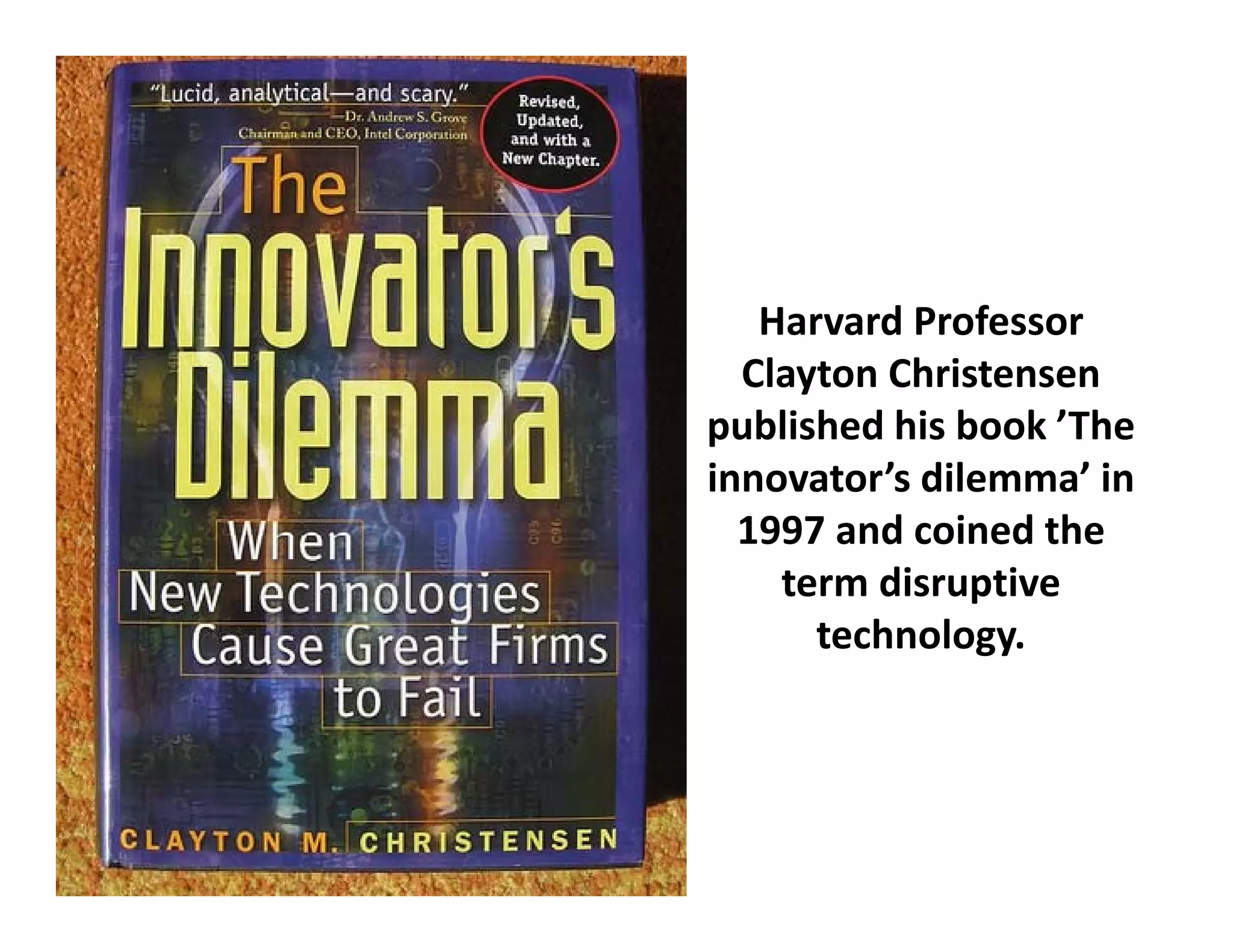
Harvard Professor 
  Clayton Christensen 
published hi b k ’Th
   bli h d his book ’The 
innovator’s dilemma’ in 
  1997 and coined the 
  1997 and coined the
    term disruptive
       technology.
                gy
In this book, Christensen sought to explain why
       great firms fail under conditions of 
              technological change.
While there are many explanations of such failure
            are many                of such failure, 
  Christensen brought an intriguingly different 
           p p
           perspective upon this issue.
                        p
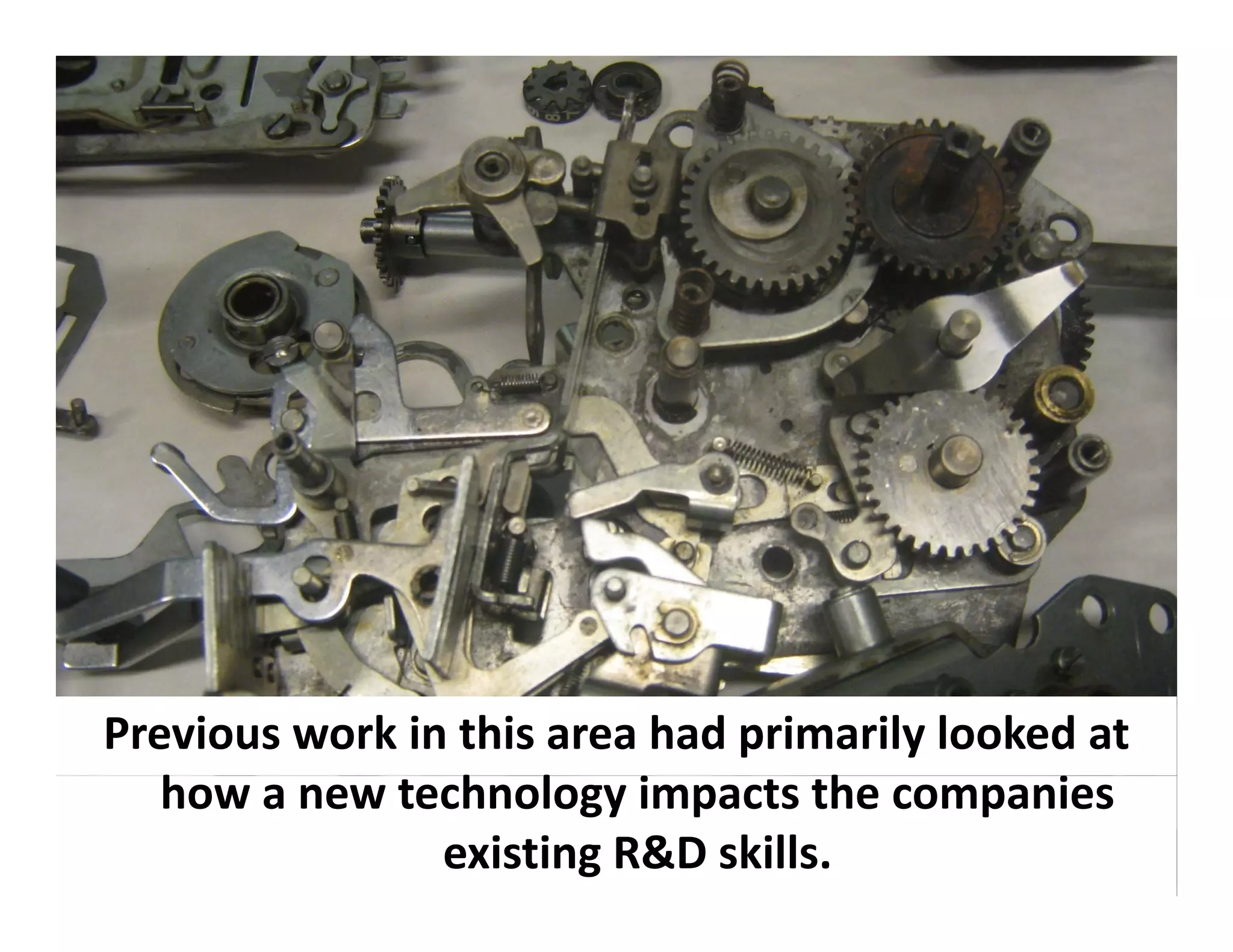
Previous work in this area had primarily looked at 
   how a new technology impacts the companies 
   h             h l      i         h         i
                existing R&D skills.
Christensen on the other hand, argued that it was the 
Christensen on the other hand argued that it was the
  impact on the market that determined whether
         established firms would fail or not.
Therefore, Christensen claimed that one
Therefore, Christensen claimed that one
must look at whether innovations satisfy
 a firm s
 a firm’s current customer base or not
                                or not.
Sustaining innovations are those which 
   mainstream customers demand.
Sustaining innovations are those which 
   mainstream customers demand.


 Those i
 Th     innovations which d not 
               ti     hi h do t
  satisfy current customers are 
        y
     regarded as disruptive.
The disruptive innovation has:

Lower performance according to what
   mainstream customers want
                         want.
The disruptive innovation has:

 Lower performance according to what
    mainstream customers want
                          want.

 Other performance attributes (smaller, 
simpler), which are not valued by current
simpler) which are not valued by current
customers, that makes it prosper in a new 
             value network.
The main problem then for established
firms is that they find it irrational to invest
 in a technology which their customers do
                not demand.
                not demand.

They
Th can’t fi d any fi
         ’t find    financial l i i
                          i l logic in 
 doing so and keep improving their
     g            p p         g
         existing products.
But once the disruptive technology has 
become ”good enough” it displaces the
         good enough it displaces the 
             former one.
But once the disruptive technology has 
 become ”good enough” it displaces the
          good enough it displaces the 
              former one.

 Those entrant firms which found a niche
                                 a niche
where customers did indeed demand the 
technology initially now move up‐market
t h l       i iti ll                  k t
   and start to dominate the industry. 
The Disruptive innovation framework
  The Disruptive innovation framework essentially
  posits that companies go bankrupt by listening to 
their customers and giving them what they demand.
                 and giving
A pretty provocative and interesting conclusion.
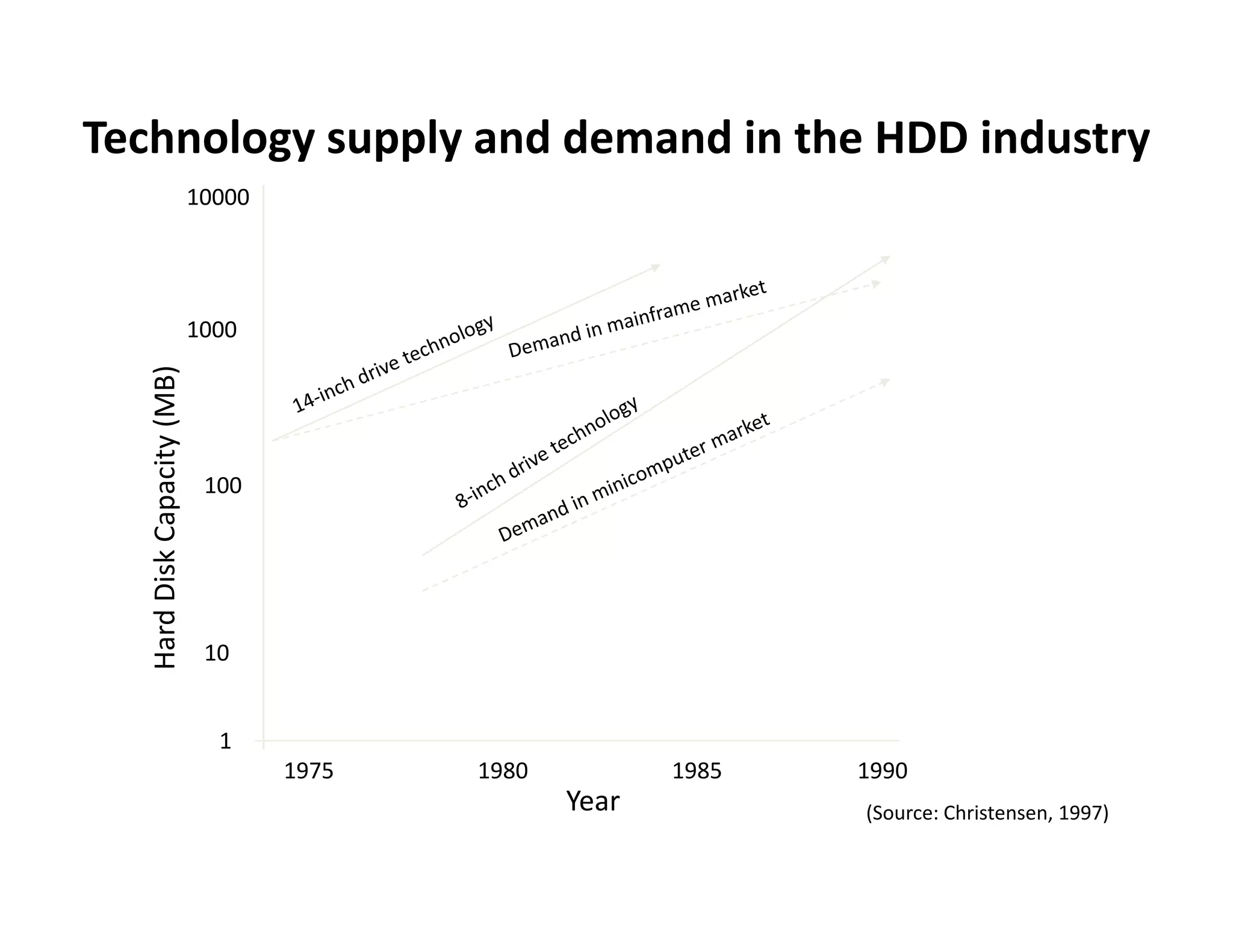
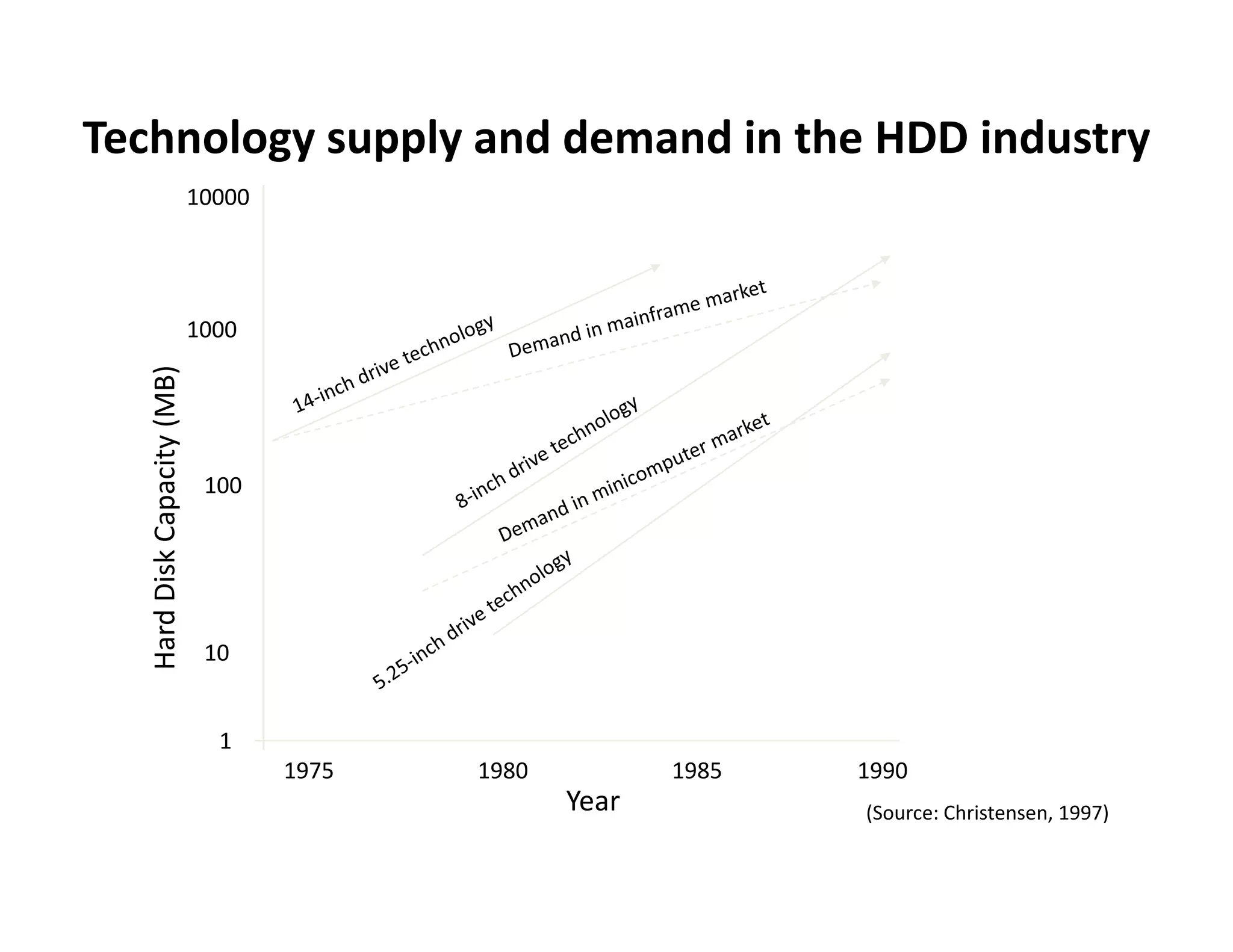
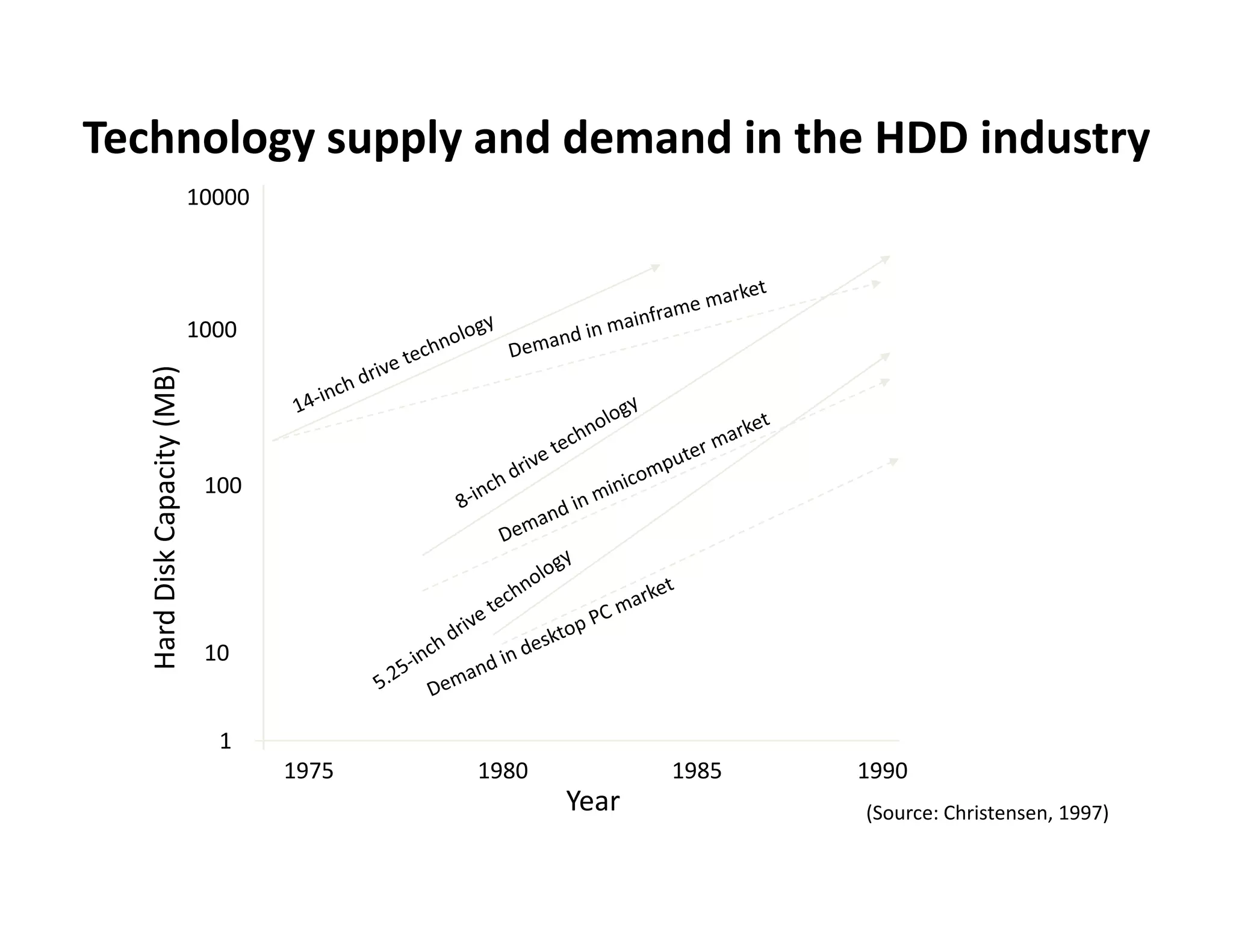
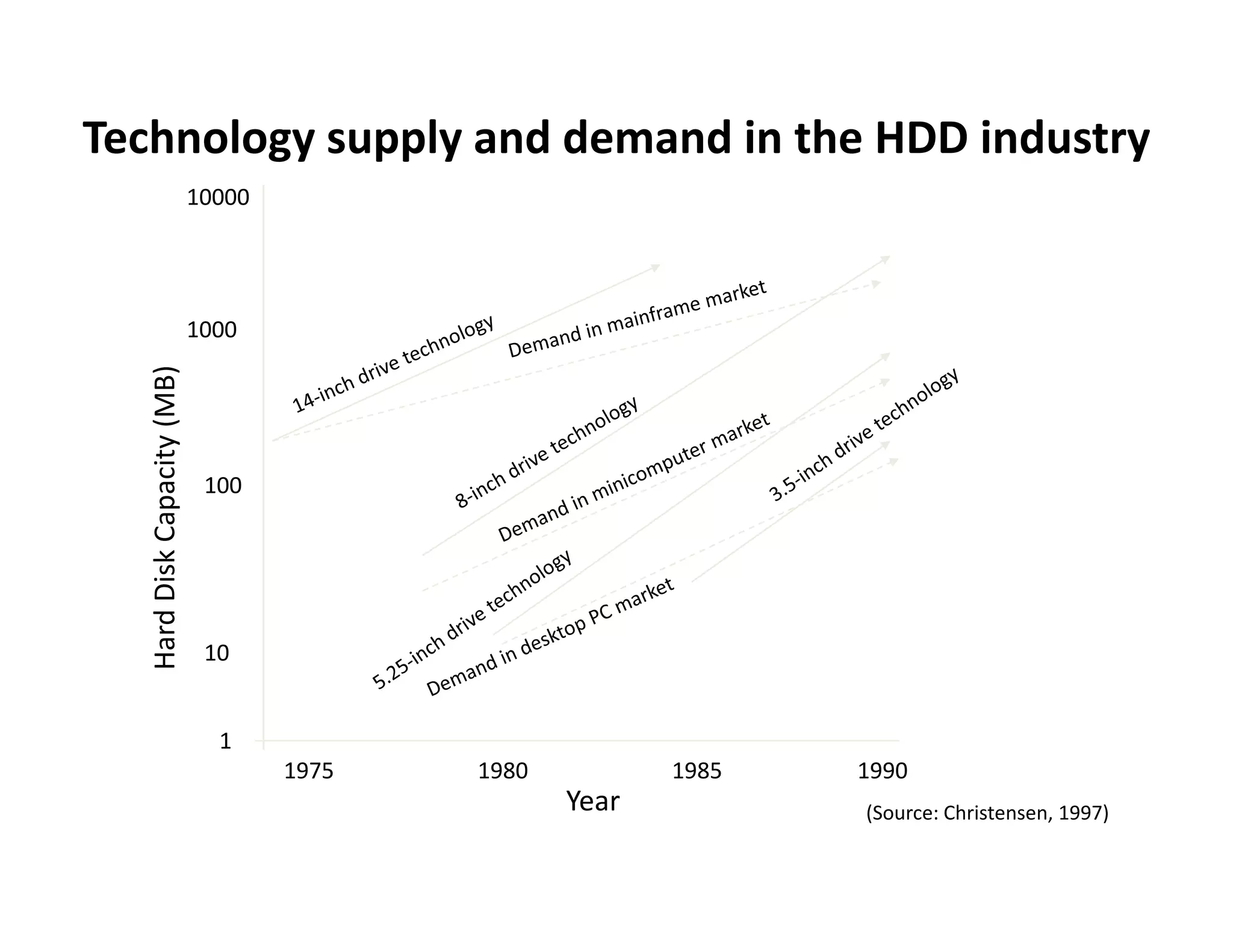
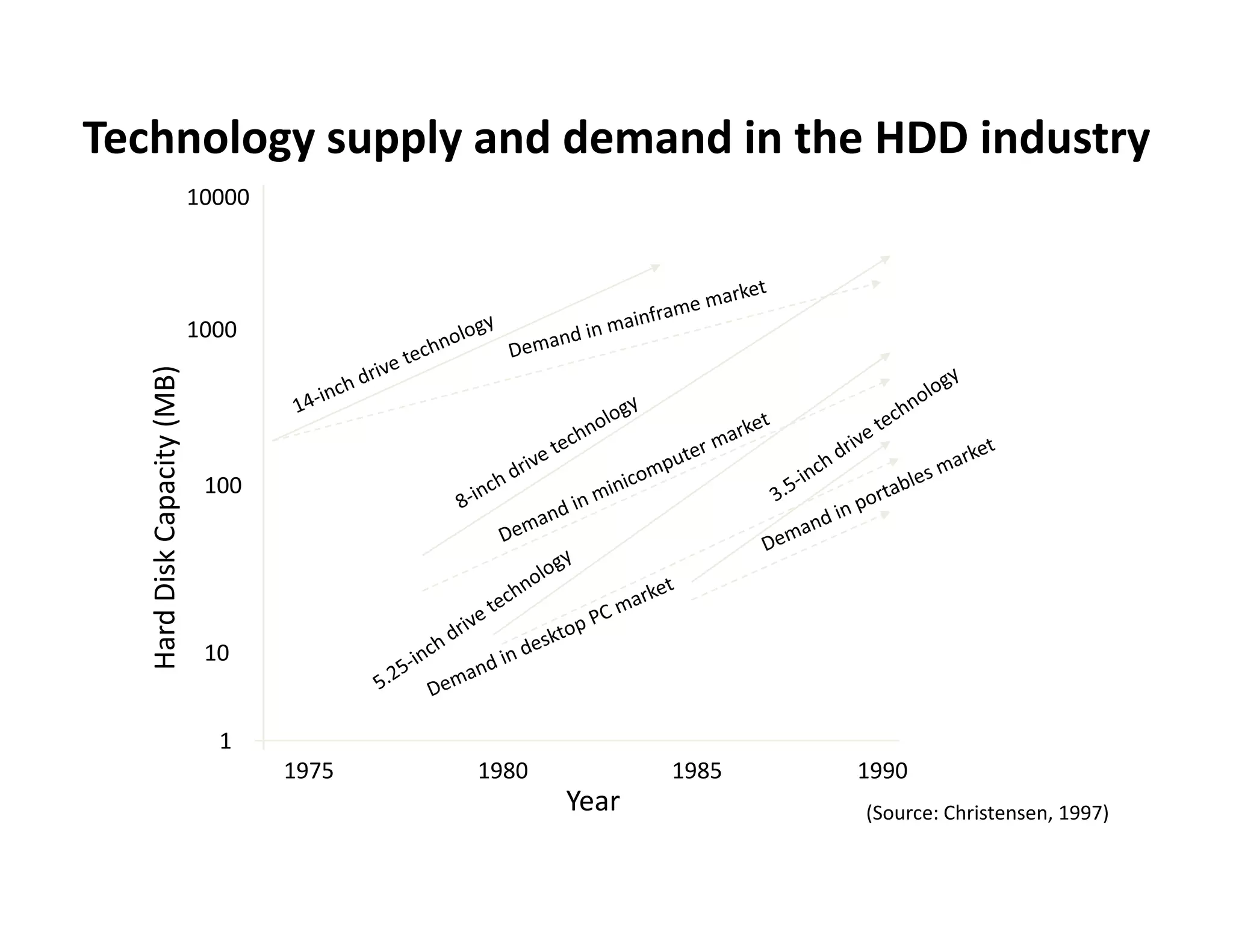
Christensen based his argument upon evidence from 
 the rigid disk drive industry, where
 the rigid disk drive industry, where each shift from
                                                 from 
 one generation of disk drives to a new one caused
        major problems for incumbent firms.
Christensen based his argument upon evidence from 
 the rigid disk drive industry, where
 the rigid disk drive industry, where each shift from
                                                 from 
 one generation of disk drives to a new one caused
        major problems for incumbent firms.


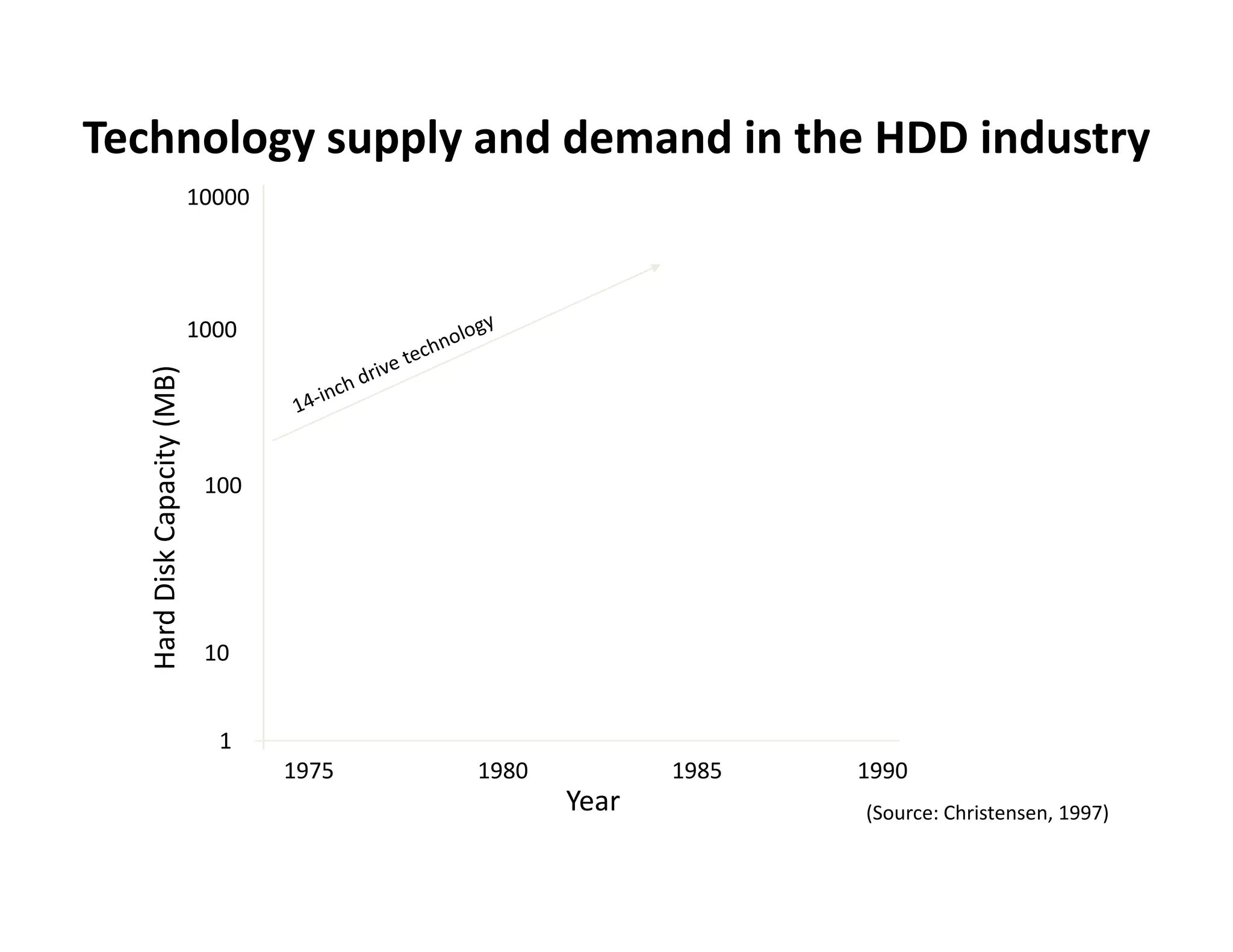
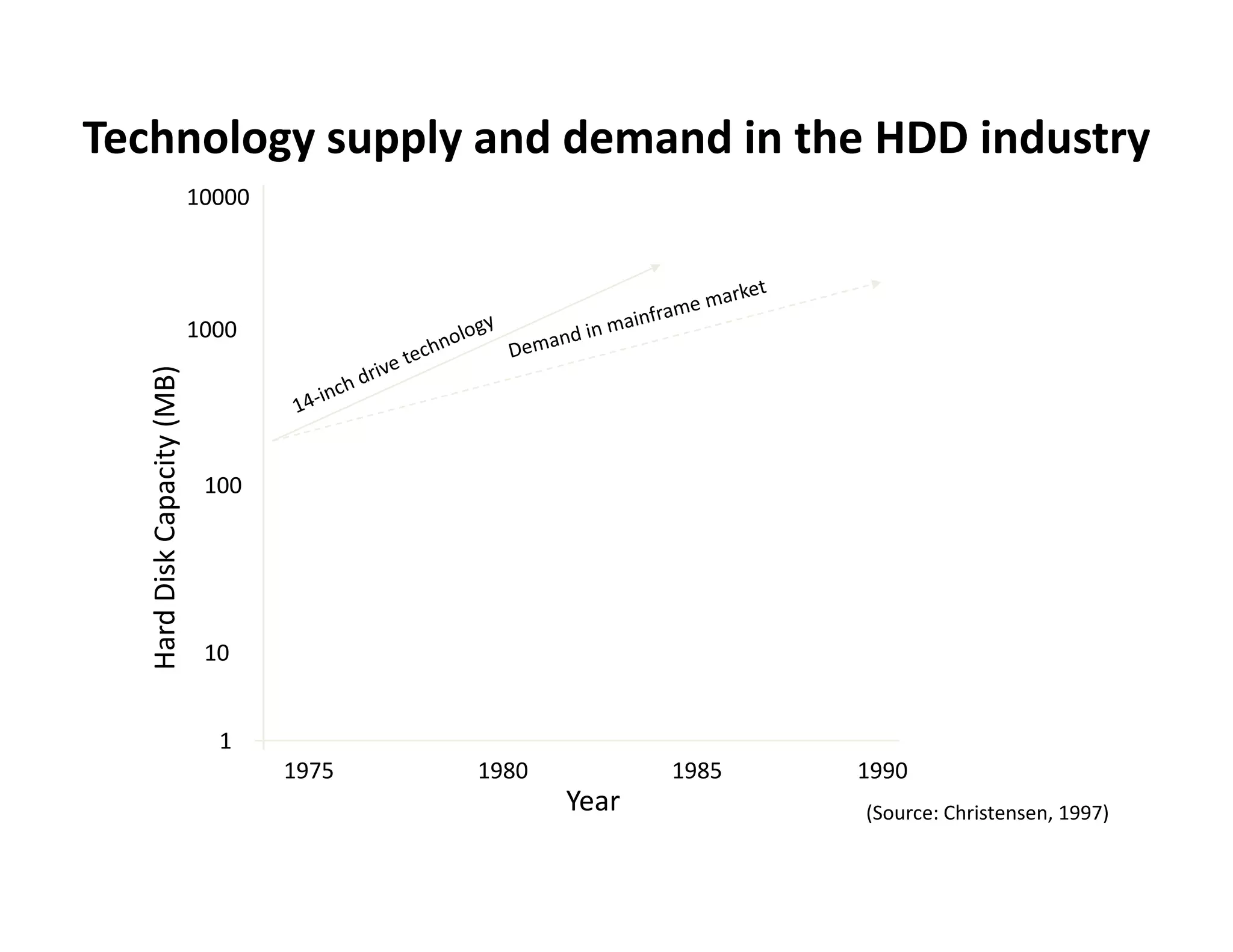
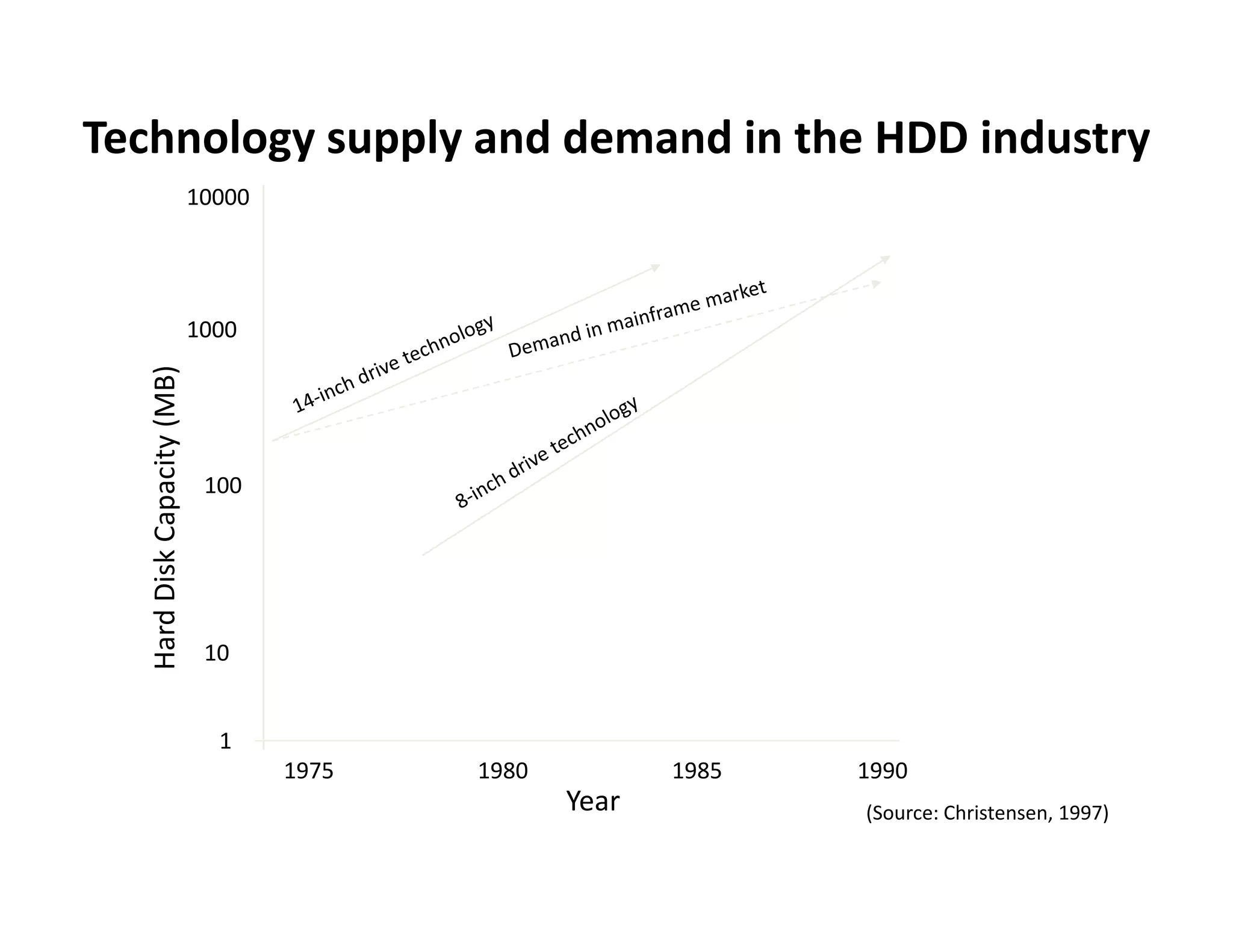
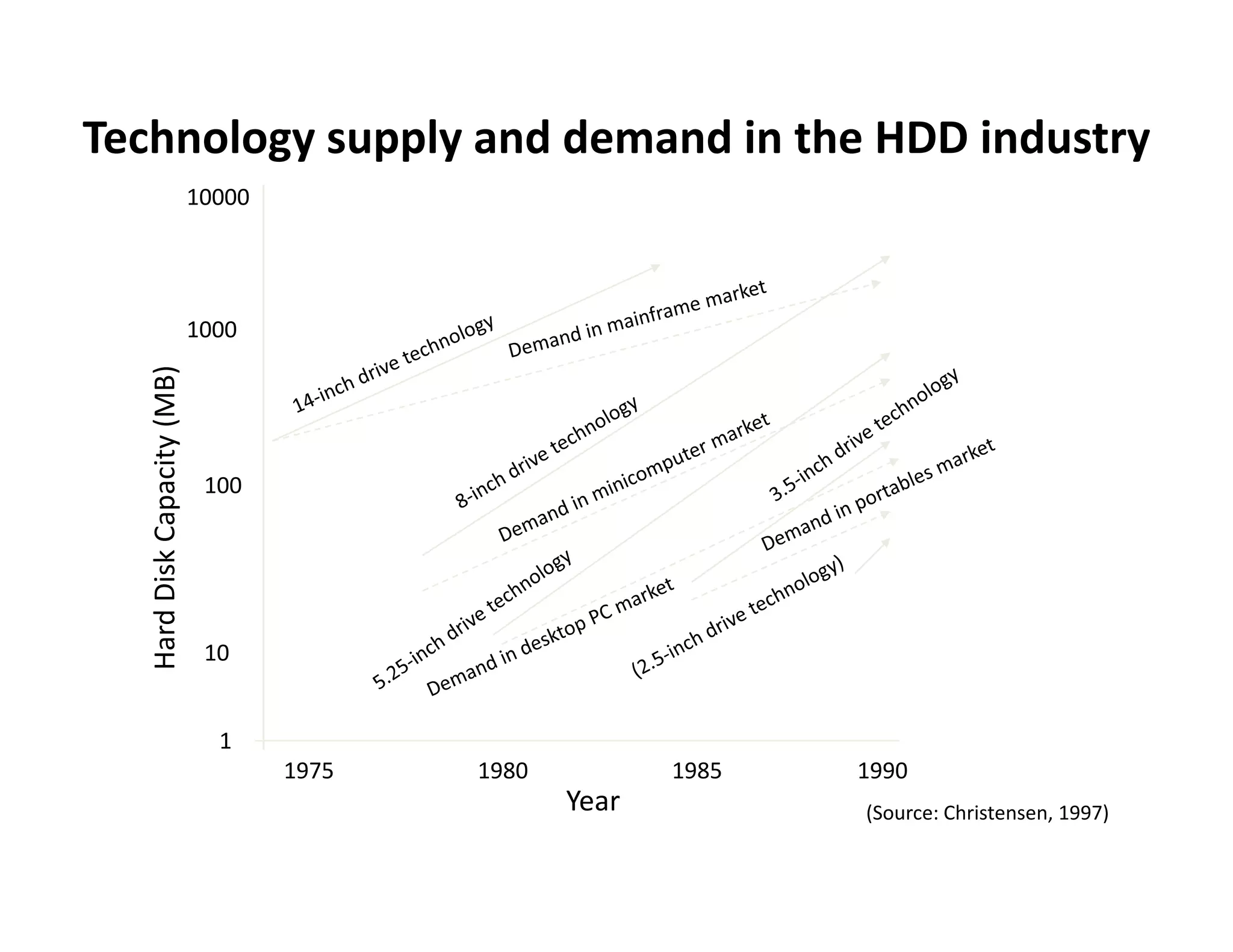
  Each new generation of disk drives was smaller and
        new generation of disk drives was        and 
    offered a lower performance in terms of storage
   capacity. Those firms that dominated the previous
generation therefore struggled to develop the new one, 
         as their customers did not demand it.
It looked something like this:
Technology supply and demand in the HDD industry
                             10000


                             1000
             Capacity (MB)


                              100
   Hard Disk C


                              10
   H


                               1
                                     1975   1980          1985   1990
                                                   Year          (Source: Christensen, 1997)
Technology supply and demand in the HDD industry
                             10000


                             1000
             Capacity (MB)


                              100
   Hard Disk C


                              10
   H


                               1
                                     1975   1980          1985   1990
                                                   Year          (Source: Christensen, 1997)
Technology supply and demand in the HDD industry
                             10000


                             1000
             Capacity (MB)


                              100
   Hard Disk C


                              10
   H


                               1
                                     1975   1980          1985   1990
                                                   Year          (Source: Christensen, 1997)
Technology supply and demand in the HDD industry
                             10000


                             1000
             Capacity (MB)


                              100
   Hard Disk C


                              10
   H


                               1
                                     1975   1980          1985   1990
                                                   Year          (Source: Christensen, 1997)
Technology supply and demand in the HDD industry
                             10000


                             1000
             Capacity (MB)


                              100
   Hard Disk C


                              10
   H


                               1
                                     1975   1980          1985   1990
                                                   Year          (Source: Christensen, 1997)
Technology supply and demand in the HDD industry
                             10000


                             1000
             Capacity (MB)


                              100
   Hard Disk C


                              10
   H


                               1
                                     1975   1980          1985   1990
                                                   Year          (Source: Christensen, 1997)
Technology supply and demand in the HDD industry
                             10000


                             1000
             Capacity (MB)


                              100
   Hard Disk C


                              10
   H


                               1
                                     1975   1980          1985   1990
                                                   Year          (Source: Christensen, 1997)
Technology supply and demand in the HDD industry
                             10000


                             1000
             Capacity (MB)


                              100
   Hard Disk C


                              10
   H


                               1
                                     1975   1980          1985   1990
                                                   Year          (Source: Christensen, 1997)
Technology supply and demand in the HDD industry
                             10000


                             1000
             Capacity (MB)


                              100
   Hard Disk C


                              10
   H


                               1
                                     1975   1980          1985   1990
                                                   Year          (Source: Christensen, 1997)
Technology supply and demand in the HDD industry
                             10000


                             1000
             Capacity (MB)


                              100
   Hard Disk C


                              10
   H


                               1
                                     1975   1980          1985   1990
                                                   Year          (Source: Christensen, 1997)
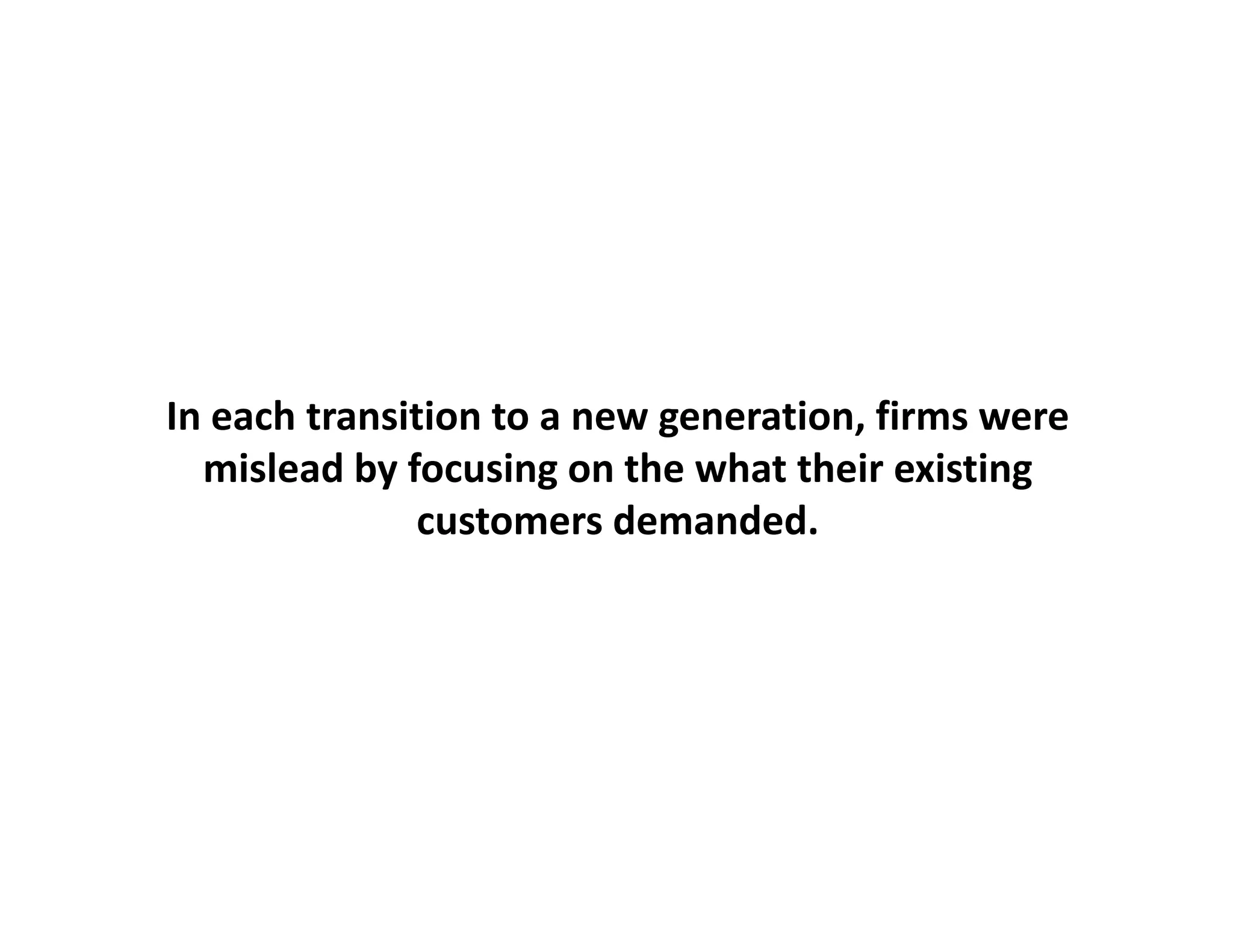
In each
In each transition to a new generation firms were
                   to a new generation, firms
  mislead by focusing on the what their existing
              customers demanded.
No let’s go back to the case of IP video.
At first sight it appears to be truly disruptive.
It had a lower performance along many of the 
        traditional dimensions such as:
It had a lower performance along many of the 
        traditional dimensions such as:

               Image quality
                Frame rate
                   Price
It had a lower performance along many of the 
          traditional dimensions such as:

                   Image quality
                    Frame rate
                       Price

At the same time, it offered new attributes such as:
    h                 ff d            b        h
It had a lower performance along many of the 
           traditional dimensions such as:

                   Image quality
                    Frame rate
                       Price

At the same time, it offered new attributes such as:
    h                 ff d            b        h

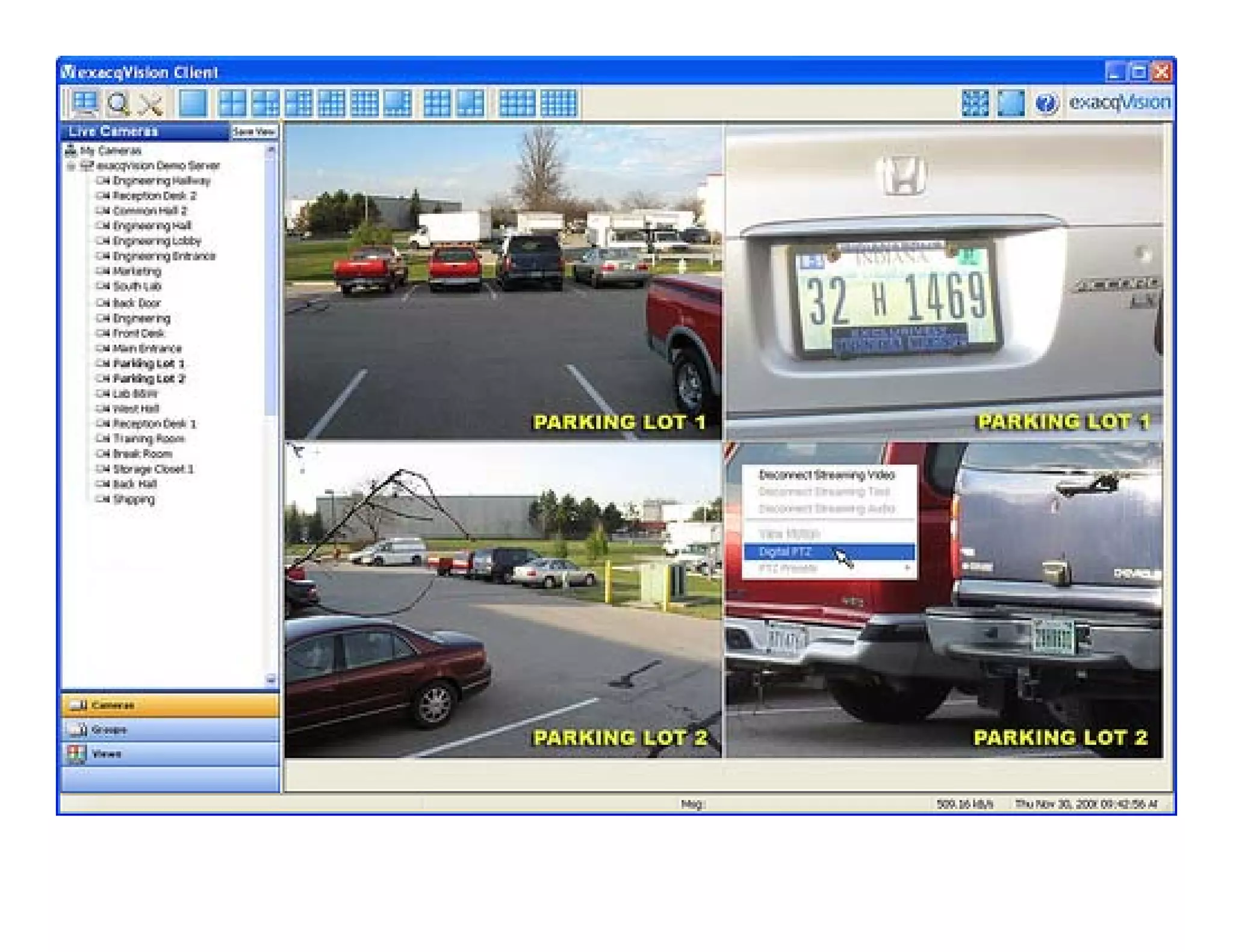
Images can be viewed from anywhere, you only
Images can be viewed from anywhere you only need
              an internet connection
          Easier to scale up these systems
                           p        y
  Software can make the cameras more intelligent
Over time, IP video has improved significantly along
 those dimensions which underperformed – image 
   quality is better today with HD and Megapixel
       cameras and the prices are declining.
                    d th    i      d li i
Sound like a schoolbook example of a disruptive
               technology, right?
But remember, Christensen stated that these
properties made a technology problematic because an 
    incumbent firm’s existing customers did not 
         appreciate such a value proposition.
               i t     h     l         iti
But in the case of IP video, this is not 
         necessarily the case.
IP video has not initially prospered in low‐end
segments or new markets as Christensen stated.
IP video has not initially prospered in low‐end
  segments or new markets as Christensen stated.
  It has rather emerged in many different, existing
segments such as retail, transportation, schools and 
                   city surveillance.
                    i         ill
IP video has not initially prospered in low‐end
  segments or new markets as Christensen stated.
  It has rather emerged in many different, existing
segments such as retail, transportation, schools and 
                   city surveillance.
                    i         ill
           These segments are hardly new, 
               or low‐end in any sense.
               or low‐end in any sense
IP video has not initially prospered in low‐end
  segments or new markets as Christensen stated.
  It has rather emerged in many different, existing
segments such as retail, transportation, schools and 
                    city surveillance.
                     i        ill
            These segments are hardly new, 
                or low‐end in any sense.
                or low‐end in any sense
    Rather, they are segments which benefited in 
     p
     particular from the scalability and other new 
                                    y
       attributes that IP brought to the market.
Wouldn’t Pelco’s customers in for instance the city 
  surveillance or retail segments benefit from 
                   adopting IP?
                    d ti
Wouldn’t Pelco’s customers in for instance the city 
  surveillance or retail segments benefit from 
                   adopting IP?
                    d ti

 I think
 I think they do and that they have adopted IP to
                 and that they              IP to 
                quite a large extent.
Wouldn’t Pelco’s customers in for instance the city 
  surveillance or retail segments benefit from 
                   adopting IP?
                    d ti

 I think
 I think they do and that they have adopted IP to
                 and that they              IP to 
                quite a large extent.

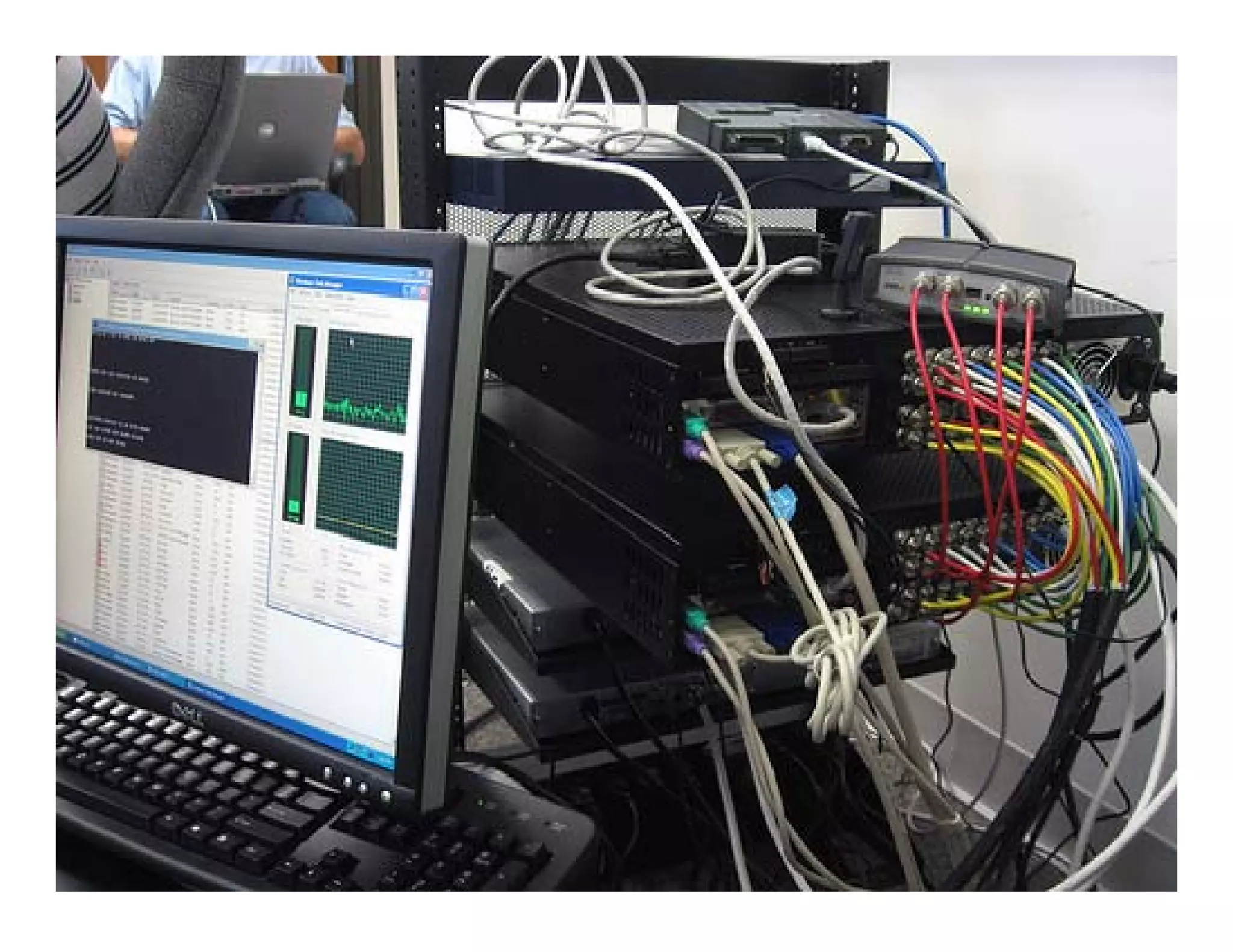
 But those cameras have not primarily come from 
 Pelco or other analogue firms. Entrants like Axis, 
ACTI, Mobotix and Indigo Vision have been leading
                 this shift, so far.
The transition to IP is therefore not a classical
     example of a disruptive technology.
One of the problems for analogue
 One of the problems for analogue firms has rather
                                          has rather
been that they are not used to delivering this kind of 
       value proposition to their customers.
             p p
One of the problems for analogue
 One of the problems for analogue firms has rather
                                          has rather
been that they are not used to delivering this kind of 
       value proposition to their customers.
             p p

  Their sales channel has been related to security
   people and with the shift to IP, surveillance is 
                becoming an IT issue.
One of the problems for analogue
 One of the problems for analogue firms has rather
                                          has rather
been that they are not used to delivering this kind of 
       value proposition to their customers.
             p p

  Their sales channel has been related to security
   people and with the shift to IP, surveillance is 
                becoming an IT issue.

Those firms find it difficult to target security people
with an IT offer and their
with an IT offer and their sales model has been built
                                         has been
 around relations with security people throughout
                   the value
                   the value chain.
And it is sometimes more difficult to change
  relations than to change technologies.
Summing up, the transition to IP may at first glance
         up, the transition to IP may at first glance
 appear to be a schoolbook example of disruptive
                    innovation.
Summing up, the transition to IP may at first glance
           up, the transition to IP may at first glance
 appear to be a schoolbook example of disruptive
                      innovation.
But a closer look makes it clear that it is actually not 
         disruptive in the traditional sense.
Summing up, the transition to IP may at first glance
           up, the transition to IP may at first glance
  appear to be a schoolbook example of disruptive
                      innovation.
But a closer look makes it clear that it is actually not 
         disruptive in the traditional sense.
IP has not primarily emerged i
IP h     t i      il         d in new markets or low‐
                                            k t     l
  end segments, rather, it has prospered in existing
 market segments, albeit in a new way that makes it 
 market segments albeit in a new way that makes it
     problematic to handle for established firms.
Sources
Christensen, C.M. (1997) The Innovator’s 
Dilemma, Harvard Business School Press, 
       Cambridge, Massachusetts.
Christian Sandström is a PhD 
                        student at Chalmers 
                        student at Chalmers
                     University of Technology in 
                      Gothenburg, Sweden. He 
                      Gothenburg, Sweden. He
                      writes and speaks about 
                     disruptive innovation and 
                       technological change.

More about IP video and disruptive innovation:
         www.christiansandstrom.org

Is IP Video a Disruptive Technology?