Superhumans and
Innovation Workshops:
Leveraging the Neurobiological
Principles of Genius to Design
Workplaces of Extraordinary Creativity
Dan Feldman
@danielrfeldman
http://www.agileandbeyond.co/
How would you design a
workplace of extraordinary
creativity and adaptability?
What ideas
might you use?
What do geniuses know
about designing
innovation workshops?
• INTERCONNECTEDNESS
• CURIOSITY
• INDEPENDENT
THINKING
• REFINE YOUR SENSES
• EMBRACE
UNCERTAINTY
• ART & SCIENCE,
WHOLE BRAIN
THINKING
• MIND-BODY CARE
Imagine a situation
where everything is
backwards
• Customers control
companies
• Jobs allow for self-
expression
• Barriers to
competition
disappear
• Strangers design
new products
• Advertising scares
customers
• Demographics are
irrelevant
• Meaning talks;
money walks
• Stability is a fantasy
• Talent trumps
obedience
• Imagination beats
knowledge
• Empathy trounces
logic
• Markets move fast
• Innovation
leapfrogs
How can you change
fast enough to benefit
from disruption?
We must CREATE
wealth to succeed
But how?
What behaviors
would you choose?
Exceptional imagination
High performance
• Brand strategy
• Design thinking
• Culture of nonstop
innovation
How do you keep growing when
adding more stuff unfocused
the meaning of your brand?
Game-changing
innovation
To overcome relentless
speed and extreme
clutter, you must innovate
If you want to innovate,
you have got to design
• Knowing
• MAKING
• Doing
Design Thinking
“A designer is anyone who
devises ways to change
existing situations to
preferred ones”
-Herbert Simon, Nobel Laureate, pioneer
of AI
Dragon Gap
• The difference between vision and
reality
• The space between what is and
what coulee be.
• You must spend time there.
Good design
•To KNOW truth
•To MAKE beauty
•To DO good.
• The financial
meltdown was the
result of bad design
• A management model
that includes a moral
dimension is needed.
Design thinking
applications
• Thought leadership /
vision
• Business model
• Organizational structure
• Strategic decisions
• Internal
communications
• Operational processes
• Brand ecosystem
• Customer relationships
• Products and services
• External conversations
Culture of innovation
• WSJ: How do you expect
to keep this up?
• Jobs: “We intend to keep
innovating”
If you want to innovate,
you’ve got to design
What abilities would
you develop?
• new ways of thinking
• interconnectedness in
everything
• new states of consciousness
What ideas might
you use?
Biomimcry
An approach to innovation that seeks sustainable
solutions to human challenges by emulating nature’s
time-tested patterns and strategies
Complex adaptive
systems
• cities
• firms
• markets
• governments
• industries
• ecosystems
• social
networks
• power grids
• animal swarms
• traffic flows
• insect colonies
• the brain
• immune
system
• cell
• embryo
What are their
characteristics?
• Emergence
• Sudden transitions /
tipping-points / non-
linear dynamics
• Limited predictability
• Large events
• Evolutionary dynamics
• Self-organization
• Fundamental
uncertainty
The most complex and
adaptable system?
Which brains provide
the greatest insights?
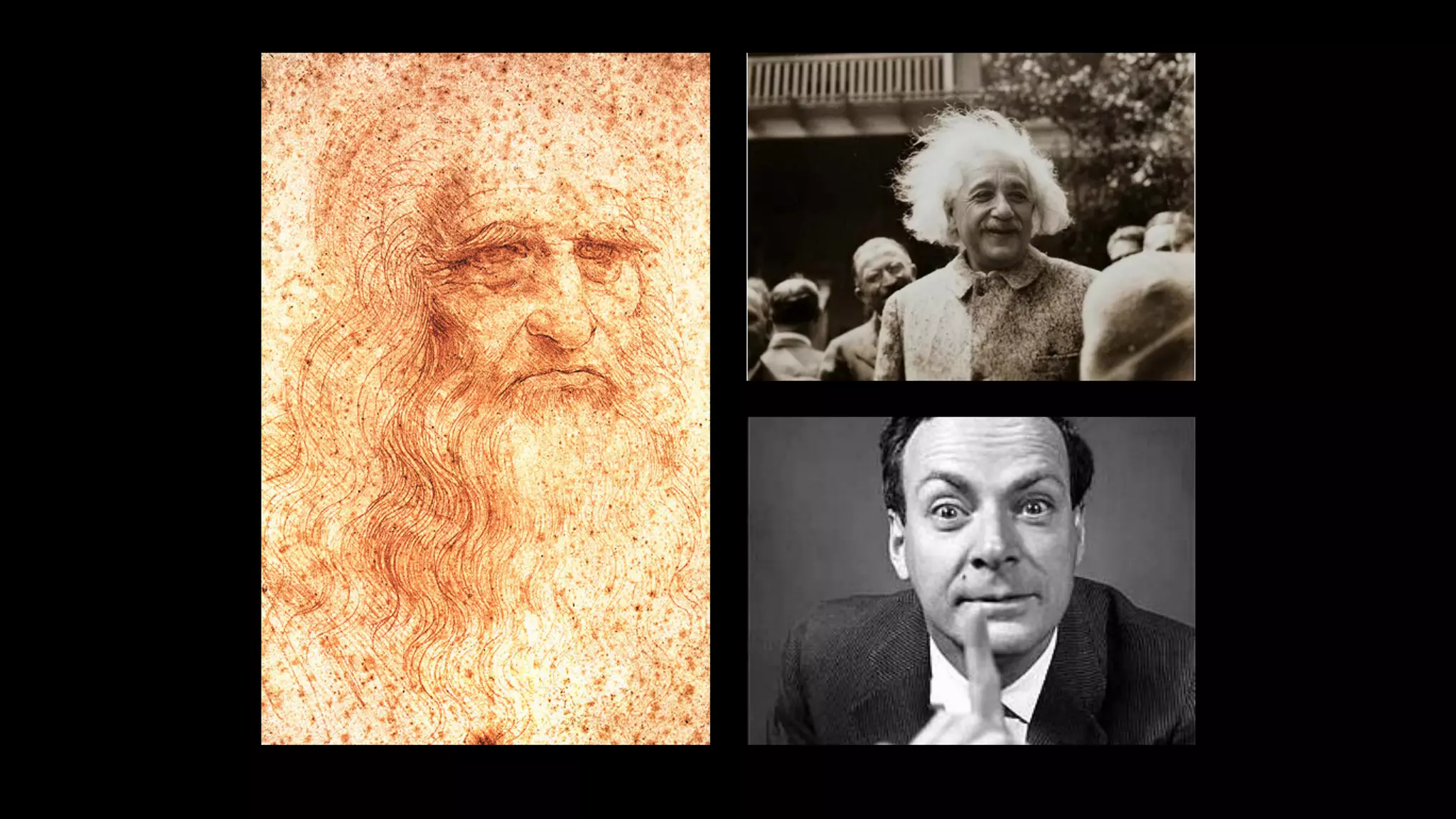
How did these
visionaries create world
changing innovations?
Do human brains relate
to organizational
structure and behavior?
Emergent complexity
Sapolsky’s definition
• Simple rules produce complex
behavior
• No single ant or neuron knows what to
do
• Not wisdom of the crowd… it is an
emergent feature
• One generation generates random info
which creates an ideal solution
• complex and
creative behavior
• increased
imagination and
performance
Bottom-up, emergent,
randomness-inducing
practices
• Mobbing
• Cross-
boundary
collaboration
• Cooperation
• Brainstorming
• Travel
• Language
learning
• Making art
• Psychedelic
experiences
Themes in systems of
emergent complexity
Power law distribution
• Enhanced creativity is linked to this
pattern of nature
• Earthquake example
• Highly pervasive in systems of
emergent complexity
Brain development
• Most connections occur
with neighboring neurons
• Longer connections occur
less often
Corpus callosum
• Connects the hemispheres
• Enables generalized skills
and insights
Gender differences
• Women
• Men
• Autism Spectrum
Communication flow and
behavioral differences
• boundless and smooth flow
• abundant and steady flow
• an insufficient and uneven flow
• limited and sporadic flow
Which brains are the
most adaptive and anti-
fragile?
Which themes would
you want to model in
organizations?
Highly siloed/
compartmentalized
organizations
Traditional, hierarchical
top-down organization
Diverse organization with
sufficient and steady flow of
communication throughout
Widely dispersed
organization with boundless
flow of communication
The most Agile, safe,
adaptive, and anti-fragile?
Can’t those on the Autism
Spectrum be creative
contributors?
The least innovative, the most
psychologically dangerous,
inflexible, and fragile?
What do we want?
• Imagination
• Performance
• Safety
• Agility
• Anti-fragility
• Societal health
• Inclusivity
• Contribution of
everyone
Enhance imagination
and performance, and
innovation and quality
• Wire up the enterprise
based on simple rules of
attraction and repulsion.
• Emergent systems yield
enhanced innovation and
quality.
• Use swarm intelligence
• Develop healthier
communication
patterns
• Encourage
charismatic
connectors
Self-management
• Morning Star - Colleague Letter of
Understanding - Doug Kirkpatrick
• Nearsoft - DIYcracy - Matt Perez
• Cocoon Projects - LiquidO - Stelio
Verzera
Build psychological
safety
(key to high-
performing teams)
Cultivate networks and
collaborative partnerships
• Riane Eisler of California Institute of Integrative
Studies
• Teddie Potter of University of Minnesota
• Breaking down hierarchies in nursing
• Improved creativity and innovation
• Improved quality and safety
De-concentrate and devolve
power (at least structurally)
“If those with power and authority
can’t justify that authority, power and
control, which is the usual case, then
the authority ought to be dismantled
and replaced by something free and
just.”
-Noam Chomsky
Democratize the workplace
• Transform the workplace into
a worker self-directed
enterprise
• Give voice, power, and safety
structurally to all members
Remove rules which
magnify fear and anxiety
• At-will employment
• Institutional bureaucracy
• Mindless bureaucracy
seeks only to keep control
Dissolve boundaries
Overcome infantilization
• Neoteny is the retention of juvenile characteristics
into adulthood
• Culture is a plot to keep you childish, dependent
• Avoid sloppy thinking, and intellectual shortcuts
• Embrace ambiguity, uncertainty, and paradox
Become a servant-leader
• Make and meet
commitments
• Do no harm
• Encourage and support
others to become leaders
Team across boundaries
• Hierarchical, functional, or extra-
organizational
• Sexism, racism, and classism
• Disciplinary, geographic,
departmental, cultural, linguistic
• Mobbing - mob across boundaries
Increase the diversity of
perspective
• Learn simple ideas and behaviors
from others
• Resolve social dis-ease
• Recover from cultural myopia
Make art
• Make your own images, stories,
systems, music
• Minimize consumption of
commercial/cultural messages
• Reclaim your humanity!
Chaos, complexity… what
does it mean?
• Quality increases with quantity (counterintutitive)
• The simpler the constituent the better
• Random noise is a good thing (better quality)
• Nearest neighbor interactions - attraction/
repulsion
• Specialists rarely yield emergence. Generalists
are essential (i.e. da Vinci)
The implications?
• Working together is natural
• Bottom-up emergent thinking needed now
• Transition to an organic, emergent live-and-let-live way of
thinking is well underway
• We must do this with other people (DIY-togetherness)
• New type of leadership. Differs from command and control
• Biological need for safety will come from a different place
Old type of leadership
• Top-down, trickle down economics
• Someone creates blueprints
• The blueprints may no longer be relevant
• Prioritization of large enterprises
• Prosperity highly concentrated
Problems with old style
leadership (Jack Ma)
• Old sets of blueprints yields economic woes
• Top-down, trickle down ideology rewards very few
• Large MNCs, fossil fuel, and warfare complex
• Money not spent on citizens
• $14 trillion wasted on warfare in past 3 decades
• Benefits of globalization distributed unevenly
• Complexity, creativity, and vitality did not emerge
• Specialized subcomponents fail to produce emergent complexity
“Globalization should be inclusive
globalization. In the past 30 years
globalization was controlled by 60,000
big companies. 100 years ago
globalization was controlled by several
kings and emperors. What if over the
next 30 years we can support 6 million
businesses.”
-Jack Ma
New type of leadership
• Based on bottom-up emergent complexity
• Organic philosophy. Embraces diversity of nature.
• Better able to address range of problems
• About inclusivity, working together, sharing prosperity
• No top down blueprints. No blueprint makers.
• Complexity, creativity and vitality emerge from the bottom
• Based on simplicity. Based on generalizable units.
“My last advice that every government
should pay attention to in the next 30 years..
critical for the world. Every technological
revolution takes about 50 years.. Make the
technology inclusive. 30 years old (Internet
generation). Pay attention to the company
with less than 30 employees.”
-Jack Ma
30-30-30 Strategy
When emergence thinking
spreads…
• Alters mindset of next generation
• When consciousness shifts, culture shifts
• Happier and healthier society
• Small businesses will prosper and proliferate
• Diversity, creativity, and vitality
Architecture of an
innovation workshop
A highly networked
enterprise with
geographically dispersed
arrangements of localized
generalists
Who will lead the next
phase in our evolution?
• The generalists. The age
of hyperspecialization is
ending.
• The charismatic
connectors.
Which practices will solve
our biggest problems?
• Higher and smoother bandwidth
communication across boundaries
of all kinds
• Mobbing and working together with
teams of individuals with diverse
perspectives
Positive Change,
an example
The Finnish government is
reinventing itself through the
application of design
thinking
Connect with me
Dan Feldman
@danielrfeldman
http://www.agileandbeyond.co/

superhumans and innovation workshops

  • 1.
    Superhumans and Innovation Workshops: Leveragingthe Neurobiological Principles of Genius to Design Workplaces of Extraordinary Creativity Dan Feldman @danielrfeldman http://www.agileandbeyond.co/
  • 3.
    How would youdesign a workplace of extraordinary creativity and adaptability?
  • 4.
  • 5.
    What do geniusesknow about designing innovation workshops?
  • 7.
    • INTERCONNECTEDNESS • CURIOSITY •INDEPENDENT THINKING • REFINE YOUR SENSES • EMBRACE UNCERTAINTY • ART & SCIENCE, WHOLE BRAIN THINKING • MIND-BODY CARE
  • 8.
    Imagine a situation whereeverything is backwards
  • 9.
    • Customers control companies •Jobs allow for self- expression • Barriers to competition disappear • Strangers design new products • Advertising scares customers • Demographics are irrelevant
  • 10.
    • Meaning talks; moneywalks • Stability is a fantasy • Talent trumps obedience • Imagination beats knowledge • Empathy trounces logic • Markets move fast • Innovation leapfrogs
  • 11.
    How can youchange fast enough to benefit from disruption?
  • 12.
  • 13.
  • 14.
  • 15.
  • 16.
  • 17.
    • Brand strategy •Design thinking • Culture of nonstop innovation
  • 18.
    How do youkeep growing when adding more stuff unfocused the meaning of your brand?
  • 19.
  • 20.
    To overcome relentless speedand extreme clutter, you must innovate
  • 21.
    If you wantto innovate, you have got to design
  • 22.
    • Knowing • MAKING •Doing Design Thinking
  • 23.
    “A designer isanyone who devises ways to change existing situations to preferred ones” -Herbert Simon, Nobel Laureate, pioneer of AI
  • 24.
    Dragon Gap • Thedifference between vision and reality • The space between what is and what coulee be. • You must spend time there.
  • 25.
    Good design •To KNOWtruth •To MAKE beauty •To DO good.
  • 26.
    • The financial meltdownwas the result of bad design • A management model that includes a moral dimension is needed.
  • 27.
    Design thinking applications • Thoughtleadership / vision • Business model • Organizational structure • Strategic decisions • Internal communications • Operational processes • Brand ecosystem • Customer relationships • Products and services • External conversations
  • 28.
    Culture of innovation •WSJ: How do you expect to keep this up? • Jobs: “We intend to keep innovating”
  • 29.
    If you wantto innovate, you’ve got to design
  • 30.
  • 31.
    • new waysof thinking • interconnectedness in everything • new states of consciousness
  • 32.
  • 33.
    Biomimcry An approach toinnovation that seeks sustainable solutions to human challenges by emulating nature’s time-tested patterns and strategies
  • 34.
    Complex adaptive systems • cities •firms • markets • governments • industries • ecosystems • social networks • power grids • animal swarms • traffic flows • insect colonies • the brain • immune system • cell • embryo
  • 35.
    What are their characteristics? •Emergence • Sudden transitions / tipping-points / non- linear dynamics • Limited predictability • Large events • Evolutionary dynamics • Self-organization • Fundamental uncertainty
  • 36.
    The most complexand adaptable system?
  • 37.
    Which brains provide thegreatest insights?
  • 39.
    How did these visionariescreate world changing innovations?
  • 40.
    Do human brainsrelate to organizational structure and behavior?
  • 41.
  • 42.
  • 43.
    • Simple rulesproduce complex behavior • No single ant or neuron knows what to do • Not wisdom of the crowd… it is an emergent feature • One generation generates random info which creates an ideal solution
  • 44.
    • complex and creativebehavior • increased imagination and performance
  • 45.
  • 46.
    • Mobbing • Cross- boundary collaboration •Cooperation • Brainstorming • Travel • Language learning • Making art • Psychedelic experiences
  • 47.
    Themes in systemsof emergent complexity
  • 48.
    Power law distribution •Enhanced creativity is linked to this pattern of nature • Earthquake example • Highly pervasive in systems of emergent complexity
  • 49.
    Brain development • Mostconnections occur with neighboring neurons • Longer connections occur less often
  • 50.
    Corpus callosum • Connectsthe hemispheres • Enables generalized skills and insights
  • 51.
    Gender differences • Women •Men • Autism Spectrum
  • 52.
    Communication flow and behavioraldifferences • boundless and smooth flow • abundant and steady flow • an insufficient and uneven flow • limited and sporadic flow
  • 53.
    Which brains arethe most adaptive and anti- fragile?
  • 54.
    Which themes would youwant to model in organizations?
  • 55.
  • 56.
  • 57.
    Diverse organization with sufficientand steady flow of communication throughout
  • 58.
    Widely dispersed organization withboundless flow of communication
  • 59.
    The most Agile,safe, adaptive, and anti-fragile?
  • 60.
    Can’t those onthe Autism Spectrum be creative contributors?
  • 61.
    The least innovative,the most psychologically dangerous, inflexible, and fragile?
  • 62.
    What do wewant? • Imagination • Performance • Safety • Agility • Anti-fragility • Societal health • Inclusivity • Contribution of everyone
  • 63.
    Enhance imagination and performance,and innovation and quality
  • 64.
    • Wire upthe enterprise based on simple rules of attraction and repulsion. • Emergent systems yield enhanced innovation and quality. • Use swarm intelligence
  • 65.
    • Develop healthier communication patterns •Encourage charismatic connectors
  • 66.
    Self-management • Morning Star- Colleague Letter of Understanding - Doug Kirkpatrick • Nearsoft - DIYcracy - Matt Perez • Cocoon Projects - LiquidO - Stelio Verzera
  • 67.
    Build psychological safety (key tohigh- performing teams)
  • 68.
    Cultivate networks and collaborativepartnerships • Riane Eisler of California Institute of Integrative Studies • Teddie Potter of University of Minnesota • Breaking down hierarchies in nursing • Improved creativity and innovation • Improved quality and safety
  • 69.
    De-concentrate and devolve power(at least structurally) “If those with power and authority can’t justify that authority, power and control, which is the usual case, then the authority ought to be dismantled and replaced by something free and just.” -Noam Chomsky
  • 70.
    Democratize the workplace •Transform the workplace into a worker self-directed enterprise • Give voice, power, and safety structurally to all members
  • 71.
    Remove rules which magnifyfear and anxiety • At-will employment • Institutional bureaucracy • Mindless bureaucracy seeks only to keep control
  • 72.
  • 73.
    Overcome infantilization • Neotenyis the retention of juvenile characteristics into adulthood • Culture is a plot to keep you childish, dependent • Avoid sloppy thinking, and intellectual shortcuts • Embrace ambiguity, uncertainty, and paradox
  • 74.
    Become a servant-leader •Make and meet commitments • Do no harm • Encourage and support others to become leaders
  • 75.
    Team across boundaries •Hierarchical, functional, or extra- organizational • Sexism, racism, and classism • Disciplinary, geographic, departmental, cultural, linguistic • Mobbing - mob across boundaries
  • 76.
    Increase the diversityof perspective • Learn simple ideas and behaviors from others • Resolve social dis-ease • Recover from cultural myopia
  • 77.
    Make art • Makeyour own images, stories, systems, music • Minimize consumption of commercial/cultural messages • Reclaim your humanity!
  • 78.
    Chaos, complexity… what doesit mean? • Quality increases with quantity (counterintutitive) • The simpler the constituent the better • Random noise is a good thing (better quality) • Nearest neighbor interactions - attraction/ repulsion • Specialists rarely yield emergence. Generalists are essential (i.e. da Vinci)
  • 79.
    The implications? • Workingtogether is natural • Bottom-up emergent thinking needed now • Transition to an organic, emergent live-and-let-live way of thinking is well underway • We must do this with other people (DIY-togetherness) • New type of leadership. Differs from command and control • Biological need for safety will come from a different place
  • 80.
    Old type ofleadership • Top-down, trickle down economics • Someone creates blueprints • The blueprints may no longer be relevant • Prioritization of large enterprises • Prosperity highly concentrated
  • 81.
    Problems with oldstyle leadership (Jack Ma) • Old sets of blueprints yields economic woes • Top-down, trickle down ideology rewards very few • Large MNCs, fossil fuel, and warfare complex • Money not spent on citizens • $14 trillion wasted on warfare in past 3 decades • Benefits of globalization distributed unevenly • Complexity, creativity, and vitality did not emerge • Specialized subcomponents fail to produce emergent complexity
  • 82.
    “Globalization should beinclusive globalization. In the past 30 years globalization was controlled by 60,000 big companies. 100 years ago globalization was controlled by several kings and emperors. What if over the next 30 years we can support 6 million businesses.” -Jack Ma
  • 83.
    New type ofleadership • Based on bottom-up emergent complexity • Organic philosophy. Embraces diversity of nature. • Better able to address range of problems • About inclusivity, working together, sharing prosperity • No top down blueprints. No blueprint makers. • Complexity, creativity and vitality emerge from the bottom • Based on simplicity. Based on generalizable units.
  • 84.
    “My last advicethat every government should pay attention to in the next 30 years.. critical for the world. Every technological revolution takes about 50 years.. Make the technology inclusive. 30 years old (Internet generation). Pay attention to the company with less than 30 employees.” -Jack Ma 30-30-30 Strategy
  • 85.
    When emergence thinking spreads… •Alters mindset of next generation • When consciousness shifts, culture shifts • Happier and healthier society • Small businesses will prosper and proliferate • Diversity, creativity, and vitality
  • 86.
    Architecture of an innovationworkshop A highly networked enterprise with geographically dispersed arrangements of localized generalists
  • 87.
    Who will leadthe next phase in our evolution?
  • 88.
    • The generalists.The age of hyperspecialization is ending. • The charismatic connectors.
  • 89.
    Which practices willsolve our biggest problems? • Higher and smoother bandwidth communication across boundaries of all kinds • Mobbing and working together with teams of individuals with diverse perspectives
  • 90.
    Positive Change, an example TheFinnish government is reinventing itself through the application of design thinking
  • 91.
    Connect with me DanFeldman @danielrfeldman http://www.agileandbeyond.co/