1
Chapter Two
Strategy, Organization Design,
and Effectiveness
©2000
South-Western College Publishing
Cincinnati, Ohio
Daft, Organization Theory and Design 7/e
2-
©2000
South-Western College Publishing
Cincinnati, Ohio
Daft, Organization Theory and Design 7/e
2-2
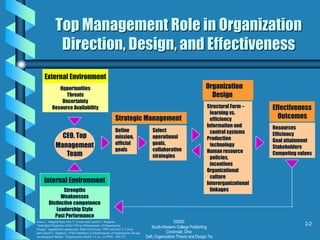
Top Management Role in Organization
Direction, Design, and Effectiveness
CEO, Top
Management
Team
External Environment
Opportunities
Threats
Uncertainty
Resource Availability
Internal Environment
Strengths
Weaknesses
Distinctive competence
Leadership Style
Past Performance
Strategic Management
Organization
Design
Effectiveness
Outcomes
Define
mission,
official
goals
Select
operational
goals,
collaborative
strategies
Resources
Efficiency
Goal attainment
Stakeholders
Competing values
Structural Form –
learning vs.
efficiency
Information and
control systems
Production
technology
Human resource
policies,
incentives
Organizational
culture
Interorganizational
linkages
Source: Adapted from Arie Y. Lewin and Carroll U. Stephens,
“Individual Properties of the CEO as Determinants of Organization
Design,” unpublished manuscript, Duke University, 1990; and Arie Y. Lewin
and Carroll U. Stephens, “CEO Attributes as Determinants of Organization Design:
An integrated Model,” Organization Studies 15, no. 2 (1994): 183-212
©2000
South-Western College Publishing
Cincinnati, Ohio
Daft, Organization Theory and Design 7/e
2-3
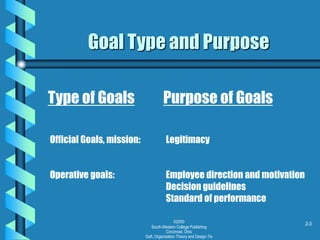
Goal Type and Purpose
Type of Goals Purpose of Goals
Official Goals, mission: Legitimacy
Operative goals: Employee direction and motivation
Decision guidelines
Standard of performance
©2000
South-Western College Publishing
Cincinnati, Ohio
Daft, Organization Theory and Design 7/e
2-4
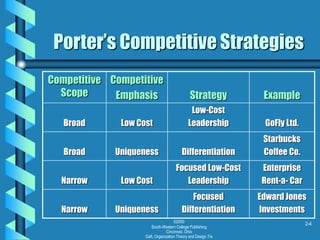
Porter’s Competitive Strategies
Competitive
Scope
Competitive
Emphasis Strategy Example
Broad Low Cost
Low-Cost
Leadership GoFly Ltd.
Broad Uniqueness Differentiation
Starbucks
Coffee Co.
Narrow Low Cost
Focused Low-Cost
Leadership
Enterprise
Rent-a- Car
Narrow Uniqueness
Focused
Differentiation
Edward Jones
Investments
©2000
South-Western College Publishing
Cincinnati, Ohio
Daft, Organization Theory and Design 7/e
2-5
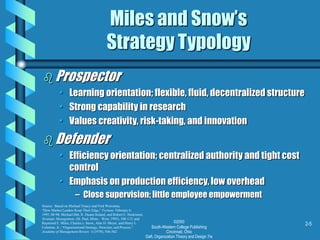
Miles and Snow’s
Strategy Typology
 Prospector
• Learning orientation; flexible, fluid, decentralized structure
• Strong capability in research
• Values creativity, risk-taking, and innovation
 Defender
• Efficiency orientation; centralized authority and tight cost
control
• Emphasis on production efficiency, low overhead
– Close supervision; little employee empowerment
Source: Based on Michael Treacy and Fred Wiersema,
“How Market Leaders Keep Their Edge,” Fortune February 6,
1995, 88-98; Michael Hitt, R. Duane Ireland, and Robert E. Hoskisson,
Strategic Management (St. Paul, Minn.: West, 1995), 100-113; and
Raymond E. Miles, Charles c. Snow, Alan D. Meyer, and Henry L.
Coleman, Jr., “Organizational Strategy, Structure, and Process,”
Academy of Management Review 3 (1978), 546-562
©2000
South-Western College Publishing
Cincinnati, Ohio
Daft, Organization Theory and Design 7/e
2-6
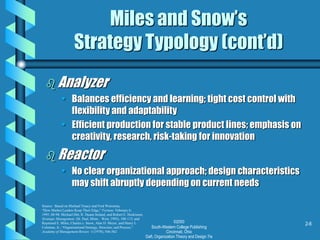
Miles and Snow’s
Strategy Typology (cont’d)
 Analyzer
• Balances efficiency and learning; tight cost control with
flexibility and adaptability
• Efficient production for stable product lines; emphasis on
creativity, research, risk-taking for innovation
 Reactor
• No clear organizational approach; design characteristics
may shift abruptly depending on current needs
Source: Based on Michael Treacy and Fred Wiersema,
“How Market Leaders Keep Their Edge,” Fortune February 6,
1995, 88-98; Michael Hitt, R. Duane Ireland, and Robert E. Hoskisson,
Strategic Management (St. Paul, Minn.: West, 1995), 100-113; and
Raymond E. Miles, Charles c. Snow, Alan D. Meyer, and Henry L.
Coleman, Jr., “Organizational Strategy, Structure, and Process,”
Academy of Management Review 3 (1978), 546-562
©2000
South-Western College Publishing
Cincinnati, Ohio
Daft, Organization Theory and Design 7/e
2-7
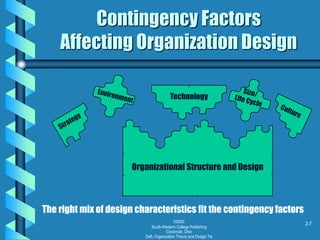
Contingency Factors
Affecting Organization Design
Organizational Structure and Design
The right mix of design characteristics fit the contingency factors
©2000
South-Western College Publishing
Cincinnati, Ohio
Daft, Organization Theory and Design 7/e
2-8
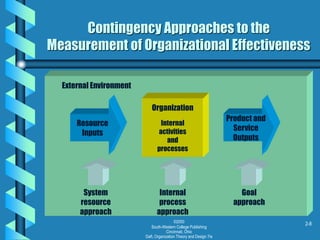
Contingency Approaches to the
Measurement of Organizational Effectiveness
Organization
Internal
activities
and
processes
Resource
Inputs
Product and
Service
Outputs
System
resource
approach
Internal
process
approach
Goal
approach
External Environment
©2000
South-Western College Publishing
Cincinnati, Ohio
Daft, Organization Theory and Design 7/e
2-9
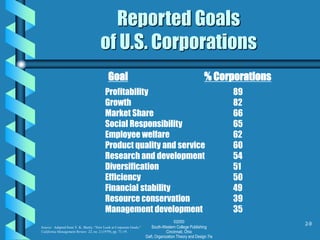
Reported Goals
of U.S. Corporations
Goal % Corporations
Profitability 89
Growth 82
Market Share 66
Social Responsibility 65
Employee welfare 62
Product quality and service 60
Research and development 54
Diversification 51
Efficiency 50
Financial stability 49
Resource conservation 39
Management development 35
Source: Adapted from Y. K. Shetty, “New Look at Corporate Goals,”
California Management Review 22, no. 2 (1979), pp. 71-19.
©2000
South-Western College Publishing
Cincinnati, Ohio
Daft, Organization Theory and Design 7/e
2-10
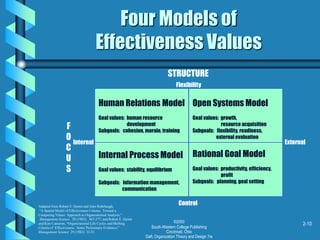
Four Models of
Effectiveness Values
Human Relations Model
Goal values: human resource
development
Subgoals: cohesion, morale, training
Internal Process Model
Goal values: stability, equilibrium
Subgoals: information management,
communication
Rational Goal Model
Goal values: productivity, efficiency,
profit
Subgoals: planning, goal setting
Open Systems Model
Goal values: growth,
resource acquisition
Subgoals: flexibility, readiness,
external evaluation
Flexibility
Control
Internal External
STRUCTURE
F
O
C
U
S
Adapted from Robert E. Quinn and John Rohrbaugh,
“A Spatial Model of Effectiveness Criteria: Toward a
Competing Values Approach to Organizational Analysis,”
Management Science 29 (1983): 363-377; and Robert E. Quinn
and Kim Cameron, “Organizational Life Cycles and Shifting
Criteria of Effectiveness: Some Preliminary Evidence,”
Management Science 29 (1983): 33-51.
©2000
South-Western College Publishing
Cincinnati, Ohio
Daft, Organization Theory and Design 7/e
2-11
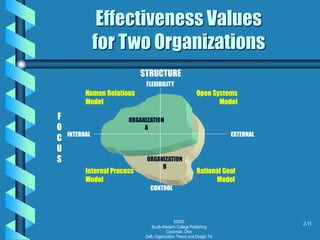
ORGANIZATION
B
ORGANIZATION
A
Effectiveness Values
for Two Organizations
Human Relations
Model
Internal Process
Model
Rational Goal
Model
Open Systems
Model
STRUCTURE
F
O
C
U
S
FLEXIBILITY
CONTROL
INTERNAL EXTERNAL
©2000
South-Western College Publishing
Cincinnati, Ohio
Daft, Organization Theory and Design 7/e
2-12
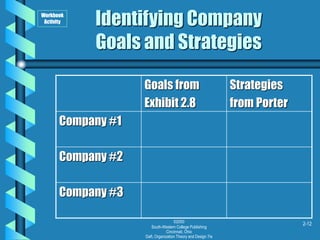
Identifying Company
Goals and Strategies
Goals from
Exhibit 2.8
Strategies
from Porter
Company #1
Company #2
Company #3
Workbook
Activity
©2000
South-Western College Publishing
Cincinnati, Ohio
Daft, Organization Theory and Design 7/e
2-13
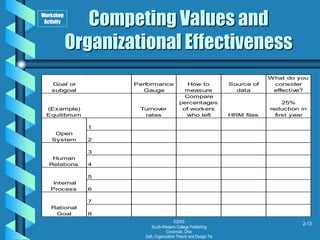
Competing Values and
Organizational Effectiveness
Workshop
Activity
Goal or
subgoal
Performance
Gauge
How to
measure
Source of
data
What do you
consider
effective?
(Example)
Equilibrium
Turnover
rates
Compare
percentages
of workers
who left HRM files
25%
reduction in
first year
1
Open
System 2
3
Human
Relations 4
5
Internal
Process 6
7
Rational
Goal 8

ch02.ppt

  • 1.
    1 Chapter Two Strategy, OrganizationDesign, and Effectiveness ©2000 South-Western College Publishing Cincinnati, Ohio Daft, Organization Theory and Design 7/e 2-
  • 2.
    ©2000 South-Western College Publishing Cincinnati,Ohio Daft, Organization Theory and Design 7/e 2-2 Top Management Role in Organization Direction, Design, and Effectiveness CEO, Top Management Team External Environment Opportunities Threats Uncertainty Resource Availability Internal Environment Strengths Weaknesses Distinctive competence Leadership Style Past Performance Strategic Management Organization Design Effectiveness Outcomes Define mission, official goals Select operational goals, collaborative strategies Resources Efficiency Goal attainment Stakeholders Competing values Structural Form – learning vs. efficiency Information and control systems Production technology Human resource policies, incentives Organizational culture Interorganizational linkages Source: Adapted from Arie Y. Lewin and Carroll U. Stephens, “Individual Properties of the CEO as Determinants of Organization Design,” unpublished manuscript, Duke University, 1990; and Arie Y. Lewin and Carroll U. Stephens, “CEO Attributes as Determinants of Organization Design: An integrated Model,” Organization Studies 15, no. 2 (1994): 183-212
  • 3.
    ©2000 South-Western College Publishing Cincinnati,Ohio Daft, Organization Theory and Design 7/e 2-3 Goal Type and Purpose Type of Goals Purpose of Goals Official Goals, mission: Legitimacy Operative goals: Employee direction and motivation Decision guidelines Standard of performance
  • 4.
    ©2000 South-Western College Publishing Cincinnati,Ohio Daft, Organization Theory and Design 7/e 2-4 Porter’s Competitive Strategies Competitive Scope Competitive Emphasis Strategy Example Broad Low Cost Low-Cost Leadership GoFly Ltd. Broad Uniqueness Differentiation Starbucks Coffee Co. Narrow Low Cost Focused Low-Cost Leadership Enterprise Rent-a- Car Narrow Uniqueness Focused Differentiation Edward Jones Investments
  • 5.
    ©2000 South-Western College Publishing Cincinnati,Ohio Daft, Organization Theory and Design 7/e 2-5 Miles and Snow’s Strategy Typology  Prospector • Learning orientation; flexible, fluid, decentralized structure • Strong capability in research • Values creativity, risk-taking, and innovation  Defender • Efficiency orientation; centralized authority and tight cost control • Emphasis on production efficiency, low overhead – Close supervision; little employee empowerment Source: Based on Michael Treacy and Fred Wiersema, “How Market Leaders Keep Their Edge,” Fortune February 6, 1995, 88-98; Michael Hitt, R. Duane Ireland, and Robert E. Hoskisson, Strategic Management (St. Paul, Minn.: West, 1995), 100-113; and Raymond E. Miles, Charles c. Snow, Alan D. Meyer, and Henry L. Coleman, Jr., “Organizational Strategy, Structure, and Process,” Academy of Management Review 3 (1978), 546-562
  • 6.
    ©2000 South-Western College Publishing Cincinnati,Ohio Daft, Organization Theory and Design 7/e 2-6 Miles and Snow’s Strategy Typology (cont’d)  Analyzer • Balances efficiency and learning; tight cost control with flexibility and adaptability • Efficient production for stable product lines; emphasis on creativity, research, risk-taking for innovation  Reactor • No clear organizational approach; design characteristics may shift abruptly depending on current needs Source: Based on Michael Treacy and Fred Wiersema, “How Market Leaders Keep Their Edge,” Fortune February 6, 1995, 88-98; Michael Hitt, R. Duane Ireland, and Robert E. Hoskisson, Strategic Management (St. Paul, Minn.: West, 1995), 100-113; and Raymond E. Miles, Charles c. Snow, Alan D. Meyer, and Henry L. Coleman, Jr., “Organizational Strategy, Structure, and Process,” Academy of Management Review 3 (1978), 546-562
  • 7.
    ©2000 South-Western College Publishing Cincinnati,Ohio Daft, Organization Theory and Design 7/e 2-7 Contingency Factors Affecting Organization Design Organizational Structure and Design The right mix of design characteristics fit the contingency factors
  • 8.
    ©2000 South-Western College Publishing Cincinnati,Ohio Daft, Organization Theory and Design 7/e 2-8 Contingency Approaches to the Measurement of Organizational Effectiveness Organization Internal activities and processes Resource Inputs Product and Service Outputs System resource approach Internal process approach Goal approach External Environment
  • 9.
    ©2000 South-Western College Publishing Cincinnati,Ohio Daft, Organization Theory and Design 7/e 2-9 Reported Goals of U.S. Corporations Goal % Corporations Profitability 89 Growth 82 Market Share 66 Social Responsibility 65 Employee welfare 62 Product quality and service 60 Research and development 54 Diversification 51 Efficiency 50 Financial stability 49 Resource conservation 39 Management development 35 Source: Adapted from Y. K. Shetty, “New Look at Corporate Goals,” California Management Review 22, no. 2 (1979), pp. 71-19.
  • 10.
    ©2000 South-Western College Publishing Cincinnati,Ohio Daft, Organization Theory and Design 7/e 2-10 Four Models of Effectiveness Values Human Relations Model Goal values: human resource development Subgoals: cohesion, morale, training Internal Process Model Goal values: stability, equilibrium Subgoals: information management, communication Rational Goal Model Goal values: productivity, efficiency, profit Subgoals: planning, goal setting Open Systems Model Goal values: growth, resource acquisition Subgoals: flexibility, readiness, external evaluation Flexibility Control Internal External STRUCTURE F O C U S Adapted from Robert E. Quinn and John Rohrbaugh, “A Spatial Model of Effectiveness Criteria: Toward a Competing Values Approach to Organizational Analysis,” Management Science 29 (1983): 363-377; and Robert E. Quinn and Kim Cameron, “Organizational Life Cycles and Shifting Criteria of Effectiveness: Some Preliminary Evidence,” Management Science 29 (1983): 33-51.
  • 11.
    ©2000 South-Western College Publishing Cincinnati,Ohio Daft, Organization Theory and Design 7/e 2-11 ORGANIZATION B ORGANIZATION A Effectiveness Values for Two Organizations Human Relations Model Internal Process Model Rational Goal Model Open Systems Model STRUCTURE F O C U S FLEXIBILITY CONTROL INTERNAL EXTERNAL
  • 12.
    ©2000 South-Western College Publishing Cincinnati,Ohio Daft, Organization Theory and Design 7/e 2-12 Identifying Company Goals and Strategies Goals from Exhibit 2.8 Strategies from Porter Company #1 Company #2 Company #3 Workbook Activity
  • 13.
    ©2000 South-Western College Publishing Cincinnati,Ohio Daft, Organization Theory and Design 7/e 2-13 Competing Values and Organizational Effectiveness Workshop Activity Goal or subgoal Performance Gauge How to measure Source of data What do you consider effective? (Example) Equilibrium Turnover rates Compare percentages of workers who left HRM files 25% reduction in first year 1 Open System 2 3 Human Relations 4 5 Internal Process 6 7 Rational Goal 8