Presenter: Dr. Nilesh Meena
Moderator: Dr syed Ifthekar
COMPRESSIVE NEUROPATHIES
COMPRESSIVE NEUROPATHY
Definition: Focal neuropathy due to restriction or mechanical
distortion of nerve within the fibrous or fibro-osseous
tunnel .
All entrapments may have one of the basic structure
a) Fibro-osseous tunnel
- Carpal tunnel
- Tarsal tunnel
- Suprascapular nerve tunnel
b) Fibro-tendinous archade
- Supinator (archade of frohse)
-Pyriformis syndrome
-Peroneal nerve entrapment
-Interosseous nerve entrapment
c) Abnormal bands causing compression
-Thoracic outlet syndrome
-Meralgia parasthetica
Compression of the Nerve
Compromised Intra-neural circulation
Reduced axoplasmic circulation
Hypoxia and altered micro-vascular permeability
Sub perineurial edema and Exacerbation of the original circulation.
Continuos vicious cycle.
PATHOPHYSIOLOGY
UPPER LIMB ENTRAPMENT
NEUROPATHY
SUPRA SCAPULAR NERVE ENTRAPMENT
Throwers, other overhead athletes and
weight- lifters and usually associated with
cysts, Ganglia or SLAP tears.
Arises from superior trunk of brachial plexus
Innervates supraspinatus and infraspinatus
Compression most commonly suprascapular
or spinoglenoid notch
Nerve compression at the
spinoglenoid notch affects
only the infraspinatus
muscle causing loss of
external rotation.
Nerve impingement at the
subacromial region will
cause Supraspinatus and
infraspinatus muscle
wasting.
Causes of Impingement of Supra-scapular nerve:
Notch narrowing
Ganglion cyst from intraarticular defect, often indicative of a
labral (SLAP) tear
Nerve kinking or traction from excessive infraspinatus motion
Superior or inferior (spinoglenoid) transverse scapular
ligament hypertrophy causing compression.
Investigations and Treatment:
MRI may exclude rotator cuff tears, demonstrate atrophy
and/or reveal a ganglion or space-occupying lesion- if
present, strongly consider surgical excision
NCS/EMG may assist with the diagnosis.
Treatment: Rest from repetitive hyperabduction.
NSAIDs and corticosteroid injections considered
Operative management:
Identify the suprascapular, notch,
and release the transverse
ligament.
Median nerve
Carpal tunnel syndrome
Anterior interosseous syndrome
Pronator syndrome
Ulnar nerve
At elbow
Guyons canal
Radial nerve
Radial tunnel
Wartenberg's syndrome
MEDIAN NERVE ENTRAPMENTS
CARPAL TUNNEL SYNDROME
MC among compressive neuropathies.
Incidence 1-3.5 cases / 1 lakh persons per year.
Depth of tunnel 10mm to 13mm.
Pressure with in a tunnel measures 2.5mmH
10 structures from volar arm passes through tunnel
8 Flexor tendons (FDS + FDP).
FPL
Median nerve
Boundaries
Floor: Transverse arch of carpal bones
Medially: Hook of hamate & pisiform
Laterally: Tubercle of scaphoid,
trapezium crest & fibro-osseous flexor
carpi-radialis sheath.
Roof: The flexor retinaculum, which
includes the transverse carpal
ligament (TCL).
Median nerve motor
innervation:
1st and the 2nd lumbricals
Opponens pollicis
Flexor pollicis brevis
Abductor pollicis brevi
Sensory innervation:
Fingers: The entire palmar surface of
the thumb, index, middle finger, and
the radial half of the ring finger.
Palm: The central palm area,
particularly over the thenar
eminence.
Dorsal aspect: The distal dorsal
aspect of the index and middle
fingers (nail beds).
Causes and Contributing Factors in Carpal Tunnel
Syndrome:
Aberrant anatomy
Anomalous flexor tendons, Congenitally small carpal canal,
Ganglionic cysts, Lipoma, Proximal lumbrical muscle
insertion, Thrombosed artery.
Infections
Mycobacterial infection,Septic arthritis.
Inflammatory conditions
Connective tissue disease, Gout or pseudogout, Nonspecific flexor
tenosynovitis, Rheumatoid arthritis,
Metabolic conditions
Acromegaly, Amyloidosis, Diabetes, Hypothyroidism or
hyperthyroidism
Increased canal volume
Congestive heart failure, Edema, Obesity, Pregnancy
Signs and symptoms
Tingling
Numbness or discomfort in the lateral 3 1/2
fingers
Intermittent pain in the distribution of the
median nerve
To relieve the symptoms, patients often
"flick" their wrist as if shaking down a
thermometer (flick sign).
MC symptom "Nocturnal acroparesthesia", painful tingling
and numbness in a thumb and one of radial digits, which
may even disturb sleep .
Day time paresthesias occurs - Activities involve extremes of
wrist flexion
Motor changes :
Apelike thumb deformity
Loss of opposition of thumb
Index and middle finger lag
behind when making the
fist.
Thenar atrophy(Late sign in neglected cases)
Sensory changes:
Loss or sensation or lateral 3.5 digits
Including the nail bed and distal
phalanges on dorsum of hand.
In Carpal tunnel syndrome there is no
sensory loss over the thenar eminence.
Because the branch of median nerve
that innervates it (palmar cutaneous
branch) passes superficial to Carpal
tunnel.
Most sensitive test for early CTS :
Semmes weinstein monofilament test (Detects sensory changes early).
Monofilaments of increasing diameters are touched to palmar side of
the digit until the patient can tell which digit is touched.
Katz hand diagram is the most specific test for carpal tunnel
syndrome.
Evaluation:
History
Physical examination
Nerve Conduction Study
Imaging:
X-ray for any degenarative cases
and calcifications.
MRI (Magnetic resonance imaging)
Transverse right distal forearm T1 C+ fat sat
USG- Triad
Palmar bowing of flexor
retinaculum.
Distal flattening of the nerve
at the level of hook of
hamate.
Enlargement of nerve
proximal to flexor
retinaculum (most sensitive
and specific criterion)
Nerve conduction velocity
studies
NCV is normally 50 to 70
m/second.
An abnormal nerve conduction
velocity (NCV) value is typically
considered to be less than 50
meters per second across the
carpal tunnel.
Conservative management
Wrist splinting:
Wearing a splint at night to keep the wrist in a neutral position,
which helps reduce pressure on the median nerve.
Medication:
Nonsteroidal anti-inflammatory drugs (NSAIDs) like ibuprofen or
naproxen to manage pain and inflammation.
Corticosteroid injections:
A local injection of corticosteroid medication directly into the carpal
tunnel can provide temporary relief from pain and swelling.
Surgical management
Should be considered in patients with symptoms that do not
respond to conservative measures.
In patients with severe nerve entrapment as evidenced by
nerve conduction studies, thenar atrophy, or motor
weakness.
Can be done by open carpal tunnel release or endoscopic
carpal tunnel release.
ANTERIOR INTEROSSEOUS SYNDROME
& PRONATOR SYNDROME
Pronator teres syndrome is a compression neuropathy of the
median nerve at the elbow.
Anterior interosseous syndrome is a isolated injury of the
anterior interosseous branch of the median nerve purely
motor branch).
Site of compression essentially same for both Pronator
syndrome(PS) and Ant. Int. nerve syndrome (AIS)
Common sites of compression in
anterior interosseous nerve (AIN)
syndrome.
Deep head of the pronator.
Fibrous arcade at the proximal
margin of the flexor digitorum
superficialis (FDS).
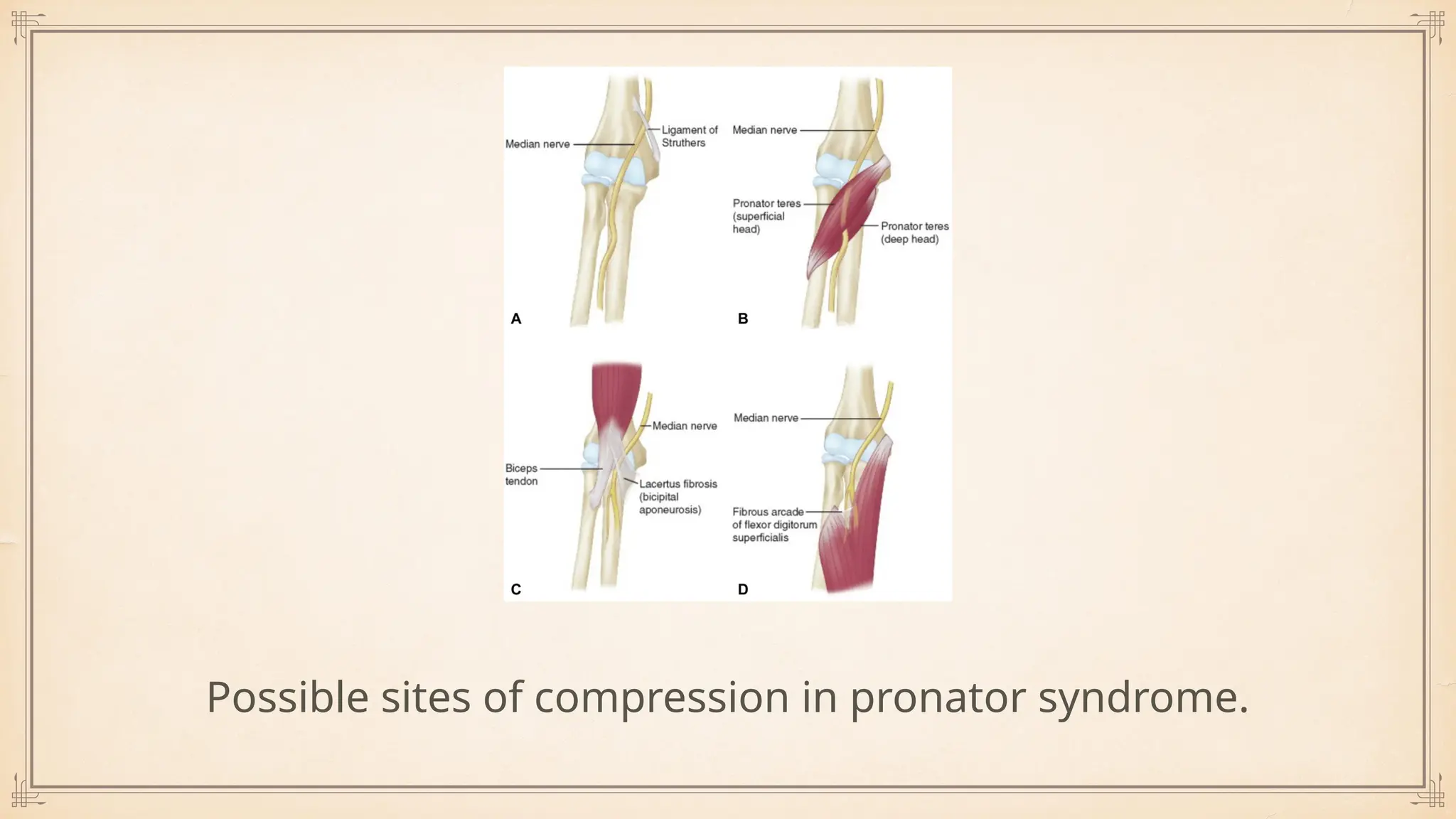
Compression site for pronator syndrome
MC cause due to fibrous bands between ulnar and humeral heads of pronator
teres where median passes.
Thickened or tight bicipital aponeurosis (Lacertus fibrosus )
Hypertrophic pronator teres
latrogenic ( compression due to casting)
Anamalous insertion of coracobrachialis muscle.
Ligament of struthers Band of connective tissues arise from supracondylar
humerus process to the medial humeral epicondyle ).
Possible sites of compression in pronator syndrome.
Clinical presentation
Pronator syndrome(sensory+motor) :
Sensory involvement.
Vague volar forearm pain, Median nerve parasthesias, minimum motor
findings.
Anterior interosseous syndrome :
Pure motor palsy of any or all three
FPL,FDP of index and middle fingers, PQ.
Differential diagnosis of sites of compression
Flexion of elbow against resistance between 120-135 degrees
(struthers ligament)
Flexion of elbow with forearm pronation (lacertus fibrosus)
Pronation against resistance combined with wrist flexion (2
heads of pronator teres)
Resisted flexion of FDS of middle finger (musculotendinous
arch of FDS)
Treatment
Initially: Conservative
Surgical indications:
No resolution of symptoms
Severe symptoms
Surgical exploration: Identification & division of the offending
structure.
ULNAR NERVE ENTRAPMENT
Ulnar nerve gets entrapped
at 2 common sites:
At the elbow (cubital tunnel
syndrome)
Guyon's canal (ulnar tunnel
syndrome
Cubital tunnel syndrome:
Second commonest nerve entrapment of the upper limb
Commonly people called as "Funny Bone"
Anatomy of cubital tunnel:
Starts at the groove between
the olecranon & the medial
epicondyle.
Tunnel is formed by a fibrous
arch connecting the 2 heads
of the flexor carpi ulnaris &
lies just distal to the medial
epicondyle.
Anatomical Boundaries
Roof - Osborne's fascia and
Arcuate ligament of Osborne's
(fibrous band from medial
epicondyle to olecranon).
Floor - Ulnar collateral
ligament and joint capsule.
Walls - formed by medial
epicondyle and olecranon.
Causes of entrapment:
Aponeurosis of FCU or b/w FCU heads [ MC site ].
Arcade of struther’s: Formed by an expansion of the medial head of the triceps muscle
that extends to the intermuscular septum[ 2nd MC site ]
Tight fascial band over the cubital tunnel.
Medial head of triceps
Recurrent subluxation of ulnar nerve, results in neuritis.
Osteophytic spurs
Cubitus valgus following supra condylar fracture.
Clinical features
Numbness involving the little finger & the ulnar half of the ring finger.
Hand weakness & clumsiness
Tenderness over the ulnar nerve at the elbow.
Tinel's sign is positive: exacerbation of paraesthesia's with light percussion
over the ulnar nerve.
Atrophy of first web space and interosseous muscles.
Reduced strength of FPB, Adductor pollicis, 4th & 5th lumbricals and All
Hypothenar muscles.
Treatment
Non-operative: Early stages
Activity modification
Immobilization of the elbow in 30 degrees of extension,
followed by periods of mobilization with elbow padding.
Surgical:
Decompression of the nerve
by dividing of the basic
offending structure.
Anterior transposition of the
ulnar nerve
Medial epicondyectomy.
ULNAR TUNNEL SYNDROME
Ulnar nerve is compressed as
it passes through Guyon’s
canal in the wrist.
Also known as "Handle bar
palsy"
Less common than
entrapment of the ulnar nerve
at the elbow
Anatomy of Guyon’s canal
Roof : Volar carpal ligament.
Medial wall : pisiform & pisiohamate
ligament.
Lateral wall: hook of hamate
Floor: Transverse carpal ligament
Ulnar nerve enters guyon's canal
accompanied by ulnar Artery & Ulnar
Vein
The distal ulnar tunnel, also known as
Guyon's canal, is divided into three zones
based on the location of the ulnar nerve
bifurcation.
Zone 1 being proximal to the bifurcation
(mixed motor and sensory).
Zone 2 encompassing the deep motor
branch (motor only).
Zone 3 surrounding the superficial sensory
branch (sensory only).
Clinical presentation
Zone 1 lesions: Mixed sensory & motor loss.
Zone 2 lesions: Isolated motor deficit.
Zone 3 lesions: Isolated ulnar sensory loss.
Common Causes in zone 1 & 2: ganglions,
fractures of the hook of hamate.
Zone 3: ulnar artery thrombosis / Aneurysm.
Investigations
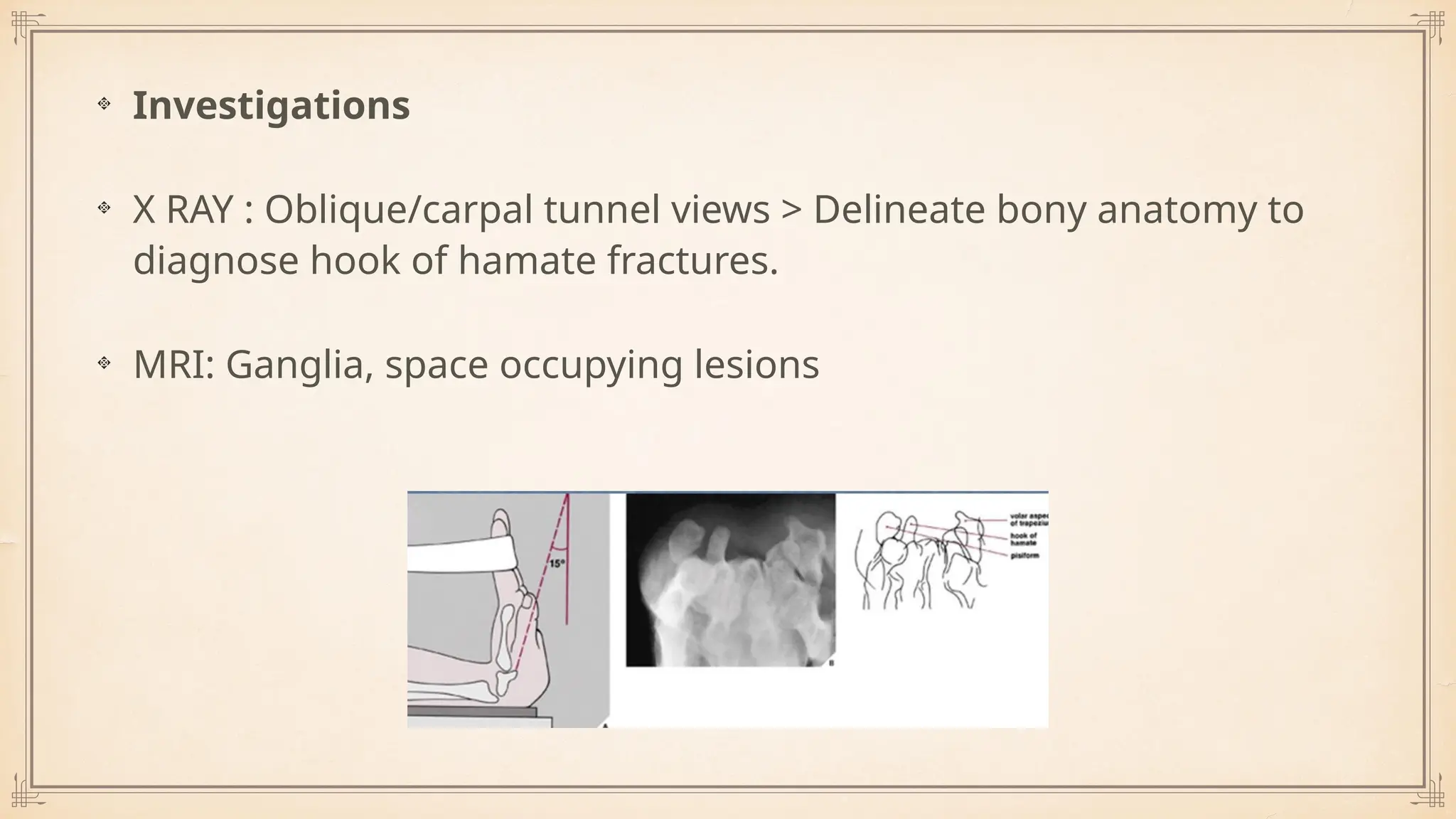
X RAY : Oblique/carpal tunnel views > Delineate bony anatomy to
diagnose hook of hamate fractures.
MRI: Ganglia, space occupying lesions
Treatment
Operative release of the canal by reflecting the FCU, pisiform
& pisiohamate ligament ulnarly.
Distal deep fascia of the forearm below the wrist crease
should be released.
Resection of any space occupying lesion
Treatment of hook of hamate fractures
RADIAL NERVE ENTRAPMENTS
Radial nerve entrapments
Posterior interosseous nerve syndrome
radial tunnel syndrome
wartenberg's syndrome
RADIAL TUNNEL SYNDROME
The PIN passes between the 2 heads of the
supinator muscle in the radial tunnel.
Boundaries of radial tunnel
Medial: Brachialis prox. & Biceps tendon distally.
Roof & Lateral : Brachioradialis, ECRL and ECRB
tendons
Floor: Capsule of radiocapitella joint.
It is a compressive neuropathy of the radial nerve main trunk
in the proximal forearm before /at /just after it splits into
main trunk PIN nerve and sensory branch which results in
both sensory and motor symptoms.
More common in male manual labourers and Body builders
Potential sites of compression
Between Brachialis and Brachioradialis.
"Leash of Henry" are recurrent radial vessels that
fan out across the PIN at the level of radial neck.
Distal border of supinator muscle at its edge.
At the origin of ECRB or fibrous bands with ECRB.
"Arcade of Frohse" (supinator fibrous arch)
Examination :
Patient has pain and inability to
extend the middle
finger against the resistance
with elbow extended and
forearm pronated with wrist
neutral.
Provocative tests:
Painful resisted supination: compression at the arcade of
frohse.
Painful resisted middle finger extension test : compression at
ECRB and Brachioradialis.
Physical examination - Atrophy can be noted in the extensor
compartment in long stand cases.
Pain is often acute & can
mimic tennis elbow.
Treatment: non-operative:
Activity modification,
splinting, NSAID'S & rest.
Surgical decompression is
often combined with
lateral epicondyle release.
POSTERIOR INTEROSSEOUS NERVE
SYNDROME
ANATOMY
Proximal to the elbow joint, the radial nerve
branches into the superficial radial nerve & the PIN.
The PIN travels around the radial neck and through
the interval between the 2 heads of the supinator
muscle.
This opening which has an overlying compressive
fibrous arch is known as arcade of frosche
Presentation:
Only motor dysfunction.
Present with dropped fingers and thumb.
ECRL is preserved as it receives supply along with brachioradialis before the nerve
enters radial tunnel.
Etiology:
Ganglion cyst, lipomas, septic arthritis of elbow
Proliferative synovitis (rheumatoid arthritis), vasculitis
Electro diagnostic testing may localize the site of compression.
Initially : observation & non operative treatment.
Operative methods: exploration & appropriate division of
compressing structures.
WARTENBERG'S SYNDROME
Also called Cheralgia paresthetica, Hand cuff neuropathy /
Wristlet watch neuritis.
Commonly associated with De Quervains disease in 20% -
50% patients
Compression of the superficial
branch(sensory) of the radial
nerve can occur most commonly
as it exits from beneath the
brachioradialis in the forearm.
Nerve can get trapped b/w the
ECRL & the brachioradialis,
especially with pronation in the
forearm
On examination
Dellons provocative test is
positive : Increased symptoms
on wrist flexion, ulnar deviation
and pronationfor 1 min.
Finkelstein test is positive in
96% of cases because of
traction on the nerve.
The patient will be unable to
tolerate wearing a tight
bracelet or wristwatch.
Symptoms include
numbness, tingling and
paresthesia on the posterior
aspect of the thumb.
There will be no weakness
associated with this
condition.
The symptoms of Wartenberg's syndrome are also
aggravated by motion such at repeative wrist flexion and
ulnar deviation.
Treatment:
Activity modification
Avoid tight bands / watches.
Conservative treatment usually acheives about 70% good - exellent result.
Injection: usually diagnostic.
Surgery: for decompression of the nerve.
Uusually done if the patient has a positive Tinel's sign and the symptoms
continue dispite conservative treatment and injections
THANK YOU
ENTRAPMENT SYNDROMES OF
LOWER LIMB
MERALGIA PARAESTHETICA
Entrapment of lateral femoral
cutaneous nerve of the thigh at the
inguinal ligament.
Nerve passes through ligament just
medial to the anterior superior iliac
spine.
Clinical features:-
Painful, burning, numb patch
of skin over anterior and
lateral thigh.
Atrophy,Weakness,Loss of
Reflex.
Etiology:-
Prolonged standing, Obese.
Tight Pants, or belts., Car seatbelts.
Sx: Bone grafts, THR, Vascular bypass, Hysterectomy,
Cesarean section.
Diabetes.
Pelvic Compression Test
Downward, compression force to
the pelvis and maintains pressure
for 45 sec. Resolution of symptoms
-Positive
Specificity - 93.3%
Sensitivity - 95%
Nerve Block Test:- 1%
Lidocaine at the site where
the LCNT exits the pelvis at
the inguinal ligament.
Positive = If immediate
symptom relief
Management:-
Non-Surgical Interventions
NSAIDS
Avoiding compression activities.
Nerve Block.
Surgical Interventions:
Lateral cutaneous nerve neurolysis.
PIRIFORMIS SYNDROME
Piriformis syndrome is a condition that occurs
when the piriformis muscle in the buttock
spasms and compresses the sciatic nerve.
Clinical features:
Pain more while sitting than standing;
Worsening with Flexion, Adduction, IR.
H/o trauma or Unusual body habitus -thin.
Etiology:- Acute injury with the forceful internal rotation of the
hip, Trauma to the hip or buttock area.
Piriformis muscle hypertrophy:- Athletes, During periods of
increased weightlifting.
Sitting for prolonged periods:- Taxi drivers, Office workers,
Bicycle riders.
Anatomic anomalies: Bipartite piriformis muscle.
Course/branching variations with respect to the piriformis
muscle.
Type 1: undivided sciatic nerve passing anterior
and below the piriformis.
Type 2: common peroneal nerve component
piercing a bifid piriformis, tibial component
running in normal position anterior and inferior to
piriformis.
Type 3: one division posterior to and the other
anterior to the piriformis.
Type 4: undivided sciatic nerve piercing bifid
piriformis.
Type 5: one division through and the other
posterior to the piriformis.
Type 6: undivided nerve posterior to piriformis.
Clinical Examination:-
FAIR (FlexIon, Adduction, Internal Rotation) maneuver: with the
patient lying supine, the examiner passively flexes, adducts,
and internally rotates the hip, stretching the piriformis.
Conservative Management
Physical Therapy: Stretching (piriformis, hamstrings), strengthening (hip muscles),
myofascial release.
Medications: NSAIDs, muscle relaxants, neuropathic pain agents (e.g., gabapentin).
Other Therapies: Heat/cold therapy, massage, TENS unit.
Interventional Management
Injections: Corticosteroid or botulinum toxin injections into the piriformis muscle.
Surgical Management (Rare cases)
Piriformis muscle release: Considered if symptoms persist despite all treatments.
FIBULAR TUNNEL SYNDROME
Foot & Toe drop.
SPN - Weak Foot eversion.
Etiology:- Compression, Casts,
Stockings, Gardening; Farm work (squatting,
kneeling), Mass lesions (Ganglion cysts,
Tumors, Baker's cyst)
Miscellaneous (Weight loss, Habitual leg
crossing)
latrogenic - After Fibular osteotomies (2-27%)
Sensory: Numbness, tingling, or burning sensation
over the lateral leg and dorsum of the foot.
Motor: Foot drop (weakness in dorsiflexion),
difficulty with toe extension, and ankle eversion.
Pain: Lateral knee pain or discomfort radiating
down the leg.
Positive Tinel’s sign: Tingling sensation when
tapping over the fibular neck.
Gait disturbances: Foot drop gate due to foot drop.
Management
Avoid Tight boots, Ballet shoe ties
Lateral shoe wedges/ Foot drop splint
Local anesthetic and steroid.
Cryoneuroablation.
Botulinum Toxin (20U).
Surgical decmpression.
TARSAL TUNNEL SYNDROME
Compression of the Posterior Tibial nerve.
Floor - Medial malleolus
Roof - Flexor retinalculum.
Content - Tibial nerve, Tibial artery, Tibial
veins,
Tendons of the FHL, FDL,TP
Etiology
Extrinsic causes :- Trauma (MC)
Poorly fitting shoes
Anatomic-biomechanical abnormalities (tarsal coalition,
valgus or varus hindfoot).
Post-surgical scarring, Pedal edema, systemic inflammatory
arthropathies.
Intrinsic causes:-
Tendinopathy, tenosynovitis, perineural fibrosis, osteophytes,
Hypertrophic retinaculum.
Space-occupying lesions:- enlarged or varicose veins,
ganglion cyst, lipoma, neoplasm, and neuroma)
Clinical features:-
Perimalleolar pain.
Burning pain in Ankle and Sole.
Intrinsic foot muscle atrophy (Non-specific).
Tinel sign ( non specific)
The Dorsiflexion-eversion
test:-Passively dorsiflexing
and everting the ankle to
end range of motion and
holding for 10 seconds.
The test is considered
positive if the patient
experiences any of the
similar symptoms.
Management:
Ice over Tarsal tunnel. Analgesics, Gabanoids, TCA.
Orthotic shoes-offloading the tarsal tunnel.
Medial heel wedge.
Night splints.
Surgery (A positive Tinel sign)
References:-
McGurk K, Tracey JA, Daley DN, Daly CA. Diagnostic Considerations in Compressive Neuropathies. J Hand Surg
Glob Online. 2022 Dec 16;5(4):525-535. doi: 10.1016/j.jhsg.2022.10.010. PMID: 37521550; PMCID: PMC10382896.
Helfenstein Júnior M. Uncommon compressive neuropathies of upper limbs. Best Pract Res Clin Rheumatol. 2020
Jun;34(3):101516. doi: 10.1016/j.berh.2020.101516. Epub 2020 Apr 21. PMID: 32327280.
Shapiro 4th edition; Electromyography and Neuromuscular disorders.
Craig, A. (2013), Entrapment Neuropathies of the Lower
Extremity. PM&R, 5: S31-S40.
Fortier LM et al. An Update on Peroneal Nerve Entrapment and Neuropathy. Orthopedic Reviews.2021;13(1).
Hong CH et al. Tarsal tunnel syndrome caused by an uncommon ossicle of the talus: A case report. Medicine
(Baltimore). 2018 Jun;97(25):e11008.
Kiel J, Kaiser K. Tarsal Tunnel Syndrome: StatPearls. Treasure
Island (FL): StatPearls Publishing; 2022 Jan-.

Compressive Neuropathies of the Upper limb

  • 1.
    Presenter: Dr. NileshMeena Moderator: Dr syed Ifthekar COMPRESSIVE NEUROPATHIES
  • 2.
    COMPRESSIVE NEUROPATHY Definition: Focalneuropathy due to restriction or mechanical distortion of nerve within the fibrous or fibro-osseous tunnel .
  • 3.
    All entrapments mayhave one of the basic structure a) Fibro-osseous tunnel - Carpal tunnel - Tarsal tunnel - Suprascapular nerve tunnel
  • 4.
    b) Fibro-tendinous archade -Supinator (archade of frohse) -Pyriformis syndrome -Peroneal nerve entrapment -Interosseous nerve entrapment
  • 5.
    c) Abnormal bandscausing compression -Thoracic outlet syndrome -Meralgia parasthetica
  • 6.
    Compression of theNerve Compromised Intra-neural circulation Reduced axoplasmic circulation Hypoxia and altered micro-vascular permeability Sub perineurial edema and Exacerbation of the original circulation. Continuos vicious cycle. PATHOPHYSIOLOGY
  • 8.
  • 9.
    SUPRA SCAPULAR NERVEENTRAPMENT Throwers, other overhead athletes and weight- lifters and usually associated with cysts, Ganglia or SLAP tears. Arises from superior trunk of brachial plexus Innervates supraspinatus and infraspinatus Compression most commonly suprascapular or spinoglenoid notch
  • 10.
    Nerve compression atthe spinoglenoid notch affects only the infraspinatus muscle causing loss of external rotation.
  • 11.
    Nerve impingement atthe subacromial region will cause Supraspinatus and infraspinatus muscle wasting.
  • 12.
    Causes of Impingementof Supra-scapular nerve: Notch narrowing Ganglion cyst from intraarticular defect, often indicative of a labral (SLAP) tear Nerve kinking or traction from excessive infraspinatus motion Superior or inferior (spinoglenoid) transverse scapular ligament hypertrophy causing compression.
  • 13.
    Investigations and Treatment: MRImay exclude rotator cuff tears, demonstrate atrophy and/or reveal a ganglion or space-occupying lesion- if present, strongly consider surgical excision NCS/EMG may assist with the diagnosis. Treatment: Rest from repetitive hyperabduction. NSAIDs and corticosteroid injections considered
  • 14.
    Operative management: Identify thesuprascapular, notch, and release the transverse ligament.
  • 15.
    Median nerve Carpal tunnelsyndrome Anterior interosseous syndrome Pronator syndrome Ulnar nerve At elbow Guyons canal Radial nerve Radial tunnel Wartenberg's syndrome
  • 16.
  • 17.
    CARPAL TUNNEL SYNDROME MCamong compressive neuropathies. Incidence 1-3.5 cases / 1 lakh persons per year. Depth of tunnel 10mm to 13mm. Pressure with in a tunnel measures 2.5mmH
  • 18.
    10 structures fromvolar arm passes through tunnel 8 Flexor tendons (FDS + FDP). FPL Median nerve
  • 19.
    Boundaries Floor: Transverse archof carpal bones Medially: Hook of hamate & pisiform Laterally: Tubercle of scaphoid, trapezium crest & fibro-osseous flexor carpi-radialis sheath. Roof: The flexor retinaculum, which includes the transverse carpal ligament (TCL).
  • 20.
    Median nerve motor innervation: 1stand the 2nd lumbricals Opponens pollicis Flexor pollicis brevis Abductor pollicis brevi
  • 21.
    Sensory innervation: Fingers: Theentire palmar surface of the thumb, index, middle finger, and the radial half of the ring finger. Palm: The central palm area, particularly over the thenar eminence. Dorsal aspect: The distal dorsal aspect of the index and middle fingers (nail beds).
  • 22.
    Causes and ContributingFactors in Carpal Tunnel Syndrome: Aberrant anatomy Anomalous flexor tendons, Congenitally small carpal canal, Ganglionic cysts, Lipoma, Proximal lumbrical muscle insertion, Thrombosed artery. Infections Mycobacterial infection,Septic arthritis.
  • 23.
    Inflammatory conditions Connective tissuedisease, Gout or pseudogout, Nonspecific flexor tenosynovitis, Rheumatoid arthritis, Metabolic conditions Acromegaly, Amyloidosis, Diabetes, Hypothyroidism or hyperthyroidism Increased canal volume Congestive heart failure, Edema, Obesity, Pregnancy
  • 24.
    Signs and symptoms Tingling Numbnessor discomfort in the lateral 3 1/2 fingers Intermittent pain in the distribution of the median nerve To relieve the symptoms, patients often "flick" their wrist as if shaking down a thermometer (flick sign).
  • 25.
    MC symptom "Nocturnalacroparesthesia", painful tingling and numbness in a thumb and one of radial digits, which may even disturb sleep . Day time paresthesias occurs - Activities involve extremes of wrist flexion
  • 26.
    Motor changes : Apelikethumb deformity Loss of opposition of thumb Index and middle finger lag behind when making the fist.
  • 27.
    Thenar atrophy(Late signin neglected cases)
  • 28.
    Sensory changes: Loss orsensation or lateral 3.5 digits Including the nail bed and distal phalanges on dorsum of hand. In Carpal tunnel syndrome there is no sensory loss over the thenar eminence. Because the branch of median nerve that innervates it (palmar cutaneous branch) passes superficial to Carpal tunnel.
  • 29.
    Most sensitive testfor early CTS : Semmes weinstein monofilament test (Detects sensory changes early). Monofilaments of increasing diameters are touched to palmar side of the digit until the patient can tell which digit is touched.
  • 30.
    Katz hand diagramis the most specific test for carpal tunnel syndrome.
  • 31.
  • 32.
    Imaging: X-ray for anydegenarative cases and calcifications. MRI (Magnetic resonance imaging) Transverse right distal forearm T1 C+ fat sat
  • 33.
    USG- Triad Palmar bowingof flexor retinaculum. Distal flattening of the nerve at the level of hook of hamate. Enlargement of nerve proximal to flexor retinaculum (most sensitive and specific criterion)
  • 34.
    Nerve conduction velocity studies NCVis normally 50 to 70 m/second. An abnormal nerve conduction velocity (NCV) value is typically considered to be less than 50 meters per second across the carpal tunnel.
  • 35.
    Conservative management Wrist splinting: Wearinga splint at night to keep the wrist in a neutral position, which helps reduce pressure on the median nerve. Medication: Nonsteroidal anti-inflammatory drugs (NSAIDs) like ibuprofen or naproxen to manage pain and inflammation. Corticosteroid injections: A local injection of corticosteroid medication directly into the carpal tunnel can provide temporary relief from pain and swelling.
  • 36.
    Surgical management Should beconsidered in patients with symptoms that do not respond to conservative measures. In patients with severe nerve entrapment as evidenced by nerve conduction studies, thenar atrophy, or motor weakness. Can be done by open carpal tunnel release or endoscopic carpal tunnel release.
  • 37.
    ANTERIOR INTEROSSEOUS SYNDROME &PRONATOR SYNDROME Pronator teres syndrome is a compression neuropathy of the median nerve at the elbow. Anterior interosseous syndrome is a isolated injury of the anterior interosseous branch of the median nerve purely motor branch). Site of compression essentially same for both Pronator syndrome(PS) and Ant. Int. nerve syndrome (AIS)
  • 38.
    Common sites ofcompression in anterior interosseous nerve (AIN) syndrome. Deep head of the pronator. Fibrous arcade at the proximal margin of the flexor digitorum superficialis (FDS).
  • 39.
    Compression site forpronator syndrome MC cause due to fibrous bands between ulnar and humeral heads of pronator teres where median passes. Thickened or tight bicipital aponeurosis (Lacertus fibrosus ) Hypertrophic pronator teres latrogenic ( compression due to casting) Anamalous insertion of coracobrachialis muscle. Ligament of struthers Band of connective tissues arise from supracondylar humerus process to the medial humeral epicondyle ).
  • 40.
    Possible sites ofcompression in pronator syndrome.
  • 41.
    Clinical presentation Pronator syndrome(sensory+motor): Sensory involvement. Vague volar forearm pain, Median nerve parasthesias, minimum motor findings. Anterior interosseous syndrome : Pure motor palsy of any or all three FPL,FDP of index and middle fingers, PQ.
  • 42.
    Differential diagnosis ofsites of compression Flexion of elbow against resistance between 120-135 degrees (struthers ligament) Flexion of elbow with forearm pronation (lacertus fibrosus) Pronation against resistance combined with wrist flexion (2 heads of pronator teres) Resisted flexion of FDS of middle finger (musculotendinous arch of FDS)
  • 43.
    Treatment Initially: Conservative Surgical indications: Noresolution of symptoms Severe symptoms Surgical exploration: Identification & division of the offending structure.
  • 45.
  • 46.
    Ulnar nerve getsentrapped at 2 common sites: At the elbow (cubital tunnel syndrome) Guyon's canal (ulnar tunnel syndrome
  • 47.
    Cubital tunnel syndrome: Secondcommonest nerve entrapment of the upper limb Commonly people called as "Funny Bone"
  • 48.
    Anatomy of cubitaltunnel: Starts at the groove between the olecranon & the medial epicondyle. Tunnel is formed by a fibrous arch connecting the 2 heads of the flexor carpi ulnaris & lies just distal to the medial epicondyle.
  • 49.
    Anatomical Boundaries Roof -Osborne's fascia and Arcuate ligament of Osborne's (fibrous band from medial epicondyle to olecranon). Floor - Ulnar collateral ligament and joint capsule. Walls - formed by medial epicondyle and olecranon.
  • 50.
    Causes of entrapment: Aponeurosisof FCU or b/w FCU heads [ MC site ]. Arcade of struther’s: Formed by an expansion of the medial head of the triceps muscle that extends to the intermuscular septum[ 2nd MC site ] Tight fascial band over the cubital tunnel. Medial head of triceps Recurrent subluxation of ulnar nerve, results in neuritis. Osteophytic spurs Cubitus valgus following supra condylar fracture.
  • 51.
    Clinical features Numbness involvingthe little finger & the ulnar half of the ring finger. Hand weakness & clumsiness Tenderness over the ulnar nerve at the elbow. Tinel's sign is positive: exacerbation of paraesthesia's with light percussion over the ulnar nerve. Atrophy of first web space and interosseous muscles. Reduced strength of FPB, Adductor pollicis, 4th & 5th lumbricals and All Hypothenar muscles.
  • 53.
    Treatment Non-operative: Early stages Activitymodification Immobilization of the elbow in 30 degrees of extension, followed by periods of mobilization with elbow padding.
  • 54.
    Surgical: Decompression of thenerve by dividing of the basic offending structure. Anterior transposition of the ulnar nerve Medial epicondyectomy.
  • 55.
    ULNAR TUNNEL SYNDROME Ulnarnerve is compressed as it passes through Guyon’s canal in the wrist. Also known as "Handle bar palsy" Less common than entrapment of the ulnar nerve at the elbow
  • 56.
    Anatomy of Guyon’scanal Roof : Volar carpal ligament. Medial wall : pisiform & pisiohamate ligament. Lateral wall: hook of hamate Floor: Transverse carpal ligament Ulnar nerve enters guyon's canal accompanied by ulnar Artery & Ulnar Vein
  • 57.
    The distal ulnartunnel, also known as Guyon's canal, is divided into three zones based on the location of the ulnar nerve bifurcation. Zone 1 being proximal to the bifurcation (mixed motor and sensory). Zone 2 encompassing the deep motor branch (motor only). Zone 3 surrounding the superficial sensory branch (sensory only).
  • 58.
    Clinical presentation Zone 1lesions: Mixed sensory & motor loss. Zone 2 lesions: Isolated motor deficit. Zone 3 lesions: Isolated ulnar sensory loss. Common Causes in zone 1 & 2: ganglions, fractures of the hook of hamate. Zone 3: ulnar artery thrombosis / Aneurysm.
  • 59.
    Investigations X RAY :Oblique/carpal tunnel views > Delineate bony anatomy to diagnose hook of hamate fractures. MRI: Ganglia, space occupying lesions
  • 60.
    Treatment Operative release ofthe canal by reflecting the FCU, pisiform & pisiohamate ligament ulnarly. Distal deep fascia of the forearm below the wrist crease should be released. Resection of any space occupying lesion Treatment of hook of hamate fractures
  • 61.
  • 62.
    Radial nerve entrapments Posteriorinterosseous nerve syndrome radial tunnel syndrome wartenberg's syndrome
  • 63.
    RADIAL TUNNEL SYNDROME ThePIN passes between the 2 heads of the supinator muscle in the radial tunnel. Boundaries of radial tunnel Medial: Brachialis prox. & Biceps tendon distally. Roof & Lateral : Brachioradialis, ECRL and ECRB tendons Floor: Capsule of radiocapitella joint.
  • 64.
    It is acompressive neuropathy of the radial nerve main trunk in the proximal forearm before /at /just after it splits into main trunk PIN nerve and sensory branch which results in both sensory and motor symptoms. More common in male manual labourers and Body builders
  • 65.
    Potential sites ofcompression Between Brachialis and Brachioradialis. "Leash of Henry" are recurrent radial vessels that fan out across the PIN at the level of radial neck. Distal border of supinator muscle at its edge. At the origin of ECRB or fibrous bands with ECRB. "Arcade of Frohse" (supinator fibrous arch)
  • 66.
    Examination : Patient haspain and inability to extend the middle finger against the resistance with elbow extended and forearm pronated with wrist neutral.
  • 67.
    Provocative tests: Painful resistedsupination: compression at the arcade of frohse. Painful resisted middle finger extension test : compression at ECRB and Brachioradialis. Physical examination - Atrophy can be noted in the extensor compartment in long stand cases.
  • 68.
    Pain is oftenacute & can mimic tennis elbow. Treatment: non-operative: Activity modification, splinting, NSAID'S & rest. Surgical decompression is often combined with lateral epicondyle release.
  • 69.
    POSTERIOR INTEROSSEOUS NERVE SYNDROME ANATOMY Proximalto the elbow joint, the radial nerve branches into the superficial radial nerve & the PIN. The PIN travels around the radial neck and through the interval between the 2 heads of the supinator muscle. This opening which has an overlying compressive fibrous arch is known as arcade of frosche
  • 70.
    Presentation: Only motor dysfunction. Presentwith dropped fingers and thumb. ECRL is preserved as it receives supply along with brachioradialis before the nerve enters radial tunnel.
  • 71.
    Etiology: Ganglion cyst, lipomas,septic arthritis of elbow Proliferative synovitis (rheumatoid arthritis), vasculitis Electro diagnostic testing may localize the site of compression. Initially : observation & non operative treatment. Operative methods: exploration & appropriate division of compressing structures.
  • 72.
    WARTENBERG'S SYNDROME Also calledCheralgia paresthetica, Hand cuff neuropathy / Wristlet watch neuritis. Commonly associated with De Quervains disease in 20% - 50% patients
  • 73.
    Compression of thesuperficial branch(sensory) of the radial nerve can occur most commonly as it exits from beneath the brachioradialis in the forearm. Nerve can get trapped b/w the ECRL & the brachioradialis, especially with pronation in the forearm
  • 74.
    On examination Dellons provocativetest is positive : Increased symptoms on wrist flexion, ulnar deviation and pronationfor 1 min. Finkelstein test is positive in 96% of cases because of traction on the nerve.
  • 75.
    The patient willbe unable to tolerate wearing a tight bracelet or wristwatch. Symptoms include numbness, tingling and paresthesia on the posterior aspect of the thumb. There will be no weakness associated with this condition.
  • 76.
    The symptoms ofWartenberg's syndrome are also aggravated by motion such at repeative wrist flexion and ulnar deviation.
  • 77.
    Treatment: Activity modification Avoid tightbands / watches. Conservative treatment usually acheives about 70% good - exellent result. Injection: usually diagnostic. Surgery: for decompression of the nerve. Uusually done if the patient has a positive Tinel's sign and the symptoms continue dispite conservative treatment and injections
  • 78.
  • 79.
  • 80.
    MERALGIA PARAESTHETICA Entrapment oflateral femoral cutaneous nerve of the thigh at the inguinal ligament. Nerve passes through ligament just medial to the anterior superior iliac spine.
  • 81.
    Clinical features:- Painful, burning,numb patch of skin over anterior and lateral thigh. Atrophy,Weakness,Loss of Reflex.
  • 82.
    Etiology:- Prolonged standing, Obese. TightPants, or belts., Car seatbelts. Sx: Bone grafts, THR, Vascular bypass, Hysterectomy, Cesarean section. Diabetes.
  • 83.
    Pelvic Compression Test Downward,compression force to the pelvis and maintains pressure for 45 sec. Resolution of symptoms -Positive Specificity - 93.3% Sensitivity - 95%
  • 84.
    Nerve Block Test:-1% Lidocaine at the site where the LCNT exits the pelvis at the inguinal ligament. Positive = If immediate symptom relief
  • 85.
    Management:- Non-Surgical Interventions NSAIDS Avoiding compressionactivities. Nerve Block. Surgical Interventions: Lateral cutaneous nerve neurolysis.
  • 86.
    PIRIFORMIS SYNDROME Piriformis syndromeis a condition that occurs when the piriformis muscle in the buttock spasms and compresses the sciatic nerve. Clinical features: Pain more while sitting than standing; Worsening with Flexion, Adduction, IR. H/o trauma or Unusual body habitus -thin.
  • 87.
    Etiology:- Acute injurywith the forceful internal rotation of the hip, Trauma to the hip or buttock area. Piriformis muscle hypertrophy:- Athletes, During periods of increased weightlifting. Sitting for prolonged periods:- Taxi drivers, Office workers, Bicycle riders. Anatomic anomalies: Bipartite piriformis muscle. Course/branching variations with respect to the piriformis muscle.
  • 88.
    Type 1: undividedsciatic nerve passing anterior and below the piriformis. Type 2: common peroneal nerve component piercing a bifid piriformis, tibial component running in normal position anterior and inferior to piriformis. Type 3: one division posterior to and the other anterior to the piriformis. Type 4: undivided sciatic nerve piercing bifid piriformis. Type 5: one division through and the other posterior to the piriformis. Type 6: undivided nerve posterior to piriformis.
  • 89.
    Clinical Examination:- FAIR (FlexIon,Adduction, Internal Rotation) maneuver: with the patient lying supine, the examiner passively flexes, adducts, and internally rotates the hip, stretching the piriformis.
  • 90.
    Conservative Management Physical Therapy:Stretching (piriformis, hamstrings), strengthening (hip muscles), myofascial release. Medications: NSAIDs, muscle relaxants, neuropathic pain agents (e.g., gabapentin). Other Therapies: Heat/cold therapy, massage, TENS unit. Interventional Management Injections: Corticosteroid or botulinum toxin injections into the piriformis muscle. Surgical Management (Rare cases) Piriformis muscle release: Considered if symptoms persist despite all treatments.
  • 91.
    FIBULAR TUNNEL SYNDROME Foot& Toe drop. SPN - Weak Foot eversion. Etiology:- Compression, Casts, Stockings, Gardening; Farm work (squatting, kneeling), Mass lesions (Ganglion cysts, Tumors, Baker's cyst) Miscellaneous (Weight loss, Habitual leg crossing) latrogenic - After Fibular osteotomies (2-27%)
  • 92.
    Sensory: Numbness, tingling,or burning sensation over the lateral leg and dorsum of the foot. Motor: Foot drop (weakness in dorsiflexion), difficulty with toe extension, and ankle eversion. Pain: Lateral knee pain or discomfort radiating down the leg. Positive Tinel’s sign: Tingling sensation when tapping over the fibular neck. Gait disturbances: Foot drop gate due to foot drop.
  • 93.
    Management Avoid Tight boots,Ballet shoe ties Lateral shoe wedges/ Foot drop splint Local anesthetic and steroid. Cryoneuroablation. Botulinum Toxin (20U). Surgical decmpression.
  • 94.
    TARSAL TUNNEL SYNDROME Compressionof the Posterior Tibial nerve. Floor - Medial malleolus Roof - Flexor retinalculum. Content - Tibial nerve, Tibial artery, Tibial veins, Tendons of the FHL, FDL,TP
  • 95.
    Etiology Extrinsic causes :-Trauma (MC) Poorly fitting shoes Anatomic-biomechanical abnormalities (tarsal coalition, valgus or varus hindfoot). Post-surgical scarring, Pedal edema, systemic inflammatory arthropathies.
  • 96.
    Intrinsic causes:- Tendinopathy, tenosynovitis,perineural fibrosis, osteophytes, Hypertrophic retinaculum. Space-occupying lesions:- enlarged or varicose veins, ganglion cyst, lipoma, neoplasm, and neuroma)
  • 97.
    Clinical features:- Perimalleolar pain. Burningpain in Ankle and Sole. Intrinsic foot muscle atrophy (Non-specific). Tinel sign ( non specific)
  • 98.
    The Dorsiflexion-eversion test:-Passively dorsiflexing andeverting the ankle to end range of motion and holding for 10 seconds. The test is considered positive if the patient experiences any of the similar symptoms.
  • 99.
    Management: Ice over Tarsaltunnel. Analgesics, Gabanoids, TCA. Orthotic shoes-offloading the tarsal tunnel. Medial heel wedge. Night splints. Surgery (A positive Tinel sign)
  • 100.
    References:- McGurk K, TraceyJA, Daley DN, Daly CA. Diagnostic Considerations in Compressive Neuropathies. J Hand Surg Glob Online. 2022 Dec 16;5(4):525-535. doi: 10.1016/j.jhsg.2022.10.010. PMID: 37521550; PMCID: PMC10382896. Helfenstein Júnior M. Uncommon compressive neuropathies of upper limbs. Best Pract Res Clin Rheumatol. 2020 Jun;34(3):101516. doi: 10.1016/j.berh.2020.101516. Epub 2020 Apr 21. PMID: 32327280. Shapiro 4th edition; Electromyography and Neuromuscular disorders. Craig, A. (2013), Entrapment Neuropathies of the Lower Extremity. PM&R, 5: S31-S40. Fortier LM et al. An Update on Peroneal Nerve Entrapment and Neuropathy. Orthopedic Reviews.2021;13(1). Hong CH et al. Tarsal tunnel syndrome caused by an uncommon ossicle of the talus: A case report. Medicine (Baltimore). 2018 Jun;97(25):e11008. Kiel J, Kaiser K. Tarsal Tunnel Syndrome: StatPearls. Treasure Island (FL): StatPearls Publishing; 2022 Jan-.