Dr. Jasminkumar Viramgami
Reader & H.O.D.,
Dept. of Swasthavritta,
Govt. Akhandanand Ayurved College, Ahmedabad, Gujarat
Definitions
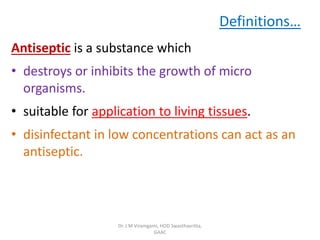
A disinfectant or germicide is a
• substance which destroys harmful microbes
• (not usually spores)
• for Preventing transmission of disease.
• suitable only for in-animate objects.
Dr. J M Viramgami, HOD Swasthavritta,
GAAC
Definitions…
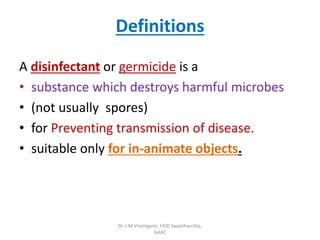
Antiseptic is a substance which
• destroys or inhibits the growth of micro
organisms.
• suitable for application to living tissues.
• disinfectant in low concentrations can act as an
antiseptic.
Dr. J M Viramgami, HOD Swasthavritta,
GAAC
Deodorant is a substance which
• suppresses or neutralizes bad odours,
• e.g., lime and bleaching powder.
Detergent is a surface cleaning agent
• which acts by lowering surface tension,
• e.g., soap removes bacteria along with dirt.
Sterilization is the
• process of destroying all life including spores.
• widely used in medical practice.
Dr. J M Viramgami, HOD Swasthavritta,
GAAC
Disinfectants
Their uses ranges from
• control of communicable diseases
• sterilization of instruments,
• treatment of infections of skin and mucous
membrane.
• the killing of infectious agents outside the
body
• by direct exposure to chemical or physical
agents.
Dr. J M Viramgami, HOD Swasthavritta,
GAAC
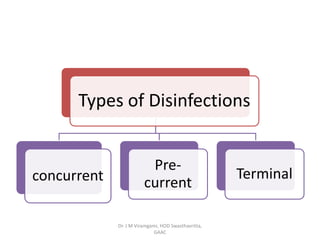
Types of Disinfections
concurrent
Pre-
current
Terminal
Dr. J M Viramgami, HOD Swasthavritta,
GAAC
Concurrent disinfection :
• Continuous disinfection
• agent is destroyed as soon as it is released from
the body and further spread is stopped.
• disinfection throughout the course of an illness.
• of urine, faeces, vomit, linen, clothes, hands,
(dressings, aprons, gloves, etc)
Dr. J M Viramgami, HOD Swasthavritta,
GAAC
Pre-current disinfection :
• Prophylactic disinfection
• Any infective organism is destroyed before the
item is used
• disinfection of water by chlorine,
pasteurization of milk and hand washing etc.
Dr. J M Viramgami, HOD Swasthavritta,
GAAC
Terminal disinfection:
• application measures in the last,
when patient is removed
• By recovery
• by death
• or to a hospital
• or has ceased to be a source of infection
• carried out along with airing and sunning of
rooms, furniture and bedding.
Dr. J M Viramgami, HOD Swasthavritta,
GAAC
NATURAL AGENTS
Sun Light: Direct and continuous exposure is
destructive to many disease producing
organisms.
• The ultraviolet rays are lethal to bacteria and
some viruses.
• linen, bedding, and furniture may be
disinfected by direct sunlight for several hours.
Air: Exposure to open air acts by drying or
evaporation of moisture which is lethal to
most bacteria.
Dr. J M Viramgami, HOD Swasthavritta,
GAAC
PHYSICAL AGENTS
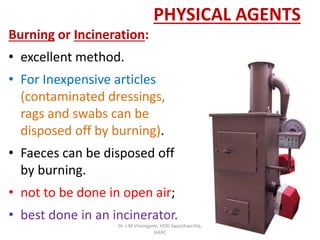
Burning or Incineration:
• excellent method.
• For Inexpensive articles
(contaminated dressings,
rags and swabs can be
disposed off by burning).
• Faeces can be disposed off
by burning.
• not to be done in open air;
• best done in an incinerator.
Dr. J M Viramgami, HOD Swasthavritta,
GAAC
Hot air :
useful for sterilizing many articles
• (glassware, syringes, swabs, dressings, and
sharp instruments. )
• no penetrating power,
• not suitable for bulky articles such as
mattresses.
• Usually done in a hot air oven.
• temp should be maintained at 160-1800 C for
at least one hour to kill spores.
Dr. J M Viramgami, HOD Swasthavritta,
GAAC
Boiling : effective method
• provides an atmosphere of boiling and steam.
• suitable for small instruments, tools, linen and
rubber goods such as gloves.
• Boiling for about 30 min is adequate for linen,
utensils and bedpans.
• kill bacteria, but not spores or viruses.
• slow process,
• unsuitable for thick beddings and woollen
materials as they shrink.
Dr. J M Viramgami, HOD Swasthavritta,
GAAC
Physical agents...
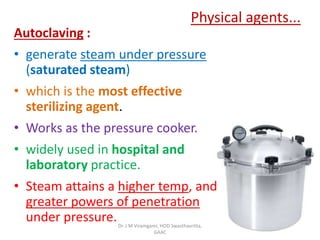
Autoclaving :
• generate steam under pressure
(saturated steam)
• which is the most effective
sterilizing agent.
• Works as the pressure cooker.
• widely used in hospital and
laboratory practice.
• Steam attains a higher temp, and
greater powers of penetration
under pressure.Dr. J M Viramgami, HOD Swasthavritta,
GAAC
• It destroys all forms of life, including spores.
• most effective for linen, dressings, gloves,
syringes, certain instruments and culture
media.
• not suitable for sterilization of plastics and
sharp instruments.
Dr. J M Viramgami, HOD Swasthavritta,
GAAC
Physical agents...
Radiation : Ionizing radiation
• one of the most viable, safe and economic
methods
• great penetrating powers.
• most effective, but costly.
• Commercially done by gamma radiation.
• used for sterilization of bandages, dressings,
catgut and surgical instruments.
• It requires special packing and equipment.
objects are placed in plastic bags for radiation.
they remain sterile until opened.Dr. J M Viramgami, HOD Swasthavritta,
GAAC
CHEMICAL AGENTS
• Articles which cannot be sterilized by boiling
or autoclaving
• may be immersed in chemical disinfectants.
• also used for the disinfection of faeces, urine
and other contaminated material.
Dr. J M Viramgami, HOD Swasthavritta,
GAAC
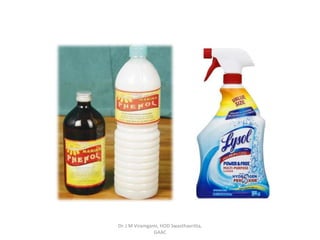
1.Phenol and related compounds
Phenol : Pure phenol is used as a standard.
Crude phenol : mixture of phenol and cresol.
effective against
• gram +ve and -ve bacteria; certain viruses.
• slow against spores and acid-fast bacteria.
• used for mopping floors and cleaning drains.
• effect is weakened by dilution.
• Aqueous solutions of 0.2 to 1 % are bacterio-
static. Dr. J M Viramgami, HOD Swasthavritta,
GAAC
Dr. J M Viramgami, HOD Swasthavritta,
GAAC
Cresol :
• coal-tar disinfectant.
• 3 to 10 times powerful than phenol,
• yet no more toxic.
• used in 5 to 10 % strength for disinfection of
faeces and urine.
• all-purpose general disinfectant.
Dr. J M Viramgami, HOD Swasthavritta,
GAAC
Cresol emulsions :
• Cresol emulsified with soap
• known as "saponified cresol".
• very powerful disinfectants.
• Lysol, Izal and Cyllin are cresol emulsions.
• 2 % solution of Lysol may be used for
disinfection of faeces.
Dr. J M Viramgami, HOD Swasthavritta,
GAAC
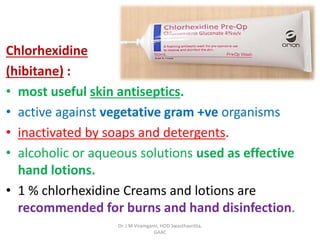
Chlorhexidine
(hibitane) :
• most useful skin antiseptics.
• active against vegetative gram +ve organisms
• inactivated by soaps and detergents.
• alcoholic or aqueous solutions used as effective
hand lotions.
• 1 % chlorhexidine Creams and lotions are
recommended for burns and hand disinfection.
Dr. J M Viramgami, HOD Swasthavritta,
GAAC
Hexachlorphane :
• highly active against gram-positive organisms,
• less active against gram-negative.
• slow in action,
• cumulative effect on the skin
• compatible with soaps
• included in soap preparation without loss of
activity.
Dr. J M Viramgami, HOD Swasthavritta,
GAAC
Dettol (chloro-xylenol):
• relatively non-toxic antiseptic.
• used safely in high concentrations.
• easily inactivated by organic matter.
• active against streptococci,
• worthless against some gram-negative
bacteria.
Dr. J M Viramgami, HOD Swasthavritta,
GAAC
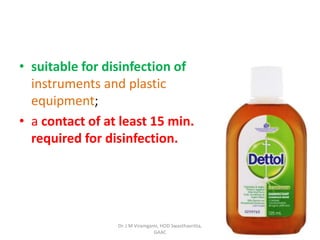
• suitable for disinfection of
instruments and plastic
equipment;
• a contact of at least 15 min.
required for disinfection.
Dr. J M Viramgami, HOD Swasthavritta,
GAAC
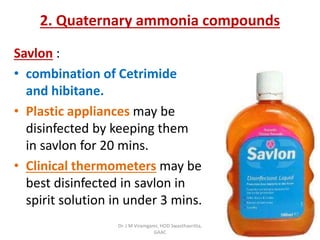
Savlon :
• combination of Cetrimide
and hibitane.
• Plastic appliances may be
disinfected by keeping them
in savlon for 20 mins.
• Clinical thermometers may be
best disinfected in savlon in
spirit solution in under 3 mins.
2. Quaternary ammonia compounds
Dr. J M Viramgami, HOD Swasthavritta,
GAAC
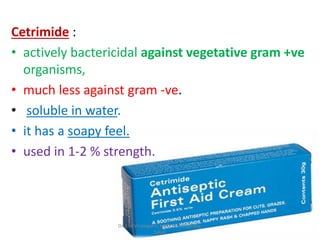
Cetrimide :
• actively bactericidal against vegetative gram +ve
organisms,
• much less against gram -ve.
• soluble in water.
• it has a soapy feel.
• used in 1-2 % strength.
Dr. J M Viramgami, HOD Swasthavritta,
GAAC
3.Halogens and their compounds
• halogens are actively bactericidal agents
• only useful antiseptics with a sporocidal
action.
• rapidly inactivated by organic matter.
Dr. J M Viramgami, HOD Swasthavritta,
GAAC
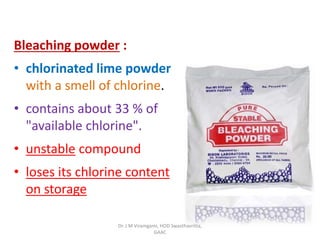
Bleaching powder :
• chlorinated lime powder
with a smell of chlorine.
• contains about 33 % of
"available chlorine".
• unstable compound
• loses its chlorine content
on storage
Dr. J M Viramgami, HOD Swasthavritta,
GAAC
• kills most of the organisms when used in the
strength of 1 to 3 %.
• widely used in public health practice for
disinfection of water, faeces and urine;
• as a deodorant.
• A 5 % solution is suitable for disinfection of
faeces and urine allowing a
period of one hour for
disinfection.
Dr. J M Viramgami, HOD Swasthavritta,
GAAC
Sodium hypochlorite :
• acts in the same way as bleaching powder,
• but is stronger.
• It corrodes metals.
• A freshly prepared hypo solution
recommended for sterilizing infant's feeding
bottles.
Dr. J M Viramgami, HOD Swasthavritta,
GAAC
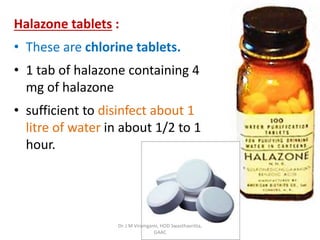
Halazone tablets :
• These are chlorine tablets.
• 1 tab of halazone containing 4
mg of halazone
• sufficient to disinfect about 1
litre of water in about 1/2 to 1
hour.
Dr. J M Viramgami, HOD Swasthavritta,
GAAC
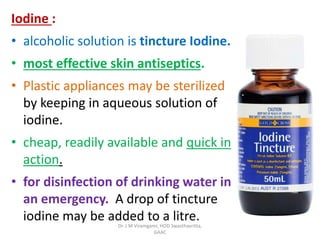
Iodine :
• alcoholic solution is tincture Iodine.
• most effective skin antiseptics.
• Plastic appliances may be sterilized
by keeping in aqueous solution of
iodine.
• cheap, readily available and quick in
action.
• for disinfection of drinking water in
an emergency. A drop of tincture
iodine may be added to a litre.
Dr. J M Viramgami, HOD Swasthavritta,
GAAC
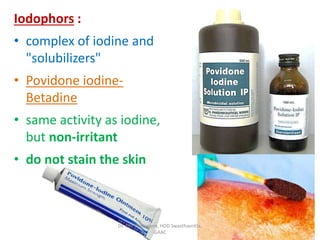
Iodophors :
• complex of iodine and
"solubilizers"
• Povidone iodine-
Betadine
• same activity as iodine,
but non-irritant
• do not stain the skin
Dr. J M Viramgami, HOD Swasthavritta,
GAAC
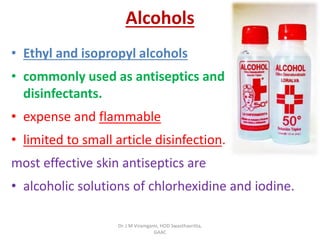
Alcohols
• Ethyl and isopropyl alcohols
• commonly used as antiseptics and
disinfectants.
• expense and flammable
• limited to small article disinfection.
most effective skin antiseptics are
• alcoholic solutions of chlorhexidine and iodine.
Dr. J M Viramgami, HOD Swasthavritta,
GAAC
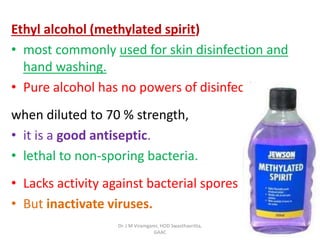
Ethyl alcohol (methylated spirit)
• most commonly used for skin disinfection and
hand washing.
• Pure alcohol has no powers of disinfection
when diluted to 70 % strength,
• it is a good antiseptic.
• lethal to non-sporing bacteria.
• Lacks activity against bacterial spores
• But inactivate viruses.
Dr. J M Viramgami, HOD Swasthavritta,
GAAC
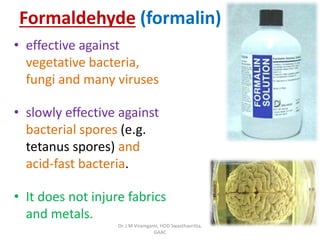
Formaldehyde (formalin)
• effective against
vegetative bacteria,
fungi and many viruses
• slowly effective against
bacterial spores (e.g.
tetanus spores) and
acid-fast bacteria.
• It does not injure fabrics
and metals.
Dr. J M Viramgami, HOD Swasthavritta,
GAAC
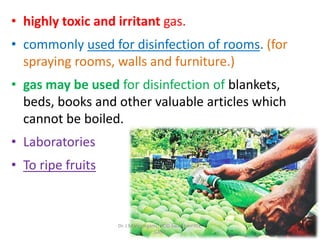
• highly toxic and irritant gas.
• commonly used for disinfection of rooms. (for
spraying rooms, walls and furniture.)
• gas may be used for disinfection of blankets,
beds, books and other valuable articles which
cannot be boiled.
• Laboratories
• To ripe fruits
Dr. J M Viramgami, HOD Swasthavritta,
GAAC
Miscellaneous
Lime :
• cheapest disinfectant.
• used in the form of fresh quick lime
• aqueous suspension as "milk of lime".
• Faeces and urine can be disinfected by mixing
aqueous suspension of lime
• used for treating walls.
• As a deodorant, sprinkled in cattle sheds and in
public places where urinal and latrines are
located.
Dr. J M Viramgami, HOD Swasthavritta,
GAAC
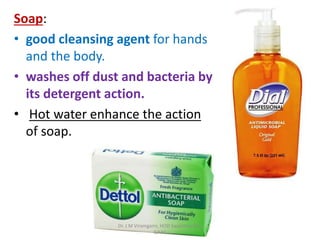
Soap:
• good cleansing agent for hands
and the body.
• washes off dust and bacteria by
its detergent action.
• Hot water enhance the action
of soap.
Dr. J M Viramgami, HOD Swasthavritta,
GAAC
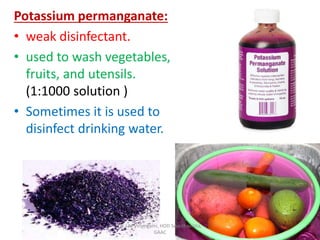
Potassium permanganate:
• weak disinfectant.
• used to wash vegetables,
fruits, and utensils.
(1:1000 solution )
• Sometimes it is used to
disinfect drinking water.
Dr. J M Viramgami, HOD Swasthavritta,
GAAC
Recommended
disinfection
procedures
Dr. J M Viramgami, HOD Swasthavritta,
GAAC
1. Faeces and urine
disinfected by
• adding an equal volume of one of the
disinfectants. allow to stand for 1-2 hours.
• equal amount of quick-lime or freshly prepared
milk of lime may be added, mixed and left for 2
hours.
• a bucket of boiling water may be added to the
faeces which is then covered and allowed to
stand until cool.
Dr. J M Viramgami, HOD Swasthavritta,
GAAC
After disinfection,
• excretal matter may be emptied into water
closet or buried in ground.
Bedpans and urinals
• ideally be steam disinfected.
• Alternatively, may be disinfected with 2.5%
cresol for an hour after cleaning.
Dr. J M Viramgami, HOD Swasthavritta,
GAAC
2. Sputum
• best destroyed by burning.
• If the amount is considerable (as in TB
hospitals), it may be disinfected by boiling or
autoclaving for 20 mins at 20 lbs pressure.
• the patient may be asked to spit in a sputum
cup half filled with 5 % cresol.
• cup is allowed to stand for an hour and the
contents may be emptied and disposed off.
Dr. J M Viramgami, HOD Swasthavritta,
GAAC
3. Room
cleaning, airing and exposure to direct sunlight,
for several hours will be sufficient.
For chemical disinfection,
• floors and hard surfaces to be sprayed or
mopped with one of the disinfectants.
(chlorinated lime; formaldehyde solution;
phenolic disinfectants such as cresol).
• The solution should remain in contact with the
surface for at least 4 hours before final washing.
Dr. J M Viramgami, HOD Swasthavritta,
GAAC
when Fumigation is required,
• the gas mostly used is formaldehyde.
• The room is kept closed for 6-12 hours to
allow disinfection.
• Formaldehyde is most effective at a high temp
and a relative humidity of 80-90 %.
Dr. J M Viramgami, HOD Swasthavritta,
GAAC
Follow us:
Facebook:
• https://fb.me/SwasthavrittaGAAC
Youtube:
• https://www.youtube.com/channel/UCPvrBlyheQcqwBXs1egxzWw
SlideShare:
• https://www.slideshare.net/SwasthvrittaAkhandan
THANK YOU
Dr. J M Viramgami, HOD Swasthavritta,
GAAC

Disinfectants

  • 1.
    Dr. Jasminkumar Viramgami Reader& H.O.D., Dept. of Swasthavritta, Govt. Akhandanand Ayurved College, Ahmedabad, Gujarat
  • 2.
    Definitions A disinfectant orgermicide is a • substance which destroys harmful microbes • (not usually spores) • for Preventing transmission of disease. • suitable only for in-animate objects. Dr. J M Viramgami, HOD Swasthavritta, GAAC
  • 3.
    Definitions… Antiseptic is asubstance which • destroys or inhibits the growth of micro organisms. • suitable for application to living tissues. • disinfectant in low concentrations can act as an antiseptic. Dr. J M Viramgami, HOD Swasthavritta, GAAC
  • 4.
    Deodorant is asubstance which • suppresses or neutralizes bad odours, • e.g., lime and bleaching powder. Detergent is a surface cleaning agent • which acts by lowering surface tension, • e.g., soap removes bacteria along with dirt. Sterilization is the • process of destroying all life including spores. • widely used in medical practice. Dr. J M Viramgami, HOD Swasthavritta, GAAC
  • 5.
    Disinfectants Their uses rangesfrom • control of communicable diseases • sterilization of instruments, • treatment of infections of skin and mucous membrane. • the killing of infectious agents outside the body • by direct exposure to chemical or physical agents. Dr. J M Viramgami, HOD Swasthavritta, GAAC
  • 6.
  • 7.
    Concurrent disinfection : •Continuous disinfection • agent is destroyed as soon as it is released from the body and further spread is stopped. • disinfection throughout the course of an illness. • of urine, faeces, vomit, linen, clothes, hands, (dressings, aprons, gloves, etc) Dr. J M Viramgami, HOD Swasthavritta, GAAC
  • 8.
    Pre-current disinfection : •Prophylactic disinfection • Any infective organism is destroyed before the item is used • disinfection of water by chlorine, pasteurization of milk and hand washing etc. Dr. J M Viramgami, HOD Swasthavritta, GAAC
  • 9.
    Terminal disinfection: • applicationmeasures in the last, when patient is removed • By recovery • by death • or to a hospital • or has ceased to be a source of infection • carried out along with airing and sunning of rooms, furniture and bedding. Dr. J M Viramgami, HOD Swasthavritta, GAAC
  • 10.
    NATURAL AGENTS Sun Light:Direct and continuous exposure is destructive to many disease producing organisms. • The ultraviolet rays are lethal to bacteria and some viruses. • linen, bedding, and furniture may be disinfected by direct sunlight for several hours. Air: Exposure to open air acts by drying or evaporation of moisture which is lethal to most bacteria. Dr. J M Viramgami, HOD Swasthavritta, GAAC
  • 11.
    PHYSICAL AGENTS Burning orIncineration: • excellent method. • For Inexpensive articles (contaminated dressings, rags and swabs can be disposed off by burning). • Faeces can be disposed off by burning. • not to be done in open air; • best done in an incinerator. Dr. J M Viramgami, HOD Swasthavritta, GAAC
  • 12.
    Hot air : usefulfor sterilizing many articles • (glassware, syringes, swabs, dressings, and sharp instruments. ) • no penetrating power, • not suitable for bulky articles such as mattresses. • Usually done in a hot air oven. • temp should be maintained at 160-1800 C for at least one hour to kill spores. Dr. J M Viramgami, HOD Swasthavritta, GAAC
  • 13.
    Boiling : effectivemethod • provides an atmosphere of boiling and steam. • suitable for small instruments, tools, linen and rubber goods such as gloves. • Boiling for about 30 min is adequate for linen, utensils and bedpans. • kill bacteria, but not spores or viruses. • slow process, • unsuitable for thick beddings and woollen materials as they shrink. Dr. J M Viramgami, HOD Swasthavritta, GAAC
  • 14.
    Physical agents... Autoclaving : •generate steam under pressure (saturated steam) • which is the most effective sterilizing agent. • Works as the pressure cooker. • widely used in hospital and laboratory practice. • Steam attains a higher temp, and greater powers of penetration under pressure.Dr. J M Viramgami, HOD Swasthavritta, GAAC
  • 15.
    • It destroysall forms of life, including spores. • most effective for linen, dressings, gloves, syringes, certain instruments and culture media. • not suitable for sterilization of plastics and sharp instruments. Dr. J M Viramgami, HOD Swasthavritta, GAAC
  • 16.
    Physical agents... Radiation :Ionizing radiation • one of the most viable, safe and economic methods • great penetrating powers. • most effective, but costly. • Commercially done by gamma radiation. • used for sterilization of bandages, dressings, catgut and surgical instruments. • It requires special packing and equipment. objects are placed in plastic bags for radiation. they remain sterile until opened.Dr. J M Viramgami, HOD Swasthavritta, GAAC
  • 17.
    CHEMICAL AGENTS • Articleswhich cannot be sterilized by boiling or autoclaving • may be immersed in chemical disinfectants. • also used for the disinfection of faeces, urine and other contaminated material. Dr. J M Viramgami, HOD Swasthavritta, GAAC
  • 18.
    1.Phenol and relatedcompounds Phenol : Pure phenol is used as a standard. Crude phenol : mixture of phenol and cresol. effective against • gram +ve and -ve bacteria; certain viruses. • slow against spores and acid-fast bacteria. • used for mopping floors and cleaning drains. • effect is weakened by dilution. • Aqueous solutions of 0.2 to 1 % are bacterio- static. Dr. J M Viramgami, HOD Swasthavritta, GAAC
  • 19.
    Dr. J MViramgami, HOD Swasthavritta, GAAC
  • 20.
    Cresol : • coal-tardisinfectant. • 3 to 10 times powerful than phenol, • yet no more toxic. • used in 5 to 10 % strength for disinfection of faeces and urine. • all-purpose general disinfectant. Dr. J M Viramgami, HOD Swasthavritta, GAAC
  • 21.
    Cresol emulsions : •Cresol emulsified with soap • known as "saponified cresol". • very powerful disinfectants. • Lysol, Izal and Cyllin are cresol emulsions. • 2 % solution of Lysol may be used for disinfection of faeces. Dr. J M Viramgami, HOD Swasthavritta, GAAC
  • 22.
    Chlorhexidine (hibitane) : • mostuseful skin antiseptics. • active against vegetative gram +ve organisms • inactivated by soaps and detergents. • alcoholic or aqueous solutions used as effective hand lotions. • 1 % chlorhexidine Creams and lotions are recommended for burns and hand disinfection. Dr. J M Viramgami, HOD Swasthavritta, GAAC
  • 23.
    Hexachlorphane : • highlyactive against gram-positive organisms, • less active against gram-negative. • slow in action, • cumulative effect on the skin • compatible with soaps • included in soap preparation without loss of activity. Dr. J M Viramgami, HOD Swasthavritta, GAAC
  • 24.
    Dettol (chloro-xylenol): • relativelynon-toxic antiseptic. • used safely in high concentrations. • easily inactivated by organic matter. • active against streptococci, • worthless against some gram-negative bacteria. Dr. J M Viramgami, HOD Swasthavritta, GAAC
  • 25.
    • suitable fordisinfection of instruments and plastic equipment; • a contact of at least 15 min. required for disinfection. Dr. J M Viramgami, HOD Swasthavritta, GAAC
  • 26.
    Savlon : • combinationof Cetrimide and hibitane. • Plastic appliances may be disinfected by keeping them in savlon for 20 mins. • Clinical thermometers may be best disinfected in savlon in spirit solution in under 3 mins. 2. Quaternary ammonia compounds Dr. J M Viramgami, HOD Swasthavritta, GAAC
  • 27.
    Cetrimide : • activelybactericidal against vegetative gram +ve organisms, • much less against gram -ve. • soluble in water. • it has a soapy feel. • used in 1-2 % strength. Dr. J M Viramgami, HOD Swasthavritta, GAAC
  • 28.
    3.Halogens and theircompounds • halogens are actively bactericidal agents • only useful antiseptics with a sporocidal action. • rapidly inactivated by organic matter. Dr. J M Viramgami, HOD Swasthavritta, GAAC
  • 29.
    Bleaching powder : •chlorinated lime powder with a smell of chlorine. • contains about 33 % of "available chlorine". • unstable compound • loses its chlorine content on storage Dr. J M Viramgami, HOD Swasthavritta, GAAC
  • 30.
    • kills mostof the organisms when used in the strength of 1 to 3 %. • widely used in public health practice for disinfection of water, faeces and urine; • as a deodorant. • A 5 % solution is suitable for disinfection of faeces and urine allowing a period of one hour for disinfection. Dr. J M Viramgami, HOD Swasthavritta, GAAC
  • 31.
    Sodium hypochlorite : •acts in the same way as bleaching powder, • but is stronger. • It corrodes metals. • A freshly prepared hypo solution recommended for sterilizing infant's feeding bottles. Dr. J M Viramgami, HOD Swasthavritta, GAAC
  • 32.
    Halazone tablets : •These are chlorine tablets. • 1 tab of halazone containing 4 mg of halazone • sufficient to disinfect about 1 litre of water in about 1/2 to 1 hour. Dr. J M Viramgami, HOD Swasthavritta, GAAC
  • 33.
    Iodine : • alcoholicsolution is tincture Iodine. • most effective skin antiseptics. • Plastic appliances may be sterilized by keeping in aqueous solution of iodine. • cheap, readily available and quick in action. • for disinfection of drinking water in an emergency. A drop of tincture iodine may be added to a litre. Dr. J M Viramgami, HOD Swasthavritta, GAAC
  • 34.
    Iodophors : • complexof iodine and "solubilizers" • Povidone iodine- Betadine • same activity as iodine, but non-irritant • do not stain the skin Dr. J M Viramgami, HOD Swasthavritta, GAAC
  • 35.
    Alcohols • Ethyl andisopropyl alcohols • commonly used as antiseptics and disinfectants. • expense and flammable • limited to small article disinfection. most effective skin antiseptics are • alcoholic solutions of chlorhexidine and iodine. Dr. J M Viramgami, HOD Swasthavritta, GAAC
  • 36.
    Ethyl alcohol (methylatedspirit) • most commonly used for skin disinfection and hand washing. • Pure alcohol has no powers of disinfection when diluted to 70 % strength, • it is a good antiseptic. • lethal to non-sporing bacteria. • Lacks activity against bacterial spores • But inactivate viruses. Dr. J M Viramgami, HOD Swasthavritta, GAAC
  • 37.
    Formaldehyde (formalin) • effectiveagainst vegetative bacteria, fungi and many viruses • slowly effective against bacterial spores (e.g. tetanus spores) and acid-fast bacteria. • It does not injure fabrics and metals. Dr. J M Viramgami, HOD Swasthavritta, GAAC
  • 38.
    • highly toxicand irritant gas. • commonly used for disinfection of rooms. (for spraying rooms, walls and furniture.) • gas may be used for disinfection of blankets, beds, books and other valuable articles which cannot be boiled. • Laboratories • To ripe fruits Dr. J M Viramgami, HOD Swasthavritta, GAAC
  • 39.
    Miscellaneous Lime : • cheapestdisinfectant. • used in the form of fresh quick lime • aqueous suspension as "milk of lime". • Faeces and urine can be disinfected by mixing aqueous suspension of lime • used for treating walls. • As a deodorant, sprinkled in cattle sheds and in public places where urinal and latrines are located. Dr. J M Viramgami, HOD Swasthavritta, GAAC
  • 40.
    Soap: • good cleansingagent for hands and the body. • washes off dust and bacteria by its detergent action. • Hot water enhance the action of soap. Dr. J M Viramgami, HOD Swasthavritta, GAAC
  • 41.
    Potassium permanganate: • weakdisinfectant. • used to wash vegetables, fruits, and utensils. (1:1000 solution ) • Sometimes it is used to disinfect drinking water. Dr. J M Viramgami, HOD Swasthavritta, GAAC
  • 42.
    Recommended disinfection procedures Dr. J MViramgami, HOD Swasthavritta, GAAC
  • 43.
    1. Faeces andurine disinfected by • adding an equal volume of one of the disinfectants. allow to stand for 1-2 hours. • equal amount of quick-lime or freshly prepared milk of lime may be added, mixed and left for 2 hours. • a bucket of boiling water may be added to the faeces which is then covered and allowed to stand until cool. Dr. J M Viramgami, HOD Swasthavritta, GAAC
  • 44.
    After disinfection, • excretalmatter may be emptied into water closet or buried in ground. Bedpans and urinals • ideally be steam disinfected. • Alternatively, may be disinfected with 2.5% cresol for an hour after cleaning. Dr. J M Viramgami, HOD Swasthavritta, GAAC
  • 45.
    2. Sputum • bestdestroyed by burning. • If the amount is considerable (as in TB hospitals), it may be disinfected by boiling or autoclaving for 20 mins at 20 lbs pressure. • the patient may be asked to spit in a sputum cup half filled with 5 % cresol. • cup is allowed to stand for an hour and the contents may be emptied and disposed off. Dr. J M Viramgami, HOD Swasthavritta, GAAC
  • 46.
    3. Room cleaning, airingand exposure to direct sunlight, for several hours will be sufficient. For chemical disinfection, • floors and hard surfaces to be sprayed or mopped with one of the disinfectants. (chlorinated lime; formaldehyde solution; phenolic disinfectants such as cresol). • The solution should remain in contact with the surface for at least 4 hours before final washing. Dr. J M Viramgami, HOD Swasthavritta, GAAC
  • 47.
    when Fumigation isrequired, • the gas mostly used is formaldehyde. • The room is kept closed for 6-12 hours to allow disinfection. • Formaldehyde is most effective at a high temp and a relative humidity of 80-90 %. Dr. J M Viramgami, HOD Swasthavritta, GAAC
  • 48.
    Follow us: Facebook: • https://fb.me/SwasthavrittaGAAC Youtube: •https://www.youtube.com/channel/UCPvrBlyheQcqwBXs1egxzWw SlideShare: • https://www.slideshare.net/SwasthvrittaAkhandan THANK YOU Dr. J M Viramgami, HOD Swasthavritta, GAAC