
Noise Pollution
Vd Rakesh Shukla
Lecturer
Dept of Swasthavritta
GAAC, Ahmedabad
Vd Rakesh Shukla, Lecturer, GAAC,
Ahmedabad
DEFINITION
• Noise pollution , also known as environmental
noise or sound pollution, is the propagation of
noise with harmful impact on the activity of
human or animal life.
Vd Rakesh Shukla, Lecturer, GAAC,
Ahmedabad
Sources of Noise pollution
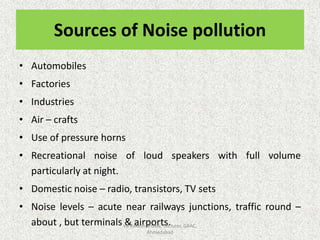
• Automobiles
• Factories
• Industries
• Air – crafts
• Use of pressure horns
• Recreational noise of loud speakers with full volume
particularly at night.
• Domestic noise – radio, transistors, TV sets
• Noise levels – acute near railways junctions, traffic round –
about , but terminals & airports.Vd Rakesh Shukla, Lecturer, GAAC,
Ahmedabad
NOISE POLLUTION
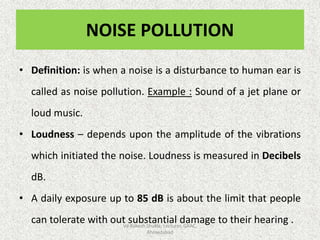
• Definition: is when a noise is a disturbance to human ear is
called as noise pollution. Example : Sound of a jet plane or
loud music.
• Loudness – depends upon the amplitude of the vibrations
which initiated the noise. Loudness is measured in Decibels
dB.
• A daily exposure up to 85 dB is about the limit that people
can tolerate with out substantial damage to their hearing .Vd Rakesh Shukla, Lecturer, GAAC,
Ahmedabad
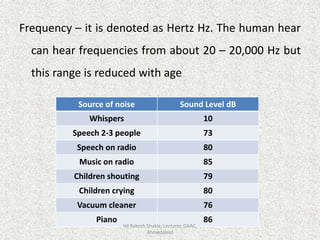
Frequency – it is denoted as Hertz Hz. The human hear
can hear frequencies from about 20 – 20,000 Hz but
this range is reduced with age
Source of noise Sound Level dB
Whispers 10
Speech 2-3 people 73
Speech on radio 80
Music on radio 85
Children shouting 79
Children crying 80
Vacuum cleaner 76
Piano 86
Vd Rakesh Shukla, Lecturer, GAAC,
Ahmedabad
Auditory effects
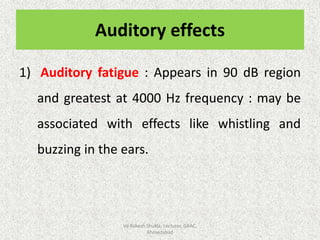
1) Auditory fatigue : Appears in 90 dB region
and greatest at 4000 Hz frequency : may be
associated with effects like whistling and
buzzing in the ears.
Vd Rakesh Shukla, Lecturer, GAAC,
Ahmedabad
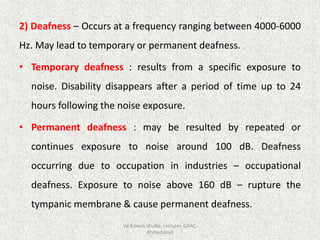
2) Deafness – Occurs at a frequency ranging between 4000-6000
Hz. May lead to temporary or permanent deafness.
• Temporary deafness : results from a specific exposure to
noise. Disability disappears after a period of time up to 24
hours following the noise exposure.
• Permanent deafness : may be resulted by repeated or
continues exposure to noise around 100 dB. Deafness
occurring due to occupation in industries – occupational
deafness. Exposure to noise above 160 dB – rupture the
tympanic membrane & cause permanent deafness.
Vd Rakesh Shukla, Lecturer, GAAC,
Ahmedabad
• 3) Inner ear damage – may vary from minor
changes in the hair cell endings to complete
destruction of organ of corti.
Vd Rakesh Shukla, Lecturer, GAAC,
Ahmedabad
Non auditory effects
• 1) Interference with speech : Most disturbance in
speech is caused at 300 -500 Hz range commonly
present in noise produced in road & air traffic.
• For good speech, intelligibility speech sound level
must exceed the SIL (Speech interference level) –
approx. 12 Db.
Vd Rakesh Shukla, Lecturer, GAAC,
Ahmedabad
2) Annoyance : Primarily a psychological response.
Neurotic people are more sensitive to noise than
balanced people.
3) Efficacy : where ever mental concentration is
required, silence or a low level of noise is required.
Reduction in noise – increases work out put.
Vd Rakesh Shukla, Lecturer, GAAC,
Ahmedabad
4) Psychological changes : Temporary
psychological changes occur in our body as a
direct result of noise pollution – Hypertension,
increased intracranial pressure, increased heart
rate , increased breathing, Increased sweating.
Vd Rakesh Shukla, Lecturer, GAAC,
Ahmedabad
5) Cardiovascular health – CV effects & exposure
to moderately high levels during a single 8 hour
period causes a statistical rise in BP of 5-10 mm
of hg.
• Stress & vasoconstriction leads to the
increases BP & increased incidence of
coronary artery disease.
Vd Rakesh Shukla, Lecturer, GAAC,
Ahmedabad
6) General symptoms :
• Giddiness
• Nausea
• Fatigue
• Interference with sleep
• Visual disturbance – constriction of pupil, affect
colour perception & reduced night vision.
7) Economic loss : Causes reduced work output &
noise induced hearing loss.
Vd Rakesh Shukla, Lecturer, GAAC,
Ahmedabad
Noise Control
1) Careful planning of cities :
• Division of city into zones with separation of
area concerned with industry & transport.
• Separation of residential areas from the main
streets with green belts.
• House fronts should lie not less than 15 mts
from road & the intervening space should
thickly planted with trees.
Vd Rakesh Shukla, Lecturer, GAAC,
Ahmedabad
2) Control of vehicles
• Heavy vehicles should not be routed into
narrow streets.
• Reduce vehicular traffic on residential streets.
• Prohibit blowing of horn & use of pressure
horn.
Vd Rakesh Shukla, Lecturer, GAAC,
Ahmedabad
3) Industries & railways
• Special areas must be earmarked – outside
residential areas, for industries, for railways &
similar installations.
• When these demands cant be met, protective
green belts must be laid down between
installation & residential area
Vd Rakesh Shukla, Lecturer, GAAC,
Ahmedabad
4) Protection of exposed persons
• Recommendations of hearing protection for all workers
who are consistently exposed to noise louder than 85db
in the frequency bands above 150Hz.
• Regularly rotate workers from noisy area to
comparatively quiet posts in factories.
• Go for periodical audiogram check –ups.
• Use ear plugs, ear muffs when ever situation demands.
Vd Rakesh Shukla, Lecturer, GAAC,
Ahmedabad
5) Legislation
• Many states have adopted legislation providing for
controls which are applicable to a wide Varity of sources.
• Workers have the right to claim compensation if they
have suffered a loss of ability to understands speech.
6) Education :
• Educate the general public through all available mass
media & highlight the importance of noise as community
hazard.
Vd Rakesh Shukla, Lecturer, GAAC,
Ahmedabad
Thank you
Follow us:
Facebook: https://www.facebook.com/SwasthavrittaGAAC
Youtube: https://www.youtube.com/channel/UCPvrBlyheQcqwBXs1egxzWw
SlideShare: https://www.slideshare.net/SwasthvrittaAkhandan
Vd Rakesh Shukla, Lecturer, GAAC,
Ahmedabad

Noise pollution

  • 1.
    Noise Pollution Vd RakeshShukla Lecturer Dept of Swasthavritta GAAC, Ahmedabad Vd Rakesh Shukla, Lecturer, GAAC, Ahmedabad
  • 2.
    DEFINITION • Noise pollution, also known as environmental noise or sound pollution, is the propagation of noise with harmful impact on the activity of human or animal life. Vd Rakesh Shukla, Lecturer, GAAC, Ahmedabad
  • 3.
    Sources of Noisepollution • Automobiles • Factories • Industries • Air – crafts • Use of pressure horns • Recreational noise of loud speakers with full volume particularly at night. • Domestic noise – radio, transistors, TV sets • Noise levels – acute near railways junctions, traffic round – about , but terminals & airports.Vd Rakesh Shukla, Lecturer, GAAC, Ahmedabad
  • 4.
    NOISE POLLUTION • Definition:is when a noise is a disturbance to human ear is called as noise pollution. Example : Sound of a jet plane or loud music. • Loudness – depends upon the amplitude of the vibrations which initiated the noise. Loudness is measured in Decibels dB. • A daily exposure up to 85 dB is about the limit that people can tolerate with out substantial damage to their hearing .Vd Rakesh Shukla, Lecturer, GAAC, Ahmedabad
  • 5.
    Frequency – itis denoted as Hertz Hz. The human hear can hear frequencies from about 20 – 20,000 Hz but this range is reduced with age Source of noise Sound Level dB Whispers 10 Speech 2-3 people 73 Speech on radio 80 Music on radio 85 Children shouting 79 Children crying 80 Vacuum cleaner 76 Piano 86 Vd Rakesh Shukla, Lecturer, GAAC, Ahmedabad
  • 6.
    Auditory effects 1) Auditoryfatigue : Appears in 90 dB region and greatest at 4000 Hz frequency : may be associated with effects like whistling and buzzing in the ears. Vd Rakesh Shukla, Lecturer, GAAC, Ahmedabad
  • 7.
    2) Deafness –Occurs at a frequency ranging between 4000-6000 Hz. May lead to temporary or permanent deafness. • Temporary deafness : results from a specific exposure to noise. Disability disappears after a period of time up to 24 hours following the noise exposure. • Permanent deafness : may be resulted by repeated or continues exposure to noise around 100 dB. Deafness occurring due to occupation in industries – occupational deafness. Exposure to noise above 160 dB – rupture the tympanic membrane & cause permanent deafness. Vd Rakesh Shukla, Lecturer, GAAC, Ahmedabad
  • 8.
    • 3) Innerear damage – may vary from minor changes in the hair cell endings to complete destruction of organ of corti. Vd Rakesh Shukla, Lecturer, GAAC, Ahmedabad
  • 9.
    Non auditory effects •1) Interference with speech : Most disturbance in speech is caused at 300 -500 Hz range commonly present in noise produced in road & air traffic. • For good speech, intelligibility speech sound level must exceed the SIL (Speech interference level) – approx. 12 Db. Vd Rakesh Shukla, Lecturer, GAAC, Ahmedabad
  • 10.
    2) Annoyance :Primarily a psychological response. Neurotic people are more sensitive to noise than balanced people. 3) Efficacy : where ever mental concentration is required, silence or a low level of noise is required. Reduction in noise – increases work out put. Vd Rakesh Shukla, Lecturer, GAAC, Ahmedabad
  • 11.
    4) Psychological changes: Temporary psychological changes occur in our body as a direct result of noise pollution – Hypertension, increased intracranial pressure, increased heart rate , increased breathing, Increased sweating. Vd Rakesh Shukla, Lecturer, GAAC, Ahmedabad
  • 12.
    5) Cardiovascular health– CV effects & exposure to moderately high levels during a single 8 hour period causes a statistical rise in BP of 5-10 mm of hg. • Stress & vasoconstriction leads to the increases BP & increased incidence of coronary artery disease. Vd Rakesh Shukla, Lecturer, GAAC, Ahmedabad
  • 13.
    6) General symptoms: • Giddiness • Nausea • Fatigue • Interference with sleep • Visual disturbance – constriction of pupil, affect colour perception & reduced night vision. 7) Economic loss : Causes reduced work output & noise induced hearing loss. Vd Rakesh Shukla, Lecturer, GAAC, Ahmedabad
  • 14.
    Noise Control 1) Carefulplanning of cities : • Division of city into zones with separation of area concerned with industry & transport. • Separation of residential areas from the main streets with green belts. • House fronts should lie not less than 15 mts from road & the intervening space should thickly planted with trees. Vd Rakesh Shukla, Lecturer, GAAC, Ahmedabad
  • 15.
    2) Control ofvehicles • Heavy vehicles should not be routed into narrow streets. • Reduce vehicular traffic on residential streets. • Prohibit blowing of horn & use of pressure horn. Vd Rakesh Shukla, Lecturer, GAAC, Ahmedabad
  • 16.
    3) Industries &railways • Special areas must be earmarked – outside residential areas, for industries, for railways & similar installations. • When these demands cant be met, protective green belts must be laid down between installation & residential area Vd Rakesh Shukla, Lecturer, GAAC, Ahmedabad
  • 17.
    4) Protection ofexposed persons • Recommendations of hearing protection for all workers who are consistently exposed to noise louder than 85db in the frequency bands above 150Hz. • Regularly rotate workers from noisy area to comparatively quiet posts in factories. • Go for periodical audiogram check –ups. • Use ear plugs, ear muffs when ever situation demands. Vd Rakesh Shukla, Lecturer, GAAC, Ahmedabad
  • 18.
    5) Legislation • Manystates have adopted legislation providing for controls which are applicable to a wide Varity of sources. • Workers have the right to claim compensation if they have suffered a loss of ability to understands speech. 6) Education : • Educate the general public through all available mass media & highlight the importance of noise as community hazard. Vd Rakesh Shukla, Lecturer, GAAC, Ahmedabad
  • 19.
    Thank you Follow us: Facebook:https://www.facebook.com/SwasthavrittaGAAC Youtube: https://www.youtube.com/channel/UCPvrBlyheQcqwBXs1egxzWw SlideShare: https://www.slideshare.net/SwasthvrittaAkhandan Vd Rakesh Shukla, Lecturer, GAAC, Ahmedabad