Dr. Jasminkumar Viramgami
Reader & H.O.D.,
Dept. of Swasthavritta,
Govt. Akhandanand Ayurved College, Ahmedabad, Gujarat
HEALTH
Health is…..
• a state of complete Physical, Mental and Social
well being and not merely an absence of
disease or infirmity….
• which allows a person to live a socio-
economically productive life.
Illness is…..
a state in which a person’s physical,
emotional, intellectual, social or spiritual
functioning is diminished or impaired.
Health care is...
• More than just Medical care
• multitude of services
• Public right & Govt responsibility
• Made available to individuals or communities
by the agents of health services or professional
• purpose
Promoting
Maintaining
Monitoring and
Restoring health
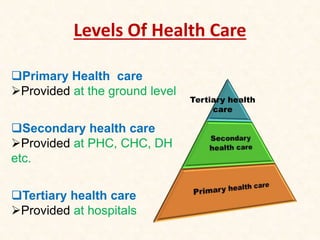
Levels Of Health Care
Primary Health care
Provided at the ground level
Secondary health care
Provided at PHC, CHC, DH
etc.
Tertiary health care
Provided at hospitals
Tertiary health
care
PRIMARY HELATH CARE
• The 1st level of contact between the Individual
and the Health system.
• Closest to the people.
• Essential Health Care is provided.
• Provided by the Primary Health Centres.
• Majority of minor health ailments can be
satisfactory handled.
SECONDARY HELATH CARE
• For more complex health problems
• Includes curative services
• 1st Level Referral Services
• Provided by District level Hospitals, CHCs
TERTIARY HELATH CARE
• Super specialist cares
• By Specialist/Regional/Central level institutes
• Provides Trainings also.
Alma-Ata international conference
In 1977, World Health Assembly launch a movement
called “Health for all by 2000”
Fundamental principle of this concept was
an equal health status for all the people in all countries
equitable distribution of health resources
marked as the major social goal for every country.
the best way to achieve HFA is by providing primary
health care……
especially to underserved rural and urban poor
Primary Health Care
• A new approach to healthcare came into
existence in 1978 after Alma-Ata conference
• 1st proposed by the Bhore Committee in 1946.
Alma-Ata conference defined Primary Health
Care as-
• ---An essential health care made universally
accessible to individual and acceptable to
them, through their full participation and at a
cost the community and country can afford.
Bhore Committee concept
Bhore committee defined Comprehensive Health Care having
following criteria—
• Provide adequate Preventive, Promotive and Curative
health services
• As close to beneficiaries as possible
• Widest co-operation between the People, Service and the
Profession
• Available to All – irrespective to their ability to pay
• Look after the vulnerable and weaker sections of the
community
• Create and maintain a healthy environment.
Primary health care
Primary Health Care as defined by the WHO in 1978 is…
Essential health care
• based on
o practical,
o scientifically sound, and
o socially acceptable method and technology.
• made universally accessible to the community through
their full participation
• at a cost that community and country can afford to
maintain every stage of their development in the spirit
of self determination.
What is there in Primary Health Care?
Primary Health Care includes:
• Primary Care (physicians, midwives & nurses);
• Health promotion, illness prevention;
• Health maintenance & home support;
• Community rehabilitation;
• Pre-hospital emergency medical services and
• Coordination and referral to other areas of
health care.
 first level of contact with the health system to
promote health, prevent illness, care for common
illnesses, and manage ongoing health problems.
 involves concerted effort to provide minimum of
health services to rural population of developing
countries
 primary health care approach starts with the
people themselves.
 This has been described as Health by the people,
placing people's health in people's hands
Primary Health Care is different in each
community depending upon:
o Needs of the residents;
o Availability of health care providers;
o The communities geographic location; &
o Proximity to other health care services in the
area.
Elements of Primary Health Care
1. Education about prevailing health conditions and
methods to prevent and control them
2. Promotion of food supply and proper Nutrition
3. Adequate Safe water supply and basic sanitation
4. MCH care with FP
5. Immunization against major infectious diseases
6. Prevention and control of locally Endemic Diseases
7. Appropriate treatment of Common Diseases and
injuries
8. Provision of essential Drugs
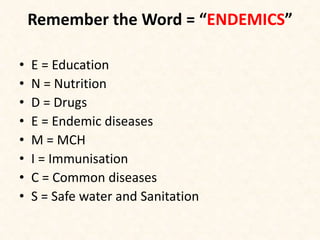
Remember the Word = “ENDEMICS”
• E = Education
• N = Nutrition
• D = Drugs
• E = Endemic diseases
• M = MCH
• I = Immunisation
• C = Common diseases
• S = Safe water and Sanitation
Principles of
Primary Health Care
• Equitable Distribution
• Community Participation
• Inter-sectoral Co-ordination
• Appropriate Technology
Equitable distribution
• health services must be shared equally by all
people irrespective of their ability to pay
• all must have access to health services (rich or
poor, urban or rural).
• Remove the imbalance by shifting the health
care system from cities (where three-quarters of
the health budget is spent) to the rural areas
(where three-quarters of the people live), and
• bring these services as near people's homes as
possible.
Community participation
• involvement of individuals, families, and
communities in promotion of their own health and
welfare.
• Universal coverage by primary health care cannot
be achieved without the involvement of the local
community.
• primary health care must be built on the principle
of community participation (or involvement).
• Max reliance on local resources (manpower,
material, etc.)
Intersectoral Co-ordination
• the components of PHC cannot be provided by
the health sector alone.
• PHC = health sector + all related sectors and
aspects of national and community development
• planning with other sectors to avoid
unnecessary duplication of activities.
Appropriate technology
technology that is
• scientifically sound,
• adaptable to local needs,
• acceptable,
• that can be maintained by the people
themselves
• with the resources the community and
country can afford.
• Inappropriate technology to local needs should
be avoided.
Health for All
Alma-ata International Conference
 In 1977, World Health Assembly launch a movement
called “Health for all by 2000”
 Fundamental principle of this concept was Equity - an
equal health status for all the people in all countries
 equitable distribution of health resources
 In 1978, “Health for all” was reaffirmed and marked as
the major social goal for every country.
 It was stated in the declaration that the best way to
achieve HFA is by providing primary health care……
 ….especially to underserved rural and urban poor
Alma-Ata Declarations
A main social target of governments, international
organizations and the whole world community in the
coming decades should be the “attainment by all
peoples of the world by the year 2000 of a level of
health that will permit them to lead a socially and
economically productive life.”
“HEALTH FOR ALL BY 2000”
Primary health care is the key to attaining this target
as part of development in the spirit of social justice.
PHC as per Alma-Ata Declaration
integral part of the country's health system
first level of contact of individuals, the family and
community with the national health system.
All govt should formulate national policies,
strategies and plans of action to launch and sustain
primary health care as part of a comprehensive
national health system and in coordination with
other sectors.
• In 1981, a global strategy for HFA was evolved
by WHO.
• a global framework which apply to all Member
States
• to be adapted with national and regional
variations of conditions and requirements.
• This was followed by individual countries
developing their own strategies for achieving
HFA
WHO established 12 global indicators
• as the basic point of reference for assessing
the progress towards HFA
as for example,
• a minimum life expectancy of 60 years and
• maximum IMR of 50 per 1000 live births.
National Strategy for HFA
• The National Health Policy echoes the WHO
call for HFA and the Alma-Ata Declaration.
• specific goals in respect of the various health
indicators.
goals to be achieved by 2000 AD were
(1) Reduction of IMR from 125 (1978) to below 60.
(2) raise the expectation of life at birth from 52 years to
64.
(3) reduce the crude death rate from the level of 14 per
1000 population to 9 per 1000.
(4) reduce the crude birth rate from the level of 33 per
1000 population to 21.
(5) achieve a net reproduction rate of one.
(6) provide potable water to the entire rural population
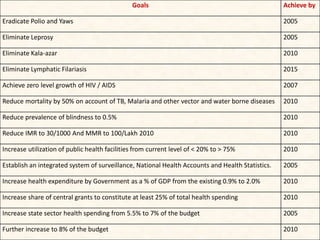
so revision of the policy was necessary, and a
new National Health Policy-2002 was evolved.
To translate the objectives into reality, the
Health Policy has laid down specific goals to
be achieved by year 2005, 2007, 2010 and
2015.
Goals Achieve by
Eradicate Polio and Yaws 2005
Eliminate Leprosy 2005
Eliminate Kala-azar 2010
Eliminate Lymphatic Filariasis 2015
Achieve zero level growth of HIV / AIDS 2007
Reduce mortality by 50% on account of TB, Malaria and other vector and water borne diseases 2010
Reduce prevalence of blindness to 0.5% 2010
Reduce IMR to 30/1000 And MMR to 100/Lakh 2010 2010
Increase utilization of public health facilities from current level of < 20% to > 75% 2010
Establish an integrated system of surveillance, National Health Accounts and Health Statistics. 2005
Increase health expenditure by Government as a % of GDP from the existing 0.9% to 2.0% 2010
Increase share of central grants to constitute at least 25% of total health spending 2010
Increase state sector health spending from 5.5% to 7% of the budget 2005
Further increase to 8% of the budget 2010
Follow us:
Facebook:
• https://fb.me/SwasthavrittaGAAC
Youtube:
• https://www.youtube.com/channel/UCPvrBlyheQcqwBXs1egxzWw
SlideShare:
• https://www.slideshare.net/SwasthvrittaAkhandan
THANK YOU
Dr. J M Viramgami, HOD Swasthavritta,
GAAC

Primary health care concept

  • 1.
    Dr. Jasminkumar Viramgami Reader& H.O.D., Dept. of Swasthavritta, Govt. Akhandanand Ayurved College, Ahmedabad, Gujarat
  • 2.
    HEALTH Health is….. • astate of complete Physical, Mental and Social well being and not merely an absence of disease or infirmity…. • which allows a person to live a socio- economically productive life. Illness is….. a state in which a person’s physical, emotional, intellectual, social or spiritual functioning is diminished or impaired.
  • 3.
    Health care is... •More than just Medical care • multitude of services • Public right & Govt responsibility • Made available to individuals or communities by the agents of health services or professional • purpose Promoting Maintaining Monitoring and Restoring health
  • 4.
    Levels Of HealthCare Primary Health care Provided at the ground level Secondary health care Provided at PHC, CHC, DH etc. Tertiary health care Provided at hospitals Tertiary health care
  • 5.
    PRIMARY HELATH CARE •The 1st level of contact between the Individual and the Health system. • Closest to the people. • Essential Health Care is provided. • Provided by the Primary Health Centres. • Majority of minor health ailments can be satisfactory handled.
  • 6.
    SECONDARY HELATH CARE •For more complex health problems • Includes curative services • 1st Level Referral Services • Provided by District level Hospitals, CHCs TERTIARY HELATH CARE • Super specialist cares • By Specialist/Regional/Central level institutes • Provides Trainings also.
  • 7.
    Alma-Ata international conference In1977, World Health Assembly launch a movement called “Health for all by 2000” Fundamental principle of this concept was an equal health status for all the people in all countries equitable distribution of health resources marked as the major social goal for every country. the best way to achieve HFA is by providing primary health care…… especially to underserved rural and urban poor
  • 8.
    Primary Health Care •A new approach to healthcare came into existence in 1978 after Alma-Ata conference • 1st proposed by the Bhore Committee in 1946. Alma-Ata conference defined Primary Health Care as- • ---An essential health care made universally accessible to individual and acceptable to them, through their full participation and at a cost the community and country can afford.
  • 9.
    Bhore Committee concept Bhorecommittee defined Comprehensive Health Care having following criteria— • Provide adequate Preventive, Promotive and Curative health services • As close to beneficiaries as possible • Widest co-operation between the People, Service and the Profession • Available to All – irrespective to their ability to pay • Look after the vulnerable and weaker sections of the community • Create and maintain a healthy environment.
  • 10.
    Primary health care PrimaryHealth Care as defined by the WHO in 1978 is… Essential health care • based on o practical, o scientifically sound, and o socially acceptable method and technology. • made universally accessible to the community through their full participation • at a cost that community and country can afford to maintain every stage of their development in the spirit of self determination.
  • 11.
    What is therein Primary Health Care? Primary Health Care includes: • Primary Care (physicians, midwives & nurses); • Health promotion, illness prevention; • Health maintenance & home support; • Community rehabilitation; • Pre-hospital emergency medical services and • Coordination and referral to other areas of health care.
  • 12.
     first levelof contact with the health system to promote health, prevent illness, care for common illnesses, and manage ongoing health problems.  involves concerted effort to provide minimum of health services to rural population of developing countries  primary health care approach starts with the people themselves.  This has been described as Health by the people, placing people's health in people's hands
  • 13.
    Primary Health Careis different in each community depending upon: o Needs of the residents; o Availability of health care providers; o The communities geographic location; & o Proximity to other health care services in the area.
  • 14.
    Elements of PrimaryHealth Care 1. Education about prevailing health conditions and methods to prevent and control them 2. Promotion of food supply and proper Nutrition 3. Adequate Safe water supply and basic sanitation 4. MCH care with FP 5. Immunization against major infectious diseases 6. Prevention and control of locally Endemic Diseases 7. Appropriate treatment of Common Diseases and injuries 8. Provision of essential Drugs
  • 15.
    Remember the Word= “ENDEMICS” • E = Education • N = Nutrition • D = Drugs • E = Endemic diseases • M = MCH • I = Immunisation • C = Common diseases • S = Safe water and Sanitation
  • 16.
    Principles of Primary HealthCare • Equitable Distribution • Community Participation • Inter-sectoral Co-ordination • Appropriate Technology
  • 17.
    Equitable distribution • healthservices must be shared equally by all people irrespective of their ability to pay • all must have access to health services (rich or poor, urban or rural). • Remove the imbalance by shifting the health care system from cities (where three-quarters of the health budget is spent) to the rural areas (where three-quarters of the people live), and • bring these services as near people's homes as possible.
  • 18.
    Community participation • involvementof individuals, families, and communities in promotion of their own health and welfare. • Universal coverage by primary health care cannot be achieved without the involvement of the local community. • primary health care must be built on the principle of community participation (or involvement). • Max reliance on local resources (manpower, material, etc.)
  • 19.
    Intersectoral Co-ordination • thecomponents of PHC cannot be provided by the health sector alone. • PHC = health sector + all related sectors and aspects of national and community development • planning with other sectors to avoid unnecessary duplication of activities.
  • 20.
    Appropriate technology technology thatis • scientifically sound, • adaptable to local needs, • acceptable, • that can be maintained by the people themselves • with the resources the community and country can afford. • Inappropriate technology to local needs should be avoided.
  • 21.
  • 22.
    Alma-ata International Conference In 1977, World Health Assembly launch a movement called “Health for all by 2000”  Fundamental principle of this concept was Equity - an equal health status for all the people in all countries  equitable distribution of health resources  In 1978, “Health for all” was reaffirmed and marked as the major social goal for every country.  It was stated in the declaration that the best way to achieve HFA is by providing primary health care……  ….especially to underserved rural and urban poor
  • 23.
    Alma-Ata Declarations A mainsocial target of governments, international organizations and the whole world community in the coming decades should be the “attainment by all peoples of the world by the year 2000 of a level of health that will permit them to lead a socially and economically productive life.” “HEALTH FOR ALL BY 2000” Primary health care is the key to attaining this target as part of development in the spirit of social justice.
  • 24.
    PHC as perAlma-Ata Declaration integral part of the country's health system first level of contact of individuals, the family and community with the national health system. All govt should formulate national policies, strategies and plans of action to launch and sustain primary health care as part of a comprehensive national health system and in coordination with other sectors.
  • 25.
    • In 1981,a global strategy for HFA was evolved by WHO. • a global framework which apply to all Member States • to be adapted with national and regional variations of conditions and requirements. • This was followed by individual countries developing their own strategies for achieving HFA
  • 26.
    WHO established 12global indicators • as the basic point of reference for assessing the progress towards HFA as for example, • a minimum life expectancy of 60 years and • maximum IMR of 50 per 1000 live births.
  • 27.
    National Strategy forHFA • The National Health Policy echoes the WHO call for HFA and the Alma-Ata Declaration. • specific goals in respect of the various health indicators.
  • 28.
    goals to beachieved by 2000 AD were (1) Reduction of IMR from 125 (1978) to below 60. (2) raise the expectation of life at birth from 52 years to 64. (3) reduce the crude death rate from the level of 14 per 1000 population to 9 per 1000. (4) reduce the crude birth rate from the level of 33 per 1000 population to 21. (5) achieve a net reproduction rate of one. (6) provide potable water to the entire rural population
  • 29.
    so revision ofthe policy was necessary, and a new National Health Policy-2002 was evolved. To translate the objectives into reality, the Health Policy has laid down specific goals to be achieved by year 2005, 2007, 2010 and 2015.
  • 30.
    Goals Achieve by EradicatePolio and Yaws 2005 Eliminate Leprosy 2005 Eliminate Kala-azar 2010 Eliminate Lymphatic Filariasis 2015 Achieve zero level growth of HIV / AIDS 2007 Reduce mortality by 50% on account of TB, Malaria and other vector and water borne diseases 2010 Reduce prevalence of blindness to 0.5% 2010 Reduce IMR to 30/1000 And MMR to 100/Lakh 2010 2010 Increase utilization of public health facilities from current level of < 20% to > 75% 2010 Establish an integrated system of surveillance, National Health Accounts and Health Statistics. 2005 Increase health expenditure by Government as a % of GDP from the existing 0.9% to 2.0% 2010 Increase share of central grants to constitute at least 25% of total health spending 2010 Increase state sector health spending from 5.5% to 7% of the budget 2005 Further increase to 8% of the budget 2010
  • 31.
    Follow us: Facebook: • https://fb.me/SwasthavrittaGAAC Youtube: •https://www.youtube.com/channel/UCPvrBlyheQcqwBXs1egxzWw SlideShare: • https://www.slideshare.net/SwasthvrittaAkhandan THANK YOU Dr. J M Viramgami, HOD Swasthavritta, GAAC