

Principles of
Software Engineering
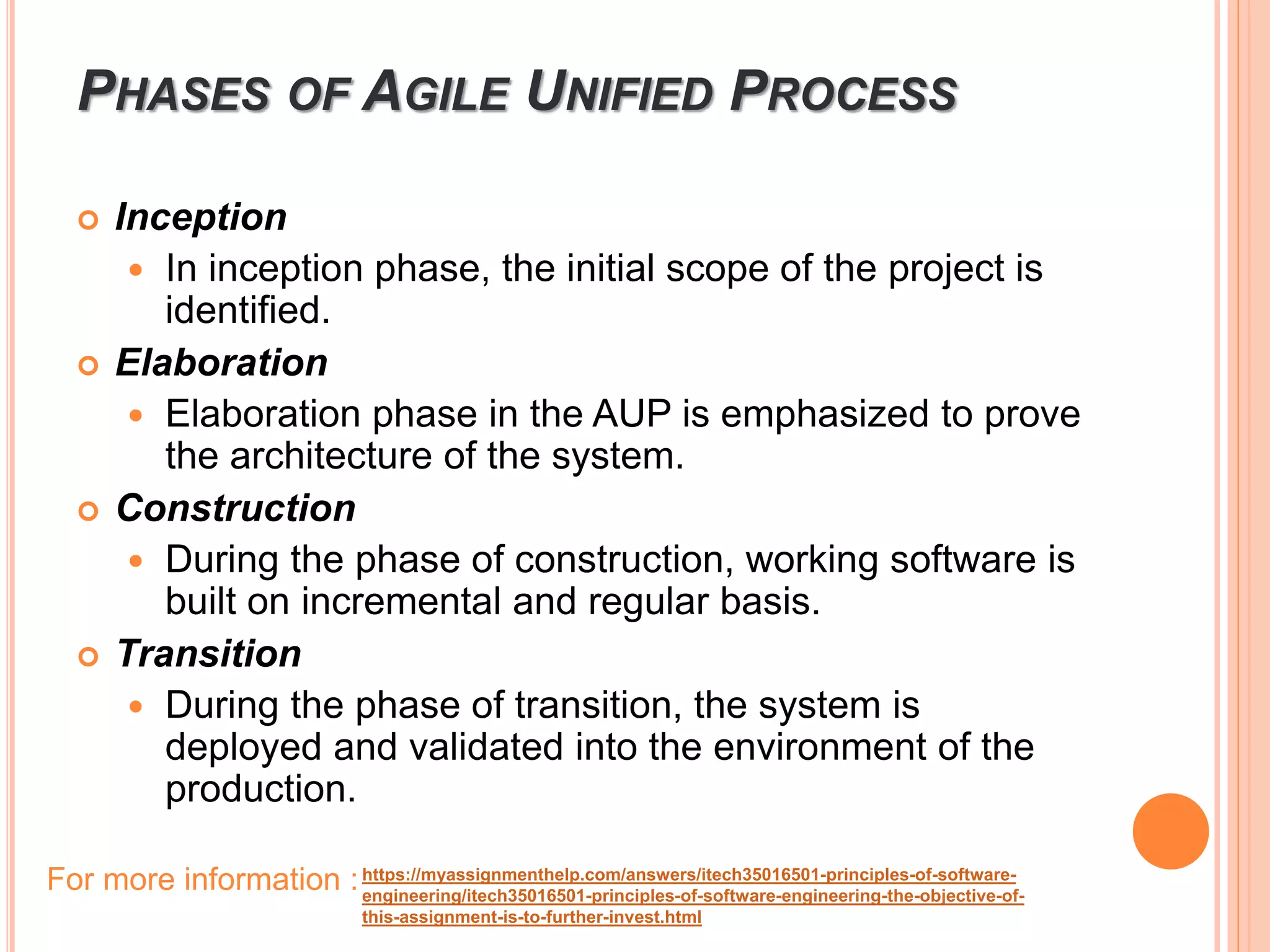
PHASES OF AGILE UNIFIED PROCESS
 Inception
 In inception phase, the initial scope of the project is
identified.
 Elaboration
 Elaboration phase in the AUP is emphasized to prove
the architecture of the system.
 Construction
 During the phase of construction, working software is
built on incremental and regular basis.
 Transition
 During the phase of transition, the system is
deployed and validated into the environment of the
production.
For more information :https://myassignmenthelp.com/answers/itech35016501-principles-of-software-
engineering/itech35016501-principles-of-software-engineering-the-objective-of-
this-assignment-is-to-further-invest.html
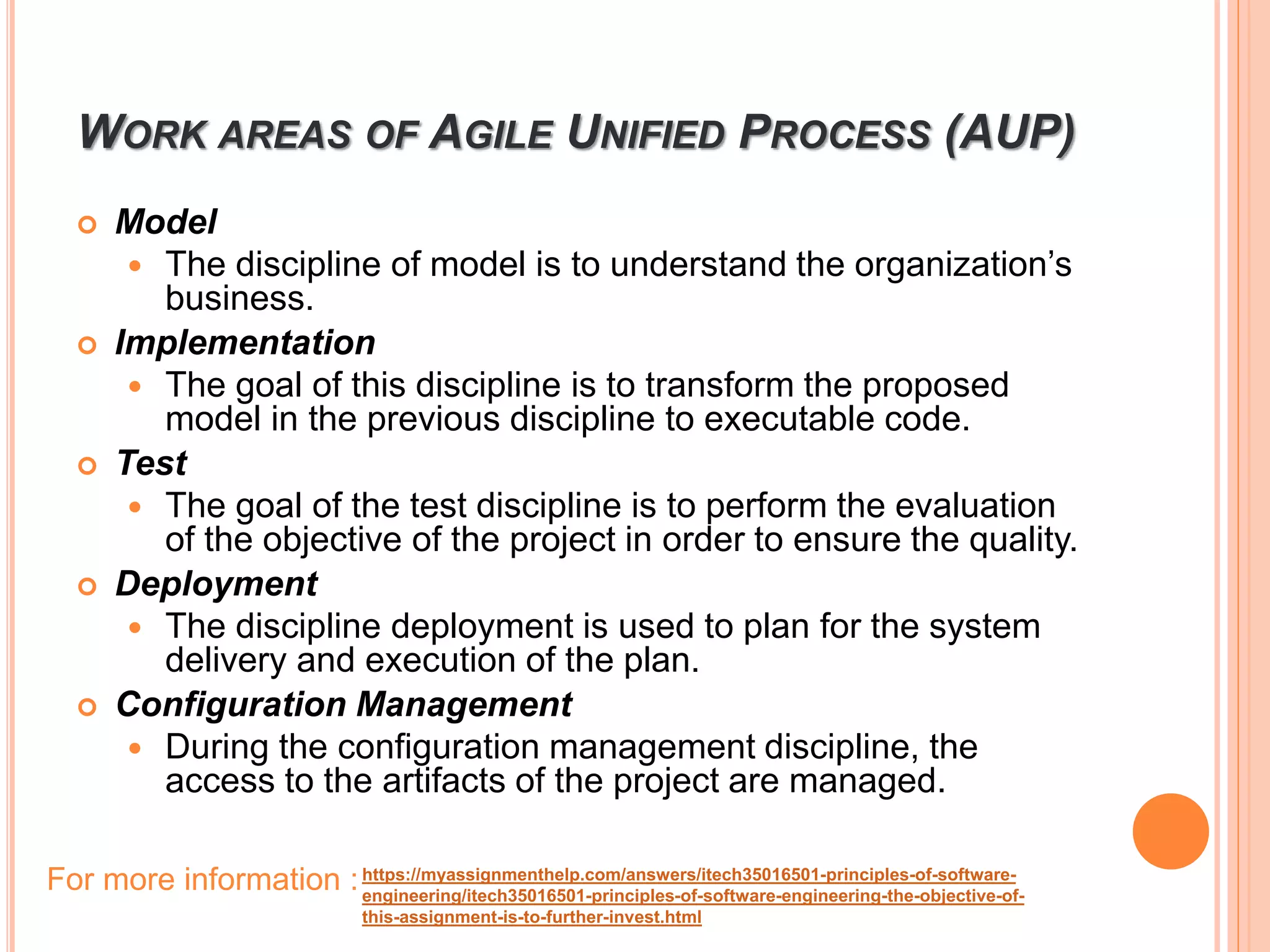
WORK AREAS OF AGILE UNIFIED PROCESS (AUP)
 Model
 The discipline of model is to understand the organization’s
business.
 Implementation
 The goal of this discipline is to transform the proposed
model in the previous discipline to executable code.
 Test
 The goal of the test discipline is to perform the evaluation
of the objective of the project in order to ensure the quality.
 Deployment
 The discipline deployment is used to plan for the system
delivery and execution of the plan.
 Configuration Management
 During the configuration management discipline, the
access to the artifacts of the project are managed.
https://myassignmenthelp.com/answers/itech35016501-principles-of-software-
engineering/itech35016501-principles-of-software-engineering-the-objective-of-
this-assignment-is-to-further-invest.html
For more information :
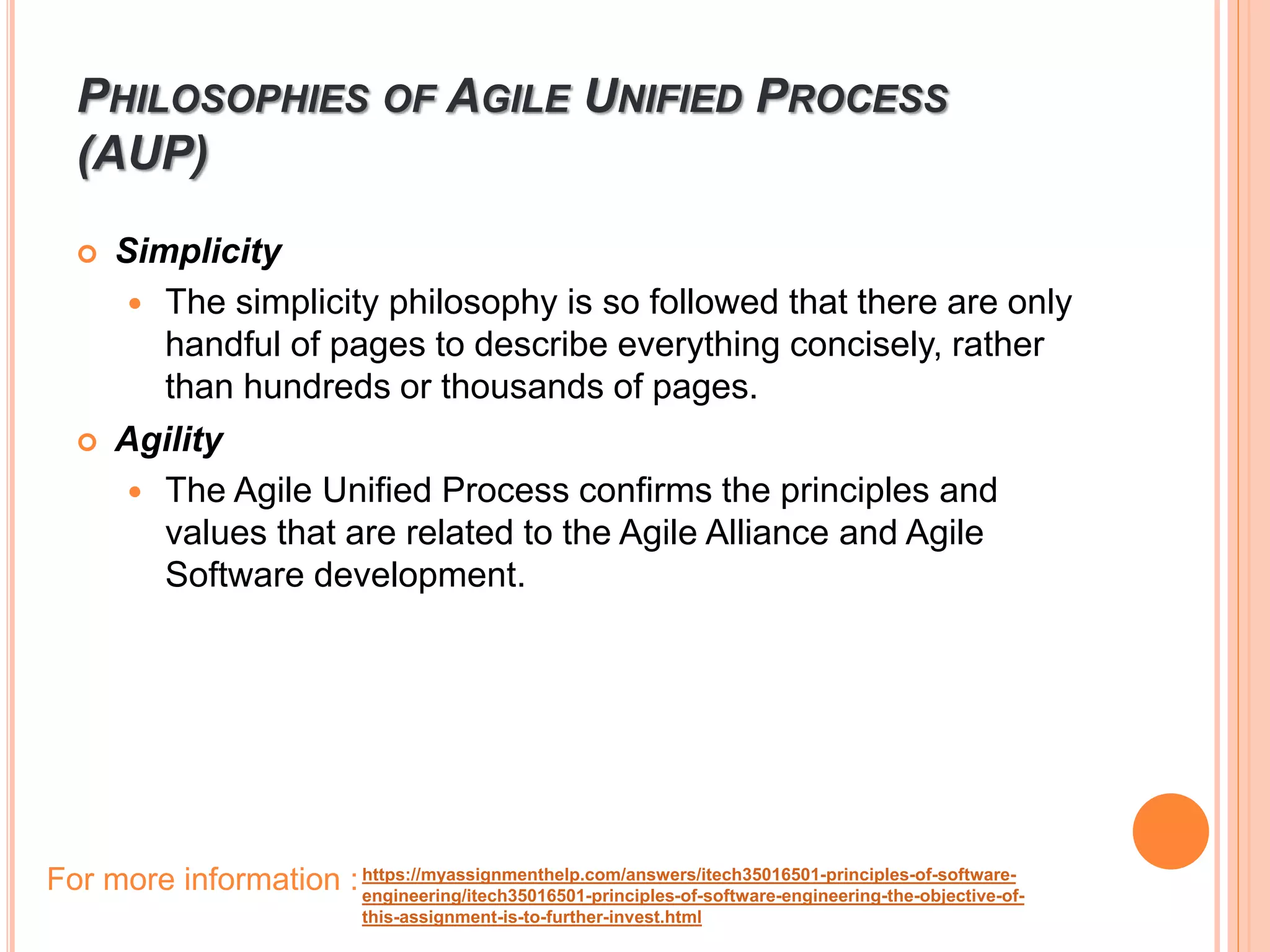
PHILOSOPHIES OF AGILE UNIFIED PROCESS
(AUP)
 Simplicity
 The simplicity philosophy is so followed that there are only
handful of pages to describe everything concisely, rather
than hundreds or thousands of pages.
 Agility
 The Agile Unified Process confirms the principles and
values that are related to the Agile Alliance and Agile
Software development.
https://myassignmenthelp.com/answers/itech35016501-principles-of-software-
engineering/itech35016501-principles-of-software-engineering-the-objective-of-
this-assignment-is-to-further-invest.html
For more information :
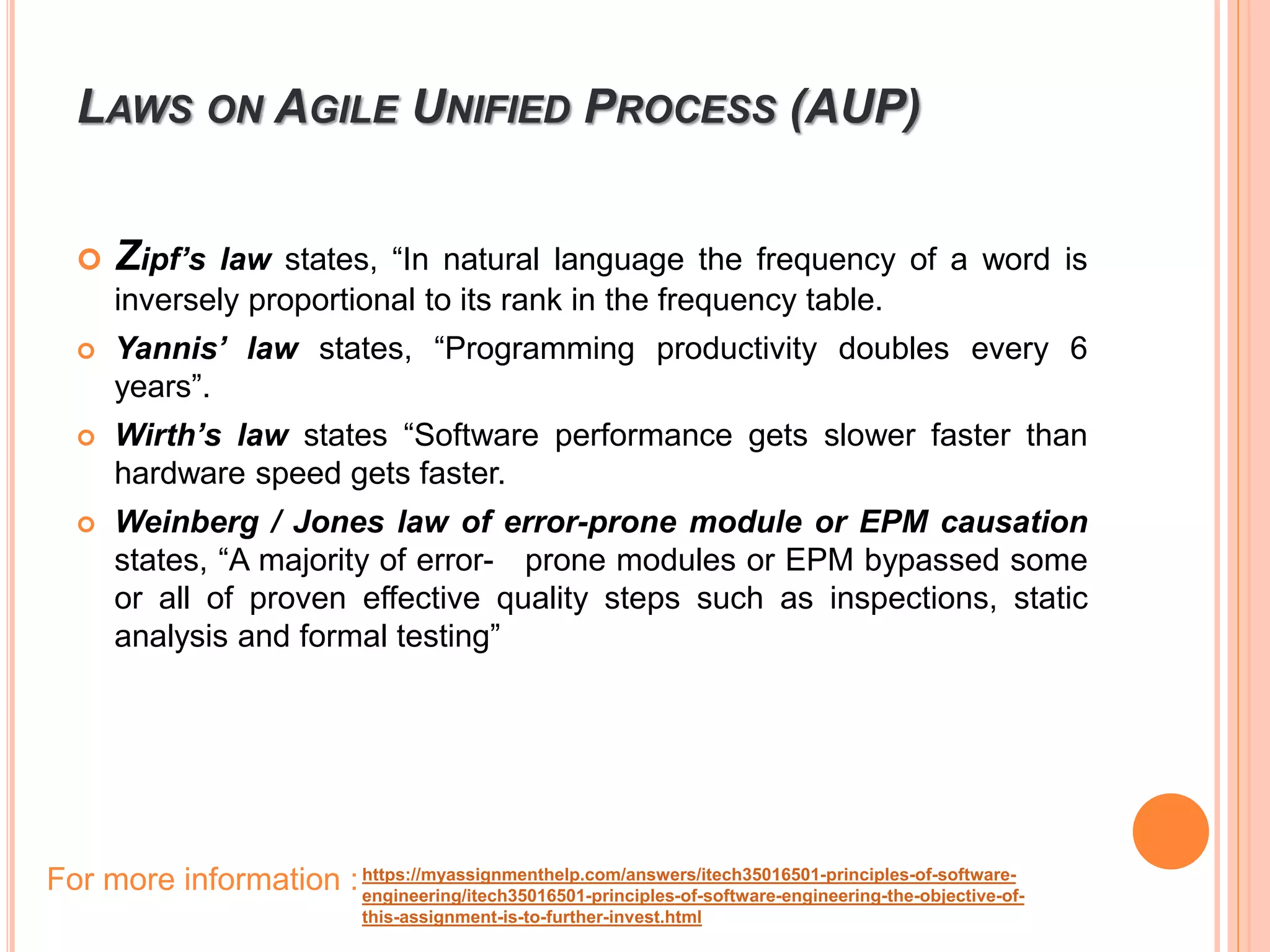
LAWS ON AGILE UNIFIED PROCESS (AUP)
 Zipf’s law states, “In natural language the frequency of a word is
inversely proportional to its rank in the frequency table.
 Yannis’ law states, “Programming productivity doubles every 6
years”.
 Wirth’s law states “Software performance gets slower faster than
hardware speed gets faster.
 Weinberg / Jones law of error-prone module or EPM causation
states, “A majority of error- prone modules or EPM bypassed some
or all of proven effective quality steps such as inspections, static
analysis and formal testing”
https://myassignmenthelp.com/answers/itech35016501-principles-of-software-
engineering/itech35016501-principles-of-software-engineering-the-objective-of-
this-assignment-is-to-further-invest.html
For more information :
HYPOTHESIS AND CONJECTURE OF AGILE
UNIFIED PROCESS (AUP)
 Hypothesis:
 If the objectives of the project are clear, the planning and
outcome of the project will be clearer.
 If the software project is complex, the number of
programming languages needed for the project will also be
more.
 If the defect removal efficiency is more, the project will be
faster to implement.
https://myassignmenthelp.com/answers/itech35016501-principles-of-software-
engineering/itech35016501-principles-of-software-engineering-the-objective-of-
this-assignment-is-to-further-invest.html
For more information :
HYPOTHESIS AND CONJECTURE OF AGILE UNIFIED
PROCESS (AUP) CONTD..
 Conjecture:
 Every software has a challenge of compatibility with the
diverse operating system and hardware.
 Hardware technology grows faster than the software
technology.
 Errors can be well corrected and will be less error-prone in
future, when discovered and covered earlier.
https://myassignmenthelp.com/answers/itech35016501-principles-of-software-
engineering/itech35016501-principles-of-software-engineering-the-objective-of-
this-assignment-is-to-further-invest.html
For more information :
THANK
YOU

Principles of Software Engineering @MyAssignmenthelp.com

  • 1.
  • 2.
    PHASES OF AGILEUNIFIED PROCESS  Inception  In inception phase, the initial scope of the project is identified.  Elaboration  Elaboration phase in the AUP is emphasized to prove the architecture of the system.  Construction  During the phase of construction, working software is built on incremental and regular basis.  Transition  During the phase of transition, the system is deployed and validated into the environment of the production. For more information :https://myassignmenthelp.com/answers/itech35016501-principles-of-software- engineering/itech35016501-principles-of-software-engineering-the-objective-of- this-assignment-is-to-further-invest.html
  • 3.
    WORK AREAS OFAGILE UNIFIED PROCESS (AUP)  Model  The discipline of model is to understand the organization’s business.  Implementation  The goal of this discipline is to transform the proposed model in the previous discipline to executable code.  Test  The goal of the test discipline is to perform the evaluation of the objective of the project in order to ensure the quality.  Deployment  The discipline deployment is used to plan for the system delivery and execution of the plan.  Configuration Management  During the configuration management discipline, the access to the artifacts of the project are managed. https://myassignmenthelp.com/answers/itech35016501-principles-of-software- engineering/itech35016501-principles-of-software-engineering-the-objective-of- this-assignment-is-to-further-invest.html For more information :
  • 4.
    PHILOSOPHIES OF AGILEUNIFIED PROCESS (AUP)  Simplicity  The simplicity philosophy is so followed that there are only handful of pages to describe everything concisely, rather than hundreds or thousands of pages.  Agility  The Agile Unified Process confirms the principles and values that are related to the Agile Alliance and Agile Software development. https://myassignmenthelp.com/answers/itech35016501-principles-of-software- engineering/itech35016501-principles-of-software-engineering-the-objective-of- this-assignment-is-to-further-invest.html For more information :
  • 5.
    LAWS ON AGILEUNIFIED PROCESS (AUP)  Zipf’s law states, “In natural language the frequency of a word is inversely proportional to its rank in the frequency table.  Yannis’ law states, “Programming productivity doubles every 6 years”.  Wirth’s law states “Software performance gets slower faster than hardware speed gets faster.  Weinberg / Jones law of error-prone module or EPM causation states, “A majority of error- prone modules or EPM bypassed some or all of proven effective quality steps such as inspections, static analysis and formal testing” https://myassignmenthelp.com/answers/itech35016501-principles-of-software- engineering/itech35016501-principles-of-software-engineering-the-objective-of- this-assignment-is-to-further-invest.html For more information :
  • 6.
    HYPOTHESIS AND CONJECTUREOF AGILE UNIFIED PROCESS (AUP)  Hypothesis:  If the objectives of the project are clear, the planning and outcome of the project will be clearer.  If the software project is complex, the number of programming languages needed for the project will also be more.  If the defect removal efficiency is more, the project will be faster to implement. https://myassignmenthelp.com/answers/itech35016501-principles-of-software- engineering/itech35016501-principles-of-software-engineering-the-objective-of- this-assignment-is-to-further-invest.html For more information :
  • 7.
    HYPOTHESIS AND CONJECTUREOF AGILE UNIFIED PROCESS (AUP) CONTD..  Conjecture:  Every software has a challenge of compatibility with the diverse operating system and hardware.  Hardware technology grows faster than the software technology.  Errors can be well corrected and will be less error-prone in future, when discovered and covered earlier. https://myassignmenthelp.com/answers/itech35016501-principles-of-software- engineering/itech35016501-principles-of-software-engineering-the-objective-of- this-assignment-is-to-further-invest.html For more information :
  • 8.