JUSTICE BASHEER AHMED SAYEED COLLEGE FOR WOMEN
(Autonomous) Afternoon Session Chennai 18.
S.I.E.T.
SOFTWARE ENGINEERING
CORE ELECTIVE-II
III BSC A -COMPUTER SCIENCE
UNIT- 1
• What is a software?
• Software encompasses: (1) instructions (computer programs) that
when executed provide desired features, function, and performance;
(2) data structures that enable the programs to adequately store and
manipulate information and (3) documentation that describes the
operation and use of the programs.
• “Software is nothing but a collection of computer programs,
procedures, rules and associated documentation and data”.
20 JULY 2020 Presenter Name: SHAKIRA FATHIMA H 2
The IEEE definition:
Software Engineering: (1) The application of a systematic, disciplined, quantifiable approach to the
development, operation, and maintenance of software; that is, the application of engineering to
software. (2) The study of approaches as in (1).
[Software engineering is] the establishment and use of sound engineering principles in
order to obtain economically software that is reliable and works efficiently on real
machines.
According to Fritz Bauer:
[Software engineering is] he establishment and use of sound engineering principles in order
to obtain economically software that is reliable and works efficiently on real machines.
Software Engineering Definition
THE PROCESS
• Software process is a framework for the tasks that are required to
build high-quality software.
• “A software process defines the approach that is taken as software is
engineered. But software engineering also encompasses
technologies that populate the process- technical methods and
automated tools.
2O JULY 2020 Presenter Name: SHAKIRA FATHIMA H 4
Software Process
• A process is a collection of activities, actions and tasks that are
performed when some work product is to be created. It is not a rigid
prescription for how to build computer software. Rather, it is an
adaptable approach that enables the people doing the work to pick
and choose the appropriate set of work actions and tasks.
• Purpose of process is to deliver software in a timely manner and with
sufficient quality to satisfy those who have sponsored its creation and
those who will use it.
5
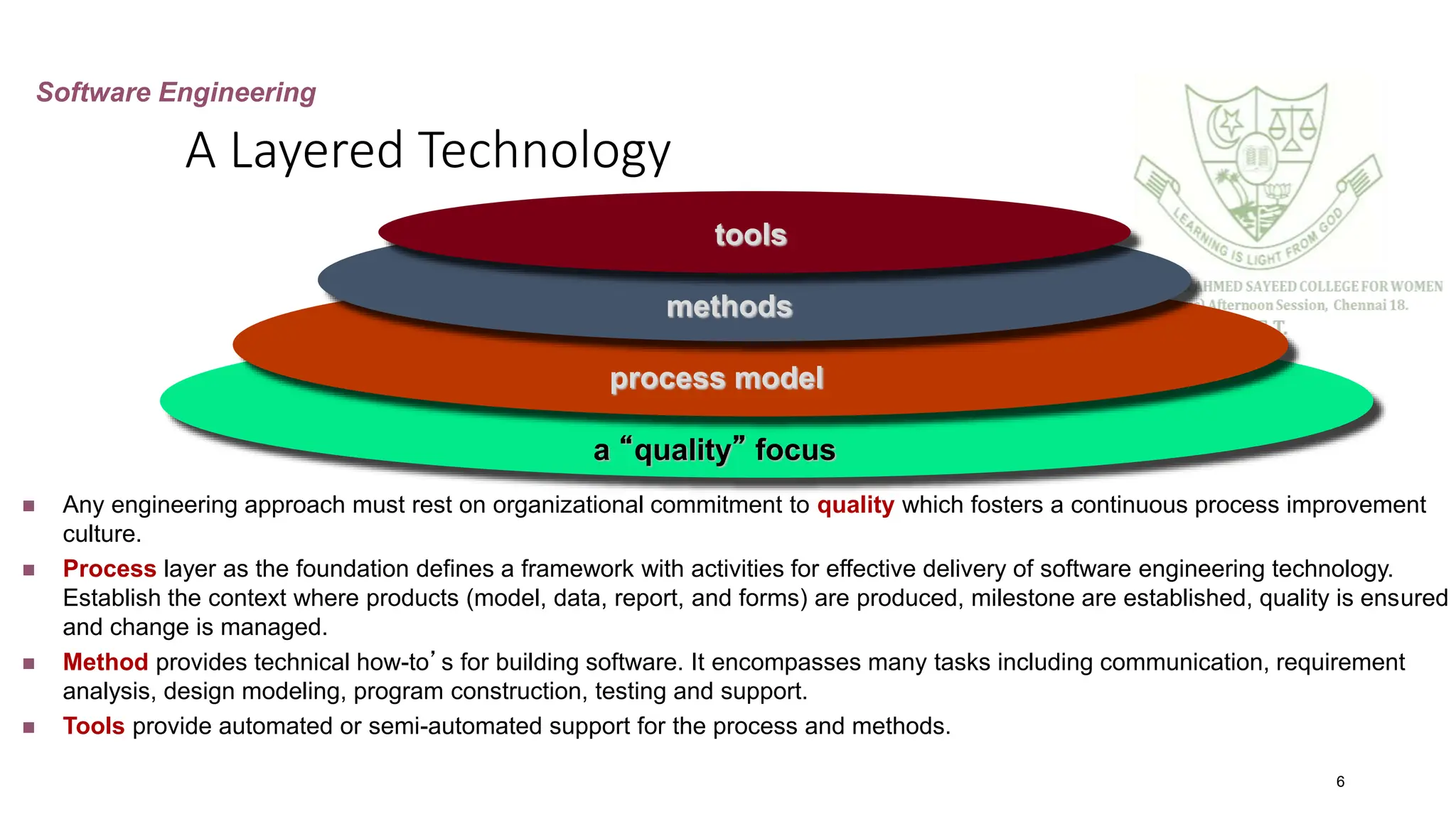
A Layered Technology
6
Software Engineering
a “quality” focus
process model
methods
tools
 Any engineering approach must rest on organizational commitment to quality which fosters a continuous process improvement
culture.
 Process layer as the foundation defines a framework with activities for effective delivery of software engineering technology.
Establish the context where products (model, data, report, and forms) are produced, milestone are established, quality is ensured
and change is managed.
 Method provides technical how-to’s for building software. It encompasses many tasks including communication, requirement
analysis, design modeling, program construction, testing and support.
 Tools provide automated or semi-automated support for the process and methods.
A GENERIC VIEW OF SOFTWARE ENGINEERING-Umbrella
Activities
Complement the five process framework activities and help team manage and control progress, quality, change,
and risk.
• Software project tracking and control: assess progress against the plan and take actions to maintain the
schedule.
• Risk management: assesses risks that may affect the outcome and quality.
• Software quality assurance: defines and conduct activities to ensure quality.
• Technical reviews: assesses work products to uncover and remove errors before going to the next activity.
• Measurement: define and collects process, project, and product measures to ensure stakeholder’s needs are
met.
• Software configuration management: manage the effects of change throughout the software process.
• Reusability management: defines criteria for work product reuse and establishes mechanism to achieve
reusable components.
• Work product preparation and production: create work products such as models, documents, logs, forms and
lists.
7
WATERFALL MODEL
• Winston Royce introduced the Waterfall Model in 1970.
• This model has five phases: Requirements analysis and specification,
design, implementation, and unit testing, integration and system testing,
and operation and maintenance.
• This model is named "Waterfall Model", because its diagrammatic
representation resembles a cascade of waterfalls.
• 1. Requirements analysis and specification phase: The aim of this phase is
to understand the exact requirements of the customer and to document
them properly.
• Both the customer and the software developer work together so as to
document all the functions, performance, and interfacing requirement of
the software.
24 JULY 2020 Presenter Name:SHAKIRA FATHIMA 8
WATERFALL MODEL-CONT
• It describes the "what" of the system to be produced and not "how."In this
phase, a large document called Software Requirement Specification
(SRS) document is created which contained a detailed description of what
the system will do.
• 2. Design Phase: This phase aims to transform the requirements gathered
in the SRS into a suitable form which permits further coding in a
programming language. It defines the overall software architecture
together with high level and detailed design. All this work is documented
as a Software Design Document (SDD).
•
3. Implementation and unit testing: During this phase, design is
implemented. If the SDD is complete, the implementation or coding phase
proceeds smoothly, because all the information needed by software
developers is contained in the SDD.
20 June 2024 Presenter Name: 9
WATERFALL MODEL
• 4. Integration and System Testing: This phase is highly crucial as the
quality of the end product is determined by the effectiveness of the
testing carried out. The better output will lead to satisfied customers,
lower maintenance costs, and accurate results. Unit testing
determines the efficiency of individual modules.
• 5. Operation and maintenance phase: Maintenance is the task
performed by every user once the software has been delivered to the
customer, installed, and operational.
20 June 2024 Presenter Name: 10
When to use SDLC Waterfall Model?
• Some Circumstances where the use of the Waterfall model is most
suited are:
• When the requirements are constant and not changed regularly.
• A project is short
• The situation is calm
• Where the tools and technology used is consistent and is not
changing
• When resources are well prepared and are available to use.
20 June 2024 Presenter Name: 11
Advantages of Waterfall model
• This model is simple to implement also the number of resources that
are required for it is minimal.
• The requirements are simple and explicitly declared; they remain
unchanged during the entire project development.
• The start and end points for each phase is fixed, which makes it easy
to cover progress.
• The release date for the complete product, as well as its final cost,
can be determined before development.
• It gives easy to control and clarity for the customer due to a strict
reporting system
20 June 2024 Presenter Name: 12
Disadvantages of Waterfall model
• In this model, the risk factor is higher, so this model is not suitable for
more significant and complex projects.
• This model cannot accept the changes in requirements during
development.
• It becomes tough to go back to the phase. For example, if the
application has now shifted to the coding phase, and there is a
change in requirement, It becomes tough to go back and change it.
• Since the testing done at a later stage, it does not allow identifying
the challenges and risks in the earlier phase, so the risk reduction
strategy is difficult to prepare.
20 June 2024 Presenter Name: 13
RAD (Rapid Application Development) Model
• RAD is an incremental software development process model.
• It is a high speed adaptation of linear sequential model, rapid development is achieved
using component-based construction.
• If the requirements are well understood and described, and the project scope is a
constraint, the RAD process enables a development team to create a fully functional
system within a concise time period.
• RAD (Rapid Application Development) is a concept that products can be developed faster
and of higher quality through:
• Gathering requirements using workshops or focus groups
• Prototyping and early, reiterative user testing of designs
• The re-use of software components
• A rigidly paced schedule that refers design improvements to the next product version
• Less formality in reviews and other team communication
20 June 2024 Presenter Name: 14
The various phases of RAD are as follows:
• Business Modelling: The information flow among business functions is
defined by answering questions like what data drives the business process,
what data is generated, who generates it, where does the information go,
who process it and so on.
• Data Modelling: The data collected from business modeling is refined into
a set of data objects (entities) that are needed to support the business. The
attributes (character of each entity) are identified, and the relation
between these data objects (entities) is defined.
• Process Modelling: The information object defined in the data modeling
phase are transformed to achieve the data flow necessary to implement a
business function. Processing descriptions are created for adding,
modifying, deleting, or retrieving a data object.
20 June 2024 Presenter Name: 15
20 June 2024 Presenter Name: 16
Application Generation: Automated tools are used to facilitate
construction of the software; even they use the 4th GL techniques.
5. Testing & Turnover: Many of the programming components have
already been tested since RAD emphasis reuse. This reduces the overall
testing time. But the new part must be tested, and all interfaces must
be fully exercised.
When to use RAD Model?
When the system should need to create the project that modularizes in
a short span time (2-3 months).
When the requirements are well-known.
When the technical risk is limited.
When there's a necessity to make a system, which modularized in 2-3
months of period.
It should be used only if the budget allows the use of automatic code
generating tools.
Advantage of RAD Model
• This model is flexible for change.
• In this model, changes are adoptable.
• Each phase in RAD brings highest priority functionality to the
customer.
• It reduced development time.
• It increases the reusability of features.
20 June 2024 Presenter Name: 17
Disadvantage of RAD Model
• It required highly skilled designers.
• All application is not compatible with RAD.
• For smaller projects, we cannot use the RAD model.
• On the high technical risk, it's not suitable.
• Required user involvement.
20 June 2024 Presenter Name: 18
EVOLUTIONARY SOFTWARE PROCESS
MODELS
• Evolutionary models are iterative in nature.
• The Evolutionary development model divides the development cycle into
smaller, incremental waterfall models in which users are able to get access
to the product at the end of each cycle.
• They are characterized in a manner that enables software engineers to
develop increasingly more complex versions of the software.
THE INCREMENTAL MODEL
Incremental Model is a process of software development where
requirements divided into multiple standalone modules of the software
development cycle. In this model, each module goes through the
requirements, design, implementation and testing phases. Every
subsequent release of the module adds function to the previous release.
The process continues until the complete system achieved.
20 June 2024 Presenter Name: 19
The various phases of incremental model are
as follows:
• Requirement analysis: In the first phase of the incremental model,
the product analysis expertise identifies the requirements. And the
system functional requirements are understood by the requirement
analysis team. To develop the software under the incremental model,
this phase performs a crucial role.
• Design & Development: In this phase of the Incremental model of
SDLC, the design of the system functionality and the development
method are finished with success. When software develops new
practicality, the incremental model uses style and development
phase.
20 June 2024 Presenter Name: 20
Cont
• Testing: In the incremental model, the testing phase checks the
performance of each existing function as well as additional
functionality. In the testing phase, the various methods are used to
test the behavior of each task.
• 4. Implementation: Implementation phase enables the coding phase
of the development system. It involves the final coding that design in
the designing and development phase and tests the functionality in
the testing phase. After completion of this phase, the number of the
product working is enhanced and upgraded up to the final system
product
20 June 2024 Presenter Name: 21
When we use the Incremental Model?
• When the requirements are superior.
• A project has a lengthy development schedule.
• When Software team are not very well skilled or trained.
• When the customer demands a quick release of the product.
• You can develop prioritized requirements first.
20 June 2024 Presenter Name: 22
Advantage of Incremental Model
• Errors are easy to be recognized.
• Easier to test and debug
• More flexible.
• Simple to manage risk because it handled during its iteration.
• The Client gets important functionality early.
Disadvantage of Incremental Model
• Need for good planning
• Total Cost is high.
• Well defined module interfaces are needed.
20 June 2024 Presenter Name: 23
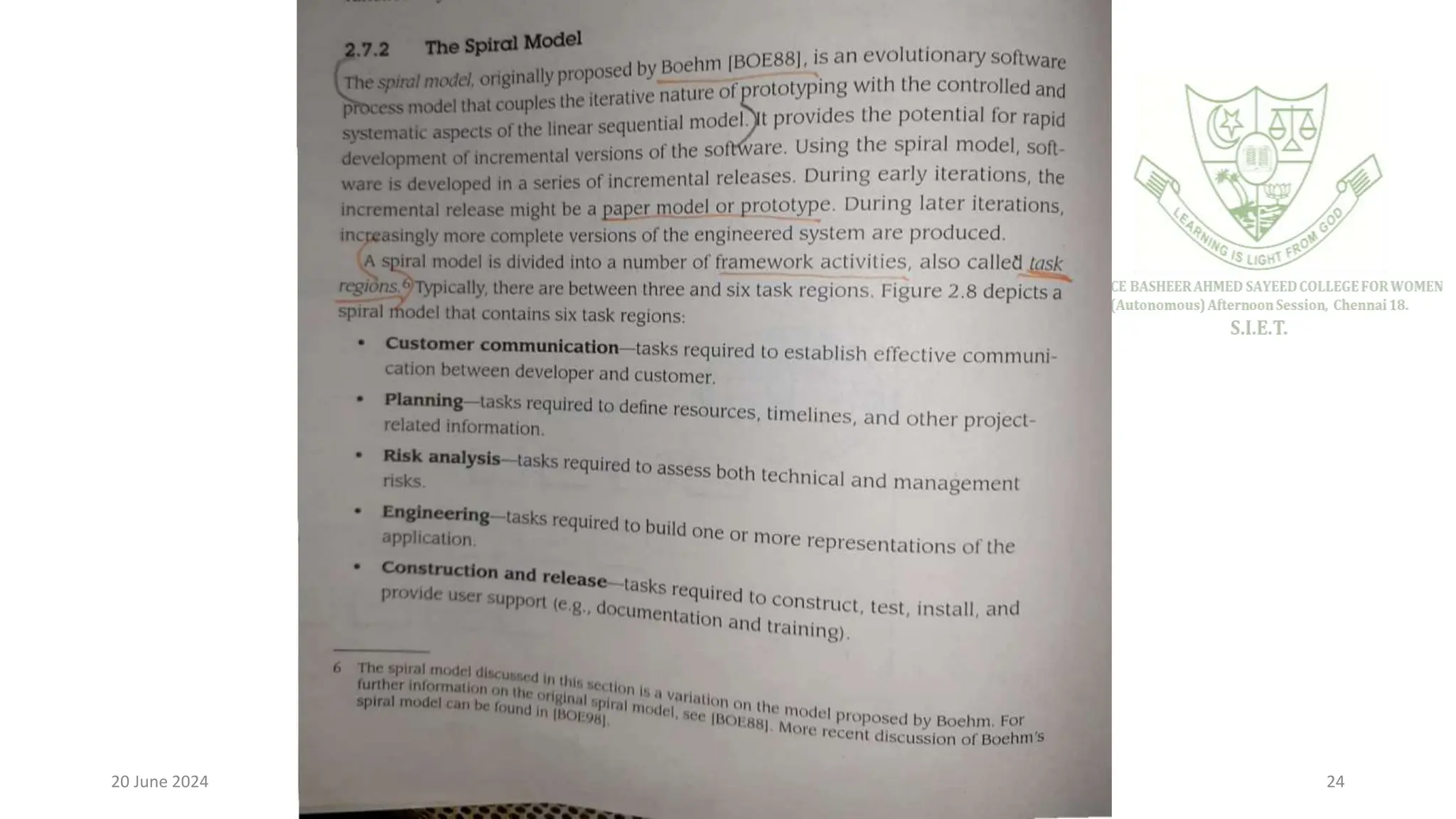
20 June 2024 Presenter Name: 24
20 June 2024 Presenter Name: 25
When to use Spiral Model?
• When deliverance is required to be frequent.
• When the project is large
• When requirements are unclear and complex
• When changes may require at any time
• Large and high budget projects
20 June 2024 Presenter Name: 26
ADV/DIS ADV
• Advantages
• High amount of risk analysis
• Useful for large and mission-critical projects.
• Disadvantages
• Can be a costly model to use.
• Risk analysis needed highly particular expertise
• Doesn't work well for smaller projects.
20 June 2024 Presenter Name: 27
CONCURRENT DEVELOPMENT MODEL
• Concurrent models are those models within which the various
activities of software development happen at the same time, for
faster development and a better outcome. The concurrent model is
also referred to as a parallel working model.
• Also called concurrent engineering.
20 June 2024 Presenter Name: 28

SOFTWARE ENGINEERING FOR BEGINNERS UNIT 1.pptx

  • 1.
    JUSTICE BASHEER AHMEDSAYEED COLLEGE FOR WOMEN (Autonomous) Afternoon Session Chennai 18. S.I.E.T. SOFTWARE ENGINEERING CORE ELECTIVE-II III BSC A -COMPUTER SCIENCE
  • 2.
    UNIT- 1 • Whatis a software? • Software encompasses: (1) instructions (computer programs) that when executed provide desired features, function, and performance; (2) data structures that enable the programs to adequately store and manipulate information and (3) documentation that describes the operation and use of the programs. • “Software is nothing but a collection of computer programs, procedures, rules and associated documentation and data”. 20 JULY 2020 Presenter Name: SHAKIRA FATHIMA H 2
  • 3.
    The IEEE definition: SoftwareEngineering: (1) The application of a systematic, disciplined, quantifiable approach to the development, operation, and maintenance of software; that is, the application of engineering to software. (2) The study of approaches as in (1). [Software engineering is] the establishment and use of sound engineering principles in order to obtain economically software that is reliable and works efficiently on real machines. According to Fritz Bauer: [Software engineering is] he establishment and use of sound engineering principles in order to obtain economically software that is reliable and works efficiently on real machines. Software Engineering Definition
  • 4.
    THE PROCESS • Softwareprocess is a framework for the tasks that are required to build high-quality software. • “A software process defines the approach that is taken as software is engineered. But software engineering also encompasses technologies that populate the process- technical methods and automated tools. 2O JULY 2020 Presenter Name: SHAKIRA FATHIMA H 4
  • 5.
    Software Process • Aprocess is a collection of activities, actions and tasks that are performed when some work product is to be created. It is not a rigid prescription for how to build computer software. Rather, it is an adaptable approach that enables the people doing the work to pick and choose the appropriate set of work actions and tasks. • Purpose of process is to deliver software in a timely manner and with sufficient quality to satisfy those who have sponsored its creation and those who will use it. 5
  • 6.
    A Layered Technology 6 SoftwareEngineering a “quality” focus process model methods tools  Any engineering approach must rest on organizational commitment to quality which fosters a continuous process improvement culture.  Process layer as the foundation defines a framework with activities for effective delivery of software engineering technology. Establish the context where products (model, data, report, and forms) are produced, milestone are established, quality is ensured and change is managed.  Method provides technical how-to’s for building software. It encompasses many tasks including communication, requirement analysis, design modeling, program construction, testing and support.  Tools provide automated or semi-automated support for the process and methods.
  • 7.
    A GENERIC VIEWOF SOFTWARE ENGINEERING-Umbrella Activities Complement the five process framework activities and help team manage and control progress, quality, change, and risk. • Software project tracking and control: assess progress against the plan and take actions to maintain the schedule. • Risk management: assesses risks that may affect the outcome and quality. • Software quality assurance: defines and conduct activities to ensure quality. • Technical reviews: assesses work products to uncover and remove errors before going to the next activity. • Measurement: define and collects process, project, and product measures to ensure stakeholder’s needs are met. • Software configuration management: manage the effects of change throughout the software process. • Reusability management: defines criteria for work product reuse and establishes mechanism to achieve reusable components. • Work product preparation and production: create work products such as models, documents, logs, forms and lists. 7
  • 8.
    WATERFALL MODEL • WinstonRoyce introduced the Waterfall Model in 1970. • This model has five phases: Requirements analysis and specification, design, implementation, and unit testing, integration and system testing, and operation and maintenance. • This model is named "Waterfall Model", because its diagrammatic representation resembles a cascade of waterfalls. • 1. Requirements analysis and specification phase: The aim of this phase is to understand the exact requirements of the customer and to document them properly. • Both the customer and the software developer work together so as to document all the functions, performance, and interfacing requirement of the software. 24 JULY 2020 Presenter Name:SHAKIRA FATHIMA 8
  • 9.
    WATERFALL MODEL-CONT • Itdescribes the "what" of the system to be produced and not "how."In this phase, a large document called Software Requirement Specification (SRS) document is created which contained a detailed description of what the system will do. • 2. Design Phase: This phase aims to transform the requirements gathered in the SRS into a suitable form which permits further coding in a programming language. It defines the overall software architecture together with high level and detailed design. All this work is documented as a Software Design Document (SDD). • 3. Implementation and unit testing: During this phase, design is implemented. If the SDD is complete, the implementation or coding phase proceeds smoothly, because all the information needed by software developers is contained in the SDD. 20 June 2024 Presenter Name: 9
  • 10.
    WATERFALL MODEL • 4.Integration and System Testing: This phase is highly crucial as the quality of the end product is determined by the effectiveness of the testing carried out. The better output will lead to satisfied customers, lower maintenance costs, and accurate results. Unit testing determines the efficiency of individual modules. • 5. Operation and maintenance phase: Maintenance is the task performed by every user once the software has been delivered to the customer, installed, and operational. 20 June 2024 Presenter Name: 10
  • 11.
    When to useSDLC Waterfall Model? • Some Circumstances where the use of the Waterfall model is most suited are: • When the requirements are constant and not changed regularly. • A project is short • The situation is calm • Where the tools and technology used is consistent and is not changing • When resources are well prepared and are available to use. 20 June 2024 Presenter Name: 11
  • 12.
    Advantages of Waterfallmodel • This model is simple to implement also the number of resources that are required for it is minimal. • The requirements are simple and explicitly declared; they remain unchanged during the entire project development. • The start and end points for each phase is fixed, which makes it easy to cover progress. • The release date for the complete product, as well as its final cost, can be determined before development. • It gives easy to control and clarity for the customer due to a strict reporting system 20 June 2024 Presenter Name: 12
  • 13.
    Disadvantages of Waterfallmodel • In this model, the risk factor is higher, so this model is not suitable for more significant and complex projects. • This model cannot accept the changes in requirements during development. • It becomes tough to go back to the phase. For example, if the application has now shifted to the coding phase, and there is a change in requirement, It becomes tough to go back and change it. • Since the testing done at a later stage, it does not allow identifying the challenges and risks in the earlier phase, so the risk reduction strategy is difficult to prepare. 20 June 2024 Presenter Name: 13
  • 14.
    RAD (Rapid ApplicationDevelopment) Model • RAD is an incremental software development process model. • It is a high speed adaptation of linear sequential model, rapid development is achieved using component-based construction. • If the requirements are well understood and described, and the project scope is a constraint, the RAD process enables a development team to create a fully functional system within a concise time period. • RAD (Rapid Application Development) is a concept that products can be developed faster and of higher quality through: • Gathering requirements using workshops or focus groups • Prototyping and early, reiterative user testing of designs • The re-use of software components • A rigidly paced schedule that refers design improvements to the next product version • Less formality in reviews and other team communication 20 June 2024 Presenter Name: 14
  • 15.
    The various phasesof RAD are as follows: • Business Modelling: The information flow among business functions is defined by answering questions like what data drives the business process, what data is generated, who generates it, where does the information go, who process it and so on. • Data Modelling: The data collected from business modeling is refined into a set of data objects (entities) that are needed to support the business. The attributes (character of each entity) are identified, and the relation between these data objects (entities) is defined. • Process Modelling: The information object defined in the data modeling phase are transformed to achieve the data flow necessary to implement a business function. Processing descriptions are created for adding, modifying, deleting, or retrieving a data object. 20 June 2024 Presenter Name: 15
  • 16.
    20 June 2024Presenter Name: 16 Application Generation: Automated tools are used to facilitate construction of the software; even they use the 4th GL techniques. 5. Testing & Turnover: Many of the programming components have already been tested since RAD emphasis reuse. This reduces the overall testing time. But the new part must be tested, and all interfaces must be fully exercised. When to use RAD Model? When the system should need to create the project that modularizes in a short span time (2-3 months). When the requirements are well-known. When the technical risk is limited. When there's a necessity to make a system, which modularized in 2-3 months of period. It should be used only if the budget allows the use of automatic code generating tools.
  • 17.
    Advantage of RADModel • This model is flexible for change. • In this model, changes are adoptable. • Each phase in RAD brings highest priority functionality to the customer. • It reduced development time. • It increases the reusability of features. 20 June 2024 Presenter Name: 17
  • 18.
    Disadvantage of RADModel • It required highly skilled designers. • All application is not compatible with RAD. • For smaller projects, we cannot use the RAD model. • On the high technical risk, it's not suitable. • Required user involvement. 20 June 2024 Presenter Name: 18
  • 19.
    EVOLUTIONARY SOFTWARE PROCESS MODELS •Evolutionary models are iterative in nature. • The Evolutionary development model divides the development cycle into smaller, incremental waterfall models in which users are able to get access to the product at the end of each cycle. • They are characterized in a manner that enables software engineers to develop increasingly more complex versions of the software. THE INCREMENTAL MODEL Incremental Model is a process of software development where requirements divided into multiple standalone modules of the software development cycle. In this model, each module goes through the requirements, design, implementation and testing phases. Every subsequent release of the module adds function to the previous release. The process continues until the complete system achieved. 20 June 2024 Presenter Name: 19
  • 20.
    The various phasesof incremental model are as follows: • Requirement analysis: In the first phase of the incremental model, the product analysis expertise identifies the requirements. And the system functional requirements are understood by the requirement analysis team. To develop the software under the incremental model, this phase performs a crucial role. • Design & Development: In this phase of the Incremental model of SDLC, the design of the system functionality and the development method are finished with success. When software develops new practicality, the incremental model uses style and development phase. 20 June 2024 Presenter Name: 20
  • 21.
    Cont • Testing: Inthe incremental model, the testing phase checks the performance of each existing function as well as additional functionality. In the testing phase, the various methods are used to test the behavior of each task. • 4. Implementation: Implementation phase enables the coding phase of the development system. It involves the final coding that design in the designing and development phase and tests the functionality in the testing phase. After completion of this phase, the number of the product working is enhanced and upgraded up to the final system product 20 June 2024 Presenter Name: 21
  • 22.
    When we usethe Incremental Model? • When the requirements are superior. • A project has a lengthy development schedule. • When Software team are not very well skilled or trained. • When the customer demands a quick release of the product. • You can develop prioritized requirements first. 20 June 2024 Presenter Name: 22
  • 23.
    Advantage of IncrementalModel • Errors are easy to be recognized. • Easier to test and debug • More flexible. • Simple to manage risk because it handled during its iteration. • The Client gets important functionality early. Disadvantage of Incremental Model • Need for good planning • Total Cost is high. • Well defined module interfaces are needed. 20 June 2024 Presenter Name: 23
  • 24.
    20 June 2024Presenter Name: 24
  • 25.
    20 June 2024Presenter Name: 25
  • 26.
    When to useSpiral Model? • When deliverance is required to be frequent. • When the project is large • When requirements are unclear and complex • When changes may require at any time • Large and high budget projects 20 June 2024 Presenter Name: 26
  • 27.
    ADV/DIS ADV • Advantages •High amount of risk analysis • Useful for large and mission-critical projects. • Disadvantages • Can be a costly model to use. • Risk analysis needed highly particular expertise • Doesn't work well for smaller projects. 20 June 2024 Presenter Name: 27
  • 28.
    CONCURRENT DEVELOPMENT MODEL •Concurrent models are those models within which the various activities of software development happen at the same time, for faster development and a better outcome. The concurrent model is also referred to as a parallel working model. • Also called concurrent engineering. 20 June 2024 Presenter Name: 28