UNIT-I
Software Process and Agile Development
Software
Software is a set of instructions , data or
programs used to operate computers and
execute specific tasks.
Types:
• System software - managing hardware
• Application software - user-oriented functions.
• System software includes operating systems,
while application software comprises programs
like word processors and games. Together, they
form the essential components of a computer's
functionality.
Software Engineering
 Engineering: It’s all about developing products, usng well-
defined scientific principles and methods
 Software Engineering: It is defined as analyzing user
requirements, designing a s/w ,Building a s/w,Testing a S/w
application which will satisfy those requirements of the user.
 WHY It’s Required:
• Efficiency: Software engineering ensures the systematic
development of software, optimizing performance and
resource utilization.
Cont..
• Reliability: Through rigorous testing and quality assurance, software
engineering enhances the dependability of software systems, minimizing
errors and faults.
• Scalability: Software engineering principles enable the creation of scalable
solutions, accommodating growth and changes in user requirements.
• Maintainability: Proper software engineering practices facilitate easier
maintenance and updates, ensuring long-term usability and adaptability of
software applications.
Chapter : Topic Covered
• About software process model
• Build and Fix Model
• Why Models are needed?
– Process as a "black box“ & Problem
– Process as a “white box“ & Advantage
• Prescriptive Model
• Waterfall Model or Linear Sequential
• Incremental Process Models
– Incremental Model
– RAD Model
• Evolutionary Process Models
– Prototyping
– Spiral Model
– Concurrent Development Model
– Fourth Generation Techniques (4GT)
– Component based development (CBD)
Software Process
• In software engineering, a software process is a
structured set of activities, methods, and tasks
that guide the creation and maintenance of
software systems, ensuring a systematic and
efficient development lifecycle.
• It encompasses planning, implementation,
testing, and maintenance phases to achieve
reliable and high-quality software products.
Software process model
• A software process model in software engineering is a
framework that defines the stages, activities, and workflows
involved in developing and maintaining software systems.
• It provides a structured approach to guide the software
development lifecycle, offering methodologies such as
Waterfall, Agile, or Spiral to manage and optimize the
process from conception to deployment.
• Process models are not perfect, but provide roadmap for
software engineering work.
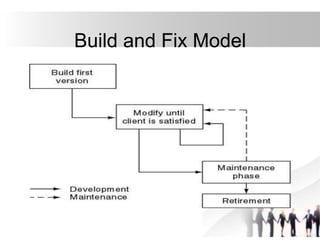
Build and Fix Model
Build and Fix Model
The earlier approach
• Product is constructed without specification or any attempt at
design.
• developers simply build a product that is reworked as many times as
necessary to satisfy the client.
• model may work for small projects but is totally unsatisfactory for
products of any reasonable size.
• Maintenance is high.
• Source of difficulties and deficiencies
– impossible to predict
– impossible to manage
Why Models are needed?
• Symptoms of inadequacy: the software crisis
– scheduled time and cost exceeded
– user expectations not met
– poor quality
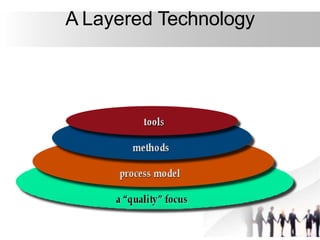
A Layered Technology
Tools
• The first layer involves choosing the semi-automated
and automated tools that will become the framework for
the project. Some examples may include:
• Choosing Microsoft Publisher for web design
• Using Selenium for testing across platforms
• Using an integrated development environment (IDE) for
building apps
Method
• The second layer establishes the methods of developing the
software. This includes any technical knowledge and resources
required for development. Some tasks include choosing
methods for:
• Communication
• Analysis
• Modeling
• Program construction
• Testing and support
Process
• Layer three focuses on the framework that needs to
be established to deliver software effectively. This
layer can be broken down into five sub-layers:
• Communication
• Planning
• Modeling
• Construction.
• Deployment.
A Quality Focus
• Layer 4
Prescriptive Model
• Prescriptive process models advocate an orderly approach to software engineering
– Organize framework activities in a certain order
• Process framework activity with set of software engineering actions.
• Each action in terms of a task set that identifies the work to be accomplished to meet
the goals.
• The resultant process model should be adapted to accommodate the nature of the
specific project, people doing the work, and the work environment.
• Software engineer choose process framework that includes activities like;
– Communication
– Planning
– Modeling
– Construction
– Deployment
Prescriptive Model
• Calling this model as “Prescribe” because
it recommend a set of process elements,
activities, action task, work product &
quality.
• Each elements are inter related to one
another (called workflow).
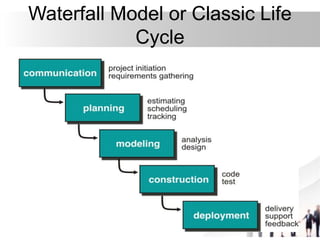
Waterfall Model or Classic Life
Cycle
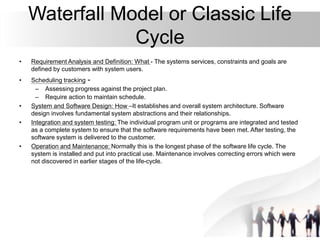
Waterfall Model or Classic Life
Cycle
• Requirement Analysis and Definition: What - The systems services, constraints and goals are
defined by customers with system users.
• Scheduling tracking -
– Assessing progress against the project plan.
– Require action to maintain schedule.
• System and Software Design: How –It establishes and overall system architecture. Software
design involves fundamental system abstractions and their relationships.
• Integration and system testing: The individual program unit or programs are integrated and tested
as a complete system to ensure that the software requirements have been met. After testing, the
software system is delivered to the customer.
• Operation and Maintenance: Normally this is the longest phase of the software life cycle. The
system is installed and put into practical use. Maintenance involves correcting errors which were
not discovered in earlier stages of the life-cycle.
20
Limitations of the waterfall model
 The nature of the requirements will not change very much During
development; during evolution
 The model implies that you should attempt to complete a given stage
before moving on to the next stage
 Does not account for the fact that requirements constantly change.
 It also means that customers can not use anything until the entire
system is complete.
 The model implies that once the product is finished, everything else is
maintenance.
 Surprises at the end are very expensive
 Some teams sit ideal for other teams to finish
 Therefore, this model is only appropriate when the requirements are
well-understood and changes will be fairly limited during the design
process.
Problems:
1. Real projects are rarely follow the sequential model.
2. Difficult for the customer to state all the requirement explicitly.
3. Assumes patience from customer - working version of program will not
available until programs not getting change fully.
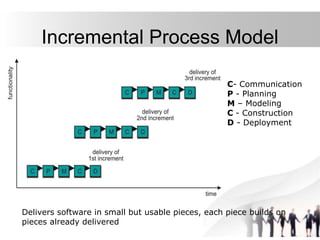
Incremental Process Model
C- Communication
P - Planning
M – Modeling
C - Construction
D - Deployment
Delivers software in small but usable pieces, each piece builds on
pieces already delivered
• Rather than deliver the system as a single delivery, the development and delivery is
broken down into increments with each increment delivering part of the required
functionality.
• First Increment is often core product
– Includes basic requirement
– Many supplementary features (known & unknown) remain undelivered
• A plan of next increment is prepared
– Modifications of the first increment
– Additional features of the first increment
• It is particularly useful when enough staffing is not available for the whole project
• Increment can be planned to manage technical risks.
• Incremental model focus more on delivery of operation product with each increment.
The Incremental Model
• User requirements are prioritised and the highest priority requirements are included in
early increments.
• Once the development of an increment is started, the requirements are frozen though
requirements for later increments can continue to evolve.
• Customer value can be delivered with each increment so system functionality is
available earlier.
• Early increments act as a prototype to help elicit requirements for later increments.
• Lower risk of overall project failure.
• The highest priority system services tend to receive the most testing.
The Incremental Model
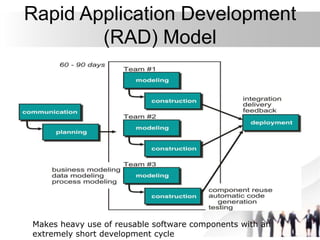
Rapid Application Development
(RAD) Model
Makes heavy use of reusable software components with an
extremely short development cycle
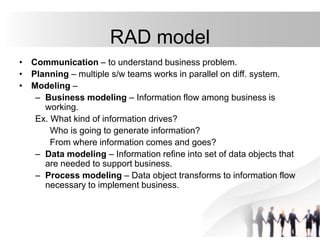
RAD model
• Communication – to understand business problem.
• Planning – multiple s/w teams works in parallel on diff. system.
• Modeling –
– Business modeling – Information flow among business is
working.
Ex. What kind of information drives?
Who is going to generate information?
From where information comes and goes?
– Data modeling – Information refine into set of data objects that
are needed to support business.
– Process modeling – Data object transforms to information flow
necessary to implement business.
• Construction – it highlighting the use of pre-existing software
component.
• Deployment – Deliver to customer basis for subsequent iteration.
• RAD model emphasize a short development cycle.
• “High speed” edition of linear sequential model.
• If requirement are well understood and project scope is constrained
then it enable development team to create “ fully functional system”
within a very short time period.
RAD Model
• If application is modularized (“Scalable Scope”), each major
function to be completed in less than three months.
• Each major function can be addressed by a separate team and
then integrated to form a whole.
Drawback:
• For large but scalable projects
– RAD requires sufficient human resources
• Projects fail if developers and customers are not committed in a
much shortened time-frame
• Problematic if system can not be modularized
• Not appropriate when technical risks are high ( heavy use of new
technology)
Evolutionary Process Model
• Produce an increasingly more complete
version of the software with each iteration.
• Evolutionary Models are iterative.
• Evolutionary models are:
– Prototyping
– Spiral Model
– Concurrent Development Model
– Fourth Generation Techniques (4GT)
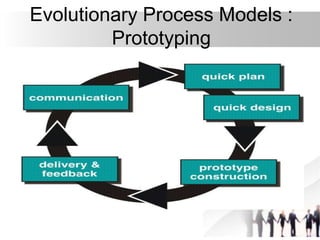
Evolutionary Process Models :
Prototyping
Prototyping cohesive
• Best approach when:
– Objectives defines by customer are general but does not have details like input,
processing, or output requirement.
– Developer may be unsure of the efficiency of an algorithm, O.S., or the form that
human machine interaction should take.
• It can be used as standalone process model.
• Model assist software engineer and customer to better understand what is to be built
when requirement are fuzzy.
• Prototyping start with communication, between a customer and software engineer to
define overall objective, identify requirements and make a boundary.
• Going ahead, planned quickly and modeling (software layout visible to the
customers/end-user) occurs.
• Quick design leads to prototype construction.
• Prototype is deployed and evaluated by the customer/user.
• Feedback from customer/end user will refine requirement and that is how iteration
occurs during prototype to satisfy the needs of the customer.
Prototyping (cont..)
 Prototype can be serve as “the first system”.
 Both customers and developers like the prototyping paradigm.
 Customer/End user gets a feel for the actual system
 Developer get to build something immediately.
Problem Areas:
 Customer cries foul and demand that “a few fixes” be applied to make
the prototype a working product, due to that software quality suffers
as a result.
 Developer often makes implementation in order to get a prototype
working quickly without considering other factors in mind like OS,
Programming language, etc.
Customer and developer both must be agree that the prototype is built to
serve as a mechanism for defining requirement.
Evolutionary Model: Spiral
Model
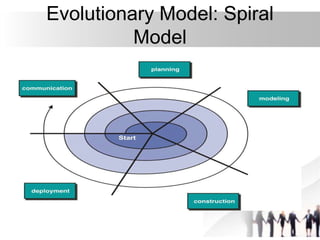
Spiral Model
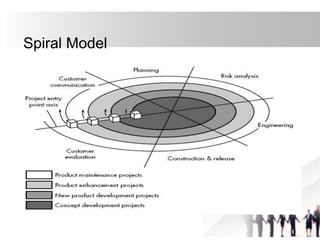
 Couples iterative nature of prototyping with the controlled and systematic
aspects of the linear sequential model
• It provide potential for rapid development of increasingly more complete
version of the software.
• Using spiral, software developed in as series of evolutionary release.
– Early iteration, release might be on paper or prototype.
– Later iteration, more complete version of software.
• Divided into framework activities (C,P,M,C,D). Each activity represent one
segment.
• Evolutionary process begins in a clockwise direction, beginning at the
center risk.
• First circuit around the spiral might result in development of a product
specification. Subsequently, develop a prototype and then progressively
more sophisticated version of software.
• Unlike other process models that end when software is delivered.
• It can be adapted to apply throughout the life of software.
Spiral Model
Spiral Model (cont.)
Concept Development Project:
• Start at the core and continues for multiple iterations until it is complete.
• If concept is developed into an actual product, the process proceeds
outward on the spiral.
New Product Development Project:
• New product will evolve through a number of iterations around the spiral.
• Later, a circuit around spiral might be used to represent a “Product
Enhancement Project”
Product Enhancement Project:
• There are times when process is dormant or software team not developing
new things but change is initiated, process start at appropriate entry point.
• Spiral models uses prototyping as a risk reduction mechanism but,
more important, enables the developer to apply the prototyping
approach at each stage in the evolution of the product.
• It maintains the systematic stepwise approach suggested by the
classic life cycle but also incorporates it into an iterative
framework activity.
• If risks cannot be resolved, project is immediately terminated
Problem Area:
• It may be difficult to convince customers (particularly in contract
situations) that the evolutionary approach is controllable.
• If a major risk is not uncovered and managed, problems will
undoubtedly occur.
Concurrent Development Model
• It represented schematically as series of major technical activities, tasks,
and their associated states.
• It is often more appropriate for system engineering projects where different
engineering teams are involved.
• The activity-modeling may be in any one of the states for a given time.
• All activities exist concurrently but reside in different states.
E.g.
• The analysis activity (existed in the none state while initial customer
communication was completed) now makes a transition into the under
development state.
• Analysis activity moves from the under development state into the
awaiting changes state only if customer indicates changes in
requirements.
• Series of event will trigger transition from state to state.
E.g. During initial stage there was inconsistency in design which was
uncovered. This will triggers the analysis action from the Done state into
Awaiting Changes state.
Concurrent Development Model
Concurrent Development (Cont.)
• Visibility of current state of project
• It define network of activities
• Each activities, actions and tasks on the
network exists simultaneously with other
activities ,actions and tasks.
• Events generated at one point in the
process network trigger transitions among
the states.
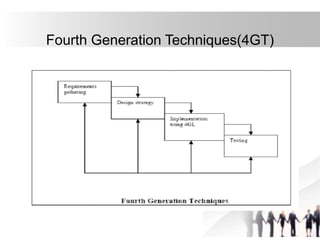
Fourth Generation Techniques(4GT)
4GT
• Like all other models, 4GT begins with a requirements gathering phase.
• Ideally, the customer would describe the requirements, which are directly
translated into an operational prototype.
• Practically, however, the client may be unsure of the requirements, may be
ambiguous in his specs or may be unable to specify information in a manner
that a 4GT tool can use.
• For small applications, it may be possible to move directly from the
requirements gathering phase to the implementation phase using a
nonprocedural fourth generation language.
• However for larger projects a design strategy is necessary. Otherwise, the
same difficulties are likely to arise as with conventional approaches.
4GT
 To transform a 4GT implementation into a product, the
developer must conduct thorough testing, develop meaningful
documentation.
 In addition, the 4GT developed software must be built in a
manner that enables maintenance to be performed quickly.
Merits:
 Dramatic reduction in software development time. (For small
and intermediate application)
 Improved productivity for software developers.
Demerits:
 Not much easier to use as compared to programming
languages
 The maintainability of large software systems built using 4GT is
open to question.
4GT
• 4GT Software tool is used to generate the source code for a
software system from a high level specification representation
• Commonly used 4GT in development models are mentioned below:
– Report Generation
– Data base query language
– Data Manipulation
– Screen definition and interaction
– Code Generation
– Web engineering Tools
– high-level graphics
Component Based
Development
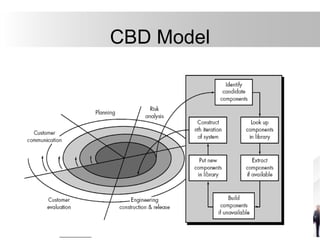
• component-based development (CBD) model
incorporates many of the characteristics of the spiral
model.
• It is evolutionary by nature and iterative approach to
create software.
• CBD model creates applications from prepackaged
software components (called classes).
CBD Model
CBD model (cont.)
• Modeling and construction activities begin with identification of candidate
components.
• Classes created in past software engineering projects are stored in a class
library or repository.
• Once candidate classes are identified, the class library is searched to
determine if these classes already exist.
• If class is already available in library extract and reuse it.
• If class is not available in library, it is engineered or developed using object-
oriented methods.
• Any new classes built to meet the unique needs of the application.
• Now process flow return to the spiral activity.
CBD model (cont.)
• CBD model leads to software reusability.
• Based on studies, CBD model leads to 70
% reduction in development cycle time.
• 84% reduction in project cost.
• Productivity is very high.

Object Oriented Software engineering.pptx

  • 1.
    UNIT-I Software Process andAgile Development
  • 2.
    Software Software is aset of instructions , data or programs used to operate computers and execute specific tasks. Types: • System software - managing hardware • Application software - user-oriented functions. • System software includes operating systems, while application software comprises programs like word processors and games. Together, they form the essential components of a computer's functionality.
  • 3.
    Software Engineering  Engineering:It’s all about developing products, usng well- defined scientific principles and methods  Software Engineering: It is defined as analyzing user requirements, designing a s/w ,Building a s/w,Testing a S/w application which will satisfy those requirements of the user.  WHY It’s Required: • Efficiency: Software engineering ensures the systematic development of software, optimizing performance and resource utilization.
  • 4.
    Cont.. • Reliability: Throughrigorous testing and quality assurance, software engineering enhances the dependability of software systems, minimizing errors and faults. • Scalability: Software engineering principles enable the creation of scalable solutions, accommodating growth and changes in user requirements. • Maintainability: Proper software engineering practices facilitate easier maintenance and updates, ensuring long-term usability and adaptability of software applications.
  • 5.
    Chapter : TopicCovered • About software process model • Build and Fix Model • Why Models are needed? – Process as a "black box“ & Problem – Process as a “white box“ & Advantage • Prescriptive Model • Waterfall Model or Linear Sequential • Incremental Process Models – Incremental Model – RAD Model • Evolutionary Process Models – Prototyping – Spiral Model – Concurrent Development Model – Fourth Generation Techniques (4GT) – Component based development (CBD)
  • 6.
    Software Process • Insoftware engineering, a software process is a structured set of activities, methods, and tasks that guide the creation and maintenance of software systems, ensuring a systematic and efficient development lifecycle. • It encompasses planning, implementation, testing, and maintenance phases to achieve reliable and high-quality software products.
  • 7.
    Software process model •A software process model in software engineering is a framework that defines the stages, activities, and workflows involved in developing and maintaining software systems. • It provides a structured approach to guide the software development lifecycle, offering methodologies such as Waterfall, Agile, or Spiral to manage and optimize the process from conception to deployment. • Process models are not perfect, but provide roadmap for software engineering work.
  • 8.
  • 9.
    Build and FixModel The earlier approach • Product is constructed without specification or any attempt at design. • developers simply build a product that is reworked as many times as necessary to satisfy the client. • model may work for small projects but is totally unsatisfactory for products of any reasonable size. • Maintenance is high. • Source of difficulties and deficiencies – impossible to predict – impossible to manage
  • 10.
    Why Models areneeded? • Symptoms of inadequacy: the software crisis – scheduled time and cost exceeded – user expectations not met – poor quality
  • 11.
  • 12.
    Tools • The firstlayer involves choosing the semi-automated and automated tools that will become the framework for the project. Some examples may include: • Choosing Microsoft Publisher for web design • Using Selenium for testing across platforms • Using an integrated development environment (IDE) for building apps
  • 13.
    Method • The secondlayer establishes the methods of developing the software. This includes any technical knowledge and resources required for development. Some tasks include choosing methods for: • Communication • Analysis • Modeling • Program construction • Testing and support
  • 14.
    Process • Layer threefocuses on the framework that needs to be established to deliver software effectively. This layer can be broken down into five sub-layers: • Communication • Planning • Modeling • Construction. • Deployment.
  • 15.
  • 16.
    Prescriptive Model • Prescriptiveprocess models advocate an orderly approach to software engineering – Organize framework activities in a certain order • Process framework activity with set of software engineering actions. • Each action in terms of a task set that identifies the work to be accomplished to meet the goals. • The resultant process model should be adapted to accommodate the nature of the specific project, people doing the work, and the work environment. • Software engineer choose process framework that includes activities like; – Communication – Planning – Modeling – Construction – Deployment
  • 17.
    Prescriptive Model • Callingthis model as “Prescribe” because it recommend a set of process elements, activities, action task, work product & quality. • Each elements are inter related to one another (called workflow).
  • 18.
    Waterfall Model orClassic Life Cycle
  • 19.
    Waterfall Model orClassic Life Cycle • Requirement Analysis and Definition: What - The systems services, constraints and goals are defined by customers with system users. • Scheduling tracking - – Assessing progress against the project plan. – Require action to maintain schedule. • System and Software Design: How –It establishes and overall system architecture. Software design involves fundamental system abstractions and their relationships. • Integration and system testing: The individual program unit or programs are integrated and tested as a complete system to ensure that the software requirements have been met. After testing, the software system is delivered to the customer. • Operation and Maintenance: Normally this is the longest phase of the software life cycle. The system is installed and put into practical use. Maintenance involves correcting errors which were not discovered in earlier stages of the life-cycle.
  • 20.
    20 Limitations of thewaterfall model  The nature of the requirements will not change very much During development; during evolution  The model implies that you should attempt to complete a given stage before moving on to the next stage  Does not account for the fact that requirements constantly change.  It also means that customers can not use anything until the entire system is complete.  The model implies that once the product is finished, everything else is maintenance.  Surprises at the end are very expensive  Some teams sit ideal for other teams to finish  Therefore, this model is only appropriate when the requirements are well-understood and changes will be fairly limited during the design process. Problems: 1. Real projects are rarely follow the sequential model. 2. Difficult for the customer to state all the requirement explicitly. 3. Assumes patience from customer - working version of program will not available until programs not getting change fully.
  • 21.
    Incremental Process Model C-Communication P - Planning M – Modeling C - Construction D - Deployment Delivers software in small but usable pieces, each piece builds on pieces already delivered
  • 22.
    • Rather thandeliver the system as a single delivery, the development and delivery is broken down into increments with each increment delivering part of the required functionality. • First Increment is often core product – Includes basic requirement – Many supplementary features (known & unknown) remain undelivered • A plan of next increment is prepared – Modifications of the first increment – Additional features of the first increment • It is particularly useful when enough staffing is not available for the whole project • Increment can be planned to manage technical risks. • Incremental model focus more on delivery of operation product with each increment. The Incremental Model
  • 23.
    • User requirementsare prioritised and the highest priority requirements are included in early increments. • Once the development of an increment is started, the requirements are frozen though requirements for later increments can continue to evolve. • Customer value can be delivered with each increment so system functionality is available earlier. • Early increments act as a prototype to help elicit requirements for later increments. • Lower risk of overall project failure. • The highest priority system services tend to receive the most testing. The Incremental Model
  • 24.
    Rapid Application Development (RAD)Model Makes heavy use of reusable software components with an extremely short development cycle
  • 25.
    RAD model • Communication– to understand business problem. • Planning – multiple s/w teams works in parallel on diff. system. • Modeling – – Business modeling – Information flow among business is working. Ex. What kind of information drives? Who is going to generate information? From where information comes and goes? – Data modeling – Information refine into set of data objects that are needed to support business. – Process modeling – Data object transforms to information flow necessary to implement business.
  • 26.
    • Construction –it highlighting the use of pre-existing software component. • Deployment – Deliver to customer basis for subsequent iteration. • RAD model emphasize a short development cycle. • “High speed” edition of linear sequential model. • If requirement are well understood and project scope is constrained then it enable development team to create “ fully functional system” within a very short time period.
  • 27.
    RAD Model • Ifapplication is modularized (“Scalable Scope”), each major function to be completed in less than three months. • Each major function can be addressed by a separate team and then integrated to form a whole. Drawback: • For large but scalable projects – RAD requires sufficient human resources • Projects fail if developers and customers are not committed in a much shortened time-frame • Problematic if system can not be modularized • Not appropriate when technical risks are high ( heavy use of new technology)
  • 28.
    Evolutionary Process Model •Produce an increasingly more complete version of the software with each iteration. • Evolutionary Models are iterative. • Evolutionary models are: – Prototyping – Spiral Model – Concurrent Development Model – Fourth Generation Techniques (4GT)
  • 29.
  • 30.
    Prototyping cohesive • Bestapproach when: – Objectives defines by customer are general but does not have details like input, processing, or output requirement. – Developer may be unsure of the efficiency of an algorithm, O.S., or the form that human machine interaction should take. • It can be used as standalone process model. • Model assist software engineer and customer to better understand what is to be built when requirement are fuzzy. • Prototyping start with communication, between a customer and software engineer to define overall objective, identify requirements and make a boundary. • Going ahead, planned quickly and modeling (software layout visible to the customers/end-user) occurs. • Quick design leads to prototype construction. • Prototype is deployed and evaluated by the customer/user. • Feedback from customer/end user will refine requirement and that is how iteration occurs during prototype to satisfy the needs of the customer.
  • 31.
    Prototyping (cont..)  Prototypecan be serve as “the first system”.  Both customers and developers like the prototyping paradigm.  Customer/End user gets a feel for the actual system  Developer get to build something immediately. Problem Areas:  Customer cries foul and demand that “a few fixes” be applied to make the prototype a working product, due to that software quality suffers as a result.  Developer often makes implementation in order to get a prototype working quickly without considering other factors in mind like OS, Programming language, etc. Customer and developer both must be agree that the prototype is built to serve as a mechanism for defining requirement.
  • 32.
  • 33.
    Spiral Model  Couplesiterative nature of prototyping with the controlled and systematic aspects of the linear sequential model • It provide potential for rapid development of increasingly more complete version of the software. • Using spiral, software developed in as series of evolutionary release. – Early iteration, release might be on paper or prototype. – Later iteration, more complete version of software. • Divided into framework activities (C,P,M,C,D). Each activity represent one segment. • Evolutionary process begins in a clockwise direction, beginning at the center risk. • First circuit around the spiral might result in development of a product specification. Subsequently, develop a prototype and then progressively more sophisticated version of software. • Unlike other process models that end when software is delivered. • It can be adapted to apply throughout the life of software.
  • 34.
  • 35.
    Spiral Model (cont.) ConceptDevelopment Project: • Start at the core and continues for multiple iterations until it is complete. • If concept is developed into an actual product, the process proceeds outward on the spiral. New Product Development Project: • New product will evolve through a number of iterations around the spiral. • Later, a circuit around spiral might be used to represent a “Product Enhancement Project” Product Enhancement Project: • There are times when process is dormant or software team not developing new things but change is initiated, process start at appropriate entry point.
  • 36.
    • Spiral modelsuses prototyping as a risk reduction mechanism but, more important, enables the developer to apply the prototyping approach at each stage in the evolution of the product. • It maintains the systematic stepwise approach suggested by the classic life cycle but also incorporates it into an iterative framework activity. • If risks cannot be resolved, project is immediately terminated Problem Area: • It may be difficult to convince customers (particularly in contract situations) that the evolutionary approach is controllable. • If a major risk is not uncovered and managed, problems will undoubtedly occur.
  • 37.
  • 38.
    • It representedschematically as series of major technical activities, tasks, and their associated states. • It is often more appropriate for system engineering projects where different engineering teams are involved. • The activity-modeling may be in any one of the states for a given time. • All activities exist concurrently but reside in different states. E.g. • The analysis activity (existed in the none state while initial customer communication was completed) now makes a transition into the under development state. • Analysis activity moves from the under development state into the awaiting changes state only if customer indicates changes in requirements. • Series of event will trigger transition from state to state. E.g. During initial stage there was inconsistency in design which was uncovered. This will triggers the analysis action from the Done state into Awaiting Changes state. Concurrent Development Model
  • 39.
    Concurrent Development (Cont.) •Visibility of current state of project • It define network of activities • Each activities, actions and tasks on the network exists simultaneously with other activities ,actions and tasks. • Events generated at one point in the process network trigger transitions among the states.
  • 40.
  • 41.
    4GT • Like allother models, 4GT begins with a requirements gathering phase. • Ideally, the customer would describe the requirements, which are directly translated into an operational prototype. • Practically, however, the client may be unsure of the requirements, may be ambiguous in his specs or may be unable to specify information in a manner that a 4GT tool can use. • For small applications, it may be possible to move directly from the requirements gathering phase to the implementation phase using a nonprocedural fourth generation language. • However for larger projects a design strategy is necessary. Otherwise, the same difficulties are likely to arise as with conventional approaches.
  • 42.
    4GT  To transforma 4GT implementation into a product, the developer must conduct thorough testing, develop meaningful documentation.  In addition, the 4GT developed software must be built in a manner that enables maintenance to be performed quickly. Merits:  Dramatic reduction in software development time. (For small and intermediate application)  Improved productivity for software developers. Demerits:  Not much easier to use as compared to programming languages  The maintainability of large software systems built using 4GT is open to question.
  • 43.
    4GT • 4GT Softwaretool is used to generate the source code for a software system from a high level specification representation • Commonly used 4GT in development models are mentioned below: – Report Generation – Data base query language – Data Manipulation – Screen definition and interaction – Code Generation – Web engineering Tools – high-level graphics
  • 44.
    Component Based Development • component-baseddevelopment (CBD) model incorporates many of the characteristics of the spiral model. • It is evolutionary by nature and iterative approach to create software. • CBD model creates applications from prepackaged software components (called classes).
  • 45.
  • 46.
    CBD model (cont.) •Modeling and construction activities begin with identification of candidate components. • Classes created in past software engineering projects are stored in a class library or repository. • Once candidate classes are identified, the class library is searched to determine if these classes already exist. • If class is already available in library extract and reuse it. • If class is not available in library, it is engineered or developed using object- oriented methods. • Any new classes built to meet the unique needs of the application. • Now process flow return to the spiral activity.
  • 47.
    CBD model (cont.) •CBD model leads to software reusability. • Based on studies, CBD model leads to 70 % reduction in development cycle time. • 84% reduction in project cost. • Productivity is very high.