Curriculum Development &
Models
3/26/2023 1
Objectives
 At the end of this lecture, student
should be able to:
1. Define curriculum development
2. Define the concept of model
3. Identify types of curriculum
development models
3/26/2023 2
What is curriculum development?
 Curriculum development is the
organized preparation of whatever is
going to be taught in schools at a given
time in a given year.
 They are made into official documents,
as guides for teachers, and made
obligatory by provincial and territorial
departments
3/26/2023 3
What is curriculum development?
 Curriculum Development can be defined
as the systematic planning of what is
taught and learned in schools as reflected
in courses of study and school programs.
 These curricula are embodied in official
documents (typically curriculum "guides"
for teachers) and made mandatory by
provincial and territorial departments of
education
3/26/2023 4
What is curriculum development?
 Curriculum development is the process
of setting up and establishing specific
guidelines of instruction for the
curriculum.
3/26/2023 5
The Curriculum: models
3/26/2023 6
Curriculum models
Model:
Definition:
A simplified representation of reality
which is often depicted in
diagrammatic form
3/26/2023 7
Curriculum models
Model:
Purpose:
To provide a structure for examining
the elements that go to make up
curriculum planning, and how these
elements interrelate.
3/26/2023 8
Curriculum models
Model:
The literature in the area of curriculum has
accepted the use of the term ‘model’ to
explain both the nature and the process of
curriculum development.
3/26/2023 9
Curriculum models
Models are used to explain:
 levels of curriculum
 aspects of organization practice
 aspects of classroom instruction
 types of decision making
3/26/2023 10
Curriculum models
Are designed to provide a basis for decisions
regarding the selection, structuring and
sequencing of the educational experiences
3/26/2023 11
The curriculum process
The development of a curriculum involves
the developer in decisions about the nature
and appropriateness of the substantive
(basic) elements, e.g. the
 Outcomes
 Content
 method
 assessment strategies
These decisions are made in relation to the
context in which the curriculum will
operate.
3/26/2023 12
Types of curriculum models
Rational/objectives models
Cyclical models
Dynamic/interaction models
3/26/2023 13
A continuum of curriculum
models
Rational/objectives models:
Ralph Tyler
Hilda Taba
3/26/2023 14
A continuum of curriculum
models
Cyclical models:
Wheeler
Nichols
3/26/2023 15
A continuum of curriculum
models
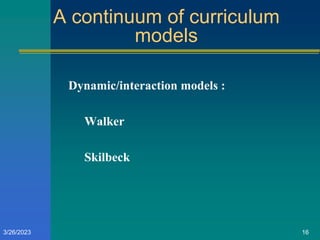
Dynamic/interaction models :
Walker
Skilbeck
3/26/2023 16
Ralph Tyler's Model/Rationale
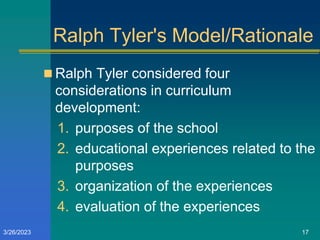
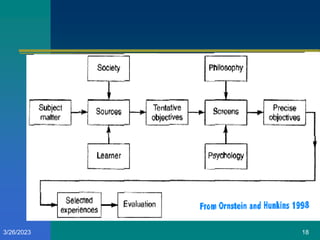
 Ralph Tyler considered four
considerations in curriculum
development:
1. purposes of the school
2. educational experiences related to the
purposes
3. organization of the experiences
4. evaluation of the experiences
3/26/2023 17
3/26/2023 18
Hilda Taba's Linear Model
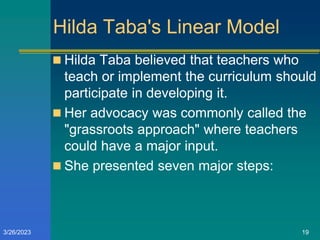
 Hilda Taba believed that teachers who
teach or implement the curriculum should
participate in developing it.
 Her advocacy was commonly called the
"grassroots approach" where teachers
could have a major input.
 She presented seven major steps:
3/26/2023 19
Hilda Taba's Linear Model
1. Diagnosis of needs. The teacher
(curriculum designer) starts the process
by identifying the needs of the students
for whom the curriculum is to be planned
2. Formulation of learning objectives. After
the teacher has identified the needs that
require attention, he or she specifies
objectives to be accomplished.
3/26/2023 20
Hilda Taba's Linear Model
3. Selection of learning content. The objectives
selected or created suggest the subject matter
or content of the curriculum. Not only should
objectives and content match but also the
validity and significance of the content chosen
needs to be determined.
4. Organization of learning content. A teacher
can not just select content, but must organize
it in some type of sequence, taking into
consideration the maturity of the learners, their
academic achievement, and their interests.
 .
3/26/2023 21
Hilda Taba's Linear Model
5. Selection of learning experiences. Content must
be presented to pupils and pupils must engage
the content. At this point, the teacher select
instructional methods that will involve students
with the content.
6. Organization of learning activities. Just as
content must be sequenced and organized, so
must the learning activities. Often the sequence
of the learning activities is determined by the
content. But the teacher needs to keep in mind
the particular students whom he or she will be
teaching.
3/26/2023 22
Hilda Taba's Linear Model
7. Evaluation and means of evaluation.
The curriculum planner must determine
just what objectives have been
accomplished. Evaluation procedures
need to be considered by the students
and teachers.
3/26/2023 23
Curriculum Development
1
• Selection of Aims
2
• Selection of Content &
Learning Experiences
3
• Organization of
content & Learning
Experiences
4
• Evaluation of Learning
outcomes
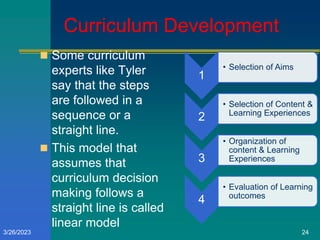
 Some curriculum
experts like Tyler
say that the steps
are followed in a
sequence or a
straight line.
 This model that
assumes that
curriculum decision
making follows a
straight line is called
linear model
3/26/2023 24
Curriculum Development
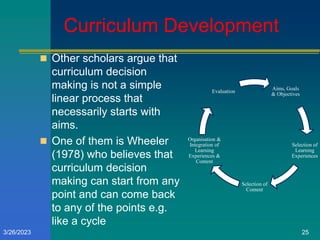
 Other scholars argue that
curriculum decision
making is not a simple
linear process that
necessarily starts with
aims.
 One of them is Wheeler
(1978) who believes that
curriculum decision
making can start from any
point and can come back
to any of the points e.g.
like a cycle
Aims, Goals
& Objectives
Selection of
Learning
Experiences
Selection of
Content
Organisation &
Integration of
Learning
Experiences &
Content
Evaluation
3/26/2023 25
Curriculum Development
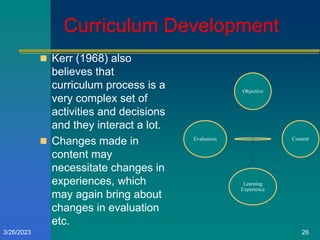
 Kerr (1968) also
believes that
curriculum process is a
very complex set of
activities and decisions
and they interact a lot.
 Changes made in
content may
necessitate changes in
experiences, which
may again bring about
changes in evaluation
etc.
Objective
Content
Learning
Experience
Evaluation
3/26/2023 26
Evaluation
 What was useful?
 What was not so useful?
 What needs to be Changed?
27
3/26/2023
THANK YOU FOR LISTENING
28
3/26/2023

Curriculum Models.ppt

  • 1.
  • 2.
    Objectives  At theend of this lecture, student should be able to: 1. Define curriculum development 2. Define the concept of model 3. Identify types of curriculum development models 3/26/2023 2
  • 3.
    What is curriculumdevelopment?  Curriculum development is the organized preparation of whatever is going to be taught in schools at a given time in a given year.  They are made into official documents, as guides for teachers, and made obligatory by provincial and territorial departments 3/26/2023 3
  • 4.
    What is curriculumdevelopment?  Curriculum Development can be defined as the systematic planning of what is taught and learned in schools as reflected in courses of study and school programs.  These curricula are embodied in official documents (typically curriculum "guides" for teachers) and made mandatory by provincial and territorial departments of education 3/26/2023 4
  • 5.
    What is curriculumdevelopment?  Curriculum development is the process of setting up and establishing specific guidelines of instruction for the curriculum. 3/26/2023 5
  • 6.
  • 7.
    Curriculum models Model: Definition: A simplifiedrepresentation of reality which is often depicted in diagrammatic form 3/26/2023 7
  • 8.
    Curriculum models Model: Purpose: To providea structure for examining the elements that go to make up curriculum planning, and how these elements interrelate. 3/26/2023 8
  • 9.
    Curriculum models Model: The literaturein the area of curriculum has accepted the use of the term ‘model’ to explain both the nature and the process of curriculum development. 3/26/2023 9
  • 10.
    Curriculum models Models areused to explain:  levels of curriculum  aspects of organization practice  aspects of classroom instruction  types of decision making 3/26/2023 10
  • 11.
    Curriculum models Are designedto provide a basis for decisions regarding the selection, structuring and sequencing of the educational experiences 3/26/2023 11
  • 12.
    The curriculum process Thedevelopment of a curriculum involves the developer in decisions about the nature and appropriateness of the substantive (basic) elements, e.g. the  Outcomes  Content  method  assessment strategies These decisions are made in relation to the context in which the curriculum will operate. 3/26/2023 12
  • 13.
    Types of curriculummodels Rational/objectives models Cyclical models Dynamic/interaction models 3/26/2023 13
  • 14.
    A continuum ofcurriculum models Rational/objectives models: Ralph Tyler Hilda Taba 3/26/2023 14
  • 15.
    A continuum ofcurriculum models Cyclical models: Wheeler Nichols 3/26/2023 15
  • 16.
    A continuum ofcurriculum models Dynamic/interaction models : Walker Skilbeck 3/26/2023 16
  • 17.
    Ralph Tyler's Model/Rationale Ralph Tyler considered four considerations in curriculum development: 1. purposes of the school 2. educational experiences related to the purposes 3. organization of the experiences 4. evaluation of the experiences 3/26/2023 17
  • 18.
  • 19.
    Hilda Taba's LinearModel  Hilda Taba believed that teachers who teach or implement the curriculum should participate in developing it.  Her advocacy was commonly called the "grassroots approach" where teachers could have a major input.  She presented seven major steps: 3/26/2023 19
  • 20.
    Hilda Taba's LinearModel 1. Diagnosis of needs. The teacher (curriculum designer) starts the process by identifying the needs of the students for whom the curriculum is to be planned 2. Formulation of learning objectives. After the teacher has identified the needs that require attention, he or she specifies objectives to be accomplished. 3/26/2023 20
  • 21.
    Hilda Taba's LinearModel 3. Selection of learning content. The objectives selected or created suggest the subject matter or content of the curriculum. Not only should objectives and content match but also the validity and significance of the content chosen needs to be determined. 4. Organization of learning content. A teacher can not just select content, but must organize it in some type of sequence, taking into consideration the maturity of the learners, their academic achievement, and their interests.  . 3/26/2023 21
  • 22.
    Hilda Taba's LinearModel 5. Selection of learning experiences. Content must be presented to pupils and pupils must engage the content. At this point, the teacher select instructional methods that will involve students with the content. 6. Organization of learning activities. Just as content must be sequenced and organized, so must the learning activities. Often the sequence of the learning activities is determined by the content. But the teacher needs to keep in mind the particular students whom he or she will be teaching. 3/26/2023 22
  • 23.
    Hilda Taba's LinearModel 7. Evaluation and means of evaluation. The curriculum planner must determine just what objectives have been accomplished. Evaluation procedures need to be considered by the students and teachers. 3/26/2023 23
  • 24.
    Curriculum Development 1 • Selectionof Aims 2 • Selection of Content & Learning Experiences 3 • Organization of content & Learning Experiences 4 • Evaluation of Learning outcomes  Some curriculum experts like Tyler say that the steps are followed in a sequence or a straight line.  This model that assumes that curriculum decision making follows a straight line is called linear model 3/26/2023 24
  • 25.
    Curriculum Development  Otherscholars argue that curriculum decision making is not a simple linear process that necessarily starts with aims.  One of them is Wheeler (1978) who believes that curriculum decision making can start from any point and can come back to any of the points e.g. like a cycle Aims, Goals & Objectives Selection of Learning Experiences Selection of Content Organisation & Integration of Learning Experiences & Content Evaluation 3/26/2023 25
  • 26.
    Curriculum Development  Kerr(1968) also believes that curriculum process is a very complex set of activities and decisions and they interact a lot.  Changes made in content may necessitate changes in experiences, which may again bring about changes in evaluation etc. Objective Content Learning Experience Evaluation 3/26/2023 26
  • 27.
    Evaluation  What wasuseful?  What was not so useful?  What needs to be Changed? 27 3/26/2023
  • 28.
    THANK YOU FORLISTENING 28 3/26/2023