Welcom
e To
My Presentation
Presentation on
How discrete-event simulation software works and
why it matters
What is discrete-event simulation ?
A discrete-event simulation (DES)models is the operation of a system as a discrete sequence of events
in time. Each event occurs at a particular instant in time and marks a change of state in the system.
Between consecutive events, no change in the system is assumed to occur; thus the simulationcan
directly jump in time from one event to thenext.
Nature of Discrete-Event Simulation
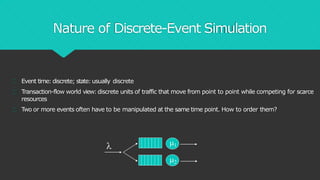
Event time: discrete; state: usually discrete
Transaction-flow world view:discrete units of traffic that move from point to point while competing for scarce
resources
Two or more events often have to be manipulated at the same time point. How to order them?



Discrete-Event Modeling Languages
There are different implementations, which aim to provide convenience for modelers.
Arena for example, provides graphical user interface for the users to input the simulation model.
Basic Simulation Constructs
Topics includes -
Entity – a unit of traffic
Resources – service machine
Control Elements – support delay or logical alternatives
Operations - an action for an entity
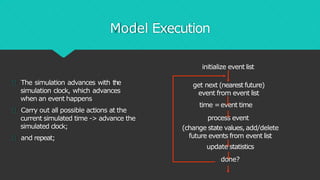
Model Execution
The simulation advances with the
simulation clock, which advances
when an event happens
Carry out all possible actions at the
current simulated time -> advance the
simulated clock;
and repeat;
initialize event list
get next (nearest future)
event from event list
time =event time
process event
(change state values, add/delete
future events from event list
update statistics
done?
Entity States
Active State:current moving state
Ready State:ready but wait due to limited resource
Time-Delayed State:entity waiting for a known future time so they can enter ready state
Condition-Delayed State:remove automatically when conditions permit
Dormant State:modelers set it
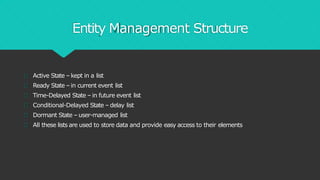
Entity Management Structure
Active State – kept in a list
Ready State – in current event list
Time-Delayed State – in future event list
Conditional-Delayed State – delay list
Dormant State – user-managed list
All these lists are used to store data and provide easy access to their elements
Different Implementation in Tools
The paper together with its WSC96’ version gives 6 representative implementations.
Two examples here -
AutoMod, version 9 (Phillips 1997)
Siman, the core of Arena
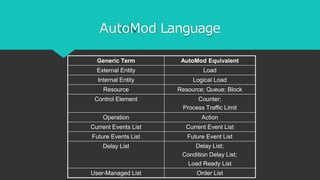
AutoMod Language
Generic Term AutoMod Equivalent
External Entity Load
Internal Entity Logical Load
Resource Resource; Queue; Block
Control Element Counter;
Process Traffic Limit
Operation Action
Current Events List Current Event List
Future Events List Future Event List
Delay List Delay List;
Condition Delay List;
Load Ready List
User-Managed List Order List
Why It Matters
Trying to re-capture a resource immediately
The first in line is still delayed
Yielding control
Conditions involving the clock
Mix Mode Waiting
Group Members
Rawnat Jahan Anika [183019042]
Subho Mrong [163019 042]
Thank You!

discrete-event-simulation-190410063238.pptx

  • 1.
  • 2.
    Presentation on How discrete-eventsimulation software works and why it matters
  • 3.
    What is discrete-eventsimulation ? A discrete-event simulation (DES)models is the operation of a system as a discrete sequence of events in time. Each event occurs at a particular instant in time and marks a change of state in the system. Between consecutive events, no change in the system is assumed to occur; thus the simulationcan directly jump in time from one event to thenext.
  • 4.
    Nature of Discrete-EventSimulation Event time: discrete; state: usually discrete Transaction-flow world view:discrete units of traffic that move from point to point while competing for scarce resources Two or more events often have to be manipulated at the same time point. How to order them?   
  • 5.
    Discrete-Event Modeling Languages Thereare different implementations, which aim to provide convenience for modelers. Arena for example, provides graphical user interface for the users to input the simulation model.
  • 6.
    Basic Simulation Constructs Topicsincludes - Entity – a unit of traffic Resources – service machine Control Elements – support delay or logical alternatives Operations - an action for an entity
  • 7.
    Model Execution The simulationadvances with the simulation clock, which advances when an event happens Carry out all possible actions at the current simulated time -> advance the simulated clock; and repeat; initialize event list get next (nearest future) event from event list time =event time process event (change state values, add/delete future events from event list update statistics done?
  • 8.
    Entity States Active State:currentmoving state Ready State:ready but wait due to limited resource Time-Delayed State:entity waiting for a known future time so they can enter ready state Condition-Delayed State:remove automatically when conditions permit Dormant State:modelers set it
  • 9.
    Entity Management Structure ActiveState – kept in a list Ready State – in current event list Time-Delayed State – in future event list Conditional-Delayed State – delay list Dormant State – user-managed list All these lists are used to store data and provide easy access to their elements
  • 10.
    Different Implementation inTools The paper together with its WSC96’ version gives 6 representative implementations. Two examples here - AutoMod, version 9 (Phillips 1997) Siman, the core of Arena
  • 11.
    AutoMod Language Generic TermAutoMod Equivalent External Entity Load Internal Entity Logical Load Resource Resource; Queue; Block Control Element Counter; Process Traffic Limit Operation Action Current Events List Current Event List Future Events List Future Event List Delay List Delay List; Condition Delay List; Load Ready List User-Managed List Order List
  • 12.
    Why It Matters Tryingto re-capture a resource immediately The first in line is still delayed Yielding control Conditions involving the clock Mix Mode Waiting
  • 13.
    Group Members Rawnat JahanAnika [183019042] Subho Mrong [163019 042]
  • 14.