Event-driven Infrastructure
Michael Place
mp@saltstack.com
@cachedout
Core Engineering
SaltStack
Question-Driven Presentation
WARNING: This talk may leave you with more
questions than answers.
(Hopefully, that’s a good thing.)
Automation brought us new toolchains.
DevOps brought us new culture.
What now?
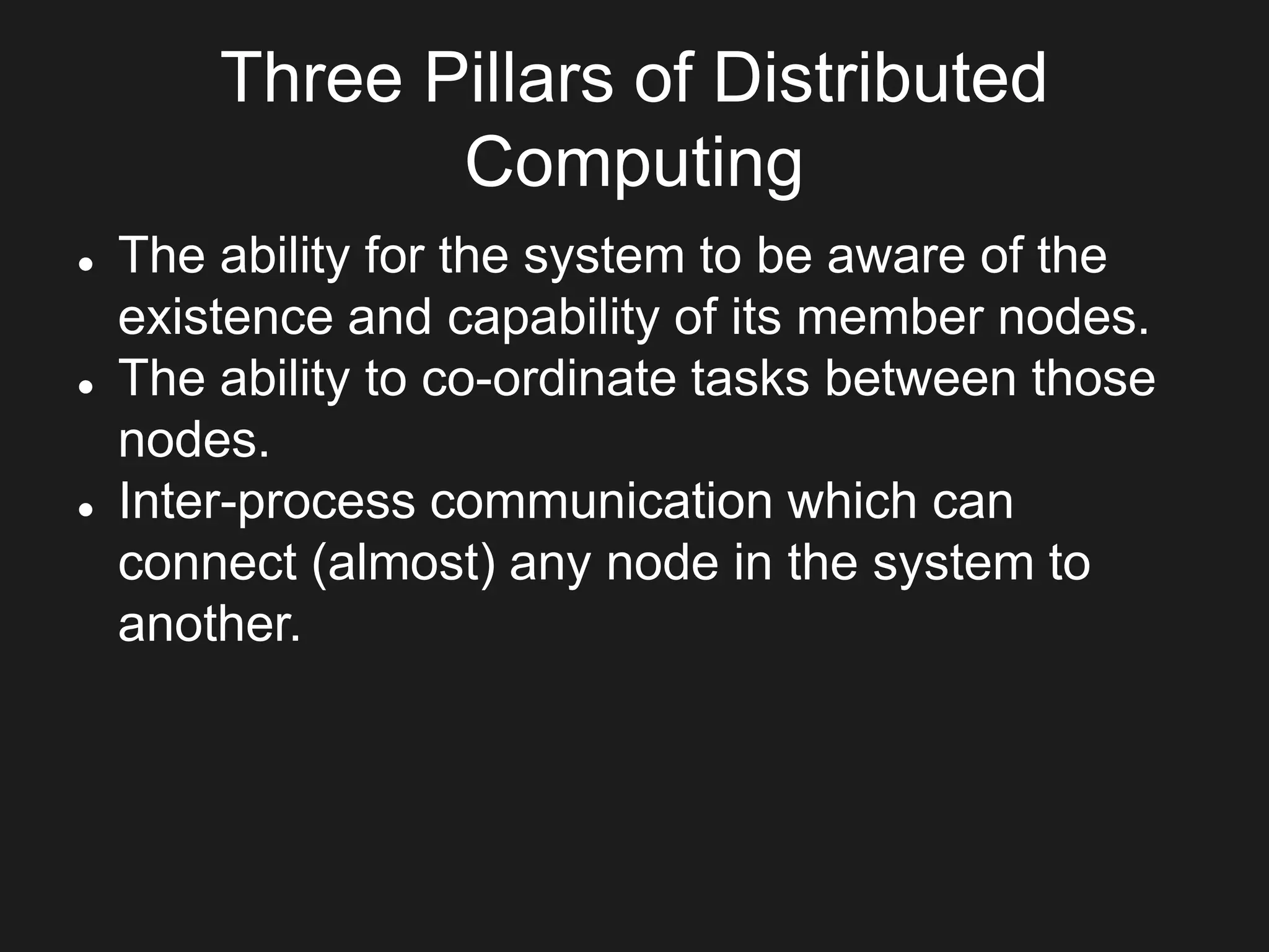
Three Pillars of Distributed
Computing
 The ability for the system to be aware of the
existence and capability of its member nodes.
 The ability to co-ordinate tasks between those
nodes.
 Inter-process communication which can
connect (almost) any node in the system to
another.
What are the properties of a
message bus?
 A data model
 A command set
 A transport infrastructure
Message Buses for Ops
 Monitoring
 Configuration management
 ChatOps
 Auto-scale
 Lambda
 Provisioning
Message Buses for Dev
 Almost anything that connects various layers of
an appliction stack has a message bus of some
kind
 Sometimes these are streaming
 Sometimes they’re just set up and torn down on
demand.
Question:
What possibilities emerge when these siloed
streams of events are shared with each other?
What does (most) automation look
like right now?
 Packaged workflows
 We take a series of steps and we list them out and
then we go and do those steps, with, hopefully a
little bit of abstraction and error control.
 Much of the time, these workflows are initiated by
lazy humans.
 Despite our best-efforts, these can still be very
brittle because one thing we’re not very good at is
understaning the state of a system before
automation runs on it. We make a lot of
assumptions, even today.
This doesn’t feel much like programming.
Event-driven Programming
 A programming paradigm in which the flow of
the program is determined by events such as
user actions (mouse clicks, key presses),
sensor outputs, or messages from other
programs/threads.
 Event-driven programming is the dominant
paradigm used in graphical user interfaces and
other applications that are centered on
performing certain actions in response to user
input.
Examples of Event Driven
Programming
 JavaScript
 node.js
 Most GUI applications on the desktop
 Pretty much any user interface on iOS
3 Principles of Event Driven
Programming
 A set of functions which handle events.
Depending on the implementation these can be
blocking or non-blocking.
 A mechanism for binding the registered functions
to events.
 A main loop (or loops, if you’re brave) which
constantly polls for new events and calls the
maching event handler(s) when a reigstered
event is received.
Traditional Criticisms of Event-
Driven Programming
 One one hand, there is imperative programming
 Writing procedures to performs steps in a particular
order.
 On the other hand, we have declarative
programming
 Describing the intended state of a system without
explicitely describing the steps to achieve that state.
Criticisms continued
 Highly asynchronous code can be difficult to
troubleshoot
 It takes a mindshift to think about imperative
and declarative approaches melded into one.
This can create some confusion.
 It can be challenging to translate procedural
workflows into something event-driven.
Event-driven Programming
Advantages
 It’s easy to find natural dividing lines for unit
testing infrastructure.
 It’s highly composeable.
 It allows for a very simple and understandable
model for both sides of the DevOps bridge.
 Both purely procedural and purely imperative
approaches get brittle as they grow in length
and complexity.
 It’s one good way to model systems that need
to be both asynchronous and reactive.
 High-speed event bus
 +
 Event-driven programming
 ==
 Event-driven infrastructure
Principles of Event-Driven
Automation
 Events originate from applications and from
systems.
 Filters exist to sort these events and apply rules
to them.
 As rules are met, registered actions occur.
Disadvantages of an Event-Driven
Approach
 Possible tight coupling between the event
schema and the consumers of the schema.
 Message loss
 Reasoning about “blocking” operations might
becoming more difficult.
 Testing
Advantages of Event-Driven
Appoach
 Distributed, scalable and loosly coupled
between systems.
 A “DevOps” automation backplane for system
 Does more than just configure/provision
systems at their birth. Allows for more complete
lifecycle management.
 Provides an immediate, common programmable
layer on top of existing automation/deployment
systems.
Fine then. How do we build one?
Flow
 An event is emitted on the event bus
 It flows to a manager
 The manager checks to see if the event
matches a registered handler
 If so, the a series of rules are checked
 For each set of rules which are matched, an
action is undertaken.
The moving pieces
 Event bus transport
 Telemetry
 Actors
 Reactors
Building Event Buses
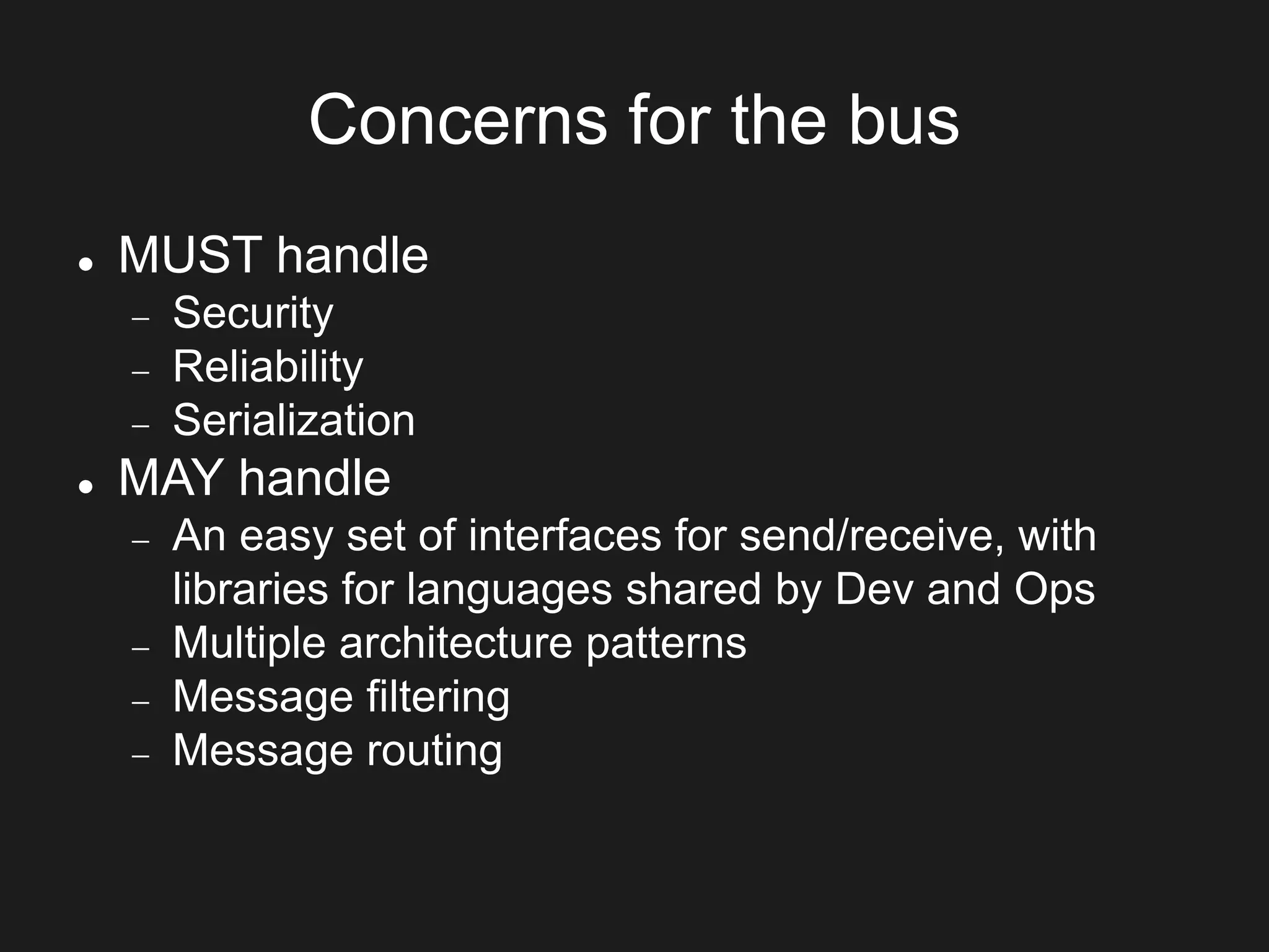
Concerns for the bus
 MUST handle
 Security
 Reliability
 Serialization
 MAY handle
 An easy set of interfaces for send/receive, with
libraries for languages shared by Dev and Ops
 Multiple architecture patterns
 Message filtering
 Message routing
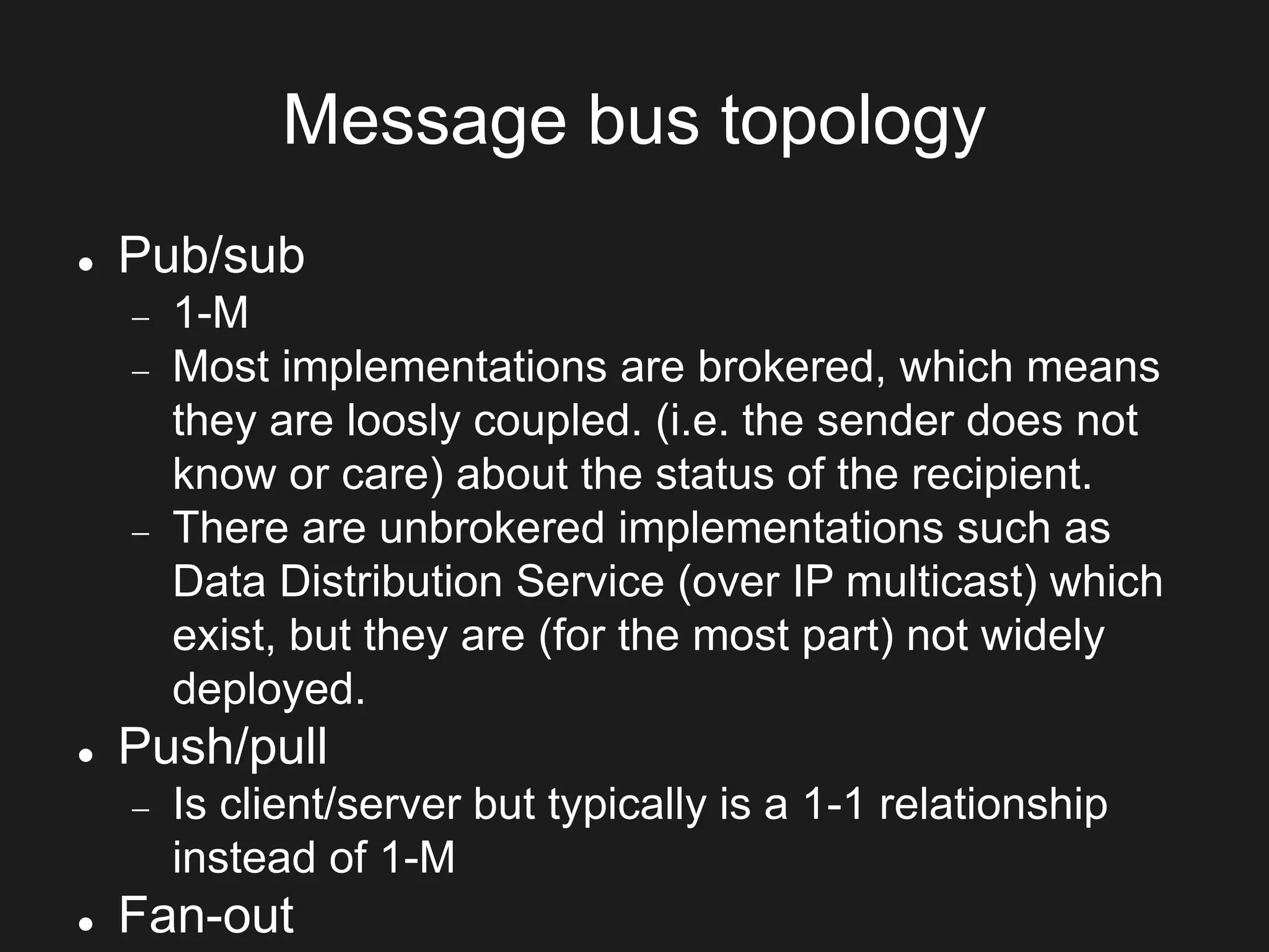
Message bus topology
 Pub/sub
 1-M
 Most implementations are brokered, which means
they are loosly coupled. (i.e. the sender does not
know or care) about the status of the recipient.
 There are unbrokered implementations such as
Data Distribution Service (over IP multicast) which
exist, but they are (for the most part) not widely
deployed.
 Push/pull
 Is client/server but typically is a 1-1 relationship
instead of 1-M
 Fan-out
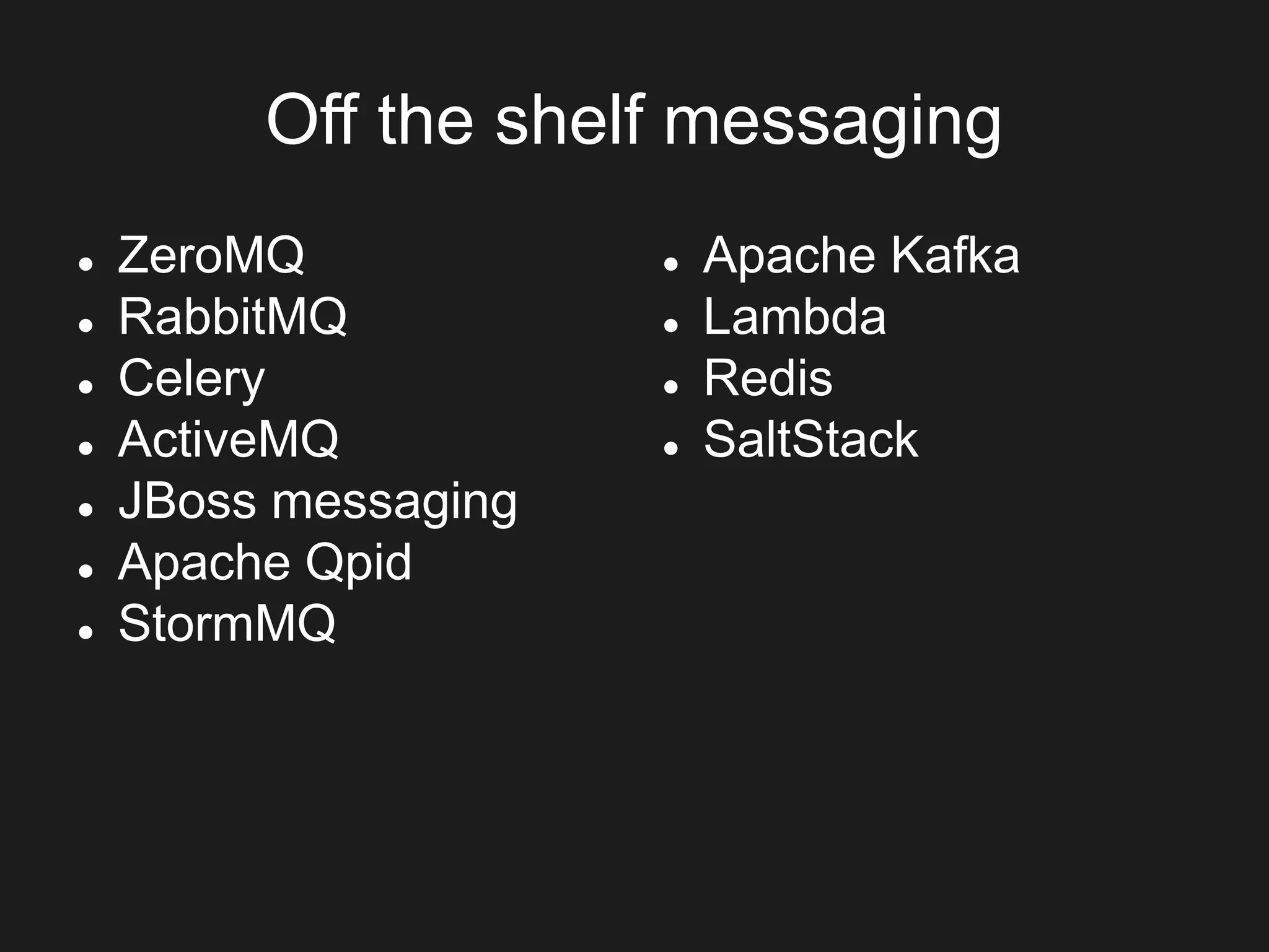
Off the shelf messaging
 ZeroMQ
 RabbitMQ
 Celery
 ActiveMQ
 JBoss messaging
 Apache Qpid
 StormMQ
 Apache Kafka
 Lambda
 Redis
 SaltStack
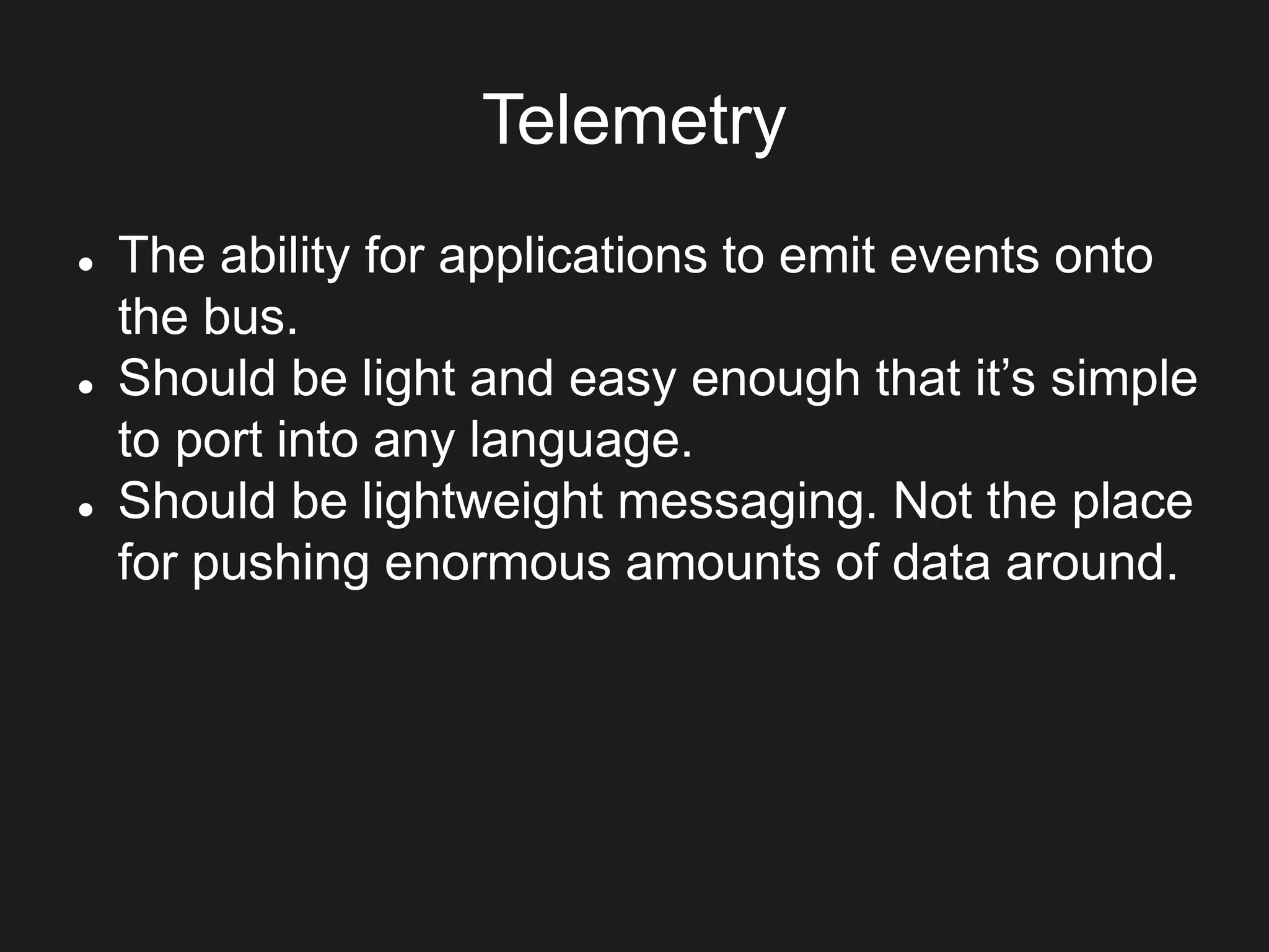
Telemetry
 The ability for applications to emit events onto
the bus.
 Should be light and easy enough that it’s simple
to port into any language.
 Should be lightweight messaging. Not the place
for pushing enormous amounts of data around.
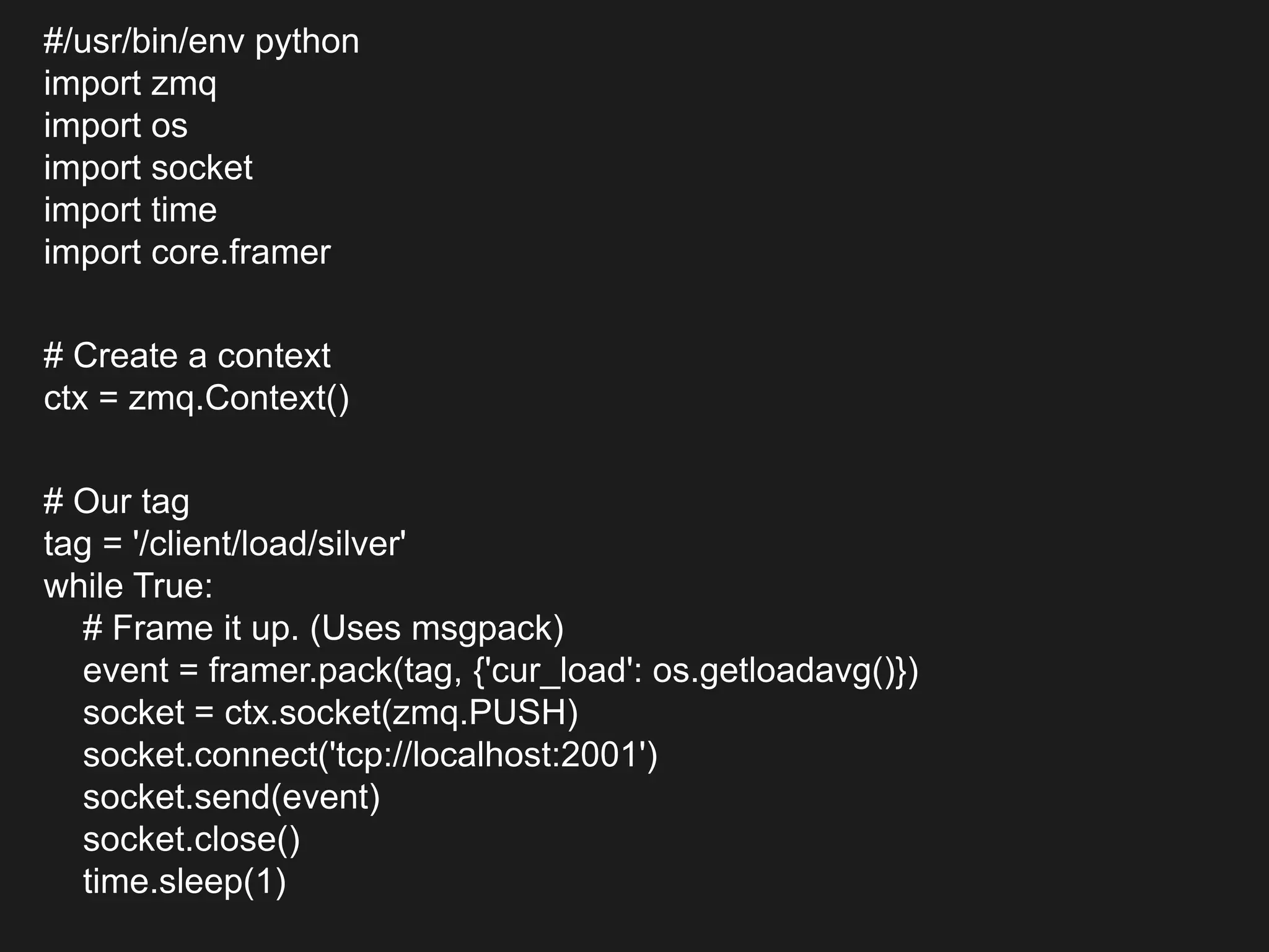
#/usr/bin/env python
import zmq
import os
import socket
import time
import core.framer
# Create a context
ctx = zmq.Context()
# Our tag
tag = '/client/load/silver'
while True:
# Frame it up. (Uses msgpack)
event = framer.pack(tag, {'cur_load': os.getloadavg()})
socket = ctx.socket(zmq.PUSH)
socket.connect('tcp://localhost:2001')
socket.send(event)
socket.close()
time.sleep(1)
Building Reactors
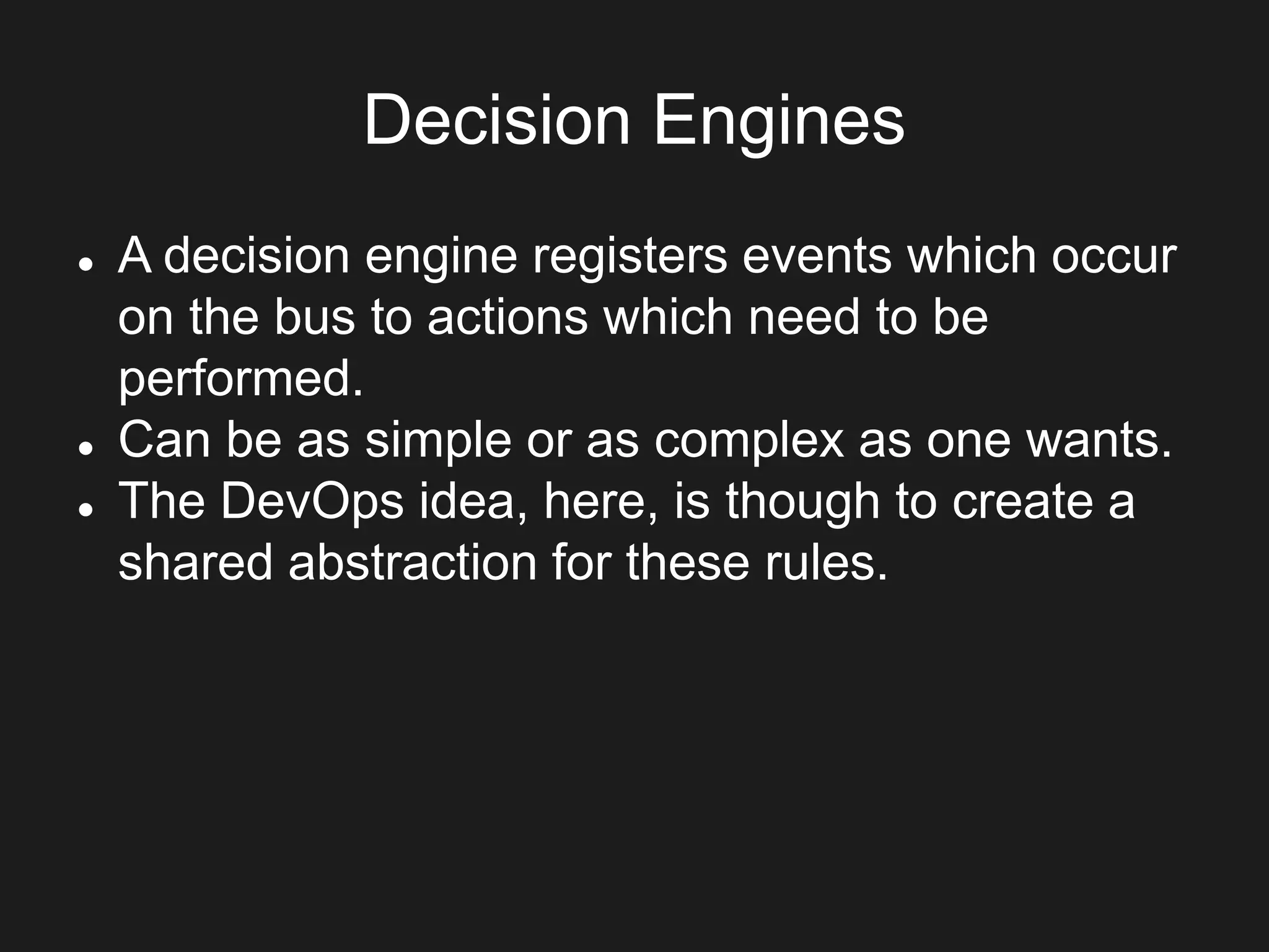
Decision Engines
 A decision engine registers events which occur
on the bus to actions which need to be
performed.
 Can be as simple or as complex as one wants.
 The DevOps idea, here, is though to create a
shared abstraction for these rules.
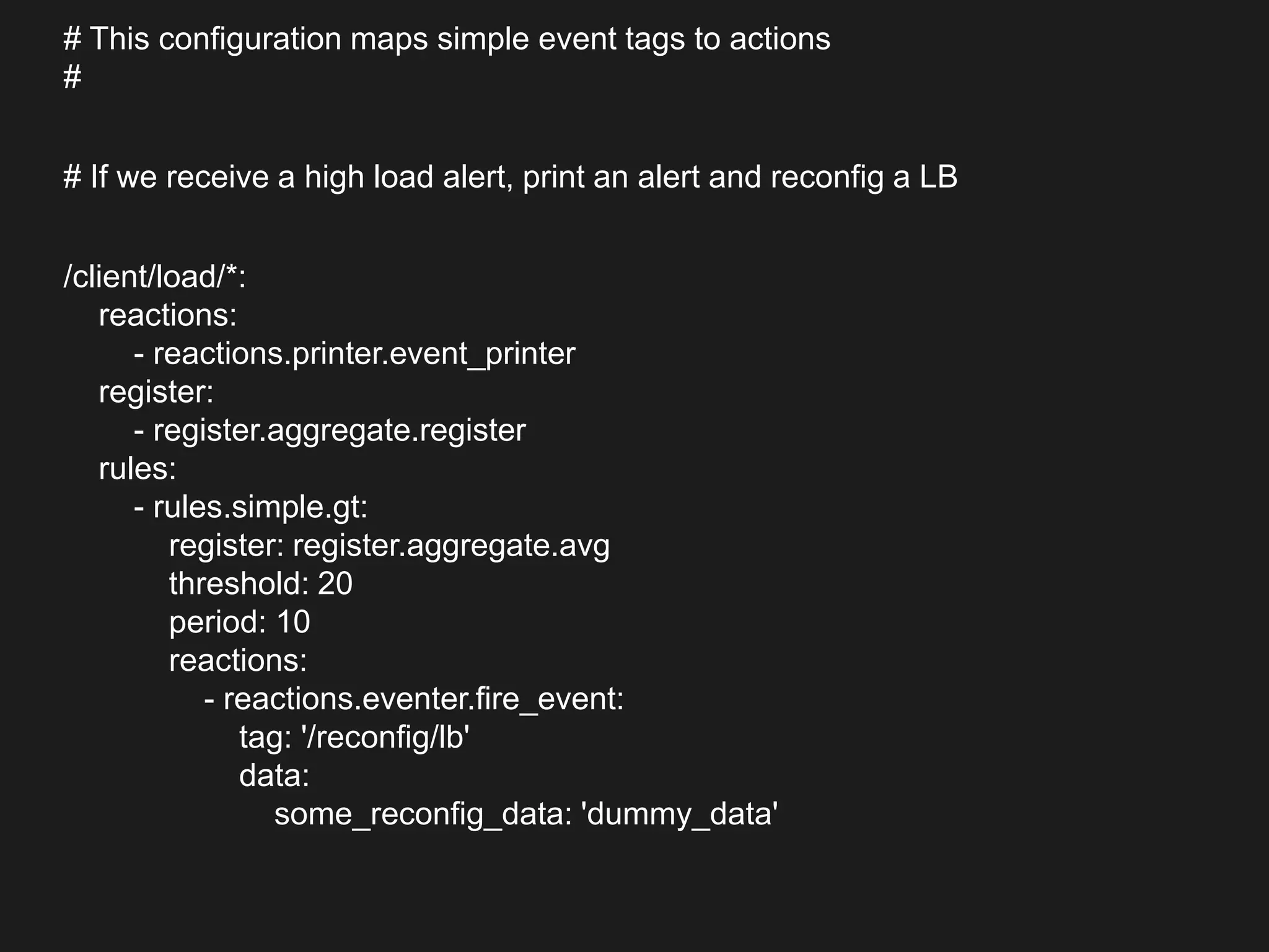
# This configuration maps simple event tags to actions
#
# If we receive a high load alert, print an alert and reconfig a LB
/client/load/*:
reactions:
- reactions.printer.event_printer
register:
- register.aggregate.register
rules:
- rules.simple.gt:
register: register.aggregate.avg
threshold: 20
period: 10
reactions:
- reactions.eventer.fire_event:
tag: '/reconfig/lb'
data:
some_reconfig_data: 'dummy_data'
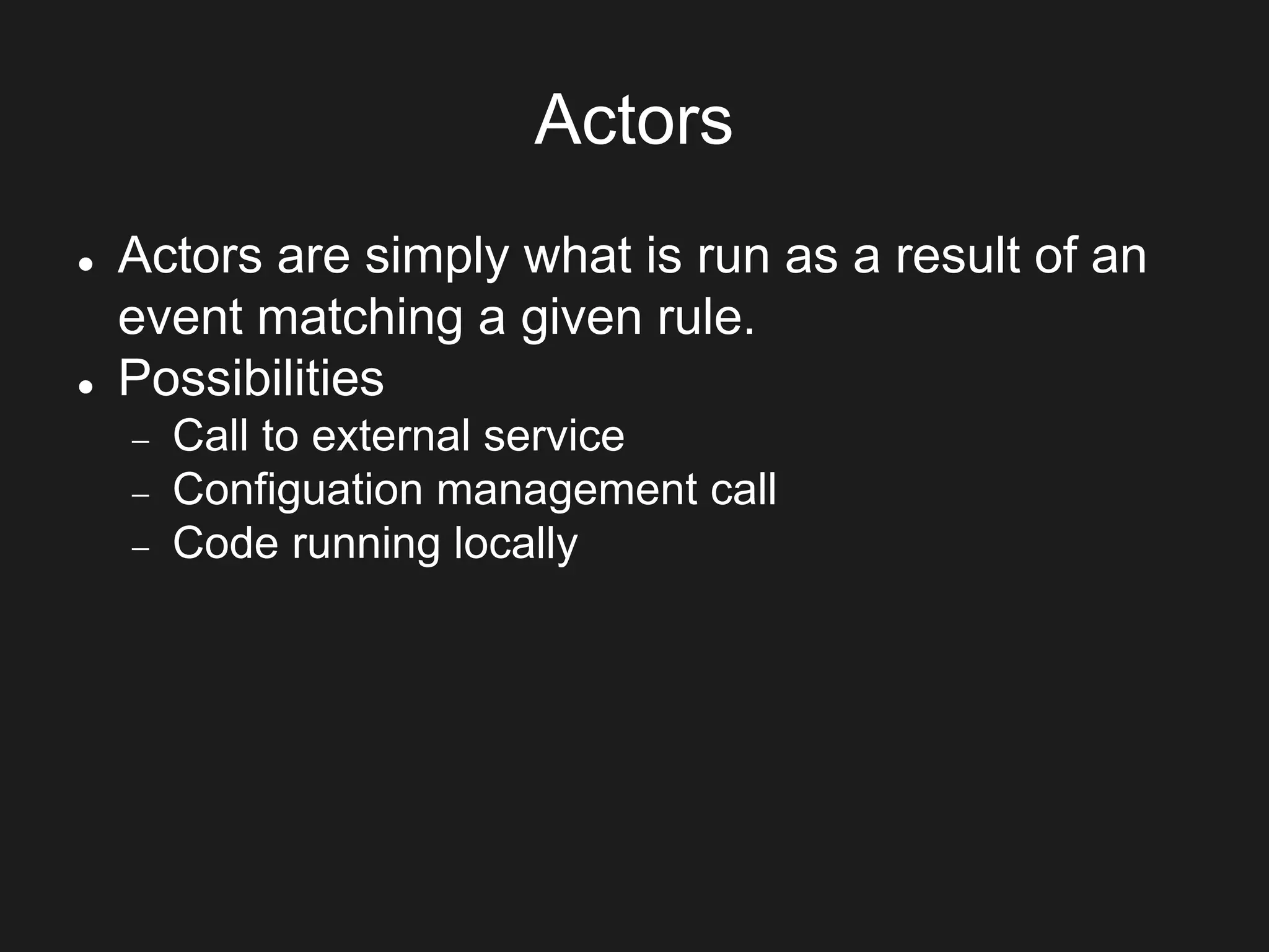
Actors
 Actors are simply what is run as a result of an
event matching a given rule.
 Possibilities
 Call to external service
 Configuation management call
 Code running locally
https://github.com/cachedout/eventdriventalk
Review
 To build scalable systems, we need to adopt the
lessons of distributed computing
 We can migrate from simple human-initiated
workflows to reactive, programmable systems.
 Event buses are pretty good. Let’s build more of
those.
Questions?
Mike Place
@cachedout
mp@saltstack.com

Event-driven Infrastructure - Mike Place, SaltStack - DevOpsDays Tel Aviv 2016

  • 1.
  • 2.
    Question-Driven Presentation WARNING: Thistalk may leave you with more questions than answers. (Hopefully, that’s a good thing.)
  • 3.
    Automation brought usnew toolchains. DevOps brought us new culture. What now?
  • 4.
    Three Pillars ofDistributed Computing  The ability for the system to be aware of the existence and capability of its member nodes.  The ability to co-ordinate tasks between those nodes.  Inter-process communication which can connect (almost) any node in the system to another.
  • 5.
    What are theproperties of a message bus?  A data model  A command set  A transport infrastructure
  • 6.
    Message Buses forOps  Monitoring  Configuration management  ChatOps  Auto-scale  Lambda  Provisioning
  • 7.
    Message Buses forDev  Almost anything that connects various layers of an appliction stack has a message bus of some kind  Sometimes these are streaming  Sometimes they’re just set up and torn down on demand.
  • 8.
    Question: What possibilities emergewhen these siloed streams of events are shared with each other?
  • 9.
    What does (most)automation look like right now?  Packaged workflows  We take a series of steps and we list them out and then we go and do those steps, with, hopefully a little bit of abstraction and error control.  Much of the time, these workflows are initiated by lazy humans.  Despite our best-efforts, these can still be very brittle because one thing we’re not very good at is understaning the state of a system before automation runs on it. We make a lot of assumptions, even today.
  • 10.
    This doesn’t feelmuch like programming.
  • 11.
    Event-driven Programming  Aprogramming paradigm in which the flow of the program is determined by events such as user actions (mouse clicks, key presses), sensor outputs, or messages from other programs/threads.  Event-driven programming is the dominant paradigm used in graphical user interfaces and other applications that are centered on performing certain actions in response to user input.
  • 12.
    Examples of EventDriven Programming  JavaScript  node.js  Most GUI applications on the desktop  Pretty much any user interface on iOS
  • 13.
    3 Principles ofEvent Driven Programming  A set of functions which handle events. Depending on the implementation these can be blocking or non-blocking.  A mechanism for binding the registered functions to events.  A main loop (or loops, if you’re brave) which constantly polls for new events and calls the maching event handler(s) when a reigstered event is received.
  • 14.
    Traditional Criticisms ofEvent- Driven Programming  One one hand, there is imperative programming  Writing procedures to performs steps in a particular order.  On the other hand, we have declarative programming  Describing the intended state of a system without explicitely describing the steps to achieve that state.
  • 15.
    Criticisms continued  Highlyasynchronous code can be difficult to troubleshoot  It takes a mindshift to think about imperative and declarative approaches melded into one. This can create some confusion.  It can be challenging to translate procedural workflows into something event-driven.
  • 16.
    Event-driven Programming Advantages  It’seasy to find natural dividing lines for unit testing infrastructure.  It’s highly composeable.  It allows for a very simple and understandable model for both sides of the DevOps bridge.  Both purely procedural and purely imperative approaches get brittle as they grow in length and complexity.  It’s one good way to model systems that need to be both asynchronous and reactive.
  • 17.
     High-speed eventbus  +  Event-driven programming  ==  Event-driven infrastructure
  • 18.
    Principles of Event-Driven Automation Events originate from applications and from systems.  Filters exist to sort these events and apply rules to them.  As rules are met, registered actions occur.
  • 19.
    Disadvantages of anEvent-Driven Approach  Possible tight coupling between the event schema and the consumers of the schema.  Message loss  Reasoning about “blocking” operations might becoming more difficult.  Testing
  • 20.
    Advantages of Event-Driven Appoach Distributed, scalable and loosly coupled between systems.  A “DevOps” automation backplane for system  Does more than just configure/provision systems at their birth. Allows for more complete lifecycle management.  Provides an immediate, common programmable layer on top of existing automation/deployment systems.
  • 21.
    Fine then. Howdo we build one?
  • 22.
    Flow  An eventis emitted on the event bus  It flows to a manager  The manager checks to see if the event matches a registered handler  If so, the a series of rules are checked  For each set of rules which are matched, an action is undertaken.
  • 23.
    The moving pieces Event bus transport  Telemetry  Actors  Reactors
  • 24.
  • 25.
    Concerns for thebus  MUST handle  Security  Reliability  Serialization  MAY handle  An easy set of interfaces for send/receive, with libraries for languages shared by Dev and Ops  Multiple architecture patterns  Message filtering  Message routing
  • 26.
    Message bus topology Pub/sub  1-M  Most implementations are brokered, which means they are loosly coupled. (i.e. the sender does not know or care) about the status of the recipient.  There are unbrokered implementations such as Data Distribution Service (over IP multicast) which exist, but they are (for the most part) not widely deployed.  Push/pull  Is client/server but typically is a 1-1 relationship instead of 1-M  Fan-out
  • 27.
    Off the shelfmessaging  ZeroMQ  RabbitMQ  Celery  ActiveMQ  JBoss messaging  Apache Qpid  StormMQ  Apache Kafka  Lambda  Redis  SaltStack
  • 28.
    Telemetry  The abilityfor applications to emit events onto the bus.  Should be light and easy enough that it’s simple to port into any language.  Should be lightweight messaging. Not the place for pushing enormous amounts of data around.
  • 29.
    #/usr/bin/env python import zmq importos import socket import time import core.framer # Create a context ctx = zmq.Context() # Our tag tag = '/client/load/silver' while True: # Frame it up. (Uses msgpack) event = framer.pack(tag, {'cur_load': os.getloadavg()}) socket = ctx.socket(zmq.PUSH) socket.connect('tcp://localhost:2001') socket.send(event) socket.close() time.sleep(1)
  • 30.
  • 32.
    Decision Engines  Adecision engine registers events which occur on the bus to actions which need to be performed.  Can be as simple or as complex as one wants.  The DevOps idea, here, is though to create a shared abstraction for these rules.
  • 33.
    # This configurationmaps simple event tags to actions # # If we receive a high load alert, print an alert and reconfig a LB /client/load/*: reactions: - reactions.printer.event_printer register: - register.aggregate.register rules: - rules.simple.gt: register: register.aggregate.avg threshold: 20 period: 10 reactions: - reactions.eventer.fire_event: tag: '/reconfig/lb' data: some_reconfig_data: 'dummy_data'
  • 34.
    Actors  Actors aresimply what is run as a result of an event matching a given rule.  Possibilities  Call to external service  Configuation management call  Code running locally
  • 35.
  • 36.
    Review  To buildscalable systems, we need to adopt the lessons of distributed computing  We can migrate from simple human-initiated workflows to reactive, programmable systems.  Event buses are pretty good. Let’s build more of those.
  • 37.