OOAD-3
By: Jitendra Singh Rathore
Lect., IT
TCT, Bhopal
OMT(Object Modeling
Technique)
   It is a methodology that combines the views of
    a modeling system.
   Three types of model used.
        (1) Object Model
        (2) Dynamic Model
        (3) Functional Model
Object Model
   It represents static, structured, data aspect of the
    system.
   Structure of a system contains following information-
•        Their Identity
•        Their Relationship to other objects
•        Their Attribute.
•        Their Operations.

   Object model provides the essential Framework into
    which Dynamic and Functional model can be placed.
   It is represent (Graphically) by Object Diagram
Dynamic Model
   It represents the-
    Temporal
    Behavioral and,
   Control aspects of the system.
Functional Model
    It represents the Transformational (Functions)
     aspects of the system.
    Describe those aspect of the system concerned
     with Transformation of values.
    It concerned with following-
1.      Functions
2.      Mapping
3.     Constraints and
4.     Functional Dependency
     Represented by – DFD, CFD
Dynamic Model
    Describes the aspect of a system concerned
     with Time and Sequencing of Operations-
1.    Events that mark changes.
2.    Sequence of Events.
3.    State that defines the context for event and
4.    The organization of events and states.
     It is represented by the a State Diagram.
Dynamic Model…………
                Summary
   The dynamic model shows the time-dependent
    behavior of the system and the objects in it.
   Begin dynamic analysis by looking for event,
    externally visible stimuli and responses.
   The dynamic model is important for interactive
    systems, but insignificant for purely static data
    repository, such as database.
Dynamic Model……
                                  State &
Events
 State
  The attribute values and link held by an object are
  called its state.
 Events-

  An individual stimulus from one object to another
  as called an event. OR
 An event is something that happens at a point in
  time.
 ex. User depress left button of a mouse.
 Overtime, the object stimulate each other,
  resulting in a series of changes to their states.
Dynamic Model……
                                     Events
    Concurrent Event- Two events that are casually
     unrelated are said to be con current events.
    Points to Ponder:
1.    In a modeling system, we don’t try to establish
      an ordering between concurrent events, because
      they can occur in any order.
2.    An event is a one way function transmission of
      information from one object to another. It is not
      like a subroutine/function that returns a value.
3.    Every event is a unique occurrence, but we
      group into event class, & give each event class a
      name to initialize a common structure and
      behavior.
Dynamic Model……
                                       Events
    For Exp.(Event class and attribute)
1.     airplane flight depart (airline, flight no, city)
2.    Mouse button pressed (button, location)
3.    Input string enterd (text)
4.    Phone receiver lifted
5.    Digit dialed (digit)
6.    Engine speed enters danger zone
Dynamic Modeling…..
                State Diagram
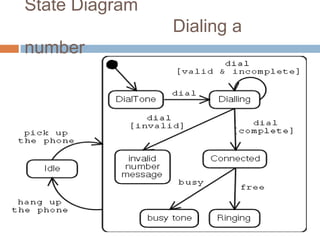
    The pattern of events, state and state transitions
     for a given class can be abstracted and
     represented as state diagram.
1.     A state diagram is network of states and events.
2.     The state diagram, one state diagram for each
       class with important dynamic behavior and
       shows the pattern of activity for an entire system.
3.     Each state machine executes concurrently and
       can change state independently
4.     The state diagram for the various classes
       combine into a single dynamic model via shared
       events.
Dynamic Modeling…..
    The following steps are performed in constructing a
     dynamic model
1.     Prepare scenarios of typical interaction
      sequences
2.     Identify events between objects
3.     Prepare an event trace for each scenario
4.     Build a state diagram
5.     Match events between objects to verify
      consistency
Dynamic Modeling…..
           Scenerios & Event
Traces
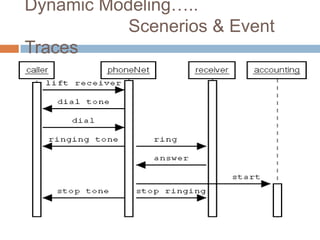
    Sequence of events that occur during one
     particular execution of a system.
    The scope of scenarios can vary-
1.    It may include all events in the system.
2.    Or, it may include only those events
      impinging on or generated by certain objects
      into the system.
3.    Or, it can be a historical records.
Dynamic Modeling…..
           Scenerios & Event
Traces
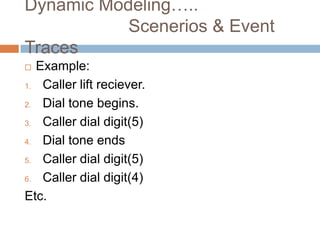
 Example:
1. Caller lift reciever.

2. Dial tone begins.

3. Caller dial digit(5)

4. Dial tone ends

5. Caller dial digit(5)

6. Caller dial digit(4)

Etc.
Dynamic Modeling…..
           Scenerios & Event
Traces
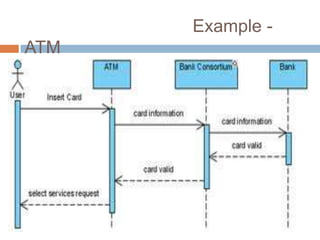
Example -
ATM
State Diagram
                Dialing a
number

Ooad 3

  • 1.
    OOAD-3 By: Jitendra SinghRathore Lect., IT TCT, Bhopal
  • 2.
    OMT(Object Modeling Technique)  It is a methodology that combines the views of a modeling system.  Three types of model used.  (1) Object Model  (2) Dynamic Model  (3) Functional Model
  • 3.
    Object Model  It represents static, structured, data aspect of the system.  Structure of a system contains following information- • Their Identity • Their Relationship to other objects • Their Attribute. • Their Operations.  Object model provides the essential Framework into which Dynamic and Functional model can be placed.  It is represent (Graphically) by Object Diagram
  • 4.
    Dynamic Model  It represents the-  Temporal  Behavioral and,  Control aspects of the system.
  • 5.
    Functional Model  It represents the Transformational (Functions) aspects of the system.  Describe those aspect of the system concerned with Transformation of values.  It concerned with following- 1. Functions 2. Mapping 3. Constraints and 4. Functional Dependency  Represented by – DFD, CFD
  • 6.
    Dynamic Model  Describes the aspect of a system concerned with Time and Sequencing of Operations- 1. Events that mark changes. 2. Sequence of Events. 3. State that defines the context for event and 4. The organization of events and states.  It is represented by the a State Diagram.
  • 7.
    Dynamic Model………… Summary  The dynamic model shows the time-dependent behavior of the system and the objects in it.  Begin dynamic analysis by looking for event, externally visible stimuli and responses.  The dynamic model is important for interactive systems, but insignificant for purely static data repository, such as database.
  • 8.
    Dynamic Model…… State & Events  State The attribute values and link held by an object are called its state.  Events- An individual stimulus from one object to another as called an event. OR  An event is something that happens at a point in time. ex. User depress left button of a mouse.  Overtime, the object stimulate each other, resulting in a series of changes to their states.
  • 9.
    Dynamic Model…… Events  Concurrent Event- Two events that are casually unrelated are said to be con current events.  Points to Ponder: 1. In a modeling system, we don’t try to establish an ordering between concurrent events, because they can occur in any order. 2. An event is a one way function transmission of information from one object to another. It is not like a subroutine/function that returns a value. 3. Every event is a unique occurrence, but we group into event class, & give each event class a name to initialize a common structure and behavior.
  • 10.
    Dynamic Model…… Events  For Exp.(Event class and attribute) 1. airplane flight depart (airline, flight no, city) 2. Mouse button pressed (button, location) 3. Input string enterd (text) 4. Phone receiver lifted 5. Digit dialed (digit) 6. Engine speed enters danger zone
  • 11.
    Dynamic Modeling….. State Diagram  The pattern of events, state and state transitions for a given class can be abstracted and represented as state diagram. 1. A state diagram is network of states and events. 2. The state diagram, one state diagram for each class with important dynamic behavior and shows the pattern of activity for an entire system. 3. Each state machine executes concurrently and can change state independently 4. The state diagram for the various classes combine into a single dynamic model via shared events.
  • 12.
    Dynamic Modeling…..  The following steps are performed in constructing a dynamic model 1. Prepare scenarios of typical interaction sequences 2. Identify events between objects 3. Prepare an event trace for each scenario 4. Build a state diagram 5. Match events between objects to verify consistency
  • 13.
    Dynamic Modeling….. Scenerios & Event Traces  Sequence of events that occur during one particular execution of a system.  The scope of scenarios can vary- 1. It may include all events in the system. 2. Or, it may include only those events impinging on or generated by certain objects into the system. 3. Or, it can be a historical records.
  • 14.
    Dynamic Modeling….. Scenerios & Event Traces  Example: 1. Caller lift reciever. 2. Dial tone begins. 3. Caller dial digit(5) 4. Dial tone ends 5. Caller dial digit(5) 6. Caller dial digit(4) Etc.
  • 15.
    Dynamic Modeling….. Scenerios & Event Traces
  • 16.
  • 17.
    State Diagram Dialing a number