Clavien-Dindo Classification of 
Surgical Complications 
Stephen Chapman 
STARSurgII : DISCOVER Protocol Launch 
16th September 2014, Royal College of Surgeons of England
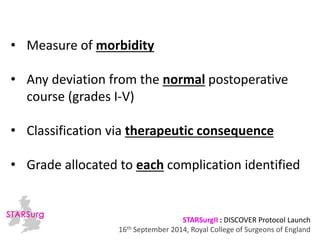
• Measure of morbidity 
• Any deviation from the normal postoperative 
course (grades I-V) 
• Classification via therapeutic consequence 
• Grade allocated to each complication identified 
STARSurgII : DISCOVER Protocol Launch 
16th September 2014, Royal College of Surgeons of England
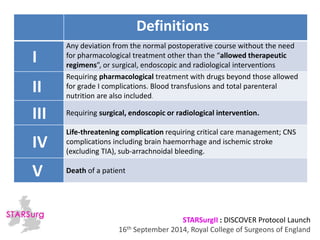
Definitions 
STARSurgII : DISCOVER Protocol Launch 
16th September 2014, Royal College of Surgeons of England 
I 
Any deviation from the normal postoperative course without the need 
for pharmacological treatment other than the “allowed therapeutic 
regimens”, or surgical, endoscopic and radiological interventions 
II 
Requiring pharmacological treatment with drugs beyond those allowed 
for grade I complications. Blood transfusions and total parenteral 
nutrition are also included. 
III Requiring surgical, endoscopic or radiological intervention. 
IV 
Life-threatening complication requiring critical care management; CNS 
complications including brain haemorrhage and ischemic stroke 
(excluding TIA), sub-arrachnoidal bleeding. 
V Death of a patient
STARSurgII : DISCOVER Protocol Launch 
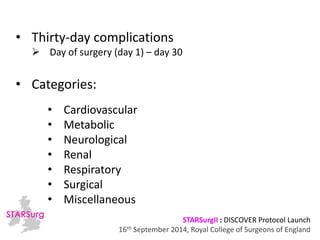
• Thirty-day complications 
 Day of surgery (day 1) – day 30 
16th September 2014, Royal College of Surgeons of England 
• Categories: 
• Cardiovascular 
• Metabolic 
• Neurological 
• Renal 
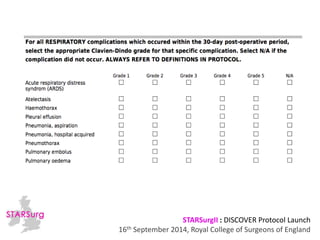
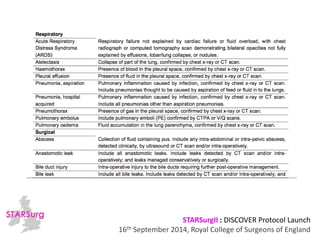
• Respiratory 
• Surgical 
• Miscellaneous
STARSurgII : DISCOVER Protocol Launch 
16th September 2014, Royal College of Surgeons of England
STARSurgII : DISCOVER Protocol Launch 
16th September 2014, Royal College of Surgeons of England
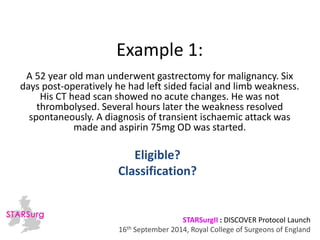
Example 1: 
A 52 year old man underwent gastrectomy for malignancy. Six 
days post-operatively he had left sided facial and limb weakness. 
His CT head scan showed no acute changes. He was not 
thrombolysed. Several hours later the weakness resolved 
spontaneously. A diagnosis of transient ischaemic attack was 
made and aspirin 75mg OD was started. 
Classification? 
STARSurgII : DISCOVER Protocol Launch 
Eligible? 
16th September 2014, Royal College of Surgeons of England
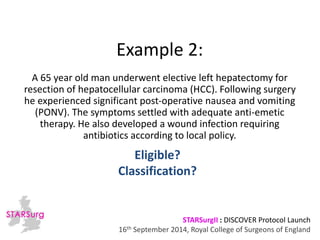
Example 2: 
A 65 year old man underwent elective left hepatectomy for 
resection of hepatocellular carcinoma (HCC). Following surgery 
he experienced significant post-operative nausea and vomiting 
(PONV). The symptoms settled with adequate anti-emetic 
therapy. He also developed a wound infection requiring 
antibiotics according to local policy. 
Classification? 
STARSurgII : DISCOVER Protocol Launch 
Eligible? 
16th September 2014, Royal College of Surgeons of England
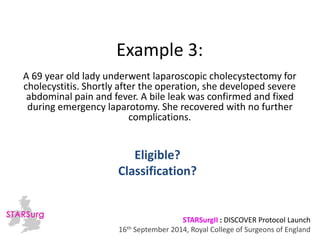
Example 3: 
A 69 year old lady underwent laparoscopic cholecystectomy for 
cholecystitis. Shortly after the operation, she developed severe 
abdominal pain and fever. A bile leak was confirmed and fixed 
during emergency laparotomy. She recovered with no further 
complications. 
Classification? 
STARSurgII : DISCOVER Protocol Launch 
Eligible? 
16th September 2014, Royal College of Surgeons of England
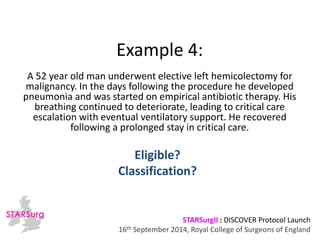
Example 4: 
A 52 year old man underwent elective left hemicolectomy for 
malignancy. In the days following the procedure he developed 
pneumonia and was started on empirical antibiotic therapy. His 
breathing continued to deteriorate, leading to critical care 
escalation with eventual ventilatory support. He recovered 
following a prolonged stay in critical care. 
Classification? 
STARSurgII : DISCOVER Protocol Launch 
Eligible? 
16th September 2014, Royal College of Surgeons of England
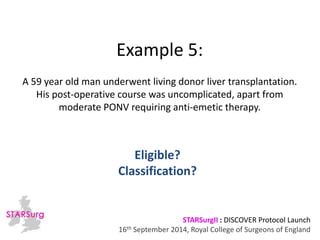
Example 5: 
A 59 year old man underwent living donor liver transplantation. 
His post-operative course was uncomplicated, apart from 
moderate PONV requiring anti-emetic therapy. 
Classification? 
STARSurgII : DISCOVER Protocol Launch 
Eligible? 
16th September 2014, Royal College of Surgeons of England
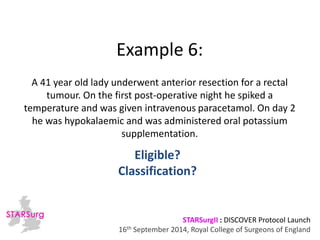
Example 6: 
A 41 year old lady underwent anterior resection for a rectal 
tumour. On the first post-operative night he spiked a 
temperature and was given intravenous paracetamol. On day 2 
he was hypokalaemic and was administered oral potassium 
supplementation. 
Classification? 
STARSurgII : DISCOVER Protocol Launch 
Eligible? 
16th September 2014, Royal College of Surgeons of England
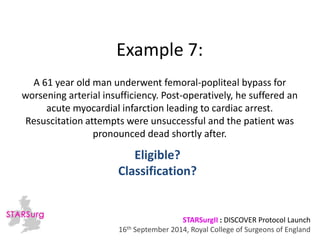
Example 7: 
A 61 year old man underwent femoral-popliteal bypass for 
worsening arterial insufficiency. Post-operatively, he suffered an 
acute myocardial infarction leading to cardiac arrest. 
Resuscitation attempts were unsuccessful and the patient was 
pronounced dead shortly after. 
Classification? 
STARSurgII : DISCOVER Protocol Launch 
Eligible? 
16th September 2014, Royal College of Surgeons of England
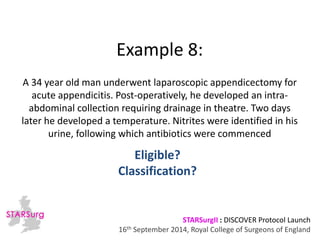
Example 8: 
A 34 year old man underwent laparoscopic appendicectomy for 
acute appendicitis. Post-operatively, he developed an intra-abdominal 
collection requiring drainage in theatre. Two days 
later he developed a temperature. Nitrites were identified in his 
urine, following which antibiotics were commenced 
Classification? 
STARSurgII : DISCOVER Protocol Launch 
Eligible? 
16th September 2014, Royal College of Surgeons of England
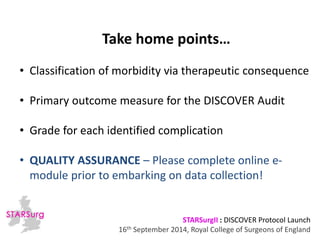
Take home points… 
• Classification of morbidity via therapeutic consequence 
• Primary outcome measure for the DISCOVER Audit 
• Grade for each identified complication 
• QUALITY ASSURANCE – Please complete online e-module 
prior to embarking on data collection! 
STARSurgII : DISCOVER Protocol Launch 
16th September 2014, Royal College of Surgeons of England

Discover Clavien-Dindo Classification

  • 1.
    Clavien-Dindo Classification of Surgical Complications Stephen Chapman STARSurgII : DISCOVER Protocol Launch 16th September 2014, Royal College of Surgeons of England
  • 2.
    • Measure ofmorbidity • Any deviation from the normal postoperative course (grades I-V) • Classification via therapeutic consequence • Grade allocated to each complication identified STARSurgII : DISCOVER Protocol Launch 16th September 2014, Royal College of Surgeons of England
  • 3.
    Definitions STARSurgII :DISCOVER Protocol Launch 16th September 2014, Royal College of Surgeons of England I Any deviation from the normal postoperative course without the need for pharmacological treatment other than the “allowed therapeutic regimens”, or surgical, endoscopic and radiological interventions II Requiring pharmacological treatment with drugs beyond those allowed for grade I complications. Blood transfusions and total parenteral nutrition are also included. III Requiring surgical, endoscopic or radiological intervention. IV Life-threatening complication requiring critical care management; CNS complications including brain haemorrhage and ischemic stroke (excluding TIA), sub-arrachnoidal bleeding. V Death of a patient
  • 4.
    STARSurgII : DISCOVERProtocol Launch • Thirty-day complications  Day of surgery (day 1) – day 30 16th September 2014, Royal College of Surgeons of England • Categories: • Cardiovascular • Metabolic • Neurological • Renal • Respiratory • Surgical • Miscellaneous
  • 5.
    STARSurgII : DISCOVERProtocol Launch 16th September 2014, Royal College of Surgeons of England
  • 6.
    STARSurgII : DISCOVERProtocol Launch 16th September 2014, Royal College of Surgeons of England
  • 7.
    Example 1: A52 year old man underwent gastrectomy for malignancy. Six days post-operatively he had left sided facial and limb weakness. His CT head scan showed no acute changes. He was not thrombolysed. Several hours later the weakness resolved spontaneously. A diagnosis of transient ischaemic attack was made and aspirin 75mg OD was started. Classification? STARSurgII : DISCOVER Protocol Launch Eligible? 16th September 2014, Royal College of Surgeons of England
  • 8.
    Example 2: A65 year old man underwent elective left hepatectomy for resection of hepatocellular carcinoma (HCC). Following surgery he experienced significant post-operative nausea and vomiting (PONV). The symptoms settled with adequate anti-emetic therapy. He also developed a wound infection requiring antibiotics according to local policy. Classification? STARSurgII : DISCOVER Protocol Launch Eligible? 16th September 2014, Royal College of Surgeons of England
  • 9.
    Example 3: A69 year old lady underwent laparoscopic cholecystectomy for cholecystitis. Shortly after the operation, she developed severe abdominal pain and fever. A bile leak was confirmed and fixed during emergency laparotomy. She recovered with no further complications. Classification? STARSurgII : DISCOVER Protocol Launch Eligible? 16th September 2014, Royal College of Surgeons of England
  • 10.
    Example 4: A52 year old man underwent elective left hemicolectomy for malignancy. In the days following the procedure he developed pneumonia and was started on empirical antibiotic therapy. His breathing continued to deteriorate, leading to critical care escalation with eventual ventilatory support. He recovered following a prolonged stay in critical care. Classification? STARSurgII : DISCOVER Protocol Launch Eligible? 16th September 2014, Royal College of Surgeons of England
  • 11.
    Example 5: A59 year old man underwent living donor liver transplantation. His post-operative course was uncomplicated, apart from moderate PONV requiring anti-emetic therapy. Classification? STARSurgII : DISCOVER Protocol Launch Eligible? 16th September 2014, Royal College of Surgeons of England
  • 12.
    Example 6: A41 year old lady underwent anterior resection for a rectal tumour. On the first post-operative night he spiked a temperature and was given intravenous paracetamol. On day 2 he was hypokalaemic and was administered oral potassium supplementation. Classification? STARSurgII : DISCOVER Protocol Launch Eligible? 16th September 2014, Royal College of Surgeons of England
  • 13.
    Example 7: A61 year old man underwent femoral-popliteal bypass for worsening arterial insufficiency. Post-operatively, he suffered an acute myocardial infarction leading to cardiac arrest. Resuscitation attempts were unsuccessful and the patient was pronounced dead shortly after. Classification? STARSurgII : DISCOVER Protocol Launch Eligible? 16th September 2014, Royal College of Surgeons of England
  • 14.
    Example 8: A34 year old man underwent laparoscopic appendicectomy for acute appendicitis. Post-operatively, he developed an intra-abdominal collection requiring drainage in theatre. Two days later he developed a temperature. Nitrites were identified in his urine, following which antibiotics were commenced Classification? STARSurgII : DISCOVER Protocol Launch Eligible? 16th September 2014, Royal College of Surgeons of England
  • 15.
    Take home points… • Classification of morbidity via therapeutic consequence • Primary outcome measure for the DISCOVER Audit • Grade for each identified complication • QUALITY ASSURANCE – Please complete online e-module prior to embarking on data collection! STARSurgII : DISCOVER Protocol Launch 16th September 2014, Royal College of Surgeons of England

Editor's Notes

  • #8 Eligible = YES Classification = II
  • #9 Eligible = YES 1) Classification = I 2) Classification = 2
  • #10 Eligible = YES Classification = III
  • #11 Eligible = YES Classification = IV
  • #12 Eligible = No = Transplant indication Classification = I
  • #13 Eligible = Yes Classification = I
  • #14 Eligible = No – vascular indication Classification = V
  • #15 Eligible = Yes Classification = IV Classification = II