MODULE - 4
Contemporary India: Issues
and Goals
245
Environmental Degradation and Disaster Management
SOCIAL SCIENCE
Notes
26
ENVIRONMENTAL
DEGRADATIONAND DISASTER
MANAGEMENT
If you live in a village, you would have seen the trees being cut for using the land
to grow crops or to construct houses.You may have also observed that small water
bodies that existed some time ago are no longer seen now. If you are a resident in
acity,youmusthaveseentreesbeingfelledforconstructinghouses,multiplexesand
roads.We all feel the impact of air pollution owing to emission of carbon monoxide
by large number of vehicles and harmful gases from factories. We come to know
by reading newspapers or listening to discussions on radio or watching on television
how the rivers and even the underground water sources are being polluted and the
water level is going down fast. In hilly areas, forests are being cut to meet the fast
growing needs of the people. Many of us are aware that all these are adversely
affecting our environment. The deterioration of environment has also led to various
kinds of man-made disasters and natural calamities.You may be aware of some of
these like The Bhopal Gas tragedy, Tsunamis, Landslides and London Smog, and
what happened regarding their management. In this lesson, therefore, we shall study
the phenomenon of environmental degradation and how it is related to natural
calamities, disasters and their management.
OBJECTIVES
After completing this lesson, you will be able to:
define the terms environment and environmental degradation;
identify various physical and biological components of environment;
analyse various reasons for the deterioration of environment and the variety of
ways in which human beings interfere with their environment;
SOCIAL SCIENCE
MODULE - 4 Environmental Degradation and Disaster Management
Contemporary India: Issues
and Goals
246
Notes
infer consequences of environmental degradation;
highlight the importance of conservation of environment;
establishrelationshipbetweendeteriorationofenvironmentandnaturalcalamities
and disasters;
describe impacts of disaster and natural calamities on development;
examine the role of individuals and society in protecting and maintaining the
environment;
suggest various schemes for disaster management; and
devise various methods to manage natural calamities/disasters at local levels.
26.1 MEANAING OF ENVIRONMENT
Letusbeginthediscussiononenvironmentaldegradationbyunderstandingtheterm
‘environment’itself.Whatdoestheword‘environment’mean?Commonlyenvironment
means the surroundings in which we live. You may have read or heard terms like
socialenvironment,politicalenvironment,literaryenvironmentandschoolenvironment.
But the environment which we shall discuss has a different meaning.
ACTIVITY 26.1
Basedontheexamplesgivenabove,canyoupreparealistofanyfourwaysinwhich
the term environment is used?
In the present context, environment denotes all the elements, processes and
conditions around us along with their interrelationships. It is defined as the sum total
of all the conditions and circumstances and the living and non living things around
an organism, which affect its life.
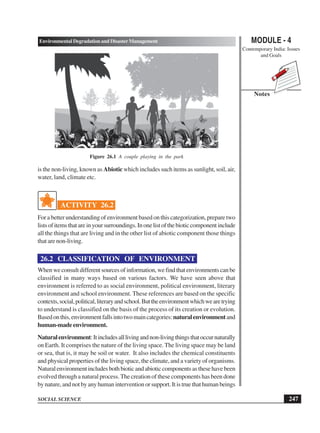
Let us try to understand this concept through a concrete example. You see in Fig.
26.1, a park with trees, flowers, plants, grass, butterfies, and also a couple with two
children.
For the children of the couple, the environment comprises the park, trees, plants,
flowers,playingequipment,airandwaterTherearefishinthepond.Butforthefish,
it is not the same. For them, environment is the surroundings within the pool. The
living and non living things in the pool make the environment of the fish. Therefore,
for any living organism like a human being or a plant or an animal, the environment
meanseverything,livingornonliving,whichsurroundsit.Aswefind,theenvironment
of any organism has two components, living and non-living. The living component
isknownasBioticandincludestheorganismsthemselves,i.e.humanbeings,plants,
animals, other organisms, their food and their interactions. The second component
MODULE - 4
Contemporary India: Issues
and Goals
247
Environmental Degradation and Disaster Management
SOCIAL SCIENCE
Notes
is the non-living, known as Abiotic which includes such items as sunlight, soil, air,
water, land, climate etc.
ACTIVITY 26.2
For a better understanding of environment based on this categorization, prepare two
listsofitemsthatareinyoursurroundings.Inonelistofthebioticcomponentinclude
all the things that are living and in the other list of abiotic component those things
that are non-living.
26.2 CLASSIFICATION OF ENVIRONMENT
When we consult different sources of information, we find that environments can be
classified in many ways based on various factors. We have seen above that
environment is referred to as social environment, political environment, literary
environment and school environment. These references are based on the specific
contexts,social,political,literaryandschool.Buttheenvironmentwhichwearetrying
to understand is classified on the basis of the process of its creation or evolution.
Basedonthis,environmentfallsintotwomaincategories:naturalenvironmentand
human-madeenvironment.
Naturalenvironment:Itincludesalllivingandnon-livingthingsthatoccurnaturally
on Earth. It comprises the nature of the living space. The living space may be land
or sea, that is, it may be soil or water. It also includes the chemical constituents
and physical properties of the living space, the climate, and a variety of organisms.
Naturalenvironmentincludesbothbioticandabioticcomponentsasthesehavebeen
evolved through a natural process. The creation of these components has been done
by nature, and not by any human intervention or support. It is true that human beings
Figure 26.1 A couple playing in the park
SOCIAL SCIENCE
MODULE - 4 Environmental Degradation and Disaster Management
Contemporary India: Issues
and Goals
248
Notes
live in an environment where both biotic and abiotic factors influence them and they
learn to adapt themselves to these in several ways. But human beings have no role
to play in the creation and evolution of natural environment.
Human-madeenvironment:Ontheotherhand,human-madeenvironmentincludes
all those things which are created by humans for their use. Human beings construct
these surroundings, as these are needed for providing the required setting for human
activity.Thesethingsrangefromthelarge-scalecivicsurroundingstopersonalplaces.
For example, houses, roads, schools, hospitals, railway lines, bridges and parks are
components of human-made environment.
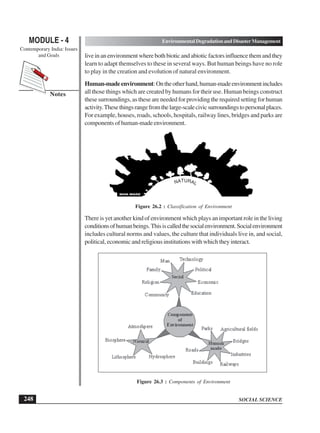
Figure 26.2 : Classification of Environment
There is yet another kind of environment which plays an important role in the living
conditionsofhumanbeings.Thisiscalledthesocialenvironment.Socialenvironment
includes cultural norms and values, the culture that individuals live in, and social,
political, economic and religious institutions with which they interact.
Figure 26.3 : Components of Environment
NATURAL
MODULE - 4
Contemporary India: Issues
and Goals
249
Environmental Degradation and Disaster Management
SOCIAL SCIENCE
Notes
Bynowwehavebeenabletounderstandthatnormally,theenvironmentatanyplace
is a combination or sum total of the natural component and the human-made
component. For example, in a town or city the people and animals living in it, the
land, air, water and trees are the components of the natural environment, whereas
the buildings, roads, other structures like schools, hospitals and establishments for
water and electricity supplies are the components of the human-made environment.
Asyoumayobserve,humanbeingsusenaturalenvironmentforcreatinghuman-made
environment.
26.3 THE DYNAMISM AND THE VARIETY OF THE
ENVIRONMENT
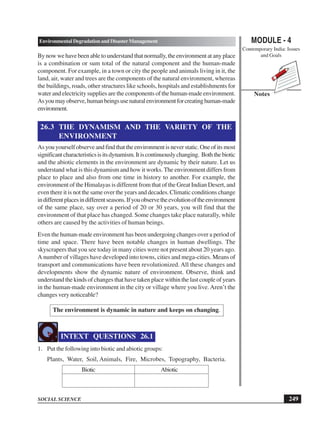
Asyouyourselfobserveandfindthattheenvironmentisneverstatic.Oneofitsmost
significantcharacteristicsisitsdynamism.Itiscontinuouslychanging. Boththebiotic
and the abiotic elements in the environment are dynamic by their nature. Let us
understand what is this dynamism and how it works. The environment differs from
place to place and also from one time in history to another. For example, the
environment of the Himalayas is different from that of the Great Indian Desert, and
even there it is not the same over the years and decades. Climatic conditions change
indifferentplacesindifferentseasons.Ifyouobservetheevolutionoftheenvironment
of the same place, say over a period of 20 or 30 years, you will find that the
environment of that place has changed. Some changes take place naturally, while
others are caused by the activities of human beings.
Even the human-made environment has been undergoing changes over a period of
time and space. There have been notable changes in human dwellings. The
skyscrapers that you see today in many cities were not present about 20 years ago.
A number of villages have developed into towns, cities and mega-cities. Means of
transport and communications have been revolutionized. All these changes and
developments show the dynamic nature of environment. Observe, think and
understand the kinds of changes that have taken place within the last couple of years
in the human-made environment in the city or village where you live. Aren’t the
changes very noticeable?
The environment is dynamic in nature and keeps on changing.
INTEXT QUESTIONS 26.1
1. Put the following into biotic and abiotic groups:
Plants, Water, Soil, Animals, Fire, Microbes, Topography, Bacteria.
Biotic Abiotic
SOCIAL SCIENCE
MODULE - 4 Environmental Degradation and Disaster Management
Contemporary India: Issues
and Goals
250
Notes
2. Fill in the blanks with appropriate words:
(a) Environment can be classified into .................... and ....................
(b) The classification of environment can also be made on the basis of its
....................
(c) Road, buildings and school are parts of .................... environment.
(d) Environment is dynamic because ....................
3. Activity-Makealistofthingsaroundyouandclassifythemintotwocategories.
In the first category mention those things that are essential for your living and
in the second category put those things that you can live without.
26.4 IMPORTANCE OF ENVIRONMENT
We always say that environment is key to our welfare and survival. Have you ever
thoughtwhyitissaidso?Theenvironmentisourlifesupportsystem.Infact,itaffects
and influences the growth, development, and survival of all organisms, including
human beings.All kinds of our needs are met by the environment. It supplies the
basic necessities for life and supports large number of life forms. We are dependent
on the environment for our food, shelter, water, air, soil, energy, medicines, fibers,
raw materials, and many other things. The environment maintains atmospheric
composition and protects all kinds of life on earth from harmful effects of solar
radiation. But in spite of all these benefits we find that the quality of environment
is deteriorating and it is being degraded continuously. It is not only that the resources
oftheenvironmentarebeingirrationallyutilised,wearecontributingdangerouslyto
itspollution.
Environmental degradation is one of the ten threats officially cautioned by
the High Level Threat Panel of the United Nations. The World Resources
Institute (WRI), the United Nations Environment Programme (UNEP), the
United Nations Development Programme (UNDP) and the World Bank made
public an important report on health and the environment worldwide on May
1, 1998.
26.5 ENVIRONMENTAL DEGRADATION
What is environmental degradation? Let us understand it. It is the process by which
our environment i.e., air, water and land, is progressively contaminated, over-
exploited and destroyed. When the environment becomes less valuable or damaged,
environmentaldegradationissaidtooccur.Inspecificterm,environmentaldegradation
is the deterioration of the environment through depletion of resources such as air,
MODULE - 4
Contemporary India: Issues
and Goals
251
Environmental Degradation and Disaster Management
SOCIAL SCIENCE
Notes
water, soil and forest; the destruction of eco-systems and the extinction of wildlife.
Let us recall our experiences in daily life.We are utilizing resources like water, soil,
trees, coal, petrol without caring for the future.We are carelessly interfering with the
eco-system and deliberately killing wild animals. In fact, there are many forms of
environmental degradation. Whenever habitats are destroyed, biodiversity is lost, or
natural resources are depleted, the environment is hurt.
26.6 CAUSES OF ENVIRONMENTAL DEGRADATION
Based on the discussion so far, we now know that healthy environment is essential
fortheveryexistenceofhumansocietyandotherlivingorganisms.Butenvironmental
degradation is going on unabated.We are being cautioned every now and then about
the deterioration in the environment and its consequences like global warming,
changingclimaticconditions,impendingwatercrisis,decreasingfertilityofagricultural
landandincreasinghealthproblems.Thereisanurgentneedtotakeallpossiblesteps
to check environmental degradation. In order to consider the required steps to be
taken for doing so, it is necessary to understand the causes of environmental
degradation. The important factors are the following:
Social Factors
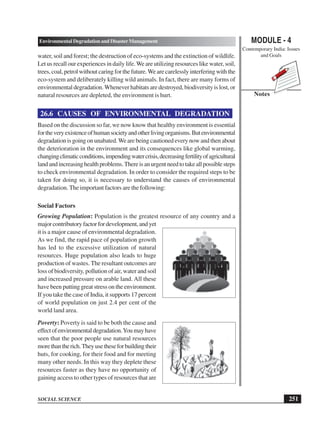
Growing Population: Population is the greatest resource of any country and a
majorcontributoryfactorfordevelopment,andyet
it is a major cause of environmental degradation.
As we find, the rapid pace of population growth
has led to the excessive utilization of natural
resources. Huge population also leads to huge
production of wastes. The resultant outcomes are
loss of biodiversity, pollution of air, water and soil
and increased pressure on arable land. All these
have been putting great stress on the environment.
If you take the case of India, it supports 17 percent
of world population on just 2.4 per cent of the
world land area.
Poverty: Poverty is said to be both the cause and
effectofenvironmentaldegradation.Youmayhave
seen that the poor people use natural resources
morethantherich.Theyusetheseforbuildingtheir
huts, for cooking, for their food and for meeting
many other needs. In this way they deplete these
resources faster as they have no opportunity of
gaining access to other types of resources that are
SOCIAL SCIENCE
MODULE - 4 Environmental Degradation and Disaster Management
Contemporary India: Issues
and Goals
252
Notes
primarily exploited by the rich.As we know, the more the resources are utilized, the
moredegradedtheenvironmentbecomes.Andthemoretheenvironmentdeteriorates,
the more impoverished the poor will be.
Urbanisation: You may have observed a large number of poor people from villages
moving to towns, cities and mega cities to earn their livelihood. This has led to
unplanned and rapid expansion of cities, creating
enormous pressure on the infrastructural facilities.
If you live in a city, you may be experiencing these
pressuresonhousing,waterandelectricsupplyand
sewage.Youwouldbeawareofthegrowingslums.
Urban slums are major sources of pollution and
sufferfromtheworstkindofunhygienicconditions.
The fast pace of urbanisation has also been
responsibleforthedepletionofforestsandirrational
use of other resources.
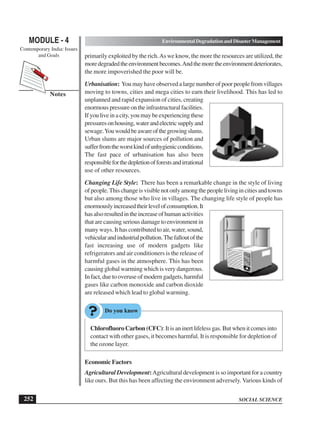
Changing Life Style: There has been a remarkable change in the style of living
ofpeople.Thischangeisvisiblenotonlyamongthepeoplelivingincitiesandtowns
but also among those who live in villages. The changing life style of people has
enormouslyincreasedtheirlevelofconsumption.It
hasalsoresultedintheincreaseofhumanactivities
that are causing serious damage to environment in
many ways. It has contributed to air, water, sound,
vehicularandindustrialpollution.Thefalloutofthe
fast increasing use of modern gadgets like
refrigerators and air conditioners is the release of
harmful gases in the atmosphere. This has been
causing global warming which is very dangerous.
In fact, due to overuse of modern gadgets, harmful
gases like carbon monoxide and carbon dioxide
are released which lead to global warming.
Chlorofluoro Carbon (CFC): It is an inert lifeless gas. But when it comes into
contact with other gases, it becomes harmful. It is responsible for depletion of
the ozone layer.
Economic Factors
Agricultural Development:Agricultural development is so important for a country
like ours. But this has been affecting the environment adversely. Various kinds of
MODULE - 4
Contemporary India: Issues
and Goals
253
Environmental Degradation and Disaster Management
SOCIAL SCIENCE
Notes
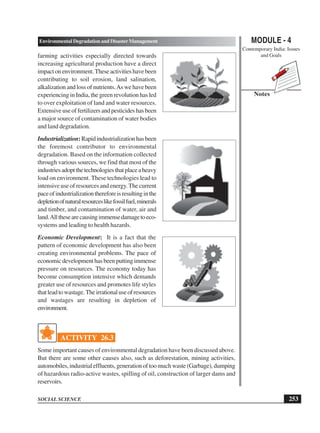
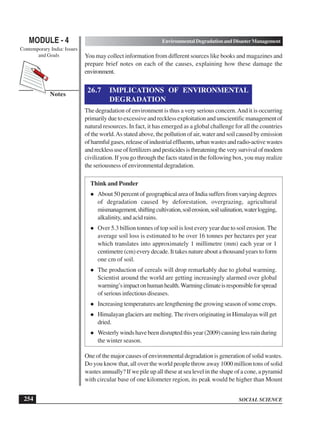
farming activities especially directed towards
increasing agricultural production have a direct
impactonenvironment.Theseactivitieshavebeen
contributing to soil erosion, land salination,
alkalization and loss of nutrients.As we have been
experiencing in India, the green revolution has led
to over exploitation of land and water resources.
Extensive use of fertilizers and pesticides has been
a major source of contamination of water bodies
and land degradation.
Industrialization:Rapidindustrializationhasbeen
the foremost contributor to environmental
degradation. Based on the information collected
through various sources, we find that most of the
industriesadoptthetechnologiesthatplaceaheavy
load on environment. These technologies lead to
intensive use of resources and energy.The current
paceofindustrializationthereforeisresultinginthe
depletionofnaturalresourceslikefossilfuel,minerals
and timber, and contamination of water, air and
land.Allthesearecausingimmensedamagetoeco-
systems and leading to health hazards.
Economic Development: It is a fact that the
pattern of economic development has also been
creating environmental problems. The pace of
economic development has been putting immense
pressure on resources. The economy today has
become consumption intensive which demands
greater use of resources and promotes life styles
thatleadtowastage.Theirrationaluseofresources
and wastages are resulting in depletion of
environment.
ACTIVITY 26.3
Some important causes of environmental degradation have been discussed above.
But there are some other causes also, such as deforestation, mining activities,
automobiles, industrial effluents, generation of too much waste (Garbage), dumping
of hazardous radio-active wastes, spilling of oil, construction of larger dams and
reservoirs.
SOCIAL SCIENCE
MODULE - 4 Environmental Degradation and Disaster Management
Contemporary India: Issues
and Goals
254
Notes
You may collect information from different sources like books and magazines and
prepare brief notes on each of the causes, explaining how these damage the
environment.
26.7 IMPLICATIONS OF ENVIRONMENTAL
DEGRADATION
The degradation of environment is thus a very serious concern.And it is occurring
primarilyduetoexcessiveandrecklessexploitationandunscientificmanagementof
natural resources. In fact, it has emerged as a global challenge for all the countries
of the world.As stated above, the pollution of air, water and soil caused by emission
ofharmfulgases,releaseofindustrialeffluents,urbanwastesandradio-activewastes
andrecklessuseoffertilizersandpesticidesisthreateningtheverysurvivalofmodern
civilization. If you go through the facts stated in the following box, you may realize
the seriousness of environmental degradation.
Think and Ponder
About 50 percent of geographical area of India suffers from varying degrees
of degradation caused by deforestation, overgrazing, agricultural
mismanagement,shiftingcultivation,soilerosion,soilsalination,waterlogging,
alkalinity, and acid rains.
Over 5.3 billion tonnes of top soil is lost every year due to soil erosion. The
average soil loss is estimated to be over 16 tonnes per hectares per year
which translates into approximately 1 millimetre (mm) each year or 1
centimetre (cm) every decade. It takes nature about a thousand years to form
one cm of soil.
The production of cereals will drop remarkably due to global warming.
Scientist around the world are getting increasingly alarmed over global
warming’simpactonhumanhealth.Warmingclimateisresponsibleforspread
of serious infectious diseases.
Increasing temperatures are lengthening the growing season of some crops.
Himalayanglaciersaremelting.TheriversoriginatinginHimalayaswillget
dried.
Westerlywindshavebeendisruptedthisyear(2009)causinglessrainduring
the winter season.
One of the major causes of environmental degradation is generation of solid wastes.
Do you know that, all over the world people throw away 1000 million tons of solid
wastes annually? If we pile up all these at sea level in the shape of a cone, a pyramid
with circular base of one kilometer region, its peak would be higher than Mount
MODULE - 4
Contemporary India: Issues
and Goals
255
Environmental Degradation and Disaster Management
SOCIAL SCIENCE
Notes
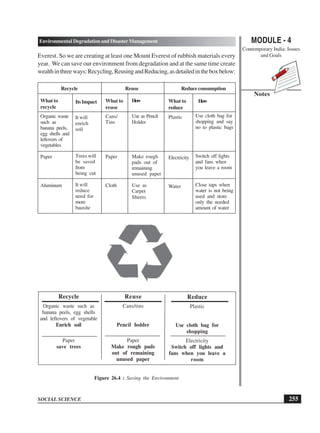
Everest. So we are creating at least one Mount Everest of rubbish materials every
year. We can save our environment from degradation and at the same time create
wealthinthreeways:Recycling,ReusingandReducing,asdetailedintheboxbelow:
Recycle Reuse Reduce consumption
Figure 26.4 : Saving the Environment
What to
recycle
Organic waste
such as
banana peels,
egg shells and
leftovers of
vegetables
Paper
Aluminum
ItsImpact
It will
enrich
soil
Trees will
be saved
from
being cut
It will
reduce
need for
more
bauxite
What to
reuse
Cans/
Tins
Paper
Cloth
How
Use as Pencil
Holder
Make rough
pads out of
remaining
unused paper
Use as
Carpet
Sheets
What to
reduce
Plastic
Electricity
Water
How
Use cloth bag for
shopping and say
no to plastic bags
Switch off lights
and fans when
you leave a room
Close taps when
water is not being
used and store
only the needed
amount of water
Recycle
Organic waste such as
banana peels, egg shells
and leftovers of vegetable
Enrich soil
Paper
save trees
Reuse
Cans/tins
Pencil holder
Paper
Make rough pads
out of remaining
unused paper
Reduce
Plastic
Use cloth bag for
shopping
Electricity
Switch off lights and
fans when you leave a
room
SOCIAL SCIENCE
MODULE - 4 Environmental Degradation and Disaster Management
Contemporary India: Issues
and Goals
256
Notes
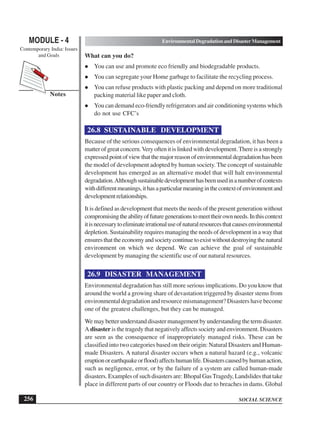
What can you do?
You can use and promote eco friendly and biodegradable products.
You can segregate your Home garbage to facilitate the recycling process.
You can refuse products with plastic packing and depend on more traditional
packing material like paper and cloth.
You can demand eco-friendly refrigerators and air conditioning systems which
do not use CFC’s
26.8 SUSTAINABLE DEVELOPMENT
Because of the serious consequences of environmental degradation, it has been a
matter of great concern.Very often it is linked with development.There is a strongly
expressedpointofviewthatthemajorreasonofenvironmentaldegradationhasbeen
the model of development adopted by human society. The concept of sustainable
development has emerged as an alternative model that will halt environmental
degradation.Althoughsustainabledevelopmenthasbeenusedinanumberofcontexts
withdifferentmeanings,ithasaparticularmeaninginthecontextofenvironmentand
developmentrelationships.
It is defined as development that meets the needs of the present generation without
compromisingtheabilityoffuturegenerationstomeettheirownneeds.Inthiscontext
itisnecessarytoeliminateirrationaluseofnaturalresourcesthatcausesenvironmental
depletion. Sustainability requires managing the needs of development in a way that
ensuresthattheeconomyandsocietycontinuetoexistwithoutdestroyingthenatural
environment on which we depend. We can achieve the goal of sustainable
development by managing the scientific use of our natural resources.
26.9 DISASTER MANAGEMENT
Environmental degradation has still more serious implications. Do you know that
around the world a growing share of devastation triggered by disaster stems from
environmental degradation and resource mismanagement? Disasters have become
one of the greatest challenges, but they can be managed.
We may better understand disaster management by understanding the term disaster.
A disaster is the tragedy that negatively affects society and environment. Disasters
are seen as the consequence of inappropriately managed risks. These can be
classified into two categories based on their origin: Natural Disasters and Human-
made Disasters. A natural disaster occurs when a natural hazard (e.g., volcanic
eruptionorearthquakeorflood)affectshumanlife.Disasterscausedbyhumanaction,
such as negligence, error, or by the failure of a system are called human-made
disasters. Examples of such disasters are: Bhopal GasTragedy, Landslides that take
place in different parts of our country or Floods due to breaches in dams. Global
MODULE - 4
Contemporary India: Issues
and Goals
257
Environmental Degradation and Disaster Management
SOCIAL SCIENCE
Notes
Warming is going to be a great disaster, and it is also the result of human interference
with the natural environment.
Although the consequences of a disaster are immense, its impact can be minimized.
Minimizing the adverse effects of natural and human-made disasters by adopting
suitable strategies is called disaster management. Its process involves four phases:
mitigation, preparedness, response, and recovery.
Mitigation
Mitigation may appear to you as a technical or difficult term. It means the efforts
that are made to prevent hazards from developing into disasters, or to reduce the
effects of disasters to the minimum, when they occur. The mitigation phase differs
from the other phases because it focuses on long-term measures for reducing or
eliminating risks. Even before the phase of mitigation, there may be a phase of the
identificationofrisks.Itisbettertoidentifytherisksbeforeyouplanandmakeefforts
to reduce the impact of disaster. For example, during rainy season, there may be
the possibility of flood in a river. If the possible damage to be caused by the flood
is identified, one may plan and take steps to reduce the damage.
Preparedness
In the preparedness phase, disaster managers develop plans of action for when the
disaster strikes. This includes (a) communication plans with easily understandable
terminologyandmethods;(b)propermaintenanceandtrainingofemergencyservices;
(c) development of emergency shelters and evacuation plans; (d) getting ready and
maintaining disaster supplies and equipment; and (e) developing organizations of
trainedvolunteersamongcivilianpopulations.
Response
When a disaster occurs, actions under the response phase are taken. These include
themobilizationofthenecessaryemergencyservicesandalsoofpeoplewhorespond
immediately in the disaster area. This is likely to include emergency services, such
as firefighters, police and ambulance crews.Awell planned strategy as part of the
preparedness phase enables efficient coordination of rescue.
Recovery
The aim of the recovery phase is to restore the affected area to its previous state.
It differs from the response phase in its focus. Recovery efforts are primarily
concerned with actions that involve rebuilding destroyed property, re-employment,
and the repair of essential infrastructure.
SOCIAL SCIENCE
MODULE - 4 Environmental Degradation and Disaster Management
Contemporary India: Issues
and Goals
258
Notes
ACTIVITY 26.4
Earthquakes, tsunamis, landslides, drought, floods and cyclones are the six major
disasters which take a heavy toll on the life and property all over the globe. Can
you prepare a disaster management plan in respect of any one of these for all the
four phases: mitigation, preparedness, response and recovery, based on the
processes discussed above?
INTEXT QUESTIONS 26.2
1. Fill in the blanks with appropriate words.
(a) When habitats are destroyed ........................ is lost.
(b) Modern gadgets release ........................ and causes ........................
(c) Extensive use of fertilizers and pesticides have been a major source of
........................ and ........................
(d) One of the biggest causes of environmental degradation is generation of
........................
2. What is disaster? Give any one example.
3. Activity:Garbagesurvey
For waste management, it is necessary that we collect the wastes for disposing
them off in three ways and take the needed steps, i.e. recycle or reuse or reduce
them. In this context you have to observe what type of waste is disposed of in
your house/area/colony? Carry out a weekly survey in your house/area/locality
in the following format and write which of the wastes can be recycled, reused
or reduced:
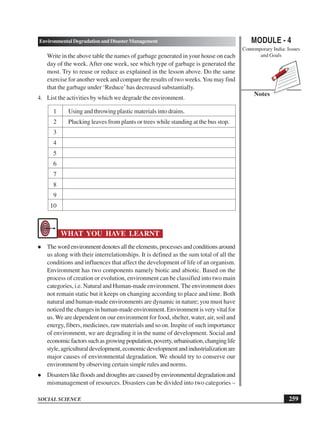
Day Recycle Reuse Reduce
Monday
Tuesday
Wednesday
Thursday
Friday
Saturday
Sunday
MODULE - 4
Contemporary India: Issues
and Goals
259
Environmental Degradation and Disaster Management
SOCIAL SCIENCE
Notes
Write in the above table the names of garbage generated in your house on each
day of the week. After one week, see which type of garbage is generated the
most. Try to reuse or reduce as explained in the lesson above. Do the same
exercise for another week and compare the results of two weeks.You may find
that the garbage under ‘Reduce’has decreased substantially.
4. List the activities by which we degrade the environment.
1 Using and throwing plastic materials into drains.
2 Plucking leaves from plants or trees while standing at the bus stop.
3
4
5
6
7
8
9
10
WHAT YOU HAVE LEARNT
Thewordenvironmentdenotesalltheelements,processesandconditionsaround
us along with their interrelationships. It is defined as the sum total of all the
conditions and influences that affect the development of life of an organism.
Environment has two components namely biotic and abiotic. Based on the
process of creation or evolution, environment can be classified into two main
categories, i.e. Natural and Human-made environment. The environment does
not remain static but it keeps on changing according to place and time. Both
natural and human-made environments are dynamic in nature; you must have
noticed the changes in human-made environment. Environment is very vital for
us. We are dependent on our environment for food, shelter, water, air, soil and
energy, fibers, medicines, raw materials and so on. Inspite of such importance
of environment, we are degrading it in the name of development. Social and
economicfactorssuchasgrowingpopulation,poverty,urbanisation,changinglife
style,agriculturaldevelopment,economicdevelopmentandindustrializationare
major causes of environmental degradation. We should try to conserve our
environment by observing certain simple rules and norms.
Disasters like floods and droughts are caused by environmental degradation and
mismanagement of resources. Disasters can be divided into two categories –
SOCIAL SCIENCE
MODULE - 4 Environmental Degradation and Disaster Management
Contemporary India: Issues
and Goals
260
Notes
natural and human made. Disaster management is a series of activities in four
phases. These are mitigation, preparedness, response and recovery. Though
natural disasters cannot be stopped but their effects can be minimized by us.
TERMINAL EXERCISES
1. What is meant by environment? Explain it with the help of an example.
2. Classifyenvironmentonthebasisofevolution.Explainthemwithexamplesfrom
yoursurroundings.
3. ‘Environment is dynamic in nature and keeps on changing.’ Substantiate this
statement with examples.
4. Discuss in brief the importance of environment.
5. Define environmental degradation. Explain the factors causing environmental
degradation.
6. Suggest any three ways to save our environment from degradation.
7. List at least ten activities by which human beings have been degrading the
environment.
8. Classify disasters on the basis of their origin.
9. What is meant by disaster management? How can we minimize the adverse
effects of disasters?
ANSWERS TO INTEXT QUESTIONS
26.1
1. Biotic – Plants, animals, microbes, bacteria
Abiotic – water, soil, fire, topography
2. (a) Natural, human made
(b) Creation or its evolution.
(c) Humanmade
(d) It changes over a period of time and space.
3. Thechildwillwritethenamesofbioticandabioticcomponentsoftheenvironment
of his own area/locality.
For example water without which nobody can live. He/she will prepare the list
ofotherthingshimself/herself.
MODULE - 4
Contemporary India: Issues
and Goals
261
Environmental Degradation and Disaster Management
SOCIAL SCIENCE
Notes
26.2
1. (a) Biodiversity
(b) Harmful gases, global warning
(c) Contamination of water bodies, land degradation
(d) Solid wastes
2. Adisasteristhetragedythatnegativelyaffectssocietyandenvironment. Example
Bhopalgastragedy,Tsunamis,Landshides,LondonSmong,floods,earthquakes
(Any one)
3. The students have to conduct this survey themselves.
4. He has to write the activities himself.
Hints forActivity
26.1
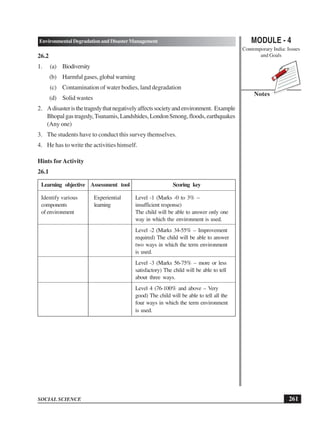
Learning objective Assessment tool Scoring key
Identify various Experiential Level -1 (Marks -0 to 3% –
components learning insufficient response)
of environment The child will be able to answer only one
way in which the environment is used.
Level -2 (Marks 34-55% – Improvement
required) The child will be able to answer
two ways in which the term environment
is used.
Level -3 (Marks 56-75% – more or less
satisfactory) The child will be able to tell
about three ways.
Level 4 (76-100% and above – Very
good) The child will be able to tell all the
four ways in which the term environment
is used.

Disaster managment in india

  • 1.
    MODULE - 4 ContemporaryIndia: Issues and Goals 245 Environmental Degradation and Disaster Management SOCIAL SCIENCE Notes 26 ENVIRONMENTAL DEGRADATIONAND DISASTER MANAGEMENT If you live in a village, you would have seen the trees being cut for using the land to grow crops or to construct houses.You may have also observed that small water bodies that existed some time ago are no longer seen now. If you are a resident in acity,youmusthaveseentreesbeingfelledforconstructinghouses,multiplexesand roads.We all feel the impact of air pollution owing to emission of carbon monoxide by large number of vehicles and harmful gases from factories. We come to know by reading newspapers or listening to discussions on radio or watching on television how the rivers and even the underground water sources are being polluted and the water level is going down fast. In hilly areas, forests are being cut to meet the fast growing needs of the people. Many of us are aware that all these are adversely affecting our environment. The deterioration of environment has also led to various kinds of man-made disasters and natural calamities.You may be aware of some of these like The Bhopal Gas tragedy, Tsunamis, Landslides and London Smog, and what happened regarding their management. In this lesson, therefore, we shall study the phenomenon of environmental degradation and how it is related to natural calamities, disasters and their management. OBJECTIVES After completing this lesson, you will be able to: define the terms environment and environmental degradation; identify various physical and biological components of environment; analyse various reasons for the deterioration of environment and the variety of ways in which human beings interfere with their environment;
  • 2.
    SOCIAL SCIENCE MODULE -4 Environmental Degradation and Disaster Management Contemporary India: Issues and Goals 246 Notes infer consequences of environmental degradation; highlight the importance of conservation of environment; establishrelationshipbetweendeteriorationofenvironmentandnaturalcalamities and disasters; describe impacts of disaster and natural calamities on development; examine the role of individuals and society in protecting and maintaining the environment; suggest various schemes for disaster management; and devise various methods to manage natural calamities/disasters at local levels. 26.1 MEANAING OF ENVIRONMENT Letusbeginthediscussiononenvironmentaldegradationbyunderstandingtheterm ‘environment’itself.Whatdoestheword‘environment’mean?Commonlyenvironment means the surroundings in which we live. You may have read or heard terms like socialenvironment,politicalenvironment,literaryenvironmentandschoolenvironment. But the environment which we shall discuss has a different meaning. ACTIVITY 26.1 Basedontheexamplesgivenabove,canyoupreparealistofanyfourwaysinwhich the term environment is used? In the present context, environment denotes all the elements, processes and conditions around us along with their interrelationships. It is defined as the sum total of all the conditions and circumstances and the living and non living things around an organism, which affect its life. Let us try to understand this concept through a concrete example. You see in Fig. 26.1, a park with trees, flowers, plants, grass, butterfies, and also a couple with two children. For the children of the couple, the environment comprises the park, trees, plants, flowers,playingequipment,airandwaterTherearefishinthepond.Butforthefish, it is not the same. For them, environment is the surroundings within the pool. The living and non living things in the pool make the environment of the fish. Therefore, for any living organism like a human being or a plant or an animal, the environment meanseverything,livingornonliving,whichsurroundsit.Aswefind,theenvironment of any organism has two components, living and non-living. The living component isknownasBioticandincludestheorganismsthemselves,i.e.humanbeings,plants, animals, other organisms, their food and their interactions. The second component
  • 3.
    MODULE - 4 ContemporaryIndia: Issues and Goals 247 Environmental Degradation and Disaster Management SOCIAL SCIENCE Notes is the non-living, known as Abiotic which includes such items as sunlight, soil, air, water, land, climate etc. ACTIVITY 26.2 For a better understanding of environment based on this categorization, prepare two listsofitemsthatareinyoursurroundings.Inonelistofthebioticcomponentinclude all the things that are living and in the other list of abiotic component those things that are non-living. 26.2 CLASSIFICATION OF ENVIRONMENT When we consult different sources of information, we find that environments can be classified in many ways based on various factors. We have seen above that environment is referred to as social environment, political environment, literary environment and school environment. These references are based on the specific contexts,social,political,literaryandschool.Buttheenvironmentwhichwearetrying to understand is classified on the basis of the process of its creation or evolution. Basedonthis,environmentfallsintotwomaincategories:naturalenvironmentand human-madeenvironment. Naturalenvironment:Itincludesalllivingandnon-livingthingsthatoccurnaturally on Earth. It comprises the nature of the living space. The living space may be land or sea, that is, it may be soil or water. It also includes the chemical constituents and physical properties of the living space, the climate, and a variety of organisms. Naturalenvironmentincludesbothbioticandabioticcomponentsasthesehavebeen evolved through a natural process. The creation of these components has been done by nature, and not by any human intervention or support. It is true that human beings Figure 26.1 A couple playing in the park
  • 4.
    SOCIAL SCIENCE MODULE -4 Environmental Degradation and Disaster Management Contemporary India: Issues and Goals 248 Notes live in an environment where both biotic and abiotic factors influence them and they learn to adapt themselves to these in several ways. But human beings have no role to play in the creation and evolution of natural environment. Human-madeenvironment:Ontheotherhand,human-madeenvironmentincludes all those things which are created by humans for their use. Human beings construct these surroundings, as these are needed for providing the required setting for human activity.Thesethingsrangefromthelarge-scalecivicsurroundingstopersonalplaces. For example, houses, roads, schools, hospitals, railway lines, bridges and parks are components of human-made environment. Figure 26.2 : Classification of Environment There is yet another kind of environment which plays an important role in the living conditionsofhumanbeings.Thisiscalledthesocialenvironment.Socialenvironment includes cultural norms and values, the culture that individuals live in, and social, political, economic and religious institutions with which they interact. Figure 26.3 : Components of Environment NATURAL
  • 5.
    MODULE - 4 ContemporaryIndia: Issues and Goals 249 Environmental Degradation and Disaster Management SOCIAL SCIENCE Notes Bynowwehavebeenabletounderstandthatnormally,theenvironmentatanyplace is a combination or sum total of the natural component and the human-made component. For example, in a town or city the people and animals living in it, the land, air, water and trees are the components of the natural environment, whereas the buildings, roads, other structures like schools, hospitals and establishments for water and electricity supplies are the components of the human-made environment. Asyoumayobserve,humanbeingsusenaturalenvironmentforcreatinghuman-made environment. 26.3 THE DYNAMISM AND THE VARIETY OF THE ENVIRONMENT Asyouyourselfobserveandfindthattheenvironmentisneverstatic.Oneofitsmost significantcharacteristicsisitsdynamism.Itiscontinuouslychanging. Boththebiotic and the abiotic elements in the environment are dynamic by their nature. Let us understand what is this dynamism and how it works. The environment differs from place to place and also from one time in history to another. For example, the environment of the Himalayas is different from that of the Great Indian Desert, and even there it is not the same over the years and decades. Climatic conditions change indifferentplacesindifferentseasons.Ifyouobservetheevolutionoftheenvironment of the same place, say over a period of 20 or 30 years, you will find that the environment of that place has changed. Some changes take place naturally, while others are caused by the activities of human beings. Even the human-made environment has been undergoing changes over a period of time and space. There have been notable changes in human dwellings. The skyscrapers that you see today in many cities were not present about 20 years ago. A number of villages have developed into towns, cities and mega-cities. Means of transport and communications have been revolutionized. All these changes and developments show the dynamic nature of environment. Observe, think and understand the kinds of changes that have taken place within the last couple of years in the human-made environment in the city or village where you live. Aren’t the changes very noticeable? The environment is dynamic in nature and keeps on changing. INTEXT QUESTIONS 26.1 1. Put the following into biotic and abiotic groups: Plants, Water, Soil, Animals, Fire, Microbes, Topography, Bacteria. Biotic Abiotic
  • 6.
    SOCIAL SCIENCE MODULE -4 Environmental Degradation and Disaster Management Contemporary India: Issues and Goals 250 Notes 2. Fill in the blanks with appropriate words: (a) Environment can be classified into .................... and .................... (b) The classification of environment can also be made on the basis of its .................... (c) Road, buildings and school are parts of .................... environment. (d) Environment is dynamic because .................... 3. Activity-Makealistofthingsaroundyouandclassifythemintotwocategories. In the first category mention those things that are essential for your living and in the second category put those things that you can live without. 26.4 IMPORTANCE OF ENVIRONMENT We always say that environment is key to our welfare and survival. Have you ever thoughtwhyitissaidso?Theenvironmentisourlifesupportsystem.Infact,itaffects and influences the growth, development, and survival of all organisms, including human beings.All kinds of our needs are met by the environment. It supplies the basic necessities for life and supports large number of life forms. We are dependent on the environment for our food, shelter, water, air, soil, energy, medicines, fibers, raw materials, and many other things. The environment maintains atmospheric composition and protects all kinds of life on earth from harmful effects of solar radiation. But in spite of all these benefits we find that the quality of environment is deteriorating and it is being degraded continuously. It is not only that the resources oftheenvironmentarebeingirrationallyutilised,wearecontributingdangerouslyto itspollution. Environmental degradation is one of the ten threats officially cautioned by the High Level Threat Panel of the United Nations. The World Resources Institute (WRI), the United Nations Environment Programme (UNEP), the United Nations Development Programme (UNDP) and the World Bank made public an important report on health and the environment worldwide on May 1, 1998. 26.5 ENVIRONMENTAL DEGRADATION What is environmental degradation? Let us understand it. It is the process by which our environment i.e., air, water and land, is progressively contaminated, over- exploited and destroyed. When the environment becomes less valuable or damaged, environmentaldegradationissaidtooccur.Inspecificterm,environmentaldegradation is the deterioration of the environment through depletion of resources such as air,
  • 7.
    MODULE - 4 ContemporaryIndia: Issues and Goals 251 Environmental Degradation and Disaster Management SOCIAL SCIENCE Notes water, soil and forest; the destruction of eco-systems and the extinction of wildlife. Let us recall our experiences in daily life.We are utilizing resources like water, soil, trees, coal, petrol without caring for the future.We are carelessly interfering with the eco-system and deliberately killing wild animals. In fact, there are many forms of environmental degradation. Whenever habitats are destroyed, biodiversity is lost, or natural resources are depleted, the environment is hurt. 26.6 CAUSES OF ENVIRONMENTAL DEGRADATION Based on the discussion so far, we now know that healthy environment is essential fortheveryexistenceofhumansocietyandotherlivingorganisms.Butenvironmental degradation is going on unabated.We are being cautioned every now and then about the deterioration in the environment and its consequences like global warming, changingclimaticconditions,impendingwatercrisis,decreasingfertilityofagricultural landandincreasinghealthproblems.Thereisanurgentneedtotakeallpossiblesteps to check environmental degradation. In order to consider the required steps to be taken for doing so, it is necessary to understand the causes of environmental degradation. The important factors are the following: Social Factors Growing Population: Population is the greatest resource of any country and a majorcontributoryfactorfordevelopment,andyet it is a major cause of environmental degradation. As we find, the rapid pace of population growth has led to the excessive utilization of natural resources. Huge population also leads to huge production of wastes. The resultant outcomes are loss of biodiversity, pollution of air, water and soil and increased pressure on arable land. All these have been putting great stress on the environment. If you take the case of India, it supports 17 percent of world population on just 2.4 per cent of the world land area. Poverty: Poverty is said to be both the cause and effectofenvironmentaldegradation.Youmayhave seen that the poor people use natural resources morethantherich.Theyusetheseforbuildingtheir huts, for cooking, for their food and for meeting many other needs. In this way they deplete these resources faster as they have no opportunity of gaining access to other types of resources that are
  • 8.
    SOCIAL SCIENCE MODULE -4 Environmental Degradation and Disaster Management Contemporary India: Issues and Goals 252 Notes primarily exploited by the rich.As we know, the more the resources are utilized, the moredegradedtheenvironmentbecomes.Andthemoretheenvironmentdeteriorates, the more impoverished the poor will be. Urbanisation: You may have observed a large number of poor people from villages moving to towns, cities and mega cities to earn their livelihood. This has led to unplanned and rapid expansion of cities, creating enormous pressure on the infrastructural facilities. If you live in a city, you may be experiencing these pressuresonhousing,waterandelectricsupplyand sewage.Youwouldbeawareofthegrowingslums. Urban slums are major sources of pollution and sufferfromtheworstkindofunhygienicconditions. The fast pace of urbanisation has also been responsibleforthedepletionofforestsandirrational use of other resources. Changing Life Style: There has been a remarkable change in the style of living ofpeople.Thischangeisvisiblenotonlyamongthepeoplelivingincitiesandtowns but also among those who live in villages. The changing life style of people has enormouslyincreasedtheirlevelofconsumption.It hasalsoresultedintheincreaseofhumanactivities that are causing serious damage to environment in many ways. It has contributed to air, water, sound, vehicularandindustrialpollution.Thefalloutofthe fast increasing use of modern gadgets like refrigerators and air conditioners is the release of harmful gases in the atmosphere. This has been causing global warming which is very dangerous. In fact, due to overuse of modern gadgets, harmful gases like carbon monoxide and carbon dioxide are released which lead to global warming. Chlorofluoro Carbon (CFC): It is an inert lifeless gas. But when it comes into contact with other gases, it becomes harmful. It is responsible for depletion of the ozone layer. Economic Factors Agricultural Development:Agricultural development is so important for a country like ours. But this has been affecting the environment adversely. Various kinds of
  • 9.
    MODULE - 4 ContemporaryIndia: Issues and Goals 253 Environmental Degradation and Disaster Management SOCIAL SCIENCE Notes farming activities especially directed towards increasing agricultural production have a direct impactonenvironment.Theseactivitieshavebeen contributing to soil erosion, land salination, alkalization and loss of nutrients.As we have been experiencing in India, the green revolution has led to over exploitation of land and water resources. Extensive use of fertilizers and pesticides has been a major source of contamination of water bodies and land degradation. Industrialization:Rapidindustrializationhasbeen the foremost contributor to environmental degradation. Based on the information collected through various sources, we find that most of the industriesadoptthetechnologiesthatplaceaheavy load on environment. These technologies lead to intensive use of resources and energy.The current paceofindustrializationthereforeisresultinginthe depletionofnaturalresourceslikefossilfuel,minerals and timber, and contamination of water, air and land.Allthesearecausingimmensedamagetoeco- systems and leading to health hazards. Economic Development: It is a fact that the pattern of economic development has also been creating environmental problems. The pace of economic development has been putting immense pressure on resources. The economy today has become consumption intensive which demands greater use of resources and promotes life styles thatleadtowastage.Theirrationaluseofresources and wastages are resulting in depletion of environment. ACTIVITY 26.3 Some important causes of environmental degradation have been discussed above. But there are some other causes also, such as deforestation, mining activities, automobiles, industrial effluents, generation of too much waste (Garbage), dumping of hazardous radio-active wastes, spilling of oil, construction of larger dams and reservoirs.
  • 10.
    SOCIAL SCIENCE MODULE -4 Environmental Degradation and Disaster Management Contemporary India: Issues and Goals 254 Notes You may collect information from different sources like books and magazines and prepare brief notes on each of the causes, explaining how these damage the environment. 26.7 IMPLICATIONS OF ENVIRONMENTAL DEGRADATION The degradation of environment is thus a very serious concern.And it is occurring primarilyduetoexcessiveandrecklessexploitationandunscientificmanagementof natural resources. In fact, it has emerged as a global challenge for all the countries of the world.As stated above, the pollution of air, water and soil caused by emission ofharmfulgases,releaseofindustrialeffluents,urbanwastesandradio-activewastes andrecklessuseoffertilizersandpesticidesisthreateningtheverysurvivalofmodern civilization. If you go through the facts stated in the following box, you may realize the seriousness of environmental degradation. Think and Ponder About 50 percent of geographical area of India suffers from varying degrees of degradation caused by deforestation, overgrazing, agricultural mismanagement,shiftingcultivation,soilerosion,soilsalination,waterlogging, alkalinity, and acid rains. Over 5.3 billion tonnes of top soil is lost every year due to soil erosion. The average soil loss is estimated to be over 16 tonnes per hectares per year which translates into approximately 1 millimetre (mm) each year or 1 centimetre (cm) every decade. It takes nature about a thousand years to form one cm of soil. The production of cereals will drop remarkably due to global warming. Scientist around the world are getting increasingly alarmed over global warming’simpactonhumanhealth.Warmingclimateisresponsibleforspread of serious infectious diseases. Increasing temperatures are lengthening the growing season of some crops. Himalayanglaciersaremelting.TheriversoriginatinginHimalayaswillget dried. Westerlywindshavebeendisruptedthisyear(2009)causinglessrainduring the winter season. One of the major causes of environmental degradation is generation of solid wastes. Do you know that, all over the world people throw away 1000 million tons of solid wastes annually? If we pile up all these at sea level in the shape of a cone, a pyramid with circular base of one kilometer region, its peak would be higher than Mount
  • 11.
    MODULE - 4 ContemporaryIndia: Issues and Goals 255 Environmental Degradation and Disaster Management SOCIAL SCIENCE Notes Everest. So we are creating at least one Mount Everest of rubbish materials every year. We can save our environment from degradation and at the same time create wealthinthreeways:Recycling,ReusingandReducing,asdetailedintheboxbelow: Recycle Reuse Reduce consumption Figure 26.4 : Saving the Environment What to recycle Organic waste such as banana peels, egg shells and leftovers of vegetables Paper Aluminum ItsImpact It will enrich soil Trees will be saved from being cut It will reduce need for more bauxite What to reuse Cans/ Tins Paper Cloth How Use as Pencil Holder Make rough pads out of remaining unused paper Use as Carpet Sheets What to reduce Plastic Electricity Water How Use cloth bag for shopping and say no to plastic bags Switch off lights and fans when you leave a room Close taps when water is not being used and store only the needed amount of water Recycle Organic waste such as banana peels, egg shells and leftovers of vegetable Enrich soil Paper save trees Reuse Cans/tins Pencil holder Paper Make rough pads out of remaining unused paper Reduce Plastic Use cloth bag for shopping Electricity Switch off lights and fans when you leave a room
  • 12.
    SOCIAL SCIENCE MODULE -4 Environmental Degradation and Disaster Management Contemporary India: Issues and Goals 256 Notes What can you do? You can use and promote eco friendly and biodegradable products. You can segregate your Home garbage to facilitate the recycling process. You can refuse products with plastic packing and depend on more traditional packing material like paper and cloth. You can demand eco-friendly refrigerators and air conditioning systems which do not use CFC’s 26.8 SUSTAINABLE DEVELOPMENT Because of the serious consequences of environmental degradation, it has been a matter of great concern.Very often it is linked with development.There is a strongly expressedpointofviewthatthemajorreasonofenvironmentaldegradationhasbeen the model of development adopted by human society. The concept of sustainable development has emerged as an alternative model that will halt environmental degradation.Althoughsustainabledevelopmenthasbeenusedinanumberofcontexts withdifferentmeanings,ithasaparticularmeaninginthecontextofenvironmentand developmentrelationships. It is defined as development that meets the needs of the present generation without compromisingtheabilityoffuturegenerationstomeettheirownneeds.Inthiscontext itisnecessarytoeliminateirrationaluseofnaturalresourcesthatcausesenvironmental depletion. Sustainability requires managing the needs of development in a way that ensuresthattheeconomyandsocietycontinuetoexistwithoutdestroyingthenatural environment on which we depend. We can achieve the goal of sustainable development by managing the scientific use of our natural resources. 26.9 DISASTER MANAGEMENT Environmental degradation has still more serious implications. Do you know that around the world a growing share of devastation triggered by disaster stems from environmental degradation and resource mismanagement? Disasters have become one of the greatest challenges, but they can be managed. We may better understand disaster management by understanding the term disaster. A disaster is the tragedy that negatively affects society and environment. Disasters are seen as the consequence of inappropriately managed risks. These can be classified into two categories based on their origin: Natural Disasters and Human- made Disasters. A natural disaster occurs when a natural hazard (e.g., volcanic eruptionorearthquakeorflood)affectshumanlife.Disasterscausedbyhumanaction, such as negligence, error, or by the failure of a system are called human-made disasters. Examples of such disasters are: Bhopal GasTragedy, Landslides that take place in different parts of our country or Floods due to breaches in dams. Global
  • 13.
    MODULE - 4 ContemporaryIndia: Issues and Goals 257 Environmental Degradation and Disaster Management SOCIAL SCIENCE Notes Warming is going to be a great disaster, and it is also the result of human interference with the natural environment. Although the consequences of a disaster are immense, its impact can be minimized. Minimizing the adverse effects of natural and human-made disasters by adopting suitable strategies is called disaster management. Its process involves four phases: mitigation, preparedness, response, and recovery. Mitigation Mitigation may appear to you as a technical or difficult term. It means the efforts that are made to prevent hazards from developing into disasters, or to reduce the effects of disasters to the minimum, when they occur. The mitigation phase differs from the other phases because it focuses on long-term measures for reducing or eliminating risks. Even before the phase of mitigation, there may be a phase of the identificationofrisks.Itisbettertoidentifytherisksbeforeyouplanandmakeefforts to reduce the impact of disaster. For example, during rainy season, there may be the possibility of flood in a river. If the possible damage to be caused by the flood is identified, one may plan and take steps to reduce the damage. Preparedness In the preparedness phase, disaster managers develop plans of action for when the disaster strikes. This includes (a) communication plans with easily understandable terminologyandmethods;(b)propermaintenanceandtrainingofemergencyservices; (c) development of emergency shelters and evacuation plans; (d) getting ready and maintaining disaster supplies and equipment; and (e) developing organizations of trainedvolunteersamongcivilianpopulations. Response When a disaster occurs, actions under the response phase are taken. These include themobilizationofthenecessaryemergencyservicesandalsoofpeoplewhorespond immediately in the disaster area. This is likely to include emergency services, such as firefighters, police and ambulance crews.Awell planned strategy as part of the preparedness phase enables efficient coordination of rescue. Recovery The aim of the recovery phase is to restore the affected area to its previous state. It differs from the response phase in its focus. Recovery efforts are primarily concerned with actions that involve rebuilding destroyed property, re-employment, and the repair of essential infrastructure.
  • 14.
    SOCIAL SCIENCE MODULE -4 Environmental Degradation and Disaster Management Contemporary India: Issues and Goals 258 Notes ACTIVITY 26.4 Earthquakes, tsunamis, landslides, drought, floods and cyclones are the six major disasters which take a heavy toll on the life and property all over the globe. Can you prepare a disaster management plan in respect of any one of these for all the four phases: mitigation, preparedness, response and recovery, based on the processes discussed above? INTEXT QUESTIONS 26.2 1. Fill in the blanks with appropriate words. (a) When habitats are destroyed ........................ is lost. (b) Modern gadgets release ........................ and causes ........................ (c) Extensive use of fertilizers and pesticides have been a major source of ........................ and ........................ (d) One of the biggest causes of environmental degradation is generation of ........................ 2. What is disaster? Give any one example. 3. Activity:Garbagesurvey For waste management, it is necessary that we collect the wastes for disposing them off in three ways and take the needed steps, i.e. recycle or reuse or reduce them. In this context you have to observe what type of waste is disposed of in your house/area/colony? Carry out a weekly survey in your house/area/locality in the following format and write which of the wastes can be recycled, reused or reduced: Day Recycle Reuse Reduce Monday Tuesday Wednesday Thursday Friday Saturday Sunday
  • 15.
    MODULE - 4 ContemporaryIndia: Issues and Goals 259 Environmental Degradation and Disaster Management SOCIAL SCIENCE Notes Write in the above table the names of garbage generated in your house on each day of the week. After one week, see which type of garbage is generated the most. Try to reuse or reduce as explained in the lesson above. Do the same exercise for another week and compare the results of two weeks.You may find that the garbage under ‘Reduce’has decreased substantially. 4. List the activities by which we degrade the environment. 1 Using and throwing plastic materials into drains. 2 Plucking leaves from plants or trees while standing at the bus stop. 3 4 5 6 7 8 9 10 WHAT YOU HAVE LEARNT Thewordenvironmentdenotesalltheelements,processesandconditionsaround us along with their interrelationships. It is defined as the sum total of all the conditions and influences that affect the development of life of an organism. Environment has two components namely biotic and abiotic. Based on the process of creation or evolution, environment can be classified into two main categories, i.e. Natural and Human-made environment. The environment does not remain static but it keeps on changing according to place and time. Both natural and human-made environments are dynamic in nature; you must have noticed the changes in human-made environment. Environment is very vital for us. We are dependent on our environment for food, shelter, water, air, soil and energy, fibers, medicines, raw materials and so on. Inspite of such importance of environment, we are degrading it in the name of development. Social and economicfactorssuchasgrowingpopulation,poverty,urbanisation,changinglife style,agriculturaldevelopment,economicdevelopmentandindustrializationare major causes of environmental degradation. We should try to conserve our environment by observing certain simple rules and norms. Disasters like floods and droughts are caused by environmental degradation and mismanagement of resources. Disasters can be divided into two categories –
  • 16.
    SOCIAL SCIENCE MODULE -4 Environmental Degradation and Disaster Management Contemporary India: Issues and Goals 260 Notes natural and human made. Disaster management is a series of activities in four phases. These are mitigation, preparedness, response and recovery. Though natural disasters cannot be stopped but their effects can be minimized by us. TERMINAL EXERCISES 1. What is meant by environment? Explain it with the help of an example. 2. Classifyenvironmentonthebasisofevolution.Explainthemwithexamplesfrom yoursurroundings. 3. ‘Environment is dynamic in nature and keeps on changing.’ Substantiate this statement with examples. 4. Discuss in brief the importance of environment. 5. Define environmental degradation. Explain the factors causing environmental degradation. 6. Suggest any three ways to save our environment from degradation. 7. List at least ten activities by which human beings have been degrading the environment. 8. Classify disasters on the basis of their origin. 9. What is meant by disaster management? How can we minimize the adverse effects of disasters? ANSWERS TO INTEXT QUESTIONS 26.1 1. Biotic – Plants, animals, microbes, bacteria Abiotic – water, soil, fire, topography 2. (a) Natural, human made (b) Creation or its evolution. (c) Humanmade (d) It changes over a period of time and space. 3. Thechildwillwritethenamesofbioticandabioticcomponentsoftheenvironment of his own area/locality. For example water without which nobody can live. He/she will prepare the list ofotherthingshimself/herself.
  • 17.
    MODULE - 4 ContemporaryIndia: Issues and Goals 261 Environmental Degradation and Disaster Management SOCIAL SCIENCE Notes 26.2 1. (a) Biodiversity (b) Harmful gases, global warning (c) Contamination of water bodies, land degradation (d) Solid wastes 2. Adisasteristhetragedythatnegativelyaffectssocietyandenvironment. Example Bhopalgastragedy,Tsunamis,Landshides,LondonSmong,floods,earthquakes (Any one) 3. The students have to conduct this survey themselves. 4. He has to write the activities himself. Hints forActivity 26.1 Learning objective Assessment tool Scoring key Identify various Experiential Level -1 (Marks -0 to 3% – components learning insufficient response) of environment The child will be able to answer only one way in which the environment is used. Level -2 (Marks 34-55% – Improvement required) The child will be able to answer two ways in which the term environment is used. Level -3 (Marks 56-75% – more or less satisfactory) The child will be able to tell about three ways. Level 4 (76-100% and above – Very good) The child will be able to tell all the four ways in which the term environment is used.