BUSINESS STUDIES204
Notes
RETAIL TRADE
You need a variety of goods for use in your day-to-day life. Where do you get
all those goods? Are they all available in your local market? If not, then you
must be buying those goods from the markets of the nearby town or city.
Generally to buy goods as per your own choice you move from shop to shop
and market to market. You may think why all these goods are not available in
a single shop? Why are these goods not available at our doorstep? Yes, there
are certain shops from where you can buy a variety of goods of different types
as per your convenience. Goods of your choice can also be made available at
your doorstep. You can also buy goods of your choice from the shops having
no salesperson either to guide you or handover the goods to you. Are you
surprised? You need not. You will learn how all this happens.
After studying this lesson, you will be able to :
• state the meaning of retail trade;
• identify the different types of retail trade;
• enlist the various forms of different types of large-scale retail trade;
• enumerate the advantages and disadvantages of each type of large scale
retail trade; and
• explain the meaning and different types of non-store retailing.
14.1 MEANING OF RETAIL TRADE
Small shopkeepers, who sell goods directly to the consumers, are called retailers.
Pedlars, hawkers, one-price-shop or petty shopkeepers are all retailers.Aretailer
is the last link in the chain of intermediaries. He is an intermediary between the
wholesaler and the ultimate consumer. He purchases from the wholesaler and
sells in very small quantities to the consumers. He needs capital smaller than the
wholesaler and usually, carries trade on cash basis. He does not specialise in any
commodity and usually carries a large variety of goods in his stock. His activities
are generally confined to the locality in which his shop is situated.
OBJECTIVES
14
MODULE - IV
Buying, Selling and
Distribution
Notes
BUSINESS STUDIES 205
14.2 TYPES OF RETAIL TRADE
You have learnt about retailers in the previous section. You may be under the
impressionthatRetailersaresmallshopkeeperstradinginthenearbylocality.However,
you will be surprised to Know that starting from hawkers and street traders, to super
bazaars,departmentalstoresandMultipleshops,allundertakeretail-tradingbusiness
in our country. We can classify this retailing Business into two categories.
Small-scale retail trade; and b. Large-scale retail trade.
Small-scale retail trade is one where a limited variety and also limited quantity
of goods are sold within a local area. It requires less capital and provides goods
to a limited number of customers. On the other hand, large-scale retail trade is
one where capital investment is more and it deals With large volume of goods.
It caters to the needs of a large number of customers. Super bazars, Departmental
stores and Multiple shops are examples of large scale retail trade organization.
In this lesson you will learn the details about small-scale retail trade.
Small-scale Retail Trade
There are varities of retailers engaged in small scale retail trading. They can
be classified as:
(i) Itinerant Retailing
(ii) Fixed Shop Retailing
(i) Itinerant Retailing
Itinerant retailing is a type of small-scale retail trade in which retailers move
around and sell a variety of items directly to the consumers. They do not have a
fixed shop where they can sell.You must have seen them distributing newspapers
early in the morning; selling peanuts, bangles, toys etc. in buses and trains; selling
fruits and vegetables in your locality using a cart, selling icecream, namkeens
etc. on a cycle, selling rice, earthen pots or even carpets by using a cart, etc. You
can also see them on pavements in your locality. In towns and cities we come
across different type of itinerant retailers.There are traders who sell their articles
on fixed days at different market places. In villages these market places are
called “Haat” and in towns or cities they are called “weekly bazars”.The itinerant
retailing also includes persons selling articles from door to door. In most cases,
the price of items is not fixed and mostly settled through bargaining. Moreover,
in most cases the items sold are not branded products.
(ii) Fixed Shop Retailing
Here the retailers sell goods and services from a fixed place known as ‘shop’.
These shops are usually located at market places or commercial areas or near
MODULE - IV
Buying, Selling and
Distribution
Retail Trade
BUSINESS STUDIES206
Notes
residential localities. These shops normally deal with a limited variety of goods.
The goods are stored as well as displayed in the shops.
On the basis of the type of goods which the fixed shops deal in, we can classify
this form of retailing as under.
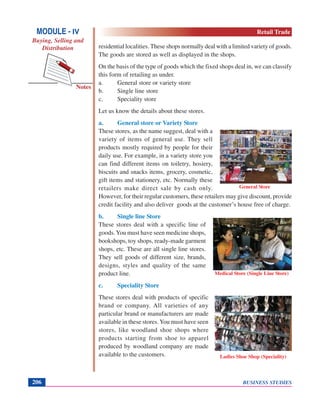
a. General store or variety store
b. Single line store
c. Speciality store
Let us know the details about these stores.
a. General store or Variety Store
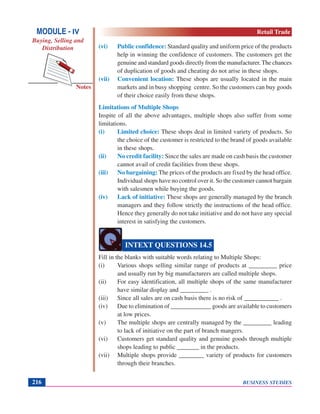
These stores, as the name suggest, deal with a
variety of items of general use. They sell
products mostly required by people for their
daily use. For example, in a variety store you
can find different items on toiletry, hosiery,
biscuits and snacks items, grocery, cosmetic,
gift items and stationery, etc. Normally these
retailers make direct sale by cash only.
However, for their regular customers, these retailers may give discount, provide
credit facility and also deliver goods at the customer’s house free of charge.
b. Single line Store
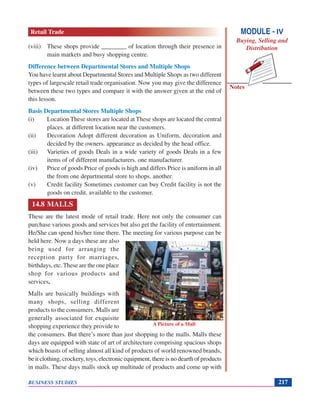
These stores deal with a specific line of
goods.You must have seen medicine shops,
bookshops, toy shops, ready-made garment
shops, etc. These are all single line stores.
They sell goods of different size, brands,
designs, styles and quality of the same
product line.
c. Speciality Store
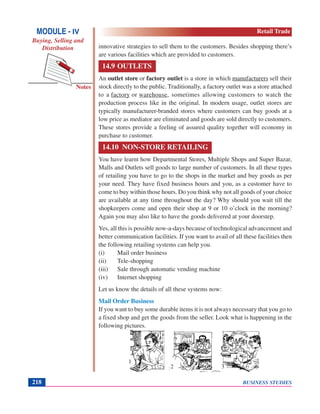
These stores deal with products of specific
brand or company. All varieties of any
particular brand or manufacturers are made
available in these stores.You must have seen
stores, like woodland shoe shops where
products starting from shoe to apparel
produced by woodland company are made
available to the customers.
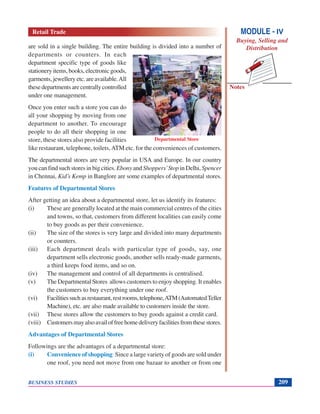
General Store
Medical Store (Single Line Store)
Ladies Shoe Shop (Speciality)
MODULE - IV
Buying, Selling and
Distribution
Retail Trade
Notes
BUSINESS STUDIES 207
Match the Column A with the statement given in Column B :
Column A Column B
(i) Super Bazar (a) Deals in goods of one brand only.
(ii) Itinerant retailer (b) Selldifferentvarietiesofthesameproductline.
(iii) Speciality Store (c) Large variety of goods of general use.
(iv) Variety Store (d) Large-scale retail trade.
(v) Single Line Store (e) Sell articles on carts.
14.3 MEANING OF LARGE - SCALE RETAIL TRADE
Suppose you want to buy new dresses, new shoes, some cosmetics and a number
of goods of daily need. You visit one shop in the market to buy your dress,
again for shoe, you visit another shop. Like wise, to buy all types of goods of
your need you generally move from one shop to another. Sometimes goods of
your choice may not be available in a particular shop. Then you need to visit
other shops. Sometimes you may also face a heavy rush in the market. These
are some general problems you may face in the local market.
To overcome all these problems, some of us may like to go to shops other than
thesmallretailshopsinthelocalmarket.Forexample,ifwedon’thavesufficient
time to visit different shops to buy the items of our need, we may like to find a
shopwherewecangetmostofourrequirementsandhaveachoicefromdifferent
varieties. Or if we are very busy, we may want goods to be available to us at our
home. Again, if we are in need of a well-known branded product, it may be
convenient for us if there is a shop where we can get it at a reasonable price.
Is there any such shop in your local market where you can get all these facilities?
Actually these facilities are available in some retail shops in big towns and
cities. They make available different types of goods under one roof. These
shops are normally situated at central places and sell goods to a large number
of customers. In some of these shops you will find a variety of goods and in
some shops you will find goods of single type like shoes, shirts, etc. made by
single manufacturer. All these shops buy goods in large quantities and sell
them to individual consumers as retailers do. Sometimes big manufacturers
also sell their products directly to the customers by opening their shops in
different parts of the country.
Now can you tell what is the meaning of ‘Large-scale retail trade’?
INTEXT QUESTIONS 14.1
MODULE - IV
Buying, Selling and
Distribution
Retail Trade
BUSINESS STUDIES208
Notes
Large scale retail trade is a type of trade in which either single type of goods or a
variety of goods are made available to a large number of consumers in a big shop
under a single roof or may be made available at the convenience of customers.
FEATURES OF LARGE-SCALE RETAIL TRADE
The followings are some of the common features of large-scale retail trade.
(i) It deals in a variety of goods of daily need and makes these goods
available to the customers at their convenience.
(ii) It purchases goods in bulk directly from the manufacturers, thus
avoiding middlemen in the process of purchase of goods.
(iii) It provides service to a large number of customers.
(iv) The size of the shops/stores is comparatively bigger than the local retail
shops/stores.
(v) It requires huge capital investment to start and run the business.
(vi) It generally sells goods to the customers on cash basis.
Fill in the blanks with suitable words :
(i) Sale of goods and commodities in __________ quantities directly to
consumers is called retail trade.
(ii) When a shopkeeper sells groceries and other items of needs to customers
through his shop, he is engaged in _________ activities.
(iii) When one or more types of goods are sold to customers through big
shops it is called _________ retail trade.
(iv) In large-scale retail trade, shops are located at __________ and sell
goods to ________number of customers.
(v) Large scale retail shops may be opened by big __________ to sell their
products directly to the customers.
14.3 FORMS OF LARGE-SCALE RETAIL TRADES
In India, generally we find the following types of Large-scale retailing business
(i) Departmental Store
(ii) Multiple Shops
(iii) Super Bazar
Let us discuss the details about all these.
14.4 DEPARTMENTAL STORES
A Departmental Store is a large-scale retail shop where a large variety of goods
INTEXT QUESTIONS 14.2
MODULE - IV
Buying, Selling and
Distribution
Retail Trade
Notes
BUSINESS STUDIES 209
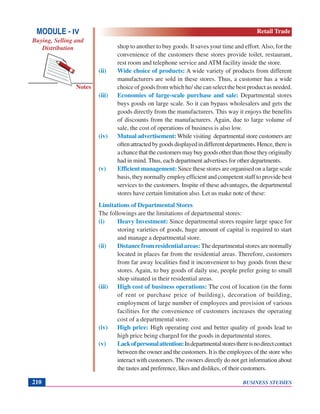
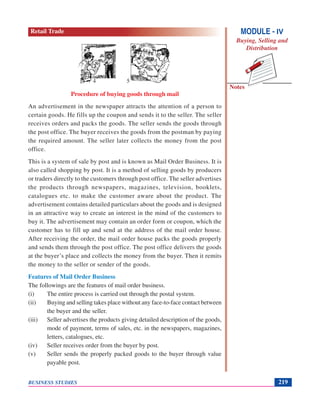
are sold in a single building. The entire building is divided into a number of
departments or counters. In each
department specific type of goods like
stationery items, books, electronic goods,
garments, jewellery etc. are available.All
thesedepartmentsarecentrallycontrolled
under one management.
Once you enter such a store you can do
all your shopping by moving from one
department to another. To encourage
people to do all their shopping in one
store, these stores also provide facilities
like restaurant, telephone, toilets,ATM etc. for the conveniences of customers.
The departmental stores are very popular in USA and Europe. In our country
you can find such stores in big cities. Ebony and Shoppers’Stop in Delhi, Spencer
in Chennai, Kid’s Kemp in Banglore are some examples of departmental stores.
Features of Departmental Stores
After getting an idea about a departmental store, let us identify its features:
(i) These are generally located at the main commercial centres of the cities
and towns, so that, customers from different localities can easily come
to buy goods as per their convenience.
(ii) The size of the stores is very large and divided into many departments
or counters.
(iii) Each department deals with particular type of goods, say, one
department sells electronic goods, another sells ready-made garments,
a third keeps food items, and so on.
(iv) The management and control of all departments is centralised.
(v) The Departmental Stores allows customers to enjoy shopping. It enables
the customers to buy everything under one roof.
(vi) Facilitiessuchasrestaurant,restrooms,telephone,ATM(AutomatedTeller
Machine), etc. are also made available to customers inside the store.
(vii) These stores allow the customers to buy goods against a credit card.
(viii) Customersmayalsoavailoffreehomedeliveryfacilitiesfromthesestores.
Advantages of Departmental Stores
Followings are the advantages of a departmental store:
(i) Convenience of shopping: Since a large variety of goods are sold under
one roof, you need not move from one bazaar to another or from one
Departmental Store
MODULE - IV
Buying, Selling and
Distribution
Retail Trade
BUSINESS STUDIES210
Notes
shop to another to buy goods. It saves your time and effort.Also, for the
convenience of the customers these stores provide toilet, restaurant,
rest room and telephone service and ATM facility inside the store.
(ii) Wide choice of products: A wide variety of products from different
manufacturers are sold in these stores. Thus, a customer has a wide
choiceofgoodsfromwhichhe/shecanselectthebestproductasneeded.
(iii) Economies of large-scale purchase and sale: Departmental stores
buys goods on large scale. So it can bypass wholesalers and gets the
goods directly from the manufacturers. This way it enjoys the benefits
of discounts from the manufacturers. Again, due to large volume of
sale, the cost of operations of business is also low.
(iv) Mutual advertisement: While visiting departmental store customers are
oftenattractedbygoodsdisplayedindifferentdepartments.Hence,thereis
achancethatthecustomersmaybuygoodsotherthanthosetheyoriginally
had in mind. Thus, each department advertises for other departments.
(v) Efficient management: Since these stores are organised on a large scale
basis, they normally employ efficient and competent staff to provide best
services to the customers. Inspite of these advantages, the departmental
stores have certain limitation also. Let us make note of these:
Limitations of Departmental Stores
The followings are the limitations of departmental stores:
(i) Heavy Investment: Since departmental stores require large space for
storing varieties of goods, huge amount of capital is required to start
and manage a departmental store.
(ii) Distance from residential areas: The departmental stores are normally
located in places far from the residential areas. Therefore, customers
from far away localities find it inconvenient to buy goods from these
stores. Again, to buy goods of daily use, people prefer going to small
shop situated in their residential areas.
(iii) High cost of business operations: The cost of location (in the form
of rent or purchase price of building), decoration of building,
employment of large number of employees and provision of various
facilities for the convenience of customers increases the operating
cost of a departmental store.
(iv) High price: High operating cost and better quality of goods lead to
high price being charged for the goods in departmental stores.
(v) Lackofpersonalattention:Indepartmentalstoresthereisnodirectcontact
between the owner and the customers. It is the employees of the store who
interact with customers. The owners directly do not get information about
the tastes and preference, likes and dislikes, of their customers.
MODULE - IV
Buying, Selling and
Distribution
Retail Trade
Notes
BUSINESS STUDIES 211
Whether the following statements relating to Departmental Stores are true or
false, write ‘T’ for true and ‘F’ for false against each statement :
(i) A departmental store is a retail shop where different goods are sold at
different counters/ departments in the same building.
(ii) The different departments like electronic goods, garments etc are
managed separately for convenience of control.
(iii) There is direct contact between the customers and the owner of the
departmental store through various departments.
(iv) Departmental Stores offer additional services to customers apart from
the goods available for sale.
(v) These stores are conveniently located in residential areas for the benefit
of large number of customers.
(vi) Departmental stores offer goods at high prices to customers due to the
high cost involved in maintaining and operating the store as well as
providing various facilities for customers.
14.5 SUPER BAZAR
Super Bazar is another kind of large-scale retail organisation from where we
can buy most of our household requirements for a week or a month on one
visit. Let us learn about this form of large scale retailing system in detail.
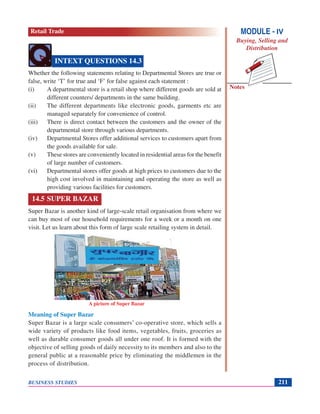
Meaning of Super Bazar
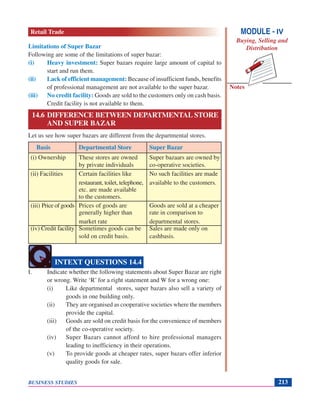
Super Bazar is a large scale consumers’ co-operative store, which sells a
wide variety of products like food items, vegetables, fruits, groceries as
well as durable consumer goods all under one roof. It is formed with the
objective of selling goods of daily necessity to its members and also to the
general public at a reasonable price by eliminating the middlemen in the
process of distribution.
INTEXT QUESTIONS 14.3
A picture of Super Bazar
MODULE - IV
Buying, Selling and
Distribution
Retail Trade
BUSINESS STUDIES212
Notes
Features of Super Bazar
The features of Super Bazar are:
(i) These stores are set up in the form of co-operative societies.
(ii) These are centrally located and also establish their branches near the
residential localities. Some Super Bazars have their mobile van, which
is taken to the residential areas for sale of goods.
(iii) It deals in standard quality products only.
(iv) These stores are often run on self-service basis. You can pick up the
goods of your choice from the open shelves and take them to the cash
counter for making payment. In some Super Bazars salesmen are also
employed to assist the customer in the process of selection of goods.
(v) These stores are managed by elected members of the co-operative
society.
(vi) Super Bazars purchase goods in bulk from the manufacturers or
government agencies and sell them to the members and general public
at a reasonable margin of profit.
(vii) In Super Bazar goods are sold only on cash basis.
(viii) The capital of Super Bazar is provided by the members of co-operative
society.
Advantages of Super Bazar
Following are the advantages of super bazar.
(i) Variety of goods: Super bazars deal with a wide range of goods of
daily household need.
(ii) Quality goods: It provides standard quality items to the customers.
Chances of adulteration and duplication are not there.
(iii) Low Price: Due to economies of large-scale purchase and avoidance
of middlemen the goods are available at a cheaper price in super bazar.
(iv) Low operating cost: In a super bazar normally services of salesmen
and shop assistants are not available. This reduces the cost of operation.
(v) Benefits to members: The members of the society get the goods at a
concessional rate. Incase of surplus or profits they also get dividend
according to their share holding.
(vi) Freedom of selection: A customer can find goods of different brands
at one place. This makes comparison and selection easy. You can take
your own time to select items of your choice.
(vii) State control: In India most of the super bazars are controlled by Central
and State Governments. This helps to maintain price and possibilities
of creating artificial shortage of goods can be avoided.
MODULE - IV
Buying, Selling and
Distribution
Retail Trade
Notes
BUSINESS STUDIES 213
INTEXT QUESTIONS 14.4
MODULE - IV
Buying, Selling and
Distribution
Retail Trade
Limitations of Super Bazar
Following are some of the limitations of super bazar:
(i) Heavy investment: Super bazars require large amount of capital to
start and run them.
(ii) Lack of efficient management: Because of insufficient funds, benefits
of professional management are not available to the super bazar.
(iii) No credit facility: Goods are sold to the customers only on cash basis.
Credit facility is not available to them.
14.6 DIFFERENCE BETWEEN DEPARTMENTAL STORE
AND SUPER BAZAR
Let us see how super bazars are different from the departmental stores.
Basis Departmental Store Super Bazar
(i) Ownership These stores are owned Super bazaars are owned by
by private individuals co-operative societies.
(ii) Facilities Certain facilities like No such facilities are made
restaurant, toilet, telephone, available to the customers.
etc. are made available
to the customers.
(iii) Price of goods Prices of goods are Goods are sold at a cheaper
generally higher than rate in comparison to
market rate departmental stores.
(iv) Credit facility Sometimes goods can be Sales are made only on
sold on credit basis. cashbasis.
I. Indicate whether the following statements about Super Bazar are right
or wrong. Write ‘R’ for a right statement and W for a wrong one:
(i) Like departmental stores, super bazars also sell a variety of
goods in one building only.
(ii) They are organised as cooperative societies where the members
provide the capital.
(iii) Goods are sold on credit basis for the convenience of members
of the co-operative society.
(iv) Super Bazars cannot afford to hire professional managers
leading to inefficiency in their operations.
(v) To provide goods at cheaper rates, super bazars offer inferior
quality goods for sale.
BUSINESS STUDIES214
Notes
II. Identify the type of large scale retail trade the following sentence refer to :
(i) Sale of goods is through different outlets located at different
places.
(ii) Goods are generally available at a price higher than its market
price elsewhere.
(iii) The stores are mostly controlled by a group of consumers.
(iv) A number of facilities are offered to customers apart from the
product for sale.
(v) Goods of the same type are sold to customers.
III. From the following sentences relating to large scale Retail Trade choose
the suitable word(s) from those given in brackets :
(i) Goods are generally purchased in bulk from
___________________ ( manufacturers, middlemen) for sale
to the consumers.
(ii) Goods are made available to consumers mostly
_____________(under same roof, in different shops)
(iii) It sells goods to _________(limited, large) number of customers.
(iv) Goods are sold on _________ (credit, cash) basis to customers.
(v) The amount of capital investment required in large-scale retail
trade is _______________ (mostly equal to, much greater than)
the capital investment in local retail shops.
14.7 MULTIPLE SHOPS
In the previous section, we learnt that in a departmental store, the whole business
is carried on in one building and the customers are drawn to it. Now we shall
read about multiple shops under which customers are approached by big
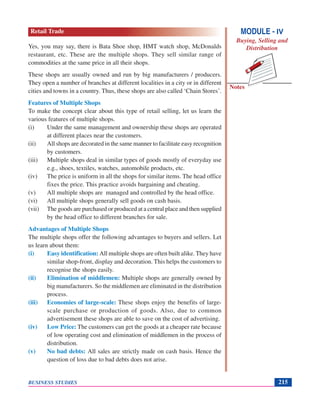
manufacturers, by setting up shops near customers. Have you ever observed that
there are some retail stores running in your town / city having the same name,
same design and dealing in the same type of products under a single brand name?
A Picture of Multiple Shops
MODULE - IV
Buying, Selling and
Distribution
Retail Trade
Notes
BUSINESS STUDIES 215
Yes, you may say, there is Bata Shoe shop, HMT watch shop, McDonalds
restaurant, etc. These are the multiple shops. They sell similar range of
commodities at the same price in all their shops.
These shops are usually owned and run by big manufacturers / producers.
They open a number of branches at different localities in a city or in different
cities and towns in a country. Thus, these shops are also called ‘Chain Stores’.
Features of Multiple Shops
To make the concept clear about this type of retail selling, let us learn the
various features of multiple shops.
(i) Under the same management and ownership these shops are operated
at different places near the customers.
(ii) All shops are decorated in the same manner to facilitate easy recognition
by customers.
(iii) Multiple shops deal in similar types of goods mostly of everyday use
e.g., shoes, textiles, watches, automobile products, etc.
(iv) The price is uniform in all the shops for similar items. The head office
fixes the price. This practice avoids bargaining and cheating.
(v) All multiple shops are managed and controlled by the head office.
(vi) All multiple shops generally sell goods on cash basis.
(vii) The goods are purchased or produced at a central place and then supplied
by the head office to different branches for sale.
Advantages of Multiple Shops
The multiple shops offer the following advantages to buyers and sellers. Let
us learn about them:
(i) Easy identification: All multiple shops are often built alike. They have
similar shop-front, display and decoration. This helps the customers to
recognise the shops easily.
(ii) Elimination of middlemen: Multiple shops are generally owned by
big manufacturers. So the middlemen are eliminated in the distribution
process.
(iii) Economies of large-scale: These shops enjoy the benefits of large-
scale purchase or production of goods. Also, due to common
advertisement these shops are able to save on the cost of advertising.
(iv) Low Price: The customers can get the goods at a cheaper rate because
of low operating cost and elimination of middlemen in the process of
distribution.
(v) No bad debts: All sales are strictly made on cash basis. Hence the
question of loss due to bad debts does not arise.
MODULE - IV
Buying, Selling and
Distribution
Retail Trade
BUSINESS STUDIES216
Notes
(vi) Public confidence: Standard quality and uniform price of the products
help in winning the confidence of customers. The customers get the
genuine and standard goods directly from the manufacturer.The chances
of duplication of goods and cheating do not arise in these shops.
(vii) Convenient location: These shops are usually located in the main
markets and in busy shopping centre. So the customers can buy goods
of their choice easily from these shops.
Limitations of Multiple Shops
Inspite of all the above advantages, multiple shops also suffer from some
limitations.
(i) Limited choice: These shops deal in limited variety of products. So
the choice of the customer is restricted to the brand of goods available
in these shops.
(ii) No credit facility: Since the sales are made on cash basis the customer
cannot avail of credit facilities from these shops.
(iii) No bargaining: The prices of the products are fixed by the head office.
Individual shops have no control over it. So the customer cannot bargain
with salesmen while buying the goods.
(iv) Lack of initiative: These shops are generally managed by the branch
managers and they follow strictly the instructions of the head office.
Hence they generally do not take initiative and do not have any special
interest in satisfying the customers.
Fill in the blanks with suitable words relating to Multiple Shops:
(i) Various shops selling similar range of products at _________ price
and usually run by big manufacturers are called multiple shops.
(ii) For easy identification, all multiple shops of the same manufacturer
have similar display and _________ .
(iii) Since all sales are on cash basis there is no risk of ___________ .
(iv) Due to elimination of _____________ goods are available to customers
at low prices.
(v) The multiple shops are centrally managed by the _________ leading
to lack of initiative on the part of branch mangers.
(vi) Customers get standard quality and genuine goods through multiple
shops leading to public _______ in the products.
(vii) Multiple shops provide ________ variety of products for customers
through their branches.
INTEXT QUESTIONS 14.5
MODULE - IV
Buying, Selling and
Distribution
Retail Trade
Notes
BUSINESS STUDIES 217
(viii) These shops provide ________ of location through their presence in
main markets and busy shopping centre.
Difference between Departmental Stores and Multiple Shops
You have learnt about Departmental Stores and Multiple Shops as two different
types of largescale retail trade organisation. Now you may give the difference
between these two types and compare it with the answer given at the end of
this lesson.
Basis Departmental Stores Multiple Shops
(i) Location These stores are located at These shops are located the central
places. at different location near the customers.
(ii) Decoration Adopt different decoration as Uniform, decoration and
decided by the owners. appearance as decided by the head office.
(iii) Varieties of goods Deals in a wide variety of goods Deals in a few
items of of different manufacturers. one manufacturer.
(iv) Price of goods Price of goods is high and differs Price is uniform in all
the from one departmental store to shops. another.
(v) Credit facility Sometimes customer can buy Credit facility is not the
goods on credit. available to the customer.
14.8 MALLS
These are the latest mode of retail trade. Here not only the consumer can
purchase various goods and services but also get the facility of entertainment.
He/She can spend his/her time there. The meeting for various purpose can be
held here. Now a days these are also
being used for arranging the
reception party for marriages,
birthdays, etc.These are the one place
shop for various products and
services.
Malls are basically buildings with
many shops, selling different
products to the consumers. Malls are
generally associated for exquisite
shopping experience they provide to
the consumers. But there’s more than just shopping to the malls. Malls these
days are equipped with state of art of architecture comprising spacious shops
which boasts of selling almost all kind of products of world renowned brands,
be it clothing, crockery, toys, electronic equipment, there is no dearth of products
in malls. These days malls stock up multitude of products and come up with
A Picture of a Mall
MODULE - IV
Buying, Selling and
Distribution
Retail Trade
BUSINESS STUDIES218
Notes
innovative strategies to sell them to the customers. Besides shopping there’s
are various facilities which are provided to customers.
14.9 OUTLETS
An outlet store or factory outlet is a store in which manufacturers sell their
stock directly to the public. Traditionally, a factory outlet was a store attached
to a factory or warehouse, sometimes allowing customers to watch the
production process like in the original. In modern usage, outlet stores are
typically manufacturer-branded stores where customers can buy goods at a
low price as mediator are eliminated and goods are sold directly to customers.
These stores provide a feeling of assured quality together will economy in
purchase to customer.
14.10 NON-STORE RETAILING
You have learnt how Departmental Stores, Multiple Shops and Super Bazar,
Malls and Outlets sell goods to large number of customers. In all these types
of retailing you have to go to the shops in the market and buy goods as per
your need. They have fixed business hours and you, as a customer have to
come to buy within those hours. Do you think why not all goods of your choice
are available at any time throughout the day? Why should you wait till the
shopkeepers come and open their shop at 9 or 10 o’clock in the morning?
Again you may also like to have the goods delivered at your doorstep.
Yes, all this is possible now-a-days because of technological advancement and
better communication facilities. If you want to avail of all these facilities then
the following retailing systems can help you.
(i) Mail order business
(ii) Tele-shopping
(iii) Sale through automatic vending machine
(iv) Internet shopping
Let us know the details of all these systems now:
Mail Order Business
If you want to buy some durable items it is not always necessary that you go to
a fixed shop and get the goods from the seller. Look what is happening in the
following pictures.
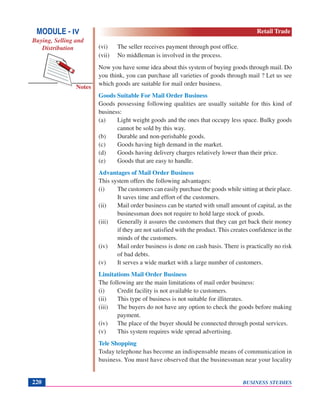
1
2 3
MODULE - IV
Buying, Selling and
Distribution
Retail Trade
Notes
BUSINESS STUDIES 219
Procedure of buying goods through mail
An advertisement in the newspaper attracts the attention of a person to
certain goods. He fills up the coupon and sends it to the seller. The seller
receives orders and packs the goods. The seller sends the goods through
the post office. The buyer receives the goods from the postman by paying
the required amount. The seller later collects the money from the post
office.
This is a system of sale by post and is known as Mail Order Business. It is
also called shopping by post. It is a method of selling goods by producers
or traders directly to the customers through post office. The seller advertises
the products through newspapers, magazines, television, booklets,
catalogues etc. to make the customer aware about the product. The
advertisement contains detailed particulars about the goods and is designed
in an attractive way to create an interest in the mind of the customers to
buy it. The advertisement may contain an order form or coupon, which the
customer has to fill up and send at the address of the mail order house.
After receiving the order, the mail order house packs the goods properly
and sends them through the post office. The post office delivers the goods
at the buyer’s place and collects the money from the buyer. Then it remits
the money to the seller or sender of the goods.
Features of Mail Order Business
The followings are the features of mail order business.
(i) The entire process is carried out through the postal system.
(ii) Buying and selling takes place without any face-to-face contact between
the buyer and the seller.
(iii) Seller advertises the products giving detailed description of the goods,
mode of payment, terms of sales, etc. in the newspapers, magazines,
letters, catalogues, etc.
(iv) Seller receives order from the buyer by post.
(v) Seller sends the properly packed goods to the buyer through value
payable post.
54
MODULE - IV
Buying, Selling and
Distribution
Retail Trade
BUSINESS STUDIES220
Notes
(vi) The seller receives payment through post office.
(vii) No middleman is involved in the process.
Now you have some idea about this system of buying goods through mail. Do
you think, you can purchase all varieties of goods through mail ? Let us see
which goods are suitable for mail order business.
Goods Suitable For Mail Order Business
Goods possessing following qualities are usually suitable for this kind of
business:
(a) Light weight goods and the ones that occupy less space. Bulky goods
cannot be sold by this way.
(b) Durable and non-perishable goods.
(c) Goods having high demand in the market.
(d) Goods having delivery charges relatively lower than their price.
(e) Goods that are easy to handle.
Advantages of Mail Order Business
This system offers the following advantages:
(i) The customers can easily purchase the goods while sitting at their place.
It saves time and effort of the customers.
(ii) Mail order business can be started with small amount of capital, as the
businessman does not require to hold large stock of goods.
(iii) Generally it assures the customers that they can get back their money
if they are not satisfied with the product. This creates confidence in the
minds of the customers.
(iv) Mail order business is done on cash basis. There is practically no risk
of bad debts.
(v) It serves a wide market with a large number of customers.
Limitations Mail Order Business
The following are the main limitations of mail order business:
(i) Credit facility is not available to customers.
(ii) This type of business is not suitable for illiterates.
(iii) The buyers do not have any option to check the goods before making
payment.
(iv) The place of the buyer should be connected through postal services.
(v) This system requires wide spread advertising.
Tele Shopping
Today telephone has become an indispensable means of communication in
business. You must have observed that the businessman near your locality
MODULE - IV
Buying, Selling and
Distribution
Retail Trade
Notes
BUSINESS STUDIES 221
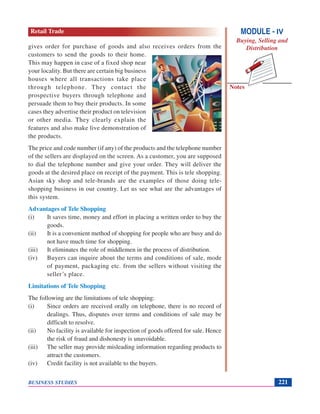
gives order for purchase of goods and also receives orders from the
customers to send the goods to their home.
This may happen in case of a fixed shop near
your locality. But there are certain big business
houses where all transactions take place
through telephone. They contact the
prospective buyers through telephone and
persuade them to buy their products. In some
cases they advertise their product on television
or other media. They clearly explain the
features and also make live demonstration of
the products.
The price and code number (if any) of the products and the telephone number
of the sellers are displayed on the screen. As a customer, you are supposed
to dial the telephone number and give your order. They will deliver the
goods at the desired place on receipt of the payment. This is tele shopping.
Asian sky shop and tele-brands are the examples of those doing tele-
shopping business in our country. Let us see what are the advantages of
this system.
Advantages of Tele Shopping
(i) It saves time, money and effort in placing a written order to buy the
goods.
(ii) It is a convenient method of shopping for people who are busy and do
not have much time for shopping.
(iii) It eliminates the role of middlemen in the process of distribution.
(iv) Buyers can inquire about the terms and conditions of sale, mode
of payment, packaging etc. from the sellers without visiting the
seller’s place.
Limitations of Tele Shopping
The following are the limitations of tele shopping:
(i) Since orders are received orally on telephone, there is no record of
dealings. Thus, disputes over terms and conditions of sale may be
difficult to resolve.
(ii) No facility is available for inspection of goods offered for sale. Hence
the risk of fraud and dishonesty is unavoidable.
(iii) The seller may provide misleading information regarding products to
attract the customers.
(iv) Credit facility is not available to the buyers.
MODULE - IV
Buying, Selling and
Distribution
Retail Trade
BUSINESS STUDIES222
Notes
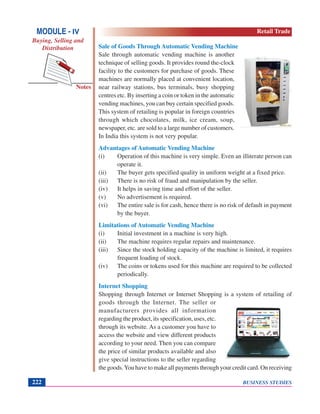
Sale of Goods Through Automatic Vending Machine
Sale through automatic vending machine is another
technique of selling goods. It provides round the-clock
facility to the customers for purchase of goods. These
machines are normally placed at convenient location,
near railway stations, bus terminals, busy shopping
centres etc. By inserting a coin or token in the automatic
vending machines, you can buy certain specified goods.
This system of retailing is popular in foreign countries
through which chocolates, milk, ice cream, soup,
newspaper, etc. are sold to a large number of customers.
In India this system is not very popular.
Advantages of Automatic Vending Machine
(i) Operation of this machine is very simple. Even an illiterate person can
operate it.
(ii) The buyer gets specified quality in uniform weight at a fixed price.
(iii) There is no risk of fraud and manipulation by the seller.
(iv) It helps in saving time and effort of the seller.
(v) No advertisement is required.
(vi) The entire sale is for cash, hence there is no risk of default in payment
by the buyer.
Limitations of Automatic Vending Machine
(i) Initial investment in a machine is very high.
(ii) The machine requires regular repairs and maintenance.
(iii) Since the stock holding capacity of the machine is limited, it requires
frequent loading of stock.
(iv) The coins or tokens used for this machine are required to be collected
periodically.
Internet Shopping
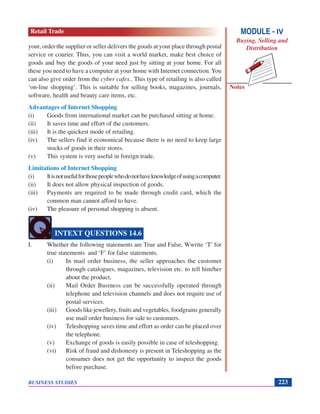
Shopping through Internet or Internet Shopping is a system of retailing of
goods through the Internet. The seller or
manufacturers provides all information
regarding the product, its specification, uses, etc.
through its website. As a customer you have to
access the website and view different products
according to your need. Then you can compare
the price of similar products available and also
give special instructions to the seller regarding
the goods.You have to make all payments through your credit card. On receiving
MODULE - IV
Buying, Selling and
Distribution
Retail Trade
Notes
BUSINESS STUDIES 223
your, order the supplier or seller delivers the goods at your place through postal
service or courier. Thus, you can visit a world market, make best choice of
goods and buy the goods of your need just by sitting at your home. For all
these you need to have a computer at your home with Internet connection. You
can also give order from the cyber cafes.. This type of retailing is also called
‘on-line shopping’. This is suitable for selling books, magazines, journals,
software, health and beauty care items, etc.
Advantages of Internet Shopping
(i) Goods from international market can be purchased sitting at home.
(ii) It saves time and effort of the customers.
(iii) It is the quickest mode of retailing.
(iv) The sellers find it economical because there is no need to keep large
stocks of goods in their stores.
(v) This system is very useful in foreign trade.
Limitations of Internet Shopping
(i) Itisnotusefulforthosepeoplewhodonothaveknowledgeofusingacomputer.
(ii) It does not allow physical inspection of goods.
(iii) Payments are required to be made through credit card, which the
common man cannot afford to have.
(iv) The pleasure of personal shopping is absent.
I. Whether the following statements are True and False, Wwrite ‘T’ for
true statements and ‘F’ for false statements.
(i) In mail order business, the seller approaches the customer
through catalogues, magazines, television etc. to tell him/her
about the product.
(ii) Mail Order Business can be successfully operated through
telephone and television channels and does not require use of
postal services.
(iii) Goods like jewellery, fruits and vegetables, foodgrains generally
use mail order business for sale to customers.
(iv) Teleshopping saves time and effort as order can be placed over
the telephone.
(v) Exchange of goods is easily possible in case of teleshopping.
(vi) Risk of fraud and dishonesty is present in Teleshopping as the
consumer does not get the opportunity to inspect the goods
before purchase.
INTEXT QUESTIONS 14.6
MODULE - IV
Buying, Selling and
Distribution
Retail Trade
BUSINESS STUDIES224
Notes
II. Fill in the blanks with suitable word(s).
(i) To buy goods any time during the day or night, a convenient
mode is ________ .
(ii) The desired goods can be bought by inserting ___________ in
the automatic vending machine.
(iii) Credit cards are used for purchase of products through
_________________ .
(iv) To buy books or magazines from anywhere in the world,
_________ may be the preferred system of retailing.
(v) Advertisement about the product is not required in
_______________.
(vi) Time and effort of ___________ is saved in on-line shopping.
(vii) The limitation of automatic vending machine is that the _______
is very expensive.
(viii) Knowledge of computers is required to buy goods through
_______________ .
III. Multiple Choice Questions
i. The type of trade which is totally dependent up on advertisement
is called :-
(a) Departmental Store (b) Mail Order Business
(c) Cooperative Stores (d) Multiple Store
ii. Which business deals in variety of goods under one roof and
one management
(a) Departmental Store (b) Cooperative Store
(c) Multiple Shops (d) None of these
iii. The place where different types of shops are available within
one building is called :-
(a)Multiple Shops (b) Departmental Store
(c) Super Bazar (d) Wholesale Market
iv. There is no need of salesman in
(a) Automatic Vending Machine
(b) Internet Shopping
(c) Departmental Stores
(d) Malls
v. Teleshopping is done through
(a) Telephone (b) T.V.
(c) Personal Visit (d) None of these
MODULE - IV
Buying, Selling and
Distribution
Retail Trade
Notes
BUSINESS STUDIES 225
• Retailers are the middlemen who buy goods from wholesalers or
producers and sell them to consumers. They deal in goods in small
quantities.
• Retailers perform the functions of buying, assembling and storage of
goods, provide credit facility, render personal services, take risk, display
the goods in stores or showrooms and also provide market information
to the producers.
• Retail trade may be classified as small-scale retail trade and large-scale
retail trade.
• Small-scale retail trade includes itinerants retailing or fixed shop
retailing.
• Large-scale retail trade includes Departmental store, multiple shops
and super bazaar where transactions take place in large volume.
• Retail the different types of fixed shop retail trade.
• Large scale retail trade is a process of trade in which either single type
of goods or a variety of goods is made available to a large number of
customers in a big shop under a single roof or may be made available
at the convenience of customers.The main types of Large-Scale retailing
business in India are (i) Departmental Stores, (ii) Multiple shops, and
(iii) Super Bazar.
• A departmental store is a large-scale retail shop selling a variety of
goods through different departments or counters in a single building.
They are located at commercial centres in big cities and towns. Besides
selling variety of goods these stores also offer facilities like restaurant,
telephone, ATM, etc. for the convenience of customers.
• Multiple shops are shops of a single brand name selling similar range
of commodities at the same price in all their shops. All shops are
decorated in the same manner for easy identification and are centrally
managed from the head office.
• Super Bazar is a large scale consumers’ co-operative store where a
wide variety of goods of daily household needs are sold under one roof
to consumers at a reasonable price.They purchase goods in bulk directly
from manufactures or government agencies and offer standard quality
goods to consumers.
• Non-store retailing may be in the form of : (a) Mail Order Business
(b) Tele shopping (c) Sale through Automatic Vending Machine and
(d) Internet Shopping
WHAT YOU HAVE LEARNT
MODULE - IV
Buying, Selling and
Distribution
Retail Trade
BUSINESS STUDIES226
Notes
• Mail Order Business is a method of sale of goods by producers or
traders directly to customers by post. The seller reaches the customer
through advertisements and the goods are delivered to the customer
through post. This is suitable only for light weight, nonperishable goods
that are easy to handle.
• Tele shopping involves contacting the customer over telephone or
through television advertising, to inform about the product and its use.
The customer places the order for the product over the telephone. This
method of shopping saves time and effort of buyers.
There is risk of fraud and dishonesty as the buyer cannot inspect the
goods offered for sale.
• Goods may be purchased round-the-clock through automatic vending
machines. Sellers place the machines at convenient locations like, bus
terminals, shopping centres, etc. Customers can buy goods simply by
inserting coins or tokens in the machine.
• Internet shopping involves getting information about the product from
internet websites and placing the order over the internet. Goods may
be delivered through post or courier and payment is made through credit
card. Goods can be bought from any where in the world sitting at home
through Internet shopping.
1. Define ‘Large-Scale Retail Trade’
2. Give two examples each of Departmental Stores and Multiple Shops
in India.
3. What is meant by Super Bazar?
4. Give examples of four products that are suitable for sale through Mail
Order Business
5. State any four advantages of Multiple Shops to buyers and sellers.
6. Explain any four advantages of Multiple Shops to buyers and sellers.
7. How are Super Bazars beneficial for customers? Explain in about 60
words.
8. Outline the procedure for buying goods through Mail Order.
9. Inspite of being a convenient method of buying goods, tele shopping is
not used by consumers very often. Why?
10. Explain any six features of Departmental Stores.
11. Distinguish between Departmental Stores and Chain Stores as large-
scale retail organisations.
12. Discussthecommonfeaturesofthedifferenttypesoflarge-scaleretailtrade.
TERMINAL EXERCISE
MODULE - IV
Buying, Selling and
Distribution
Retail Trade
Notes
BUSINESS STUDIES 227
13. Explain the advantages and limitations of Internet Shopping for
customers?
14. SaleofgoodsthroughAutomaticVendingMachineisasystemofretailing
that offers a number of advantages to the seller and buyer. Discuss.
15. What is meant by ‘Internet Retailing’?
16. Describe the different types of fixed shop retail trade.
14.1 (i) c, (ii) e, (iii) a, (iv) b, (v) d
14.2 (i) Small, (ii) retailing, (iii) large-scale,
(iv) central places, large, (v) manufacturers
14.3 (i) True, (ii)False, (iii) False, (iv) True, (v) False, (vi) True
14.4 I. (i) True, (ii) True, (iii) False, (iv) True, (v) False
II. (i) Multiple Shops, (ii) Departmental Store, (iii) Super Bazar,
(iv) Departmental Store, (v) Multiple Shops
III. (i) manufacturers, (ii) under same roof, (iii) large,
(iv) cash, (v) much greater than
14.5 (i) Same, (ii) decoration, (iii) bad debts, (iv) middlemen,
(v) head office, (vi) confidence, (vii) limited, (viii) convenience
14.6 I. (i) True, (ii) False, iii) False, (iv) True, (v) False, (vi) True
II. (i) Automatic vending machine,
(ii) Coins/tokens,
(iii) Internet shopping/on line shopping,
(iv) internet shopping/on line shopping,
(v) Automatic Vending Machine,
(vi) Customers, vii. machine,
(viii) Internet shopping /on line shopping
III. (i) b, (ii) a, (iii) b, (iv) b, (v) a
ACTIVITY FOR YOU
Read the newspaper and find out from the articles and advertisements about
the products being sold through:
• Departmental Stores
• Multiple Shopes
• Chain Stores
• Mail Order Business
ANSWER TO INTEXT QUESTIONS
MODULE - IV
Buying, Selling and
Distribution
Retail Trade

Retail trade

  • 1.
    BUSINESS STUDIES204 Notes RETAIL TRADE Youneed a variety of goods for use in your day-to-day life. Where do you get all those goods? Are they all available in your local market? If not, then you must be buying those goods from the markets of the nearby town or city. Generally to buy goods as per your own choice you move from shop to shop and market to market. You may think why all these goods are not available in a single shop? Why are these goods not available at our doorstep? Yes, there are certain shops from where you can buy a variety of goods of different types as per your convenience. Goods of your choice can also be made available at your doorstep. You can also buy goods of your choice from the shops having no salesperson either to guide you or handover the goods to you. Are you surprised? You need not. You will learn how all this happens. After studying this lesson, you will be able to : • state the meaning of retail trade; • identify the different types of retail trade; • enlist the various forms of different types of large-scale retail trade; • enumerate the advantages and disadvantages of each type of large scale retail trade; and • explain the meaning and different types of non-store retailing. 14.1 MEANING OF RETAIL TRADE Small shopkeepers, who sell goods directly to the consumers, are called retailers. Pedlars, hawkers, one-price-shop or petty shopkeepers are all retailers.Aretailer is the last link in the chain of intermediaries. He is an intermediary between the wholesaler and the ultimate consumer. He purchases from the wholesaler and sells in very small quantities to the consumers. He needs capital smaller than the wholesaler and usually, carries trade on cash basis. He does not specialise in any commodity and usually carries a large variety of goods in his stock. His activities are generally confined to the locality in which his shop is situated. OBJECTIVES 14 MODULE - IV Buying, Selling and Distribution
  • 2.
    Notes BUSINESS STUDIES 205 14.2TYPES OF RETAIL TRADE You have learnt about retailers in the previous section. You may be under the impressionthatRetailersaresmallshopkeeperstradinginthenearbylocality.However, you will be surprised to Know that starting from hawkers and street traders, to super bazaars,departmentalstoresandMultipleshops,allundertakeretail-tradingbusiness in our country. We can classify this retailing Business into two categories. Small-scale retail trade; and b. Large-scale retail trade. Small-scale retail trade is one where a limited variety and also limited quantity of goods are sold within a local area. It requires less capital and provides goods to a limited number of customers. On the other hand, large-scale retail trade is one where capital investment is more and it deals With large volume of goods. It caters to the needs of a large number of customers. Super bazars, Departmental stores and Multiple shops are examples of large scale retail trade organization. In this lesson you will learn the details about small-scale retail trade. Small-scale Retail Trade There are varities of retailers engaged in small scale retail trading. They can be classified as: (i) Itinerant Retailing (ii) Fixed Shop Retailing (i) Itinerant Retailing Itinerant retailing is a type of small-scale retail trade in which retailers move around and sell a variety of items directly to the consumers. They do not have a fixed shop where they can sell.You must have seen them distributing newspapers early in the morning; selling peanuts, bangles, toys etc. in buses and trains; selling fruits and vegetables in your locality using a cart, selling icecream, namkeens etc. on a cycle, selling rice, earthen pots or even carpets by using a cart, etc. You can also see them on pavements in your locality. In towns and cities we come across different type of itinerant retailers.There are traders who sell their articles on fixed days at different market places. In villages these market places are called “Haat” and in towns or cities they are called “weekly bazars”.The itinerant retailing also includes persons selling articles from door to door. In most cases, the price of items is not fixed and mostly settled through bargaining. Moreover, in most cases the items sold are not branded products. (ii) Fixed Shop Retailing Here the retailers sell goods and services from a fixed place known as ‘shop’. These shops are usually located at market places or commercial areas or near MODULE - IV Buying, Selling and Distribution Retail Trade
  • 3.
    BUSINESS STUDIES206 Notes residential localities.These shops normally deal with a limited variety of goods. The goods are stored as well as displayed in the shops. On the basis of the type of goods which the fixed shops deal in, we can classify this form of retailing as under. a. General store or variety store b. Single line store c. Speciality store Let us know the details about these stores. a. General store or Variety Store These stores, as the name suggest, deal with a variety of items of general use. They sell products mostly required by people for their daily use. For example, in a variety store you can find different items on toiletry, hosiery, biscuits and snacks items, grocery, cosmetic, gift items and stationery, etc. Normally these retailers make direct sale by cash only. However, for their regular customers, these retailers may give discount, provide credit facility and also deliver goods at the customer’s house free of charge. b. Single line Store These stores deal with a specific line of goods.You must have seen medicine shops, bookshops, toy shops, ready-made garment shops, etc. These are all single line stores. They sell goods of different size, brands, designs, styles and quality of the same product line. c. Speciality Store These stores deal with products of specific brand or company. All varieties of any particular brand or manufacturers are made available in these stores.You must have seen stores, like woodland shoe shops where products starting from shoe to apparel produced by woodland company are made available to the customers. General Store Medical Store (Single Line Store) Ladies Shoe Shop (Speciality) MODULE - IV Buying, Selling and Distribution Retail Trade
  • 4.
    Notes BUSINESS STUDIES 207 Matchthe Column A with the statement given in Column B : Column A Column B (i) Super Bazar (a) Deals in goods of one brand only. (ii) Itinerant retailer (b) Selldifferentvarietiesofthesameproductline. (iii) Speciality Store (c) Large variety of goods of general use. (iv) Variety Store (d) Large-scale retail trade. (v) Single Line Store (e) Sell articles on carts. 14.3 MEANING OF LARGE - SCALE RETAIL TRADE Suppose you want to buy new dresses, new shoes, some cosmetics and a number of goods of daily need. You visit one shop in the market to buy your dress, again for shoe, you visit another shop. Like wise, to buy all types of goods of your need you generally move from one shop to another. Sometimes goods of your choice may not be available in a particular shop. Then you need to visit other shops. Sometimes you may also face a heavy rush in the market. These are some general problems you may face in the local market. To overcome all these problems, some of us may like to go to shops other than thesmallretailshopsinthelocalmarket.Forexample,ifwedon’thavesufficient time to visit different shops to buy the items of our need, we may like to find a shopwherewecangetmostofourrequirementsandhaveachoicefromdifferent varieties. Or if we are very busy, we may want goods to be available to us at our home. Again, if we are in need of a well-known branded product, it may be convenient for us if there is a shop where we can get it at a reasonable price. Is there any such shop in your local market where you can get all these facilities? Actually these facilities are available in some retail shops in big towns and cities. They make available different types of goods under one roof. These shops are normally situated at central places and sell goods to a large number of customers. In some of these shops you will find a variety of goods and in some shops you will find goods of single type like shoes, shirts, etc. made by single manufacturer. All these shops buy goods in large quantities and sell them to individual consumers as retailers do. Sometimes big manufacturers also sell their products directly to the customers by opening their shops in different parts of the country. Now can you tell what is the meaning of ‘Large-scale retail trade’? INTEXT QUESTIONS 14.1 MODULE - IV Buying, Selling and Distribution Retail Trade
  • 5.
    BUSINESS STUDIES208 Notes Large scaleretail trade is a type of trade in which either single type of goods or a variety of goods are made available to a large number of consumers in a big shop under a single roof or may be made available at the convenience of customers. FEATURES OF LARGE-SCALE RETAIL TRADE The followings are some of the common features of large-scale retail trade. (i) It deals in a variety of goods of daily need and makes these goods available to the customers at their convenience. (ii) It purchases goods in bulk directly from the manufacturers, thus avoiding middlemen in the process of purchase of goods. (iii) It provides service to a large number of customers. (iv) The size of the shops/stores is comparatively bigger than the local retail shops/stores. (v) It requires huge capital investment to start and run the business. (vi) It generally sells goods to the customers on cash basis. Fill in the blanks with suitable words : (i) Sale of goods and commodities in __________ quantities directly to consumers is called retail trade. (ii) When a shopkeeper sells groceries and other items of needs to customers through his shop, he is engaged in _________ activities. (iii) When one or more types of goods are sold to customers through big shops it is called _________ retail trade. (iv) In large-scale retail trade, shops are located at __________ and sell goods to ________number of customers. (v) Large scale retail shops may be opened by big __________ to sell their products directly to the customers. 14.3 FORMS OF LARGE-SCALE RETAIL TRADES In India, generally we find the following types of Large-scale retailing business (i) Departmental Store (ii) Multiple Shops (iii) Super Bazar Let us discuss the details about all these. 14.4 DEPARTMENTAL STORES A Departmental Store is a large-scale retail shop where a large variety of goods INTEXT QUESTIONS 14.2 MODULE - IV Buying, Selling and Distribution Retail Trade
  • 6.
    Notes BUSINESS STUDIES 209 aresold in a single building. The entire building is divided into a number of departments or counters. In each department specific type of goods like stationery items, books, electronic goods, garments, jewellery etc. are available.All thesedepartmentsarecentrallycontrolled under one management. Once you enter such a store you can do all your shopping by moving from one department to another. To encourage people to do all their shopping in one store, these stores also provide facilities like restaurant, telephone, toilets,ATM etc. for the conveniences of customers. The departmental stores are very popular in USA and Europe. In our country you can find such stores in big cities. Ebony and Shoppers’Stop in Delhi, Spencer in Chennai, Kid’s Kemp in Banglore are some examples of departmental stores. Features of Departmental Stores After getting an idea about a departmental store, let us identify its features: (i) These are generally located at the main commercial centres of the cities and towns, so that, customers from different localities can easily come to buy goods as per their convenience. (ii) The size of the stores is very large and divided into many departments or counters. (iii) Each department deals with particular type of goods, say, one department sells electronic goods, another sells ready-made garments, a third keeps food items, and so on. (iv) The management and control of all departments is centralised. (v) The Departmental Stores allows customers to enjoy shopping. It enables the customers to buy everything under one roof. (vi) Facilitiessuchasrestaurant,restrooms,telephone,ATM(AutomatedTeller Machine), etc. are also made available to customers inside the store. (vii) These stores allow the customers to buy goods against a credit card. (viii) Customersmayalsoavailoffreehomedeliveryfacilitiesfromthesestores. Advantages of Departmental Stores Followings are the advantages of a departmental store: (i) Convenience of shopping: Since a large variety of goods are sold under one roof, you need not move from one bazaar to another or from one Departmental Store MODULE - IV Buying, Selling and Distribution Retail Trade
  • 7.
    BUSINESS STUDIES210 Notes shop toanother to buy goods. It saves your time and effort.Also, for the convenience of the customers these stores provide toilet, restaurant, rest room and telephone service and ATM facility inside the store. (ii) Wide choice of products: A wide variety of products from different manufacturers are sold in these stores. Thus, a customer has a wide choiceofgoodsfromwhichhe/shecanselectthebestproductasneeded. (iii) Economies of large-scale purchase and sale: Departmental stores buys goods on large scale. So it can bypass wholesalers and gets the goods directly from the manufacturers. This way it enjoys the benefits of discounts from the manufacturers. Again, due to large volume of sale, the cost of operations of business is also low. (iv) Mutual advertisement: While visiting departmental store customers are oftenattractedbygoodsdisplayedindifferentdepartments.Hence,thereis achancethatthecustomersmaybuygoodsotherthanthosetheyoriginally had in mind. Thus, each department advertises for other departments. (v) Efficient management: Since these stores are organised on a large scale basis, they normally employ efficient and competent staff to provide best services to the customers. Inspite of these advantages, the departmental stores have certain limitation also. Let us make note of these: Limitations of Departmental Stores The followings are the limitations of departmental stores: (i) Heavy Investment: Since departmental stores require large space for storing varieties of goods, huge amount of capital is required to start and manage a departmental store. (ii) Distance from residential areas: The departmental stores are normally located in places far from the residential areas. Therefore, customers from far away localities find it inconvenient to buy goods from these stores. Again, to buy goods of daily use, people prefer going to small shop situated in their residential areas. (iii) High cost of business operations: The cost of location (in the form of rent or purchase price of building), decoration of building, employment of large number of employees and provision of various facilities for the convenience of customers increases the operating cost of a departmental store. (iv) High price: High operating cost and better quality of goods lead to high price being charged for the goods in departmental stores. (v) Lackofpersonalattention:Indepartmentalstoresthereisnodirectcontact between the owner and the customers. It is the employees of the store who interact with customers. The owners directly do not get information about the tastes and preference, likes and dislikes, of their customers. MODULE - IV Buying, Selling and Distribution Retail Trade
  • 8.
    Notes BUSINESS STUDIES 211 Whetherthe following statements relating to Departmental Stores are true or false, write ‘T’ for true and ‘F’ for false against each statement : (i) A departmental store is a retail shop where different goods are sold at different counters/ departments in the same building. (ii) The different departments like electronic goods, garments etc are managed separately for convenience of control. (iii) There is direct contact between the customers and the owner of the departmental store through various departments. (iv) Departmental Stores offer additional services to customers apart from the goods available for sale. (v) These stores are conveniently located in residential areas for the benefit of large number of customers. (vi) Departmental stores offer goods at high prices to customers due to the high cost involved in maintaining and operating the store as well as providing various facilities for customers. 14.5 SUPER BAZAR Super Bazar is another kind of large-scale retail organisation from where we can buy most of our household requirements for a week or a month on one visit. Let us learn about this form of large scale retailing system in detail. Meaning of Super Bazar Super Bazar is a large scale consumers’ co-operative store, which sells a wide variety of products like food items, vegetables, fruits, groceries as well as durable consumer goods all under one roof. It is formed with the objective of selling goods of daily necessity to its members and also to the general public at a reasonable price by eliminating the middlemen in the process of distribution. INTEXT QUESTIONS 14.3 A picture of Super Bazar MODULE - IV Buying, Selling and Distribution Retail Trade
  • 9.
    BUSINESS STUDIES212 Notes Features ofSuper Bazar The features of Super Bazar are: (i) These stores are set up in the form of co-operative societies. (ii) These are centrally located and also establish their branches near the residential localities. Some Super Bazars have their mobile van, which is taken to the residential areas for sale of goods. (iii) It deals in standard quality products only. (iv) These stores are often run on self-service basis. You can pick up the goods of your choice from the open shelves and take them to the cash counter for making payment. In some Super Bazars salesmen are also employed to assist the customer in the process of selection of goods. (v) These stores are managed by elected members of the co-operative society. (vi) Super Bazars purchase goods in bulk from the manufacturers or government agencies and sell them to the members and general public at a reasonable margin of profit. (vii) In Super Bazar goods are sold only on cash basis. (viii) The capital of Super Bazar is provided by the members of co-operative society. Advantages of Super Bazar Following are the advantages of super bazar. (i) Variety of goods: Super bazars deal with a wide range of goods of daily household need. (ii) Quality goods: It provides standard quality items to the customers. Chances of adulteration and duplication are not there. (iii) Low Price: Due to economies of large-scale purchase and avoidance of middlemen the goods are available at a cheaper price in super bazar. (iv) Low operating cost: In a super bazar normally services of salesmen and shop assistants are not available. This reduces the cost of operation. (v) Benefits to members: The members of the society get the goods at a concessional rate. Incase of surplus or profits they also get dividend according to their share holding. (vi) Freedom of selection: A customer can find goods of different brands at one place. This makes comparison and selection easy. You can take your own time to select items of your choice. (vii) State control: In India most of the super bazars are controlled by Central and State Governments. This helps to maintain price and possibilities of creating artificial shortage of goods can be avoided. MODULE - IV Buying, Selling and Distribution Retail Trade
  • 10.
    Notes BUSINESS STUDIES 213 INTEXTQUESTIONS 14.4 MODULE - IV Buying, Selling and Distribution Retail Trade Limitations of Super Bazar Following are some of the limitations of super bazar: (i) Heavy investment: Super bazars require large amount of capital to start and run them. (ii) Lack of efficient management: Because of insufficient funds, benefits of professional management are not available to the super bazar. (iii) No credit facility: Goods are sold to the customers only on cash basis. Credit facility is not available to them. 14.6 DIFFERENCE BETWEEN DEPARTMENTAL STORE AND SUPER BAZAR Let us see how super bazars are different from the departmental stores. Basis Departmental Store Super Bazar (i) Ownership These stores are owned Super bazaars are owned by by private individuals co-operative societies. (ii) Facilities Certain facilities like No such facilities are made restaurant, toilet, telephone, available to the customers. etc. are made available to the customers. (iii) Price of goods Prices of goods are Goods are sold at a cheaper generally higher than rate in comparison to market rate departmental stores. (iv) Credit facility Sometimes goods can be Sales are made only on sold on credit basis. cashbasis. I. Indicate whether the following statements about Super Bazar are right or wrong. Write ‘R’ for a right statement and W for a wrong one: (i) Like departmental stores, super bazars also sell a variety of goods in one building only. (ii) They are organised as cooperative societies where the members provide the capital. (iii) Goods are sold on credit basis for the convenience of members of the co-operative society. (iv) Super Bazars cannot afford to hire professional managers leading to inefficiency in their operations. (v) To provide goods at cheaper rates, super bazars offer inferior quality goods for sale.
  • 11.
    BUSINESS STUDIES214 Notes II. Identifythe type of large scale retail trade the following sentence refer to : (i) Sale of goods is through different outlets located at different places. (ii) Goods are generally available at a price higher than its market price elsewhere. (iii) The stores are mostly controlled by a group of consumers. (iv) A number of facilities are offered to customers apart from the product for sale. (v) Goods of the same type are sold to customers. III. From the following sentences relating to large scale Retail Trade choose the suitable word(s) from those given in brackets : (i) Goods are generally purchased in bulk from ___________________ ( manufacturers, middlemen) for sale to the consumers. (ii) Goods are made available to consumers mostly _____________(under same roof, in different shops) (iii) It sells goods to _________(limited, large) number of customers. (iv) Goods are sold on _________ (credit, cash) basis to customers. (v) The amount of capital investment required in large-scale retail trade is _______________ (mostly equal to, much greater than) the capital investment in local retail shops. 14.7 MULTIPLE SHOPS In the previous section, we learnt that in a departmental store, the whole business is carried on in one building and the customers are drawn to it. Now we shall read about multiple shops under which customers are approached by big manufacturers, by setting up shops near customers. Have you ever observed that there are some retail stores running in your town / city having the same name, same design and dealing in the same type of products under a single brand name? A Picture of Multiple Shops MODULE - IV Buying, Selling and Distribution Retail Trade
  • 12.
    Notes BUSINESS STUDIES 215 Yes,you may say, there is Bata Shoe shop, HMT watch shop, McDonalds restaurant, etc. These are the multiple shops. They sell similar range of commodities at the same price in all their shops. These shops are usually owned and run by big manufacturers / producers. They open a number of branches at different localities in a city or in different cities and towns in a country. Thus, these shops are also called ‘Chain Stores’. Features of Multiple Shops To make the concept clear about this type of retail selling, let us learn the various features of multiple shops. (i) Under the same management and ownership these shops are operated at different places near the customers. (ii) All shops are decorated in the same manner to facilitate easy recognition by customers. (iii) Multiple shops deal in similar types of goods mostly of everyday use e.g., shoes, textiles, watches, automobile products, etc. (iv) The price is uniform in all the shops for similar items. The head office fixes the price. This practice avoids bargaining and cheating. (v) All multiple shops are managed and controlled by the head office. (vi) All multiple shops generally sell goods on cash basis. (vii) The goods are purchased or produced at a central place and then supplied by the head office to different branches for sale. Advantages of Multiple Shops The multiple shops offer the following advantages to buyers and sellers. Let us learn about them: (i) Easy identification: All multiple shops are often built alike. They have similar shop-front, display and decoration. This helps the customers to recognise the shops easily. (ii) Elimination of middlemen: Multiple shops are generally owned by big manufacturers. So the middlemen are eliminated in the distribution process. (iii) Economies of large-scale: These shops enjoy the benefits of large- scale purchase or production of goods. Also, due to common advertisement these shops are able to save on the cost of advertising. (iv) Low Price: The customers can get the goods at a cheaper rate because of low operating cost and elimination of middlemen in the process of distribution. (v) No bad debts: All sales are strictly made on cash basis. Hence the question of loss due to bad debts does not arise. MODULE - IV Buying, Selling and Distribution Retail Trade
  • 13.
    BUSINESS STUDIES216 Notes (vi) Publicconfidence: Standard quality and uniform price of the products help in winning the confidence of customers. The customers get the genuine and standard goods directly from the manufacturer.The chances of duplication of goods and cheating do not arise in these shops. (vii) Convenient location: These shops are usually located in the main markets and in busy shopping centre. So the customers can buy goods of their choice easily from these shops. Limitations of Multiple Shops Inspite of all the above advantages, multiple shops also suffer from some limitations. (i) Limited choice: These shops deal in limited variety of products. So the choice of the customer is restricted to the brand of goods available in these shops. (ii) No credit facility: Since the sales are made on cash basis the customer cannot avail of credit facilities from these shops. (iii) No bargaining: The prices of the products are fixed by the head office. Individual shops have no control over it. So the customer cannot bargain with salesmen while buying the goods. (iv) Lack of initiative: These shops are generally managed by the branch managers and they follow strictly the instructions of the head office. Hence they generally do not take initiative and do not have any special interest in satisfying the customers. Fill in the blanks with suitable words relating to Multiple Shops: (i) Various shops selling similar range of products at _________ price and usually run by big manufacturers are called multiple shops. (ii) For easy identification, all multiple shops of the same manufacturer have similar display and _________ . (iii) Since all sales are on cash basis there is no risk of ___________ . (iv) Due to elimination of _____________ goods are available to customers at low prices. (v) The multiple shops are centrally managed by the _________ leading to lack of initiative on the part of branch mangers. (vi) Customers get standard quality and genuine goods through multiple shops leading to public _______ in the products. (vii) Multiple shops provide ________ variety of products for customers through their branches. INTEXT QUESTIONS 14.5 MODULE - IV Buying, Selling and Distribution Retail Trade
  • 14.
    Notes BUSINESS STUDIES 217 (viii)These shops provide ________ of location through their presence in main markets and busy shopping centre. Difference between Departmental Stores and Multiple Shops You have learnt about Departmental Stores and Multiple Shops as two different types of largescale retail trade organisation. Now you may give the difference between these two types and compare it with the answer given at the end of this lesson. Basis Departmental Stores Multiple Shops (i) Location These stores are located at These shops are located the central places. at different location near the customers. (ii) Decoration Adopt different decoration as Uniform, decoration and decided by the owners. appearance as decided by the head office. (iii) Varieties of goods Deals in a wide variety of goods Deals in a few items of of different manufacturers. one manufacturer. (iv) Price of goods Price of goods is high and differs Price is uniform in all the from one departmental store to shops. another. (v) Credit facility Sometimes customer can buy Credit facility is not the goods on credit. available to the customer. 14.8 MALLS These are the latest mode of retail trade. Here not only the consumer can purchase various goods and services but also get the facility of entertainment. He/She can spend his/her time there. The meeting for various purpose can be held here. Now a days these are also being used for arranging the reception party for marriages, birthdays, etc.These are the one place shop for various products and services. Malls are basically buildings with many shops, selling different products to the consumers. Malls are generally associated for exquisite shopping experience they provide to the consumers. But there’s more than just shopping to the malls. Malls these days are equipped with state of art of architecture comprising spacious shops which boasts of selling almost all kind of products of world renowned brands, be it clothing, crockery, toys, electronic equipment, there is no dearth of products in malls. These days malls stock up multitude of products and come up with A Picture of a Mall MODULE - IV Buying, Selling and Distribution Retail Trade
  • 15.
    BUSINESS STUDIES218 Notes innovative strategiesto sell them to the customers. Besides shopping there’s are various facilities which are provided to customers. 14.9 OUTLETS An outlet store or factory outlet is a store in which manufacturers sell their stock directly to the public. Traditionally, a factory outlet was a store attached to a factory or warehouse, sometimes allowing customers to watch the production process like in the original. In modern usage, outlet stores are typically manufacturer-branded stores where customers can buy goods at a low price as mediator are eliminated and goods are sold directly to customers. These stores provide a feeling of assured quality together will economy in purchase to customer. 14.10 NON-STORE RETAILING You have learnt how Departmental Stores, Multiple Shops and Super Bazar, Malls and Outlets sell goods to large number of customers. In all these types of retailing you have to go to the shops in the market and buy goods as per your need. They have fixed business hours and you, as a customer have to come to buy within those hours. Do you think why not all goods of your choice are available at any time throughout the day? Why should you wait till the shopkeepers come and open their shop at 9 or 10 o’clock in the morning? Again you may also like to have the goods delivered at your doorstep. Yes, all this is possible now-a-days because of technological advancement and better communication facilities. If you want to avail of all these facilities then the following retailing systems can help you. (i) Mail order business (ii) Tele-shopping (iii) Sale through automatic vending machine (iv) Internet shopping Let us know the details of all these systems now: Mail Order Business If you want to buy some durable items it is not always necessary that you go to a fixed shop and get the goods from the seller. Look what is happening in the following pictures. 1 2 3 MODULE - IV Buying, Selling and Distribution Retail Trade
  • 16.
    Notes BUSINESS STUDIES 219 Procedureof buying goods through mail An advertisement in the newspaper attracts the attention of a person to certain goods. He fills up the coupon and sends it to the seller. The seller receives orders and packs the goods. The seller sends the goods through the post office. The buyer receives the goods from the postman by paying the required amount. The seller later collects the money from the post office. This is a system of sale by post and is known as Mail Order Business. It is also called shopping by post. It is a method of selling goods by producers or traders directly to the customers through post office. The seller advertises the products through newspapers, magazines, television, booklets, catalogues etc. to make the customer aware about the product. The advertisement contains detailed particulars about the goods and is designed in an attractive way to create an interest in the mind of the customers to buy it. The advertisement may contain an order form or coupon, which the customer has to fill up and send at the address of the mail order house. After receiving the order, the mail order house packs the goods properly and sends them through the post office. The post office delivers the goods at the buyer’s place and collects the money from the buyer. Then it remits the money to the seller or sender of the goods. Features of Mail Order Business The followings are the features of mail order business. (i) The entire process is carried out through the postal system. (ii) Buying and selling takes place without any face-to-face contact between the buyer and the seller. (iii) Seller advertises the products giving detailed description of the goods, mode of payment, terms of sales, etc. in the newspapers, magazines, letters, catalogues, etc. (iv) Seller receives order from the buyer by post. (v) Seller sends the properly packed goods to the buyer through value payable post. 54 MODULE - IV Buying, Selling and Distribution Retail Trade
  • 17.
    BUSINESS STUDIES220 Notes (vi) Theseller receives payment through post office. (vii) No middleman is involved in the process. Now you have some idea about this system of buying goods through mail. Do you think, you can purchase all varieties of goods through mail ? Let us see which goods are suitable for mail order business. Goods Suitable For Mail Order Business Goods possessing following qualities are usually suitable for this kind of business: (a) Light weight goods and the ones that occupy less space. Bulky goods cannot be sold by this way. (b) Durable and non-perishable goods. (c) Goods having high demand in the market. (d) Goods having delivery charges relatively lower than their price. (e) Goods that are easy to handle. Advantages of Mail Order Business This system offers the following advantages: (i) The customers can easily purchase the goods while sitting at their place. It saves time and effort of the customers. (ii) Mail order business can be started with small amount of capital, as the businessman does not require to hold large stock of goods. (iii) Generally it assures the customers that they can get back their money if they are not satisfied with the product. This creates confidence in the minds of the customers. (iv) Mail order business is done on cash basis. There is practically no risk of bad debts. (v) It serves a wide market with a large number of customers. Limitations Mail Order Business The following are the main limitations of mail order business: (i) Credit facility is not available to customers. (ii) This type of business is not suitable for illiterates. (iii) The buyers do not have any option to check the goods before making payment. (iv) The place of the buyer should be connected through postal services. (v) This system requires wide spread advertising. Tele Shopping Today telephone has become an indispensable means of communication in business. You must have observed that the businessman near your locality MODULE - IV Buying, Selling and Distribution Retail Trade
  • 18.
    Notes BUSINESS STUDIES 221 givesorder for purchase of goods and also receives orders from the customers to send the goods to their home. This may happen in case of a fixed shop near your locality. But there are certain big business houses where all transactions take place through telephone. They contact the prospective buyers through telephone and persuade them to buy their products. In some cases they advertise their product on television or other media. They clearly explain the features and also make live demonstration of the products. The price and code number (if any) of the products and the telephone number of the sellers are displayed on the screen. As a customer, you are supposed to dial the telephone number and give your order. They will deliver the goods at the desired place on receipt of the payment. This is tele shopping. Asian sky shop and tele-brands are the examples of those doing tele- shopping business in our country. Let us see what are the advantages of this system. Advantages of Tele Shopping (i) It saves time, money and effort in placing a written order to buy the goods. (ii) It is a convenient method of shopping for people who are busy and do not have much time for shopping. (iii) It eliminates the role of middlemen in the process of distribution. (iv) Buyers can inquire about the terms and conditions of sale, mode of payment, packaging etc. from the sellers without visiting the seller’s place. Limitations of Tele Shopping The following are the limitations of tele shopping: (i) Since orders are received orally on telephone, there is no record of dealings. Thus, disputes over terms and conditions of sale may be difficult to resolve. (ii) No facility is available for inspection of goods offered for sale. Hence the risk of fraud and dishonesty is unavoidable. (iii) The seller may provide misleading information regarding products to attract the customers. (iv) Credit facility is not available to the buyers. MODULE - IV Buying, Selling and Distribution Retail Trade
  • 19.
    BUSINESS STUDIES222 Notes Sale ofGoods Through Automatic Vending Machine Sale through automatic vending machine is another technique of selling goods. It provides round the-clock facility to the customers for purchase of goods. These machines are normally placed at convenient location, near railway stations, bus terminals, busy shopping centres etc. By inserting a coin or token in the automatic vending machines, you can buy certain specified goods. This system of retailing is popular in foreign countries through which chocolates, milk, ice cream, soup, newspaper, etc. are sold to a large number of customers. In India this system is not very popular. Advantages of Automatic Vending Machine (i) Operation of this machine is very simple. Even an illiterate person can operate it. (ii) The buyer gets specified quality in uniform weight at a fixed price. (iii) There is no risk of fraud and manipulation by the seller. (iv) It helps in saving time and effort of the seller. (v) No advertisement is required. (vi) The entire sale is for cash, hence there is no risk of default in payment by the buyer. Limitations of Automatic Vending Machine (i) Initial investment in a machine is very high. (ii) The machine requires regular repairs and maintenance. (iii) Since the stock holding capacity of the machine is limited, it requires frequent loading of stock. (iv) The coins or tokens used for this machine are required to be collected periodically. Internet Shopping Shopping through Internet or Internet Shopping is a system of retailing of goods through the Internet. The seller or manufacturers provides all information regarding the product, its specification, uses, etc. through its website. As a customer you have to access the website and view different products according to your need. Then you can compare the price of similar products available and also give special instructions to the seller regarding the goods.You have to make all payments through your credit card. On receiving MODULE - IV Buying, Selling and Distribution Retail Trade
  • 20.
    Notes BUSINESS STUDIES 223 your,order the supplier or seller delivers the goods at your place through postal service or courier. Thus, you can visit a world market, make best choice of goods and buy the goods of your need just by sitting at your home. For all these you need to have a computer at your home with Internet connection. You can also give order from the cyber cafes.. This type of retailing is also called ‘on-line shopping’. This is suitable for selling books, magazines, journals, software, health and beauty care items, etc. Advantages of Internet Shopping (i) Goods from international market can be purchased sitting at home. (ii) It saves time and effort of the customers. (iii) It is the quickest mode of retailing. (iv) The sellers find it economical because there is no need to keep large stocks of goods in their stores. (v) This system is very useful in foreign trade. Limitations of Internet Shopping (i) Itisnotusefulforthosepeoplewhodonothaveknowledgeofusingacomputer. (ii) It does not allow physical inspection of goods. (iii) Payments are required to be made through credit card, which the common man cannot afford to have. (iv) The pleasure of personal shopping is absent. I. Whether the following statements are True and False, Wwrite ‘T’ for true statements and ‘F’ for false statements. (i) In mail order business, the seller approaches the customer through catalogues, magazines, television etc. to tell him/her about the product. (ii) Mail Order Business can be successfully operated through telephone and television channels and does not require use of postal services. (iii) Goods like jewellery, fruits and vegetables, foodgrains generally use mail order business for sale to customers. (iv) Teleshopping saves time and effort as order can be placed over the telephone. (v) Exchange of goods is easily possible in case of teleshopping. (vi) Risk of fraud and dishonesty is present in Teleshopping as the consumer does not get the opportunity to inspect the goods before purchase. INTEXT QUESTIONS 14.6 MODULE - IV Buying, Selling and Distribution Retail Trade
  • 21.
    BUSINESS STUDIES224 Notes II. Fillin the blanks with suitable word(s). (i) To buy goods any time during the day or night, a convenient mode is ________ . (ii) The desired goods can be bought by inserting ___________ in the automatic vending machine. (iii) Credit cards are used for purchase of products through _________________ . (iv) To buy books or magazines from anywhere in the world, _________ may be the preferred system of retailing. (v) Advertisement about the product is not required in _______________. (vi) Time and effort of ___________ is saved in on-line shopping. (vii) The limitation of automatic vending machine is that the _______ is very expensive. (viii) Knowledge of computers is required to buy goods through _______________ . III. Multiple Choice Questions i. The type of trade which is totally dependent up on advertisement is called :- (a) Departmental Store (b) Mail Order Business (c) Cooperative Stores (d) Multiple Store ii. Which business deals in variety of goods under one roof and one management (a) Departmental Store (b) Cooperative Store (c) Multiple Shops (d) None of these iii. The place where different types of shops are available within one building is called :- (a)Multiple Shops (b) Departmental Store (c) Super Bazar (d) Wholesale Market iv. There is no need of salesman in (a) Automatic Vending Machine (b) Internet Shopping (c) Departmental Stores (d) Malls v. Teleshopping is done through (a) Telephone (b) T.V. (c) Personal Visit (d) None of these MODULE - IV Buying, Selling and Distribution Retail Trade
  • 22.
    Notes BUSINESS STUDIES 225 •Retailers are the middlemen who buy goods from wholesalers or producers and sell them to consumers. They deal in goods in small quantities. • Retailers perform the functions of buying, assembling and storage of goods, provide credit facility, render personal services, take risk, display the goods in stores or showrooms and also provide market information to the producers. • Retail trade may be classified as small-scale retail trade and large-scale retail trade. • Small-scale retail trade includes itinerants retailing or fixed shop retailing. • Large-scale retail trade includes Departmental store, multiple shops and super bazaar where transactions take place in large volume. • Retail the different types of fixed shop retail trade. • Large scale retail trade is a process of trade in which either single type of goods or a variety of goods is made available to a large number of customers in a big shop under a single roof or may be made available at the convenience of customers.The main types of Large-Scale retailing business in India are (i) Departmental Stores, (ii) Multiple shops, and (iii) Super Bazar. • A departmental store is a large-scale retail shop selling a variety of goods through different departments or counters in a single building. They are located at commercial centres in big cities and towns. Besides selling variety of goods these stores also offer facilities like restaurant, telephone, ATM, etc. for the convenience of customers. • Multiple shops are shops of a single brand name selling similar range of commodities at the same price in all their shops. All shops are decorated in the same manner for easy identification and are centrally managed from the head office. • Super Bazar is a large scale consumers’ co-operative store where a wide variety of goods of daily household needs are sold under one roof to consumers at a reasonable price.They purchase goods in bulk directly from manufactures or government agencies and offer standard quality goods to consumers. • Non-store retailing may be in the form of : (a) Mail Order Business (b) Tele shopping (c) Sale through Automatic Vending Machine and (d) Internet Shopping WHAT YOU HAVE LEARNT MODULE - IV Buying, Selling and Distribution Retail Trade
  • 23.
    BUSINESS STUDIES226 Notes • MailOrder Business is a method of sale of goods by producers or traders directly to customers by post. The seller reaches the customer through advertisements and the goods are delivered to the customer through post. This is suitable only for light weight, nonperishable goods that are easy to handle. • Tele shopping involves contacting the customer over telephone or through television advertising, to inform about the product and its use. The customer places the order for the product over the telephone. This method of shopping saves time and effort of buyers. There is risk of fraud and dishonesty as the buyer cannot inspect the goods offered for sale. • Goods may be purchased round-the-clock through automatic vending machines. Sellers place the machines at convenient locations like, bus terminals, shopping centres, etc. Customers can buy goods simply by inserting coins or tokens in the machine. • Internet shopping involves getting information about the product from internet websites and placing the order over the internet. Goods may be delivered through post or courier and payment is made through credit card. Goods can be bought from any where in the world sitting at home through Internet shopping. 1. Define ‘Large-Scale Retail Trade’ 2. Give two examples each of Departmental Stores and Multiple Shops in India. 3. What is meant by Super Bazar? 4. Give examples of four products that are suitable for sale through Mail Order Business 5. State any four advantages of Multiple Shops to buyers and sellers. 6. Explain any four advantages of Multiple Shops to buyers and sellers. 7. How are Super Bazars beneficial for customers? Explain in about 60 words. 8. Outline the procedure for buying goods through Mail Order. 9. Inspite of being a convenient method of buying goods, tele shopping is not used by consumers very often. Why? 10. Explain any six features of Departmental Stores. 11. Distinguish between Departmental Stores and Chain Stores as large- scale retail organisations. 12. Discussthecommonfeaturesofthedifferenttypesoflarge-scaleretailtrade. TERMINAL EXERCISE MODULE - IV Buying, Selling and Distribution Retail Trade
  • 24.
    Notes BUSINESS STUDIES 227 13.Explain the advantages and limitations of Internet Shopping for customers? 14. SaleofgoodsthroughAutomaticVendingMachineisasystemofretailing that offers a number of advantages to the seller and buyer. Discuss. 15. What is meant by ‘Internet Retailing’? 16. Describe the different types of fixed shop retail trade. 14.1 (i) c, (ii) e, (iii) a, (iv) b, (v) d 14.2 (i) Small, (ii) retailing, (iii) large-scale, (iv) central places, large, (v) manufacturers 14.3 (i) True, (ii)False, (iii) False, (iv) True, (v) False, (vi) True 14.4 I. (i) True, (ii) True, (iii) False, (iv) True, (v) False II. (i) Multiple Shops, (ii) Departmental Store, (iii) Super Bazar, (iv) Departmental Store, (v) Multiple Shops III. (i) manufacturers, (ii) under same roof, (iii) large, (iv) cash, (v) much greater than 14.5 (i) Same, (ii) decoration, (iii) bad debts, (iv) middlemen, (v) head office, (vi) confidence, (vii) limited, (viii) convenience 14.6 I. (i) True, (ii) False, iii) False, (iv) True, (v) False, (vi) True II. (i) Automatic vending machine, (ii) Coins/tokens, (iii) Internet shopping/on line shopping, (iv) internet shopping/on line shopping, (v) Automatic Vending Machine, (vi) Customers, vii. machine, (viii) Internet shopping /on line shopping III. (i) b, (ii) a, (iii) b, (iv) b, (v) a ACTIVITY FOR YOU Read the newspaper and find out from the articles and advertisements about the products being sold through: • Departmental Stores • Multiple Shopes • Chain Stores • Mail Order Business ANSWER TO INTEXT QUESTIONS MODULE - IV Buying, Selling and Distribution Retail Trade