D I S A S T E R
M A N A G E M E N T
TA B L E O F
C O N T E N T S
1. What is disaster management
2. Disaster management cycle
3. Disaster management : Types of
disaster
4. Disaster management act, 2005
5. Disaster management agencies in
India
W H AT I S D I S A S T E R
M A N A G E M E N T
Accordingto the United Nations,a
disaster is a major disruption of a
community or society’s ability to
functionthat involves extensive
affectson people, property,the
economy,or the environmentand
beyondthe capacity of the affected
community or society to deal using its
ownresources.
.Disaster managementis the process
by whichwe “preparefor, respondto
and learn from the effectsof big
failures”.It is howwe cope with the
human,material, economic,or
environmentalimpacts of a given
disaster. Disasters can have human
causes,despite the factthat nature
frequentlycausesthem.
D I S A S T E R
M A N A G E M E N T
C Y C L E
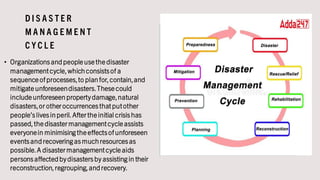
• Organizationsandpeopleusethedisaster
managementcycle,which consistsof a
sequenceof processes,to plan for,contain,and
mitigateunforeseendisasters.Thesecould
includeunforeseen propertydamage,natural
disasters,or otheroccurrencesthatputother
people’slivesin peril.Aftertheinitial crisishas
passed,thedisastermanagementcycleassists
everyonein minimising theeffectsof unforeseen
eventsandrecovering asmuch resourcesas
possible.A disastermanagementcycleaids
personsaffectedbydisastersby assisting in their
reconstruction,regrouping,andrecovery.
D I S A S T E R
M A N A G E M E N T
: T Y P E S O F
D I S A S T E R S
• Disasterscan take manydifferentforms.
Disasters,in whatevershapethey take,
disturbcommunitiesand can havemajor
consequencesfor people,property,
businesses,and the environment.They
frequentlytest a community’s ability to cope.
Human-causeddisasters, suchas industrial
explosionsor structuralbreakdowns,are the
resultof humanerror.Naturalcatastrophes
are causedby physicaloccurrencessuch as
earthquakes anddroughts.Complexdisasters
mightinclude epidemicsor armedconflicts.
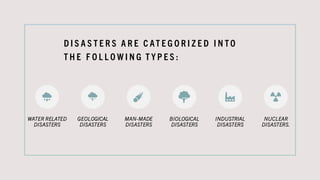
D I S A S T E R S A R E C AT E G O R I Z E D I N TO
T H E F O L L O W I N G T Y P E S :
WATER RELATED
DISASTERS
GEOLOGICAL
DISASTERS
MAN-MADE
DISASTERS
BIOLOGICAL
DISASTERS
INDUSTRIAL
DISASTERS
NUCLEAR
DISASTERS.
W AT E R R E L AT E D
D I S A S T E R S
• Water-related disasters include:
• Floods
• Droughts and aridification
• Landslides
• Storms
• Heat waves
• Water-related disasters are
frequently visible globallyand are
caused by complex and excessive
interactions and interlinkages
between human activities and the
water cycle1. Over 90% of “natural”
disasters are water-related
G E O L O G I C A L
D I S A S T E R S
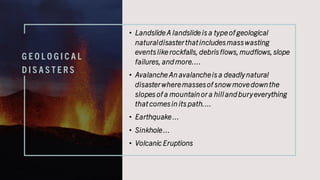
• Landslide A landslide is a type of geological
naturaldisasterthatincludesmasswasting
eventslike rockfalls, debrisflows,mudflows,slope
failures, and more....
• Avalanche An avalancheis a deadlynatural
disasterwheremassesof snowmove downthe
slopes of a mountainor a hill and buryeverything
that comesin its path....
• Earthquake ...
• Sinkhole ...
• Volcanic Eruptions
M A N - MADE
DI S A ST ER
A man-made disaster is a
disaster resulting from
human intent, negligence, or
error. They can be both
intentional and unintentional.
It results in a huge loss of life
and property. Examples of
man-made disasters include
terrorist attacks, oil spills,
industrial accidents, nuclear
explosions, and wars.
B I O L O G I C A L D I S A S T E R S
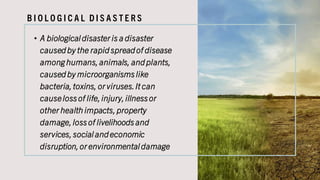
• A biological disaster is a disaster
caused by the rapid spread of disease
amonghumans,animals, and plants,
caused by microorganismslike
bacteria,toxins, or viruses.It can
causelossof life,injury,illnessor
other health impacts,property
damage,lossof livelihoodsand
services,social and economic
disruption,or environmental damage
I N D U S T R I A L
D I S A S T E R
INDUSTRIAL DISASTERS ARE DISASTERS CAUSEDBY
INDUSTRIAL COMPANIES,EITHER BY ACCIDENT,NEGLIGENCE
OR INCOMPETENCE.THEY ARE A FORMOF INDUSTRIAL
ACCIDENT WHERE GREAT DAMAGE, INJURY OR LOSS OF LIFE
ARE CAUSED
N U C L E A R
D I S A S T E R S
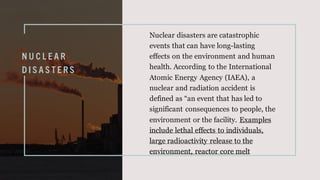
Nuclear disasters are catastrophic
events that can have long-lasting
effects on the environment and human
health. According to the International
Atomic Energy Agency (IAEA), a
nuclear and radiation accident is
defined as “an event that has led to
significant consequences to people, the
environment or the facility. Examples
include lethal effects to individuals,
large radioactivity release to the
environment, reactor core melt
D I S A S T E R
M A N A G E M E N T
A C T, 2 0 0 5
• The Lok Sabha enacted the Disaster Management Act on November 28,
2005, and the Rajya Sabha did it on December 12, 2005. On January 9,
2006, the Indian President gave his approval. The Act mandates the
creation of the National Disaster Management Authority (NDMA),
whose chairman shall be the Prime Minister of India. At any given
moment, the NDMA can only have nine members total, including the
vice-chairperson. The NDMA members are appointed for a five-year
term. On 27 September 2005, the NDMA was formally established in
accordance with Section 3(1) of the Disaster Management Act after
being first established on 30 May 2005 by executive order. The NDMA
is in charge of “setting down the rules, plans, and procedures for
disaster management” as well as making sure that disaster responses
are swift and efficient. It is tasked with establishing “guidelines to be
followed by the State Authorities in drawing up the national Plans” in
accordance with Section 6 of the act
T H E D I S A S T E R
M A N A G E M E N T A C T O F
2 0 0 5 A C K N O W L E D G E S
D I S A S T E R M A N A G E M E N T
A S A C R U C I A L P R O C E S S
O F P L A N N I N G ,
O R G A N I Z I N G ,
C O O R D I N A T I N G , A N D
I M P L E M E N T I N G
M E A S U R E S W H I C H A R E
N E C E S S A R Y F O R .
• Prevention of the threat of any disaster
• Reduction of risk of any disaster or its
consequences
• Readiness to deal with any disaster
• Promptness in dealing with a disaster
• Assessing the severity of the effects of any
disaster
• Rescue and relief
• Rehabilitation and Reconstruction..
D I S A S T E R M A N A G E M E N T
A G E N C I E S I N I N D I A
• National Disaster Management Authority
(NDMA)
• National Executive Committee (NEC)
• State Disaster Management Authority
(SDMA)
• District Disaster Management Authority
(DDMA)
• Local Authorities
N A T I O N A L D I S A S T E R
M A N A G E M E N T
A U T H O R I T Y
• The National Disaster Management
Authority, or the NDMA, is an apex
body for disaster management,
governed by the Prime Minister of
India. It is charge of the supervision,
direction, and control of the
National Disaster Response Force
(NDRF).
N AT I O N A L
E X E C U T I V E
C O M M I T T E E ( N E C )
• The NEC is composed of high-profile
ministerial members from the government of
India that consist of the Union Home
Secretary as Chairperson, and the Secretaries
to the Government of India (GoI)like
Ministries/Departments of Agriculture,
Atomic Energy, Defence, Drinking Water
Supply, Environment and Forests, etc. The
NEC covers the National Plan for Disaster
Management as per the National Policy on
Disaster Management.
S TAT E D I S A S T E R
M A N A G E M E N T A U T H O R I T Y
• The Chief Minister of the
respective state is the head
of the SDMA.The State
Government has a State
Executive Committee (SEC)
which assists the State
Disaster Management
Authority (SDMA) on Disaster
Management.
D I S T R I C T D I S A S T E R
M A N A G E M E N T
A U T H O R I T Y
• The DDMA is headed by the District
Collector, Deputy Commissioner or
District Magistrate depending on
the situation, with the elected
representatives of the local
authority as the Co-Chairperson.
The DDMA ensures that the
guidelines framed by the NDMA
and the SDMA are followed by all
the departments of the State
Government at the District level
and the local authorities in the
District.
L O C A L A U T H O R I T I E S
• Local authorities would include
Panchayati Raj Institutions (PRI),
Municipalities, District and
Cantonment 11Institutional and
Legal Arrangements Boards, and
Town Planning Authorities which
control and manage civic services.

Presentation.pdf

  • 1.
    D I SA S T E R M A N A G E M E N T
  • 2.
    TA B LE O F C O N T E N T S 1. What is disaster management 2. Disaster management cycle 3. Disaster management : Types of disaster 4. Disaster management act, 2005 5. Disaster management agencies in India
  • 3.
    W H ATI S D I S A S T E R M A N A G E M E N T Accordingto the United Nations,a disaster is a major disruption of a community or society’s ability to functionthat involves extensive affectson people, property,the economy,or the environmentand beyondthe capacity of the affected community or society to deal using its ownresources. .Disaster managementis the process by whichwe “preparefor, respondto and learn from the effectsof big failures”.It is howwe cope with the human,material, economic,or environmentalimpacts of a given disaster. Disasters can have human causes,despite the factthat nature frequentlycausesthem.
  • 4.
    D I SA S T E R M A N A G E M E N T C Y C L E • Organizationsandpeopleusethedisaster managementcycle,which consistsof a sequenceof processes,to plan for,contain,and mitigateunforeseendisasters.Thesecould includeunforeseen propertydamage,natural disasters,or otheroccurrencesthatputother people’slivesin peril.Aftertheinitial crisishas passed,thedisastermanagementcycleassists everyonein minimising theeffectsof unforeseen eventsandrecovering asmuch resourcesas possible.A disastermanagementcycleaids personsaffectedbydisastersby assisting in their reconstruction,regrouping,andrecovery.
  • 5.
    D I SA S T E R M A N A G E M E N T : T Y P E S O F D I S A S T E R S • Disasterscan take manydifferentforms. Disasters,in whatevershapethey take, disturbcommunitiesand can havemajor consequencesfor people,property, businesses,and the environment.They frequentlytest a community’s ability to cope. Human-causeddisasters, suchas industrial explosionsor structuralbreakdowns,are the resultof humanerror.Naturalcatastrophes are causedby physicaloccurrencessuch as earthquakes anddroughts.Complexdisasters mightinclude epidemicsor armedconflicts.
  • 6.
    D I SA S T E R S A R E C AT E G O R I Z E D I N TO T H E F O L L O W I N G T Y P E S : WATER RELATED DISASTERS GEOLOGICAL DISASTERS MAN-MADE DISASTERS BIOLOGICAL DISASTERS INDUSTRIAL DISASTERS NUCLEAR DISASTERS.
  • 7.
    W AT ER R E L AT E D D I S A S T E R S • Water-related disasters include: • Floods • Droughts and aridification • Landslides • Storms • Heat waves • Water-related disasters are frequently visible globallyand are caused by complex and excessive interactions and interlinkages between human activities and the water cycle1. Over 90% of “natural” disasters are water-related
  • 8.
    G E OL O G I C A L D I S A S T E R S • Landslide A landslide is a type of geological naturaldisasterthatincludesmasswasting eventslike rockfalls, debrisflows,mudflows,slope failures, and more.... • Avalanche An avalancheis a deadlynatural disasterwheremassesof snowmove downthe slopes of a mountainor a hill and buryeverything that comesin its path.... • Earthquake ... • Sinkhole ... • Volcanic Eruptions
  • 9.
    M A N- MADE DI S A ST ER A man-made disaster is a disaster resulting from human intent, negligence, or error. They can be both intentional and unintentional. It results in a huge loss of life and property. Examples of man-made disasters include terrorist attacks, oil spills, industrial accidents, nuclear explosions, and wars.
  • 10.
    B I OL O G I C A L D I S A S T E R S • A biological disaster is a disaster caused by the rapid spread of disease amonghumans,animals, and plants, caused by microorganismslike bacteria,toxins, or viruses.It can causelossof life,injury,illnessor other health impacts,property damage,lossof livelihoodsand services,social and economic disruption,or environmental damage
  • 11.
    I N DU S T R I A L D I S A S T E R INDUSTRIAL DISASTERS ARE DISASTERS CAUSEDBY INDUSTRIAL COMPANIES,EITHER BY ACCIDENT,NEGLIGENCE OR INCOMPETENCE.THEY ARE A FORMOF INDUSTRIAL ACCIDENT WHERE GREAT DAMAGE, INJURY OR LOSS OF LIFE ARE CAUSED
  • 12.
    N U CL E A R D I S A S T E R S Nuclear disasters are catastrophic events that can have long-lasting effects on the environment and human health. According to the International Atomic Energy Agency (IAEA), a nuclear and radiation accident is defined as “an event that has led to significant consequences to people, the environment or the facility. Examples include lethal effects to individuals, large radioactivity release to the environment, reactor core melt
  • 13.
    D I SA S T E R M A N A G E M E N T A C T, 2 0 0 5 • The Lok Sabha enacted the Disaster Management Act on November 28, 2005, and the Rajya Sabha did it on December 12, 2005. On January 9, 2006, the Indian President gave his approval. The Act mandates the creation of the National Disaster Management Authority (NDMA), whose chairman shall be the Prime Minister of India. At any given moment, the NDMA can only have nine members total, including the vice-chairperson. The NDMA members are appointed for a five-year term. On 27 September 2005, the NDMA was formally established in accordance with Section 3(1) of the Disaster Management Act after being first established on 30 May 2005 by executive order. The NDMA is in charge of “setting down the rules, plans, and procedures for disaster management” as well as making sure that disaster responses are swift and efficient. It is tasked with establishing “guidelines to be followed by the State Authorities in drawing up the national Plans” in accordance with Section 6 of the act
  • 14.
    T H ED I S A S T E R M A N A G E M E N T A C T O F 2 0 0 5 A C K N O W L E D G E S D I S A S T E R M A N A G E M E N T A S A C R U C I A L P R O C E S S O F P L A N N I N G , O R G A N I Z I N G , C O O R D I N A T I N G , A N D I M P L E M E N T I N G M E A S U R E S W H I C H A R E N E C E S S A R Y F O R . • Prevention of the threat of any disaster • Reduction of risk of any disaster or its consequences • Readiness to deal with any disaster • Promptness in dealing with a disaster • Assessing the severity of the effects of any disaster • Rescue and relief • Rehabilitation and Reconstruction..
  • 15.
    D I SA S T E R M A N A G E M E N T A G E N C I E S I N I N D I A • National Disaster Management Authority (NDMA) • National Executive Committee (NEC) • State Disaster Management Authority (SDMA) • District Disaster Management Authority (DDMA) • Local Authorities
  • 16.
    N A TI O N A L D I S A S T E R M A N A G E M E N T A U T H O R I T Y • The National Disaster Management Authority, or the NDMA, is an apex body for disaster management, governed by the Prime Minister of India. It is charge of the supervision, direction, and control of the National Disaster Response Force (NDRF).
  • 17.
    N AT IO N A L E X E C U T I V E C O M M I T T E E ( N E C ) • The NEC is composed of high-profile ministerial members from the government of India that consist of the Union Home Secretary as Chairperson, and the Secretaries to the Government of India (GoI)like Ministries/Departments of Agriculture, Atomic Energy, Defence, Drinking Water Supply, Environment and Forests, etc. The NEC covers the National Plan for Disaster Management as per the National Policy on Disaster Management.
  • 18.
    S TAT ED I S A S T E R M A N A G E M E N T A U T H O R I T Y • The Chief Minister of the respective state is the head of the SDMA.The State Government has a State Executive Committee (SEC) which assists the State Disaster Management Authority (SDMA) on Disaster Management.
  • 19.
    D I ST R I C T D I S A S T E R M A N A G E M E N T A U T H O R I T Y • The DDMA is headed by the District Collector, Deputy Commissioner or District Magistrate depending on the situation, with the elected representatives of the local authority as the Co-Chairperson. The DDMA ensures that the guidelines framed by the NDMA and the SDMA are followed by all the departments of the State Government at the District level and the local authorities in the District.
  • 20.
    L O CA L A U T H O R I T I E S • Local authorities would include Panchayati Raj Institutions (PRI), Municipalities, District and Cantonment 11Institutional and Legal Arrangements Boards, and Town Planning Authorities which control and manage civic services.