Disaster
Management –
Basic Concepts
Surya Parkash, Prof. & Head, GMR Division
National Institute of Disaster Management,
New Delhi
www.nidm.gov.in
 disasters are inevitable
 proactive rather then reactive
 need for preventive, mitigation, preparedness, rescue,
relief and rehabilitation efforts/ measures
 pre-disaster planning becomes crucial
 need for well planned and well rehearsed plan
 Role of districts is crucial and therefore need for DDMP
Background
Government’s role for mitigation measures
finds mention in Kautilya’s Arthashstra
Medieval Period
British Period
Post Independence era (upto 1990)
International Decade of Natural Disaster
Reduction (1991-2000)
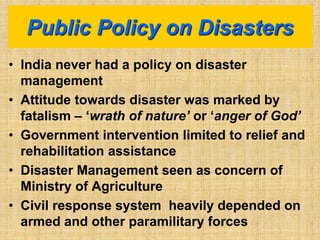
• India never had a policy on disaster
management
• Attitude towards disaster was marked by
fatalism – ‘wrath of nature’ or ‘anger of God’
• Government intervention limited to relief and
rehabilitation assistance
• Disaster Management seen as concern of
Ministry of Agriculture
• Civil response system heavily depended on
armed and other paramilitary forces
Public Policy on Disasters
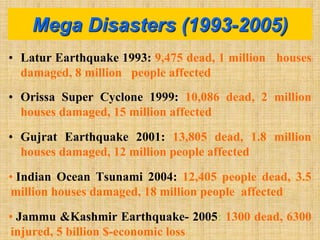
• Latur Earthquake 1993: 9,475 dead, 1 million houses
damaged, 8 million people affected
• Orissa Super Cyclone 1999: 10,086 dead, 2 million
houses damaged, 15 million affected
• Gujrat Earthquake 2001: 13,805 dead, 1.8 million
houses damaged, 12 million people affected
• Indian Ocean Tsunami 2004: 12,405 people dead, 3.5
million houses damaged, 18 million people affected
• Jammu &Kashmir Earthquake- 2005: 1300 dead, 6300
injured, 5 billion $-economic loss
Mega Disasters (1993-2005)
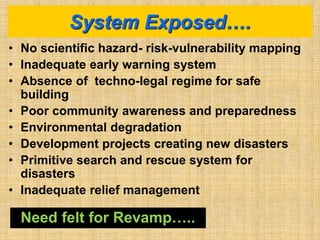
• No scientific hazard- risk-vulnerability mapping
• Inadequate early warning system
• Absence of techno-legal regime for safe
building
• Poor community awareness and preparedness
• Environmental degradation
• Development projects creating new disasters
• Primitive search and rescue system for
disasters
• Inadequate relief management
System Exposed….
Need felt for Revamp…..
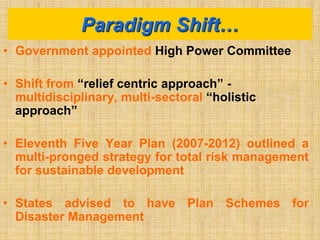
• Government appointed High Power Committee
• Shift from “relief centric approach” -
multidisciplinary, multi-sectoral “holistic
approach”
• Eleventh Five Year Plan (2007-2012) outlined a
multi-pronged strategy for total risk management
for sustainable development
• States advised to have Plan Schemes for
Disaster Management
Paradigm Shift…
Result…….
 A National Roadmap on Disaster
Management
 Development of Disaster Management
Framework
 Enactment of Disaster Management
Act 2005
Disaster Management
Framework
Role of Central and State Governments
• DM - collective responsibility of State and
Central Governments
• During Disasters- concerned State is “FIRST
RESPONDER”
• During major disasters- Central Government
supplements efforts of the State
Governments
Legal Framework
 Government enacted a Central Law on
Disaster Management - Disaster
Management Act 2005
 Aim: Institutional mechanism for a
holistic and coordinated approach to
disaster management
Central Legislation- DM Act 2005
The Act provides for: -
Constitution of Disaster Management
Authorities at National, State and District
levels.
Role of local authorities (Panchayati Raj
Institutions & Municipalities) in disaster
management.
Put in place Disaster Management Plans at
National, State and District levels.
Constitution of a National Disaster
Response Force (NDRF)
National Fund for Disaster Response and
Mitigation
Similar Funds to be constituted at State
and District level
Mitigation Funds to be utilized for projects
exclusively addressing mitigation at
National, State and District level
National Disaster Response Fund
Section 46(1) of DM Act 2005 provides for constitution of NDRF
Notification for the constitution of NDRF on 28th September 2010
Finance Ministry has also issued guidelines to the state for operation of
NDRF
NDRF is operated by the GoI for the purpose of providing immediate relief
to people affected /victims of natural calamities of severe nature
NCCF has been merged and reconstituted as NDRF and CRF as SDRF
State Disaster Response Fund
• Section 48(1) of Disaster Management Act 2005 provides for constitution of
State Disaster Response Fund (SDRF) by the state Governments
• The Ministry of Home Affairs has issued the guidelines to the state for
operation of SDRF.
• Allocations to the State Relief Funds have been made based on the
recommendations of the successive Finance Commissions. While allocating
the funds to various states for a period of five years, the factors considered
include the expenditure incurred by the state government on relief
operations during the last about 10 years, vulnerability of the state to
natural disasters and economic of the state .
• As per the recommendations of the 13th Finance Commission, the Gol has
approved an allocation of Rs.33580.93 crore in the State Disaster Relief
Fund to all the states, comprising of Rs.25847.93 crore as central share and
Rs.7733.00 crore as state share .The scheme of SDRF provides for release
of the central share SDRF in two equal installments in the months of June
and December.
Institutional Framework
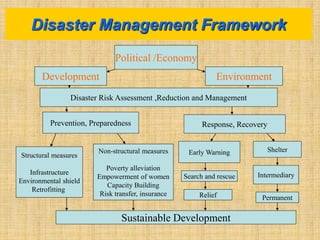
Political /Economy
Development Environment
Disaster Risk Assessment ,Reduction and Management
Prevention, Preparedness Response, Recovery
Structural measures
Infrastructure
Environmental shield
Retrofitting
Non-structural measures
Poverty alleviation
Empowerment of women
Capacity Building
Risk transfer, insurance
Early Warning Shelter
Sustainable Development
Search and rescue Intermediary
Relief Permanent
Disaster Management Framework
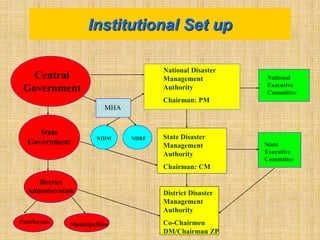
Central
Government
National Disaster
Management
Authority
Chairman: PM
State Disaster
Management
Authority
Chairman: CM
State
Government
District
Administration
Panchayats Municipalities
MHA
District Disaster
Management
Authority
Co-Chairmen
DM/Chairman ZP
National
Executive
Committee
State
Executive
Committee
NIDM NDRF
Institutional Set up
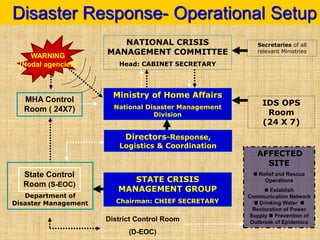
Disaster Response- Operational Setup
Ministry of Home Affairs
National Disaster Management
Division
NATIONAL CRISIS
MANAGEMENT COMMITTEE
Head: CABINET SECRETARY
Secretaries of all
relevant Ministries
WARNING
(Nodal agencies)
MHA Control
Room ( 24X7)
State Control
Room (S-EOC)
STATE CRISIS
MANAGEMENT GROUP
Chairman: CHIEF SECRETARY
Directors-Response,
Logistics & Coordination
District Control Room
(D-EOC)
AFFECTED
SITE
 Relief and Rescue
Operations
 Establish
Communication Network
 Drinking Water 
Restoration of Power
Supply  Prevention of
Outbreak of Epidemics
Department of
Disaster Management
IDS OPS
Room
(24 X 7)
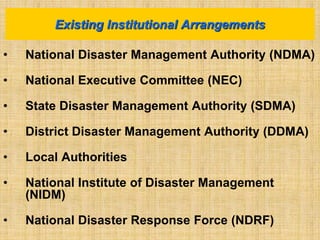
• National Disaster Management Authority (NDMA)
• National Executive Committee (NEC)
• State Disaster Management Authority (SDMA)
• District Disaster Management Authority (DDMA)
• Local Authorities
• National Institute of Disaster Management
(NIDM)
• National Disaster Response Force (NDRF)
Existing Institutional Arrangements
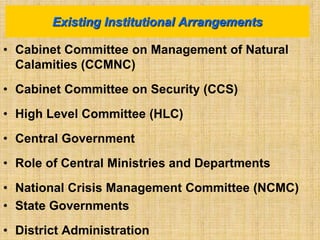
• Cabinet Committee on Management of Natural
Calamities (CCMNC)
• Cabinet Committee on Security (CCS)
• High Level Committee (HLC)
• Central Government
• Role of Central Ministries and Departments
• National Crisis Management Committee (NCMC)
• State Governments
• District Administration
Existing Institutional Arrangements
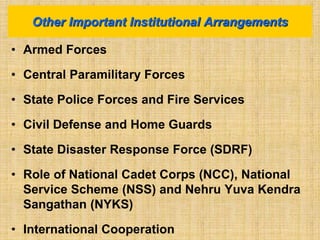
• Armed Forces
• Central Paramilitary Forces
• State Police Forces and Fire Services
• Civil Defense and Home Guards
• State Disaster Response Force (SDRF)
• Role of National Cadet Corps (NCC), National
Service Scheme (NSS) and Nehru Yuva Kendra
Sangathan (NYKS)
• International Cooperation
Other Important Institutional Arrangements
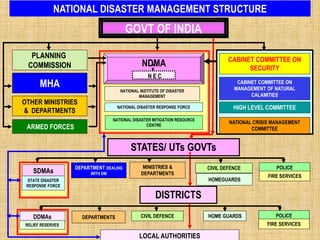
CABINET COMMITTEE ON
MANAGEMENT OF NATURAL
CALAMITIES
HIGH LEVEL COMMITTEE
CABINET COMMITTEE ON
SECURITY
NATIONAL CRISIS MANAGEMENT
COMMITTEE
NATIONAL INSTITUTE OF DISASTER
MANAGEMENT
NATIONAL DISASTER RESPONSE FORCE
NDMA
NATIONAL DISASTER MANAGEMENT STRUCTURE
GOVT OF INDIA
NATIONAL DISASTER MITIGATION RESOURCE
CENTRE
STATES/ UTs GOVTs
SDMAs
STATE DISASTER
RESPONSE FORCE
MINISTRIES &
DEPARTMENTS
DEPARTMENT DEALING
WITH DM
CIVIL DEFENCE POLICE
DISTRICTS
HOME GUARDS
CIVIL DEFENCE
DDMAs
LOCAL AUTHORITIES
FIRE SERVICES
PLANNING
COMMISSION
MHA
OTHER MINISTRIES
& DEPARTMENTS
ARMED FORCES
N E C
RELIEF RESERVES
POLICE
FIRE SERVICES
DEPARTMENTS
HOMEGUARDS
Financial Arrangement
• DM to be in-built in Developmental Plans
• National Disaster Response and
Mitigation Funds
• Responsibilities of the Central Ministries
and Departments
• State and District Level Arrangements
• Mitigation Projects
• Techno-Financial Regime
New Funding Initiatives
Major Initiatives of
Government of India
Major Initiatives of GoI
Setting up of National Disaster Response
Force
Setting up of Regional Response Centers
Setting up of Disaster Mitigation Centers
A fail proof emergency communication
network established
National Institute of Disaster Management
(NIDM) for National capacity building
India Disaster Resource Network-
centralized database
CBDP- GoI - UNDP Disaster Risk
Management Programme.
Awareness Generation- Mass media
campaign.
Tsunami Early Warning System set up in the
Indian Ocean.
Major Initiatives of GoI
Institutionalization of Incident Response System
Incorporation of DM in School Curriculum,
Professional Courses, Technical Education etc.
Training of Engineers, Architects, Masons
Structural Safety of lifeline buildings- Retrofit
Programs
Projects addressing disaster mitigation given
priority
Projects in vulnerable areas must have disaster
mitigation as a Terms of Reference
Major Initiatives of GoI
National Policy on Disaster
Management has been formulated
and approved in October 2009
Lays down the roadmap/direction
for all Government endeavors
Copy available at www.ndma.gov.in
National Policy on Disaster Management (2009)
 Approve National plan
 Lay Down policies on Disaster Management
 Approve plans prepared by the Ministries and departments of
Government of India in accordance with National Plan
 Lay down guidelines to be followed by State Authorities in
drawing State Plan
 Coordinate the enforcement and implementation of Policy and
Plan for Disaster management
 Recommend provision of fund for Mitigation
 Provide support to other countries affected by major disaster as
determined by the Central Government
 Take such other measures for prevention , mitigation, or
preparedness and capacity building for dealing with disasters
National Disaster Management Authority (NDMA)
• State-of-the-art Emergency Operation Centers established in
Ministry of Home Affairs for data, video and audio up-linking
with all State, District and remote areas
• EOCs set up in all State, Union Territory and District
headquarters
• India Disaster Resource Network (IDRN) -web-enabled,
centralized inventory of resources established –
www.idrn.gov.in
• Resources records from 624 districts across country is being
uploaded.
Emergency Operation Center (EOC)
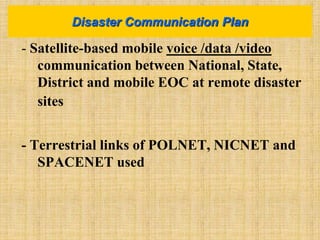
- Satellite-based mobile voice /data /video
communication between National, State,
District and mobile EOC at remote disaster
sites
- Terrestrial links of POLNET, NICNET and
SPACENET used
Disaster Communication Plan
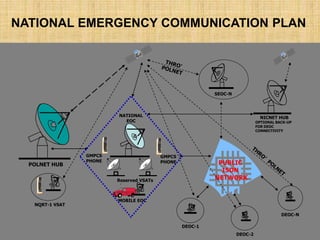
NATIONAL EMERGENCY COMMUNICATION PLAN
POLNET HUB
-
NATIONAL
EOC
MOBILE EOC
NICNET HUB
OPTIONAL BACK-UP
FOR DEOC
CONNECTIVITY
PUBLIC
ISDN
NETWORK
DEOC-N
Reserved VSATs
SEOC-N
DEOC-1
DEOC-2
NQRT-1 VSAT
GMPCS
PHONE
GMPCS
PHONE
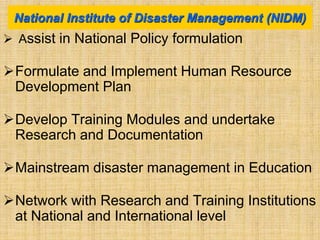
 Assist in National Policy formulation
Formulate and Implement Human Resource
Development Plan
Develop Training Modules and undertake
Research and Documentation
Mainstream disaster management in Education
Network with Research and Training Institutions
at National and International level
National Institute of Disaster Management (NIDM)
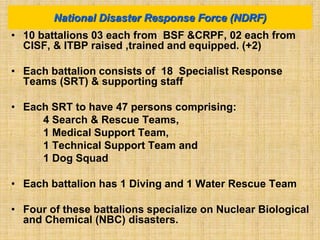
• 10 battalions 03 each from BSF &CRPF, 02 each from
CISF, & ITBP raised ,trained and equipped. (+2)
• Each battalion consists of 18 Specialist Response
Teams (SRT) & supporting staff
• Each SRT to have 47 persons comprising:
4 Search & Rescue Teams,
1 Medical Support Team,
1 Technical Support Team and
1 Dog Squad
• Each battalion has 1 Diving and 1 Water Rescue Team
• Four of these battalions specialize on Nuclear Biological
and Chemical (NBC) disasters.
National Disaster Response Force (NDRF)
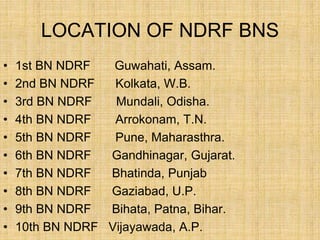
LOCATION OF NDRF BNS
• 1st BN NDRF Guwahati, Assam.
• 2nd BN NDRF Kolkata, W.B.
• 3rd BN NDRF Mundali, Odisha.
• 4th BN NDRF Arrokonam, T.N.
• 5th BN NDRF Pune, Maharasthra.
• 6th BN NDRF Gandhinagar, Gujarat.
• 7th BN NDRF Bhatinda, Punjab
• 8th BN NDRF Gaziabad, U.P.
• 9th BN NDRF Bihata, Patna, Bihar.
• 10th BN NDRF Vijayawada, A.P.
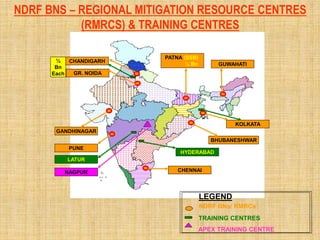
NDRF BNS – REGIONAL MITIGATION RESOURCE CENTRES
(RMRCS) & TRAINING CENTRES
NDRF BNs/ RMRCs
TRAINING CENTRES
APEX TRAINING CENTRE
LEGEND
CHANDIGARH
GR. NOIDA
½
Bn
Each
GANDHINAGAR
PUNE
BHUBANESHWAR
KOLKATA
GUWAHATI
PATNA (SSB)
½ Bn
NAGPUR
LATUR
CHENNAI
HYDERABAD
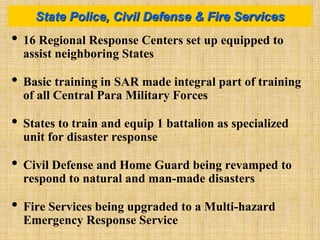
• 16 Regional Response Centers set up equipped to
assist neighboring States
• Basic training in SAR made integral part of training
of all Central Para Military Forces
• States to train and equip 1 battalion as specialized
unit for disaster response
• Civil Defense and Home Guard being revamped to
respond to natural and man-made disasters
• Fire Services being upgraded to a Multi-hazard
Emergency Response Service
State Police, Civil Defense & Fire Services
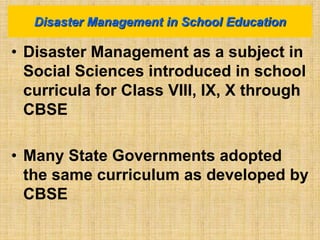
• Disaster Management as a subject in
Social Sciences introduced in school
curricula for Class VIII, IX, X through
CBSE
• Many State Governments adopted
the same curriculum as developed by
CBSE
Disaster Management in School Education
• Curriculum on Earthquake Resistant
Technology in undergraduate courses on
engineering and architecture finalized in
consultation with AICTE
• Introduced in Civil Engineering and
architectural courses throughout the country
from the academic year 2006-07 onwards
Disaster Management in Engineering & Architecture
• Curriculum on emergency health
management in MBBS and Nursing
courses finalized in consultation with
MCI
• To be introduced in MBBS and Nursing
courses throughout the country from
the academic year 2007-08
Disaster Management in Medical Education
• India implemented largest community based
Disaster Risk Mitigation program in the world
• Sponsored by UNDP it covered nearly 300 million
people in 169 multi-hazard districts in 17 States
• Village Disaster Management Plan
• VDMP is integrated vertically with District and
State Disaster Management Plans and horizontally
with sectoral plans
Community Based Disaster Risk Management
(CBDRM) -2007-2012
• NCRMP to cover 13 cyclone prone States/Union Territories
[cost US $ 365 million/ Rs 1650 cr.]
• Main elements of the project:
– Strengthening of cyclone tracking and monitoring
– Developing cyclone shelters in coastal areas
– Regenerating mangrove forests as protective shields for
coastal settlements
– Supporting State/UTs for taking up high priority cyclone
risk mitigation activities
– Providing technical assistance for hazard risk
management capacity building
National Cyclone Risk Mitigation Project (NCRMP)
• National Project to cover 229 districts
located in seismic zone IV & V
• Main elements of the project:
– Earthquake hazard assessment and micro
zonation in selected metropolitan cities
– Techno-legal regime for earthquake risk
mitigation
– Retrofitting of life-line buildings and
infrastructure
Earthquake Risk Mitigation Project
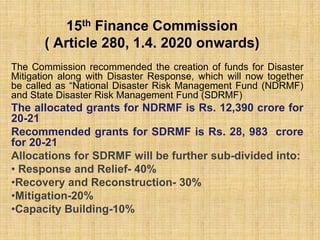
15th Finance Commission
( Article 280, 1.4. 2020 onwards)
The Commission recommended the creation of funds for Disaster
Mitigation along with Disaster Response, which will now together
be called as “National Disaster Risk Management Fund (NDRMF)
and State Disaster Risk Management Fund (SDRMF)
The allocated grants for NDRMF is Rs. 12,390 crore for
20-21
Recommended grants for SDRMF is Rs. 28, 983 crore
for 20-21
Allocations for SDRMF will be further sub-divided into:
• Response and Relief- 40%
•Recovery and Reconstruction- 30%
•Mitigation-20%
•Capacity Building-10%
Thank You

DM Basic Concepts.ppt

  • 1.
    Disaster Management – Basic Concepts SuryaParkash, Prof. & Head, GMR Division National Institute of Disaster Management, New Delhi www.nidm.gov.in
  • 2.
     disasters areinevitable  proactive rather then reactive  need for preventive, mitigation, preparedness, rescue, relief and rehabilitation efforts/ measures  pre-disaster planning becomes crucial  need for well planned and well rehearsed plan  Role of districts is crucial and therefore need for DDMP Background
  • 3.
    Government’s role formitigation measures finds mention in Kautilya’s Arthashstra Medieval Period British Period Post Independence era (upto 1990) International Decade of Natural Disaster Reduction (1991-2000)
  • 4.
    • India neverhad a policy on disaster management • Attitude towards disaster was marked by fatalism – ‘wrath of nature’ or ‘anger of God’ • Government intervention limited to relief and rehabilitation assistance • Disaster Management seen as concern of Ministry of Agriculture • Civil response system heavily depended on armed and other paramilitary forces Public Policy on Disasters
  • 5.
    • Latur Earthquake1993: 9,475 dead, 1 million houses damaged, 8 million people affected • Orissa Super Cyclone 1999: 10,086 dead, 2 million houses damaged, 15 million affected • Gujrat Earthquake 2001: 13,805 dead, 1.8 million houses damaged, 12 million people affected • Indian Ocean Tsunami 2004: 12,405 people dead, 3.5 million houses damaged, 18 million people affected • Jammu &Kashmir Earthquake- 2005: 1300 dead, 6300 injured, 5 billion $-economic loss Mega Disasters (1993-2005)
  • 6.
    • No scientifichazard- risk-vulnerability mapping • Inadequate early warning system • Absence of techno-legal regime for safe building • Poor community awareness and preparedness • Environmental degradation • Development projects creating new disasters • Primitive search and rescue system for disasters • Inadequate relief management System Exposed…. Need felt for Revamp…..
  • 7.
    • Government appointedHigh Power Committee • Shift from “relief centric approach” - multidisciplinary, multi-sectoral “holistic approach” • Eleventh Five Year Plan (2007-2012) outlined a multi-pronged strategy for total risk management for sustainable development • States advised to have Plan Schemes for Disaster Management Paradigm Shift…
  • 8.
    Result…….  A NationalRoadmap on Disaster Management  Development of Disaster Management Framework  Enactment of Disaster Management Act 2005
  • 9.
  • 10.
    Role of Centraland State Governments • DM - collective responsibility of State and Central Governments • During Disasters- concerned State is “FIRST RESPONDER” • During major disasters- Central Government supplements efforts of the State Governments
  • 11.
  • 12.
     Government enacteda Central Law on Disaster Management - Disaster Management Act 2005  Aim: Institutional mechanism for a holistic and coordinated approach to disaster management Central Legislation- DM Act 2005
  • 13.
    The Act providesfor: - Constitution of Disaster Management Authorities at National, State and District levels. Role of local authorities (Panchayati Raj Institutions & Municipalities) in disaster management. Put in place Disaster Management Plans at National, State and District levels.
  • 14.
    Constitution of aNational Disaster Response Force (NDRF) National Fund for Disaster Response and Mitigation Similar Funds to be constituted at State and District level Mitigation Funds to be utilized for projects exclusively addressing mitigation at National, State and District level
  • 15.
    National Disaster ResponseFund Section 46(1) of DM Act 2005 provides for constitution of NDRF Notification for the constitution of NDRF on 28th September 2010 Finance Ministry has also issued guidelines to the state for operation of NDRF NDRF is operated by the GoI for the purpose of providing immediate relief to people affected /victims of natural calamities of severe nature NCCF has been merged and reconstituted as NDRF and CRF as SDRF
  • 16.
    State Disaster ResponseFund • Section 48(1) of Disaster Management Act 2005 provides for constitution of State Disaster Response Fund (SDRF) by the state Governments • The Ministry of Home Affairs has issued the guidelines to the state for operation of SDRF. • Allocations to the State Relief Funds have been made based on the recommendations of the successive Finance Commissions. While allocating the funds to various states for a period of five years, the factors considered include the expenditure incurred by the state government on relief operations during the last about 10 years, vulnerability of the state to natural disasters and economic of the state . • As per the recommendations of the 13th Finance Commission, the Gol has approved an allocation of Rs.33580.93 crore in the State Disaster Relief Fund to all the states, comprising of Rs.25847.93 crore as central share and Rs.7733.00 crore as state share .The scheme of SDRF provides for release of the central share SDRF in two equal installments in the months of June and December.
  • 17.
  • 18.
    Political /Economy Development Environment DisasterRisk Assessment ,Reduction and Management Prevention, Preparedness Response, Recovery Structural measures Infrastructure Environmental shield Retrofitting Non-structural measures Poverty alleviation Empowerment of women Capacity Building Risk transfer, insurance Early Warning Shelter Sustainable Development Search and rescue Intermediary Relief Permanent Disaster Management Framework
  • 19.
    Central Government National Disaster Management Authority Chairman: PM StateDisaster Management Authority Chairman: CM State Government District Administration Panchayats Municipalities MHA District Disaster Management Authority Co-Chairmen DM/Chairman ZP National Executive Committee State Executive Committee NIDM NDRF Institutional Set up
  • 20.
    Disaster Response- OperationalSetup Ministry of Home Affairs National Disaster Management Division NATIONAL CRISIS MANAGEMENT COMMITTEE Head: CABINET SECRETARY Secretaries of all relevant Ministries WARNING (Nodal agencies) MHA Control Room ( 24X7) State Control Room (S-EOC) STATE CRISIS MANAGEMENT GROUP Chairman: CHIEF SECRETARY Directors-Response, Logistics & Coordination District Control Room (D-EOC) AFFECTED SITE  Relief and Rescue Operations  Establish Communication Network  Drinking Water  Restoration of Power Supply  Prevention of Outbreak of Epidemics Department of Disaster Management IDS OPS Room (24 X 7)
  • 21.
    • National DisasterManagement Authority (NDMA) • National Executive Committee (NEC) • State Disaster Management Authority (SDMA) • District Disaster Management Authority (DDMA) • Local Authorities • National Institute of Disaster Management (NIDM) • National Disaster Response Force (NDRF) Existing Institutional Arrangements
  • 22.
    • Cabinet Committeeon Management of Natural Calamities (CCMNC) • Cabinet Committee on Security (CCS) • High Level Committee (HLC) • Central Government • Role of Central Ministries and Departments • National Crisis Management Committee (NCMC) • State Governments • District Administration Existing Institutional Arrangements
  • 23.
    • Armed Forces •Central Paramilitary Forces • State Police Forces and Fire Services • Civil Defense and Home Guards • State Disaster Response Force (SDRF) • Role of National Cadet Corps (NCC), National Service Scheme (NSS) and Nehru Yuva Kendra Sangathan (NYKS) • International Cooperation Other Important Institutional Arrangements
  • 24.
    CABINET COMMITTEE ON MANAGEMENTOF NATURAL CALAMITIES HIGH LEVEL COMMITTEE CABINET COMMITTEE ON SECURITY NATIONAL CRISIS MANAGEMENT COMMITTEE NATIONAL INSTITUTE OF DISASTER MANAGEMENT NATIONAL DISASTER RESPONSE FORCE NDMA NATIONAL DISASTER MANAGEMENT STRUCTURE GOVT OF INDIA NATIONAL DISASTER MITIGATION RESOURCE CENTRE STATES/ UTs GOVTs SDMAs STATE DISASTER RESPONSE FORCE MINISTRIES & DEPARTMENTS DEPARTMENT DEALING WITH DM CIVIL DEFENCE POLICE DISTRICTS HOME GUARDS CIVIL DEFENCE DDMAs LOCAL AUTHORITIES FIRE SERVICES PLANNING COMMISSION MHA OTHER MINISTRIES & DEPARTMENTS ARMED FORCES N E C RELIEF RESERVES POLICE FIRE SERVICES DEPARTMENTS HOMEGUARDS
  • 25.
  • 26.
    • DM tobe in-built in Developmental Plans • National Disaster Response and Mitigation Funds • Responsibilities of the Central Ministries and Departments • State and District Level Arrangements • Mitigation Projects • Techno-Financial Regime New Funding Initiatives
  • 27.
  • 28.
    Major Initiatives ofGoI Setting up of National Disaster Response Force Setting up of Regional Response Centers Setting up of Disaster Mitigation Centers A fail proof emergency communication network established National Institute of Disaster Management (NIDM) for National capacity building
  • 29.
    India Disaster ResourceNetwork- centralized database CBDP- GoI - UNDP Disaster Risk Management Programme. Awareness Generation- Mass media campaign. Tsunami Early Warning System set up in the Indian Ocean. Major Initiatives of GoI
  • 30.
    Institutionalization of IncidentResponse System Incorporation of DM in School Curriculum, Professional Courses, Technical Education etc. Training of Engineers, Architects, Masons Structural Safety of lifeline buildings- Retrofit Programs Projects addressing disaster mitigation given priority Projects in vulnerable areas must have disaster mitigation as a Terms of Reference Major Initiatives of GoI
  • 31.
    National Policy onDisaster Management has been formulated and approved in October 2009 Lays down the roadmap/direction for all Government endeavors Copy available at www.ndma.gov.in National Policy on Disaster Management (2009)
  • 32.
     Approve Nationalplan  Lay Down policies on Disaster Management  Approve plans prepared by the Ministries and departments of Government of India in accordance with National Plan  Lay down guidelines to be followed by State Authorities in drawing State Plan  Coordinate the enforcement and implementation of Policy and Plan for Disaster management  Recommend provision of fund for Mitigation  Provide support to other countries affected by major disaster as determined by the Central Government  Take such other measures for prevention , mitigation, or preparedness and capacity building for dealing with disasters National Disaster Management Authority (NDMA)
  • 33.
    • State-of-the-art EmergencyOperation Centers established in Ministry of Home Affairs for data, video and audio up-linking with all State, District and remote areas • EOCs set up in all State, Union Territory and District headquarters • India Disaster Resource Network (IDRN) -web-enabled, centralized inventory of resources established – www.idrn.gov.in • Resources records from 624 districts across country is being uploaded. Emergency Operation Center (EOC)
  • 34.
    - Satellite-based mobilevoice /data /video communication between National, State, District and mobile EOC at remote disaster sites - Terrestrial links of POLNET, NICNET and SPACENET used Disaster Communication Plan
  • 35.
    NATIONAL EMERGENCY COMMUNICATIONPLAN POLNET HUB - NATIONAL EOC MOBILE EOC NICNET HUB OPTIONAL BACK-UP FOR DEOC CONNECTIVITY PUBLIC ISDN NETWORK DEOC-N Reserved VSATs SEOC-N DEOC-1 DEOC-2 NQRT-1 VSAT GMPCS PHONE GMPCS PHONE
  • 36.
     Assist inNational Policy formulation Formulate and Implement Human Resource Development Plan Develop Training Modules and undertake Research and Documentation Mainstream disaster management in Education Network with Research and Training Institutions at National and International level National Institute of Disaster Management (NIDM)
  • 37.
    • 10 battalions03 each from BSF &CRPF, 02 each from CISF, & ITBP raised ,trained and equipped. (+2) • Each battalion consists of 18 Specialist Response Teams (SRT) & supporting staff • Each SRT to have 47 persons comprising: 4 Search & Rescue Teams, 1 Medical Support Team, 1 Technical Support Team and 1 Dog Squad • Each battalion has 1 Diving and 1 Water Rescue Team • Four of these battalions specialize on Nuclear Biological and Chemical (NBC) disasters. National Disaster Response Force (NDRF)
  • 38.
    LOCATION OF NDRFBNS • 1st BN NDRF Guwahati, Assam. • 2nd BN NDRF Kolkata, W.B. • 3rd BN NDRF Mundali, Odisha. • 4th BN NDRF Arrokonam, T.N. • 5th BN NDRF Pune, Maharasthra. • 6th BN NDRF Gandhinagar, Gujarat. • 7th BN NDRF Bhatinda, Punjab • 8th BN NDRF Gaziabad, U.P. • 9th BN NDRF Bihata, Patna, Bihar. • 10th BN NDRF Vijayawada, A.P.
  • 39.
    NDRF BNS –REGIONAL MITIGATION RESOURCE CENTRES (RMRCS) & TRAINING CENTRES NDRF BNs/ RMRCs TRAINING CENTRES APEX TRAINING CENTRE LEGEND CHANDIGARH GR. NOIDA ½ Bn Each GANDHINAGAR PUNE BHUBANESHWAR KOLKATA GUWAHATI PATNA (SSB) ½ Bn NAGPUR LATUR CHENNAI HYDERABAD
  • 40.
    • 16 RegionalResponse Centers set up equipped to assist neighboring States • Basic training in SAR made integral part of training of all Central Para Military Forces • States to train and equip 1 battalion as specialized unit for disaster response • Civil Defense and Home Guard being revamped to respond to natural and man-made disasters • Fire Services being upgraded to a Multi-hazard Emergency Response Service State Police, Civil Defense & Fire Services
  • 41.
    • Disaster Managementas a subject in Social Sciences introduced in school curricula for Class VIII, IX, X through CBSE • Many State Governments adopted the same curriculum as developed by CBSE Disaster Management in School Education
  • 42.
    • Curriculum onEarthquake Resistant Technology in undergraduate courses on engineering and architecture finalized in consultation with AICTE • Introduced in Civil Engineering and architectural courses throughout the country from the academic year 2006-07 onwards Disaster Management in Engineering & Architecture
  • 43.
    • Curriculum onemergency health management in MBBS and Nursing courses finalized in consultation with MCI • To be introduced in MBBS and Nursing courses throughout the country from the academic year 2007-08 Disaster Management in Medical Education
  • 44.
    • India implementedlargest community based Disaster Risk Mitigation program in the world • Sponsored by UNDP it covered nearly 300 million people in 169 multi-hazard districts in 17 States • Village Disaster Management Plan • VDMP is integrated vertically with District and State Disaster Management Plans and horizontally with sectoral plans Community Based Disaster Risk Management (CBDRM) -2007-2012
  • 45.
    • NCRMP tocover 13 cyclone prone States/Union Territories [cost US $ 365 million/ Rs 1650 cr.] • Main elements of the project: – Strengthening of cyclone tracking and monitoring – Developing cyclone shelters in coastal areas – Regenerating mangrove forests as protective shields for coastal settlements – Supporting State/UTs for taking up high priority cyclone risk mitigation activities – Providing technical assistance for hazard risk management capacity building National Cyclone Risk Mitigation Project (NCRMP)
  • 46.
    • National Projectto cover 229 districts located in seismic zone IV & V • Main elements of the project: – Earthquake hazard assessment and micro zonation in selected metropolitan cities – Techno-legal regime for earthquake risk mitigation – Retrofitting of life-line buildings and infrastructure Earthquake Risk Mitigation Project
  • 47.
    15th Finance Commission (Article 280, 1.4. 2020 onwards) The Commission recommended the creation of funds for Disaster Mitigation along with Disaster Response, which will now together be called as “National Disaster Risk Management Fund (NDRMF) and State Disaster Risk Management Fund (SDRMF) The allocated grants for NDRMF is Rs. 12,390 crore for 20-21 Recommended grants for SDRMF is Rs. 28, 983 crore for 20-21 Allocations for SDRMF will be further sub-divided into: • Response and Relief- 40% •Recovery and Reconstruction- 30% •Mitigation-20% •Capacity Building-10%
  • 48.