Presented by,
V M Reema Barveen
2016041045
(Pradhan Mantri Gram Sadak Yojana)
 Introduction
 Aims
 OMMS
 Main features
 NRRDA
 Impacts
 PMGSY - Prime Minister’s Rural Road scheme
 It was launched on 25th December 2000 by Atal
Behari Vajpayee.
 It is a nationwide plan in India to provide good all
weather road connectivity to unconnected villages.
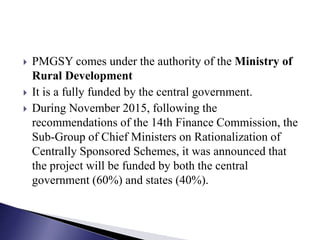
 PMGSY comes under the authority of the Ministry of
Rural Development
 It is a fully funded by the central government.
 During November 2015, following the
recommendations of the 14th Finance Commission, the
Sub-Group of Chief Ministers on Rationalization of
Centrally Sponsored Schemes, it was announced that
the project will be funded by both the central
government (60%) and states (40%).
 To provide roads to all villages
1. With a population of 1000 persons and above by
2003.
2. With a population of 500 persons and above by 2007.
3. In hill states ,Tribal and desert area villages with a
population of 500 persons and above by 2003
4. In hill states ,Tribal and desert area villages with a
population of 250 person and above by 2007.
 In order to implement this, an Online Management &
Monitoring System was developed to identify targets
and monitor progress.
 The OMMS has separate module to track the expenses
made on each road.
 Based on the data entered by state and district officers,
OMMS generates detailed reports which are viewable
in citizens section.
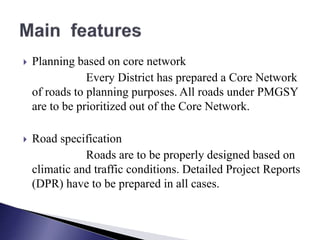
 Planning based on core network
Every District has prepared a Core Network
of roads to planning purposes. All roads under PMGSY
are to be prioritized out of the Core Network.
 Road specification
Roads are to be properly designed based on
climatic and traffic conditions. Detailed Project Reports
(DPR) have to be prepared in all cases.
 Scrutiny , approval and clearance.
The detailed Project Reports are scrutinized
by the State Technical Agencies (STAs)
 Programme management in states
Each State has designated a State level
Autonomous Agency to maintain and operate Bank
account to receive the project funds from the Ministry
of Rural Development.
 Tendering
Projects will be completed within 9-10 months
except in case of Hilly States where the duration of the
project will be for 18 months.
 Quality
PMGSY roads are expected to be of the highest
quality
 Online monitoring
OMMS
 Maintenance
by state goverment
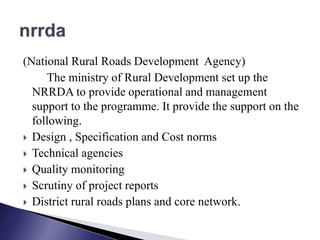
(National Rural Roads Development Agency)
The ministry of Rural Development set up the
NRRDA to provide operational and management
support to the programme. It provide the support on the
following.
 Design , Specification and Cost norms
 Technical agencies
 Quality monitoring
 Scrutiny of project reports
 District rural roads plans and core network.
Agriculture
 . Prior to the construction of the PMGSY roads, farmers
found it difficult to sell agricultural goods in the bigger
markets that are located at a distance from their villages
 The PMGSY roads had a positive impact on the
agricultural infrastructure as habitations are now using
motorized equipments such as tractors, threshing
machines for cultivation leading to a more efficient, time
saving and profitable process of cultivation.
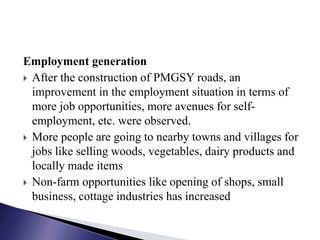
Employment generation
 After the construction of PMGSY roads, an
improvement in the employment situation in terms of
more job opportunities, more avenues for self-
employment, etc. were observed.
 More people are going to nearby towns and villages for
jobs like selling woods, vegetables, dairy products and
locally made items
 Non-farm opportunities like opening of shops, small
business, cottage industries has increased
 Impact on industry
Easier access to raw materials, availability of
commercial vehicles to transport bulk product to the
markets etc
 Impact on health
 Impact on education sector
 Impact on transport facility
 Impact on poverty alleviation
http://online.omms.nic.in
http://pmgsy.nic.in
www.omms.nic.in
www.pmgsytenders.gov.in/
PMGSY

PMGSY

  • 1.
    Presented by, V MReema Barveen 2016041045 (Pradhan Mantri Gram Sadak Yojana)
  • 2.
     Introduction  Aims OMMS  Main features  NRRDA  Impacts
  • 3.
     PMGSY -Prime Minister’s Rural Road scheme  It was launched on 25th December 2000 by Atal Behari Vajpayee.  It is a nationwide plan in India to provide good all weather road connectivity to unconnected villages.
  • 4.
     PMGSY comesunder the authority of the Ministry of Rural Development  It is a fully funded by the central government.  During November 2015, following the recommendations of the 14th Finance Commission, the Sub-Group of Chief Ministers on Rationalization of Centrally Sponsored Schemes, it was announced that the project will be funded by both the central government (60%) and states (40%).
  • 5.
     To provideroads to all villages 1. With a population of 1000 persons and above by 2003. 2. With a population of 500 persons and above by 2007. 3. In hill states ,Tribal and desert area villages with a population of 500 persons and above by 2003 4. In hill states ,Tribal and desert area villages with a population of 250 person and above by 2007.
  • 6.
     In orderto implement this, an Online Management & Monitoring System was developed to identify targets and monitor progress.  The OMMS has separate module to track the expenses made on each road.  Based on the data entered by state and district officers, OMMS generates detailed reports which are viewable in citizens section.
  • 7.
     Planning basedon core network Every District has prepared a Core Network of roads to planning purposes. All roads under PMGSY are to be prioritized out of the Core Network.  Road specification Roads are to be properly designed based on climatic and traffic conditions. Detailed Project Reports (DPR) have to be prepared in all cases.
  • 8.
     Scrutiny ,approval and clearance. The detailed Project Reports are scrutinized by the State Technical Agencies (STAs)  Programme management in states Each State has designated a State level Autonomous Agency to maintain and operate Bank account to receive the project funds from the Ministry of Rural Development.
  • 9.
     Tendering Projects willbe completed within 9-10 months except in case of Hilly States where the duration of the project will be for 18 months.  Quality PMGSY roads are expected to be of the highest quality  Online monitoring OMMS  Maintenance by state goverment
  • 10.
    (National Rural RoadsDevelopment Agency) The ministry of Rural Development set up the NRRDA to provide operational and management support to the programme. It provide the support on the following.  Design , Specification and Cost norms  Technical agencies  Quality monitoring  Scrutiny of project reports  District rural roads plans and core network.
  • 11.
    Agriculture  . Priorto the construction of the PMGSY roads, farmers found it difficult to sell agricultural goods in the bigger markets that are located at a distance from their villages  The PMGSY roads had a positive impact on the agricultural infrastructure as habitations are now using motorized equipments such as tractors, threshing machines for cultivation leading to a more efficient, time saving and profitable process of cultivation.
  • 12.
    Employment generation  Afterthe construction of PMGSY roads, an improvement in the employment situation in terms of more job opportunities, more avenues for self- employment, etc. were observed.  More people are going to nearby towns and villages for jobs like selling woods, vegetables, dairy products and locally made items  Non-farm opportunities like opening of shops, small business, cottage industries has increased
  • 13.
     Impact onindustry Easier access to raw materials, availability of commercial vehicles to transport bulk product to the markets etc  Impact on health  Impact on education sector  Impact on transport facility  Impact on poverty alleviation
  • 14.