ROLE OF NGOS IN
DISASTER
MANAGEMENT
WHAT IS A HAZARD?
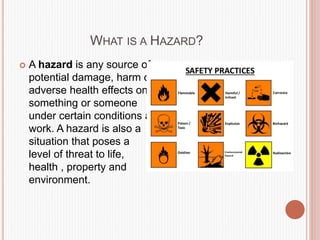
 A hazard is any source of
potential damage, harm or
adverse health effects on
something or someone
under certain conditions at
work. A hazard is also a
situation that poses a
level of threat to life,
health , property and
environment.
WHAT IS A DISASTER ?
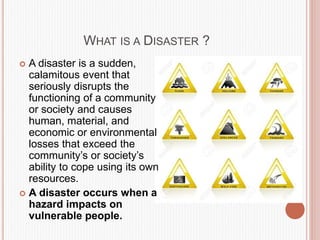
 A disaster is a sudden,
calamitous event that
seriously disrupts the
functioning of a community
or society and causes
human, material, and
economic or environmental
losses that exceed the
community’s or society’s
ability to cope using its own
resources.
 A disaster occurs when a
hazard impacts on
vulnerable people.
WHAT IS DISASTER MANAGEMENT?
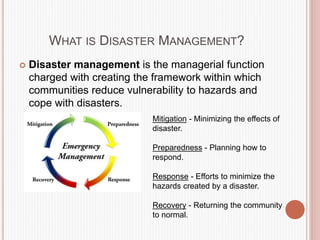
 Disaster management is the managerial function
charged with creating the framework within which
communities reduce vulnerability to hazards and
cope with disasters.
Mitigation - Minimizing the effects of
disaster.
Preparedness - Planning how to
respond.
Response - Efforts to minimize the
hazards created by a disaster.
Recovery - Returning the community
to normal.
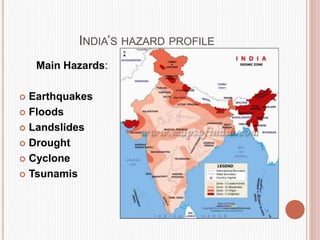
INDIA’S HAZARD PROFILE
Main Hazards:
 Earthquakes
 Floods
 Landslides
 Drought
 Cyclone
 Tsunamis
DISASTER MANAGEMENT DEVELOPMENT
BACKGROUND IN INDIA
 The Great Famine of 1876-1878
 The Indian Famine Codes, developed by the
colonial British in the 1880, is one of the oldest
relief codes in the world.
 The government of West Bengal had published a
Manual for relief of distress in the year 1959.
 That manual was a significant step forward from
the Bengal Famine code, 1913 and the Bengal
Famine Manual,1941.
ACTS AND LEGAL FRAMEWORK FOR DISASTER
MANAGEMENT
 A High Powered Committee set up in August 1999.
 Until 2001, the responsibility of disaster management
was with Agriculture Ministry,
 It was transferred to Ministry of Home Affairs in June
2002.
 Disaster Management Act passed in December 2005.
The Act entrusts/mandates the State Executive
Committees at different levels with the
responsibility to advise, assist and coordinate the
activities of NGOs engaged in disaster management.
 The National Policy on DM 2009 mentions that Non-
Governmental Organizations will be encouraged to
empower the community and generate awareness
through their respective institutional mechanisms.
WHAT IS AN NGO?
 A non-governmental organization (NGO) is any
non-profit, voluntary citizens' group which is
organized on a local, national or international level.
 Task-oriented and driven by people with a common
interest, NGOs perform a variety of service and
humanitarian functions, bring citizen concerns to
Governments, advocate and monitor policies and
encourage political particpation through provision of
information.
WHAT IS AN NGO? (CONT.)
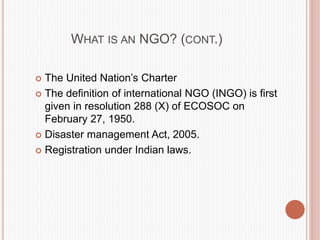
 The United Nation’s Charter
 The definition of international NGO (INGO) is first
given in resolution 288 (X) of ECOSOC on
February 27, 1950.
 Disaster management Act, 2005.
 Registration under Indian laws.
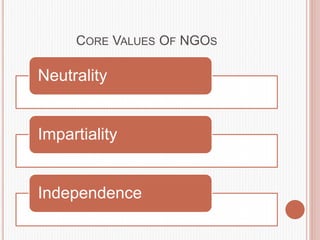
CORE VALUES OF NGOS
Neutrality
Impartiality
Independence
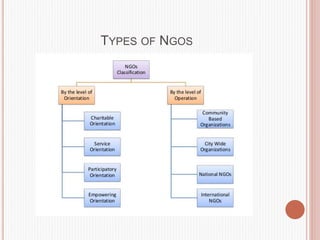
TYPES OF NGOS
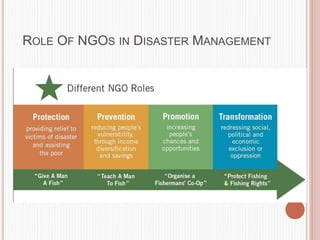
ROLE OF NGOS IN DISASTER MANAGEMENT
ROLE IN DISASTER PREPAREDNESS
Disaster Preparedness
 Advocacy/ awareness
 Assessment/ Analysis
 Capacity building
 Co-ordination and partnership
 Miscellaneous like shelter, water availability,
sanitation, conservation, mock drills, etc.
 Other responsibilities
ROLE IN DISASTER RESPONSE
Disaster Response
 Early warning and evacuation
 Search and Rescue
 Emergency Relief and Humanitarian Assistance
 Civil Military Coordination
 Primary Damage and Needs Assessment
ROLE IN RECOVERY
Recovery phase
 Water
 Sanitation
 Pulic health promotion
 Vector control
 Food security and nutrition
 Shelter
 Reconstruction
ROLES IN DISASTER MITIGATION
Disaster Mitigation
 Participatory & Inclusive Approach in mitigation
 Mitigation planning (Assessment, Identification,
Analysis of Risk and Planning)
 Information Dissemination
 Techno-Legal and Techno-Financial regime
CASE STUDY 1:
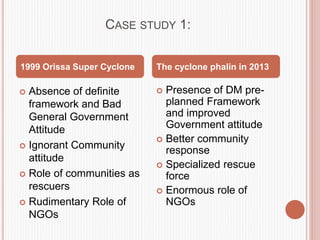
 Absence of definite
framework and Bad
General Government
Attitude
 Ignorant Community
attitude
 Role of communities as
rescuers
 Rudimentary Role of
NGOs
 Presence of DM pre-
planned Framework
and improved
Government attitude
 Better community
response
 Specialized rescue
force
 Enormous role of
NGOs
1999 Orissa Super Cyclone The cyclone phalin in 2013
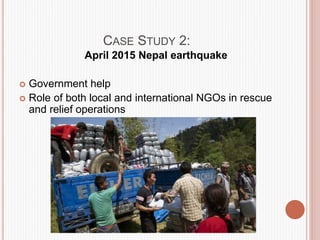
CASE STUDY 2:
April 2015 Nepal earthquake
 Government help
 Role of both local and international NGOs in rescue
and relief operations
THE POSITIVE POINTS OF NGOS
IN DM
 Initial response and as first responders
 Ability to experiment freely with innovative
approaches and, if necessary, to take risks.
 Ability to recruit both experts and highly motivated
staff with fewer restrictions than the government
 Ability of international NGOs to provide specialized
emergency medical care
 Ability to gather funds from international societies /
communities
 Ability of local NGOs to communicate without
language barriers
 Their knowledge of the local area and community
THE NEGATIVE POINTS OF NGOS IN
DM
 Political pressure
 Lack of proper Funds from governments and their
proper utilization
 Harassment of victims by un-sensitized volunteers
 Paternalistic attitudes restrict the degree of
participation in programme/project design.
 Territorial possessiveness/ competitiveness
 Lack of Dedicated Leadership
 After-response phase wastages
PRESENT SCENARIO IN INDIA: REALITY
 Roles of NGOs are Response/ relief oriented
 Lack of properly trained NGO volunteer
 Gender insensitivity in relief camps
 Lack of co-ordination
HOW GOVERNMENT VIEWS THE LOCAL
NGOS?
As Hippies….!
As
Beggars
…..!
And as Jokers…!
CHALLENGES
 Co-ordination
 Proper Finance channeling
 Grass-root level of Participation in Planning
 Encouraging communities and individuals to be
Active participants
 Building of disaster resilient cities/towns/villages
 External collaboration
RECOMMENDATIONS
 Specific Code of conduct for NGOs
 Quality of service
 Popularize volunteerism
 Mandatory training of NGO members
 Establishment of coordinating agencies
 Mock drills
 Revision of allowances and funds for NGOs
 Modernized equipment's and technological support.
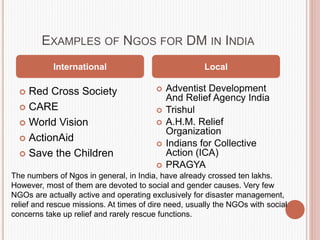
EXAMPLES OF NGOS FOR DM IN INDIA
 Red Cross Society
 CARE
 World Vision
 ActionAid
 Save the Children
 Adventist Development
And Relief Agency India
 Trishul
 A.H.M. Relief
Organization
 Indians for Collective
Action (ICA)
 PRAGYA
International Local
The numbers of Ngos in general, in India, have already crossed ten lakhs.
However, most of them are devoted to social and gender causes. Very few
NGOs are actually active and operating exclusively for disaster management,
relief and rescue missions. At times of dire need, usually the NGOs with social
concerns take up relief and rarely rescue functions.
EXAMPLES OF NGOS FOR DM IN INDIA
(CONT.)
Other social NGOs, known for relief operation during
emergencies are:
 ActionAid India
 Goonj
 Impact india Foundation
 IDRF
 The Environmental Support Group,
 The Uday Foundation
 NAF
THE HIMALAYAN REGION
SCENARIO
 The Siliguri chicken neck corridor
 Himalayan earthquakes
 How North Bengal Can be affected?
 Need for disaster awareness and participation of
public
 Need for more DM oriented NGOs
DISCUSSION
GENERAL EARTHQUAKE
SAFETY BRIEFING
Role_of_NGOs_In_Disaster_Management.pptx

Role_of_NGOs_In_Disaster_Management.pptx

  • 1.
    ROLE OF NGOSIN DISASTER MANAGEMENT
  • 2.
    WHAT IS AHAZARD?  A hazard is any source of potential damage, harm or adverse health effects on something or someone under certain conditions at work. A hazard is also a situation that poses a level of threat to life, health , property and environment.
  • 3.
    WHAT IS ADISASTER ?  A disaster is a sudden, calamitous event that seriously disrupts the functioning of a community or society and causes human, material, and economic or environmental losses that exceed the community’s or society’s ability to cope using its own resources.  A disaster occurs when a hazard impacts on vulnerable people.
  • 4.
    WHAT IS DISASTERMANAGEMENT?  Disaster management is the managerial function charged with creating the framework within which communities reduce vulnerability to hazards and cope with disasters. Mitigation - Minimizing the effects of disaster. Preparedness - Planning how to respond. Response - Efforts to minimize the hazards created by a disaster. Recovery - Returning the community to normal.
  • 5.
    INDIA’S HAZARD PROFILE MainHazards:  Earthquakes  Floods  Landslides  Drought  Cyclone  Tsunamis
  • 6.
    DISASTER MANAGEMENT DEVELOPMENT BACKGROUNDIN INDIA  The Great Famine of 1876-1878  The Indian Famine Codes, developed by the colonial British in the 1880, is one of the oldest relief codes in the world.  The government of West Bengal had published a Manual for relief of distress in the year 1959.  That manual was a significant step forward from the Bengal Famine code, 1913 and the Bengal Famine Manual,1941.
  • 7.
    ACTS AND LEGALFRAMEWORK FOR DISASTER MANAGEMENT  A High Powered Committee set up in August 1999.  Until 2001, the responsibility of disaster management was with Agriculture Ministry,  It was transferred to Ministry of Home Affairs in June 2002.  Disaster Management Act passed in December 2005. The Act entrusts/mandates the State Executive Committees at different levels with the responsibility to advise, assist and coordinate the activities of NGOs engaged in disaster management.  The National Policy on DM 2009 mentions that Non- Governmental Organizations will be encouraged to empower the community and generate awareness through their respective institutional mechanisms.
  • 8.
    WHAT IS ANNGO?  A non-governmental organization (NGO) is any non-profit, voluntary citizens' group which is organized on a local, national or international level.  Task-oriented and driven by people with a common interest, NGOs perform a variety of service and humanitarian functions, bring citizen concerns to Governments, advocate and monitor policies and encourage political particpation through provision of information.
  • 9.
    WHAT IS ANNGO? (CONT.)  The United Nation’s Charter  The definition of international NGO (INGO) is first given in resolution 288 (X) of ECOSOC on February 27, 1950.  Disaster management Act, 2005.  Registration under Indian laws.
  • 10.
    CORE VALUES OFNGOS Neutrality Impartiality Independence
  • 11.
  • 12.
    ROLE OF NGOSIN DISASTER MANAGEMENT
  • 13.
    ROLE IN DISASTERPREPAREDNESS Disaster Preparedness  Advocacy/ awareness  Assessment/ Analysis  Capacity building  Co-ordination and partnership  Miscellaneous like shelter, water availability, sanitation, conservation, mock drills, etc.  Other responsibilities
  • 14.
    ROLE IN DISASTERRESPONSE Disaster Response  Early warning and evacuation  Search and Rescue  Emergency Relief and Humanitarian Assistance  Civil Military Coordination  Primary Damage and Needs Assessment
  • 15.
    ROLE IN RECOVERY Recoveryphase  Water  Sanitation  Pulic health promotion  Vector control  Food security and nutrition  Shelter  Reconstruction
  • 16.
    ROLES IN DISASTERMITIGATION Disaster Mitigation  Participatory & Inclusive Approach in mitigation  Mitigation planning (Assessment, Identification, Analysis of Risk and Planning)  Information Dissemination  Techno-Legal and Techno-Financial regime
  • 17.
    CASE STUDY 1: Absence of definite framework and Bad General Government Attitude  Ignorant Community attitude  Role of communities as rescuers  Rudimentary Role of NGOs  Presence of DM pre- planned Framework and improved Government attitude  Better community response  Specialized rescue force  Enormous role of NGOs 1999 Orissa Super Cyclone The cyclone phalin in 2013
  • 18.
    CASE STUDY 2: April2015 Nepal earthquake  Government help  Role of both local and international NGOs in rescue and relief operations
  • 19.
    THE POSITIVE POINTSOF NGOS IN DM  Initial response and as first responders  Ability to experiment freely with innovative approaches and, if necessary, to take risks.  Ability to recruit both experts and highly motivated staff with fewer restrictions than the government  Ability of international NGOs to provide specialized emergency medical care  Ability to gather funds from international societies / communities  Ability of local NGOs to communicate without language barriers  Their knowledge of the local area and community
  • 20.
    THE NEGATIVE POINTSOF NGOS IN DM  Political pressure  Lack of proper Funds from governments and their proper utilization  Harassment of victims by un-sensitized volunteers  Paternalistic attitudes restrict the degree of participation in programme/project design.  Territorial possessiveness/ competitiveness  Lack of Dedicated Leadership  After-response phase wastages
  • 21.
    PRESENT SCENARIO ININDIA: REALITY  Roles of NGOs are Response/ relief oriented  Lack of properly trained NGO volunteer  Gender insensitivity in relief camps  Lack of co-ordination
  • 22.
    HOW GOVERNMENT VIEWSTHE LOCAL NGOS? As Hippies….! As Beggars …..! And as Jokers…!
  • 23.
    CHALLENGES  Co-ordination  ProperFinance channeling  Grass-root level of Participation in Planning  Encouraging communities and individuals to be Active participants  Building of disaster resilient cities/towns/villages  External collaboration
  • 24.
    RECOMMENDATIONS  Specific Codeof conduct for NGOs  Quality of service  Popularize volunteerism  Mandatory training of NGO members  Establishment of coordinating agencies  Mock drills  Revision of allowances and funds for NGOs  Modernized equipment's and technological support.
  • 25.
    EXAMPLES OF NGOSFOR DM IN INDIA  Red Cross Society  CARE  World Vision  ActionAid  Save the Children  Adventist Development And Relief Agency India  Trishul  A.H.M. Relief Organization  Indians for Collective Action (ICA)  PRAGYA International Local The numbers of Ngos in general, in India, have already crossed ten lakhs. However, most of them are devoted to social and gender causes. Very few NGOs are actually active and operating exclusively for disaster management, relief and rescue missions. At times of dire need, usually the NGOs with social concerns take up relief and rarely rescue functions.
  • 26.
    EXAMPLES OF NGOSFOR DM IN INDIA (CONT.) Other social NGOs, known for relief operation during emergencies are:  ActionAid India  Goonj  Impact india Foundation  IDRF  The Environmental Support Group,  The Uday Foundation  NAF
  • 27.
    THE HIMALAYAN REGION SCENARIO The Siliguri chicken neck corridor  Himalayan earthquakes  How North Bengal Can be affected?  Need for disaster awareness and participation of public  Need for more DM oriented NGOs
  • 28.
  • 29.