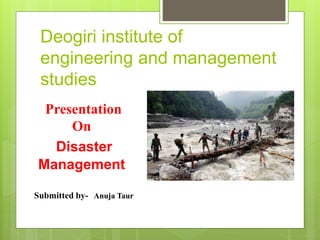
Deogiri institute of
engineering and management
studies
Presentation
On
Disaster
Management
Submitted by- Anuja Taur
What is disaster management
???
 “A disaster can be defined as any occurrence that
cause damage, ecological disruption, loss of
human life, deterioration of health and health
services on a scale, sufficient to warrant an
extraordinary response from outside the affected
community or area”.
(W.H.O.)
 “A disaster can be defined as an occurrence either
nature or manmade that causes human suffering
and creates human needs that victims cannot
alleviate without assistance”.
American Red Cross (ARC) ’
What it involves ??
 Dealing with and avoiding both natural and
man made disasters.
 Preparedness before disaster.
 Rebuilding and supporting society after
natural disasters.
TYPES OF DISASTER
Natural
Disasters
Meteorological
Topographical
Environmental
Man-made
Disasters
Technological
Industrial
accidents
Security
related
PRINCIPLES OF DISASTER
MANAGEMENT
 Disaster management is the responsibility of all
spheres of government
 Disaster management should use resources that exist
for a day-to-day purpose.
 Organizations should function as an extension of their
core business
 Individuals are responsible for their own safety.
 Disaster management planning should focus on large-
scale events.
PHASES OF DISASTER
MANAGEMENT
Disaster Preparedness
Disaster impact
Disaster Response
Rehabilitation
Disaster Mitigation
Disaster preparedness
Preparedness should be in the form of money,
manpower and materials
 Evaluation from past experiences about risk
 Location of disaster prone areas
 Organization of communication, information and
warning system
 Ensuring co-ordination and response mechanisms
Disaster response
 Epidemiologic surveillance and disease control
 Vaccination
 Nutrition
Rehabilitation phase
 Water supply
 Food safety
 Basic sanitation and personal hygiene
 Vector control
DISASTER-EFFECTS
 Deaths
 Disability
 Increase in communicable disease
 Psychological problems
 Food shortage
 Socioeconomic losses
 Shortage of drugs and medical supplies.
 Environmental disruption
DISASTER RECOVERY
 Successful Recovery Preparation
 Be vigilant in Health teaching
 Psychological support
 Referrals to hospital as needed
 Remain alert for environmental health
 Nurse must be attentive to the danger
Major Disasters in India
 1984 Bhopal Gas Tragedy
 2001 Gujarat earthquake
 2004 Indian Ocean tsunami
 2008 Mumbai attacks
Lessons Learnt
 Be Prepared : Preparedness and Mitigation is bound
to yield more effective returns than distributing relief
after a disaster.
 Create a Culture of Preparedness and Prevention.
 Evolve a code of conduct for all stake-holders
Thanks

Disaster management 31152

  • 1.
    Deogiri institute of engineeringand management studies Presentation On Disaster Management Submitted by- Anuja Taur
  • 2.
    What is disastermanagement ???  “A disaster can be defined as any occurrence that cause damage, ecological disruption, loss of human life, deterioration of health and health services on a scale, sufficient to warrant an extraordinary response from outside the affected community or area”. (W.H.O.)  “A disaster can be defined as an occurrence either nature or manmade that causes human suffering and creates human needs that victims cannot alleviate without assistance”. American Red Cross (ARC) ’
  • 3.
    What it involves??  Dealing with and avoiding both natural and man made disasters.  Preparedness before disaster.  Rebuilding and supporting society after natural disasters.
  • 4.
  • 5.
    PRINCIPLES OF DISASTER MANAGEMENT Disaster management is the responsibility of all spheres of government  Disaster management should use resources that exist for a day-to-day purpose.  Organizations should function as an extension of their core business  Individuals are responsible for their own safety.  Disaster management planning should focus on large- scale events.
  • 6.
    PHASES OF DISASTER MANAGEMENT DisasterPreparedness Disaster impact Disaster Response Rehabilitation Disaster Mitigation
  • 7.
    Disaster preparedness Preparedness shouldbe in the form of money, manpower and materials  Evaluation from past experiences about risk  Location of disaster prone areas  Organization of communication, information and warning system  Ensuring co-ordination and response mechanisms
  • 8.
    Disaster response  Epidemiologicsurveillance and disease control  Vaccination  Nutrition
  • 9.
    Rehabilitation phase  Watersupply  Food safety  Basic sanitation and personal hygiene  Vector control
  • 10.
    DISASTER-EFFECTS  Deaths  Disability Increase in communicable disease  Psychological problems  Food shortage  Socioeconomic losses  Shortage of drugs and medical supplies.  Environmental disruption
  • 11.
    DISASTER RECOVERY  SuccessfulRecovery Preparation  Be vigilant in Health teaching  Psychological support  Referrals to hospital as needed  Remain alert for environmental health  Nurse must be attentive to the danger
  • 12.
    Major Disasters inIndia  1984 Bhopal Gas Tragedy  2001 Gujarat earthquake  2004 Indian Ocean tsunami  2008 Mumbai attacks
  • 13.
    Lessons Learnt  BePrepared : Preparedness and Mitigation is bound to yield more effective returns than distributing relief after a disaster.  Create a Culture of Preparedness and Prevention.  Evolve a code of conduct for all stake-holders
  • 14.