

ROLE OF COMMUNITY HEALTH
NURSE IN DISASTER
MANAGEMENT
MD.YUSUF.ALI
B.sc (N), PGDHHM
welcome
Md Yusuf Ali
INTRODUCTION
“Act in time, Save life” holds true to disaster
management. Disaster occurrence is
a global phenomenon. It can occur at any
where at any time. Disaster occurrence in any
countries affects its health and economic
conditions. Most types of natural disaster are
to reoccur in the same areas or countries.
Furthermore with the
changing ecosystem, deforestation, misuse of
land we have every reason to believe that
frequency of disasters such as floods, will
increase in the coming decades.
Md Yusuf Ali
DEFINITION
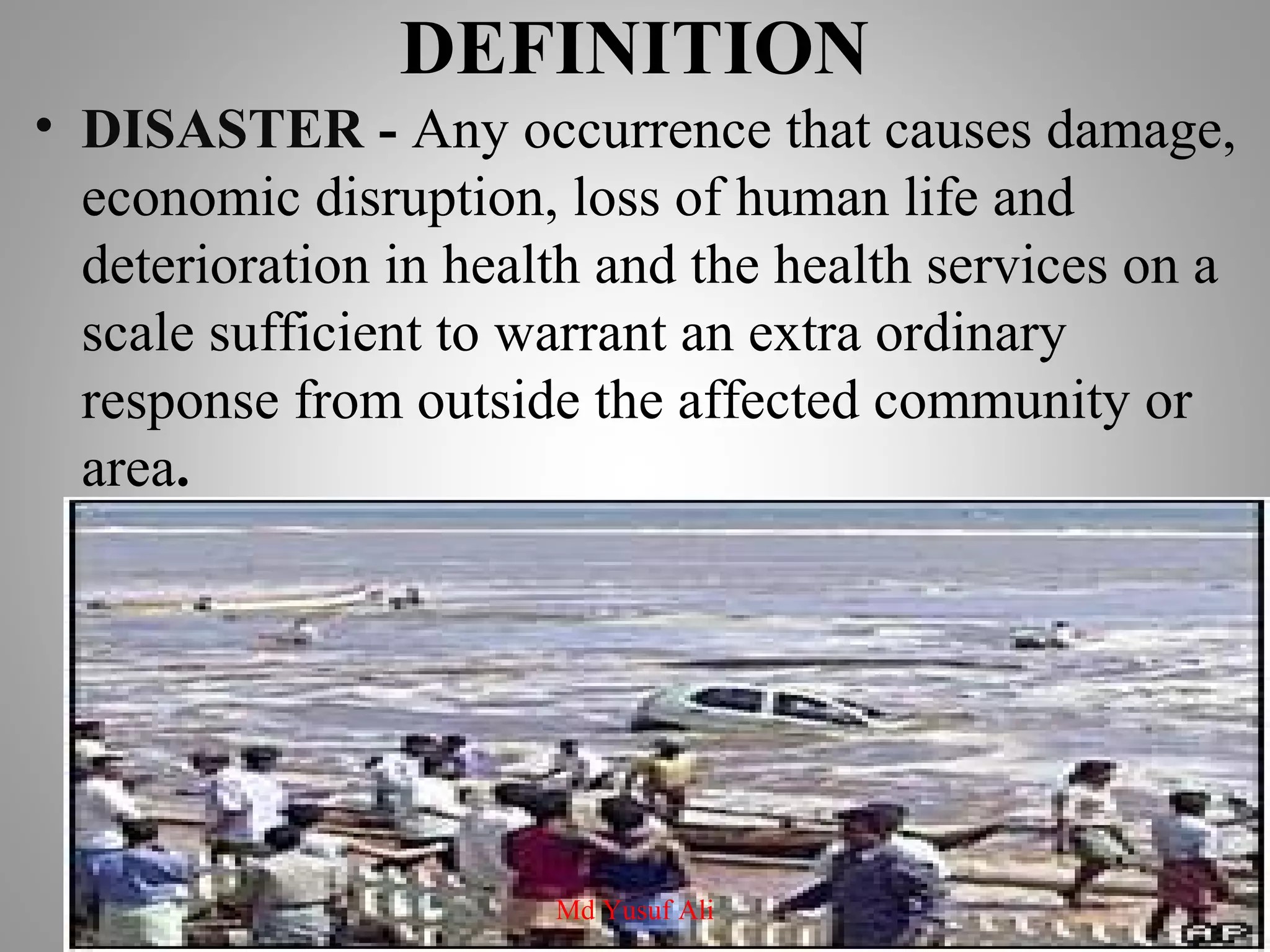
• DISASTER - Any occurrence that causes damage,
economic disruption, loss of human life and
deterioration in health and the health services on a
scale sufficient to warrant an extra ordinary
response from outside the affected community or
area.
Md Yusuf Ali
• DISASTER MANAGEMENT-It can be
defined as the effective organization
direction and utilization of available counter-
disaster resources
Md Yusuf Ali
PHASES OF DISASTER MANAGEMENT:
1.Preventive phase-(Mitigation, storm shelter,
warning system etc.)
2.Personal preparedness
Professional preparedness
Community preparedness
3.Response phase
4.Recovery phase
Md Yusuf Ali
NURSES ROLE IN COMMUNITY
ASSESSMENT
• Assess the community
(E.g.-Local climate conductive for disaster)
• Past history of disaster
• Available community disaster center
• Personal available in the community
• Local agencies
• Health care facilities available.
Md Yusuf Ali
DIAGNOSIS
• Diagnose community disaster threats.
• Determine the actual and potential disaster threats.
• Community disaster planning.
PLANNING
Develop disaster plan:
*Aim:
To provide prompt and effective medical care to
the maximum possible in order to minimize
morbidity and mortality.
Md Yusuf Ali
*Objectives
 Prepare the staff and institutional resources.
 Create a community awareness.
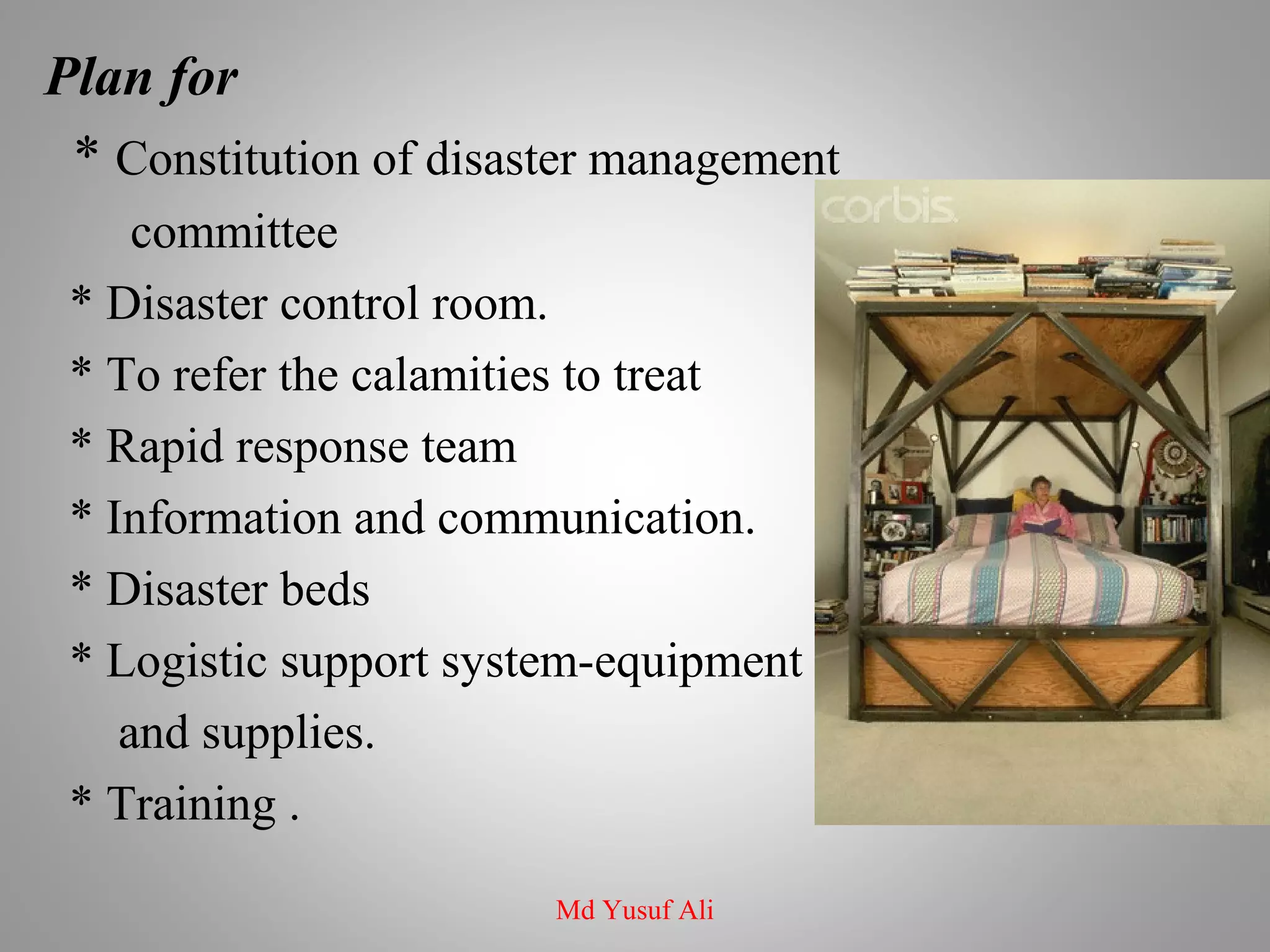
Plan for
* Constitution of disaster management
committee
* Disaster control room.
* To refer the calamities to treat
* Rapid response team
* Information and communication.
* Disaster beds
* Logistic support system-equipment
and supplies.
* Training .
Md Yusuf Ali
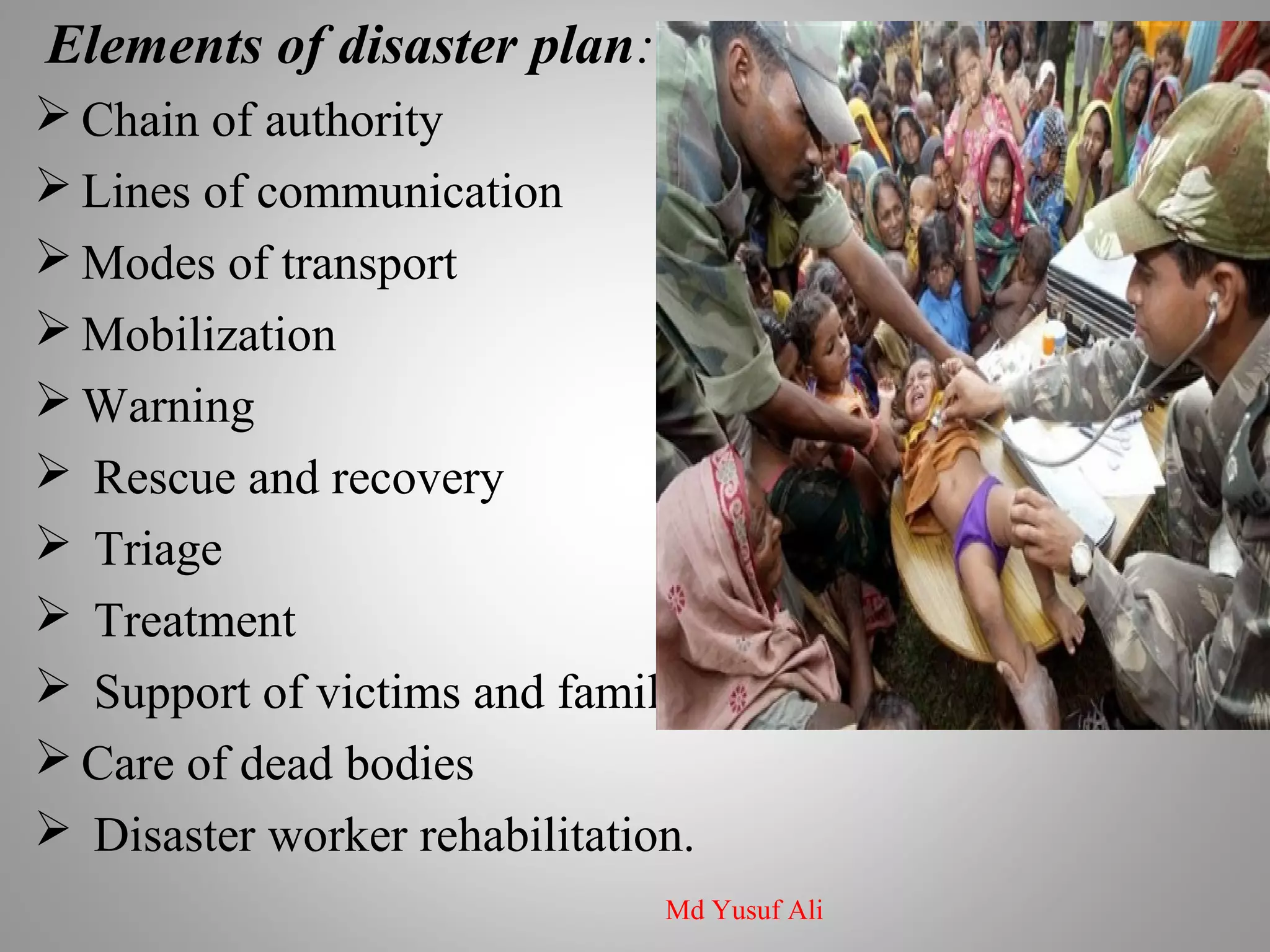
Elements of disaster plan:
 Chain of authority
 Lines of communication
 Modes of transport
 Mobilization
 Warning
 Rescue and recovery
 Triage
 Treatment
 Support of victims and families
 Care of dead bodies
 Disaster worker rehabilitation.
Md Yusuf Ali
Activation of disaster management plans:
 Develop a standard operating procedure
 Reception area-Disaster content room.
 Triage
 Documentation at control room
 Public relation
 Essential services-eg.water
and power and food
 Crowd management/security
arrangements.
Md Yusuf Ali
Activities needed in planning:
 Identify local community communication system
 Identify disaster personnel like private and
professional voluntary etc.
 Identify regional back up agencies and personnel
 Identify specific responsibilities for various personnel
involved in the disaster plan.
Set up an emergency medical system and chain of
activation.
 Identify location and accessibility of equipments and
supplies.
 Check proper functioning of emergency equipments.
 Identify outdated supplies and replace.
Md Yusuf Ali
Implement disaster plans:
 Focus on primary prevention activities to prevent
occurrence of man made disaster.
 Practice community disaster plans with all personnal-eg.
Triage, Supply of food ,water.
 practice using equipment, obtaining and distributing
supplies.
Md Yusuf Ali
Shelter management plans:
 Nurse can act as shelter managers
 Listen to the victims
 Encourage victims to overcome the crisis
 Delegate tasks to team members and co-ordinate activities
 Provide the basic resources. like food, water etc
 Provide compassion and dignity to the victim.
Md Yusuf Ali
Md Yusuf Ali
ROLE OF NURSE IN DIFFERENT PHASES
Disaster phases.
 Passing message to the
near by hospitals
 Getting ready with emergency
equipment
 Discharging the patients
 Creating awareness.
Md Yusuf Ali
Response phase.
Identify the population
Triaging the victim
Care for injured persons
Transporting patients
Arranging for physical
facilities for the victim.
Recovery phase.
Counseling
Continuing care
Vocational training
Behavior modification
Rehabilitation
Md Yusuf Ali
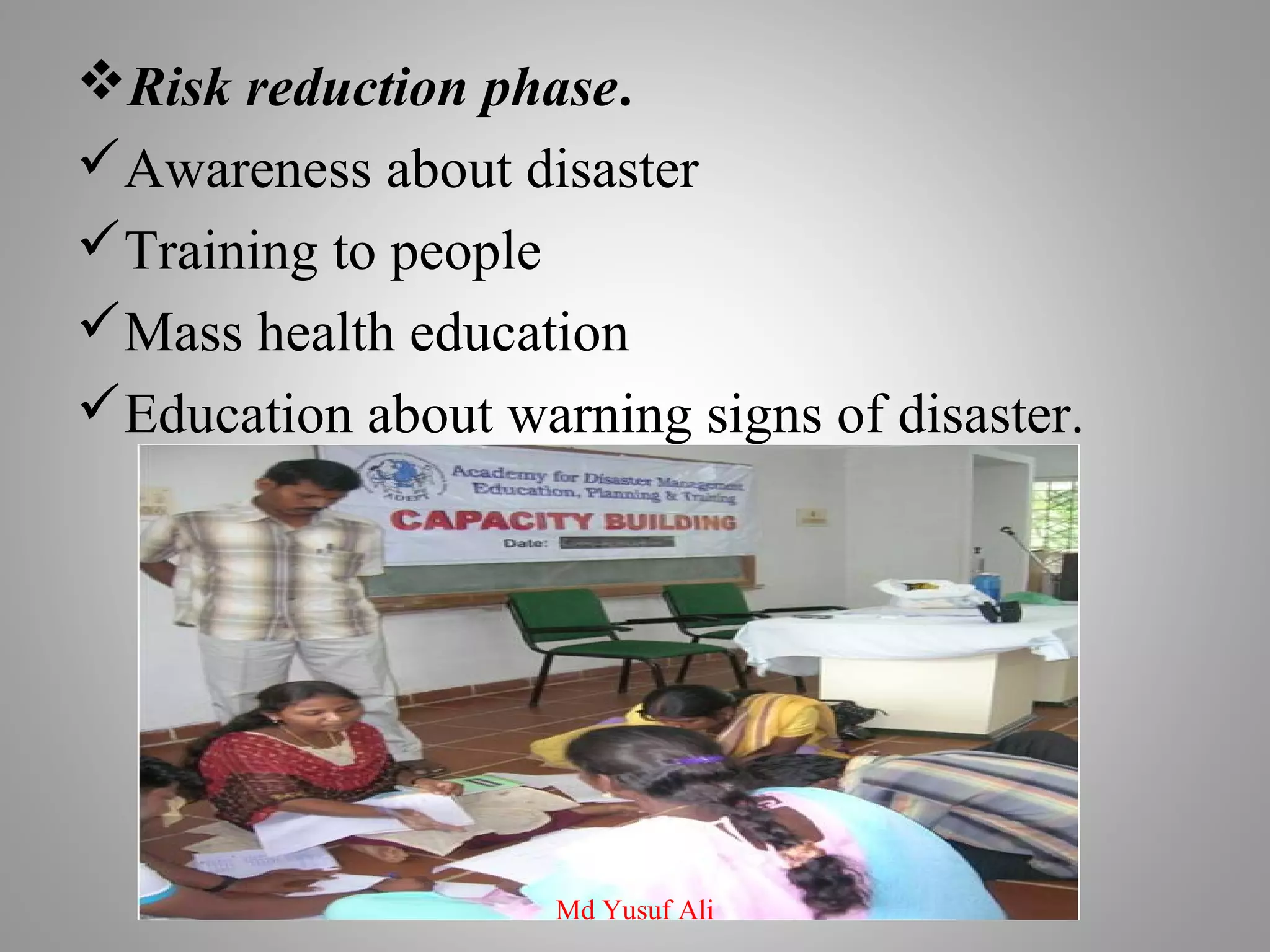
Risk reduction phase.
Awareness about disaster
Training to people
Mass health education
Education about warning signs of disaster.
Md Yusuf Ali
NURSES RESPONSIBILITY
• PRE-PLANNING: developing a responsible plan
• Storage of equipment and supplies
• Follow the protocol of notification
• Designation of an alternative reporting
site for health care workers
• Very familiar with the equipment and
supplies to use
• Use of personal protective devices
• Knowledge on potential hazards at
• the disaster sites. E.g.: unstable building structure
Md Yusuf Ali
COMMUNITY PREPAREDNESS
• Education
• First aid program
• Making each home to store
• Emergency telephone numbers
• Battery operated radio
• Flash light
• First aid kit
• Three day supply of water
• Medical information &family physician details
• Persons to be notified in emergency
Md Yusuf Ali
ROLE AND RESPONSIBILITIES OF THE
DISASTER MANAGEMENT BOARD
Develop a National Disaster Action plan
Helping the ministries and agencies
Working with local authorities
Providing documentation and information services
Monitoring and referring the Govt.
Md Yusuf Ali
During an emergency:
Ensure the effective communication and information
Activity and operate National emergency
Private secretarial service and expert advice to the National
Disaster management Council and inter ministerial disaster
management co-ordination
committee.
Provide information
with the economic relations
divisions and the ministry of
information.
Md Yusuf Ali
During post disaster recovery:
Co-operate with the planning commission and
line agencies on reconstruction requirements
Ensure the risk reduction measures.
Under take final evaluation.
Md Yusuf Ali
CONCLUSION
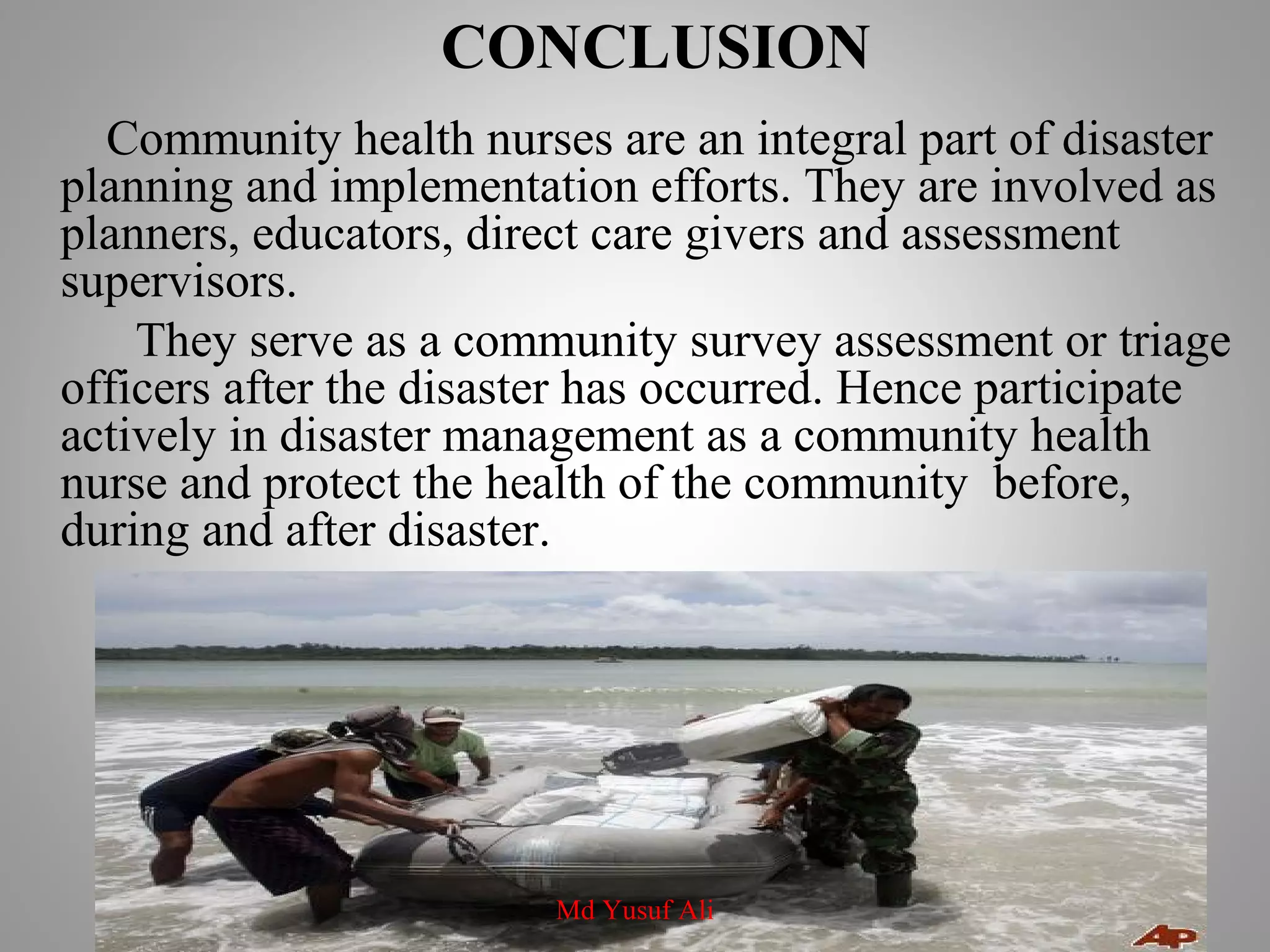
Community health nurses are an integral part of disaster
planning and implementation efforts. They are involved as
planners, educators, direct care givers and assessment
supervisors.
They serve as a community survey assessment or triage
officers after the disaster has occurred. Hence participate
actively in disaster management as a community health
nurse and protect the health of the community before,
during and after disaster.
Md Yusuf Ali
TAKE HOME MESSAGE: DISASTER CAN OCCUR AT
ANY TIME ANY FORM OR TO ANY ONE. BE
PREPARED TO MEET THE CHALLENGES AFTER
THE EFFECT OF DISASTER.
Md Yusuf Ali
THANK YOU

yusuf conf

  • 1.
    ROLE OF COMMUNITYHEALTH NURSE IN DISASTER MANAGEMENT MD.YUSUF.ALI B.sc (N), PGDHHM
  • 2.
  • 3.
    INTRODUCTION “Act in time,Save life” holds true to disaster management. Disaster occurrence is a global phenomenon. It can occur at any where at any time. Disaster occurrence in any countries affects its health and economic conditions. Most types of natural disaster are to reoccur in the same areas or countries. Furthermore with the changing ecosystem, deforestation, misuse of land we have every reason to believe that frequency of disasters such as floods, will increase in the coming decades. Md Yusuf Ali
  • 4.
    DEFINITION • DISASTER -Any occurrence that causes damage, economic disruption, loss of human life and deterioration in health and the health services on a scale sufficient to warrant an extra ordinary response from outside the affected community or area. Md Yusuf Ali
  • 5.
    • DISASTER MANAGEMENT-Itcan be defined as the effective organization direction and utilization of available counter- disaster resources Md Yusuf Ali
  • 6.
    PHASES OF DISASTERMANAGEMENT: 1.Preventive phase-(Mitigation, storm shelter, warning system etc.) 2.Personal preparedness Professional preparedness Community preparedness 3.Response phase 4.Recovery phase Md Yusuf Ali
  • 7.
    NURSES ROLE INCOMMUNITY ASSESSMENT • Assess the community (E.g.-Local climate conductive for disaster) • Past history of disaster • Available community disaster center • Personal available in the community • Local agencies • Health care facilities available. Md Yusuf Ali
  • 8.
    DIAGNOSIS • Diagnose communitydisaster threats. • Determine the actual and potential disaster threats. • Community disaster planning. PLANNING Develop disaster plan: *Aim: To provide prompt and effective medical care to the maximum possible in order to minimize morbidity and mortality. Md Yusuf Ali
  • 9.
    *Objectives  Prepare thestaff and institutional resources.  Create a community awareness.
  • 10.
    Plan for * Constitutionof disaster management committee * Disaster control room. * To refer the calamities to treat * Rapid response team * Information and communication. * Disaster beds * Logistic support system-equipment and supplies. * Training . Md Yusuf Ali
  • 11.
    Elements of disasterplan:  Chain of authority  Lines of communication  Modes of transport  Mobilization  Warning  Rescue and recovery  Triage  Treatment  Support of victims and families  Care of dead bodies  Disaster worker rehabilitation. Md Yusuf Ali
  • 12.
    Activation of disastermanagement plans:  Develop a standard operating procedure  Reception area-Disaster content room.  Triage  Documentation at control room  Public relation  Essential services-eg.water and power and food  Crowd management/security arrangements. Md Yusuf Ali
  • 13.
    Activities needed inplanning:  Identify local community communication system  Identify disaster personnel like private and professional voluntary etc.  Identify regional back up agencies and personnel  Identify specific responsibilities for various personnel involved in the disaster plan. Set up an emergency medical system and chain of activation.  Identify location and accessibility of equipments and supplies.  Check proper functioning of emergency equipments.  Identify outdated supplies and replace. Md Yusuf Ali
  • 14.
    Implement disaster plans: Focus on primary prevention activities to prevent occurrence of man made disaster.  Practice community disaster plans with all personnal-eg. Triage, Supply of food ,water.  practice using equipment, obtaining and distributing supplies. Md Yusuf Ali
  • 15.
    Shelter management plans: Nurse can act as shelter managers  Listen to the victims  Encourage victims to overcome the crisis  Delegate tasks to team members and co-ordinate activities  Provide the basic resources. like food, water etc  Provide compassion and dignity to the victim. Md Yusuf Ali
  • 16.
  • 17.
    ROLE OF NURSEIN DIFFERENT PHASES Disaster phases.  Passing message to the near by hospitals  Getting ready with emergency equipment  Discharging the patients  Creating awareness. Md Yusuf Ali
  • 18.
    Response phase. Identify thepopulation Triaging the victim Care for injured persons Transporting patients Arranging for physical facilities for the victim. Recovery phase. Counseling Continuing care Vocational training Behavior modification Rehabilitation Md Yusuf Ali
  • 19.
    Risk reduction phase. Awarenessabout disaster Training to people Mass health education Education about warning signs of disaster. Md Yusuf Ali
  • 20.
    NURSES RESPONSIBILITY • PRE-PLANNING:developing a responsible plan • Storage of equipment and supplies • Follow the protocol of notification • Designation of an alternative reporting site for health care workers • Very familiar with the equipment and supplies to use • Use of personal protective devices • Knowledge on potential hazards at • the disaster sites. E.g.: unstable building structure Md Yusuf Ali
  • 21.
    COMMUNITY PREPAREDNESS • Education •First aid program • Making each home to store • Emergency telephone numbers • Battery operated radio • Flash light • First aid kit • Three day supply of water • Medical information &family physician details • Persons to be notified in emergency Md Yusuf Ali
  • 22.
    ROLE AND RESPONSIBILITIESOF THE DISASTER MANAGEMENT BOARD Develop a National Disaster Action plan Helping the ministries and agencies Working with local authorities Providing documentation and information services Monitoring and referring the Govt. Md Yusuf Ali
  • 23.
    During an emergency: Ensurethe effective communication and information Activity and operate National emergency Private secretarial service and expert advice to the National Disaster management Council and inter ministerial disaster management co-ordination committee. Provide information with the economic relations divisions and the ministry of information. Md Yusuf Ali
  • 24.
    During post disasterrecovery: Co-operate with the planning commission and line agencies on reconstruction requirements Ensure the risk reduction measures. Under take final evaluation. Md Yusuf Ali
  • 25.
    CONCLUSION Community health nursesare an integral part of disaster planning and implementation efforts. They are involved as planners, educators, direct care givers and assessment supervisors. They serve as a community survey assessment or triage officers after the disaster has occurred. Hence participate actively in disaster management as a community health nurse and protect the health of the community before, during and after disaster. Md Yusuf Ali
  • 26.
    TAKE HOME MESSAGE:DISASTER CAN OCCUR AT ANY TIME ANY FORM OR TO ANY ONE. BE PREPARED TO MEET THE CHALLENGES AFTER THE EFFECT OF DISASTER. Md Yusuf Ali
  • 27.