





HISTORY
It was established in Germany and France around 1900 and contrasts with the Grammar
translation method and other traditional approaches.
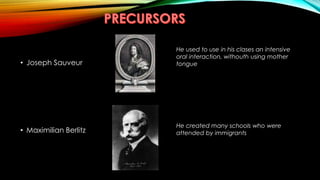
• Joseph Sauveur
• Maximilian Berlitz
He used to use in his clases an intensive
oral interaction, withouth using mother
tongue
He created many schools who were
attended by immigrants
DIRECT?
• New knowledge should be connected directly with the target Language
In the Direct Method language is learnt for
communication where language is
primarily speech, as Larsen-Freeman (2000)
states.
Vietor (1882) "This study of grammar is a
useless torture. It is certainly not
understood; therefore it can have no
effect as far as the moulding of the
intellect is concerned and no-one could
seriously believe that children could learn
their living tongue from it."
DEFINITION
HOW THE DIRECT METHOD IS
DEVELOPPED?
-Response to the Grammar-Translation method.
-Immerse the learner in the same way as when a first
language is learnt.
-All teaching is done in the target language, grammar is
taught inductively, there is a focus on speaking and listening,
and only useful ‘everyday' language is taught.
-The weakness in the Direct Method is its assumption that a
second language can be learnt in exactly the same way as a
first, when in fact the conditions under which a second
language is learnt are very different.
EXAMPLE:
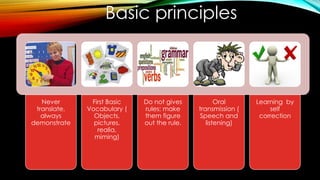
Never
translate,
always
demonstrate
First Basic
Vocabulary (
Objects,
pictures,
realia,
miming)
Do not gives
rules: make
them figure
out the rule.
Oral
transmission (
Speech and
listening)
Learning by
self
correction
Basic principles
Competence
in language
Vocation
Direct
method
Teacher
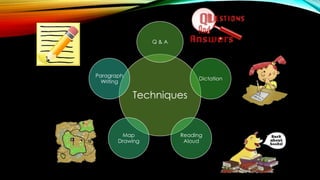
Techniques
Q & A
Dictation
Reading
Aloud
Map
Drawing
Paragraph
Writing
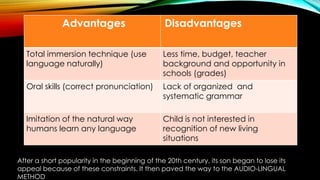
Advantages Disadvantages
Total immersion technique (use
language naturally)
Less time, budget, teacher
background and opportunity in
schools (grades)
Oral skills (correct pronunciation) Lack of organized and
systematic grammar
Imitation of the natural way
humans learn any language
Child is not interested in
recognition of new living
situations
After a short popularity in the beginning of the 20th century, its son began to lose its
appeal because of these constraints. It then paved the way to the AUDIO-LINGUAL
METHOD
BIBLIOGRAPHY:
-Bashir, A. (2013). Direct Method (DM) of Language Teaching. Retrieved from:
http://es.slideshare.net/Ayeshabashir1990/direct-method-of-language-teaching
-Direct Method. (n.d.). British Council. Retrieved from:
https://www.teachingenglish.org.uk/article/direct-method
-Lugilde, S. (2012). Direct method’s innovations in the mother tongue’s teaching. Retrieved
from: http://revista.academiamaestre.es/2012/05/las-innovaciones-del-metodo-directo-
en-la-ensenanza-de-lenguas/
-Tugrul, C. (2013). The Direct-Method: A Good Start to Teach Oral Language. Iraq:
Department of Languages, Ishik University
-

Direct method By Katherine Camacho

  • 2.
    HISTORY It was establishedin Germany and France around 1900 and contrasts with the Grammar translation method and other traditional approaches.
  • 3.
    • Joseph Sauveur •Maximilian Berlitz He used to use in his clases an intensive oral interaction, withouth using mother tongue He created many schools who were attended by immigrants
  • 4.
    DIRECT? • New knowledgeshould be connected directly with the target Language
  • 5.
    In the DirectMethod language is learnt for communication where language is primarily speech, as Larsen-Freeman (2000) states. Vietor (1882) "This study of grammar is a useless torture. It is certainly not understood; therefore it can have no effect as far as the moulding of the intellect is concerned and no-one could seriously believe that children could learn their living tongue from it." DEFINITION
  • 6.
    HOW THE DIRECTMETHOD IS DEVELOPPED? -Response to the Grammar-Translation method. -Immerse the learner in the same way as when a first language is learnt. -All teaching is done in the target language, grammar is taught inductively, there is a focus on speaking and listening, and only useful ‘everyday' language is taught. -The weakness in the Direct Method is its assumption that a second language can be learnt in exactly the same way as a first, when in fact the conditions under which a second language is learnt are very different.
  • 7.
  • 8.
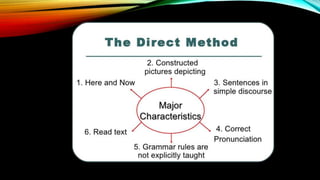
    Never translate, always demonstrate First Basic Vocabulary ( Objects, pictures, realia, miming) Donot gives rules: make them figure out the rule. Oral transmission ( Speech and listening) Learning by self correction Basic principles
  • 10.
  • 11.
  • 12.
    Advantages Disadvantages Total immersiontechnique (use language naturally) Less time, budget, teacher background and opportunity in schools (grades) Oral skills (correct pronunciation) Lack of organized and systematic grammar Imitation of the natural way humans learn any language Child is not interested in recognition of new living situations After a short popularity in the beginning of the 20th century, its son began to lose its appeal because of these constraints. It then paved the way to the AUDIO-LINGUAL METHOD
  • 13.
    BIBLIOGRAPHY: -Bashir, A. (2013).Direct Method (DM) of Language Teaching. Retrieved from: http://es.slideshare.net/Ayeshabashir1990/direct-method-of-language-teaching -Direct Method. (n.d.). British Council. Retrieved from: https://www.teachingenglish.org.uk/article/direct-method -Lugilde, S. (2012). Direct method’s innovations in the mother tongue’s teaching. Retrieved from: http://revista.academiamaestre.es/2012/05/las-innovaciones-del-metodo-directo- en-la-ensenanza-de-lenguas/ -Tugrul, C. (2013). The Direct-Method: A Good Start to Teach Oral Language. Iraq: Department of Languages, Ishik University -