Based on: Approaches and Methods in Language
Teaching
Jack C. Richards,Theodore S. Rodgers
María José Burgos
Direct Method
Origins of Direct Method
• Based on Natural method ‘s principles from the XIX
century
It can be taught without translation or usage of learner´s native language
Meaning can be conveyed through actions and demonstrations
Usage of language actively to teach itself inside the classroom
Induction of grammar rules from the activities in second language
Speaking teaching focused in prononciation
New vocabulary words are introduced by asociation with
previously learnt words, miming and pictures
Features of the Direct method
 Most known of the “natural methods”
 Oficially approved by the french and german
governments as language teaching methods,
comecially known as Berlitz Method in the U.S
 Direct and Berlitz methods used to operate under the
principles of:
1. Classroom instruction
was conducted
exclusively in the target
language.
2. Only everyday
vocabulary and sentences
were taught.
3. Oral communication
skills were built up in a
carefully graded
progression organized
around question-and-
answer exchanges
between teachers and
students in small,
intensive classes.
4. Grammar was taught
inductively.
5. New teaching points
were introduced orally.
6. Concrete vocabulary
was taught through
demonstration, objects,
and pictures; abstract
vocabulary was taught by
association of ideas.
7. Both speech and
listening comprehension
were taught.
8. Correct pronunciation
and grammar were
emphasized.
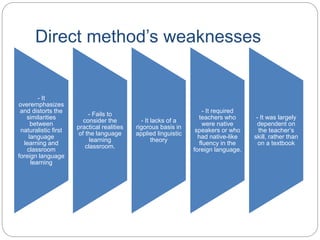
Direct method’s weaknesses
- It
overemphasizes
and distorts the
similarities
between
naturalistic first
language
learning and
classroom
foreign language
learning
- Fails to
consider the
practical realities
of the language
learning
classroom.
- It lacks of a
rigorous basis in
applied linguistic
theory
- It required
teachers who
were native
speakers or who
had native-like
fluency in the
foreign language.
- It was largely
dependent on
the teacher’s
skill, rather than
on a textbook
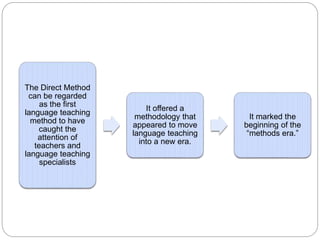
The Direct Method
can be regarded
as the first
language teaching
method to have
caught the
attention of
teachers and
language teaching
specialists
It offered a
methodology that
appeared to move
language teaching
into a new era.
It marked the
beginning of the
“methods era.”
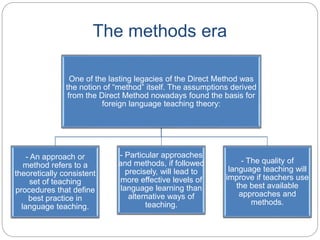
The methods era
One of the lasting legacies of the Direct Method was
the notion of “method” itself. The assumptions derived
from the Direct Method nowadays found the basis for
foreign language teaching theory:
- An approach or
method refers to a
theoretically consistent
set of teaching
procedures that define
best practice in
language teaching.
- Particular approaches
and methods, if followed
precisely, will lead to
more effective levels of
language learning than
alternative ways of
teaching.
- The quality of
language teaching will
improve if teachers use
the best available
approaches and
methods.

Direct method

  • 1.
    Based on: Approachesand Methods in Language Teaching Jack C. Richards,Theodore S. Rodgers María José Burgos Direct Method
  • 2.
    Origins of DirectMethod • Based on Natural method ‘s principles from the XIX century It can be taught without translation or usage of learner´s native language Meaning can be conveyed through actions and demonstrations Usage of language actively to teach itself inside the classroom Induction of grammar rules from the activities in second language Speaking teaching focused in prononciation New vocabulary words are introduced by asociation with previously learnt words, miming and pictures
  • 3.
    Features of theDirect method  Most known of the “natural methods”  Oficially approved by the french and german governments as language teaching methods, comecially known as Berlitz Method in the U.S  Direct and Berlitz methods used to operate under the principles of: 1. Classroom instruction was conducted exclusively in the target language. 2. Only everyday vocabulary and sentences were taught. 3. Oral communication skills were built up in a carefully graded progression organized around question-and- answer exchanges between teachers and students in small, intensive classes. 4. Grammar was taught inductively. 5. New teaching points were introduced orally. 6. Concrete vocabulary was taught through demonstration, objects, and pictures; abstract vocabulary was taught by association of ideas. 7. Both speech and listening comprehension were taught. 8. Correct pronunciation and grammar were emphasized.
  • 4.
    Direct method’s weaknesses -It overemphasizes and distorts the similarities between naturalistic first language learning and classroom foreign language learning - Fails to consider the practical realities of the language learning classroom. - It lacks of a rigorous basis in applied linguistic theory - It required teachers who were native speakers or who had native-like fluency in the foreign language. - It was largely dependent on the teacher’s skill, rather than on a textbook
  • 5.
    The Direct Method canbe regarded as the first language teaching method to have caught the attention of teachers and language teaching specialists It offered a methodology that appeared to move language teaching into a new era. It marked the beginning of the “methods era.”
  • 6.
    The methods era Oneof the lasting legacies of the Direct Method was the notion of “method” itself. The assumptions derived from the Direct Method nowadays found the basis for foreign language teaching theory: - An approach or method refers to a theoretically consistent set of teaching procedures that define best practice in language teaching. - Particular approaches and methods, if followed precisely, will lead to more effective levels of language learning than alternative ways of teaching. - The quality of language teaching will improve if teachers use the best available approaches and methods.