NYSTAGMUS
DEFINITION
 It is defined as regular and
rhythmic to-and-fro involuntary
oscillatory movements of the
eyes.
Classification
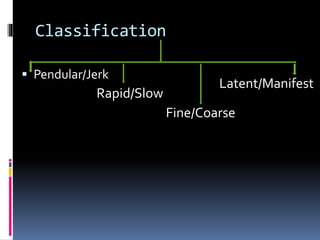
 Pendular/Jerk
Rapid/Slow
Fine/Coarse
Latent/Manifest
FEATURES
 Pendular or Jerk:
 In pendular nystagmus, movements are of equal
velocity in each direction.
 May be horizontal, vertical or rotatory.
 In jerk nystagmus, the movements have a slow
component in one direction and a fast
component in the other direction.
 The direction of the nystagmus is defined by the
direction of the fast component.
 It may be right, left, up, down or rotatory.
FEATURES contd…
 Rapid or Slow:
 It can be rapid or slow.
 Fine or Coarse:
 The movement may be fine or coarse.
 Latent or Manifest:
 Nystagmus may be latent or manifest.
ETIOLOGY
 This occurs due to disturbances in:
a) Sensory visual pathway
b) Vestibular apparatus
c) Semicircular canals,
d) Mid-brain disturbance
e) Cerebellar disturbance
TYPES OF NYSTAGMUS
 This is broadly classified as:
1. Physiological nystagmus
2. Congenital nystagmus and
3. Acquired nystagmus
PHYSIOLOGICAL NYSTAGMUS
 This is further classified as:
A. Optokinetic nystagmus (OKN)
B. End-gaze nystagmus (EGN)
C. Physiological vestibular nystagmus (VOR)
(vestibulo-ocular reflex)
OKN: it is physiological jerk nystagmus induced by
presenting to gaze objects serially in one
direction, such as strips of a spinning
optokinetic drum.
 EGN: it is a fine jerk horizontal nystagmus seen
in normal persons on extreme right or left gaze.
 VOR: it is a jerk nystagmus which can be elicited
by stimulating the tympanic membrane with hot
or cold water.
 This is the basis of caloric test.
 COWS- cold opposite and warm same.
CONGENITAL NYSTAGMUS
 These are classified as:
A. Afferent or sensory nystagmus
B. Idiopathic infantile nystagmus
C. Latent/latent manifest nystagmus
D. Spasmus nutans
E. Nystagmus blockage syndrome
 Afferent or sensory nystagmus:
 It is also known as congenital ocular nystagmus
and is usually associated with sensory
deprivation due to:
a) Ocular albinism
b) Leber’s congenital amaurosis
c) Bilateral congenital cataract
d) Aniridia
e) Bilateral optic nerve hypoplasia etc.,
 Idiopathic infantile nystagmus:
 It is also known as idiopathic congenital nystagmus.
 It is characterised by:
a) Hereditary
b) Onset – very early, usually by two months of age.
c) Waveform – conjugate horizontal jerk nystagmus,
worsens with fixation but improves within ‘null
zone’ and on convergence.
 The null zone is the direction of gaze in which
nystagmus reduces.
 Occasionally the nystagmus can be vertical or
rotatory.
 Latent/Manifest latent nystagmus:
 It is not present when both eyes are open.
 Is present only when one eye is closed.
 It is a jerk nystagmus, with the rapid phase
towards the uncovered eye.
 These patients are tested for visual acuity
by fogging the other eye rather than
occluding.
 Associated with congenital esotropia and
DVD.
 Spasm nutans:
 It is a fine pendular horizontal nystagmus
associated with head nodding and abnormal
head posture.
 Its onset is in infancy and self-resolves by the
age of 3 years.
 Nystagmus blockage syndrome:
 The nystagmus is congenital, manifest and
horizontal and remains the same whether both
eyes are open or one eye is covered.
 It increases in intensity as the eye is abducted
and is blocked when the eye is adducted.
 The esotropia is non-accommodative and
variable: it has an inverse relationship with the
nystagmus.
 When the esotropia increases, the intensity of
the nystagmus decreases and the vision
improves.
ACQUIRED NYSTAGMUS
 It is characterized by oscillopsia, is often associated
with other neurological abnormalities.They are:
a) Gaze-evoked nystagmus
b) Periodic alternating nystagmus
c) Peripheral vestibular nystagmus
d) Central vestibular nystagmus
e) Acquired pendular nystagmus
f) See-saw nystagmus
g) Convergence retraction syndrome
h) Dissociated or disconjugate nystagmus
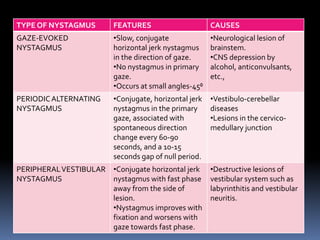
TYPE OF NYSTAGMUS FEATURES CAUSES
GAZE-EVOKED
NYSTAGMUS
•Slow, conjugate
horizontal jerk nystagmus
in the direction of gaze.
•No nystagmus in primary
gaze.
•Occurs at small angles-45⁰
•Neurological lesion of
brainstem.
•CNS depression by
alcohol, anticonvulsants,
etc.,
PERIODICALTERNATING
NYSTAGMUS
•Conjugate, horizontal jerk
nystagmus in the primary
gaze, associated with
spontaneous direction
change every 60-90
seconds, and a 10-15
seconds gap of null period.
•Vestibulo-cerebellar
diseases
•Lesions in the cervico-
medullary junction
PERIPHERALVESTIBULAR
NYSTAGMUS
•Conjugate horizontal jerk
nystagmus with fast phase
away from the side of
lesion.
•Nystagmus improves with
fixation and worsens with
gaze towards fast phase.
•Destructive lesions of
vestibular system such as
labyrinthitis and vestibular
neuritis.
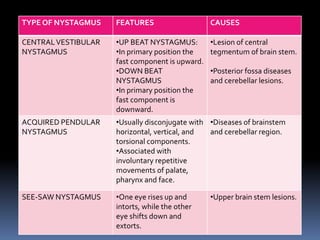
TYPE OF NYSTAGMUS FEATURES CAUSES
CENTRALVESTIBULAR
NYSTAGMUS
•UP BEAT NYSTAGMUS:
•In primary position the
fast component is upward.
•DOWN BEAT
NYSTAGMUS
•In primary position the
fast component is
downward.
•Lesion of central
tegmentum of brain stem.
•Posterior fossa diseases
and cerebellar lesions.
ACQUIRED PENDULAR
NYSTAGMUS
•Usually disconjugate with
horizontal, vertical, and
torsional components.
•Associated with
involuntary repetitive
movements of palate,
pharynx and face.
•Diseases of brainstem
and cerebellar region.
SEE-SAW NYSTAGMUS •One eye rises up and
intorts, while the other
eye shifts down and
extorts.
•Upper brain stem lesions.
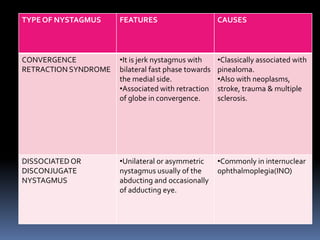
TYPE OF NYSTAGMUS FEATURES CAUSES
CONVERGENCE
RETRACTION SYNDROME
•It is jerk nystagmus with
bilateral fast phase towards
the medial side.
•Associated with retraction
of globe in convergence.
•Classically associated with
pinealoma.
•Also with neoplasms,
stroke, trauma & multiple
sclerosis.
DISSOCIATEDOR
DISCONJUGATE
NYSTAGMUS
•Unilateral or asymmetric
nystagmus usually of the
abducting and occasionally
of adducting eye.
•Commonly in internuclear
ophthalmoplegia(INO)
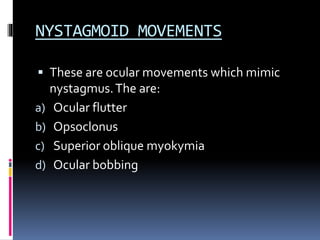
NYSTAGMOID MOVEMENTS
 These are ocular movements which mimic
nystagmus.The are:
a) Ocular flutter
b) Opsoclonus
c) Superior oblique myokymia
d) Ocular bobbing
 Ocular flutter occurs due to interruption of cerebellar
connection to brain stem.
 It is horizontal oscillation and inability to fixate after
change of gaze.
 Opsoclonus is combined horizontal, vertical and/or
torsional oscillations associated with repetative
movement of face, arms, and legs.
 It is seen in patients with encephalitis.
 Superior oblique myokymia is characterized by
monocular, rapid, intermittent, torsional vertical
movements which are best seen on slit-lamp
examination.
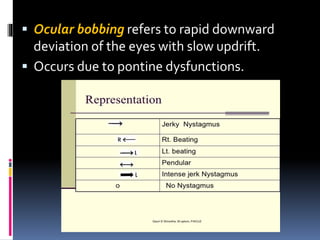
 Ocular bobbing refers to rapid downward
deviation of the eyes with slow updrift.
 Occurs due to pontine dysfunctions.
Assessment of the patient with
nystagmus
 The degree to which the condition can be
assessed depends on the patient's age and
ability to co-operate with instructions.
 Some history and examination are possible in
most patients, as even very young babies
should look with interest at brightly coloured
objects or the light of a pen torch.
History
 Ask about age of onset: this will help determine
which type of nystagmus it is and hence point to a
possible diagnosis.
 Ask when it occurs and when/whether it ceases -
accommodation and sleep are two occasions to
enquire about specifically.
 Ask about related visual symptoms. Some patients
describe oscillopsia (the perception of continual
movement of the visual environment). Generally, if
a patient is unaware of oscillopsia, the nystagmus is
likely to be congenital.
 Ask about a history of headaches, tearing,
avoidance of near tasks, and blurry vision.
 Ask about dizziness and loss of balance, nausea and
vomiting.
 Related systemic symptoms - particularly with
regard to the nervous system - are highly relevant.
 Use of prescribed or non-prescribed drugs is
important, particularly anticonvulsants.
 Ask about family history.
Examination
 Nystagmus is described in terms of
 Direction (of the faster, corrective phase).
 Amplitude (fine or coarse).
 Frequency (high, moderate or low).
 Waveform (jerk, pendular or mixed).
 Symmetry and conjugacy (if bilateral).
 Note in which position of gaze it occurs:
 Primary position - looking straight ahead.
 Secondary positions - looking straight
up/down, straight right or left.
 Tertiary positions - these are the four oblique
positions: up and right, down and right, up and
left, down and left.
 Cardinal positions - these include all the
secondary and tertiary positions.
 Examine the patient sitting facing you: observe
the nystagmus in the primary position.
 Using a small fixation target, observe the
nystagmus in all positions of gaze.
 Ask the patient to comment on visual symptoms
as the eyes move (eg, blurring, double vision).
 Enquire about the 'null' point: this is an angle
which some patients find minimises their visual
impairment - it often results in abnormal head
positioning.
 Check oculocephalic reflex (doll's head
phenomenon):
 This reflex is produced by moving the patient's
head left to right or up and down.When the reflex
is present, the eyes remain stationary while the
head is moved, moving in relation to the head.
 An alert patient normally does not have the doll's-
eye reflex because it is suppressed. Inability to
suppress the oculocephalic reflex suggests
vestibular imbalance.
 The test may be performed by having the patient
extend the arm out in front of the body and fixate
on the outstretched thumb:
 Patients should be instructed to rotate their torso such
that the thumb remains in front of the body at all times.
 Patients with the ability to suppress the oculocephalic
reflex should be able to maintain fixation on their thumb
while rotating.
 An abnormal test result would show the
patient continuously losing fixation of the
thumb
 Other tests of the vestibular system include Romberg's
test and caloric testing (see 'Vestibular nystagmus',
below).
 Carry out a full neurological examination.
 Other examination depends on findings.
Associated problems
 The majority of those with nystagmus have vision which
is significantly worse than average.
 The combination of reduced acuity and oscillopsia may
cause difficulties with facial recognition which are more
severe than would be expected from low acuity alone.
 At school, difficulties arise when copying
information both from books and from overhead
devices.
 This is partly due to difficulties with manipulating
the null point to maximise vision, and partly due
to altered acuity.
 Nystagmus can have profound personal and
social consequences for young people, affecting
relationships, confidence, educational and work
opportunities and their self-image.
 Patients with nystagmus can tire easily from the
extra effort it takes to look at things.
 Patients may experience balance problems, as
their depth of perception may be impaired:
 uneven surfaces or stairs may be difficult to
negotiate.
 This may be perceived as clumsiness by others.
 Oscillopsia may mean that tasks such as riding a
bicycle, if not impossible, are more precarious
because of apparent movement of the roadside
or parked cars.
 There may be associated stress and nervousness
at being in unfamiliar surroundings, particularly
as they often have poor vision.
 Patients often have difficulty in making and
maintaining eye contact.
 School children and students may need extra
time for reading and sitting exams.
 Small print can usually be read with aids but
children will find it hard to share books.
Management
 AIMS OFTREATMENNT:
 To improve visual acuity by stabilising eye.
 To decrease the oscillopsia.
 To shift the null zone if any to primary position.
 Modalities:
 Optical
 Medical
 surgical
• Correction of refractive errors sometimes
significantly decreases nystagmus.
.Retinoscopy is performed in null zone if
present.
.Amblyopia therapy:Occlusion therapy is often
successful in patients with strabismic
amblyopia and helps in improving vision and
decreasing nystagmus.
.Latent nystagmus is not a contraindication to
patching.
• Overcorrecting minus lenses may improve visual acuity
at distance fixation by stimulating accommodative
convergence thereby dampening the nystagmus.
• PrismTherapy: they are useful as follows:
• Base out prisms may stimulate fusional convergence
especially in congenital motor type & thus improve visual
acuity by dampening the nystagmus.
• Prism with apex towards the preferred direction of gaze
helps in correcting head posture.
• Similarly appropriate prisms can be useful to correct
vertical head turns.
Contact lenses:
• Advantage of contact lenses are, they move
in synchrony with eye movements, so that
visual axis coincides with the optical center of
the lens at all times thereby improving the
visual acuity.
• Galilean arrangement of contact lenses and
glasses can be used to stabilize retinal images
in acquired nystagmus and oscillopsia. It also
improves visual acuity in congenital nystagmus.
Medical:
• Drugs like gabapentin,baclofen, clonazepam,
propranolol, carbamazepine are used in the
management of acquired nystagmus.
• Benefits are limited till usage period.
Pre-operative Evaluation:
•The prisms are inserted with the base opposite the
preferred direction of gaze.
• Example:With a head turn to the left, the null zone is
in dextroversion, and a base-in before the right eye and
a base-out before the left eye will correct the head turn.
• Similarly a compensatory chin elevation by a null zone
in deorsumversion will be improved with prisms base-
up before each eye.
•A combibation of vertical and horizontal prisms are
used when the null zone is in an oblique position of
gaze.
•The results of surgery for head turn in nystagmus can
be reasonably predicted on the response to prisms and
postoperative residual head turn may be alleviated
further with prisms.
Surgical management
 Indications for surgical intervention:
1. Large face turns-more than 40 degrees
2. Associated with strabismus
3. Successful prism adaptation.
 Principles of surgical management:
a) To improve head posture-move the eyes toward
the null position.
1. Kestenbaum procedure.
2. Augumented kestenbaum procedure.
3. Modified Anderson procedure-the two muscle
recession.
b) To improve the visual acuity.
1. Four muscle recessions
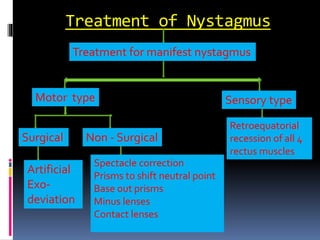
Treatment of Nystagmus
Treatment for manifest nystagmus
Motor type Sensory type
Surgical Non - Surgical
Artificial
Exo-
deviation
Spectacle correction
Prisms to shift neutral point
Base out prisms
Minus lenses
Contact lenses
Retroequatorial
recession of all 4
rectus muscles
Advice to patients, parents and
schools
 Encouragement:
 Parents should be encouraged to explain
nystagmus to family, friends and others.
 The explanation should be short and positive,
emphasising that most people with nystagmus
can see, learn and interact well enough to lead
normal lives.
 Parents should not lower expectations for their
child.
 Children with nystagmus need help in
understanding why their eyes are different.
 They also need to be able to explain their
condition to other children, who will ask them
about it.
 Counselling may be helpful to support young
people through the social and personal
challenges often associated with nystagmus.
 Fatigue and stress can make nystagmus worse.
Maximising functional vision
 In most children with nystagmus, a spectacle or
lens prescription improves vision significantly.
 Both spectacles and contact lenses can maximise
acuity: the majority of patients with nystagmus
will have some benefit from this.
 Patients often find contact lenses superior, as
with glasses, the eyes sweep back and forth over
the lens centres and vision is not as clear.
 With contacts, the lens centres move with the
eyes.
 Some patients find that contact lenses
reduce their nystagmus.
 A prism may be put in spectacles to help
position the eye at its null point.
 Low vision devices such as telescopes and
magnifiers may help people if their vision
cannot be fully corrected with spectacles and
contact lenses.
 Tinting glasses or using sunglasses may decrease
nystagmus in patients with albinism.
 Acupuncture, biofeedback and vision therapy have
been successful for some patients.
 In school the pupil should be allowed to sit near the
front and be supplied, where possible, with hard
copy of what they must copy from boards, so that
they can place it appropriately to maximise their
vision of it.
 On black chalkboards and on whiteboards, high-
contrast colours are often easier to see.
 It may sometimes be necessary for the teacher
to read out what they have written.
 Teachers should check frequently that pupils are
able to access material as offered.
 Large-print books can help, particularly for
children learning to read.
 Extra reading time should be allowed in school
examinations, as reading may be slower.
 Children should not be expected to share
textbooks in class, as this may impede their
freedom to find the best reading position.
 Some patients have found it helpful to block
out moving text on the edges ofTV screens (eg,
during news programmes), which subjectively
improves their ability to fix on the screen.
 Conclusion:
1. In reality nystagmus has no cure.
2. Treatment plans should be tailored.
3. Goals should be realistic.
4. Recurrences are almost the rule.

NYSTAGMUS.pptx

  • 1.
  • 2.
    DEFINITION  It isdefined as regular and rhythmic to-and-fro involuntary oscillatory movements of the eyes.
  • 3.
  • 4.
    FEATURES  Pendular orJerk:  In pendular nystagmus, movements are of equal velocity in each direction.  May be horizontal, vertical or rotatory.  In jerk nystagmus, the movements have a slow component in one direction and a fast component in the other direction.  The direction of the nystagmus is defined by the direction of the fast component.  It may be right, left, up, down or rotatory.
  • 5.
    FEATURES contd…  Rapidor Slow:  It can be rapid or slow.  Fine or Coarse:  The movement may be fine or coarse.  Latent or Manifest:  Nystagmus may be latent or manifest.
  • 6.
    ETIOLOGY  This occursdue to disturbances in: a) Sensory visual pathway b) Vestibular apparatus c) Semicircular canals, d) Mid-brain disturbance e) Cerebellar disturbance
  • 7.
    TYPES OF NYSTAGMUS This is broadly classified as: 1. Physiological nystagmus 2. Congenital nystagmus and 3. Acquired nystagmus
  • 8.
    PHYSIOLOGICAL NYSTAGMUS  Thisis further classified as: A. Optokinetic nystagmus (OKN) B. End-gaze nystagmus (EGN) C. Physiological vestibular nystagmus (VOR) (vestibulo-ocular reflex) OKN: it is physiological jerk nystagmus induced by presenting to gaze objects serially in one direction, such as strips of a spinning optokinetic drum.
  • 9.
     EGN: itis a fine jerk horizontal nystagmus seen in normal persons on extreme right or left gaze.  VOR: it is a jerk nystagmus which can be elicited by stimulating the tympanic membrane with hot or cold water.  This is the basis of caloric test.  COWS- cold opposite and warm same.
  • 10.
    CONGENITAL NYSTAGMUS  Theseare classified as: A. Afferent or sensory nystagmus B. Idiopathic infantile nystagmus C. Latent/latent manifest nystagmus D. Spasmus nutans E. Nystagmus blockage syndrome
  • 11.
     Afferent orsensory nystagmus:  It is also known as congenital ocular nystagmus and is usually associated with sensory deprivation due to: a) Ocular albinism b) Leber’s congenital amaurosis c) Bilateral congenital cataract d) Aniridia e) Bilateral optic nerve hypoplasia etc.,
  • 12.
     Idiopathic infantilenystagmus:  It is also known as idiopathic congenital nystagmus.  It is characterised by: a) Hereditary b) Onset – very early, usually by two months of age. c) Waveform – conjugate horizontal jerk nystagmus, worsens with fixation but improves within ‘null zone’ and on convergence.  The null zone is the direction of gaze in which nystagmus reduces.  Occasionally the nystagmus can be vertical or rotatory.
  • 13.
     Latent/Manifest latentnystagmus:  It is not present when both eyes are open.  Is present only when one eye is closed.  It is a jerk nystagmus, with the rapid phase towards the uncovered eye.  These patients are tested for visual acuity by fogging the other eye rather than occluding.  Associated with congenital esotropia and DVD.
  • 14.
     Spasm nutans: It is a fine pendular horizontal nystagmus associated with head nodding and abnormal head posture.  Its onset is in infancy and self-resolves by the age of 3 years.  Nystagmus blockage syndrome:  The nystagmus is congenital, manifest and horizontal and remains the same whether both eyes are open or one eye is covered.
  • 15.
     It increasesin intensity as the eye is abducted and is blocked when the eye is adducted.  The esotropia is non-accommodative and variable: it has an inverse relationship with the nystagmus.  When the esotropia increases, the intensity of the nystagmus decreases and the vision improves.
  • 16.
    ACQUIRED NYSTAGMUS  Itis characterized by oscillopsia, is often associated with other neurological abnormalities.They are: a) Gaze-evoked nystagmus b) Periodic alternating nystagmus c) Peripheral vestibular nystagmus d) Central vestibular nystagmus e) Acquired pendular nystagmus f) See-saw nystagmus g) Convergence retraction syndrome h) Dissociated or disconjugate nystagmus
  • 17.
    TYPE OF NYSTAGMUSFEATURES CAUSES GAZE-EVOKED NYSTAGMUS •Slow, conjugate horizontal jerk nystagmus in the direction of gaze. •No nystagmus in primary gaze. •Occurs at small angles-45⁰ •Neurological lesion of brainstem. •CNS depression by alcohol, anticonvulsants, etc., PERIODICALTERNATING NYSTAGMUS •Conjugate, horizontal jerk nystagmus in the primary gaze, associated with spontaneous direction change every 60-90 seconds, and a 10-15 seconds gap of null period. •Vestibulo-cerebellar diseases •Lesions in the cervico- medullary junction PERIPHERALVESTIBULAR NYSTAGMUS •Conjugate horizontal jerk nystagmus with fast phase away from the side of lesion. •Nystagmus improves with fixation and worsens with gaze towards fast phase. •Destructive lesions of vestibular system such as labyrinthitis and vestibular neuritis.
  • 18.
    TYPE OF NYSTAGMUSFEATURES CAUSES CENTRALVESTIBULAR NYSTAGMUS •UP BEAT NYSTAGMUS: •In primary position the fast component is upward. •DOWN BEAT NYSTAGMUS •In primary position the fast component is downward. •Lesion of central tegmentum of brain stem. •Posterior fossa diseases and cerebellar lesions. ACQUIRED PENDULAR NYSTAGMUS •Usually disconjugate with horizontal, vertical, and torsional components. •Associated with involuntary repetitive movements of palate, pharynx and face. •Diseases of brainstem and cerebellar region. SEE-SAW NYSTAGMUS •One eye rises up and intorts, while the other eye shifts down and extorts. •Upper brain stem lesions.
  • 19.
    TYPE OF NYSTAGMUSFEATURES CAUSES CONVERGENCE RETRACTION SYNDROME •It is jerk nystagmus with bilateral fast phase towards the medial side. •Associated with retraction of globe in convergence. •Classically associated with pinealoma. •Also with neoplasms, stroke, trauma & multiple sclerosis. DISSOCIATEDOR DISCONJUGATE NYSTAGMUS •Unilateral or asymmetric nystagmus usually of the abducting and occasionally of adducting eye. •Commonly in internuclear ophthalmoplegia(INO)
  • 20.
    NYSTAGMOID MOVEMENTS  Theseare ocular movements which mimic nystagmus.The are: a) Ocular flutter b) Opsoclonus c) Superior oblique myokymia d) Ocular bobbing
  • 21.
     Ocular flutteroccurs due to interruption of cerebellar connection to brain stem.  It is horizontal oscillation and inability to fixate after change of gaze.  Opsoclonus is combined horizontal, vertical and/or torsional oscillations associated with repetative movement of face, arms, and legs.  It is seen in patients with encephalitis.  Superior oblique myokymia is characterized by monocular, rapid, intermittent, torsional vertical movements which are best seen on slit-lamp examination.
  • 22.
     Ocular bobbingrefers to rapid downward deviation of the eyes with slow updrift.  Occurs due to pontine dysfunctions.
  • 23.
    Assessment of thepatient with nystagmus  The degree to which the condition can be assessed depends on the patient's age and ability to co-operate with instructions.  Some history and examination are possible in most patients, as even very young babies should look with interest at brightly coloured objects or the light of a pen torch.
  • 24.
    History  Ask aboutage of onset: this will help determine which type of nystagmus it is and hence point to a possible diagnosis.  Ask when it occurs and when/whether it ceases - accommodation and sleep are two occasions to enquire about specifically.  Ask about related visual symptoms. Some patients describe oscillopsia (the perception of continual movement of the visual environment). Generally, if a patient is unaware of oscillopsia, the nystagmus is likely to be congenital.
  • 25.
     Ask abouta history of headaches, tearing, avoidance of near tasks, and blurry vision.  Ask about dizziness and loss of balance, nausea and vomiting.  Related systemic symptoms - particularly with regard to the nervous system - are highly relevant.  Use of prescribed or non-prescribed drugs is important, particularly anticonvulsants.  Ask about family history.
  • 26.
    Examination  Nystagmus isdescribed in terms of  Direction (of the faster, corrective phase).  Amplitude (fine or coarse).  Frequency (high, moderate or low).  Waveform (jerk, pendular or mixed).  Symmetry and conjugacy (if bilateral).
  • 27.
     Note inwhich position of gaze it occurs:  Primary position - looking straight ahead.  Secondary positions - looking straight up/down, straight right or left.  Tertiary positions - these are the four oblique positions: up and right, down and right, up and left, down and left.  Cardinal positions - these include all the secondary and tertiary positions.
  • 28.
     Examine thepatient sitting facing you: observe the nystagmus in the primary position.  Using a small fixation target, observe the nystagmus in all positions of gaze.  Ask the patient to comment on visual symptoms as the eyes move (eg, blurring, double vision).  Enquire about the 'null' point: this is an angle which some patients find minimises their visual impairment - it often results in abnormal head positioning.
  • 29.
     Check oculocephalicreflex (doll's head phenomenon):  This reflex is produced by moving the patient's head left to right or up and down.When the reflex is present, the eyes remain stationary while the head is moved, moving in relation to the head.  An alert patient normally does not have the doll's- eye reflex because it is suppressed. Inability to suppress the oculocephalic reflex suggests vestibular imbalance.
  • 30.
     The testmay be performed by having the patient extend the arm out in front of the body and fixate on the outstretched thumb:  Patients should be instructed to rotate their torso such that the thumb remains in front of the body at all times.  Patients with the ability to suppress the oculocephalic reflex should be able to maintain fixation on their thumb while rotating.  An abnormal test result would show the patient continuously losing fixation of the thumb
  • 31.
     Other testsof the vestibular system include Romberg's test and caloric testing (see 'Vestibular nystagmus', below).  Carry out a full neurological examination.  Other examination depends on findings. Associated problems  The majority of those with nystagmus have vision which is significantly worse than average.  The combination of reduced acuity and oscillopsia may cause difficulties with facial recognition which are more severe than would be expected from low acuity alone.
  • 32.
     At school,difficulties arise when copying information both from books and from overhead devices.  This is partly due to difficulties with manipulating the null point to maximise vision, and partly due to altered acuity.  Nystagmus can have profound personal and social consequences for young people, affecting relationships, confidence, educational and work opportunities and their self-image.  Patients with nystagmus can tire easily from the extra effort it takes to look at things.
  • 33.
     Patients mayexperience balance problems, as their depth of perception may be impaired:  uneven surfaces or stairs may be difficult to negotiate.  This may be perceived as clumsiness by others.  Oscillopsia may mean that tasks such as riding a bicycle, if not impossible, are more precarious because of apparent movement of the roadside or parked cars.
  • 34.
     There maybe associated stress and nervousness at being in unfamiliar surroundings, particularly as they often have poor vision.  Patients often have difficulty in making and maintaining eye contact.  School children and students may need extra time for reading and sitting exams.  Small print can usually be read with aids but children will find it hard to share books.
  • 35.
    Management  AIMS OFTREATMENNT: To improve visual acuity by stabilising eye.  To decrease the oscillopsia.  To shift the null zone if any to primary position.  Modalities:  Optical  Medical  surgical
  • 36.
    • Correction ofrefractive errors sometimes significantly decreases nystagmus. .Retinoscopy is performed in null zone if present. .Amblyopia therapy:Occlusion therapy is often successful in patients with strabismic amblyopia and helps in improving vision and decreasing nystagmus. .Latent nystagmus is not a contraindication to patching.
  • 37.
    • Overcorrecting minuslenses may improve visual acuity at distance fixation by stimulating accommodative convergence thereby dampening the nystagmus. • PrismTherapy: they are useful as follows: • Base out prisms may stimulate fusional convergence especially in congenital motor type & thus improve visual acuity by dampening the nystagmus. • Prism with apex towards the preferred direction of gaze helps in correcting head posture. • Similarly appropriate prisms can be useful to correct vertical head turns.
  • 38.
    Contact lenses: • Advantageof contact lenses are, they move in synchrony with eye movements, so that visual axis coincides with the optical center of the lens at all times thereby improving the visual acuity. • Galilean arrangement of contact lenses and glasses can be used to stabilize retinal images in acquired nystagmus and oscillopsia. It also improves visual acuity in congenital nystagmus.
  • 39.
    Medical: • Drugs likegabapentin,baclofen, clonazepam, propranolol, carbamazepine are used in the management of acquired nystagmus. • Benefits are limited till usage period. Pre-operative Evaluation: •The prisms are inserted with the base opposite the preferred direction of gaze. • Example:With a head turn to the left, the null zone is in dextroversion, and a base-in before the right eye and a base-out before the left eye will correct the head turn.
  • 40.
    • Similarly acompensatory chin elevation by a null zone in deorsumversion will be improved with prisms base- up before each eye. •A combibation of vertical and horizontal prisms are used when the null zone is in an oblique position of gaze. •The results of surgery for head turn in nystagmus can be reasonably predicted on the response to prisms and postoperative residual head turn may be alleviated further with prisms.
  • 41.
    Surgical management  Indicationsfor surgical intervention: 1. Large face turns-more than 40 degrees 2. Associated with strabismus 3. Successful prism adaptation.  Principles of surgical management: a) To improve head posture-move the eyes toward the null position. 1. Kestenbaum procedure. 2. Augumented kestenbaum procedure. 3. Modified Anderson procedure-the two muscle recession. b) To improve the visual acuity. 1. Four muscle recessions
  • 42.
    Treatment of Nystagmus Treatmentfor manifest nystagmus Motor type Sensory type Surgical Non - Surgical Artificial Exo- deviation Spectacle correction Prisms to shift neutral point Base out prisms Minus lenses Contact lenses Retroequatorial recession of all 4 rectus muscles
  • 43.
    Advice to patients,parents and schools  Encouragement:  Parents should be encouraged to explain nystagmus to family, friends and others.  The explanation should be short and positive, emphasising that most people with nystagmus can see, learn and interact well enough to lead normal lives.  Parents should not lower expectations for their child.
  • 44.
     Children withnystagmus need help in understanding why their eyes are different.  They also need to be able to explain their condition to other children, who will ask them about it.  Counselling may be helpful to support young people through the social and personal challenges often associated with nystagmus.  Fatigue and stress can make nystagmus worse.
  • 45.
    Maximising functional vision In most children with nystagmus, a spectacle or lens prescription improves vision significantly.  Both spectacles and contact lenses can maximise acuity: the majority of patients with nystagmus will have some benefit from this.  Patients often find contact lenses superior, as with glasses, the eyes sweep back and forth over the lens centres and vision is not as clear.
  • 46.
     With contacts,the lens centres move with the eyes.  Some patients find that contact lenses reduce their nystagmus.  A prism may be put in spectacles to help position the eye at its null point.  Low vision devices such as telescopes and magnifiers may help people if their vision cannot be fully corrected with spectacles and contact lenses.
  • 47.
     Tinting glassesor using sunglasses may decrease nystagmus in patients with albinism.  Acupuncture, biofeedback and vision therapy have been successful for some patients.  In school the pupil should be allowed to sit near the front and be supplied, where possible, with hard copy of what they must copy from boards, so that they can place it appropriately to maximise their vision of it.  On black chalkboards and on whiteboards, high- contrast colours are often easier to see.
  • 48.
     It maysometimes be necessary for the teacher to read out what they have written.  Teachers should check frequently that pupils are able to access material as offered.  Large-print books can help, particularly for children learning to read.  Extra reading time should be allowed in school examinations, as reading may be slower.
  • 49.
     Children shouldnot be expected to share textbooks in class, as this may impede their freedom to find the best reading position.  Some patients have found it helpful to block out moving text on the edges ofTV screens (eg, during news programmes), which subjectively improves their ability to fix on the screen.  Conclusion: 1. In reality nystagmus has no cure. 2. Treatment plans should be tailored. 3. Goals should be realistic. 4. Recurrences are almost the rule.