Market intelligence
Market Intelligence is a process
of giving you insights into what
might happen in the near future.
This process requires that we go
from data to information to
intelligence.
Marketing intelligence can be
used to assess market entry
opportunities and to formulate
market development plans and
penetration strategies.
 MI pulls together data and information
from a very large and strategic view,
allowing to predict or forecast what is
going to happen.
 This interns allows to effectively
strategizing in relation to competitive
environment.
Need for Market Intelligence
 Innovation - moved to market quickly and marketed
aggressively.
 The early comers establish the market standard often
wins over the better technology.
 Technopreneurs-lack marketing skills and
management. These have to be supplement.
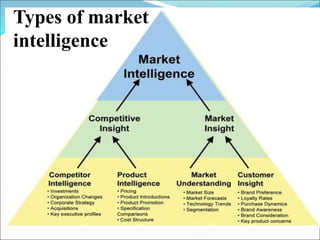
Types of market
intelligence
Process of MI
Phase I: Secondary Research
(80% volume / 20% time)
Phase II: Primary Research
(20% volume / 80% time
 Primary research is often done through a
interview, such as contacting suppliers,
customers, business writers, and Government
agencies. Surveys are sometimes used where
several sources are involved
 Secondary sources of information are public
knowledge.
Among the secondary sources of
information; local sources are more
revealing than national or global.
Secondary sources should be varied
so that you collect different
viewpoints. This helps reduce bias
in your research.
Internet related sources of
information are often opinionated.
Opinion related information is
usually subjective and unreliable.
Secondary research consists mainly
of printed type sources of
information.
 Consider the 80 / 20 rule in relation to
internal vs. external sources of
information.
 All of these internal sources can
represent great sources of intelligence. The
external sources represent the general
body of information at large, easy to
obtain, and widely distributed.
Steps in Market Intelligence
 What critical question(s) must get
answered?
 What is the time frame for meeting the
competitive intelligence objective?
 Define the Market Intelligence Project,
allocate resources, establish a scope, and
issue a quick plan for execution.
 Launch secondary research – collect and
organize data.
 Analyze appropriate information,
conduct primary research, and enlist
others in developing the deliverable.
 Draft findings and recommendations;
circulate for review.
 Approve and distribute final report.
Market intelligence
Market intelligence

Market intelligence

  • 2.
    Market intelligence Market Intelligenceis a process of giving you insights into what might happen in the near future. This process requires that we go from data to information to intelligence.
  • 3.
    Marketing intelligence canbe used to assess market entry opportunities and to formulate market development plans and penetration strategies.
  • 4.
     MI pullstogether data and information from a very large and strategic view, allowing to predict or forecast what is going to happen.  This interns allows to effectively strategizing in relation to competitive environment.
  • 7.
    Need for MarketIntelligence  Innovation - moved to market quickly and marketed aggressively.  The early comers establish the market standard often wins over the better technology.  Technopreneurs-lack marketing skills and management. These have to be supplement.
  • 8.
  • 9.
    Process of MI PhaseI: Secondary Research (80% volume / 20% time) Phase II: Primary Research (20% volume / 80% time
  • 10.
     Primary researchis often done through a interview, such as contacting suppliers, customers, business writers, and Government agencies. Surveys are sometimes used where several sources are involved  Secondary sources of information are public knowledge.
  • 12.
    Among the secondarysources of information; local sources are more revealing than national or global. Secondary sources should be varied so that you collect different viewpoints. This helps reduce bias in your research.
  • 13.
    Internet related sourcesof information are often opinionated. Opinion related information is usually subjective and unreliable. Secondary research consists mainly of printed type sources of information.
  • 14.
     Consider the80 / 20 rule in relation to internal vs. external sources of information.  All of these internal sources can represent great sources of intelligence. The external sources represent the general body of information at large, easy to obtain, and widely distributed.
  • 15.
    Steps in MarketIntelligence  What critical question(s) must get answered?  What is the time frame for meeting the competitive intelligence objective?  Define the Market Intelligence Project, allocate resources, establish a scope, and issue a quick plan for execution.  Launch secondary research – collect and organize data.
  • 16.
     Analyze appropriateinformation, conduct primary research, and enlist others in developing the deliverable.  Draft findings and recommendations; circulate for review.  Approve and distribute final report.