
ANTHROPOLOGY- CONCEPTS AND
THEORIES
Presented by,
KAVI
ANTHROPOLOGY
• Anthropology-“anthropos” - man.
“logos”-science or study.
• Scientific study of the origin, the
behaviour, the physical, social
and cultural development of
humans.
Definitions
• “Anthropology is the science of
man” - A L Kroeber
• “Anthropology is the study of
man and his works” -Melville J
Herskovits
• “Out of all the sciences which
study various aspects of man,
anthropology is the one which
comes nearest to the total study
of man” –Clyde Kluckhohn
Anthropology provides a
window to our past, a
mirror to our present and a
lens through which we
look to the future.
Anthropologists research,
observe, analyze and
apply what they learn
toward an understanding
of the many variations of
the human condition.
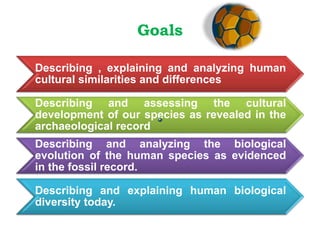
Goals
Describing , explaining and analyzing human
cultural similarities and differences
Describing and assessing the cultural
development of our species as revealed in the
archaeological record
Describing and analyzing the biological
evolution of the human species as evidenced
in the fossil record.
Describing and explaining human biological
diversity today.
.
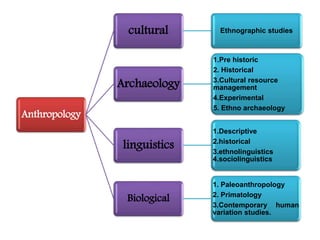
Anthropology
cultural Ethnographic studies
Archaeology
1.Pre historic
2. Historical
3.Cultural resource
management
4.Experimental
5. Ethno archaeology
linguistics
1.Descriptive
2.historical
3.ethnolinguistics
4.sociolinguistics
Biological
1. Paleoanthropology
2. Primatology
3.Contemporary human
variation studies.
• Cultural anthropology studies human cultures. It is
description and comparison of the adaptations made by
human groups to the diverse eco system of the earth.
• Cultural anthropology studies human customs, mores,
traditions, social life, religion, art, science, literature and
economic and political organization.
• According to E.A. Hoebel. “The phase of anthropology
that devotes its attention to the customs of mankind, is
called cultural anthropology”.
• Traditional areas of focus within cultural anthropology
include ethnographic and ethnological research.
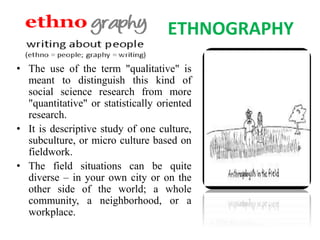
ETHNOGRAPHY
• The use of the term "qualitative" is
meant to distinguish this kind of
social science research from more
"quantitative" or statistically oriented
research.
• It is descriptive study of one culture,
subculture, or micro culture based on
fieldwork.
• The field situations can be quite
diverse – in your own city or on the
other side of the world; a whole
community, a neighborhood, or a
workplace.
ETHNOLOGY
• The comparative study of
cultures, presents analytical
generalizations about human
culture. Ethnology studies
human races.
• The process leading to these
generalizations involves
explaining the similarities and
differences in cultures.
• Ethnology classifies human
races and studies their physical
characteristics.
2.Archaeology
• It is systematic study of the
remains of previous cultures as a
means of reconstructing the life
ways of people who lived in the
past.
• Archaeologists focus on culture,
the culture of people.
• Archaeologists use to study how
peoples adapted to their natural
and socio cultural environments
and how culture spread and
changed through time.
.
• Pre historic archaeology : literally
speaking, archeology is the study of
ancient time. Thus it studies ancient
things.
• Archeology studies the ancient history
which has no written records.
• Things and articles discovered by
archeological excavations give us an idea
about the culture of the people using
them.
• It records cultural successes of a
particular era and also area of its
expansions.
• Historical archaeology : It is the study
of the remains of cultures and
subcultures that have written records but
about which little if anything was
recorded.
.
It is growing field for individuals
with degrees in archaeology.
CRM specialists work on
threatened archaeological sites,
produce environmental impacts
reports, and do salvage digs on
sites that will be destroyed by
contemporary building.
.
Experimental archaeology: it is plays an
important part in the analysis of prehistoric
artifacts and technology.
For example, researchers try to duplicate the
prehistoric techniques of manufacturing
stone tools and other artifacts to better
understand and appreciate the technological
knowledge of prehistoric peoples.
.
Ethno archaeology: it is also contributes to the
analysis of artifacts and eco facts by observing
present-day societies behaviors and uses of
material objects.
Example, studying how contemporary hunters
and gatherers butcher and transport meat to their
camps helps the archaeologist to interpret bones
and their distribution in prehistoric sites.
3. LINGUISTICS
• Linguistics is the study of language.
• Anthropological linguists do not necessarily speak
several languages(such a person is called a polyglot.)
• Rather, linguists study language – how language formed
and how it works, the history and development of
language, and its relationship to other aspects of culture.
• Linguistics became a part of anthropology for two
reasons.
• First, language is the cornerstone of culture.
• Second, dictionaries and grammars of a native
language.
.
Descriptive linguistics focuses on the
mechanics of language. The linguistics must
first describe the sounds used in the language
under study (called phonology).
Historical linguistics works to reconstruct the
history of languages, including their
development and relationship to other
languages.
Ethno linguistics is a specialized field that
analyzes the relationship between a language
and culture. It investigates questions such as
does your language create your reality?
Sociolinguistics evaluates the relationship
between language and culture with a focus on
how people speak in social contexts such as in
the workplace or at home.
4. Biological anthropology
• It is also called physical anthropology
studies homo sapiens as biological beings
both in the present and in the past. As the
name indicates, it studies the biological
and physical characteristics of humans.
• Paleoanthropology is the study of human
biological evolution through an examination
of the fossils of our ancient ancestors and
relatives. It is relies heavily on comparative
anatomy and evolutionary biology.
• This helps in the classification and
comparison of the fossils of different stages
to determine the link between the modern
humans and their ancestors.
.
Primatology is the study of our nearest animal relatives –
the primates.
This area of biological anthropology includes an
investigation of the anatomy, physiology, genetics, and
behaviors of apes, monkey and prosimians.
Contemporary human variations studies, another area
of research in biological anthropology, focus on living
humans and how our anatomy and physiology vary.
Genetics, including DNA research, contributes greatly to such studies,
the long-range goal of which is to account for and offer explanations for
the variation among humans, as well as to demonstrate our many
similarities and shared biological adaptations.
Forensic Anthropology:
• The knowledge of Forensic Anthropology
is applied to solve the issues related to
criminal and legal matters.
• Forensic anthropologists are called upon
by police and other authorities to identify
the remains of murder victims, missing
cases or people who die in disasters.
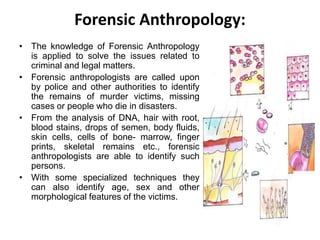
• From the analysis of DNA, hair with root,
blood stains, drops of semen, body fluids,
skin cells, cells of bone- marrow, finger
prints, skeletal remains etc., forensic
anthropologists are able to identify such
persons.
• With some specialized techniques they
can also identify age, sex and other
morphological features of the victims.
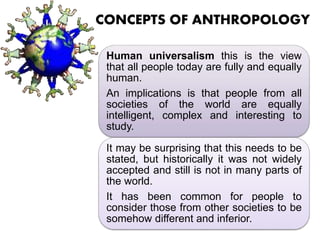
CONCEPTS OF ANTHROPOLOGY
Human universalism this is the view
that all people today are fully and equally
human.
An implications is that people from all
societies of the world are equally
intelligent, complex and interesting to
study.
It may be surprising that this needs to be
stated, but historically it was not widely
accepted and still is not in many parts of
the world.
It has been common for people to
consider those from other societies to be
somehow different and inferior.
.
Integration that is the view that all
aspects of a culture are interrelated and
that an understanding of any cultural trait
or institution requires knowing how it
impacts and is in turn impacted by other
institutions.
Likewise, human biological traits do not
evolve and functions in isolation. In order
to understand them, it is necessary to
grasp how they are interrelated with other
genetically inherited characteristics and
how environmental factors might select
for or against them.
.
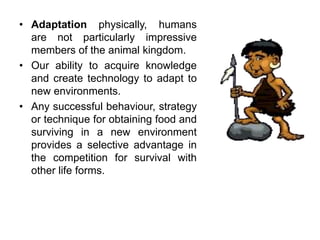
• Adaptation physically, humans
are not particularly impressive
members of the animal kingdom.
• Our ability to acquire knowledge
and create technology to adapt to
new environments.
• Any successful behaviour, strategy
or technique for obtaining food and
surviving in a new environment
provides a selective advantage in
the competition for survival with
other life forms.
.
Culture is a unique possession of man. It is one of the
distinguishing traits of human society.
Culture does not exist at the sub-human level. Only man
is born and brought up in a cultural environment.
Culture is very broad term that includes in itself all our walks
of life, our modes of behavior, our philosophies and ethics,
our morals and manners, our customs and traditions, our
religious, political, economic and other types of activities.
Culture includes all that man has acquired in his
individual and social life.
.
• B.Malinowski has defined culture as the
‘cumulative creation of man’. He also regards culture
as the handiwork of man and the medium through
which he achieves his ends.
• Edward B. Tylor, a famous English anthropologist,
has defined culture as ‘that complex whole which
includes knowledge, belief, art, morals, law, custom,
and any other capabilities and habits acquired by
man as a member of society’.
• Robert Bierstedt is of the opinion that ‘culture is
the complex whole that consists of all the ways we
think and do and everything we have as members of
society’.
Social change anthropology

Social change anthropology

  • 1.
  • 2.
    ANTHROPOLOGY • Anthropology-“anthropos” -man. “logos”-science or study. • Scientific study of the origin, the behaviour, the physical, social and cultural development of humans.
  • 3.
    Definitions • “Anthropology isthe science of man” - A L Kroeber • “Anthropology is the study of man and his works” -Melville J Herskovits • “Out of all the sciences which study various aspects of man, anthropology is the one which comes nearest to the total study of man” –Clyde Kluckhohn
  • 4.
    Anthropology provides a windowto our past, a mirror to our present and a lens through which we look to the future. Anthropologists research, observe, analyze and apply what they learn toward an understanding of the many variations of the human condition.
  • 5.
    Goals Describing , explainingand analyzing human cultural similarities and differences Describing and assessing the cultural development of our species as revealed in the archaeological record Describing and analyzing the biological evolution of the human species as evidenced in the fossil record. Describing and explaining human biological diversity today.
  • 6.
    . Anthropology cultural Ethnographic studies Archaeology 1.Prehistoric 2. Historical 3.Cultural resource management 4.Experimental 5. Ethno archaeology linguistics 1.Descriptive 2.historical 3.ethnolinguistics 4.sociolinguistics Biological 1. Paleoanthropology 2. Primatology 3.Contemporary human variation studies.
  • 7.
    • Cultural anthropologystudies human cultures. It is description and comparison of the adaptations made by human groups to the diverse eco system of the earth. • Cultural anthropology studies human customs, mores, traditions, social life, religion, art, science, literature and economic and political organization. • According to E.A. Hoebel. “The phase of anthropology that devotes its attention to the customs of mankind, is called cultural anthropology”. • Traditional areas of focus within cultural anthropology include ethnographic and ethnological research.
  • 8.
    ETHNOGRAPHY • The useof the term "qualitative" is meant to distinguish this kind of social science research from more "quantitative" or statistically oriented research. • It is descriptive study of one culture, subculture, or micro culture based on fieldwork. • The field situations can be quite diverse – in your own city or on the other side of the world; a whole community, a neighborhood, or a workplace.
  • 9.
    ETHNOLOGY • The comparativestudy of cultures, presents analytical generalizations about human culture. Ethnology studies human races. • The process leading to these generalizations involves explaining the similarities and differences in cultures. • Ethnology classifies human races and studies their physical characteristics.
  • 10.
    2.Archaeology • It issystematic study of the remains of previous cultures as a means of reconstructing the life ways of people who lived in the past. • Archaeologists focus on culture, the culture of people. • Archaeologists use to study how peoples adapted to their natural and socio cultural environments and how culture spread and changed through time.
  • 11.
    . • Pre historicarchaeology : literally speaking, archeology is the study of ancient time. Thus it studies ancient things. • Archeology studies the ancient history which has no written records. • Things and articles discovered by archeological excavations give us an idea about the culture of the people using them. • It records cultural successes of a particular era and also area of its expansions. • Historical archaeology : It is the study of the remains of cultures and subcultures that have written records but about which little if anything was recorded.
  • 12.
    . It is growingfield for individuals with degrees in archaeology. CRM specialists work on threatened archaeological sites, produce environmental impacts reports, and do salvage digs on sites that will be destroyed by contemporary building.
  • 13.
    . Experimental archaeology: itis plays an important part in the analysis of prehistoric artifacts and technology. For example, researchers try to duplicate the prehistoric techniques of manufacturing stone tools and other artifacts to better understand and appreciate the technological knowledge of prehistoric peoples.
  • 14.
    . Ethno archaeology: itis also contributes to the analysis of artifacts and eco facts by observing present-day societies behaviors and uses of material objects. Example, studying how contemporary hunters and gatherers butcher and transport meat to their camps helps the archaeologist to interpret bones and their distribution in prehistoric sites.
  • 15.
    3. LINGUISTICS • Linguisticsis the study of language. • Anthropological linguists do not necessarily speak several languages(such a person is called a polyglot.) • Rather, linguists study language – how language formed and how it works, the history and development of language, and its relationship to other aspects of culture. • Linguistics became a part of anthropology for two reasons. • First, language is the cornerstone of culture. • Second, dictionaries and grammars of a native language.
  • 16.
    . Descriptive linguistics focuseson the mechanics of language. The linguistics must first describe the sounds used in the language under study (called phonology). Historical linguistics works to reconstruct the history of languages, including their development and relationship to other languages. Ethno linguistics is a specialized field that analyzes the relationship between a language and culture. It investigates questions such as does your language create your reality? Sociolinguistics evaluates the relationship between language and culture with a focus on how people speak in social contexts such as in the workplace or at home.
  • 17.
    4. Biological anthropology •It is also called physical anthropology studies homo sapiens as biological beings both in the present and in the past. As the name indicates, it studies the biological and physical characteristics of humans. • Paleoanthropology is the study of human biological evolution through an examination of the fossils of our ancient ancestors and relatives. It is relies heavily on comparative anatomy and evolutionary biology. • This helps in the classification and comparison of the fossils of different stages to determine the link between the modern humans and their ancestors.
  • 18.
    . Primatology is thestudy of our nearest animal relatives – the primates. This area of biological anthropology includes an investigation of the anatomy, physiology, genetics, and behaviors of apes, monkey and prosimians. Contemporary human variations studies, another area of research in biological anthropology, focus on living humans and how our anatomy and physiology vary. Genetics, including DNA research, contributes greatly to such studies, the long-range goal of which is to account for and offer explanations for the variation among humans, as well as to demonstrate our many similarities and shared biological adaptations.
  • 19.
    Forensic Anthropology: • Theknowledge of Forensic Anthropology is applied to solve the issues related to criminal and legal matters. • Forensic anthropologists are called upon by police and other authorities to identify the remains of murder victims, missing cases or people who die in disasters. • From the analysis of DNA, hair with root, blood stains, drops of semen, body fluids, skin cells, cells of bone- marrow, finger prints, skeletal remains etc., forensic anthropologists are able to identify such persons. • With some specialized techniques they can also identify age, sex and other morphological features of the victims.
  • 20.
    CONCEPTS OF ANTHROPOLOGY Humanuniversalism this is the view that all people today are fully and equally human. An implications is that people from all societies of the world are equally intelligent, complex and interesting to study. It may be surprising that this needs to be stated, but historically it was not widely accepted and still is not in many parts of the world. It has been common for people to consider those from other societies to be somehow different and inferior.
  • 21.
    . Integration that isthe view that all aspects of a culture are interrelated and that an understanding of any cultural trait or institution requires knowing how it impacts and is in turn impacted by other institutions. Likewise, human biological traits do not evolve and functions in isolation. In order to understand them, it is necessary to grasp how they are interrelated with other genetically inherited characteristics and how environmental factors might select for or against them.
  • 22.
    . • Adaptation physically,humans are not particularly impressive members of the animal kingdom. • Our ability to acquire knowledge and create technology to adapt to new environments. • Any successful behaviour, strategy or technique for obtaining food and surviving in a new environment provides a selective advantage in the competition for survival with other life forms.
  • 23.
    . Culture is aunique possession of man. It is one of the distinguishing traits of human society. Culture does not exist at the sub-human level. Only man is born and brought up in a cultural environment. Culture is very broad term that includes in itself all our walks of life, our modes of behavior, our philosophies and ethics, our morals and manners, our customs and traditions, our religious, political, economic and other types of activities. Culture includes all that man has acquired in his individual and social life.
  • 24.
    . • B.Malinowski hasdefined culture as the ‘cumulative creation of man’. He also regards culture as the handiwork of man and the medium through which he achieves his ends. • Edward B. Tylor, a famous English anthropologist, has defined culture as ‘that complex whole which includes knowledge, belief, art, morals, law, custom, and any other capabilities and habits acquired by man as a member of society’. • Robert Bierstedt is of the opinion that ‘culture is the complex whole that consists of all the ways we think and do and everything we have as members of society’.