Power of a Power Finding powers of numbers with exponents (x m ) n  = x mn
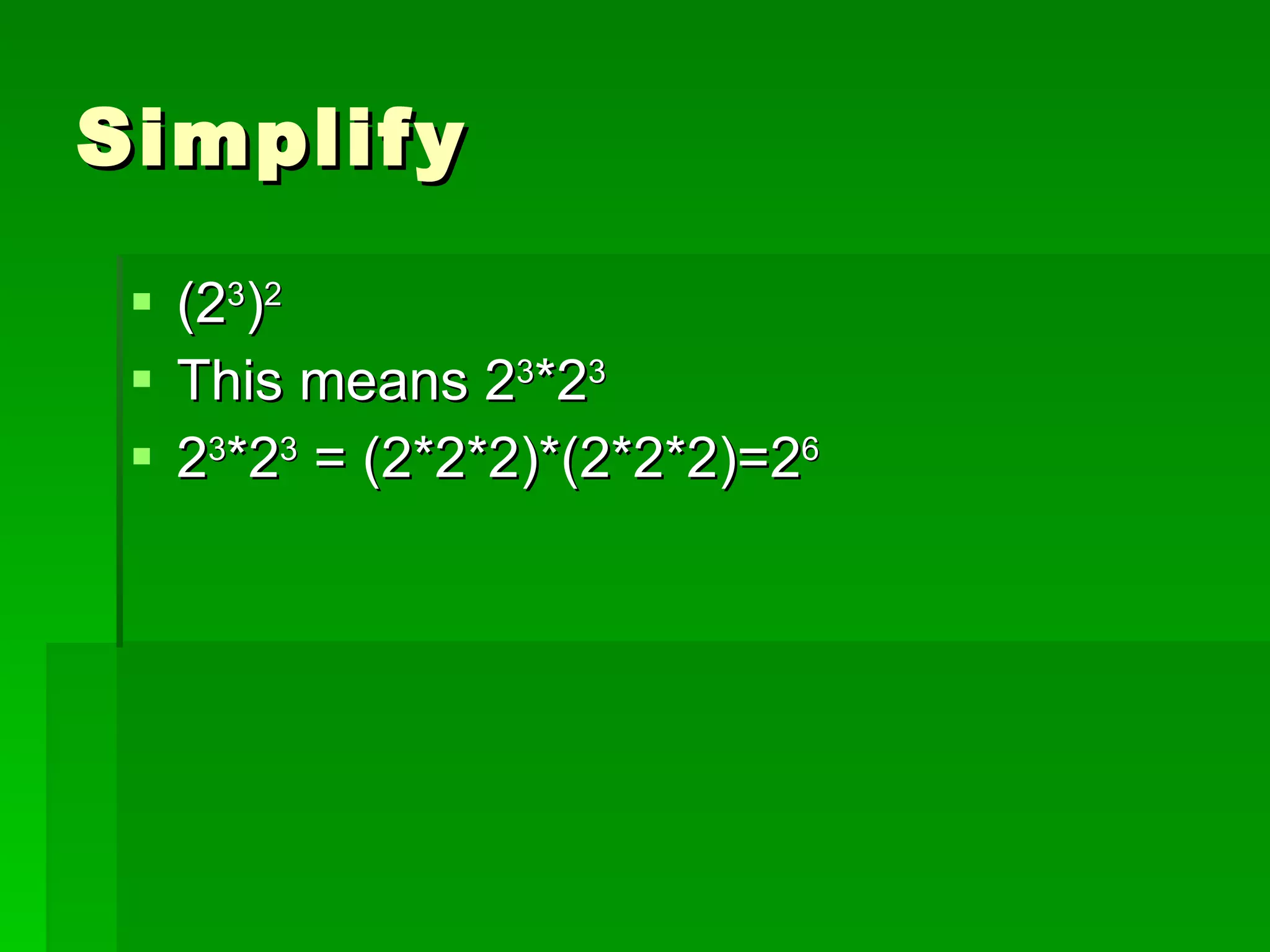
Simplify (2 3 ) 2 This means 2 3 *2 3  2 3 *2 3  = (2*2*2)*(2*2*2)=2 6
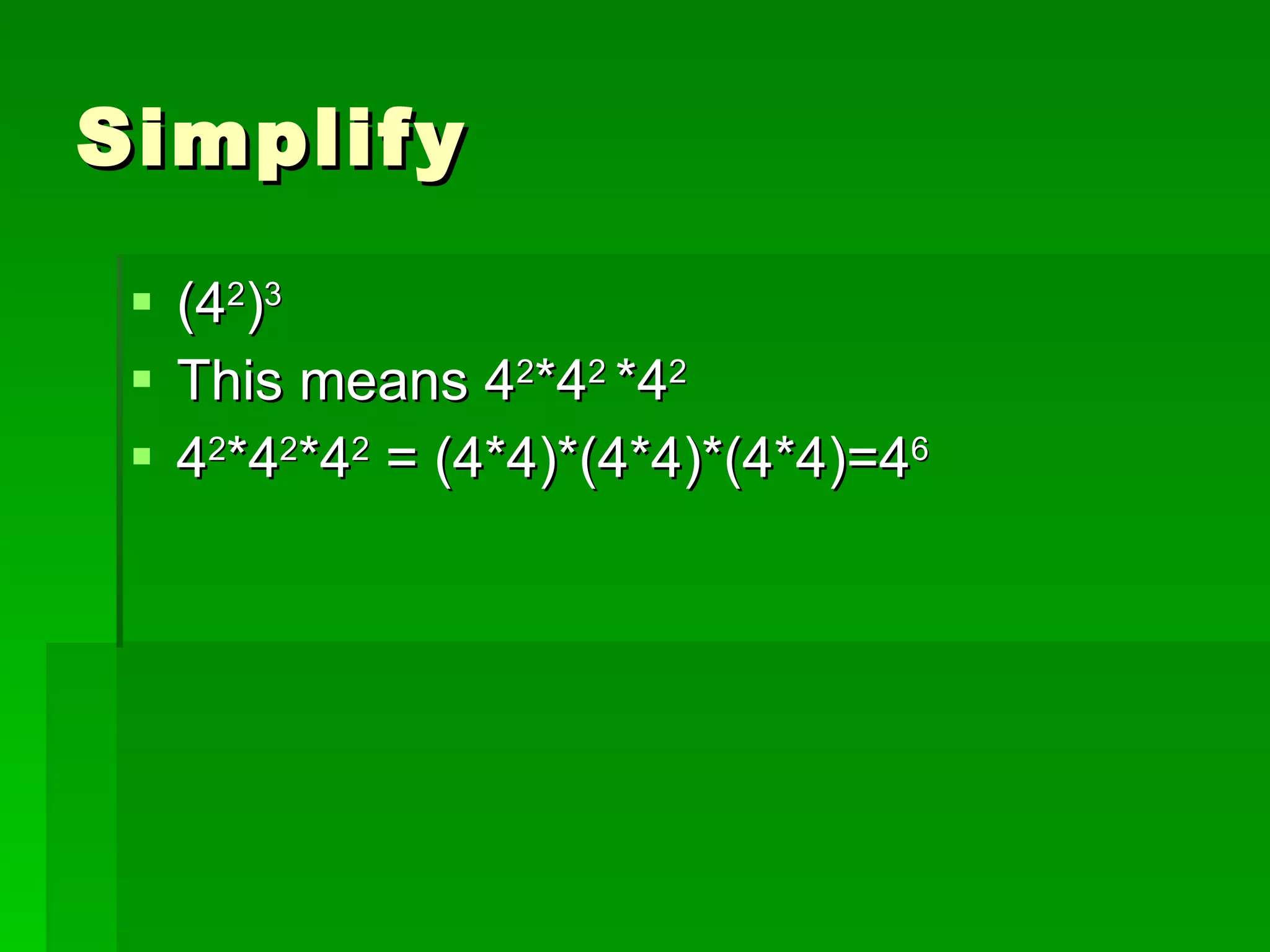
Simplify (4 2 ) 3 This means 4 2 *4 2  *4 2 4 2 *4 2 *4 2  = (4*4)*(4*4)*(4*4)=4 6
How does this work? Look again (4 2 ) 3  = 4 6 (2 3 ) 2  =2 6 How do the exponents 2 and 3 relate to the exponent 6?
Let’s look at some more (3 3)4  = (3*3*3)*(3*3*3)*(3*3*3)*(3*3*3) (3 3)4  =3 ?? 3 (3x4)  =  3 12 As you can see (3 3)4  shows 3 multiplied by itself 12 times. (3 3)4  = 3 (3*4) =3 12
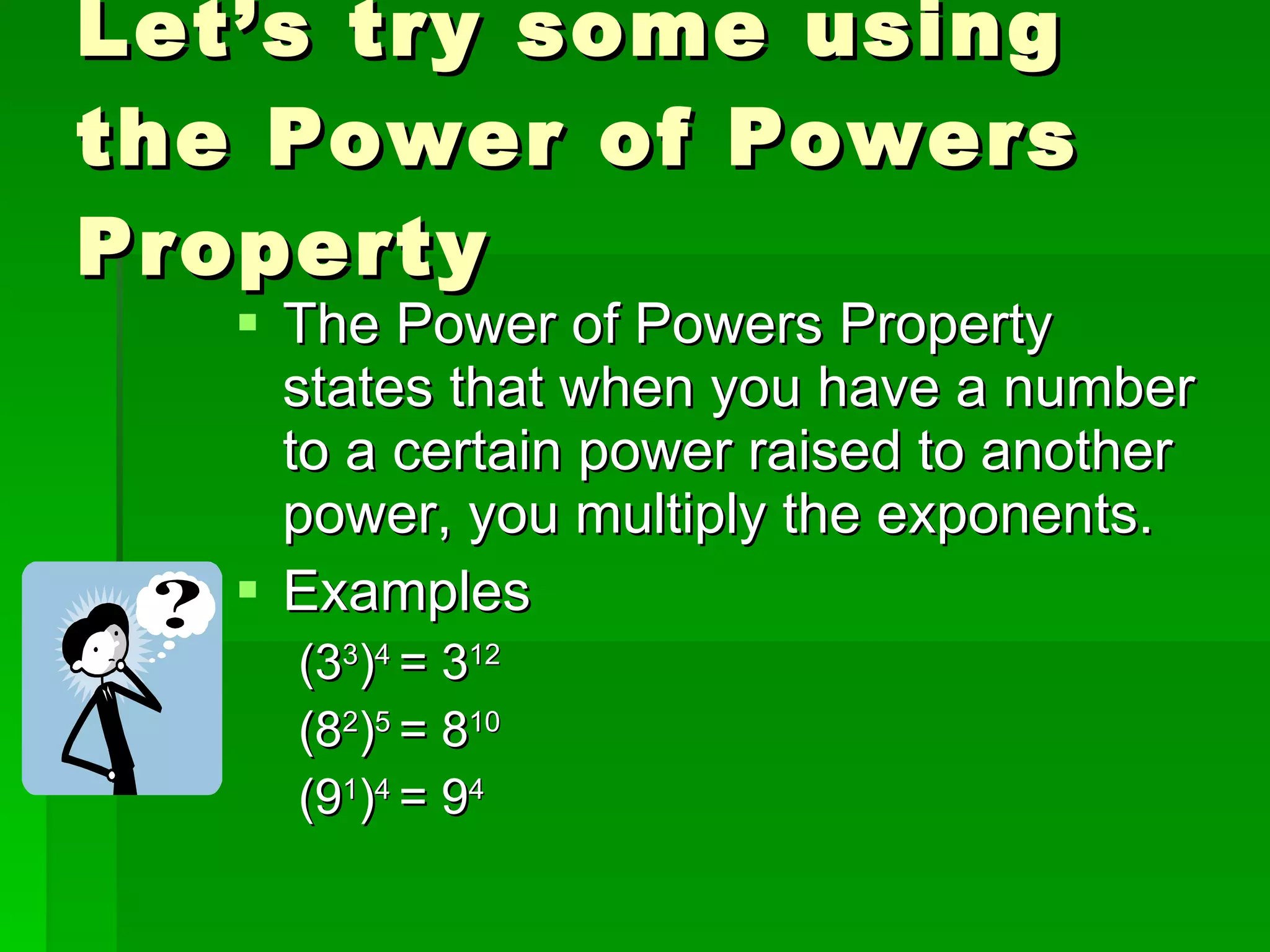
Let’s try some using the Power of Powers Property The Power of Powers Property states that when you have a number to a certain power raised to another power, you multiply the exponents. Examples (3 3 ) 4  = 3 12 (8 2 ) 5  = 8 10 (9 1 ) 4  = 9 4
Try some (2 3)4  = ? (10 3)2  = ? (p 2)5  = ? (x m)3  = ? Go to the next slide when you have the solutions to check your work.
Power of Powers (2 3)4  = 2 12 (10 3)2  = 10 6 (p 2)5  = p 10 (x m)3  = x 3m
Raise a monomial to a power (xy) 2   = xy*xy = x*x*y*y = x 2 y 2 (xy 2 ) 2= If you get stuck with powers of powers, try writing out the multiplication of numbers and variables. (x*y*y)* (x*y*y) = x*y*y*x*y*y = x*x*y*y*y*y = x 2 y 4
Try some (xy) 2  = ? (xy 2 ) 2  = ? (  r 2 ) 4  = ? Go to the next slide when you have the solutions to check your work.
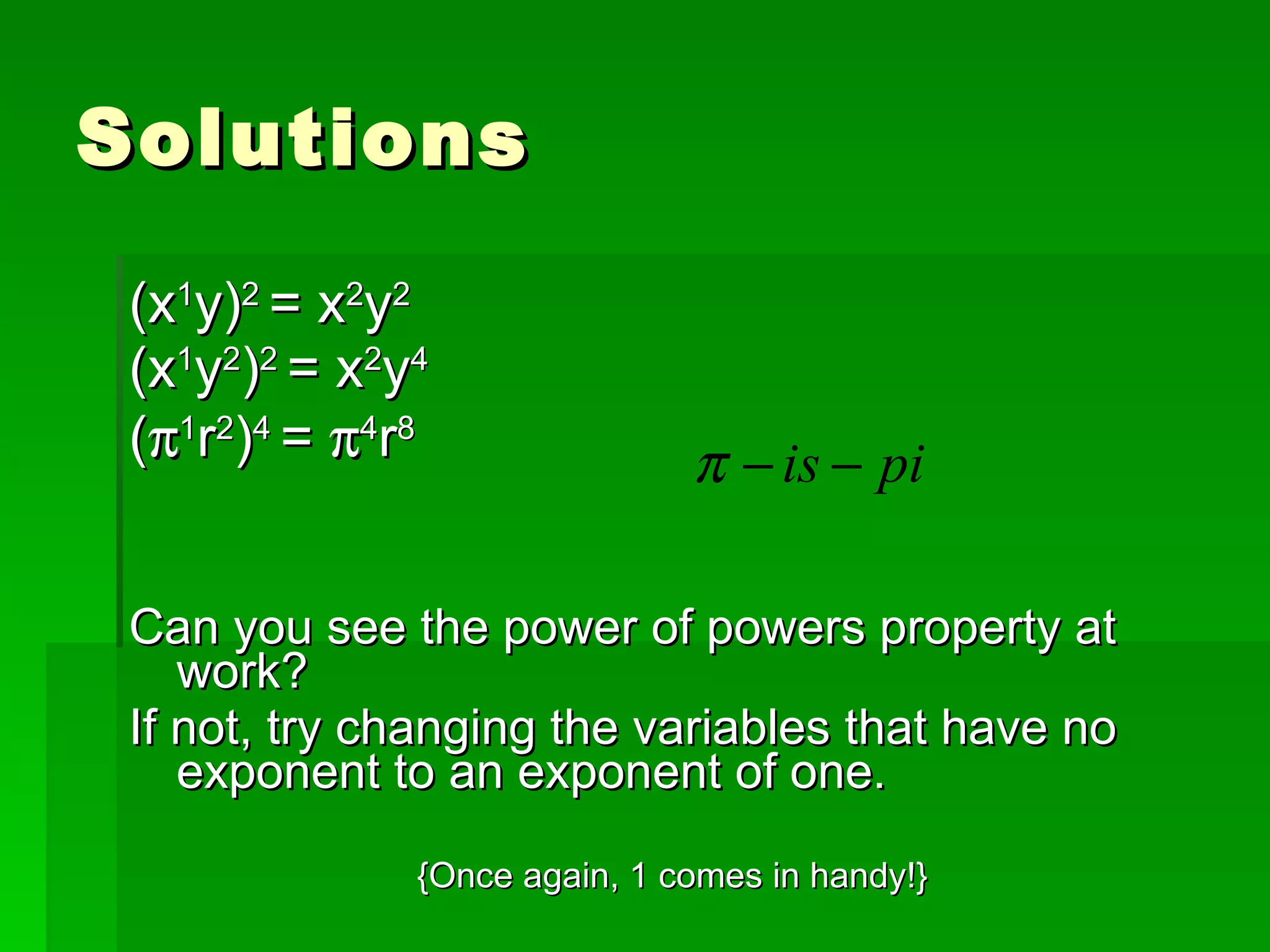
Solutions (x 1 y) 2  = x 2 y 2 (x 1 y 2 ) 2  = x 2 y 4 (  1 r 2 ) 4  =   4 r 8 Can you see the power of powers property at work? If not, try changing the variables that have no exponent to an exponent of one. {Once again, 1 comes in handy!}
Let’s take another look (xy) 2  =(x 1 y 1 ) 2  = x 2 y 2 (x 1 y 2 ) 2  = x 2 y 4 (  1 r 2 ) 4  =   4 r 8
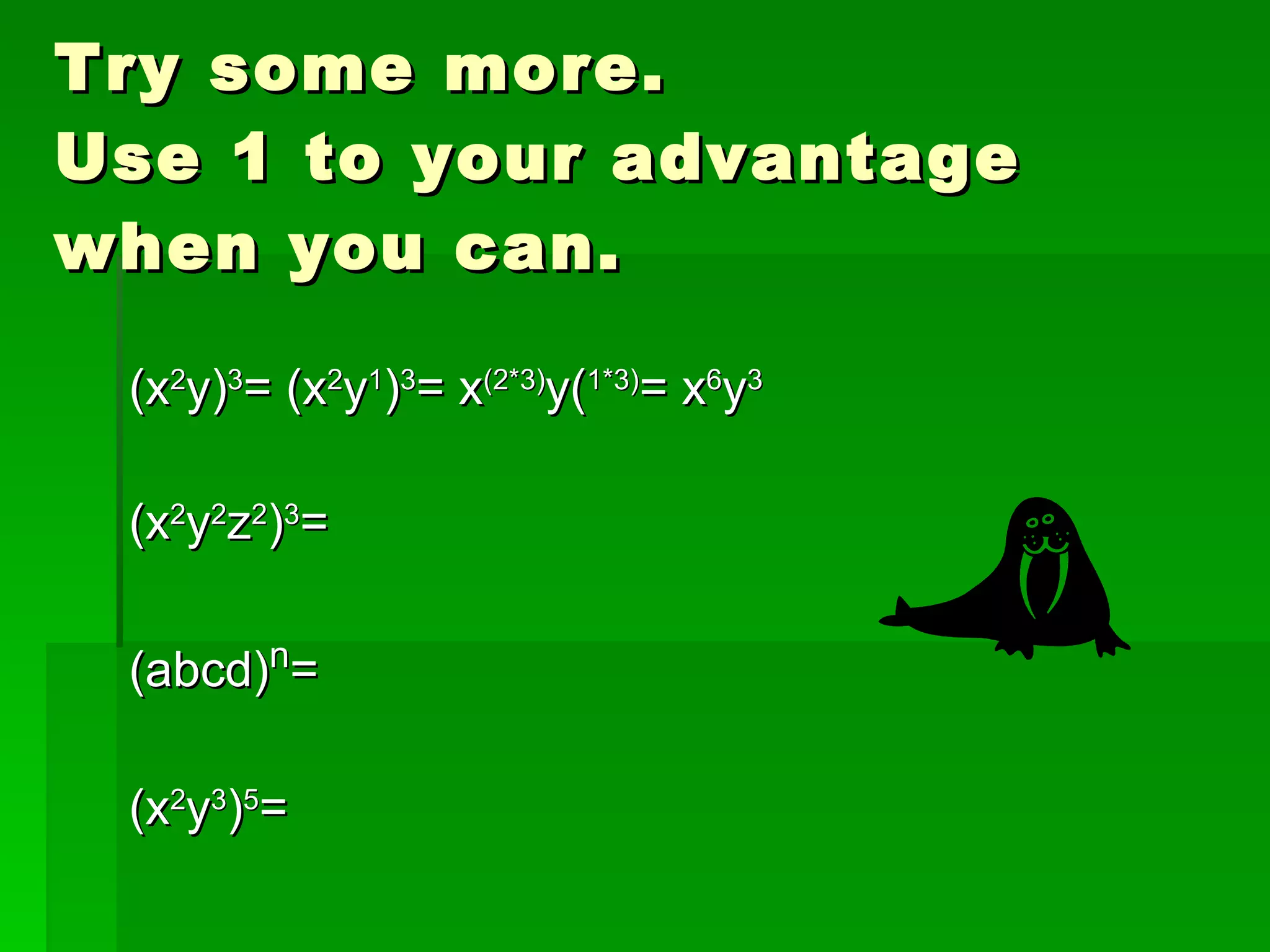
Try some more.  Use 1 to your advantage  when you can. (x 2 y) 3 = (x 2 y 1 ) 3 = x (2*3) y( 1*3) = x 6 y 3 (x 2 y 2 z 2 ) 3 = (abcd) n = (x 2 y 3 ) 5 =
Solutions (x 2 y 2 z 2 ) 3 =x 2*3 y 2*3 z 2*3 =x 6 y 6 z 6 (abcd) n =a n b n c n d n (x 2 y 3 ) 5 =x 2*5 y 3*5 =  x 10 y 15
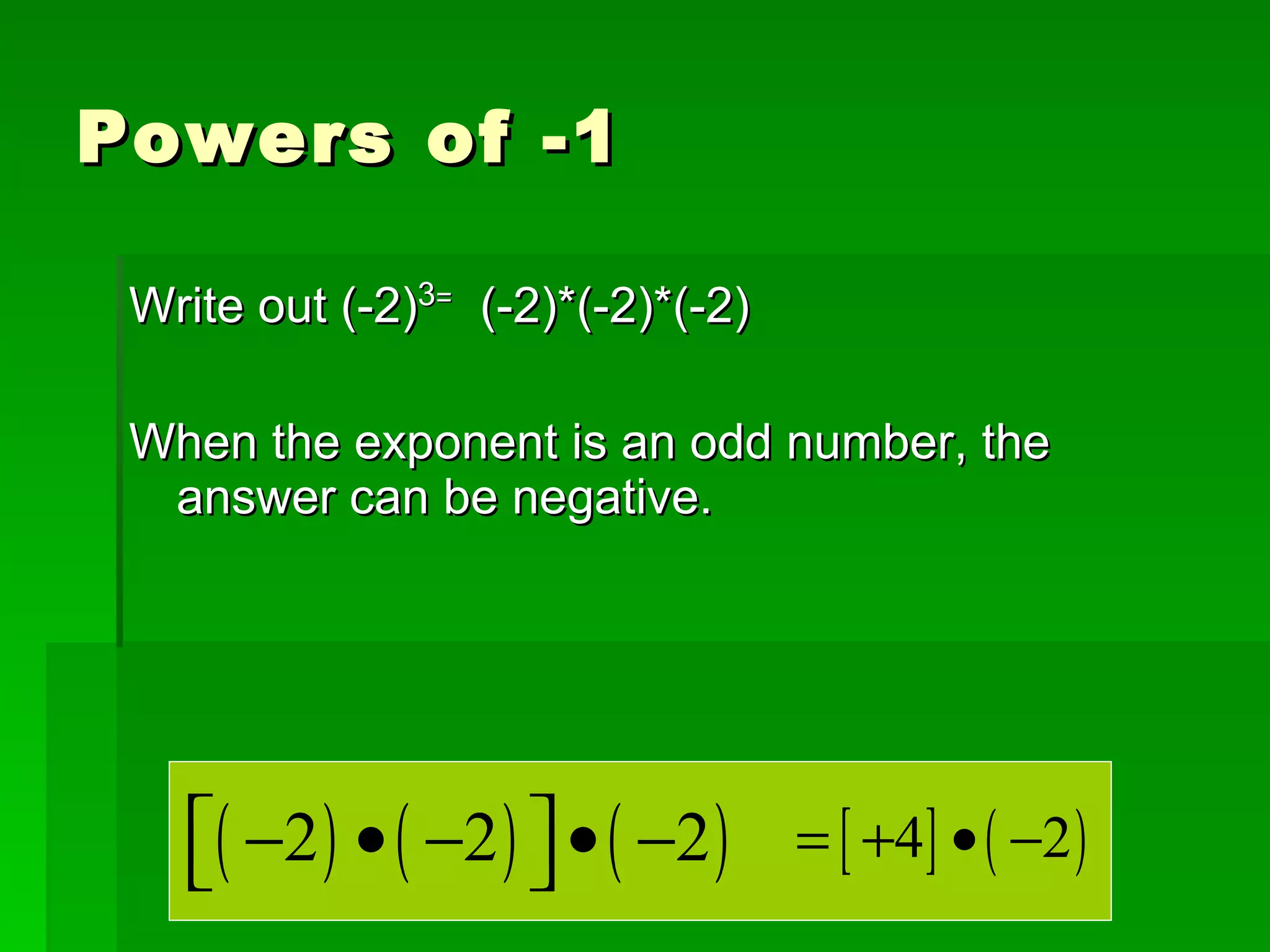
Powers of -1 Write out (-2) 3 =   (-2)*(-2)*(-2) When the exponent is an odd number, the answer can be negative.
Suggestion Once again, the suggestion is to write out the multiplication statements to help you solve tricky exponential products.
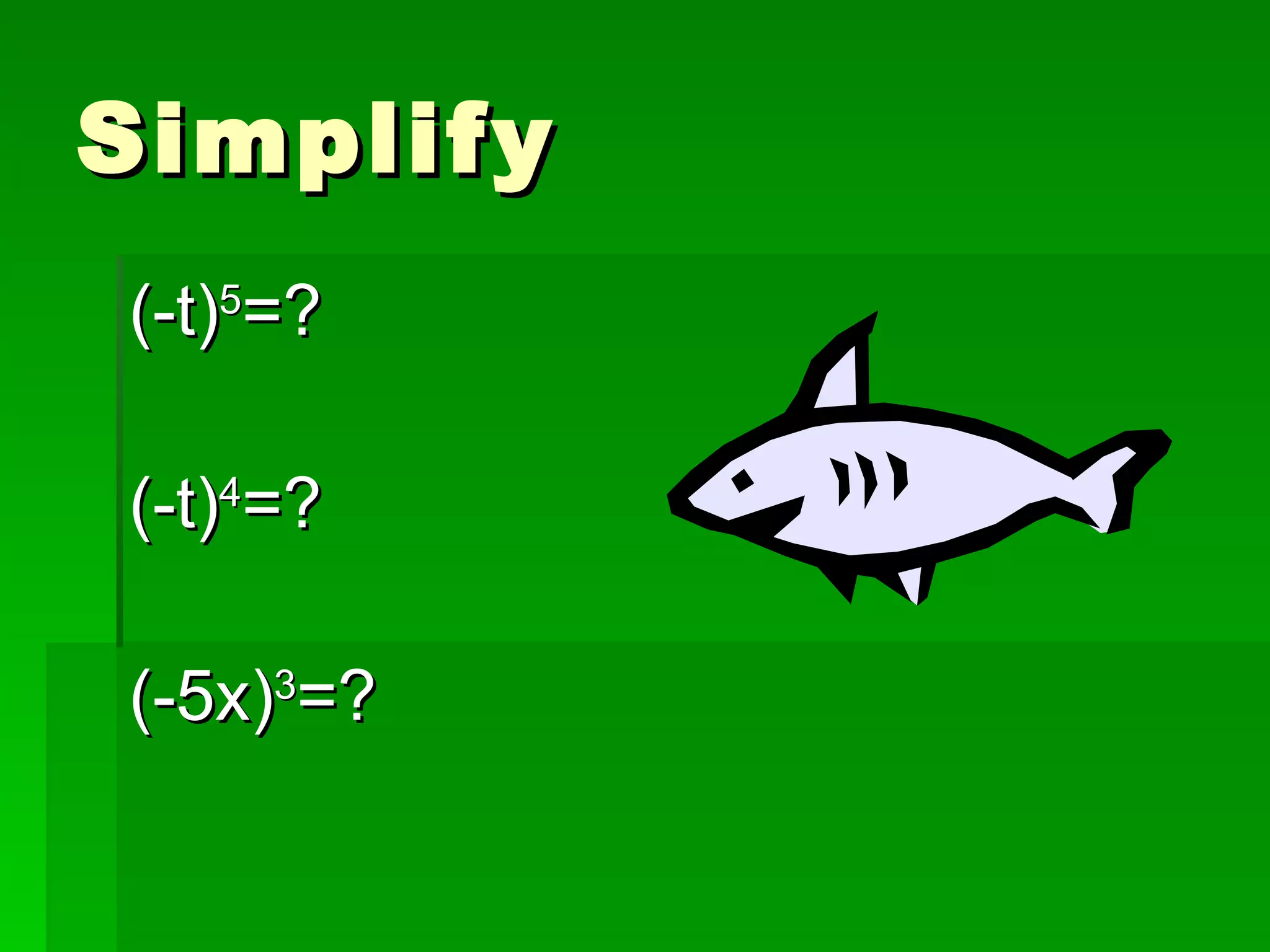
Simplify (-t) 5 =? (-t) 4 =? (-5x) 3 =?
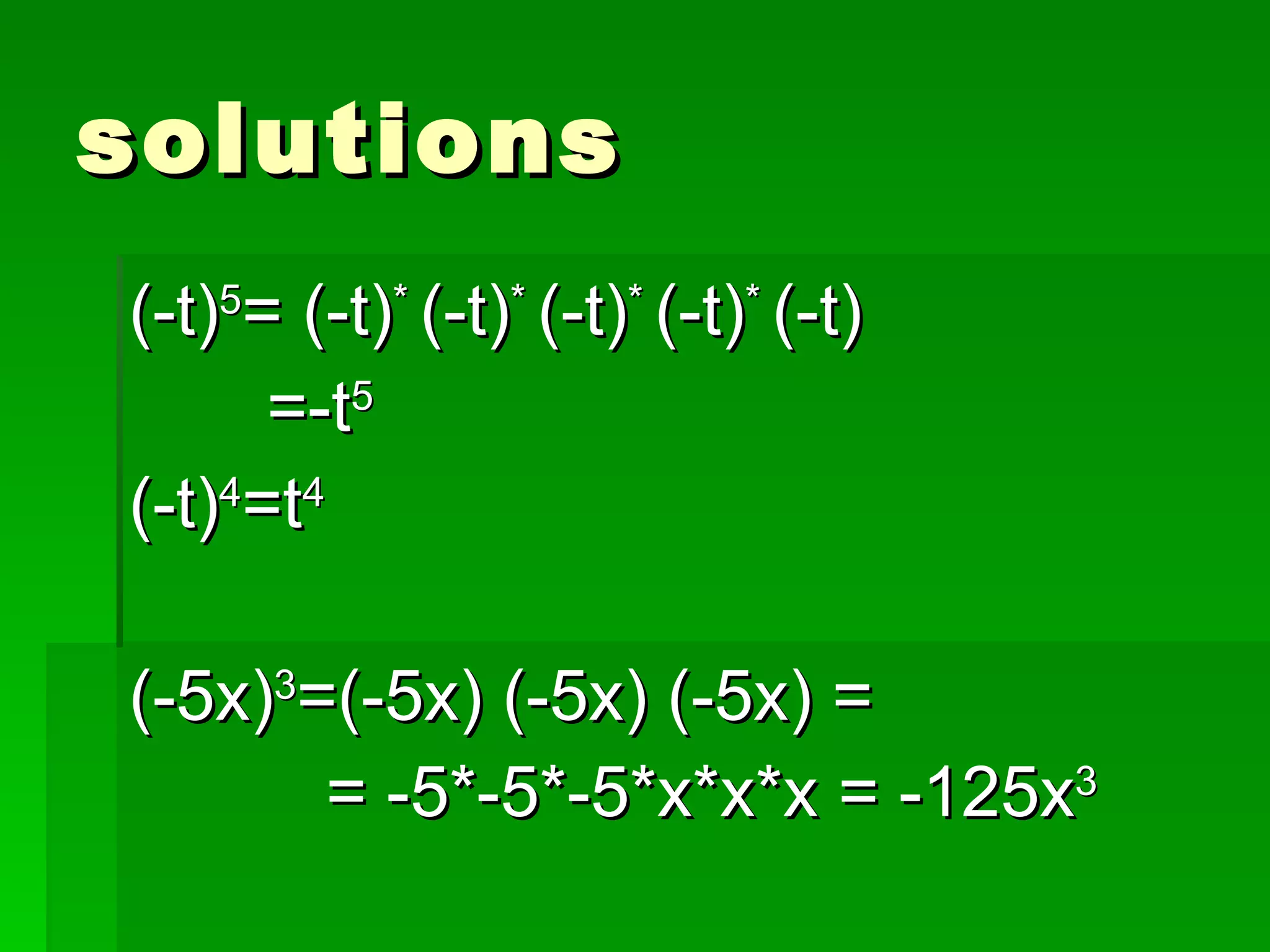
solutions (-t) 5 = (-t) *  (-t) *  (-t) *  (-t) *  (-t) =-t 5 (-t) 4 =t 4 (-5x) 3 =(-5x) (-5x) (-5x) =  = -5*-5*-5*x*x*x = -125x 3
Negative and Zero Exponents Integrated II  Chapter 9.2
Negative Integers do NOT mean negative numbers
Numbers to the Zero Power Every number to the Zero Power, such as 5 0  = 1. We can use last lesson’s division of powers as a proof.
Using division to prove Any number divided by itself equals 1. Using the Quotient of Powers Property, the exponents would be subtracted. 6 5-5  = 6 0  = 1
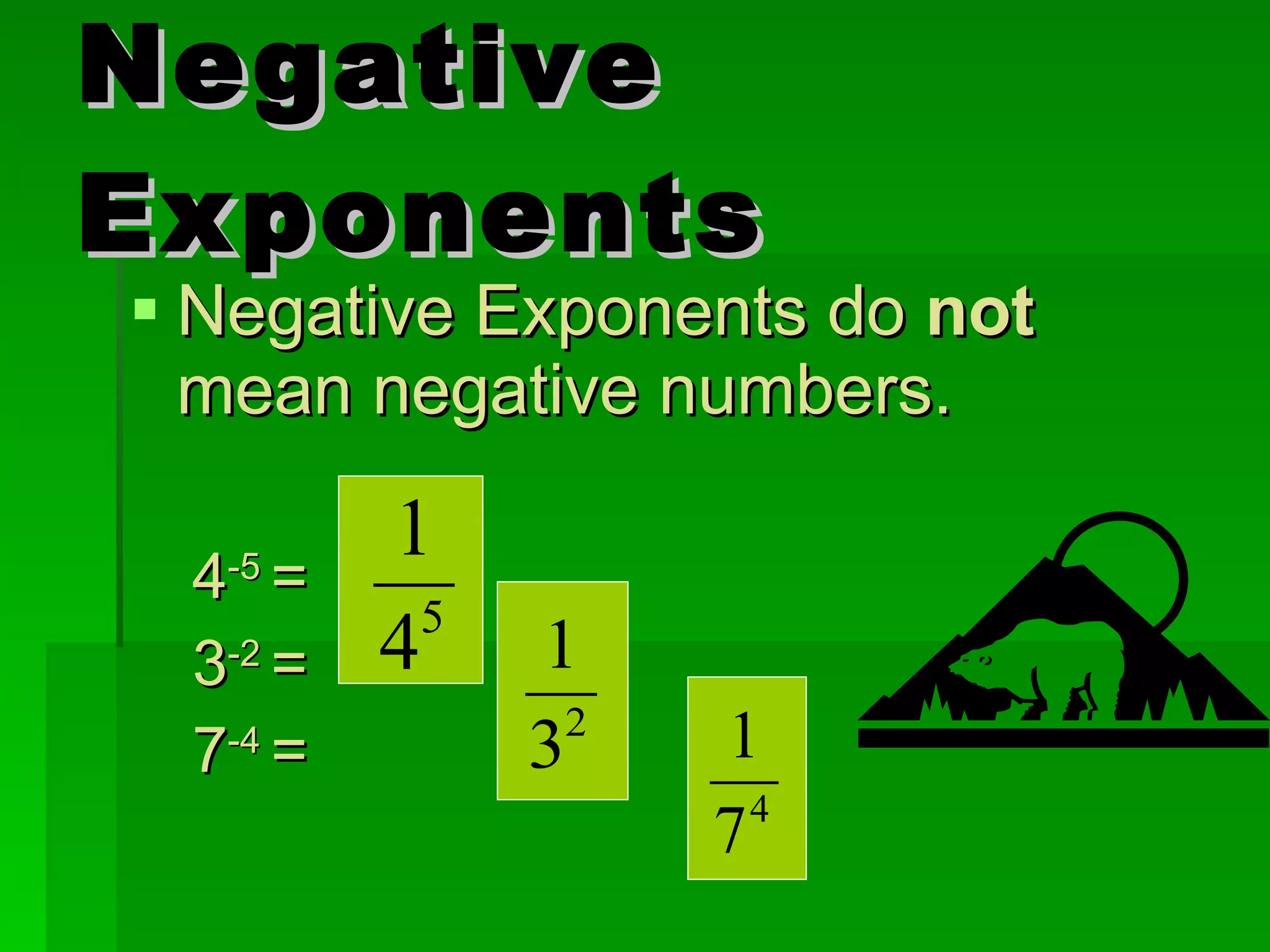
Negative Exponents Negative Exponents do  not  mean negative numbers. 4 -5  = 3 -2  = 7 -4  =
Solve.
Simplify. b 6 *b -2   =b 4   = 1 b 4   b 4 -3y -2 -6p -7 8a 4 b 7 c -4 3a 6 b -6 c -4
Simplify. - 3y -2  =  -3 y 2 -6p -7  =  -6 p 7 8a 4 b 7 c -4  =  8  a 4-6 b 7--6 c -4--4  =  8   b 13  3a 6 b -6 c -4  3  3 a 2 ** (c 0 =1 which when multiplied is no longer part of the answer.
 
Let’s Divide! Dividing Monomials Focus: Quotient of Powers Rule
Quotients of Powers How do I find   ? a*a*a*a*a*a   = a*a*a*a a 2 1  =  a 2 a*a*a*a*a*a   = a*a*a*a
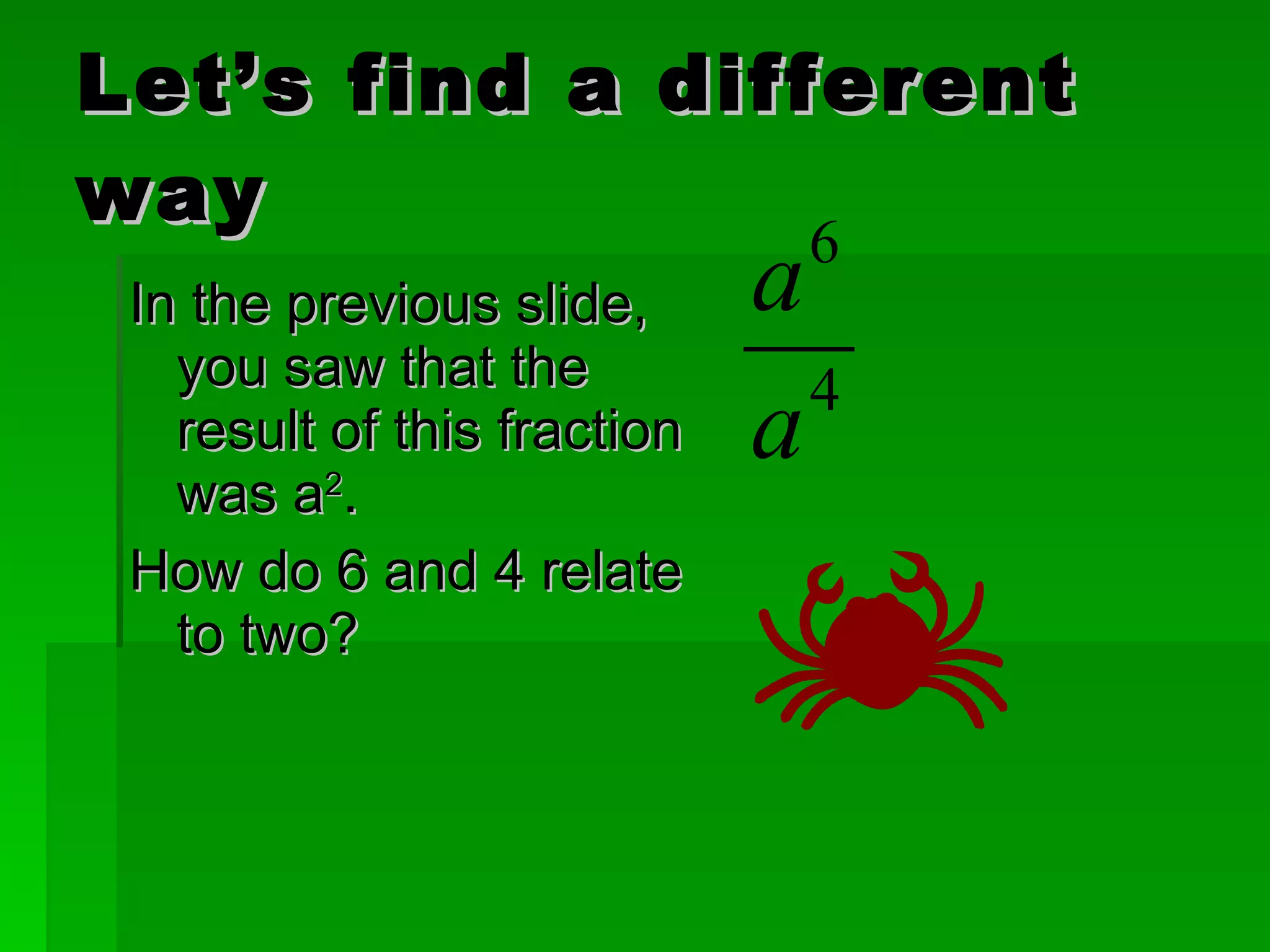
Let’s find a different way In the previous slide, you saw that the result of this fraction was a 2 .  How do 6 and 4 relate to two?
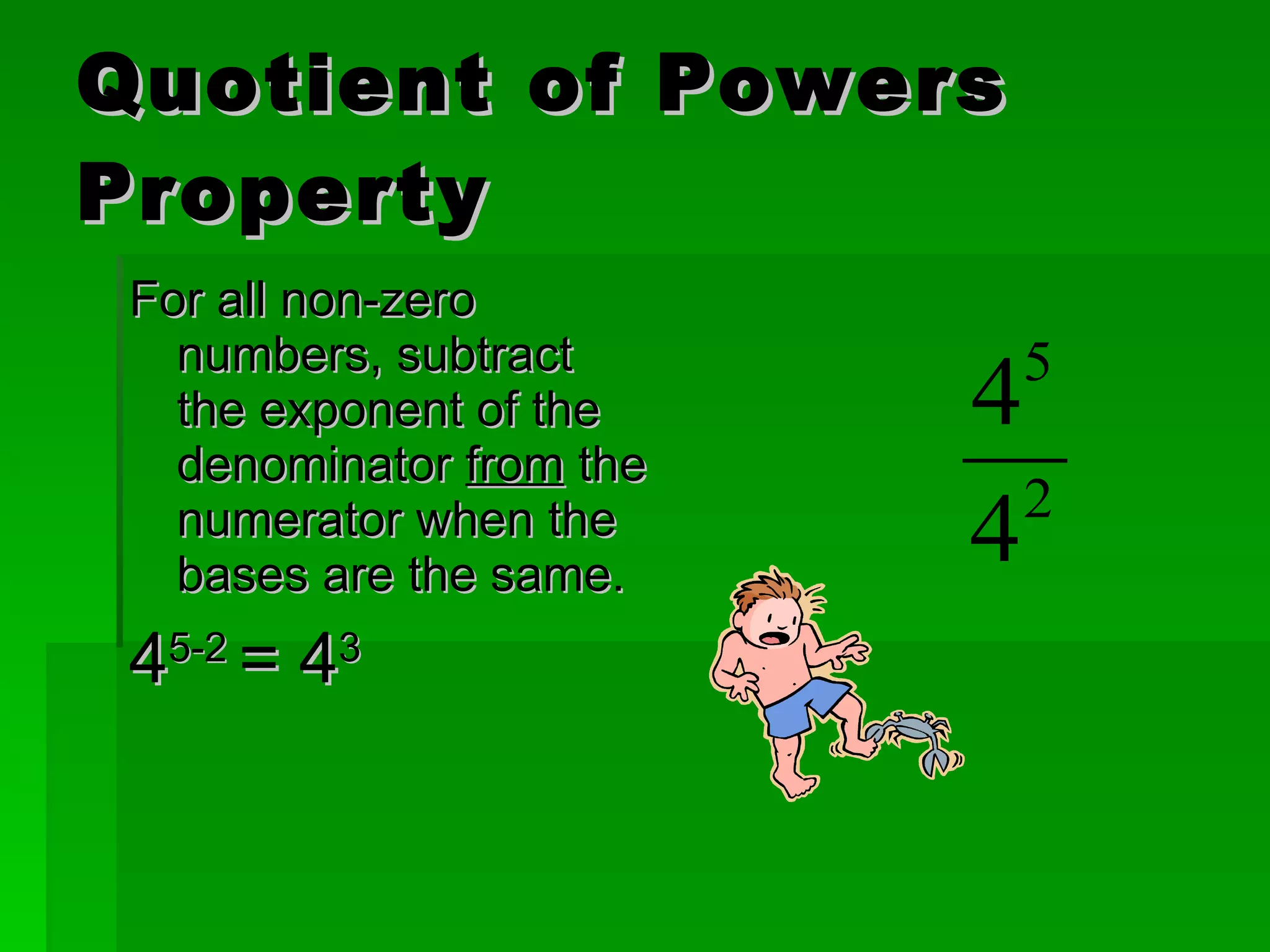
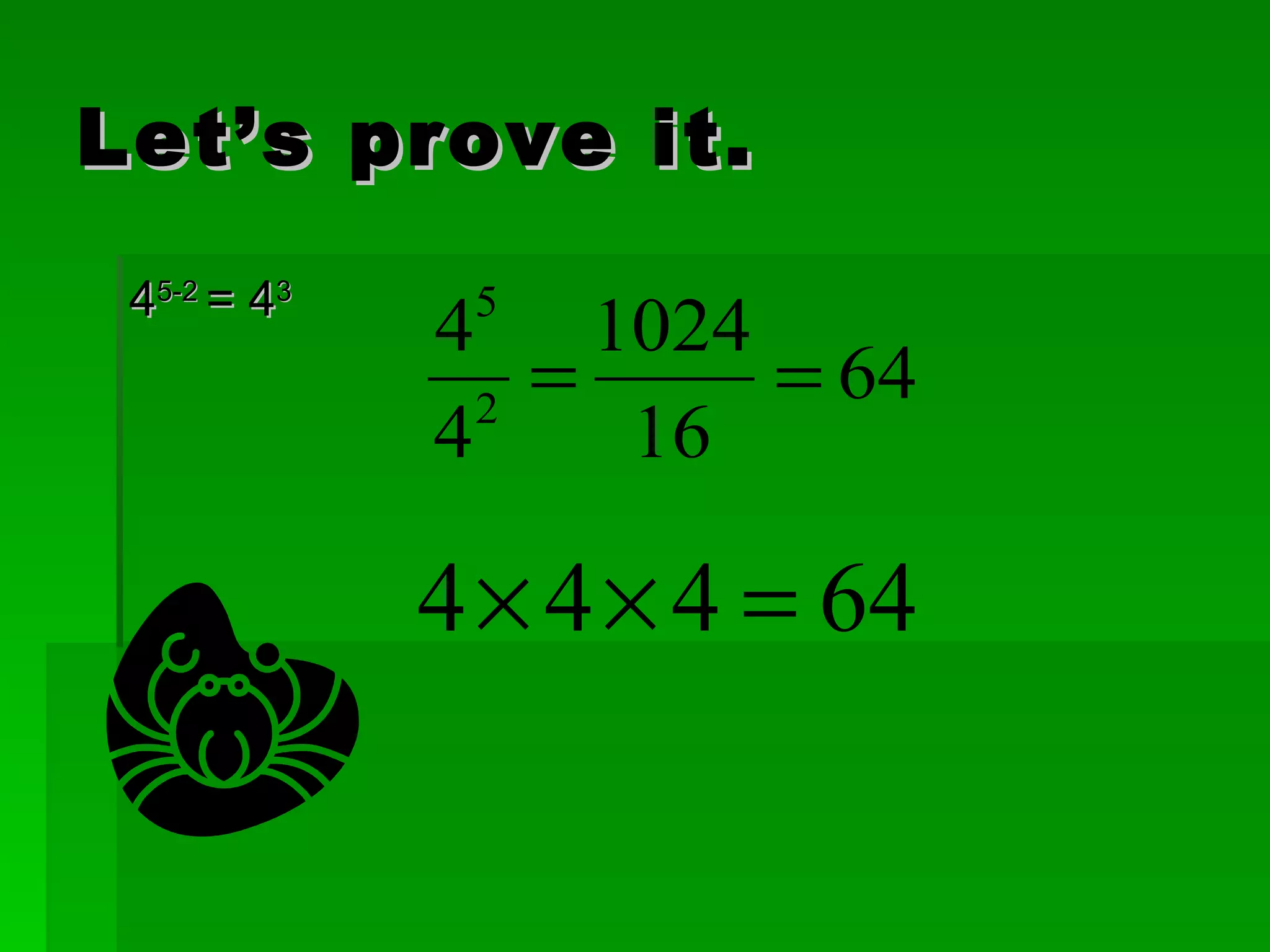
Quotient of Powers Property For all non-zero numbers, subtract the exponent of the denominator  from  the numerator when the bases are the same. 4 5-2  = 4 3
Let’s prove it. 4 5-2  = 4 3
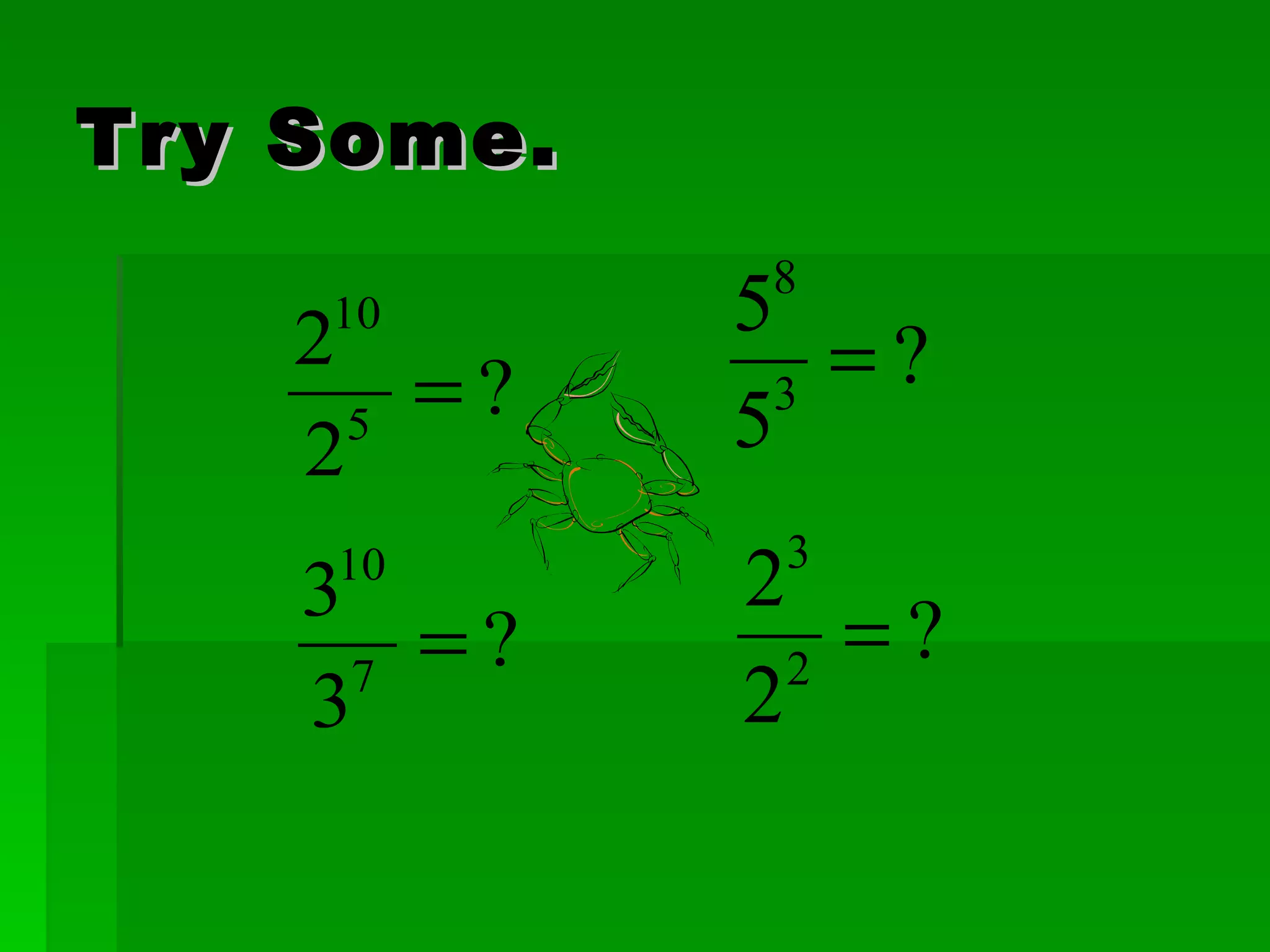
Try Some.
Solutions 2 10-5  = 2 5 3 10-7  = 3 3 5 8-3  = 5 5 2 3-2  = 2 1= 2
Try Some with variables. x j-1  x a+b-c x m+1-1  = x m
Fun Fun Fun
Fun Fun Fun -2x 2-1 y 5-3 =-2xy 2 -40a 4-1 b2c -5 = -40a 3 b 2 c 5
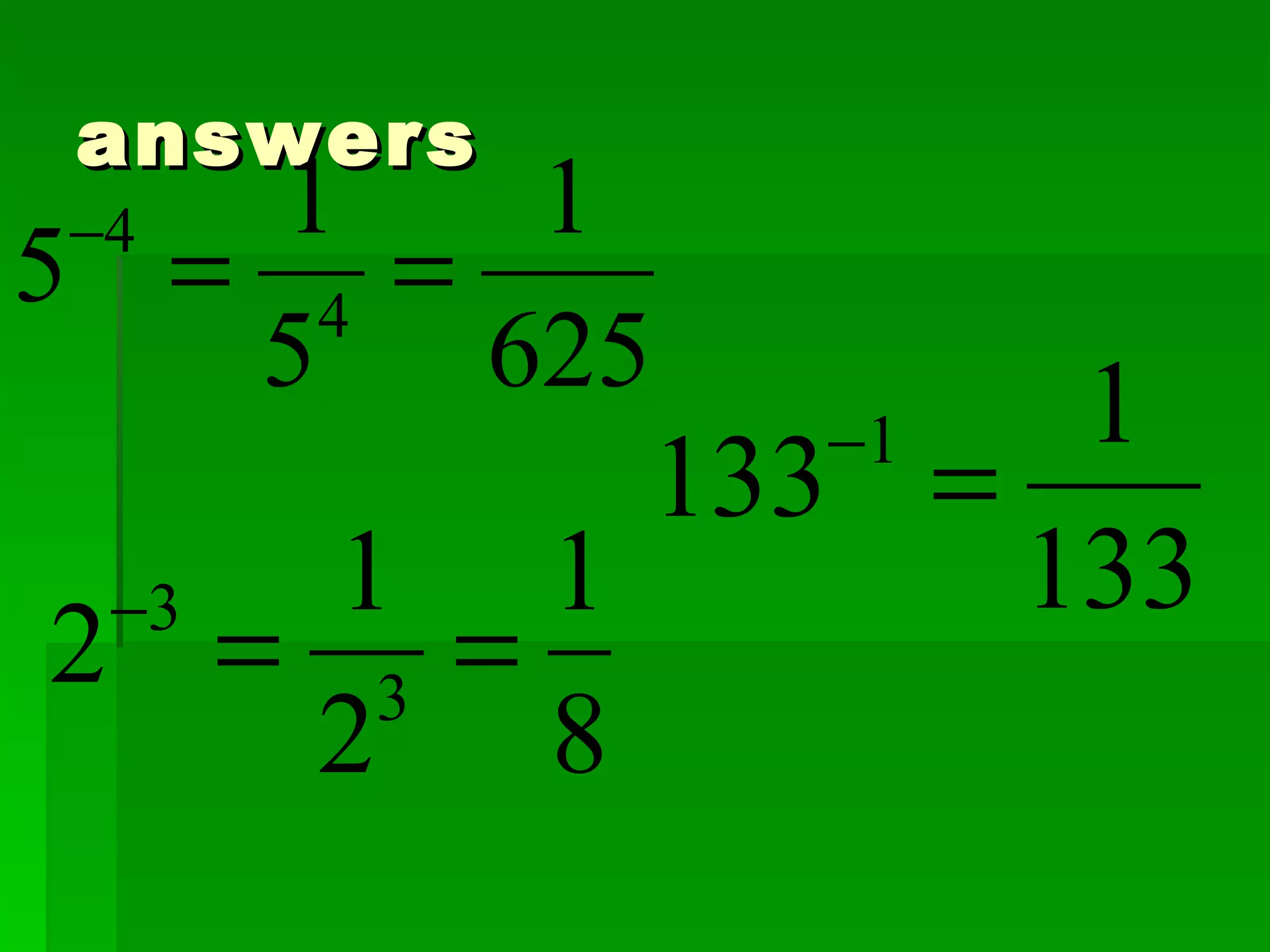
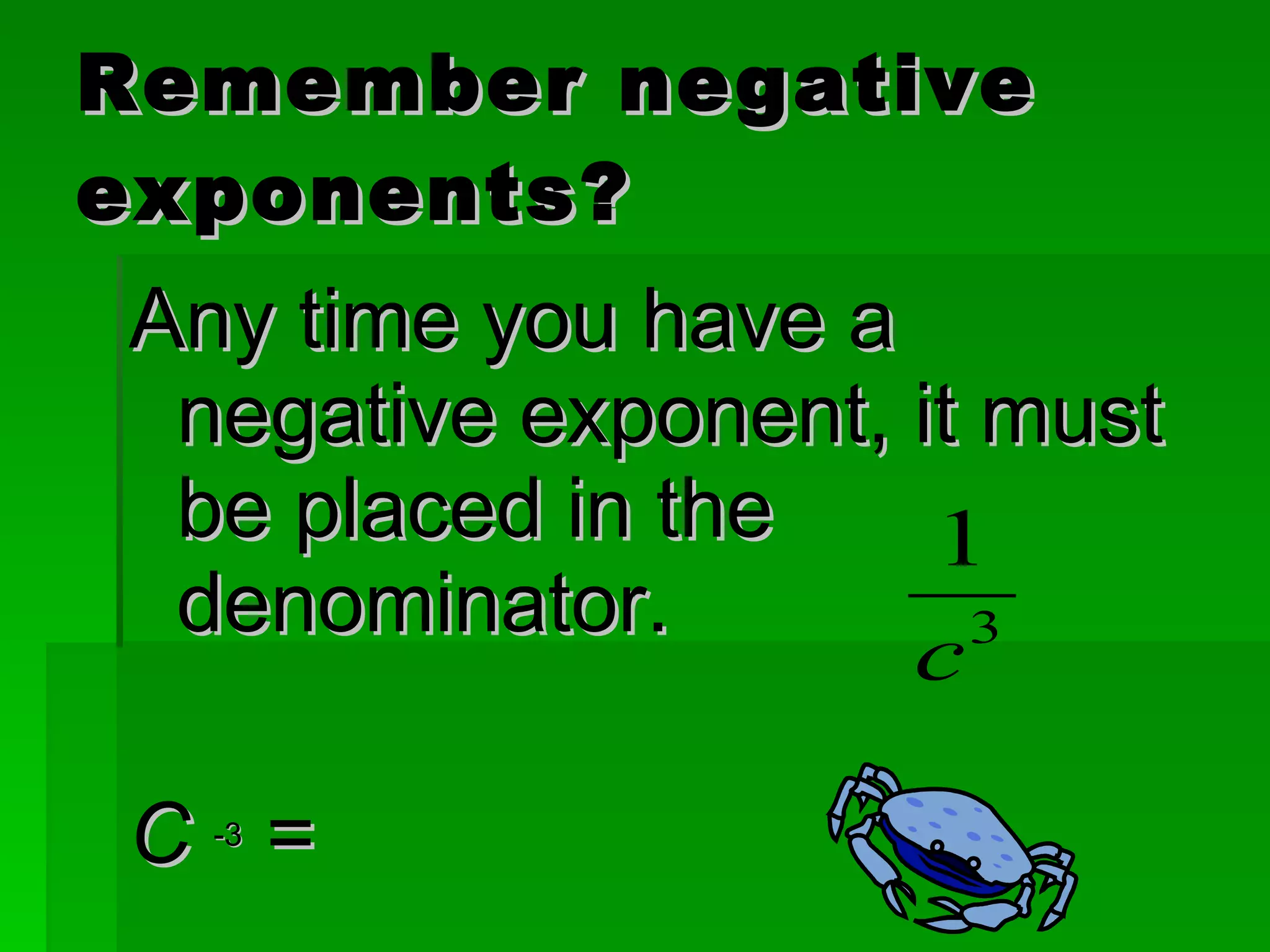
Remember negative exponents? Any time you have a negative exponent, it must be placed in the denominator. C  -3  =
Try Some
answers
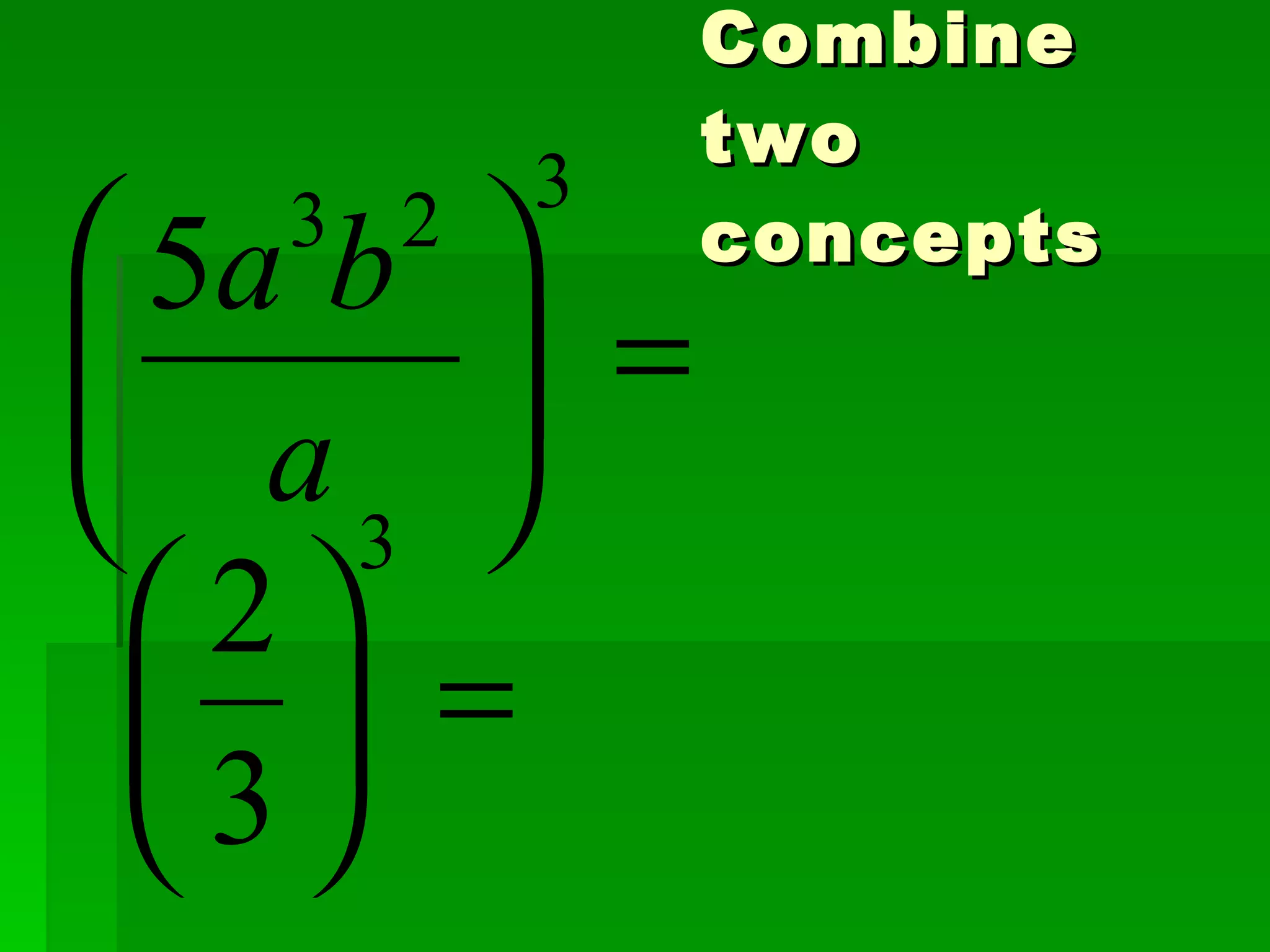
Combine two concepts
Combine two concepts (answers)
 
Thanks for enjoying math! Nothing will be due for today’s work.

9 2power Of Power

  • 1.
    Power of aPower Finding powers of numbers with exponents (x m ) n = x mn
  • 2.
    Simplify (2 3) 2 This means 2 3 *2 3 2 3 *2 3 = (2*2*2)*(2*2*2)=2 6
  • 3.
    Simplify (4 2) 3 This means 4 2 *4 2 *4 2 4 2 *4 2 *4 2 = (4*4)*(4*4)*(4*4)=4 6
  • 4.
    How does thiswork? Look again (4 2 ) 3 = 4 6 (2 3 ) 2 =2 6 How do the exponents 2 and 3 relate to the exponent 6?
  • 5.
    Let’s look atsome more (3 3)4 = (3*3*3)*(3*3*3)*(3*3*3)*(3*3*3) (3 3)4 =3 ?? 3 (3x4) = 3 12 As you can see (3 3)4 shows 3 multiplied by itself 12 times. (3 3)4 = 3 (3*4) =3 12
  • 6.
    Let’s try someusing the Power of Powers Property The Power of Powers Property states that when you have a number to a certain power raised to another power, you multiply the exponents. Examples (3 3 ) 4 = 3 12 (8 2 ) 5 = 8 10 (9 1 ) 4 = 9 4
  • 7.
    Try some (23)4 = ? (10 3)2 = ? (p 2)5 = ? (x m)3 = ? Go to the next slide when you have the solutions to check your work.
  • 8.
    Power of Powers(2 3)4 = 2 12 (10 3)2 = 10 6 (p 2)5 = p 10 (x m)3 = x 3m
  • 9.
    Raise a monomialto a power (xy) 2 = xy*xy = x*x*y*y = x 2 y 2 (xy 2 ) 2= If you get stuck with powers of powers, try writing out the multiplication of numbers and variables. (x*y*y)* (x*y*y) = x*y*y*x*y*y = x*x*y*y*y*y = x 2 y 4
  • 10.
    Try some (xy)2 = ? (xy 2 ) 2 = ? (  r 2 ) 4 = ? Go to the next slide when you have the solutions to check your work.
  • 11.
    Solutions (x 1y) 2 = x 2 y 2 (x 1 y 2 ) 2 = x 2 y 4 (  1 r 2 ) 4 =  4 r 8 Can you see the power of powers property at work? If not, try changing the variables that have no exponent to an exponent of one. {Once again, 1 comes in handy!}
  • 12.
    Let’s take anotherlook (xy) 2 =(x 1 y 1 ) 2 = x 2 y 2 (x 1 y 2 ) 2 = x 2 y 4 (  1 r 2 ) 4 =  4 r 8
  • 13.
    Try some more. Use 1 to your advantage when you can. (x 2 y) 3 = (x 2 y 1 ) 3 = x (2*3) y( 1*3) = x 6 y 3 (x 2 y 2 z 2 ) 3 = (abcd) n = (x 2 y 3 ) 5 =
  • 14.
    Solutions (x 2y 2 z 2 ) 3 =x 2*3 y 2*3 z 2*3 =x 6 y 6 z 6 (abcd) n =a n b n c n d n (x 2 y 3 ) 5 =x 2*5 y 3*5 = x 10 y 15
  • 15.
    Powers of -1Write out (-2) 3 = (-2)*(-2)*(-2) When the exponent is an odd number, the answer can be negative.
  • 16.
    Suggestion Once again,the suggestion is to write out the multiplication statements to help you solve tricky exponential products.
  • 17.
    Simplify (-t) 5=? (-t) 4 =? (-5x) 3 =?
  • 18.
    solutions (-t) 5= (-t) * (-t) * (-t) * (-t) * (-t) =-t 5 (-t) 4 =t 4 (-5x) 3 =(-5x) (-5x) (-5x) = = -5*-5*-5*x*x*x = -125x 3
  • 19.
    Negative and ZeroExponents Integrated II Chapter 9.2
  • 20.
    Negative Integers doNOT mean negative numbers
  • 21.
    Numbers to theZero Power Every number to the Zero Power, such as 5 0 = 1. We can use last lesson’s division of powers as a proof.
  • 22.
    Using division toprove Any number divided by itself equals 1. Using the Quotient of Powers Property, the exponents would be subtracted. 6 5-5 = 6 0 = 1
  • 23.
    Negative Exponents NegativeExponents do not mean negative numbers. 4 -5 = 3 -2 = 7 -4 =
  • 24.
  • 25.
    Simplify. b 6*b -2 =b 4 = 1 b 4 b 4 -3y -2 -6p -7 8a 4 b 7 c -4 3a 6 b -6 c -4
  • 26.
    Simplify. - 3y-2 = -3 y 2 -6p -7 = -6 p 7 8a 4 b 7 c -4 = 8 a 4-6 b 7--6 c -4--4 = 8 b 13 3a 6 b -6 c -4 3 3 a 2 ** (c 0 =1 which when multiplied is no longer part of the answer.
  • 27.
  • 28.
    Let’s Divide! DividingMonomials Focus: Quotient of Powers Rule
  • 29.
    Quotients of PowersHow do I find ? a*a*a*a*a*a = a*a*a*a a 2 1 = a 2 a*a*a*a*a*a = a*a*a*a
  • 30.
    Let’s find adifferent way In the previous slide, you saw that the result of this fraction was a 2 . How do 6 and 4 relate to two?
  • 31.
    Quotient of PowersProperty For all non-zero numbers, subtract the exponent of the denominator from the numerator when the bases are the same. 4 5-2 = 4 3
  • 32.
    Let’s prove it.4 5-2 = 4 3
  • 33.
  • 34.
    Solutions 2 10-5 = 2 5 3 10-7 = 3 3 5 8-3 = 5 5 2 3-2 = 2 1= 2
  • 35.
    Try Some withvariables. x j-1 x a+b-c x m+1-1 = x m
  • 36.
  • 37.
    Fun Fun Fun-2x 2-1 y 5-3 =-2xy 2 -40a 4-1 b2c -5 = -40a 3 b 2 c 5
  • 38.
    Remember negative exponents?Any time you have a negative exponent, it must be placed in the denominator. C -3 =
  • 39.
  • 40.
  • 41.
  • 42.
  • 43.
  • 44.
    Thanks for enjoyingmath! Nothing will be due for today’s work.