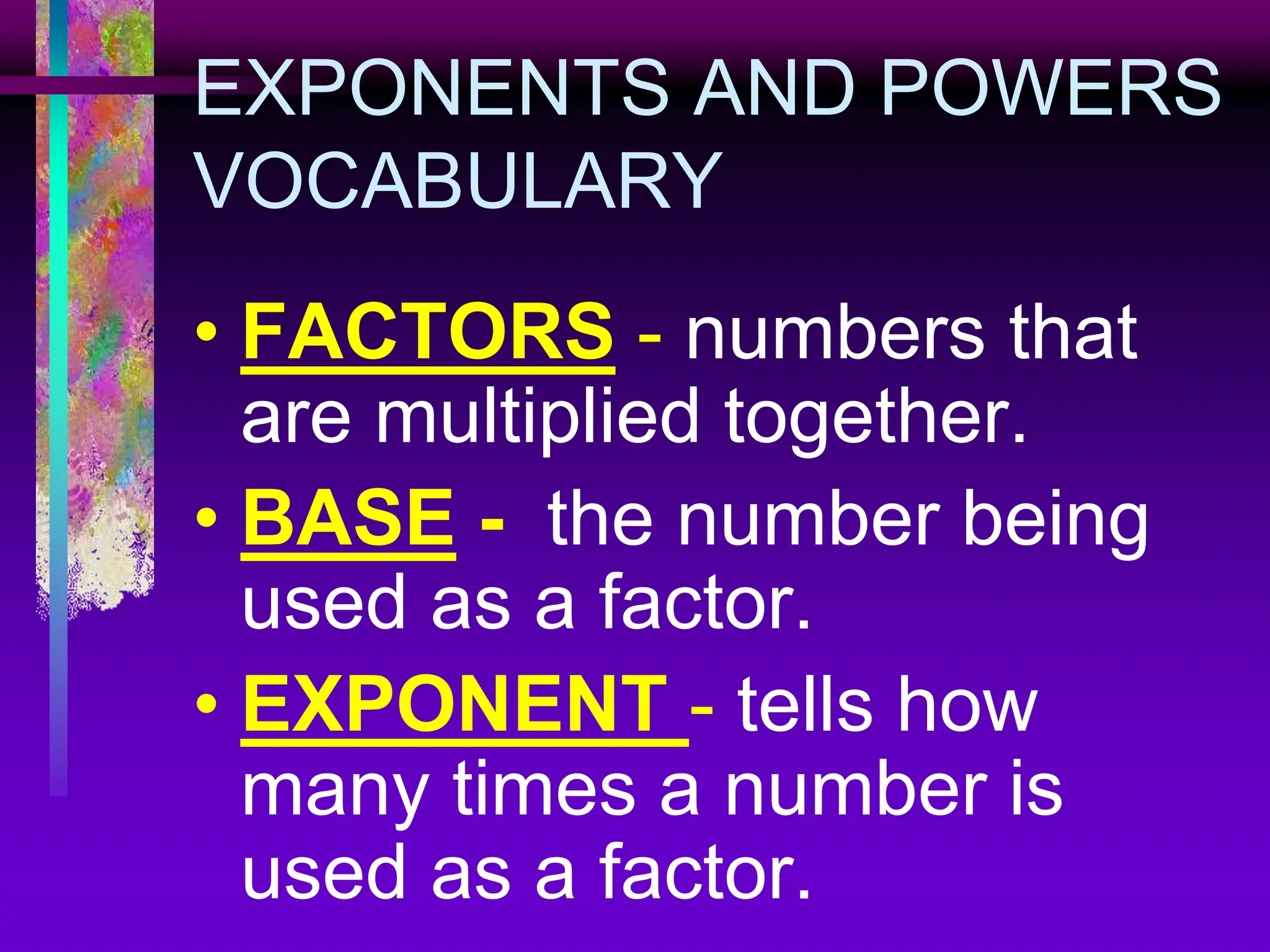
EXPONENTS AND POWERS
VOCABULARY
• FACTORS - numbers that
are multiplied together.
• BASE - the number being
used as a factor.
• EXPONENT - tells how
many times a number is
used as a factor.
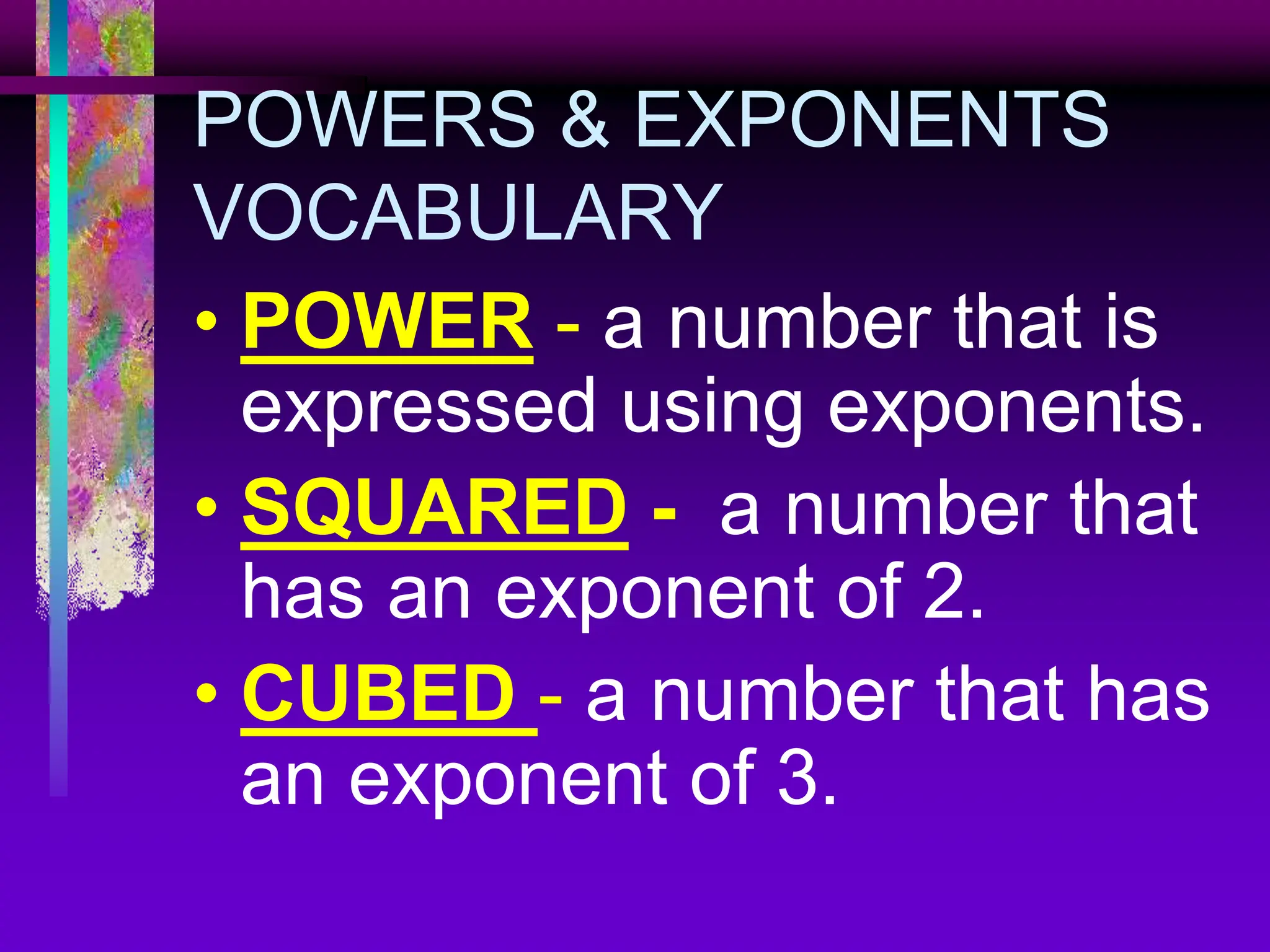
POWERS & EXPONENTS
VOCABULARY
• POWER - a number that is
expressed using exponents.
• SQUARED - a number that
has an exponent of 2.
• CUBED - a number that has
an exponent of 3.
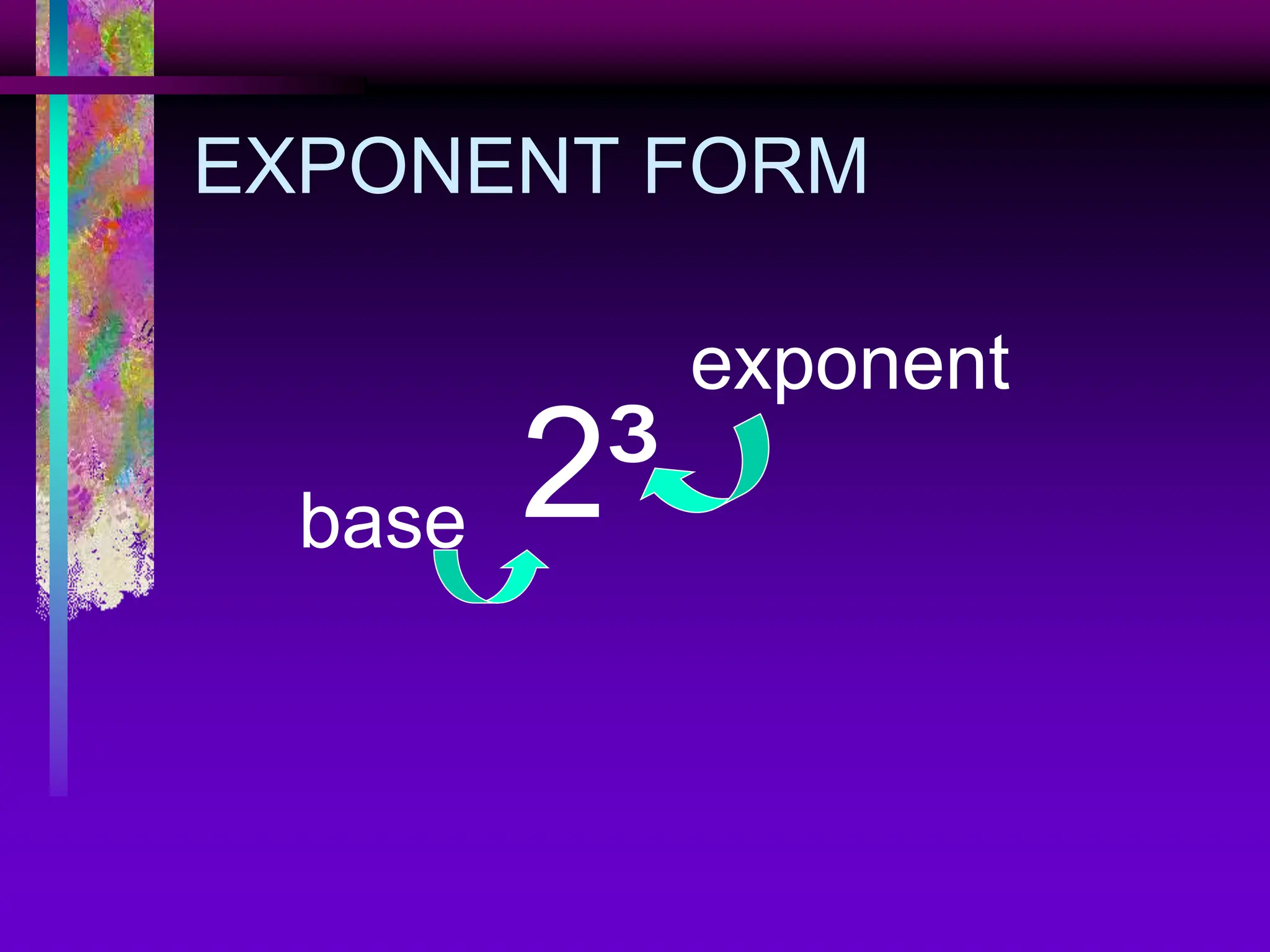
EXPONENT FORM
2³
base
exponent
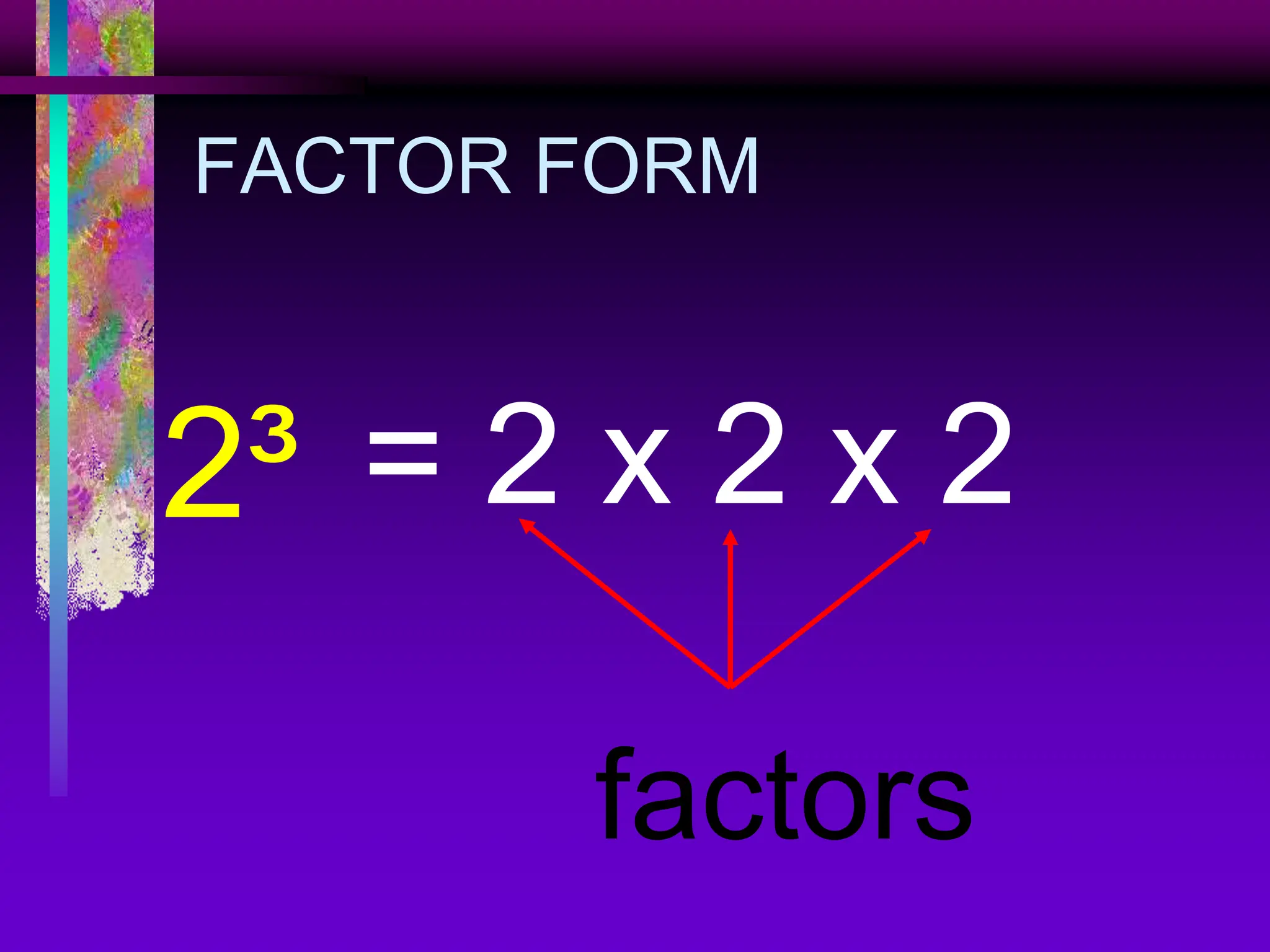
FACTOR FORM
2³ = 2 x 2 x 2
factors
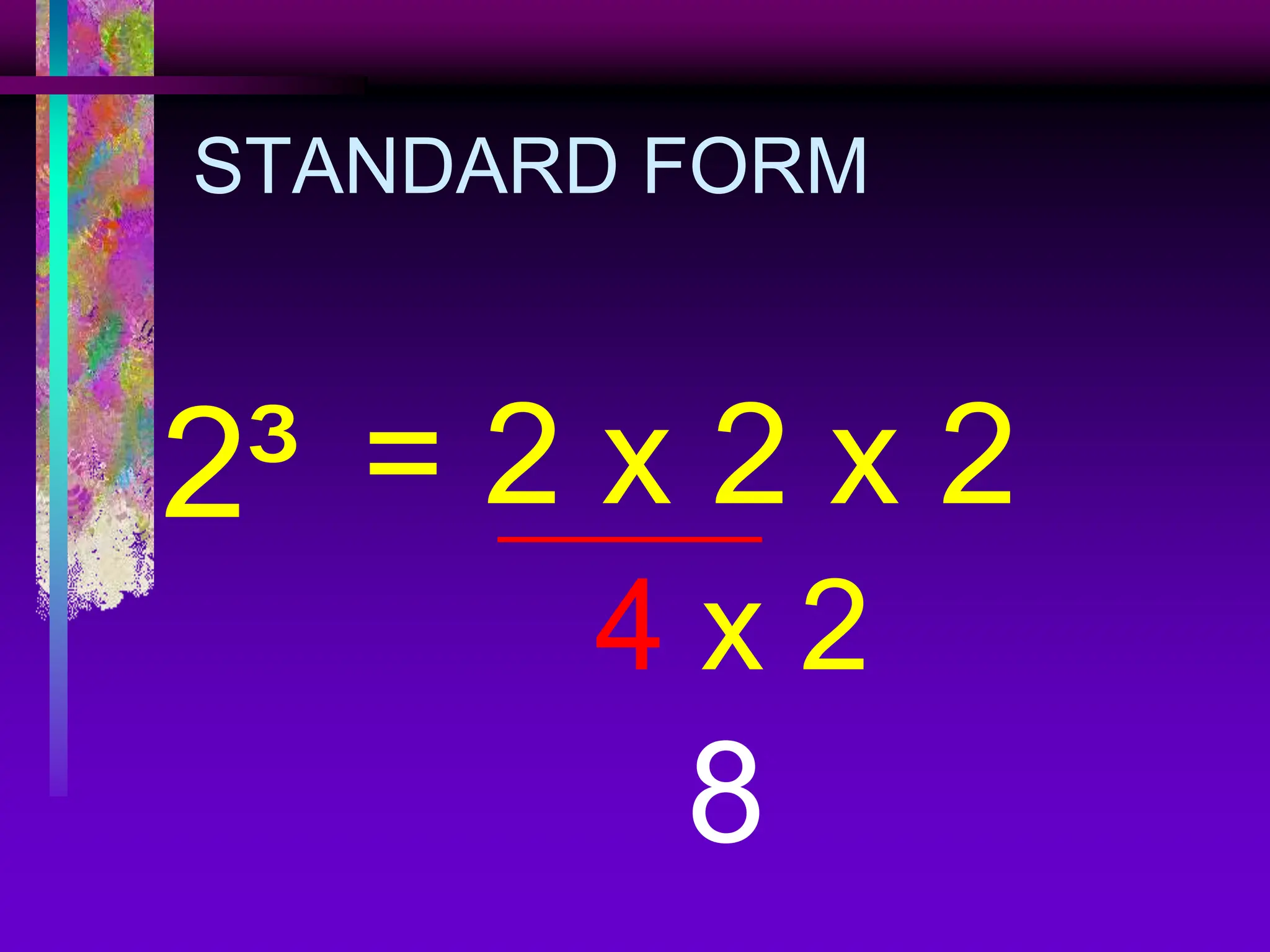
STANDARD FORM
2³ = 2 x 2 x 2
8
4 x 2
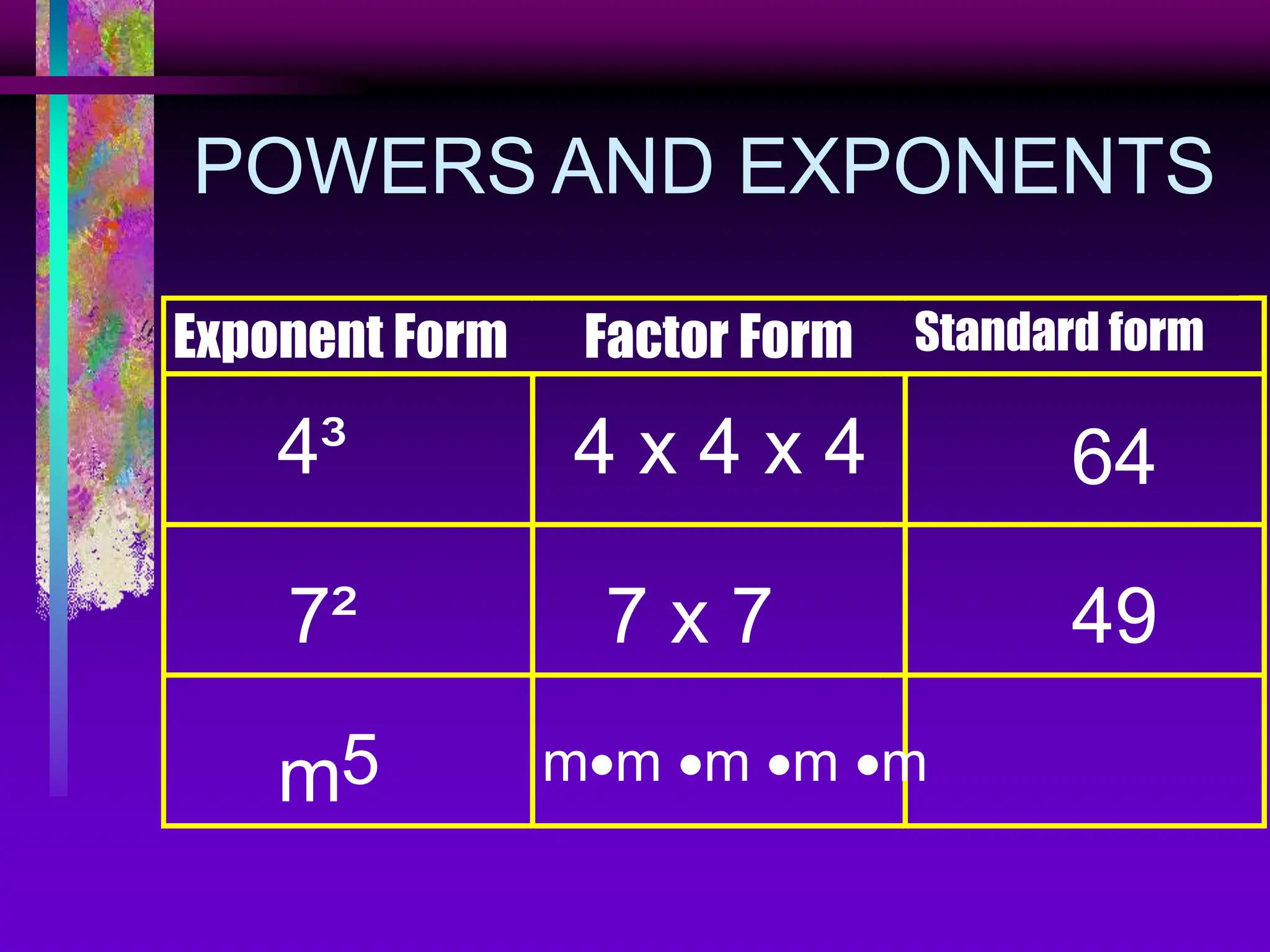
POWERS AND EXPONENTS
Exponent Form Factor Form Standard form
4³ 4 x 4 x 4 64
7² 7 x 7 49
m5 mm m m m
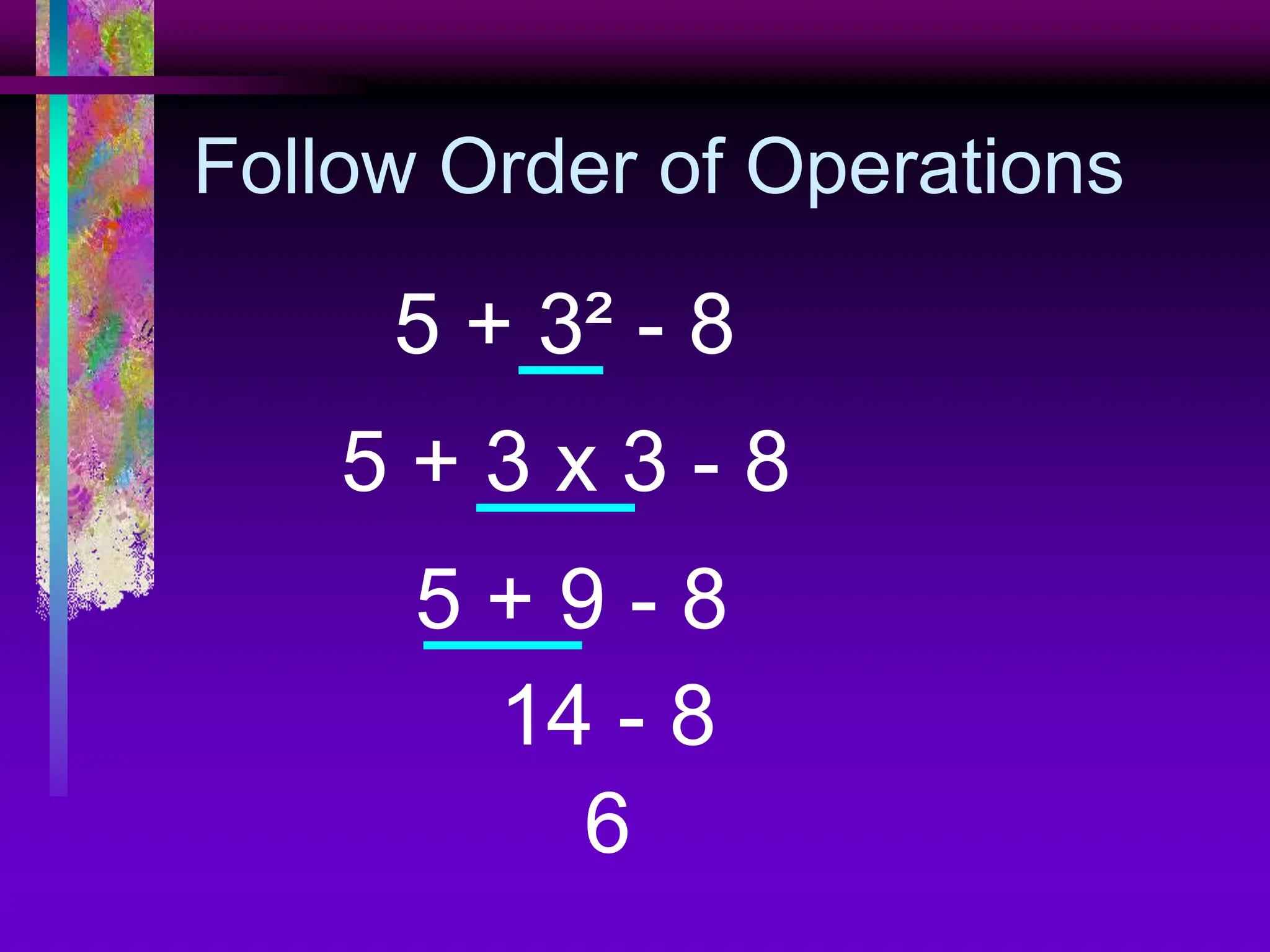
Follow Order of Operations
5 + 3² - 8
5 + 3 x 3 - 8
5 + 9 - 8
14 - 8
6
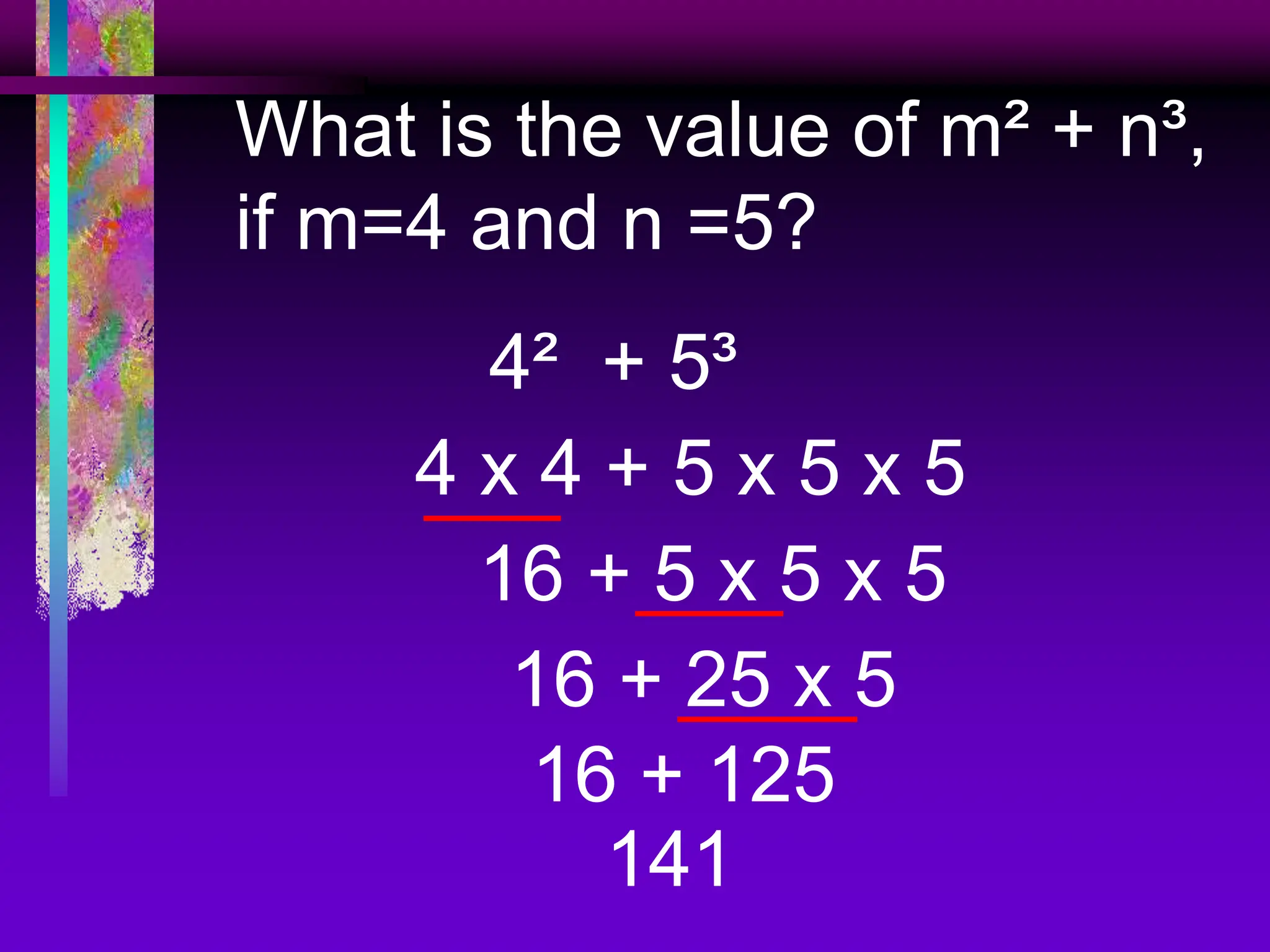
What is the value of m² + n³,
if m=4 and n =5?
4² + 5³
4 x 4 + 5 x 5 x 5
16 + 5 x 5 x 5
16 + 25 x 5
16 + 125
141
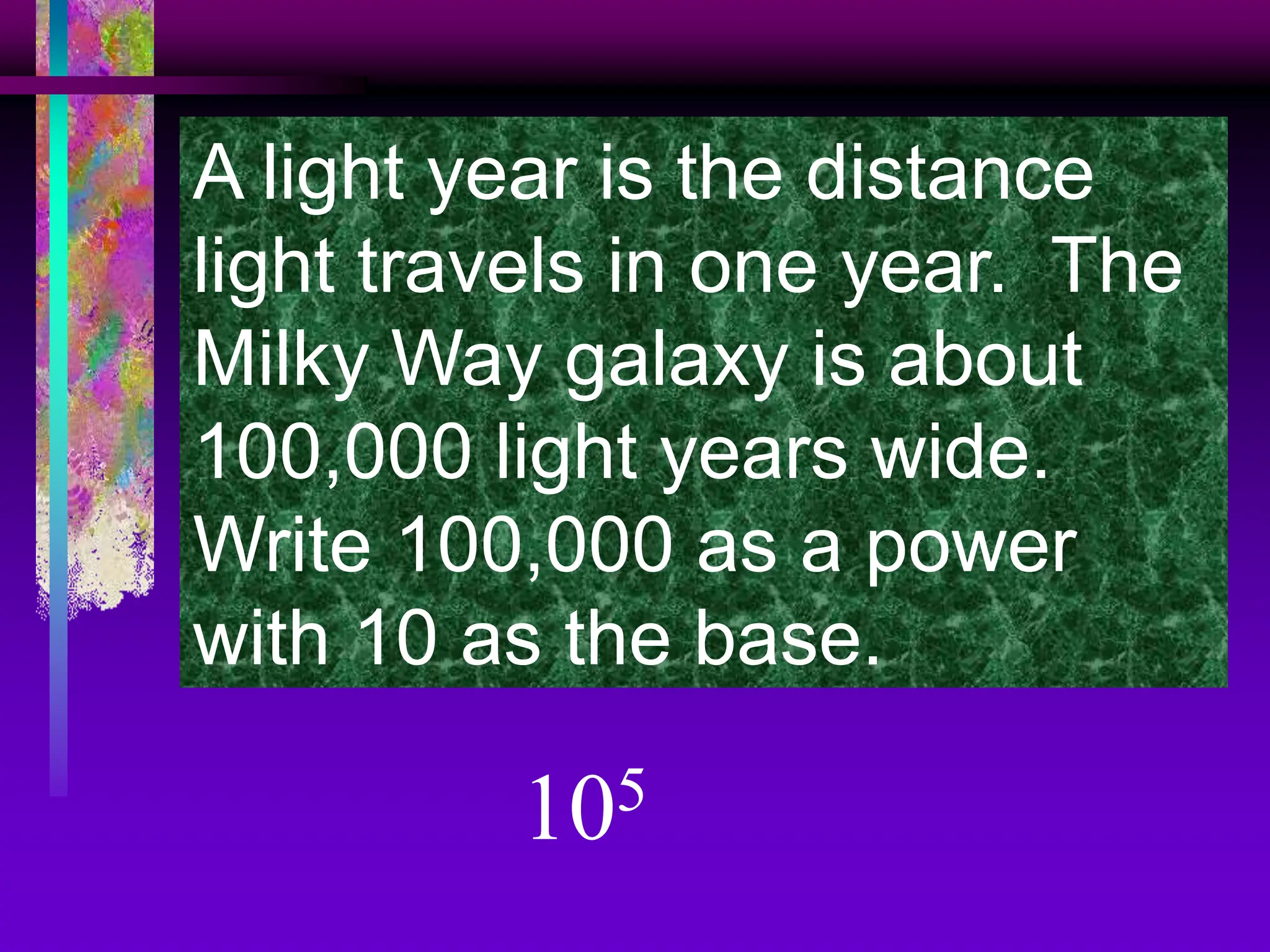
A light year is the distance
light travels in one year. The
Milky Way galaxy is about
100,000 light years wide.
Write 100,000 as a power
with 10 as the base.
105
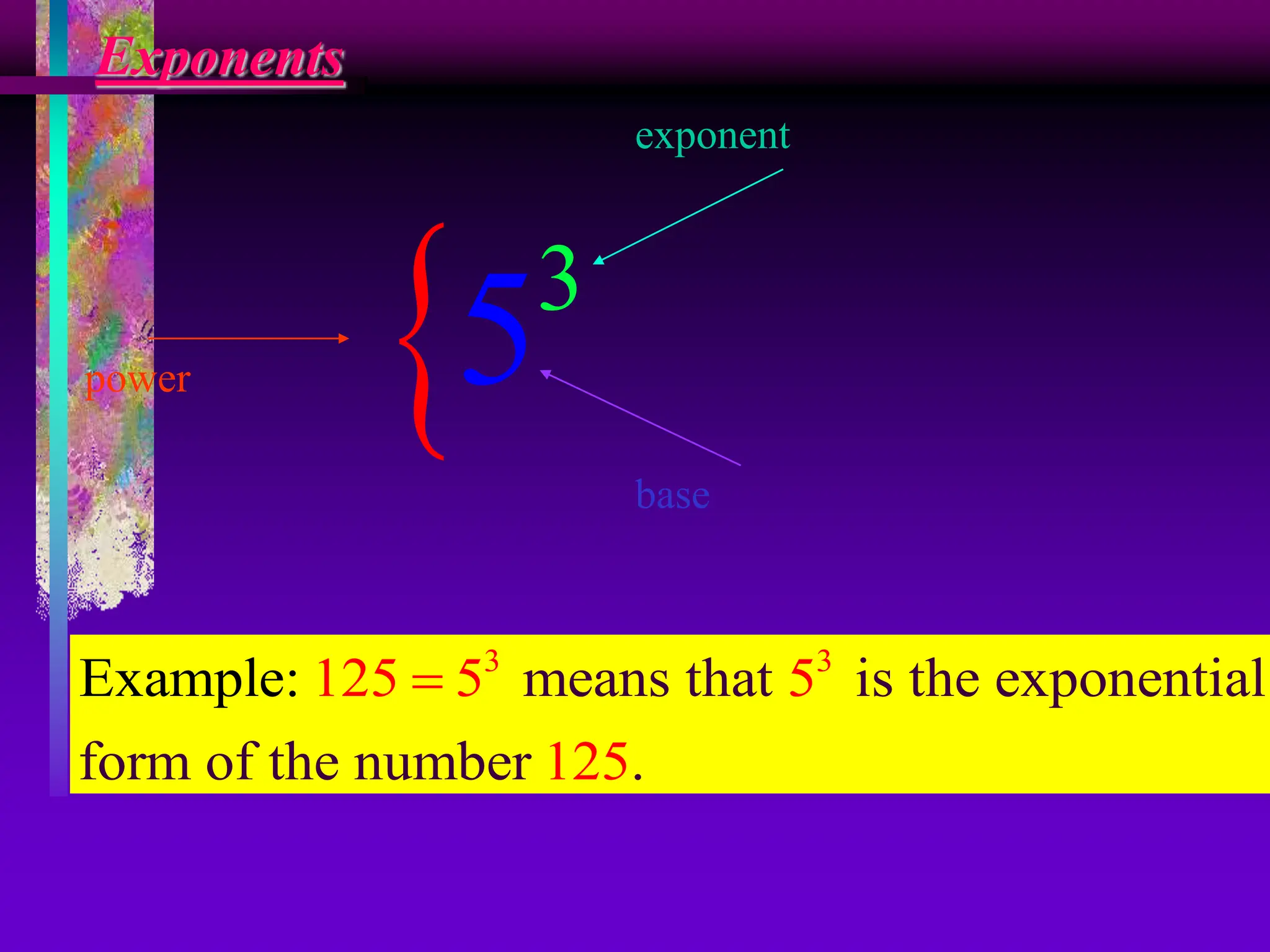
Exponents
 3
5
power
base
exponent
3 3
means that is the exponential
form of t
Example:
he number
125 5 5
.
125

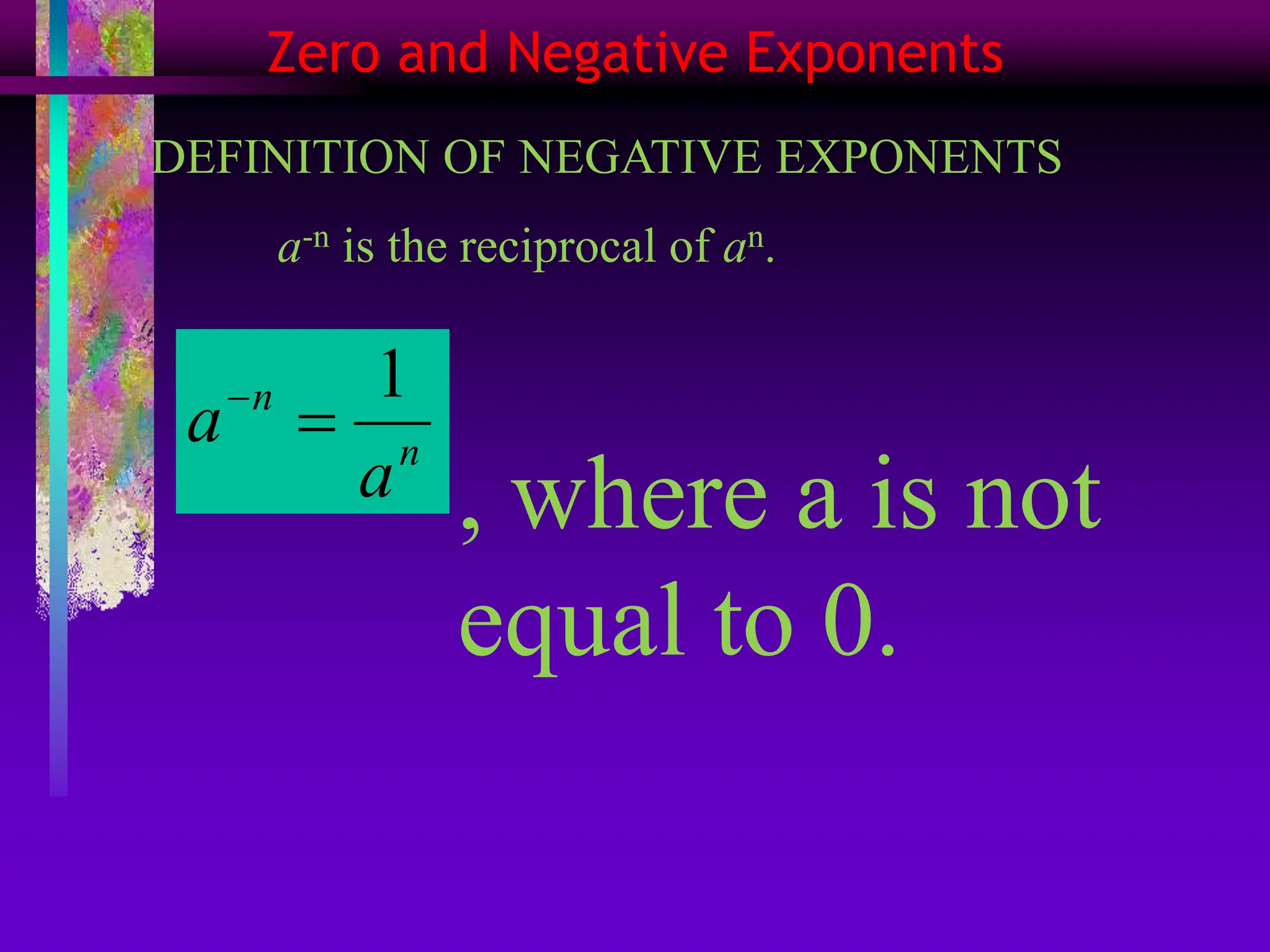
Zero and Negative Exponents
DEFINITION OF NEGATIVE EXPONENTS
a-n is the reciprocal of an.
n
n
a
a
1


, where a is not
equal to 0.
Example
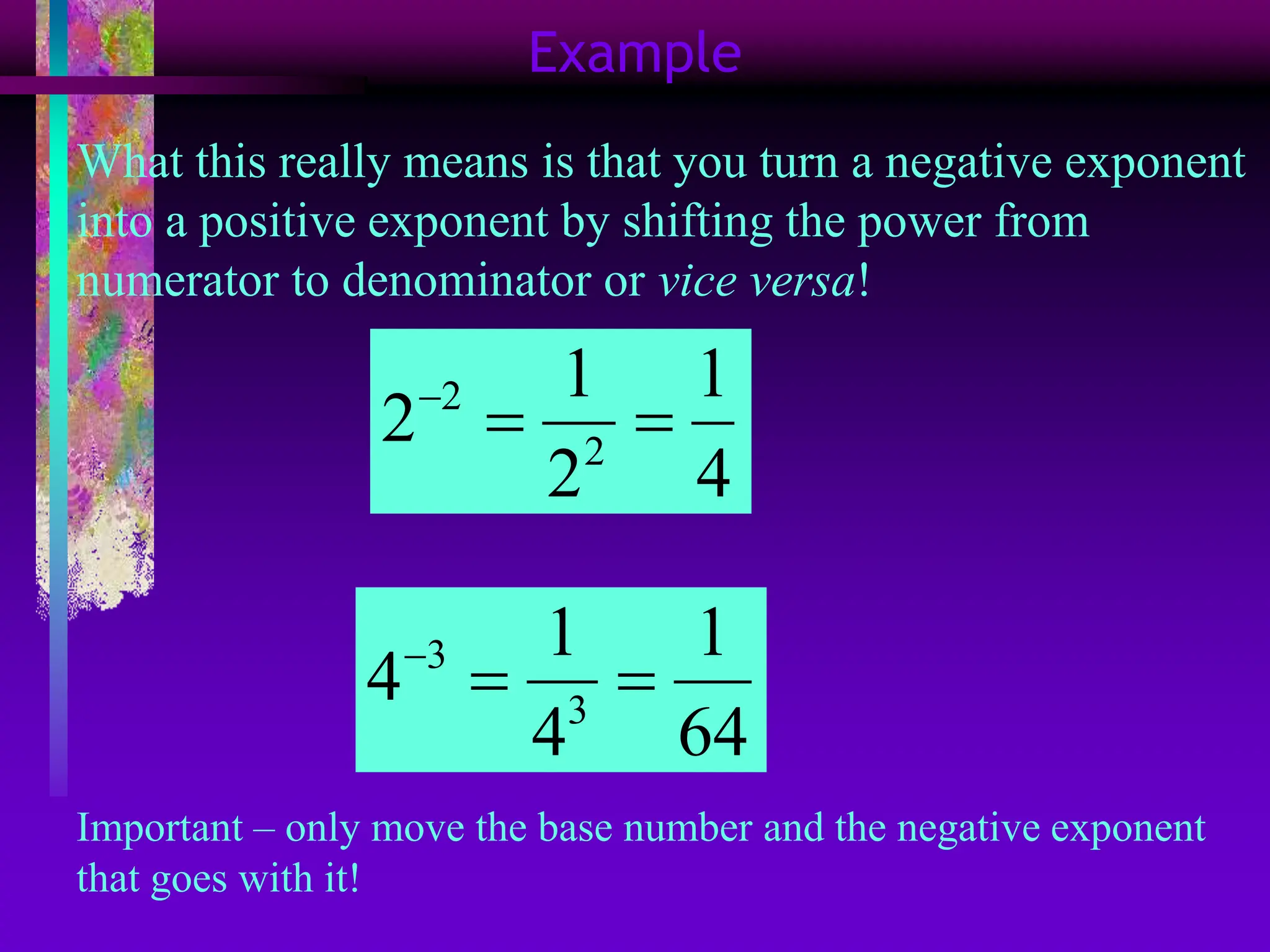
What this really means is that you turn a negative exponent
into a positive exponent by shifting the power from
numerator to denominator or vice versa!
2
2
1 1
2
2 4

 
3
3
1 1
4
4 64

 
Important – only move the base number and the negative exponent
that goes with it!
NUMBERS WITH
NEGATIVE EXPONENTS
FOLLOW THE SAME
LAWS OF EXPONENTS
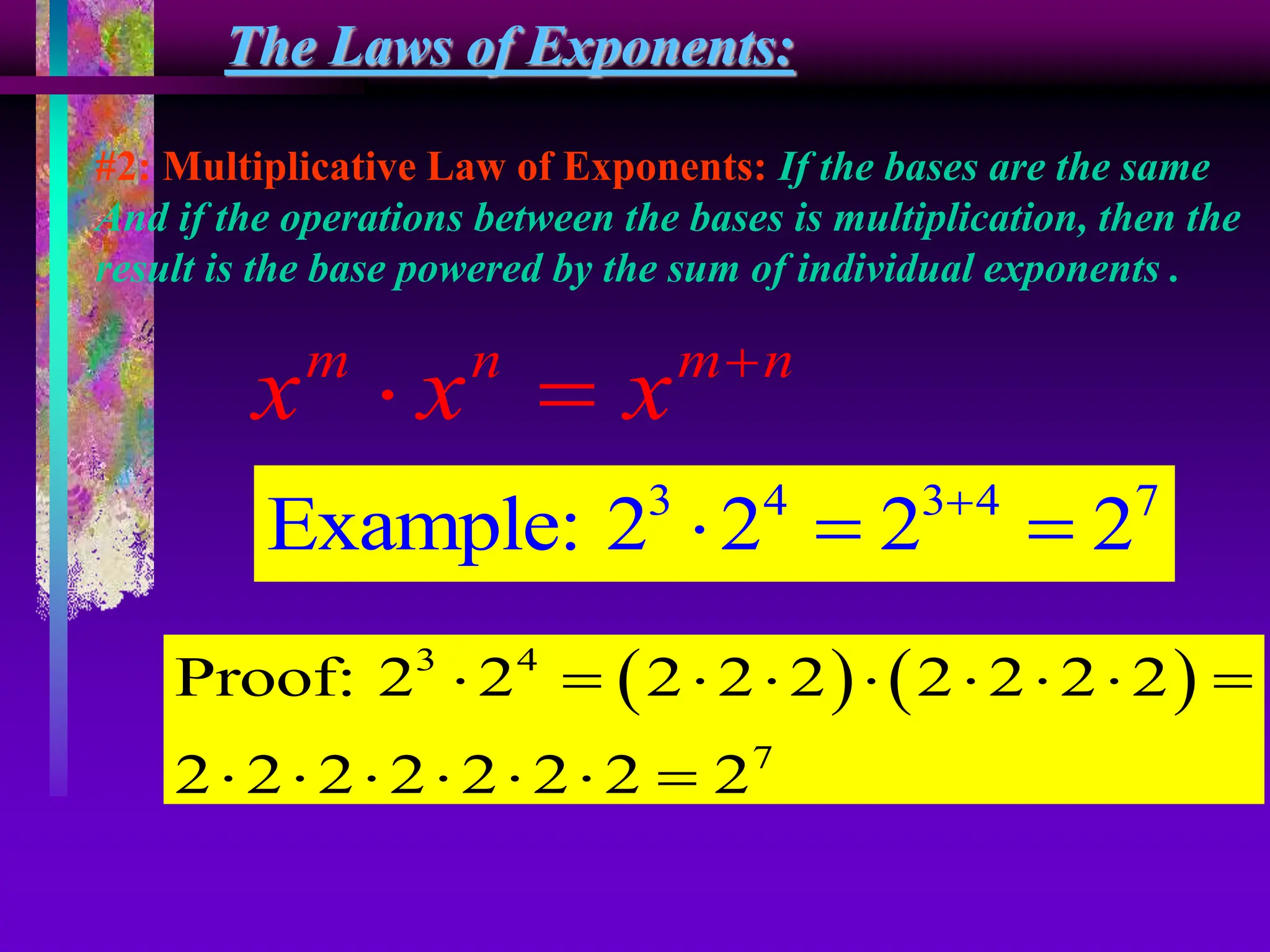
The Laws of Exponents:
#2: Multiplicative Law of Exponents: If the bases are the same
And if the operations between the bases is multiplication, then the
result is the base powered by the sum of individual exponents .
m n m n
x x x 
 
3 4 3 4 7
Example: 2 2 2 2

  
   
3 4
7
Proof: 2 2 2 2 2 2 2 2 2
2 2 2 2 2 2 2 2
        
      
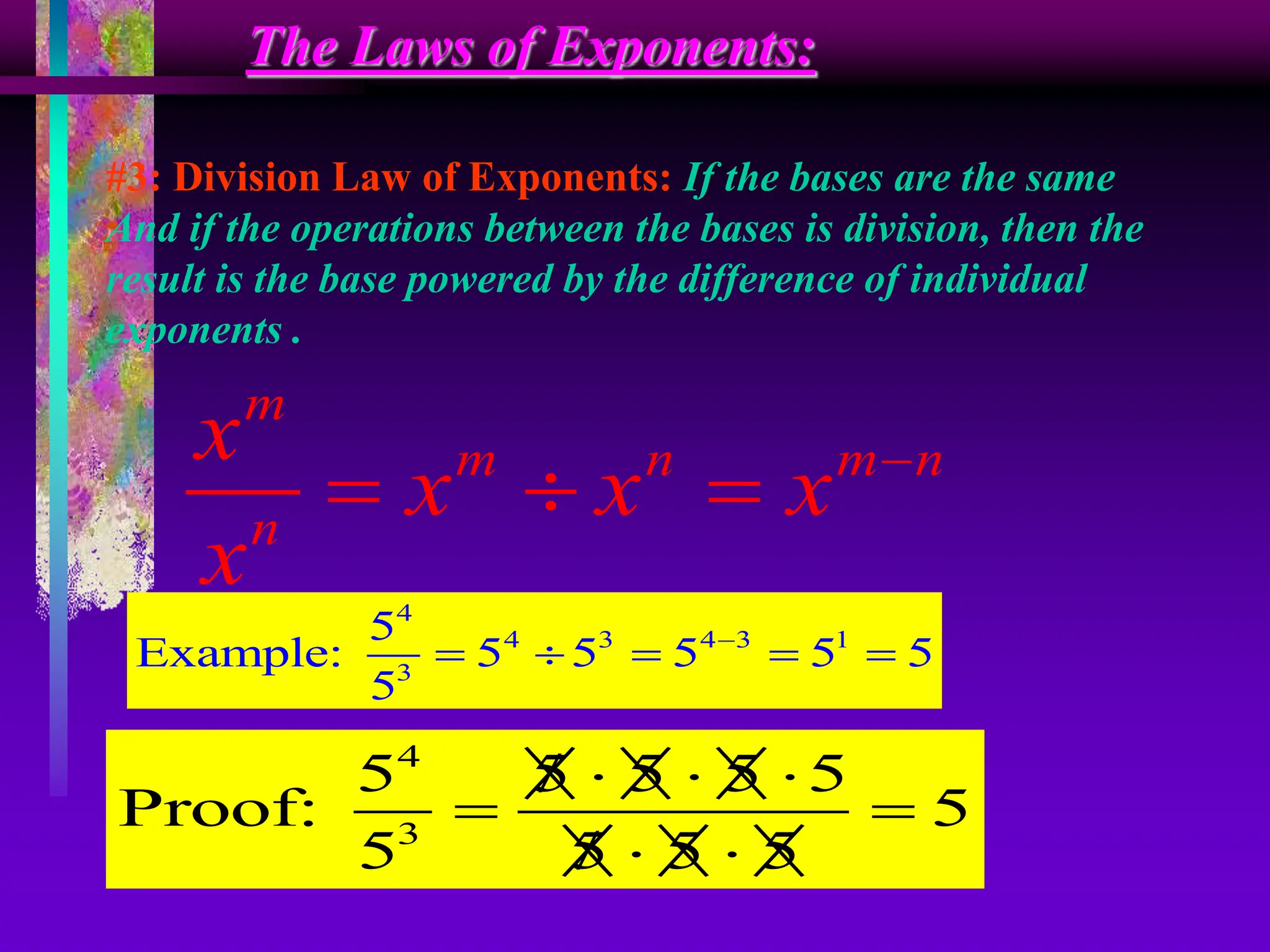
The Laws of Exponents:
#3: Division Law of Exponents: If the bases are the same
And if the operations between the bases is division, then the
result is the base powered by the difference of individual
exponents .
m
m n m n
n
x
x x x
x

  
4
4 3 4 3 1
3
5
Example: 5 5 5 5 5
5

    
4
3
5 5 5 5 5
Proof: 5
5 5 5 5
  

 
 

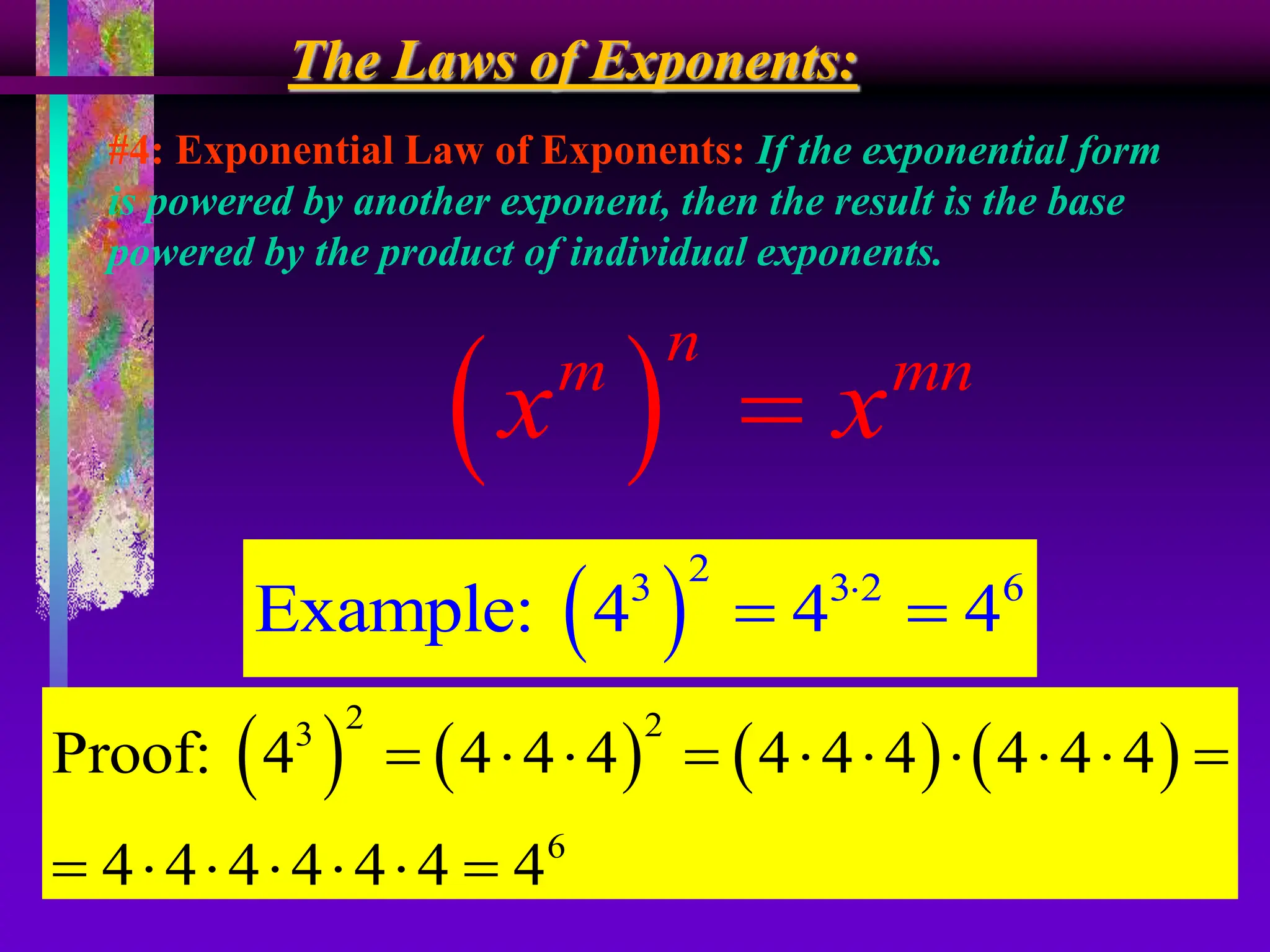
The Laws of Exponents:
#4: Exponential Law of Exponents: If the exponential form
is powered by another exponent, then the result is the base
powered by the product of individual exponents.
 
n
m mn
x x

 
2
3 3 2 6
Example: 4 4 4

 
       
2 2
3
6
Proof: 4 4 4 4 4 4 4 4 4 4
4 4 4 4 4 4 4
         
      
The Laws of Exponents:
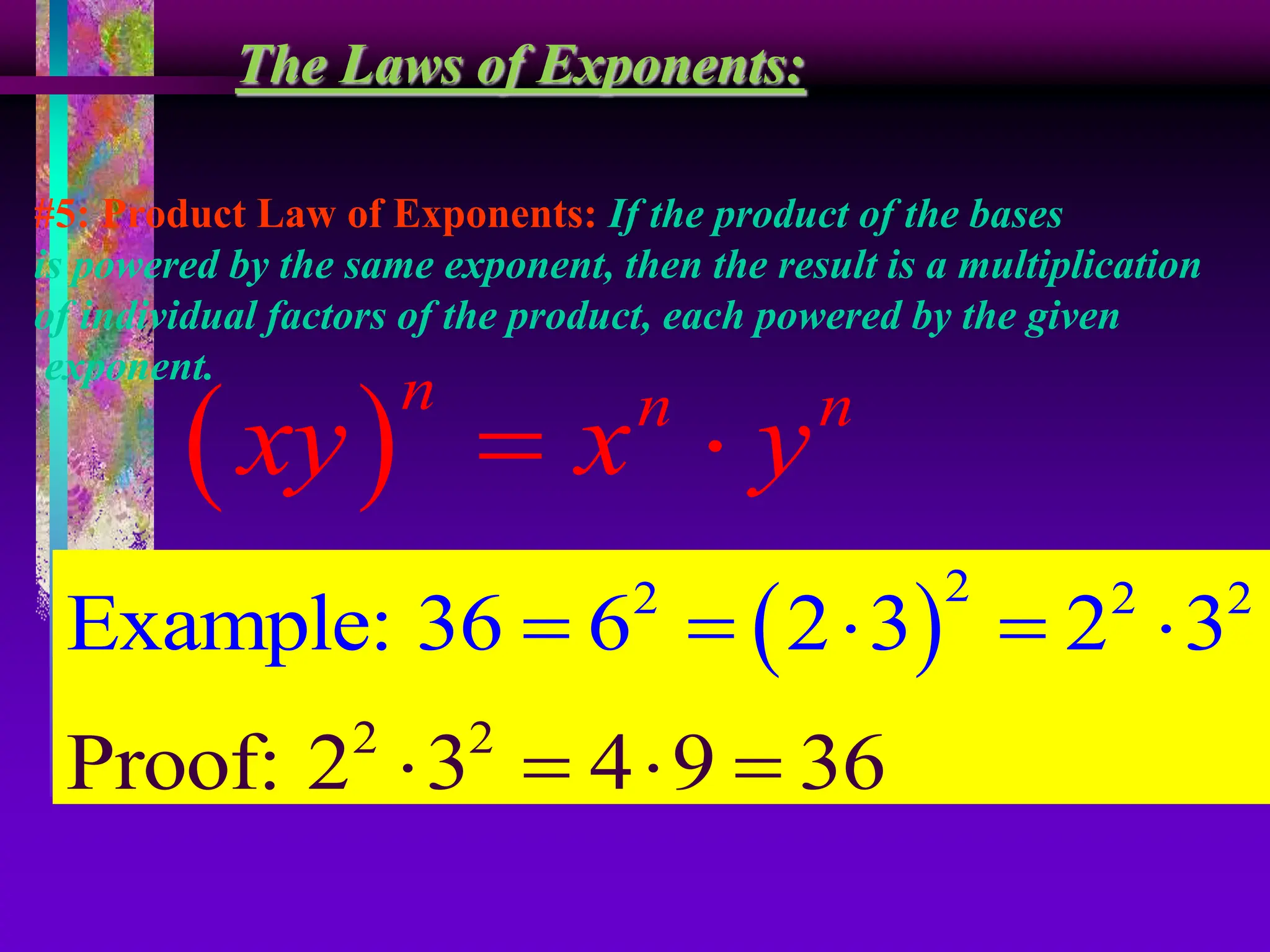
#5: Product Law of Exponents: If the product of the bases
is powered by the same exponent, then the result is a multiplication
of individual factors of the product, each powered by the given
exponent.
 
n n n
xy x y
 
 
2
2 2
2 2
2
Proof: 2 3 4 9
Example: 36 6 2 3 2 3
36
    
   
The Laws of Exponents:
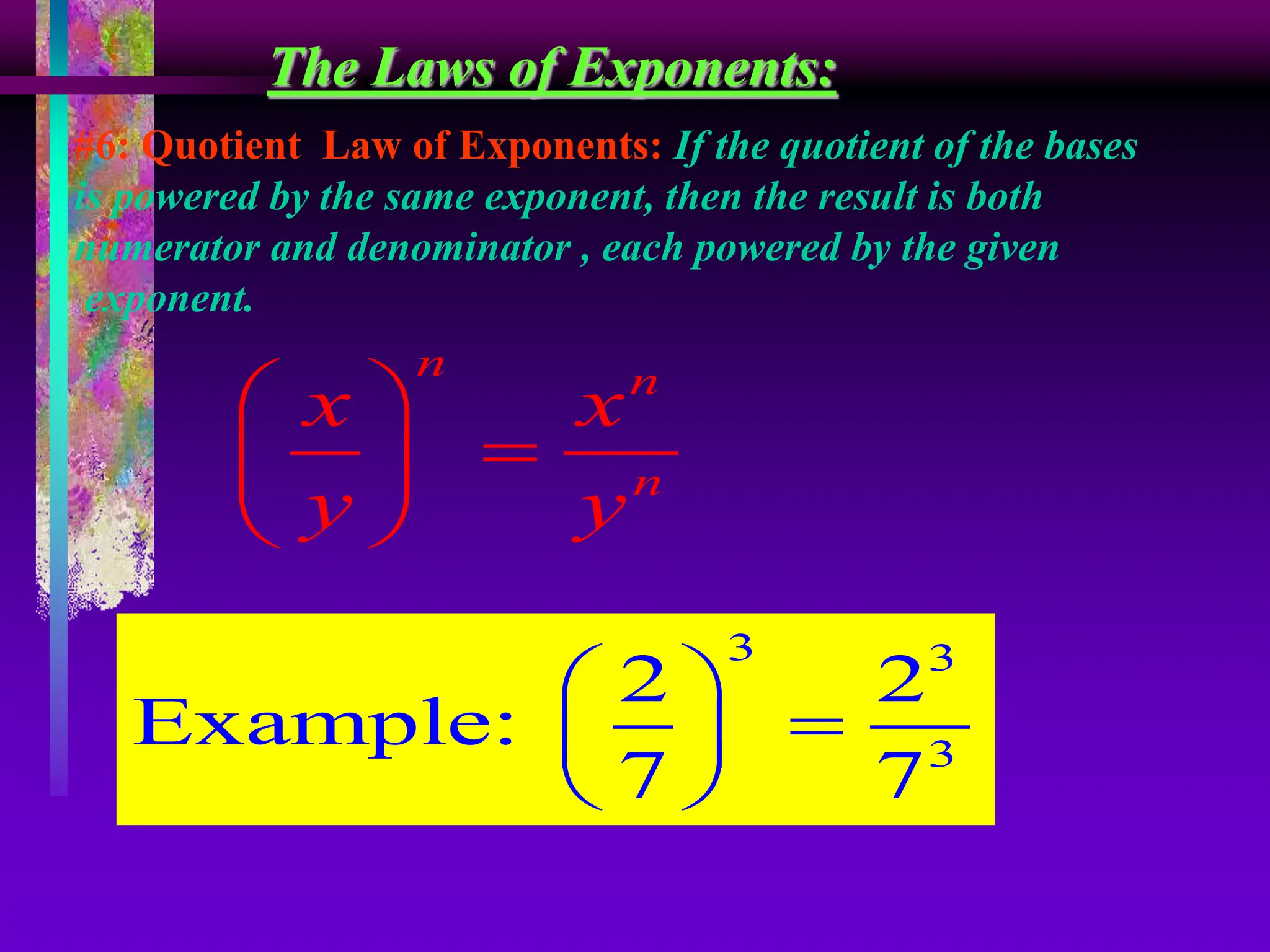
#6: Quotient Law of Exponents: If the quotient of the bases
is powered by the same exponent, then the result is both
numerator and denominator , each powered by the given
exponent.
n n
n
x x
y y
 

 
 
3 3
3
2 2
Example:
7 7
 

 
 
The Laws of Exponents:
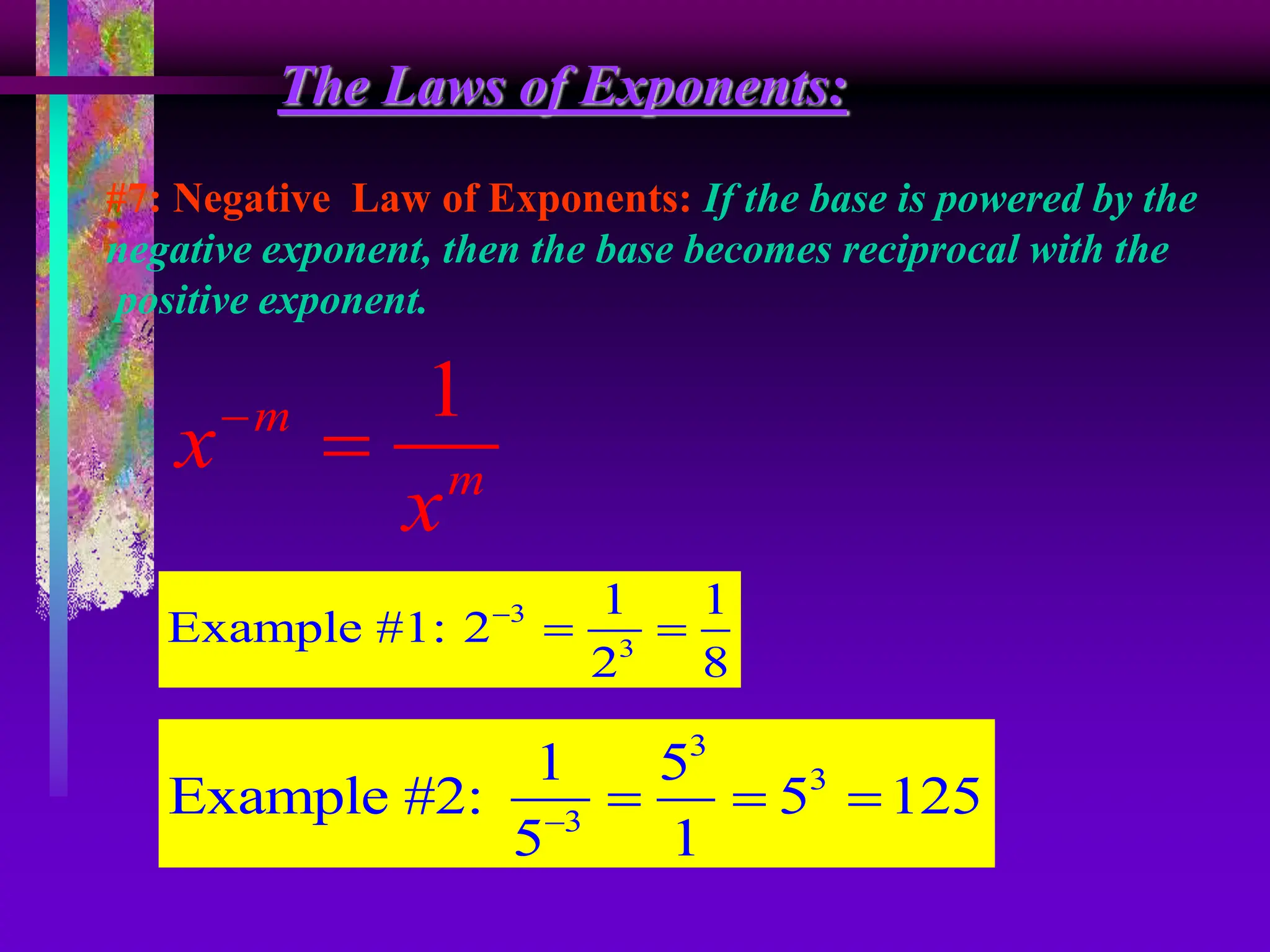
#7: Negative Law of Exponents: If the base is powered by the
negative exponent, then the base becomes reciprocal with the
positive exponent.
1
m
m
x
x


3
3
1 1
Example #1: 2
2 8

 
3
3
3
1 5
Example #2: 5 125
5 1

  
The Laws of Exponents:
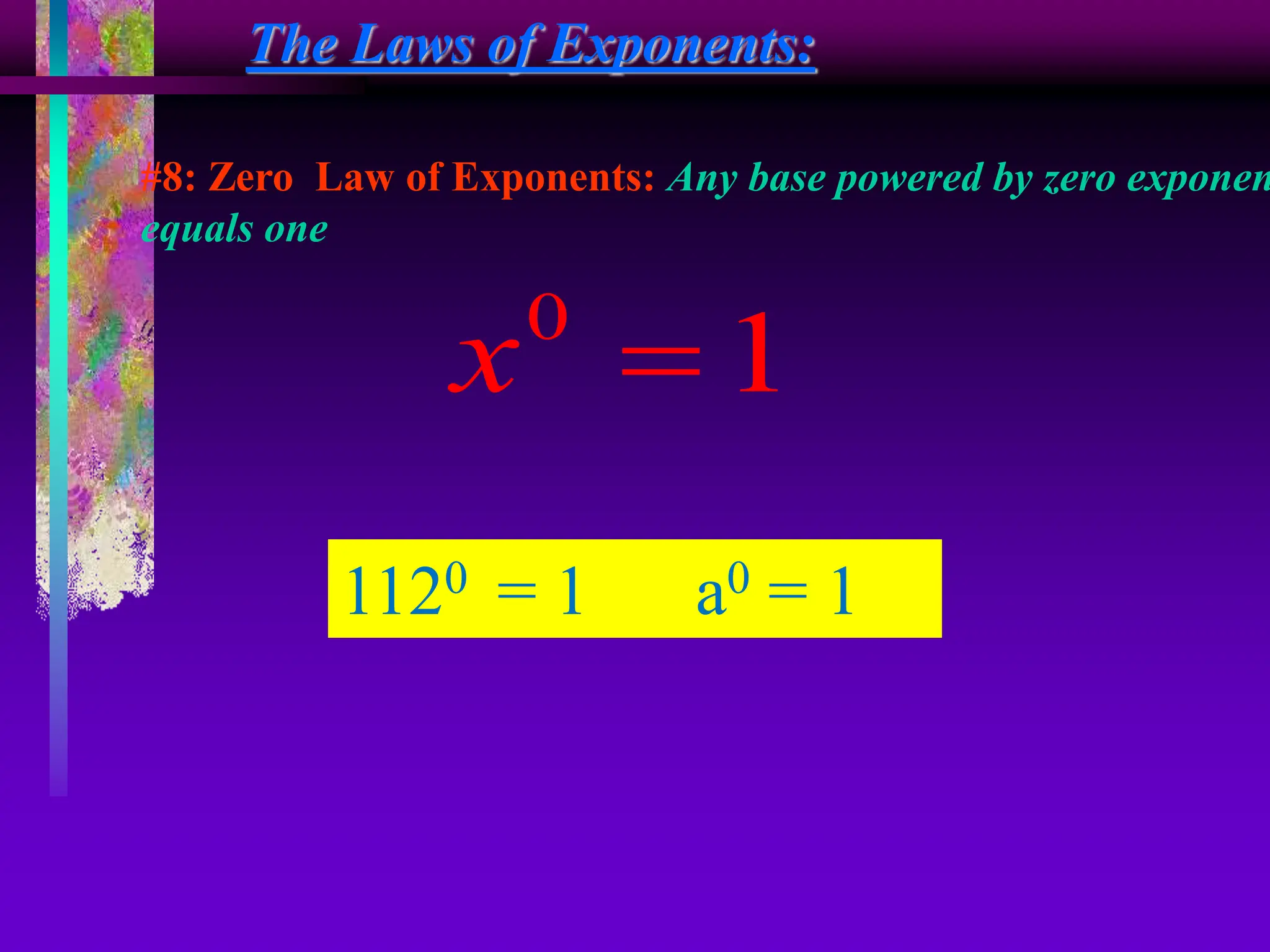
#8: Zero Law of Exponents: Any base powered by zero exponen
equals one
0
1
x 
1120 = 1 a0 = 1
USE OF
EXPONENTS TO
EXPRESS SMALL
NUMBERS IN
STANDARD
NUMBER
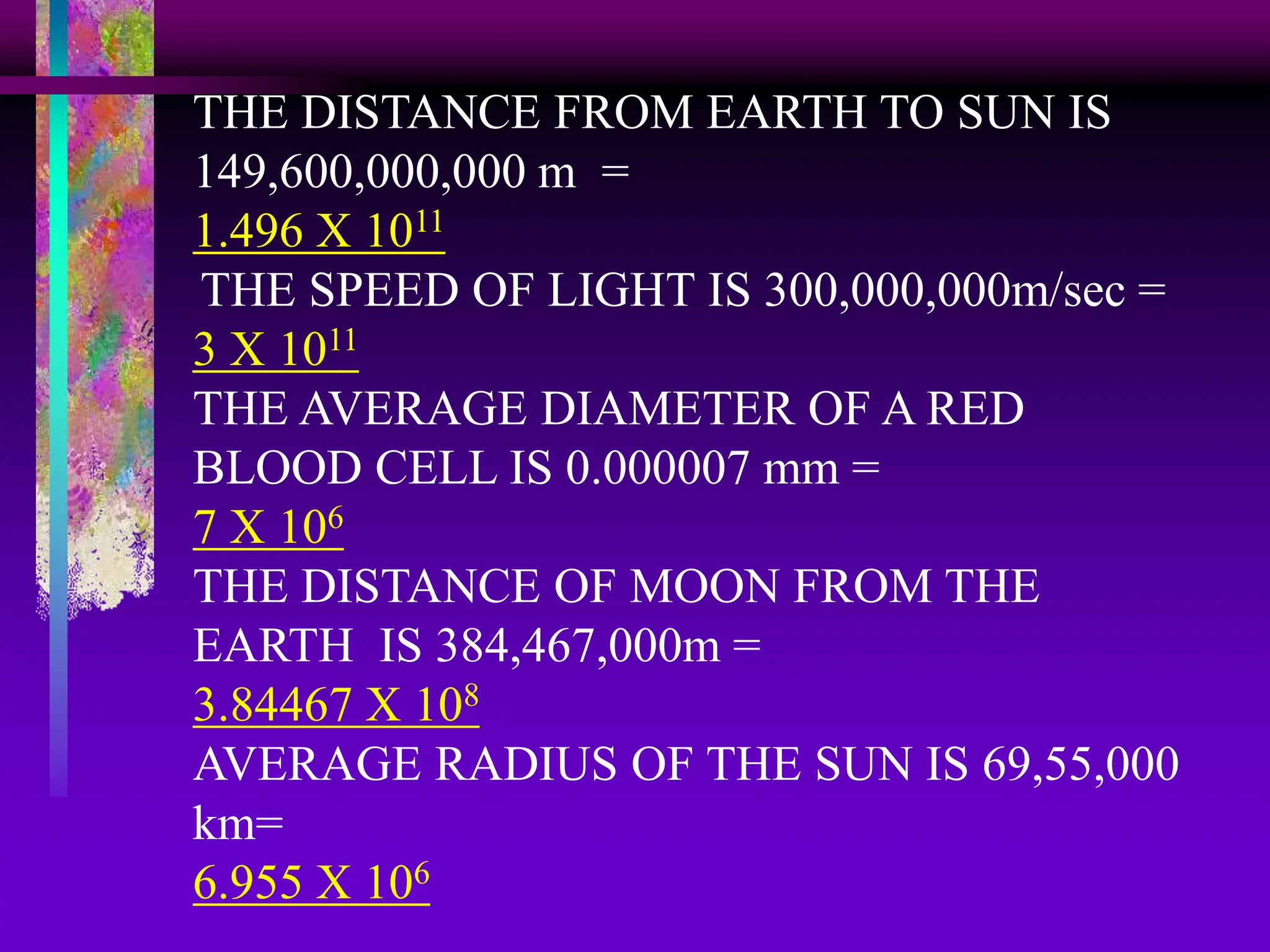
THE DISTANCE FROM EARTH TO SUN IS
149,600,000,000 m =
1.496 X 10¹¹
THE SPEED OF LIGHT IS 300,000,000m/sec =
3 X 10¹¹
THE AVERAGE DIAMETER OF A RED
BLOOD CELL IS 0.000007 mm =
7 X 10⁶
THE DISTANCE OF MOON FROM THE
EARTH IS 384,467,000m =
3.84467 X 10⁸
AVERAGE RADIUS OF THE SUN IS 69,55,000
km=
6.955 X 10⁶
COMPARING VERY
LARGE AND VERY
SMALL NUMBERS
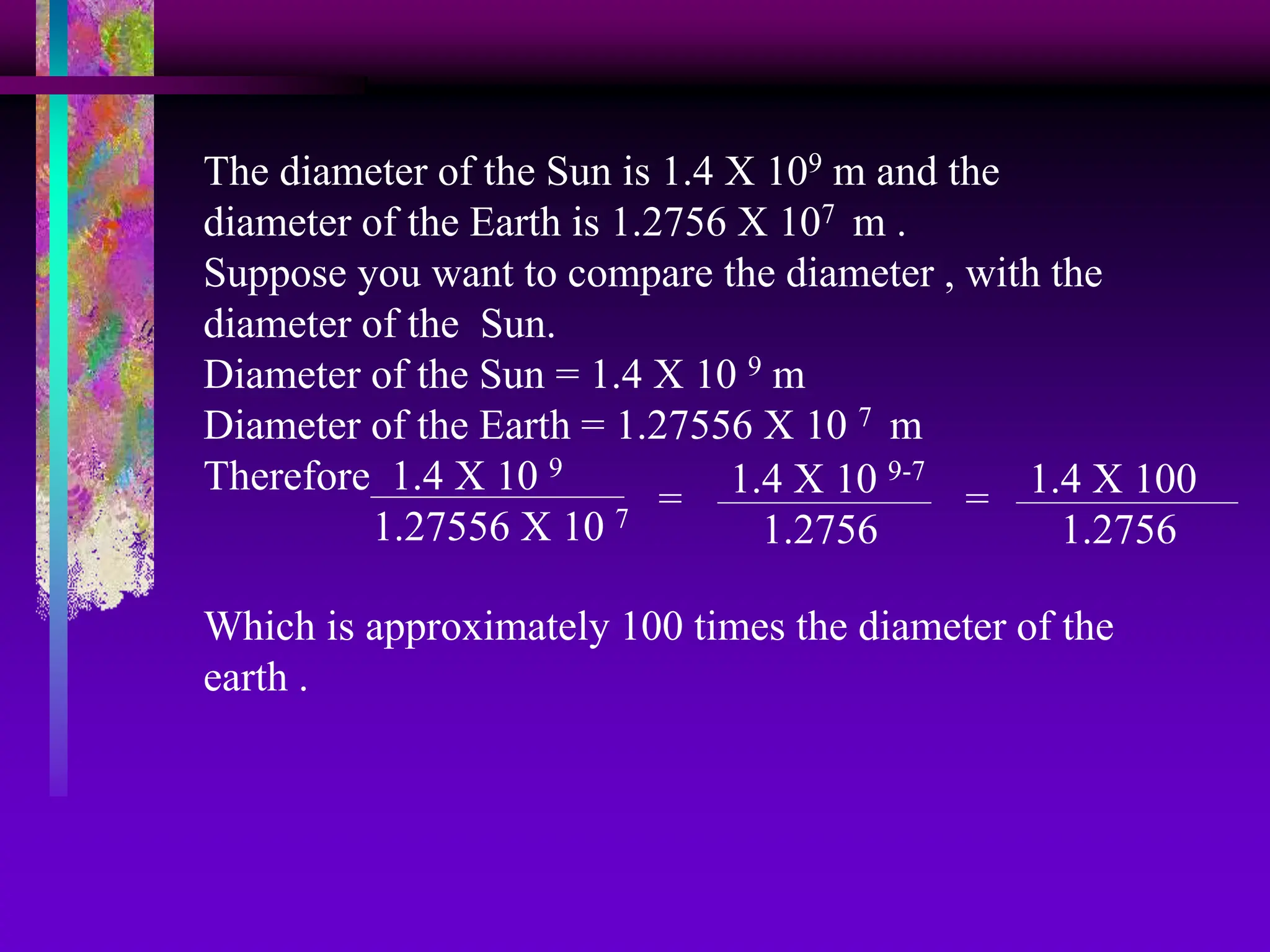
The diameter of the Sun is 1.4 X 10⁹ m and the
diameter of the Earth is 1.2756 X 10⁷ m .
Suppose you want to compare the diameter , with the
diameter of the Sun.
Diameter of the Sun = 1.4 X 10 9 m
Diameter of the Earth = 1.27556 X 10 7 m
Therefore 1.4 X 10 9
1.27556 X 10 7
= 1.4 X 10 9-7
1.2756
= 1.4 X 100
1.2756
Which is approximately 100 times the diameter of the
earth .
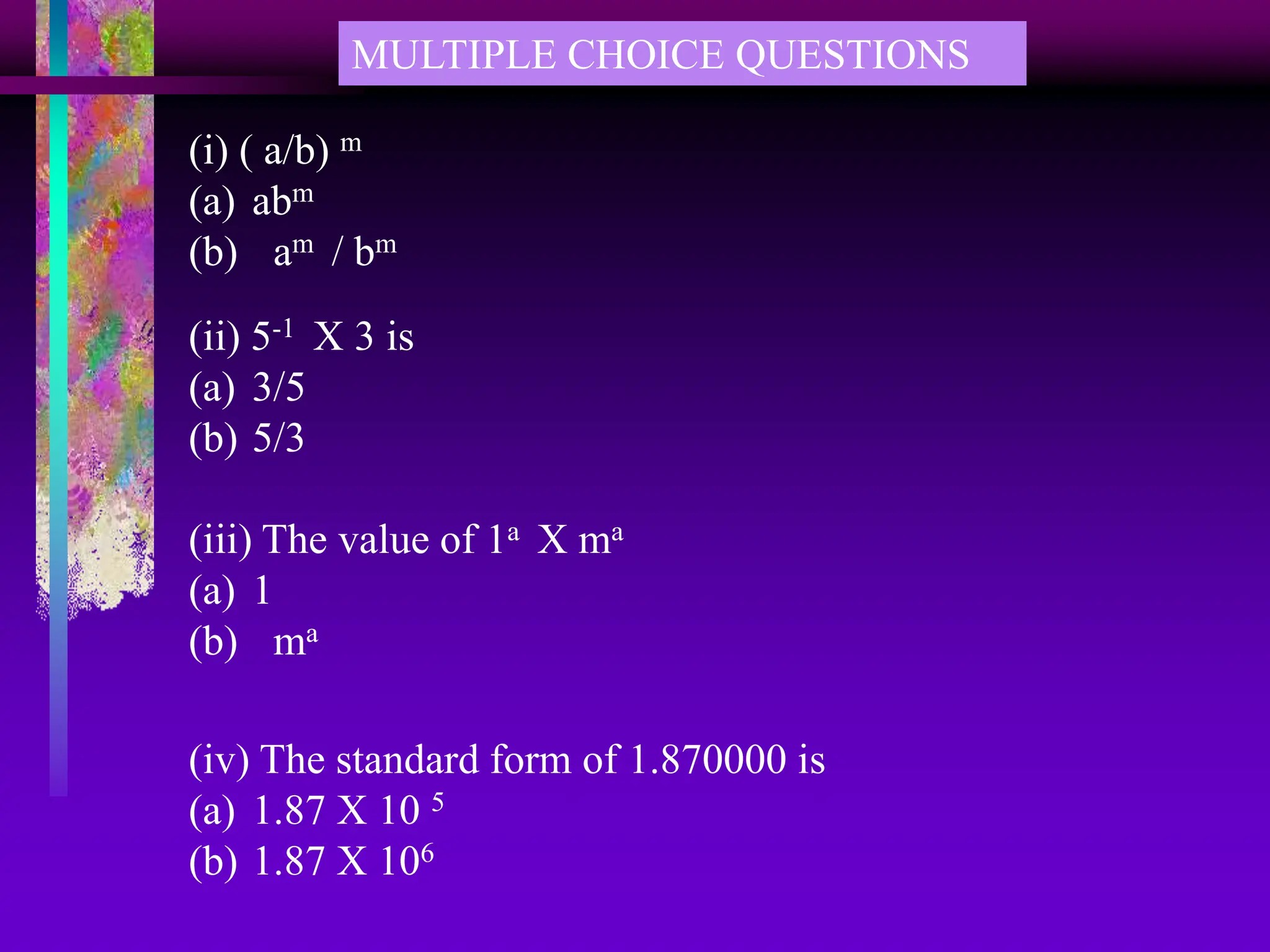
MULTIPLE CHOICE QUESTIONS
(i) ( a/b) m
(a) abm
(b) am / bm
(ii) 5-1 X 3 is
(a) 3/5
(b) 5/3
(iii) The value of 1a X ma
(a) 1
(b) ma
(iv) The standard form of 1.870000 is
(a) 1.87 X 10 5
(b) 1.87 X 10⁶
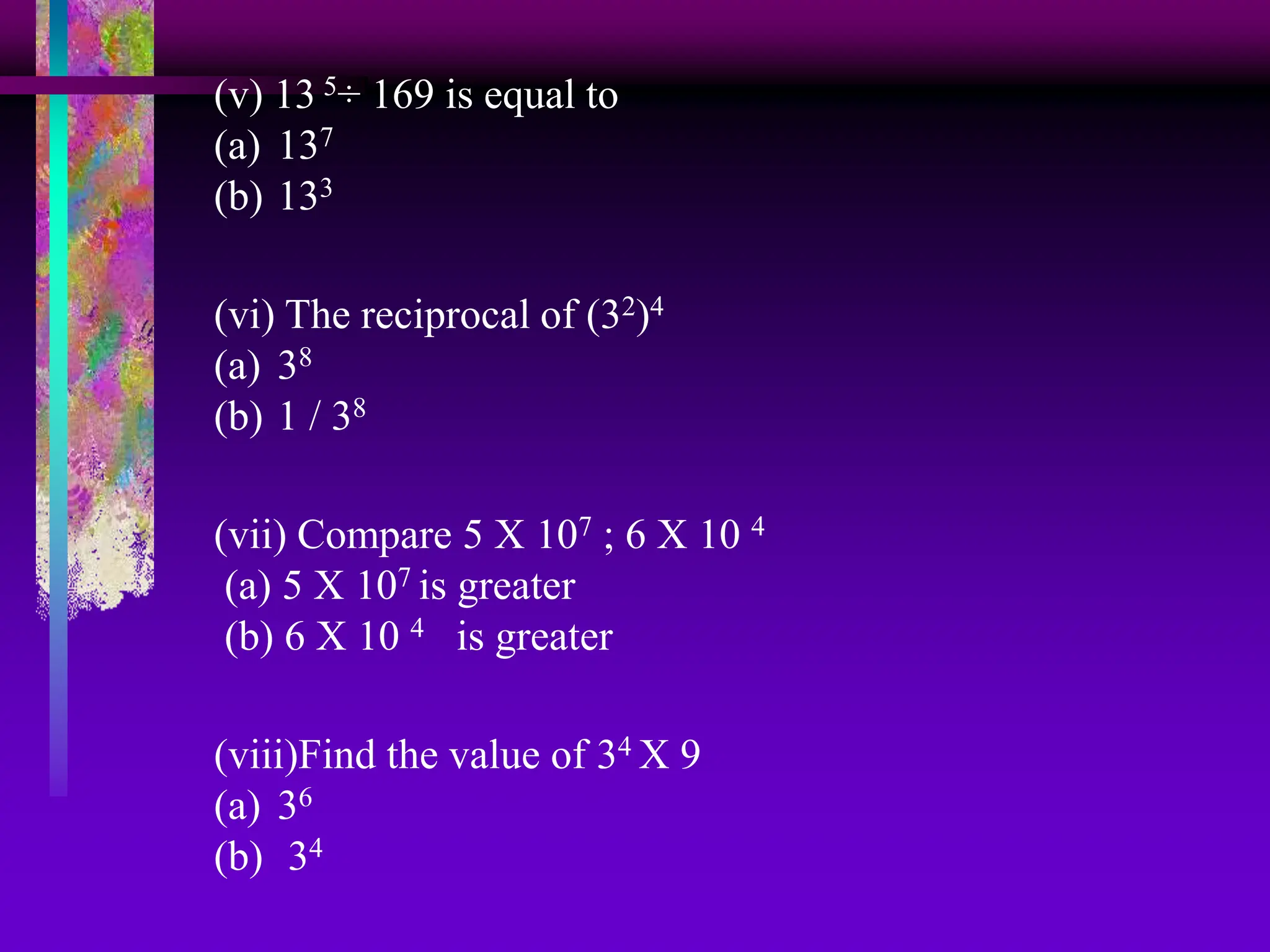
(v) 13 5÷ 169 is equal to
(a) 137
(b) 133
(vi) The reciprocal of (32)4
(a) 38
(b) 1 / 38
(vii) Compare 5 X 10⁷ ; 6 X 10 4
(a) 5 X 10⁷ is greater
(b) 6 X 10 4 is greater
(viii)Find the value of 34 X 9
(a) 36
(b) 34
Find the value of n :
𝑎5
𝑎3 X [ a8 ] = (a n-6 )
Solution :
= a5-3 x a 8 = a n-6 [ am ÷ an = a m-n ]
= a2 x a8 = an-6
= a 10 = a n-6
= a 10 + 6
Ans. n = 16
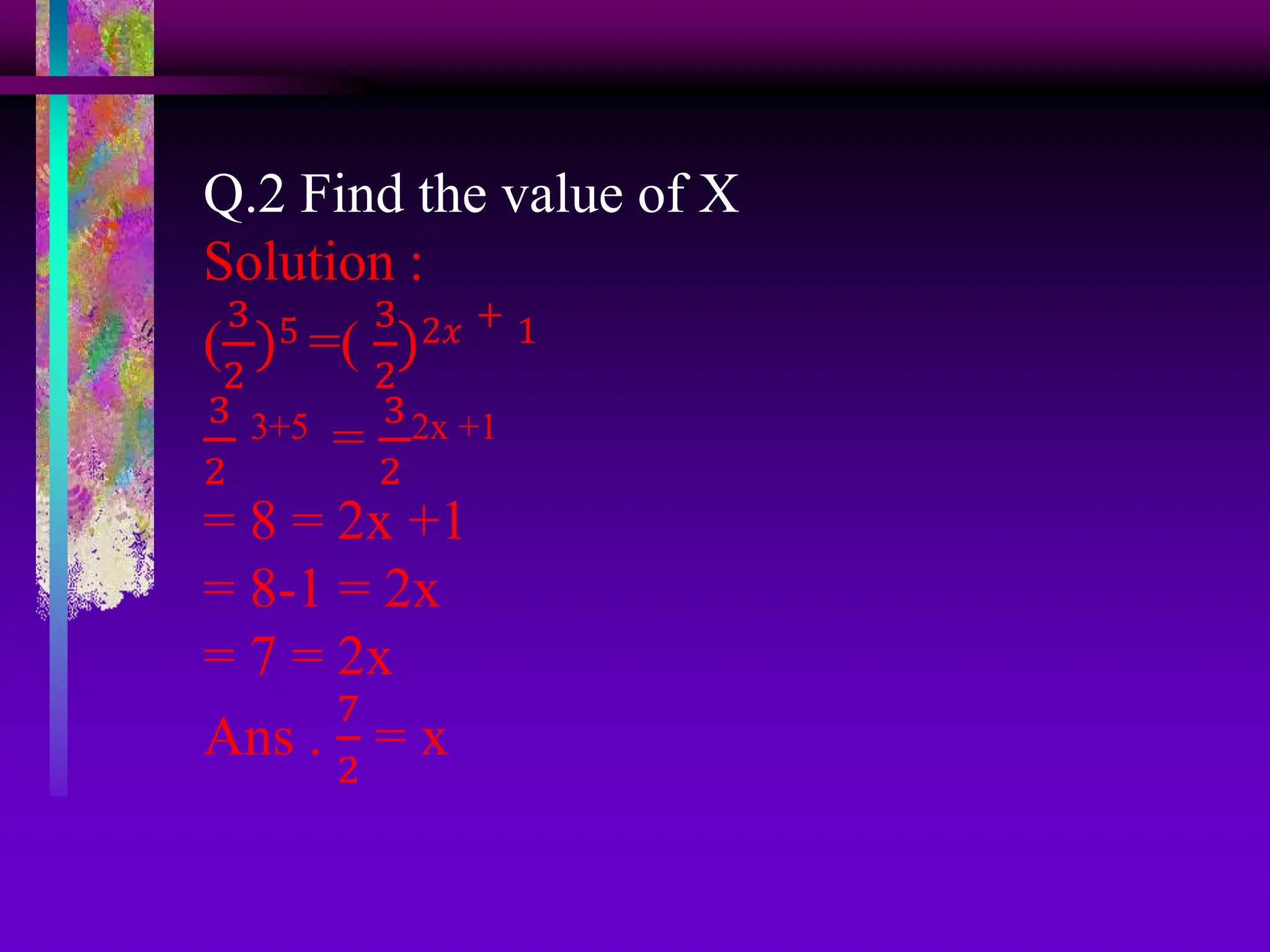
Q.2 Find the value of X
Solution :
(
3
2
)5 =(
3
2
)2𝑥 + 1
3
2
3+5 =
3
2
2x +1
= 8 = 2x +1
= 8-1 = 2x
= 7 = 2x
Ans .
7
2
= x
THANK YOU !

ppt /exp.pptx/ NCERT based /Class 8/2024

  • 1.
  • 2.
    EXPONENTS AND POWERS VOCABULARY •FACTORS - numbers that are multiplied together. • BASE - the number being used as a factor. • EXPONENT - tells how many times a number is used as a factor.
  • 3.
    POWERS & EXPONENTS VOCABULARY •POWER - a number that is expressed using exponents. • SQUARED - a number that has an exponent of 2. • CUBED - a number that has an exponent of 3.
  • 4.
  • 5.
    FACTOR FORM 2³ =2 x 2 x 2 factors
  • 6.
    STANDARD FORM 2³ =2 x 2 x 2 8 4 x 2
  • 7.
    POWERS AND EXPONENTS ExponentForm Factor Form Standard form 4³ 4 x 4 x 4 64 7² 7 x 7 49 m5 mm m m m
  • 8.
    Follow Order ofOperations 5 + 3² - 8 5 + 3 x 3 - 8 5 + 9 - 8 14 - 8 6
  • 9.
    What is thevalue of m² + n³, if m=4 and n =5? 4² + 5³ 4 x 4 + 5 x 5 x 5 16 + 5 x 5 x 5 16 + 25 x 5 16 + 125 141
  • 10.
    A light yearis the distance light travels in one year. The Milky Way galaxy is about 100,000 light years wide. Write 100,000 as a power with 10 as the base. 105
  • 11.
    Exponents  3 5 power base exponent 3 3 meansthat is the exponential form of t Example: he number 125 5 5 . 125 
  • 12.
    Zero and NegativeExponents DEFINITION OF NEGATIVE EXPONENTS a-n is the reciprocal of an. n n a a 1   , where a is not equal to 0.
  • 13.
    Example What this reallymeans is that you turn a negative exponent into a positive exponent by shifting the power from numerator to denominator or vice versa! 2 2 1 1 2 2 4    3 3 1 1 4 4 64    Important – only move the base number and the negative exponent that goes with it!
  • 14.
    NUMBERS WITH NEGATIVE EXPONENTS FOLLOWTHE SAME LAWS OF EXPONENTS
  • 15.
    The Laws ofExponents: #2: Multiplicative Law of Exponents: If the bases are the same And if the operations between the bases is multiplication, then the result is the base powered by the sum of individual exponents . m n m n x x x    3 4 3 4 7 Example: 2 2 2 2         3 4 7 Proof: 2 2 2 2 2 2 2 2 2 2 2 2 2 2 2 2 2                
  • 16.
    The Laws ofExponents: #3: Division Law of Exponents: If the bases are the same And if the operations between the bases is division, then the result is the base powered by the difference of individual exponents . m m n m n n x x x x x     4 4 3 4 3 1 3 5 Example: 5 5 5 5 5 5       4 3 5 5 5 5 5 Proof: 5 5 5 5 5         
  • 17.
    The Laws ofExponents: #4: Exponential Law of Exponents: If the exponential form is powered by another exponent, then the result is the base powered by the product of individual exponents.   n m mn x x    2 3 3 2 6 Example: 4 4 4            2 2 3 6 Proof: 4 4 4 4 4 4 4 4 4 4 4 4 4 4 4 4 4                 
  • 18.
    The Laws ofExponents: #5: Product Law of Exponents: If the product of the bases is powered by the same exponent, then the result is a multiplication of individual factors of the product, each powered by the given exponent.   n n n xy x y     2 2 2 2 2 2 Proof: 2 3 4 9 Example: 36 6 2 3 2 3 36         
  • 19.
    The Laws ofExponents: #6: Quotient Law of Exponents: If the quotient of the bases is powered by the same exponent, then the result is both numerator and denominator , each powered by the given exponent. n n n x x y y        3 3 3 2 2 Example: 7 7       
  • 20.
    The Laws ofExponents: #7: Negative Law of Exponents: If the base is powered by the negative exponent, then the base becomes reciprocal with the positive exponent. 1 m m x x   3 3 1 1 Example #1: 2 2 8    3 3 3 1 5 Example #2: 5 125 5 1    
  • 21.
    The Laws ofExponents: #8: Zero Law of Exponents: Any base powered by zero exponen equals one 0 1 x  1120 = 1 a0 = 1
  • 22.
    USE OF EXPONENTS TO EXPRESSSMALL NUMBERS IN STANDARD NUMBER
  • 23.
    THE DISTANCE FROMEARTH TO SUN IS 149,600,000,000 m = 1.496 X 10¹¹ THE SPEED OF LIGHT IS 300,000,000m/sec = 3 X 10¹¹ THE AVERAGE DIAMETER OF A RED BLOOD CELL IS 0.000007 mm = 7 X 10⁶ THE DISTANCE OF MOON FROM THE EARTH IS 384,467,000m = 3.84467 X 10⁸ AVERAGE RADIUS OF THE SUN IS 69,55,000 km= 6.955 X 10⁶
  • 24.
    COMPARING VERY LARGE ANDVERY SMALL NUMBERS
  • 25.
    The diameter ofthe Sun is 1.4 X 10⁹ m and the diameter of the Earth is 1.2756 X 10⁷ m . Suppose you want to compare the diameter , with the diameter of the Sun. Diameter of the Sun = 1.4 X 10 9 m Diameter of the Earth = 1.27556 X 10 7 m Therefore 1.4 X 10 9 1.27556 X 10 7 = 1.4 X 10 9-7 1.2756 = 1.4 X 100 1.2756 Which is approximately 100 times the diameter of the earth .
  • 26.
    MULTIPLE CHOICE QUESTIONS (i)( a/b) m (a) abm (b) am / bm (ii) 5-1 X 3 is (a) 3/5 (b) 5/3 (iii) The value of 1a X ma (a) 1 (b) ma (iv) The standard form of 1.870000 is (a) 1.87 X 10 5 (b) 1.87 X 10⁶
  • 27.
    (v) 13 5÷169 is equal to (a) 137 (b) 133 (vi) The reciprocal of (32)4 (a) 38 (b) 1 / 38 (vii) Compare 5 X 10⁷ ; 6 X 10 4 (a) 5 X 10⁷ is greater (b) 6 X 10 4 is greater (viii)Find the value of 34 X 9 (a) 36 (b) 34
  • 28.
    Find the valueof n : 𝑎5 𝑎3 X [ a8 ] = (a n-6 ) Solution : = a5-3 x a 8 = a n-6 [ am ÷ an = a m-n ] = a2 x a8 = an-6 = a 10 = a n-6 = a 10 + 6 Ans. n = 16
  • 29.
    Q.2 Find thevalue of X Solution : ( 3 2 )5 =( 3 2 )2𝑥 + 1 3 2 3+5 = 3 2 2x +1 = 8 = 2x +1 = 8-1 = 2x = 7 = 2x Ans . 7 2 = x
  • 30.