THE DIGITAL
Text BOOK REPORT
2015
JUNE JAMRICH PARSONS
Presented at the Text and Academic Authors Association (TAA) Conference
Las Vega, NV
June 2015
BARGAINING
POWER OF
SUPPLIERS
THREAT OF
NEW
ENTRANTS
INDUSTRY
RIVALRY
MOOCs
Boundless
PIRATE
USED
DON’T BUY
BARGAINING
POWER OF
BUYERS
THREAT OF
SUBSTITUTE
PRODUCTS
OR SERVICES
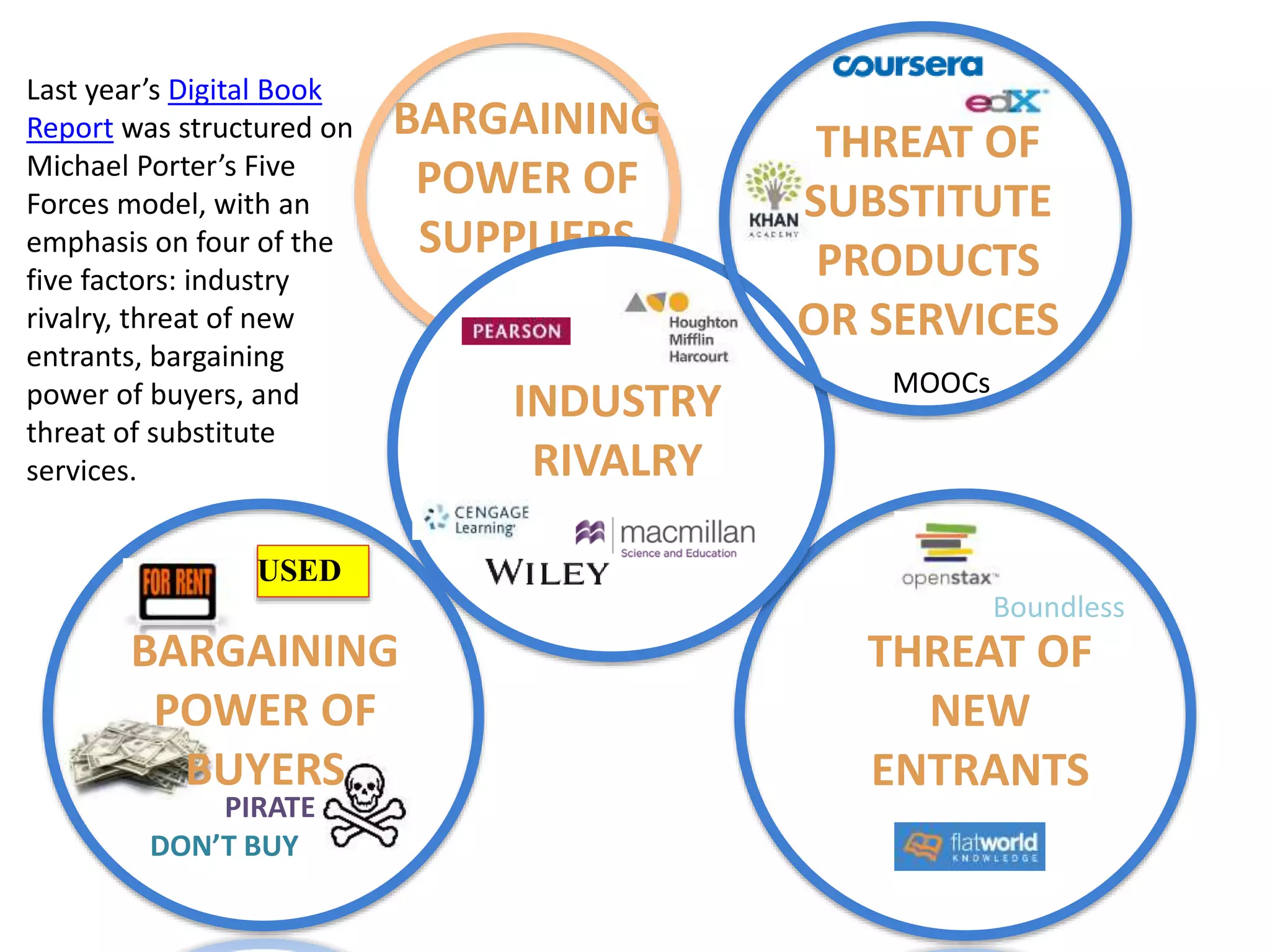
Last year’s Digital Book
Report was structured on
Michael Porter’s Five
Forces model, with an
emphasis on four of the
five factors: industry
rivalry, threat of new
entrants, bargaining
power of buyers, and
threat of substitute
services.
INDUSTRY
RIVALRY
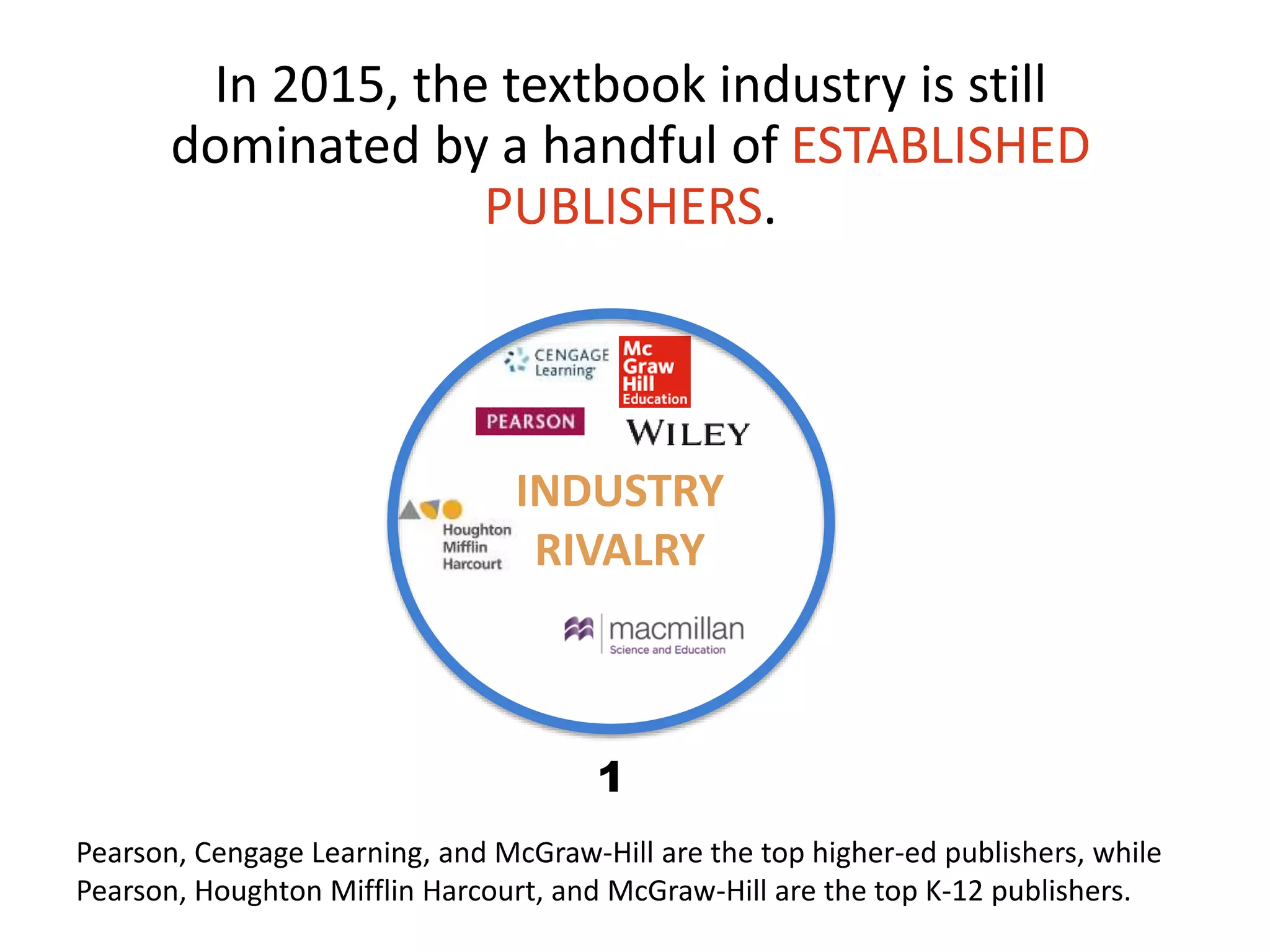
In 2015, the textbook industry is still
dominated by a handful of ESTABLISHED
PUBLISHERS.
1
Pearson, Cengage Learning, and McGraw-Hill are the top higher-ed publishers, while
Pearson, Houghton Mifflin Harcourt, and McGraw-Hill are the top K-12 publishers.
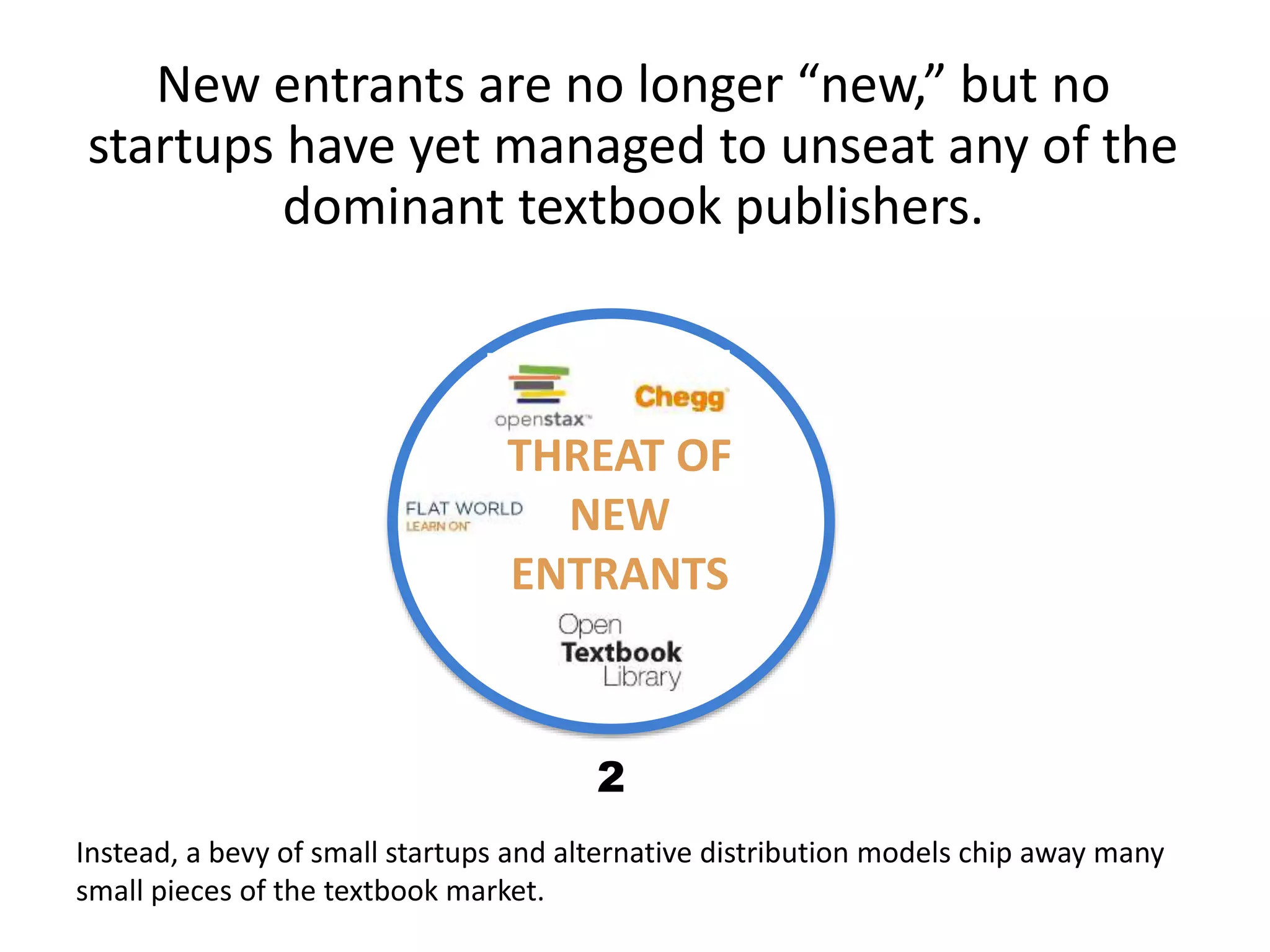
New entrants are no longer “new,” but no
startups have yet managed to unseat any of the
dominant textbook publishers.
2
THREAT OF
NEW
ENTRANTS
Instead, a bevy of small startups and alternative distribution models chip away many
small pieces of the textbook market.
Buyers continue to seek less expensive
ALTERNATIVES to mainstream textbook distribution
channels, such as rentals and used books.
USED
PIRATE
BARGANING
POWER OF
BUYERS
3
Alternative distribution models may cut off income
streams to publishers and authors.
USED
PIRATE
BARGANING
POWER OF
BUYERS
3
The economics of mainstream publishing do not
have much wiggle room for reduced pricing. Author
royalties, editorial costs, sales costs, and overhead
make producing a high-quality academic book
expensive.
Simply “going digital” does not offer much cost
savings. The current model in which textbooks are
offered in print and as digital actually increases
costs because of the expense of the digital platform
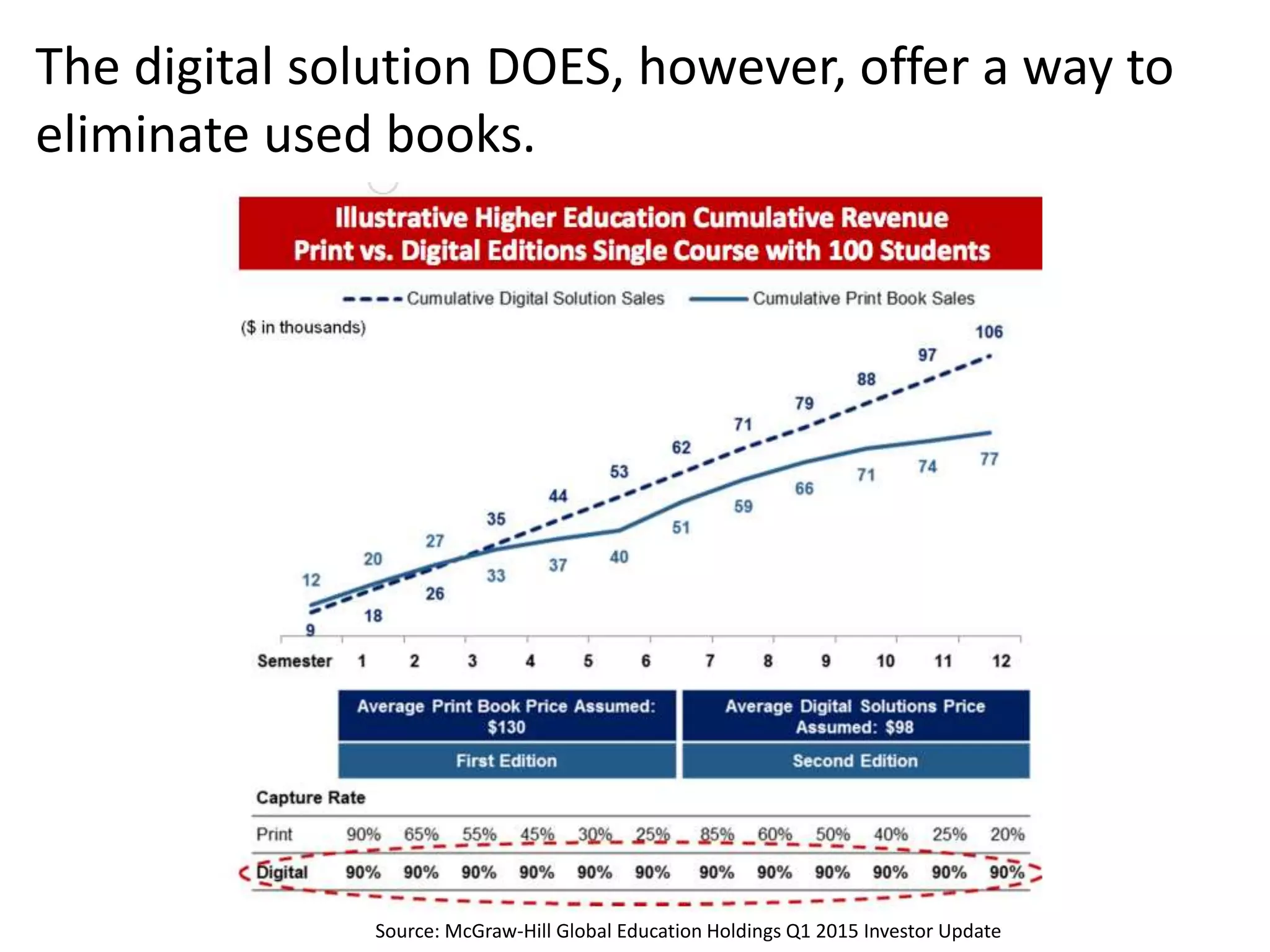
and conversion. The digital solution DOES, however,
offer a way to eliminate used books.
Source: McGraw-Hill Global Education Holdings Q1 2015 Investor Update
The digital solution DOES, however, offer a way to
eliminate used books.
THREAT OF
SUBSTITUTE
PRODUCTS
OR SERVICES
DIGITAL BOOKS were once considered a huge threat to the
textbook market. Would edtech companies eliminate the
market for printed textbooks?
The surge in overall digital book sales that began in 2010 reached a plateau in
2014. Several studies show that most students still prefer printed textbooks over
digital formats.
THREAT OF
SUBSTITUTE
PRODUCTS
OR SERVICES
DIGITAL BOOKS might not be the biggest threat
to the traditional publishing model. DIGITAL
PLATFORMS may offer a bigger threat.
4
THREAT OF
SUBSTITUTE
PRODUCTS
OR SERVICES
Authors need to remain aware of the trend toward
online learning platforms.
4
THREAT OF
SUBSTITUTE
PRODUCTS
OR SERVICES
These platforms essentially merge a content
management system with a learning management
system.
4
THREAT OF
SUBSTITUTE
PRODUCTS
OR SERVICES
Learning content is served to students from within
the platform.
4
THREAT OF
SUBSTITUTE
PRODUCTS
OR SERVICES
These platforms use “chunked,” or modular content
rather than monolithic textbooks.
4
THREAT OF
SUBSTITUTE
PRODUCTS
OR SERVICES
These platforms may not require textbooks as we
know them, or even digital versions of the
textbooks we create.
4
THREAT OF
SUBSTITUTE
PRODUCTS
OR SERVICES
These platforms do need CONTENT, however, but
supplying that content may require authors to learn
new skill sets in pedagogy and in the process of
creating and submitting material.
4
THREAT OF
SUBSTITUTE
PRODUCTS
OR SERVICES
Publishers are likely to pay content creators using a
work-for-hire model rather than a royalty model.
4
THREAT OF
SUBSTITUTE
PRODUCTS
OR SERVICES
The work-for-hire model will severely curtail upside
profit potential for authors.
4
BARGANING
POWER OF
SUPPLIERS
The publishing industry has SUPPLIERS that include paper
merchants and commercial printing companies for print
books; and cloud service providers, programming teams,
and digital developers for content delivered digitally.
And then there are AUTHORS.
5
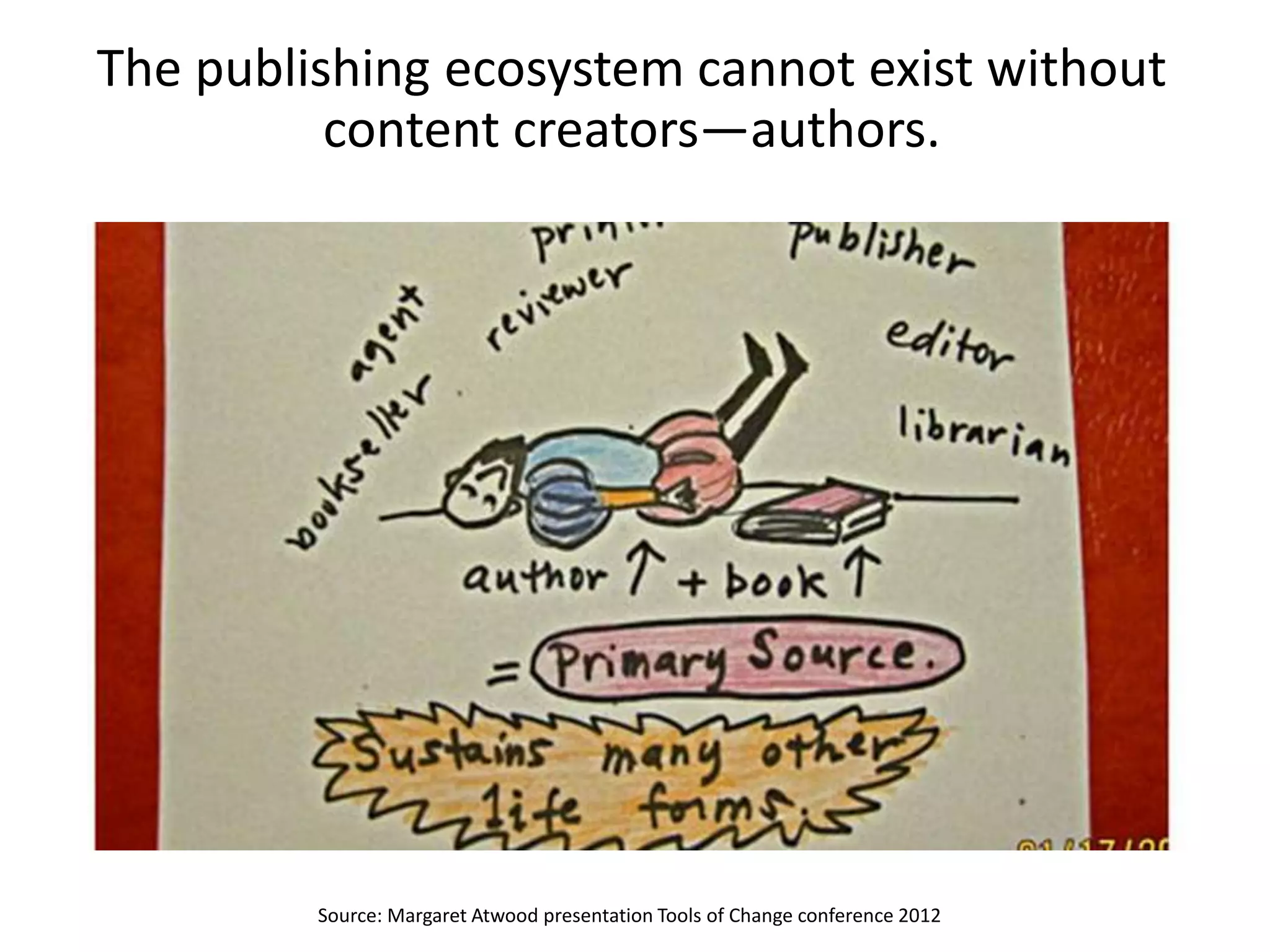
Source: Margaret Atwood presentation Tools of Change conference 2012
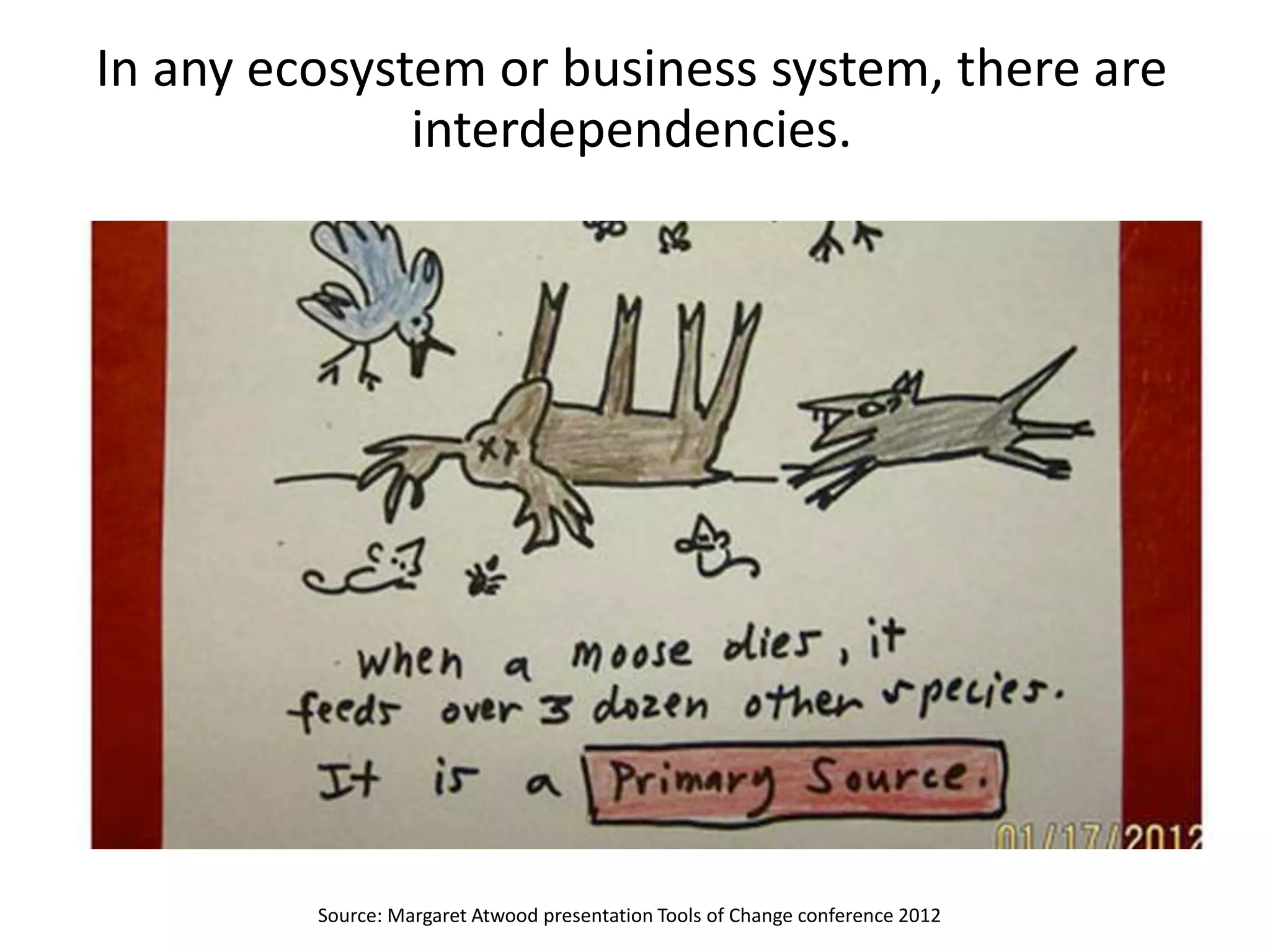
In any ecosystem or business system, there are
interdependencies.
Source: Margaret Atwood presentation Tools of Change conference 2012
The publishing ecosystem cannot exist without
content creators—authors.
BARGANING
POWER OF
SUPPLIERS
What do we know about textbook AUTHORS AS
SUPPLIERS in the publishing industry?
5
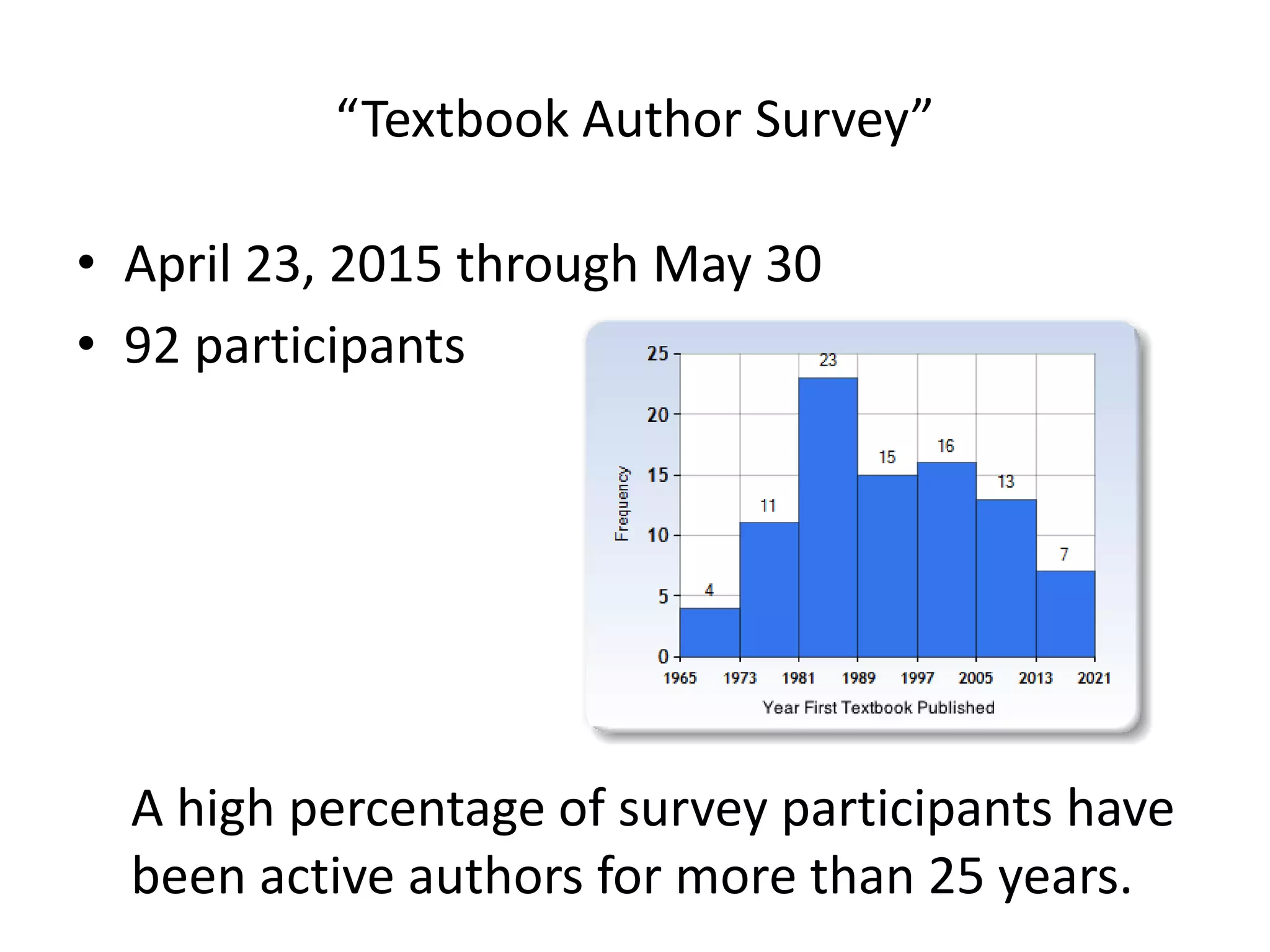
“Textbook Author Survey”
• April 23, 2015 through May 30
• 92 participants
A high percentage of survey participants have
been active authors for more than 25 years.
Survey Results
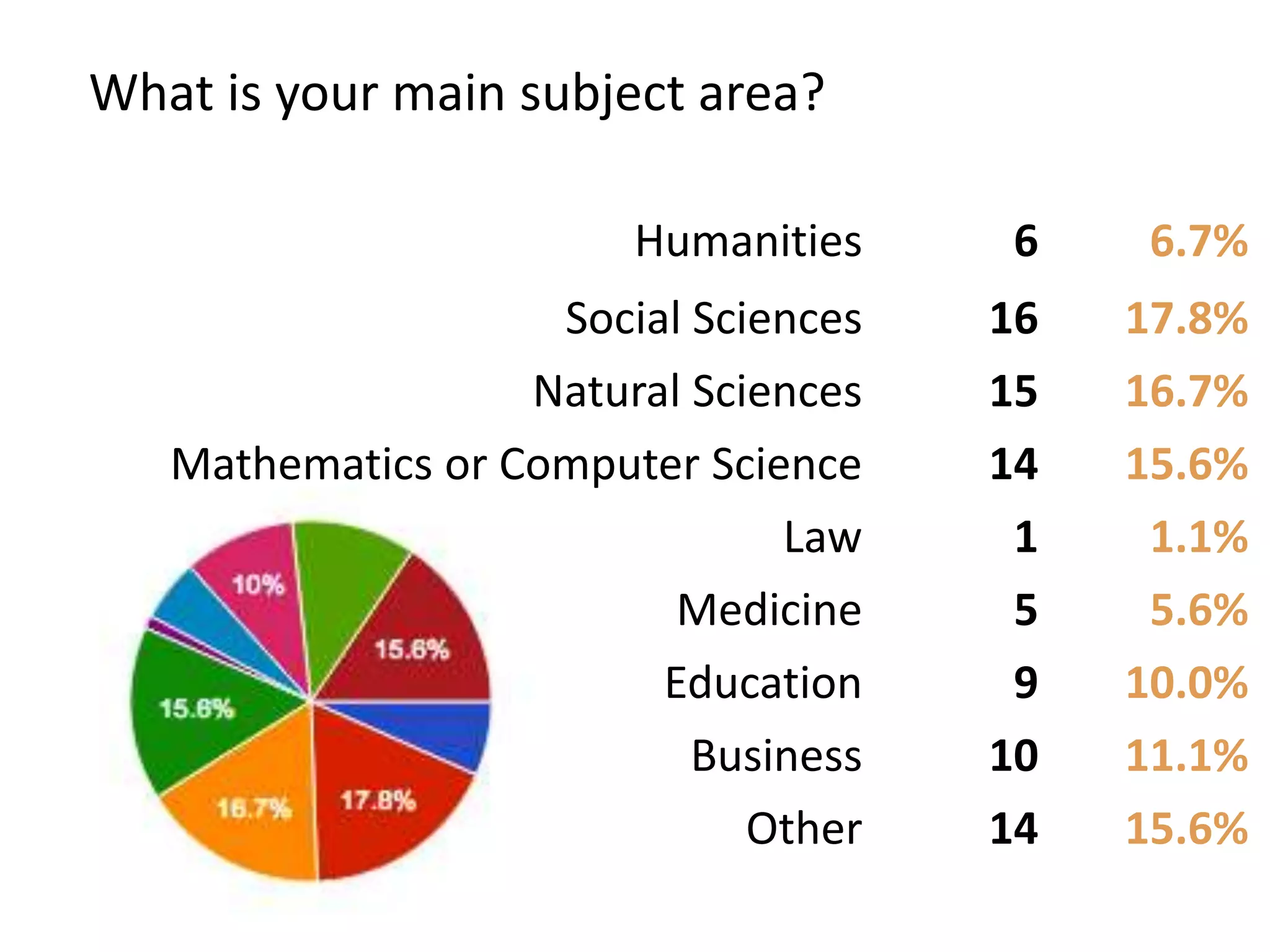
Humanities 6 6.7%
Social Sciences 16 17.8%
Natural Sciences 15 16.7%
Mathematics or Computer Science 14 15.6%
Law 1 1.1%
Medicine 5 5.6%
Education 9 10.0%
Business 10 11.1%
Other 14 15.6%
What is your main subject area?
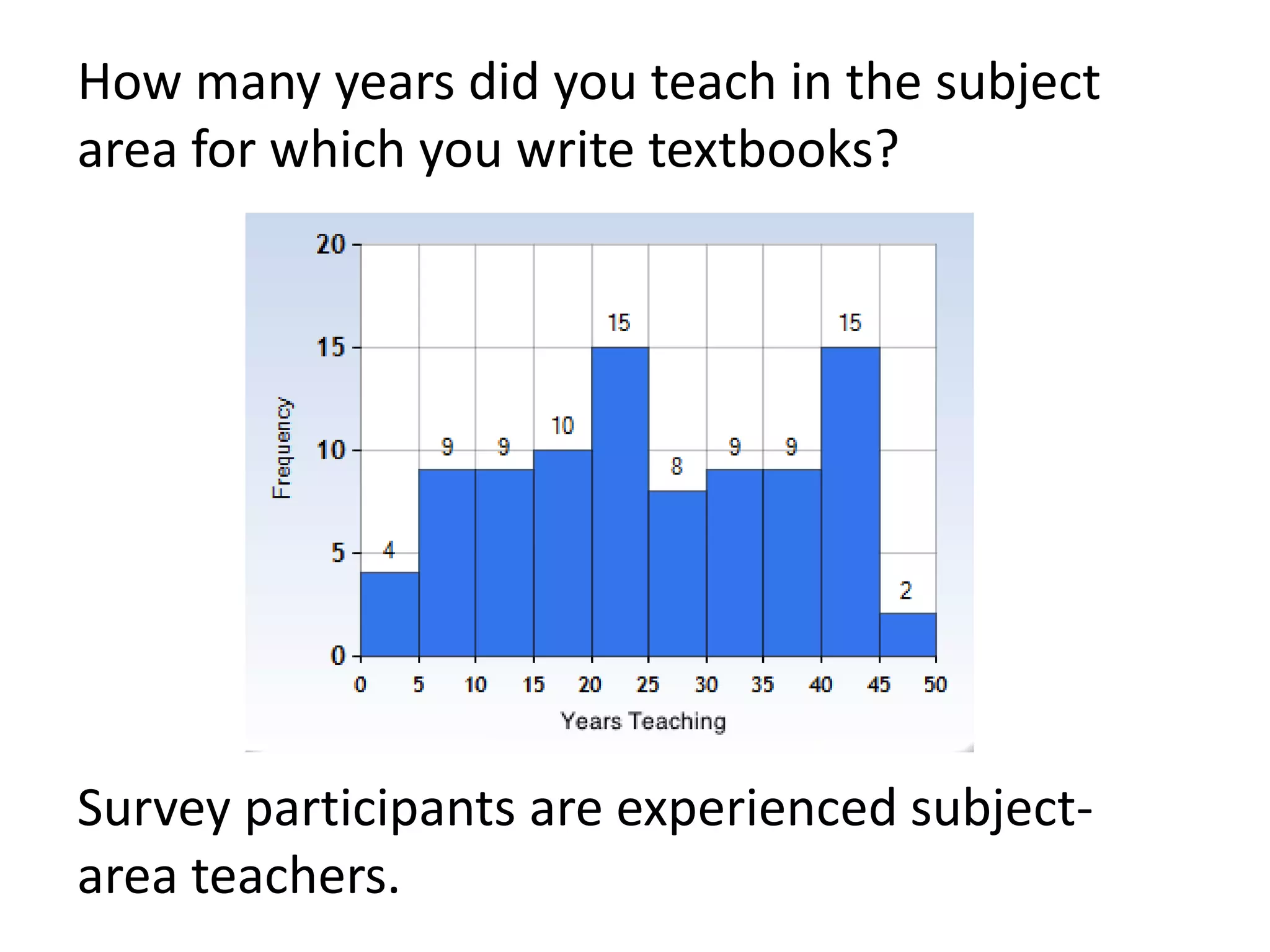
How many years did you teach in the subject
area for which you write textbooks?
Survey participants are experienced subject-
area teachers.
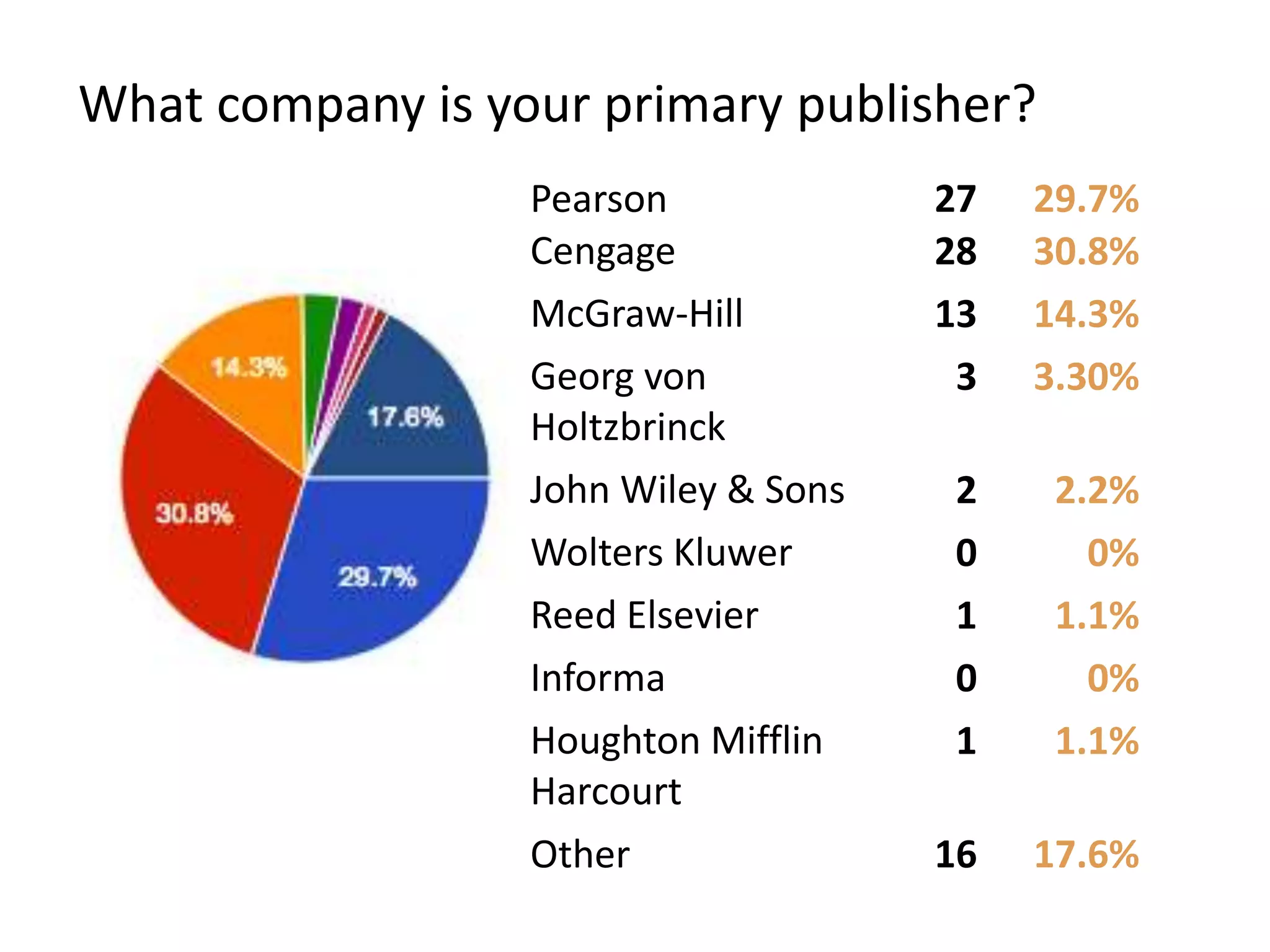
What company is your primary publisher?
Pearson 27 29.7%
Cengage 28 30.8%
McGraw-Hill 13 14.3%
Georg von
Holtzbrinck
3 3.30%
John Wiley & Sons 2 2.2%
Wolters Kluwer 0 0%
Reed Elsevier 1 1.1%
Informa 0 0%
Houghton Mifflin
Harcourt
1 1.1%
Other 16 17.6%
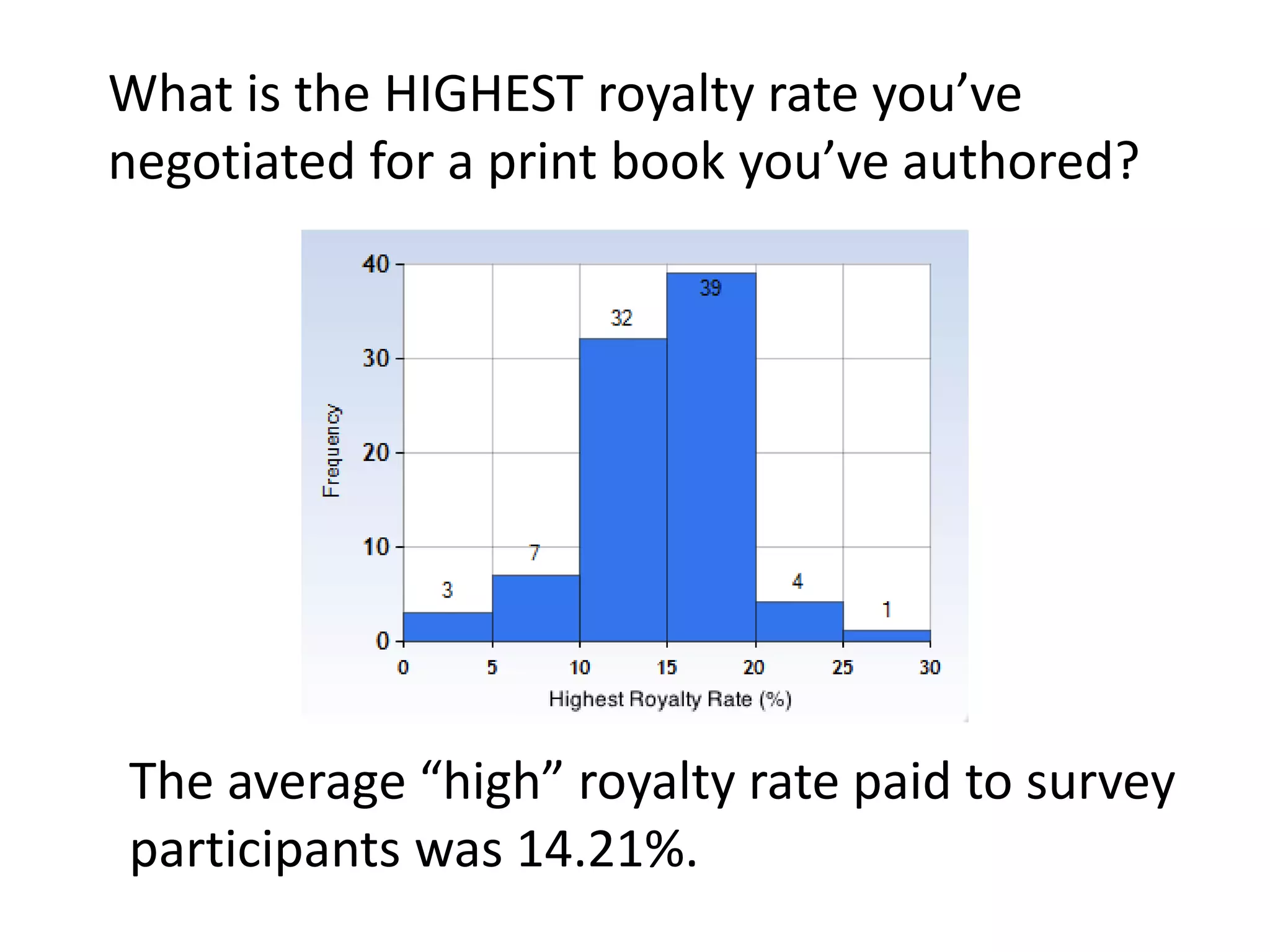
What is the HIGHEST royalty rate you’ve
negotiated for a print book you’ve authored?
The average “high” royalty rate paid to survey
participants was 14.21%.
What is the HIGHEST royalty rate you’ve
negotiated for a print book you’ve authored?
A breakdown of the bracket with the highest
frequency shows 15% and 18% to be common.
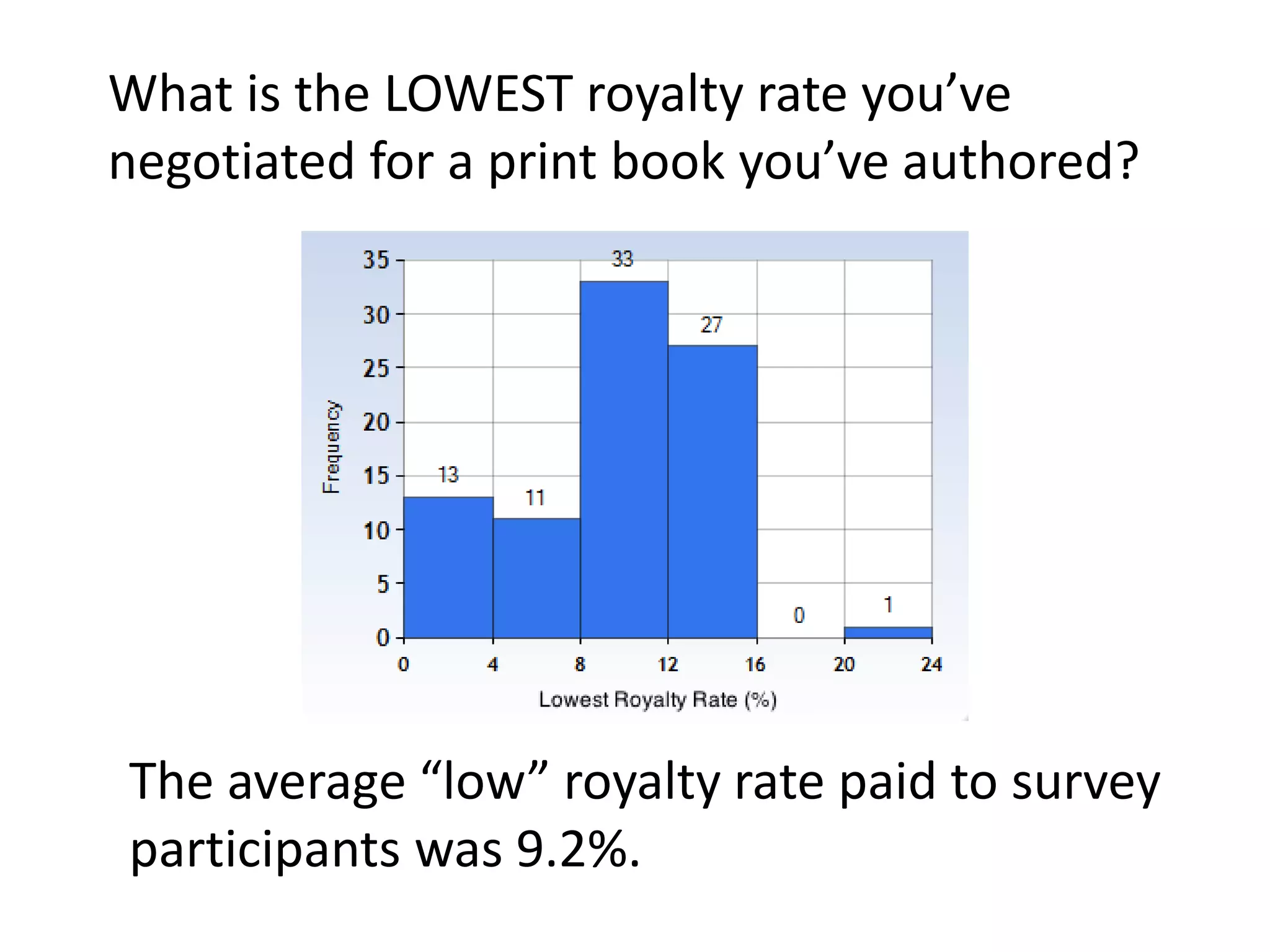
What is the LOWEST royalty rate you’ve
negotiated for a print book you’ve authored?
The average “low” royalty rate paid to survey
participants was 9.2%.
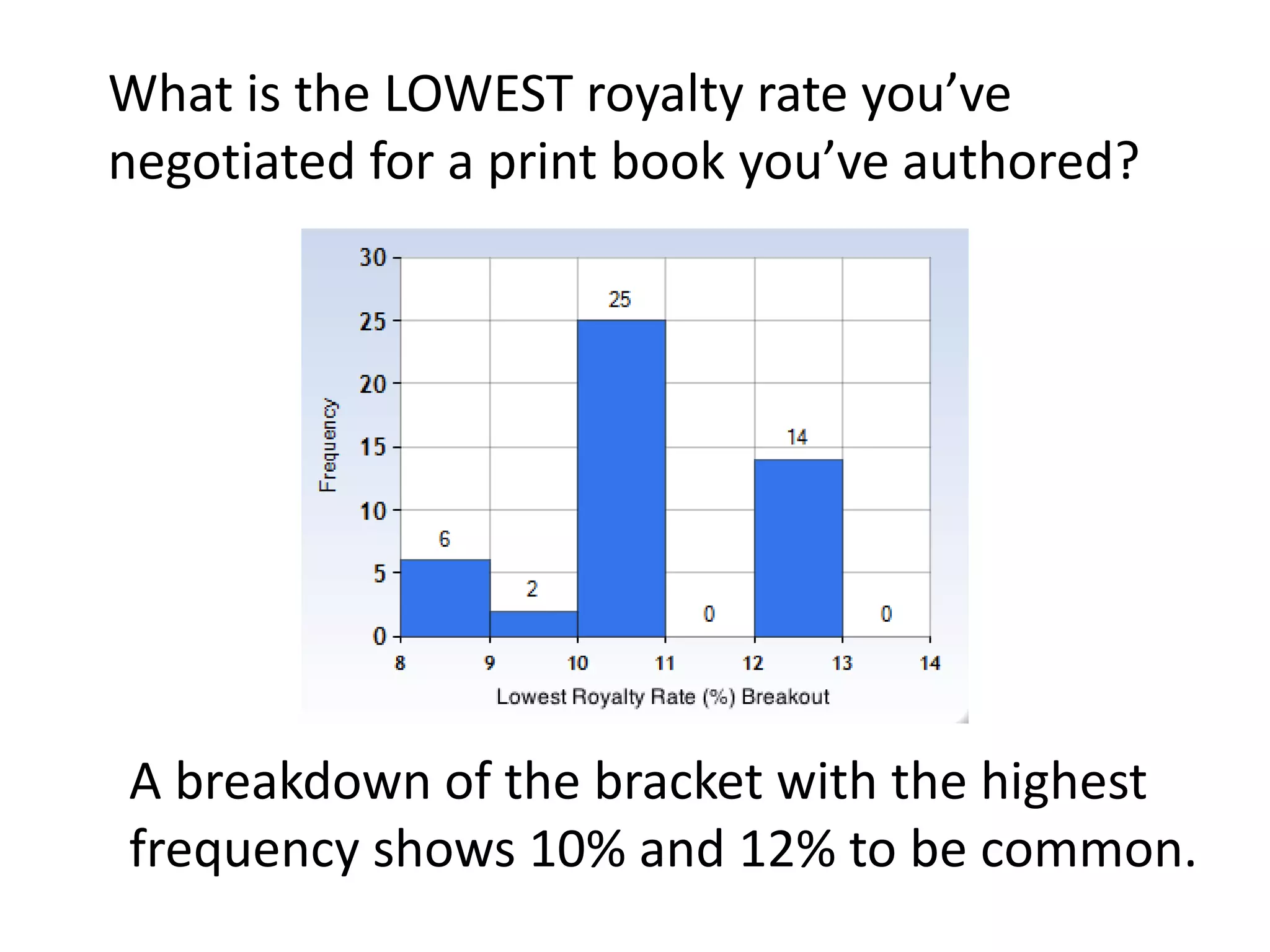
What is the LOWEST royalty rate you’ve
negotiated for a print book you’ve authored?
A breakdown of the bracket with the highest
frequency shows 10% and 12% to be common.
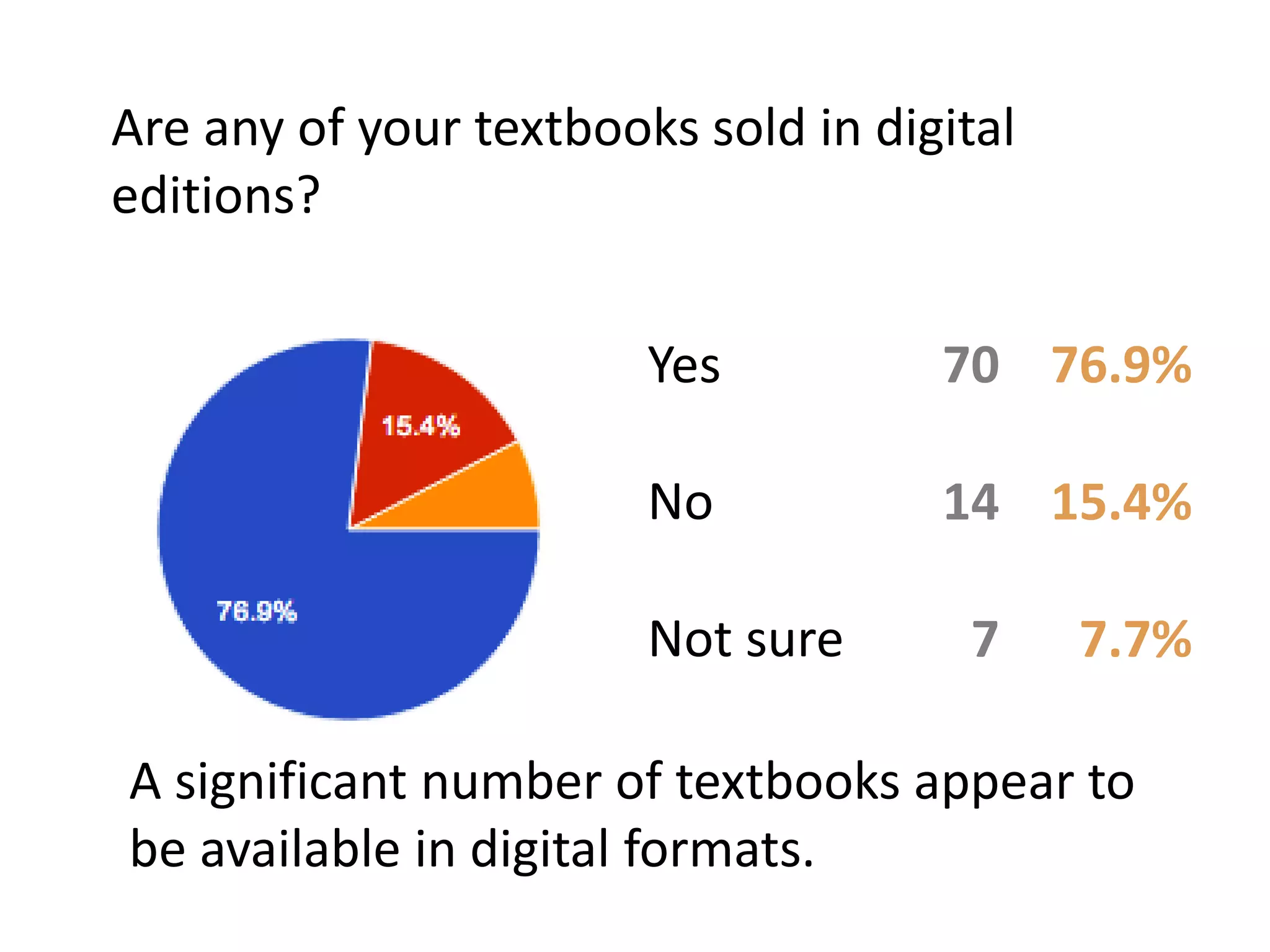
Are any of your textbooks sold in digital
editions?
Yes 70 76.9%
No 14 15.4%
Not sure 7 7.7%
A significant number of textbooks appear to
be available in digital formats.
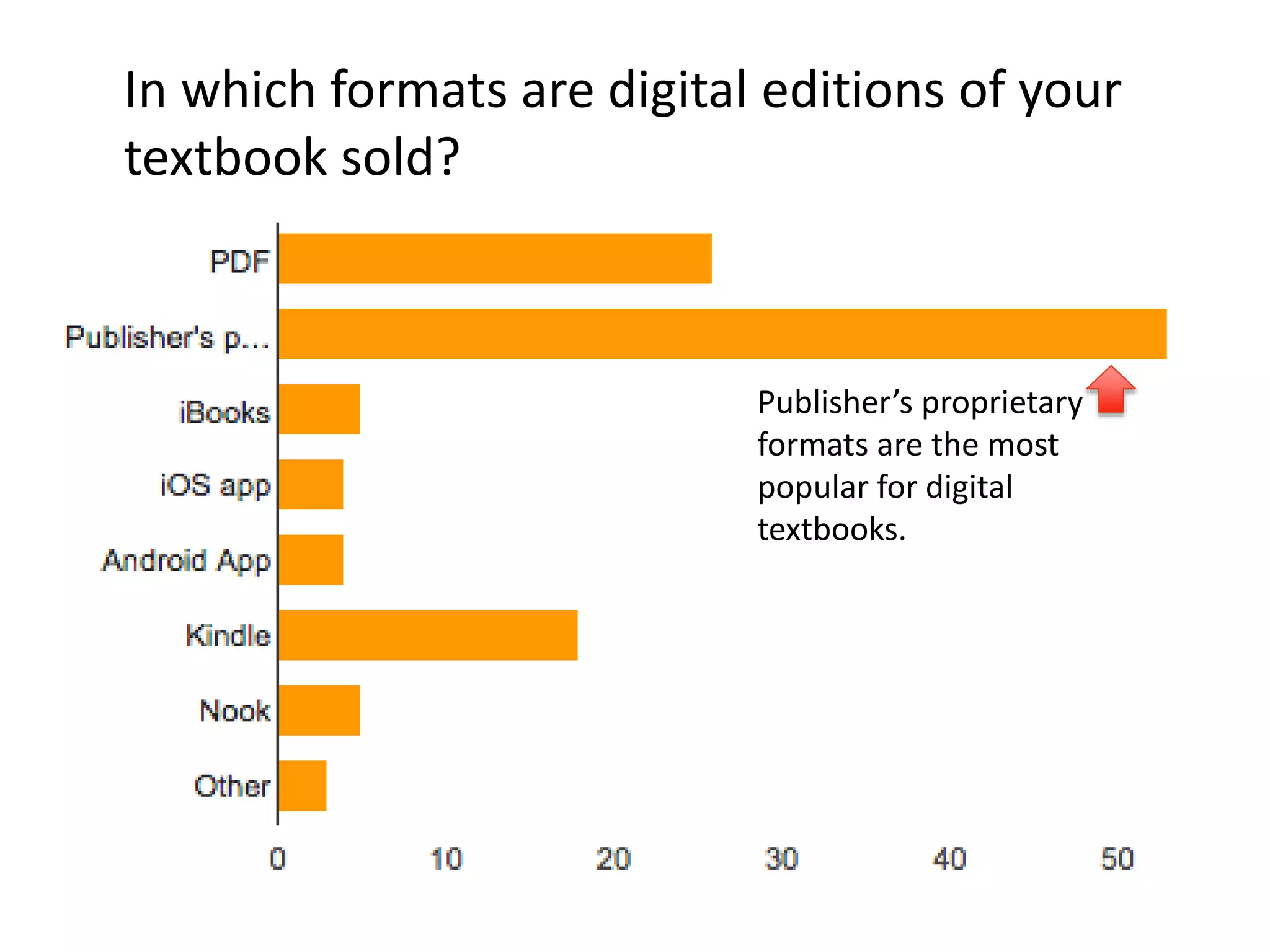
In which formats are digital editions of your
textbook sold?
Publisher’s proprietary
formats are the most
popular for digital
textbooks.
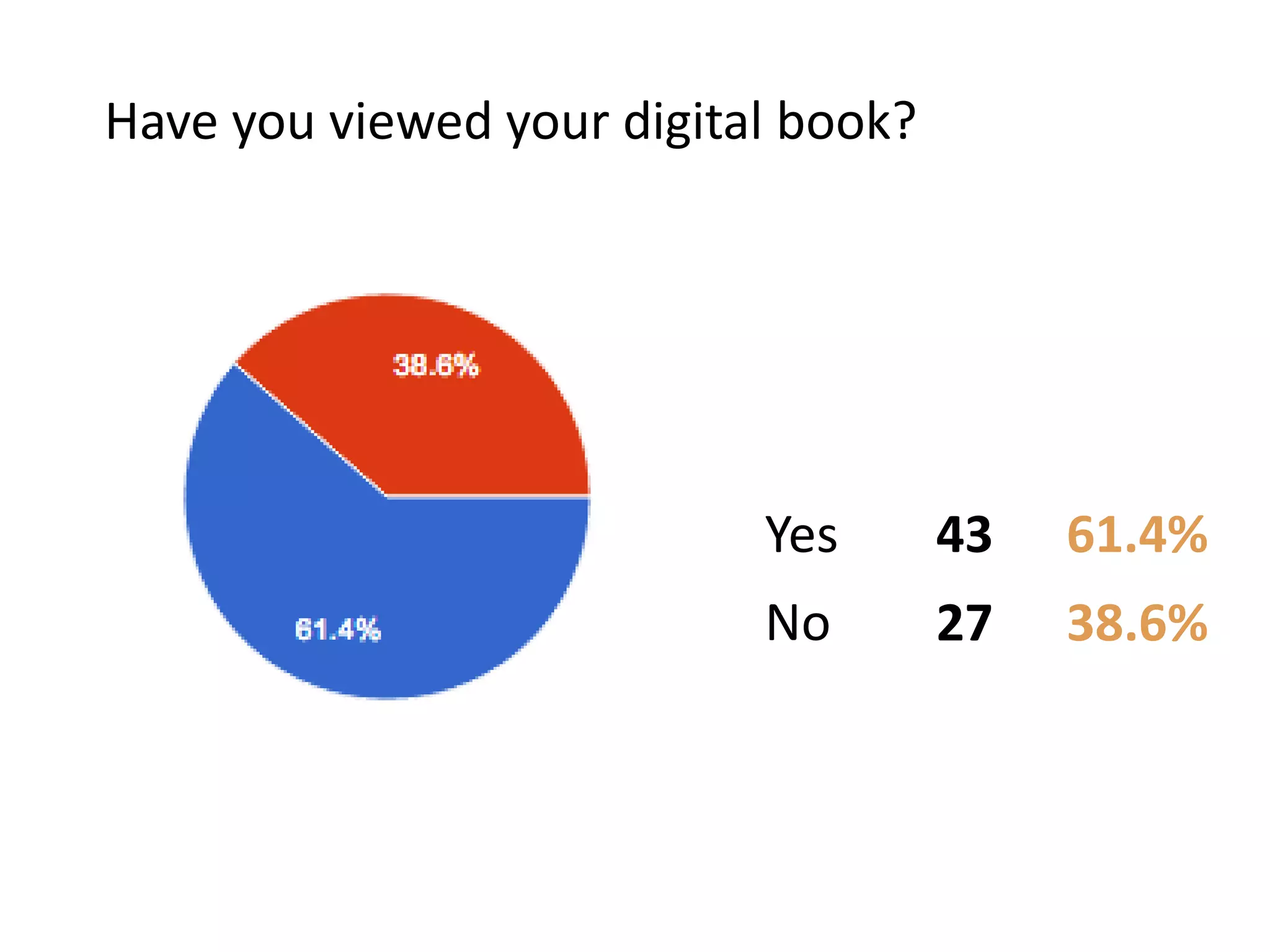
Yes 43 61.4%
No 27 38.6%
Have you viewed your digital book?
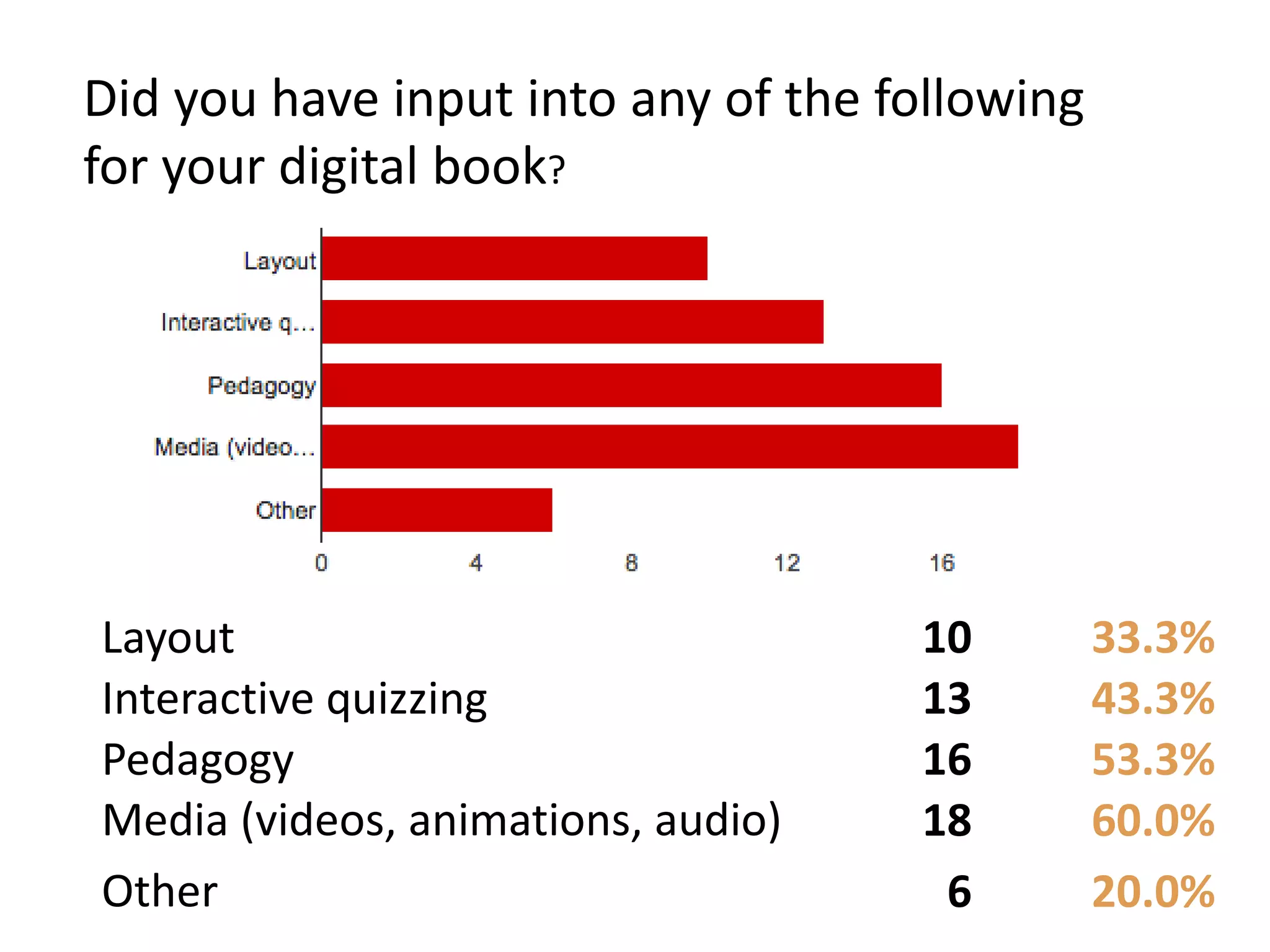
Did you have input into any of the following
for your digital book?
Layout 10 33.3%
Interactive quizzing 13 43.3%
Pedagogy 16 53.3%
Media (videos, animations, audio) 18 60.0%
Other 6 20.0%
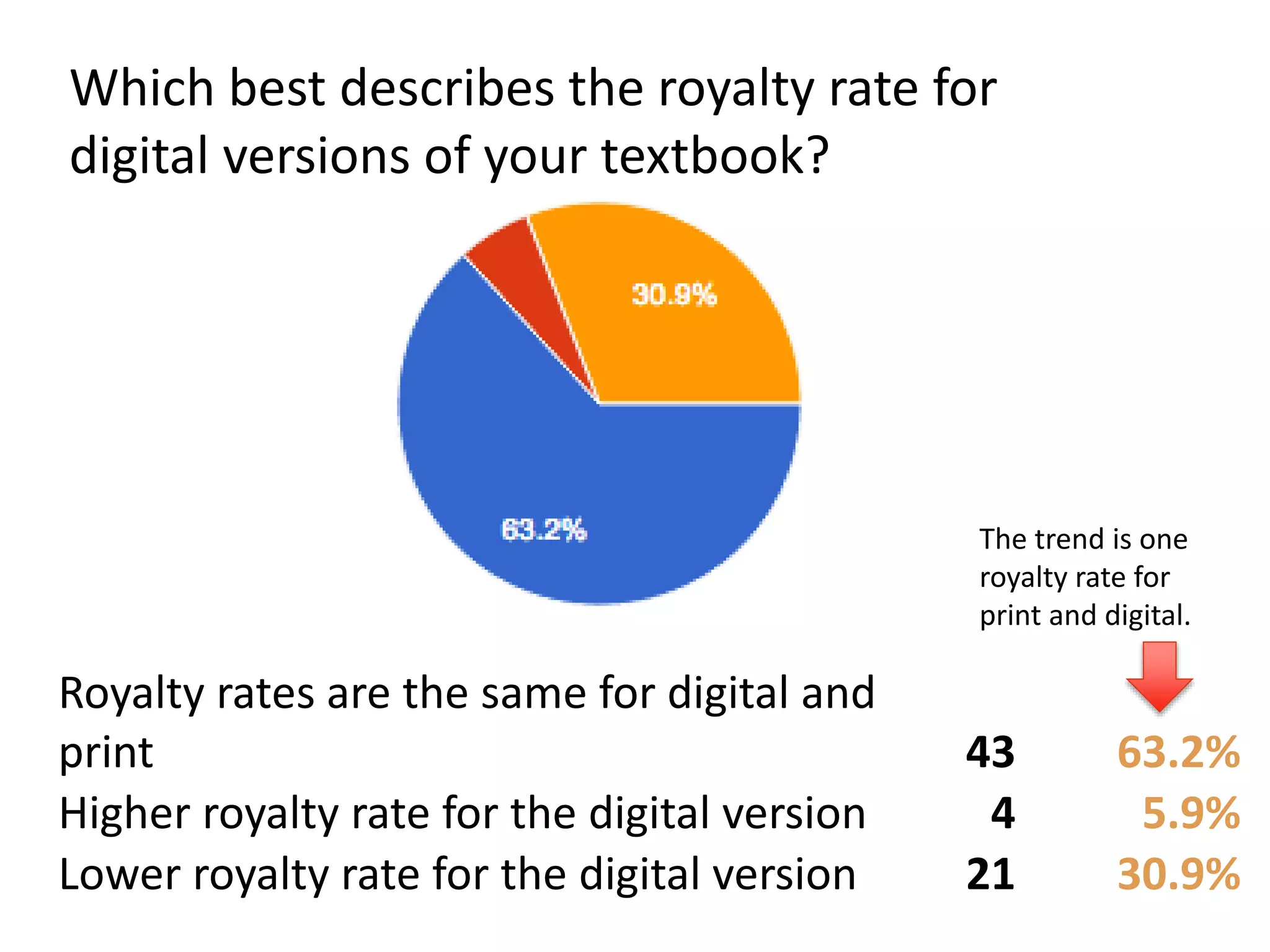
Which best describes the royalty rate for
digital versions of your textbook?
Royalty rates are the same for digital and
print 43 63.2%
Higher royalty rate for the digital version 4 5.9%
Lower royalty rate for the digital version 21 30.9%
The trend is one
royalty rate for
print and digital.
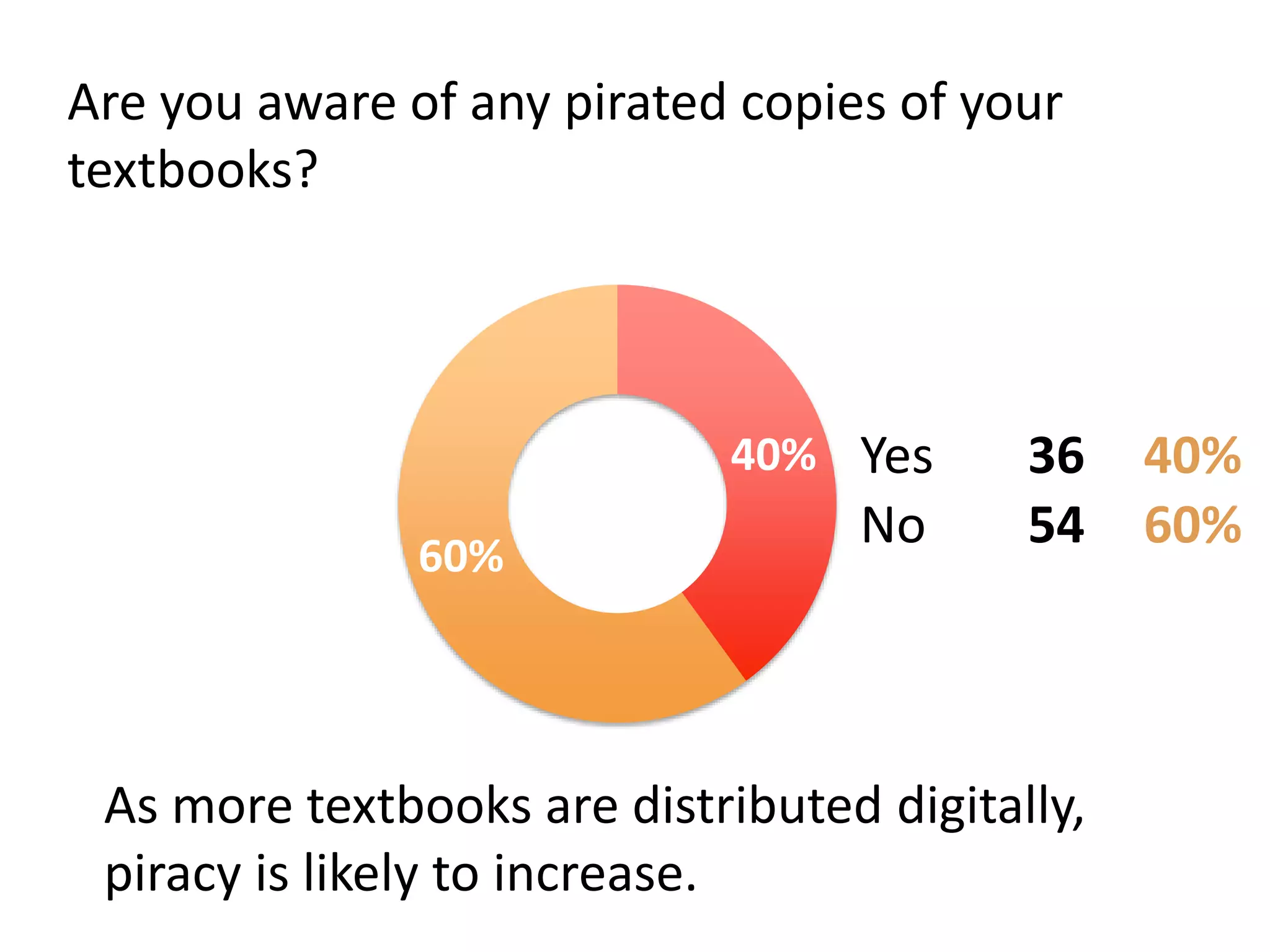
Yes 36 40%
No 54 60%
40%
60%
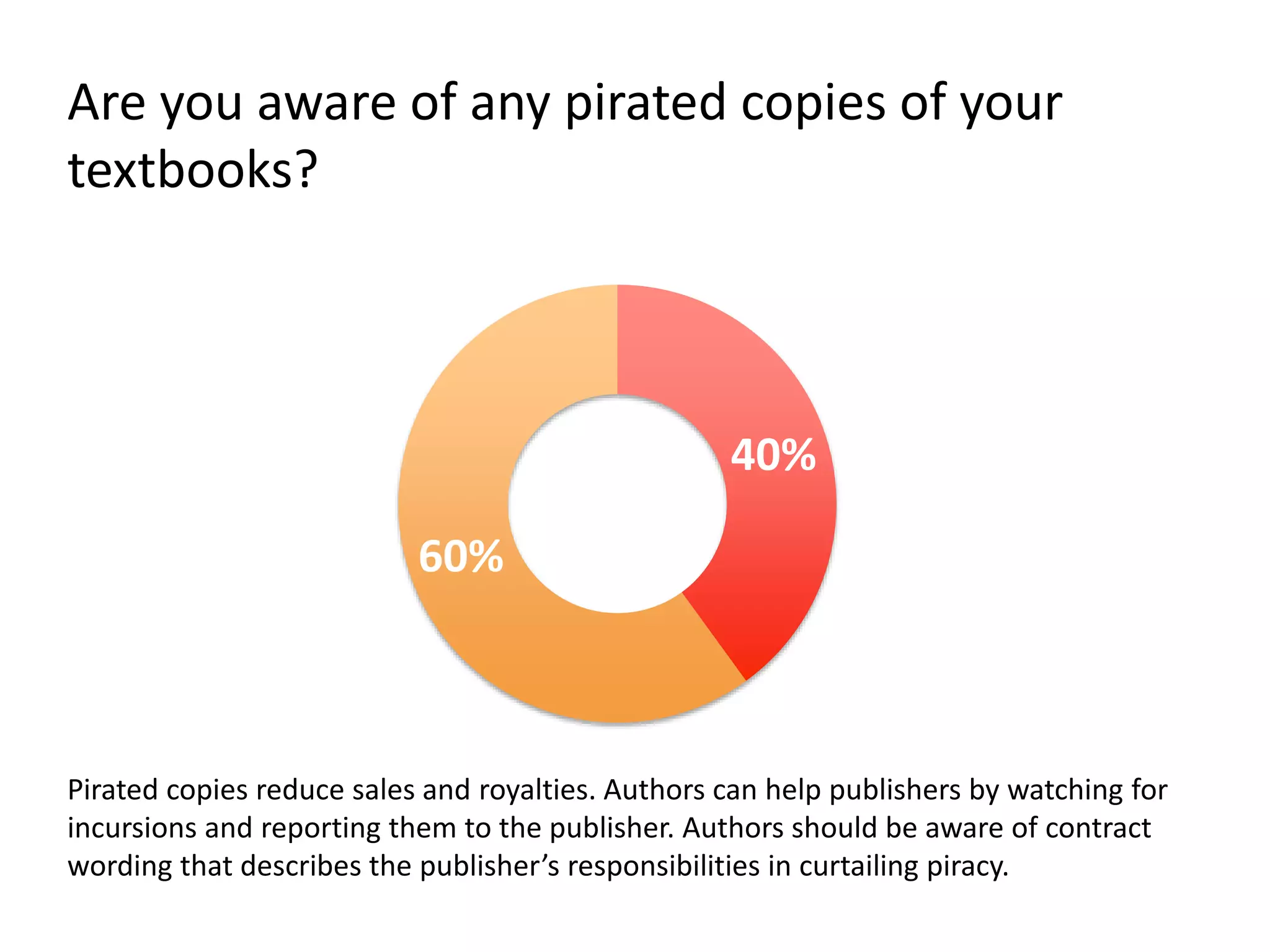
Are you aware of any pirated copies of your
textbooks?
As more textbooks are distributed digitally,
piracy is likely to increase.
40%
60%
Are you aware of any pirated copies of your
textbooks?
Pirated copies reduce sales and royalties. Authors can help publishers by watching for
incursions and reporting them to the publisher. Authors should be aware of contract
wording that describes the publisher’s responsibilities in curtailing piracy.
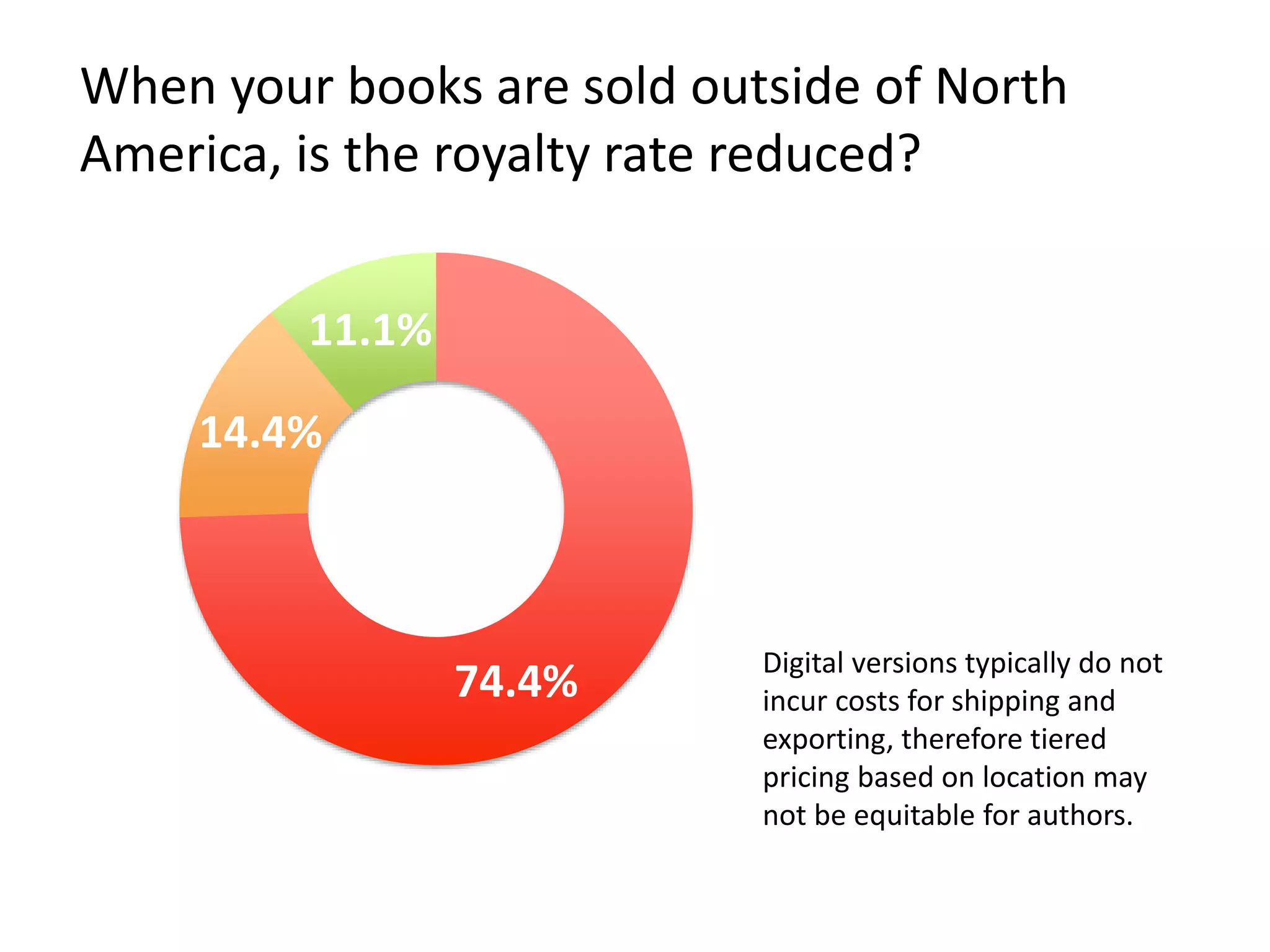
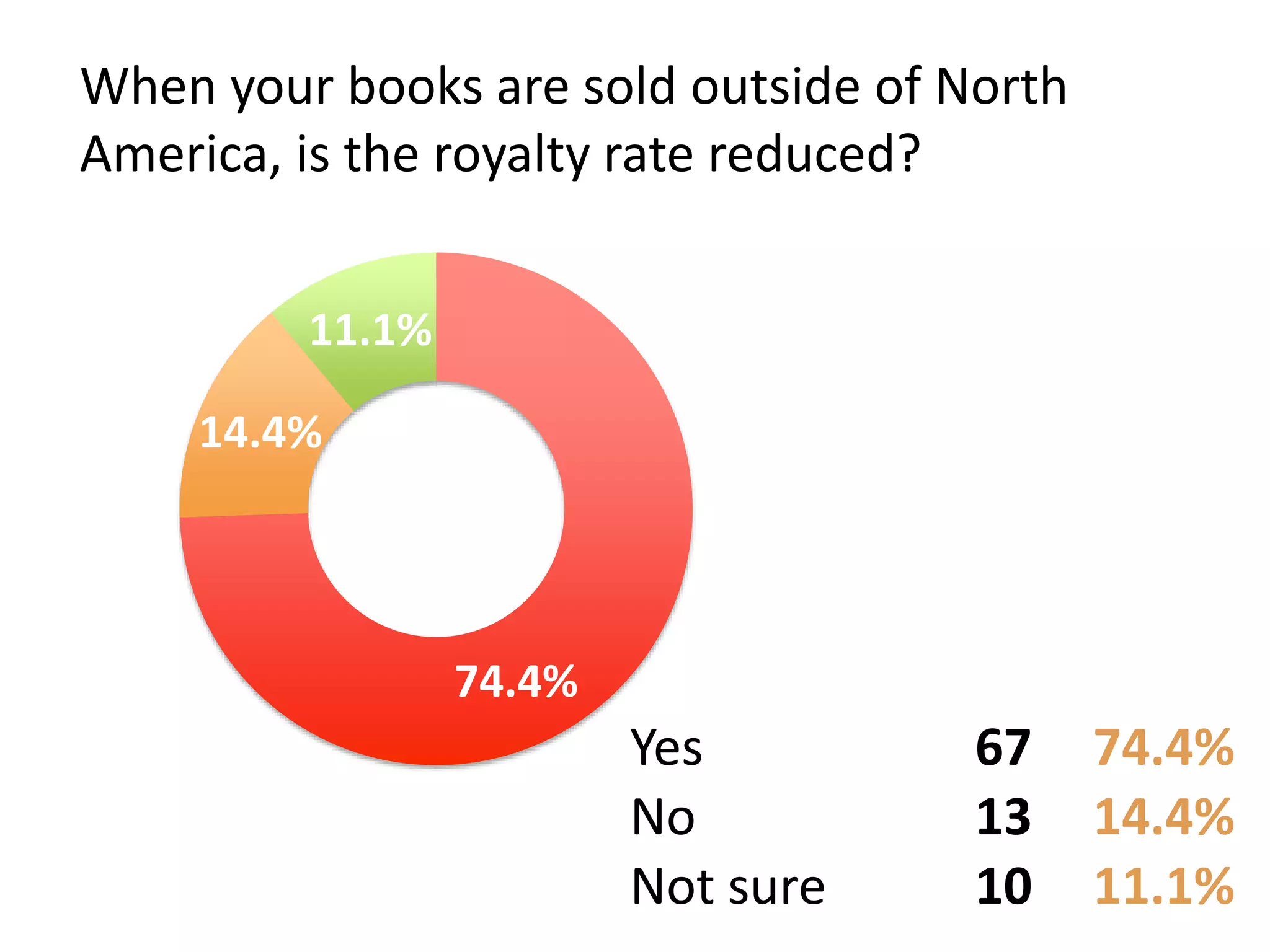
When your books are sold outside of North
America, is the royalty rate reduced?
Yes 67 74.4%
No 13 14.4%
Not sure 10 11.1%
74.4%
14.4%
11.1%
When your books are sold outside of North
America, is the royalty rate reduced?
74.4%
14.4%
11.1%
Digital versions typically do not
incur costs for shipping and
exporting, therefore tiered
pricing based on location may
not be equitable for authors.
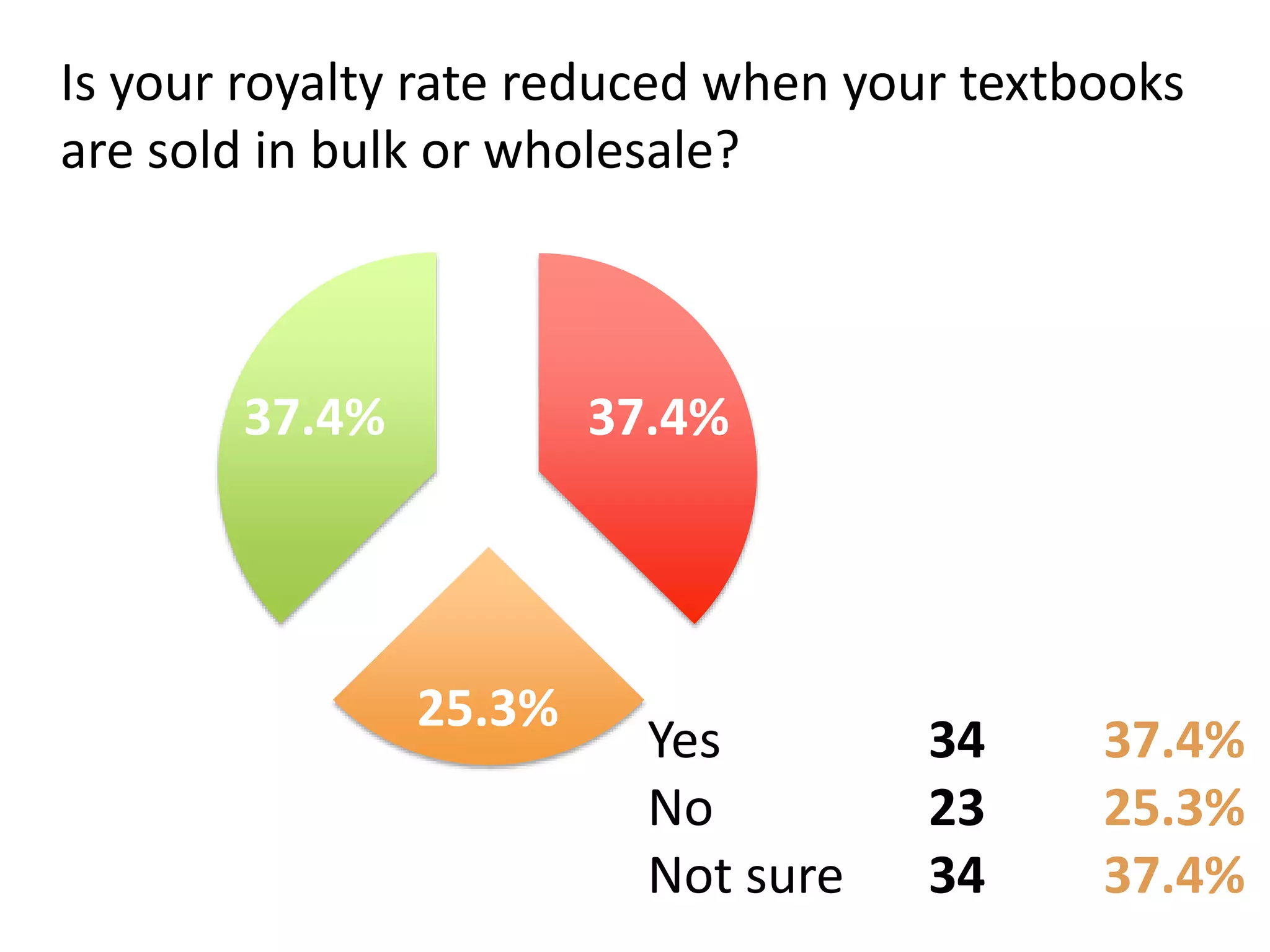
Is your royalty rate reduced when your textbooks
are sold in bulk or wholesale?
Yes 34 37.4%
No 23 25.3%
Not sure 34 37.4%
37.4%
25.3%
37.4%
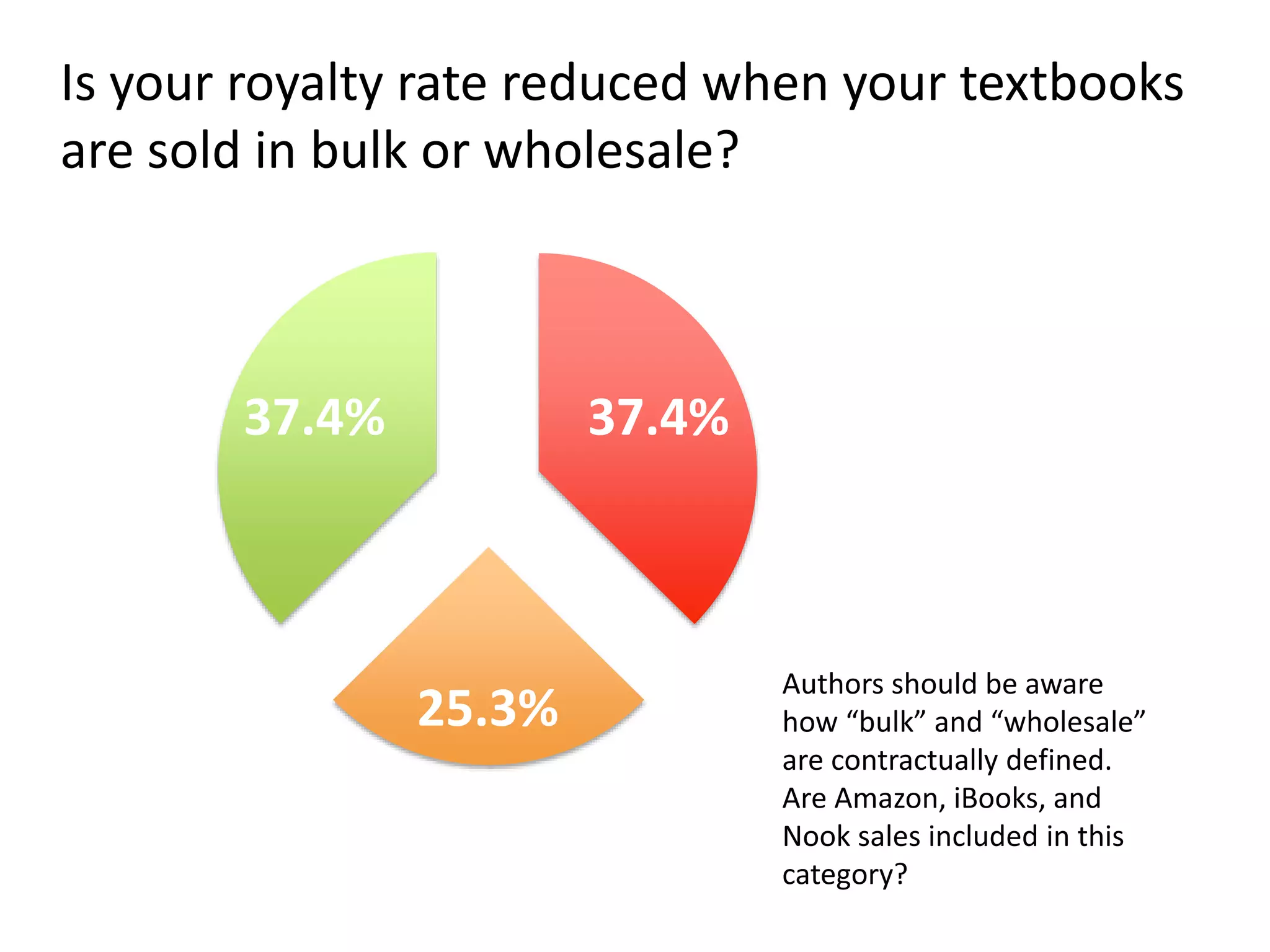
Is your royalty rate reduced when your textbooks
are sold in bulk or wholesale?
37.4%
25.3%
37.4%
Authors should be aware
how “bulk” and “wholesale”
are contractually defined.
Are Amazon, iBooks, and
Nook sales included in this
category?
67.8%
26.7%
5.6%
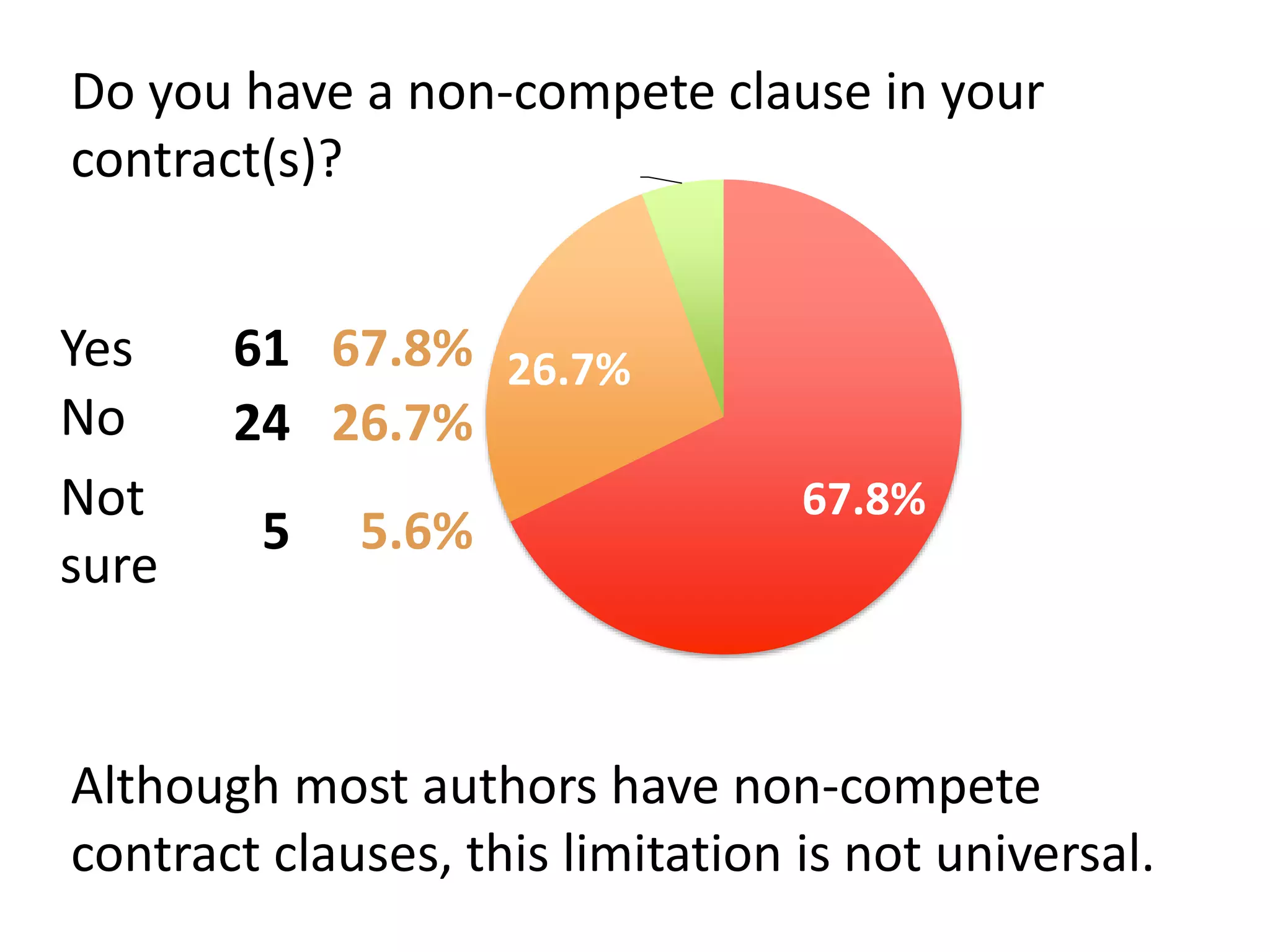
Do you have a non-compete clause in your
contract(s)?
Yes 61 67.8%
No 24 26.7%
Not
sure
5 5.6%
Although most authors have non-compete
contract clauses, this limitation is not universal.
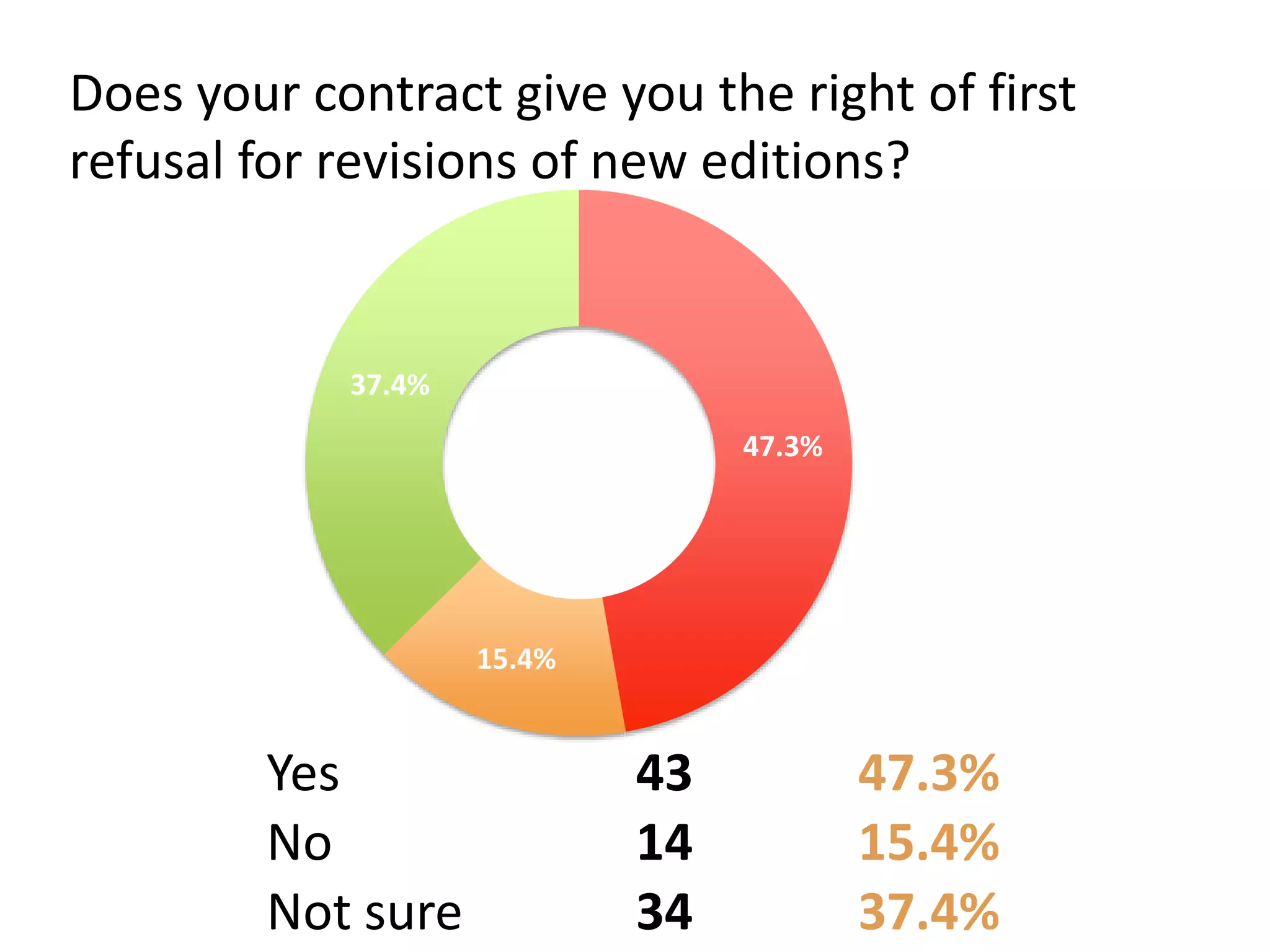
Does your contract give you the right of first
refusal for revisions of new editions?
Yes 43 47.3%
No 14 15.4%
Not sure 34 37.4%
47.3%
15.4%
37.4%
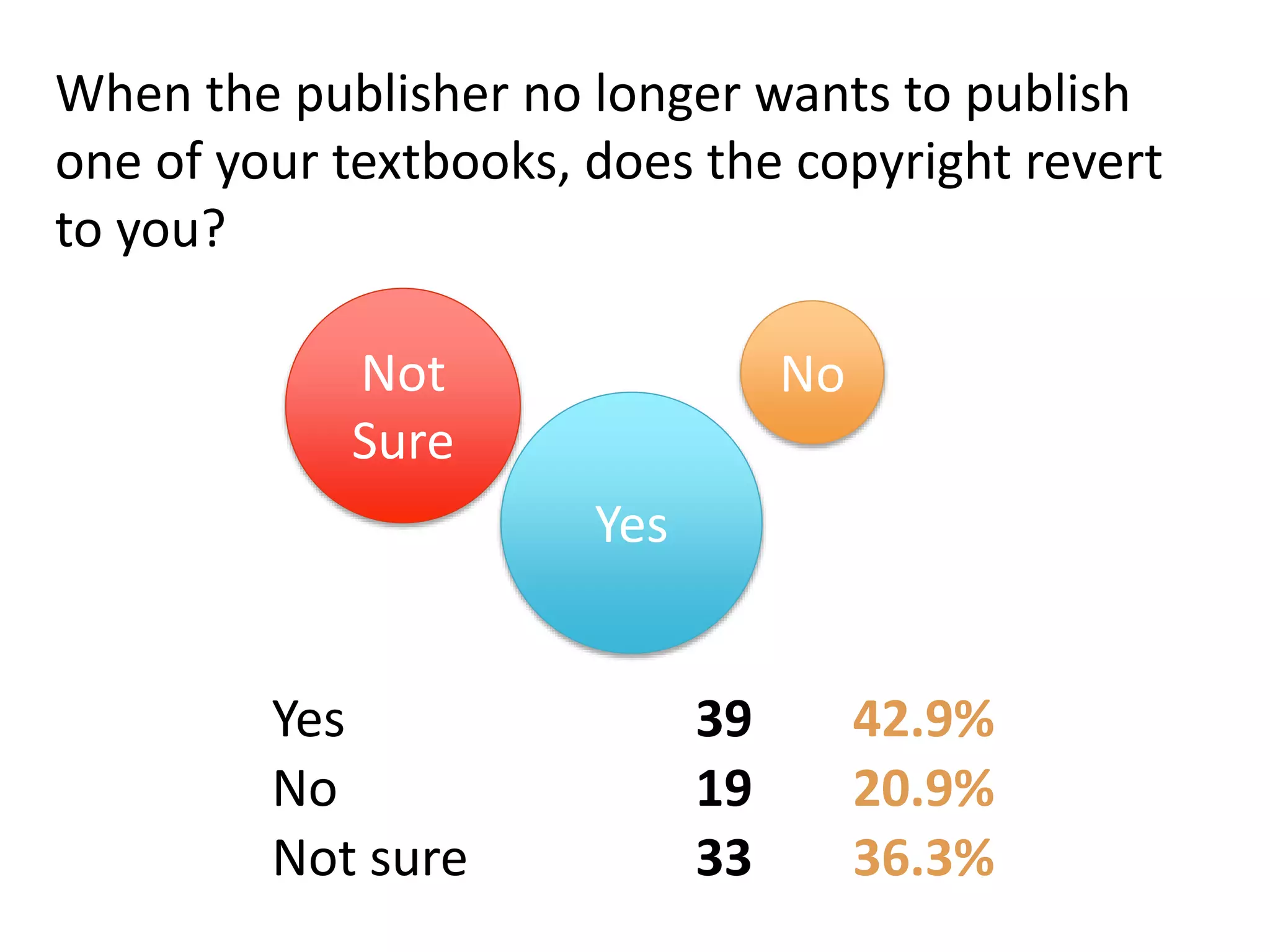
Yes 39 42.9%
No 19 20.9%
Not sure 33 36.3%
Not
Sure
Yes
No
When the publisher no longer wants to publish
one of your textbooks, does the copyright revert
to you?
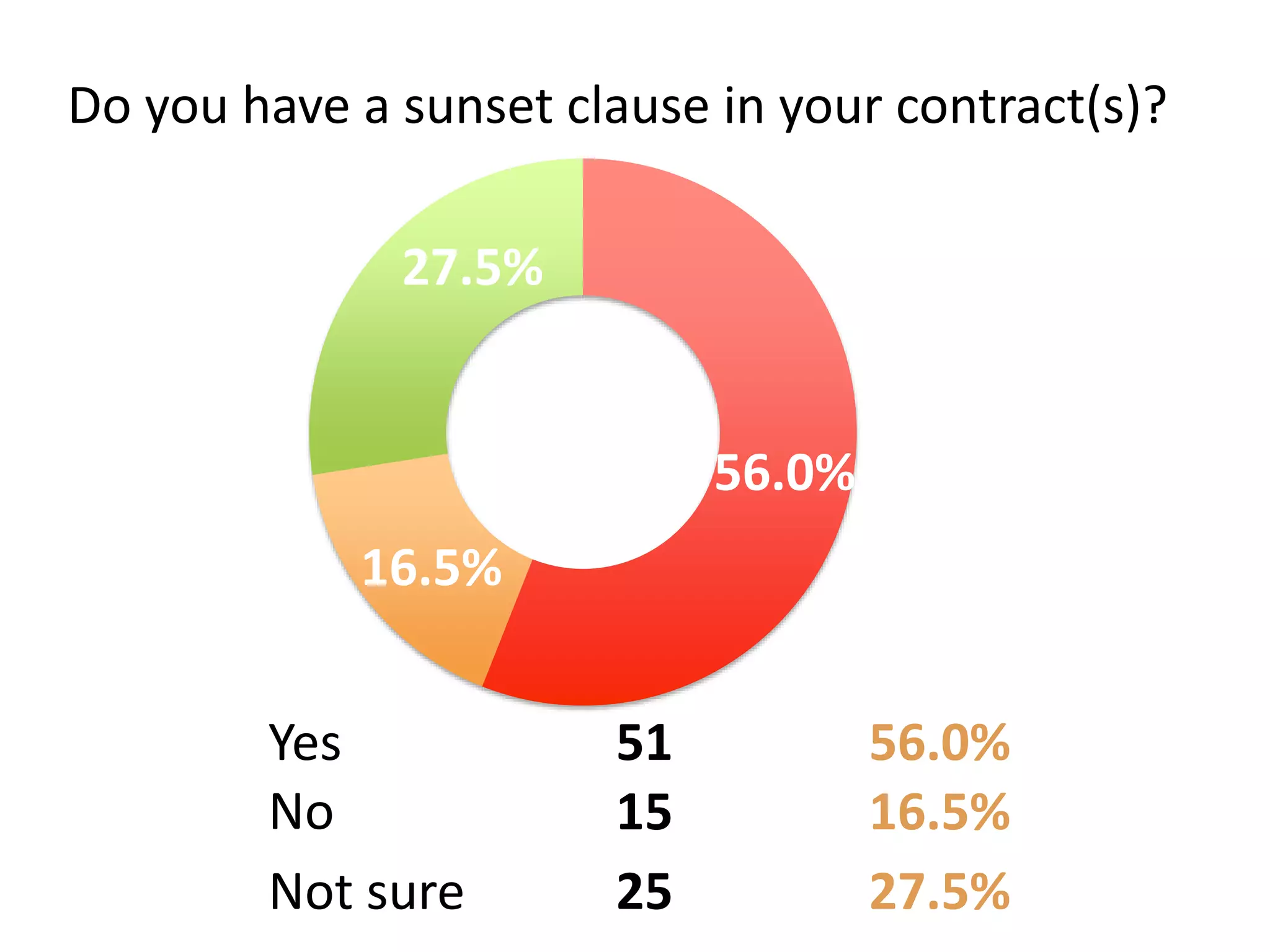
56.0%
16.5%
27.5%
Yes 51 56.0%
No 15 16.5%
Not sure 25 27.5%
Do you have a sunset clause in your contract(s)?
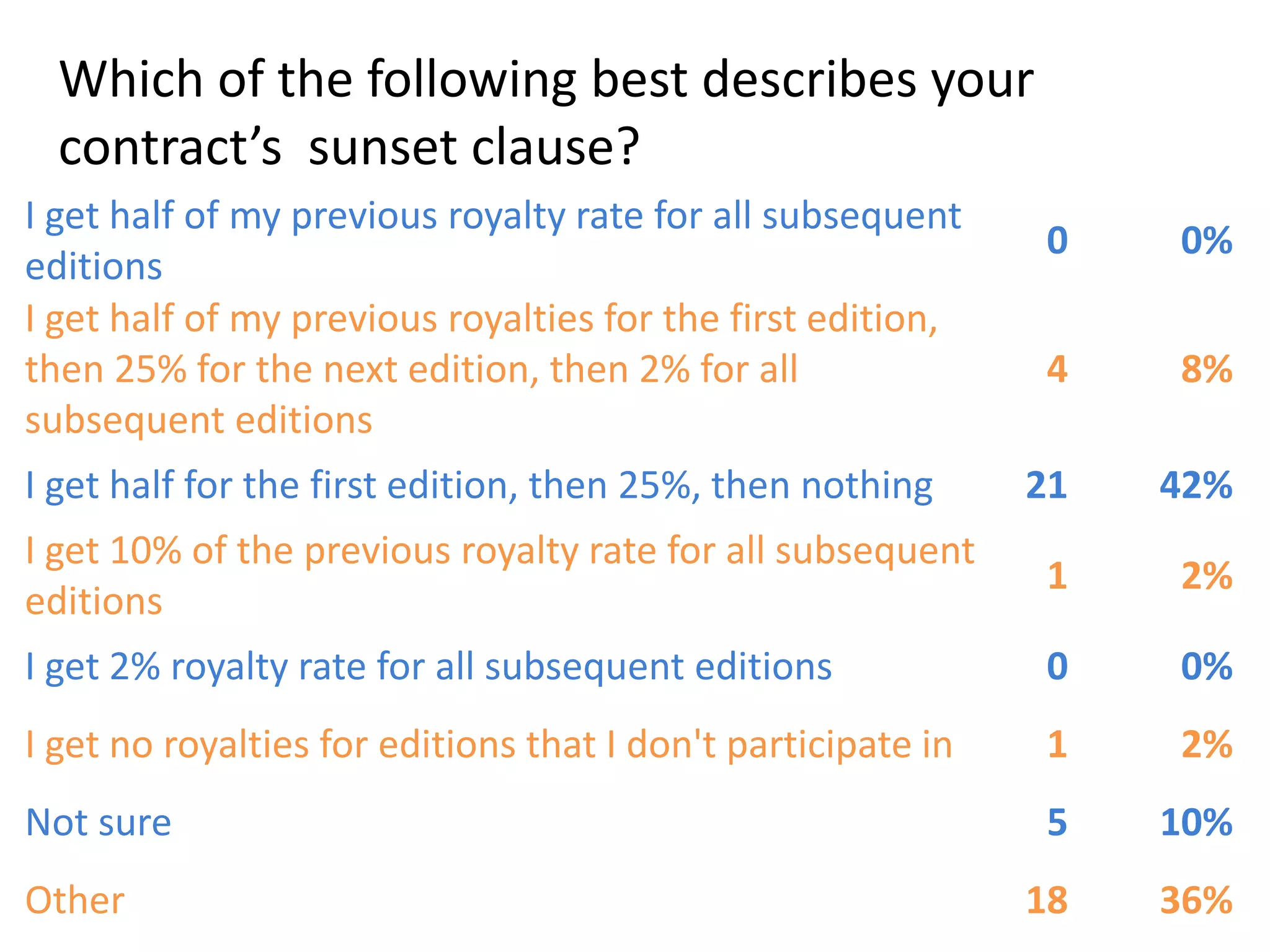
I get half of my previous royalty rate for all subsequent
editions
0 0%
I get half of my previous royalties for the first edition,
then 25% for the next edition, then 2% for all
subsequent editions
4 8%
I get half for the first edition, then 25%, then nothing 21 42%
I get 10% of the previous royalty rate for all subsequent
editions
1 2%
I get 2% royalty rate for all subsequent editions 0 0%
I get no royalties for editions that I don't participate in 1 2%
Not sure 5 10%
Other 18 36%
Which of the following best describes your
contract’s sunset clause?
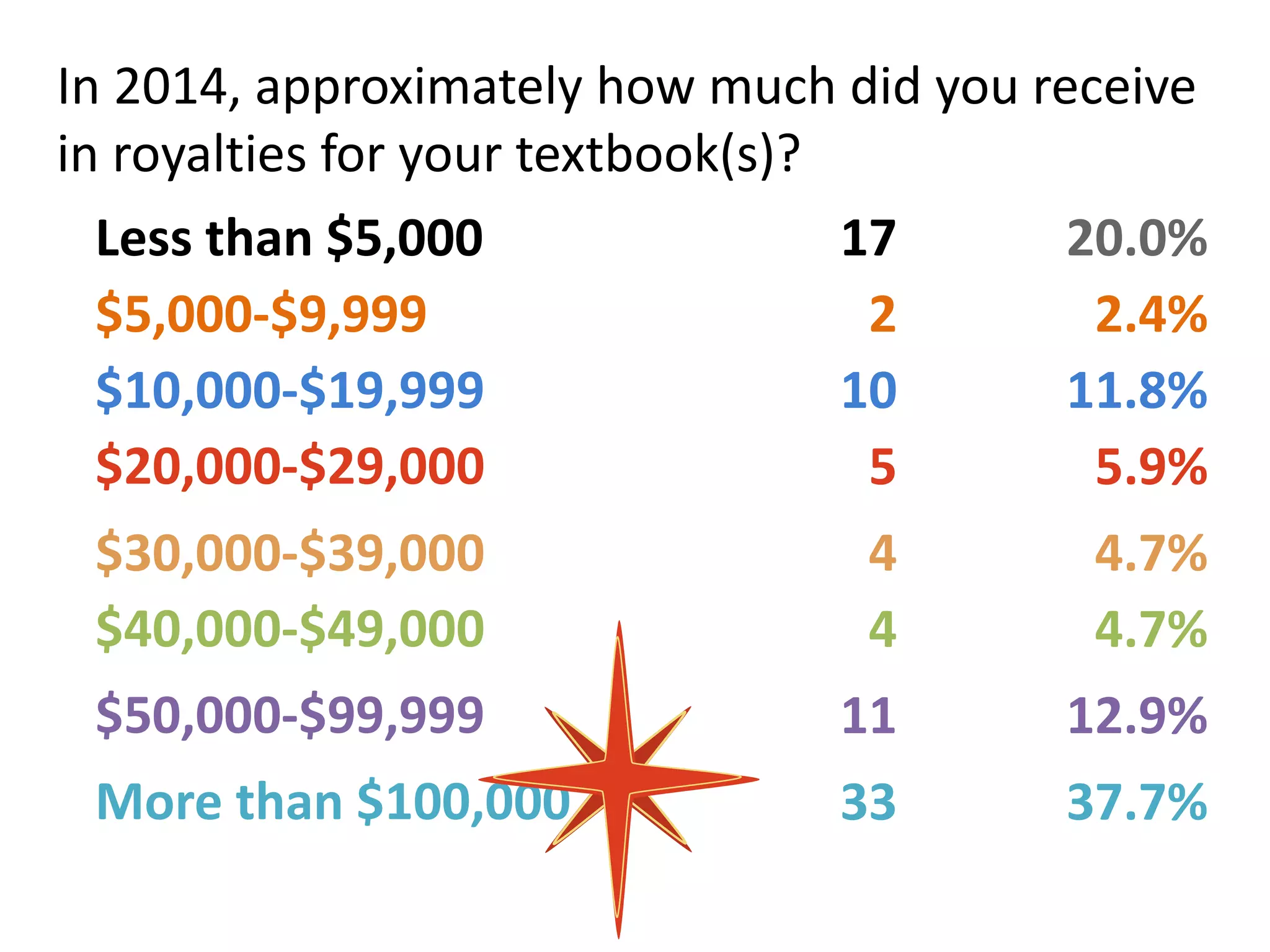
In 2014, approximately how much did you receive
in royalties for your textbook(s)?
Less than $5,000 17 20.0%
$5,000-$9,999 2 2.4%
$10,000-$19,999 10 11.8%
$20,000-$29,000 5 5.9%
$30,000-$39,000 4 4.7%
$40,000-$49,000 4 4.7%
$50,000-$99,999 11 12.9%
More than $100,000 33 37.7%
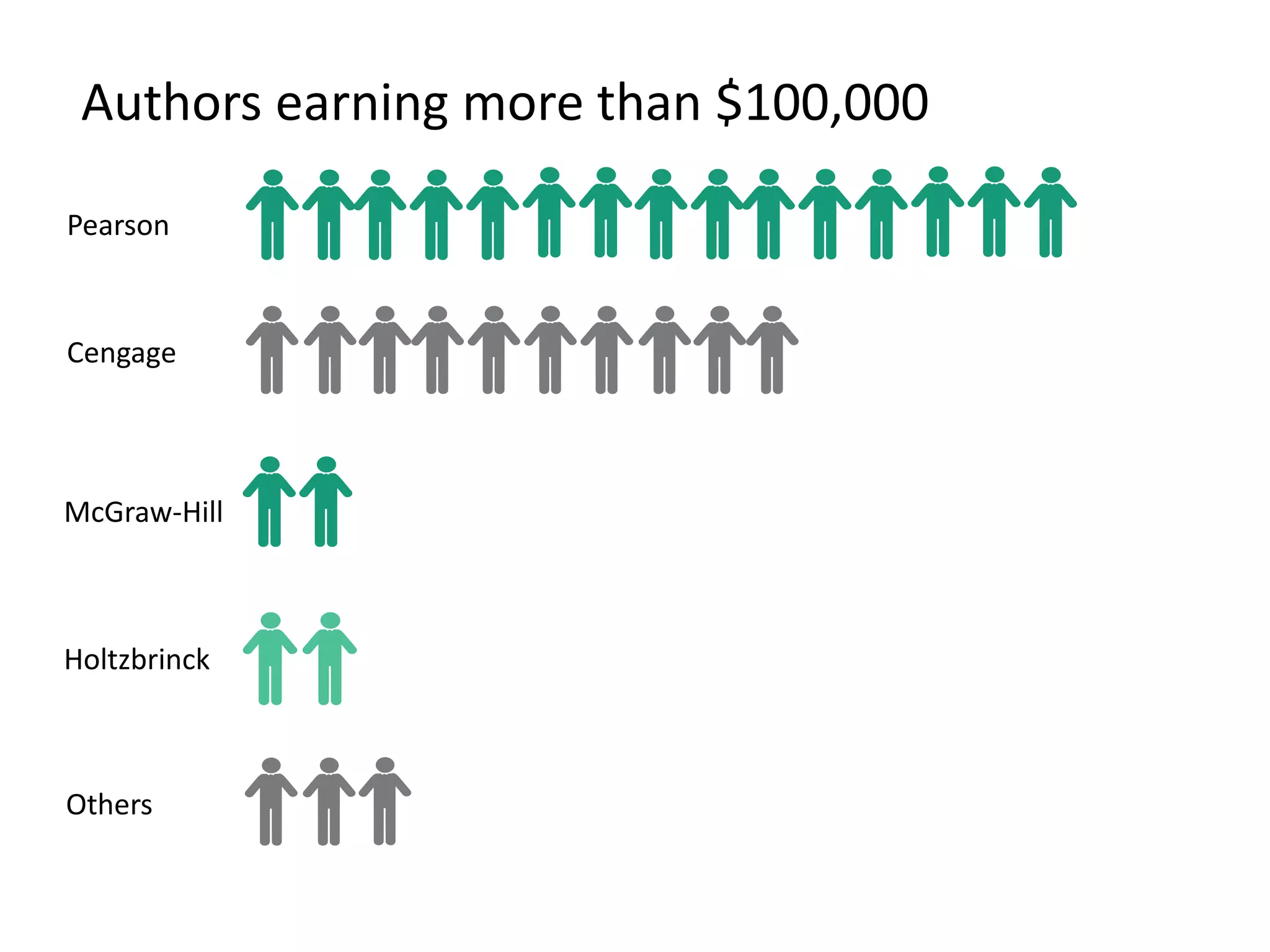
Pearson
Cengage
Holtzbrinck
Authors earning more than $100,000
Others
McGraw-Hill
Conclusions and Analysis
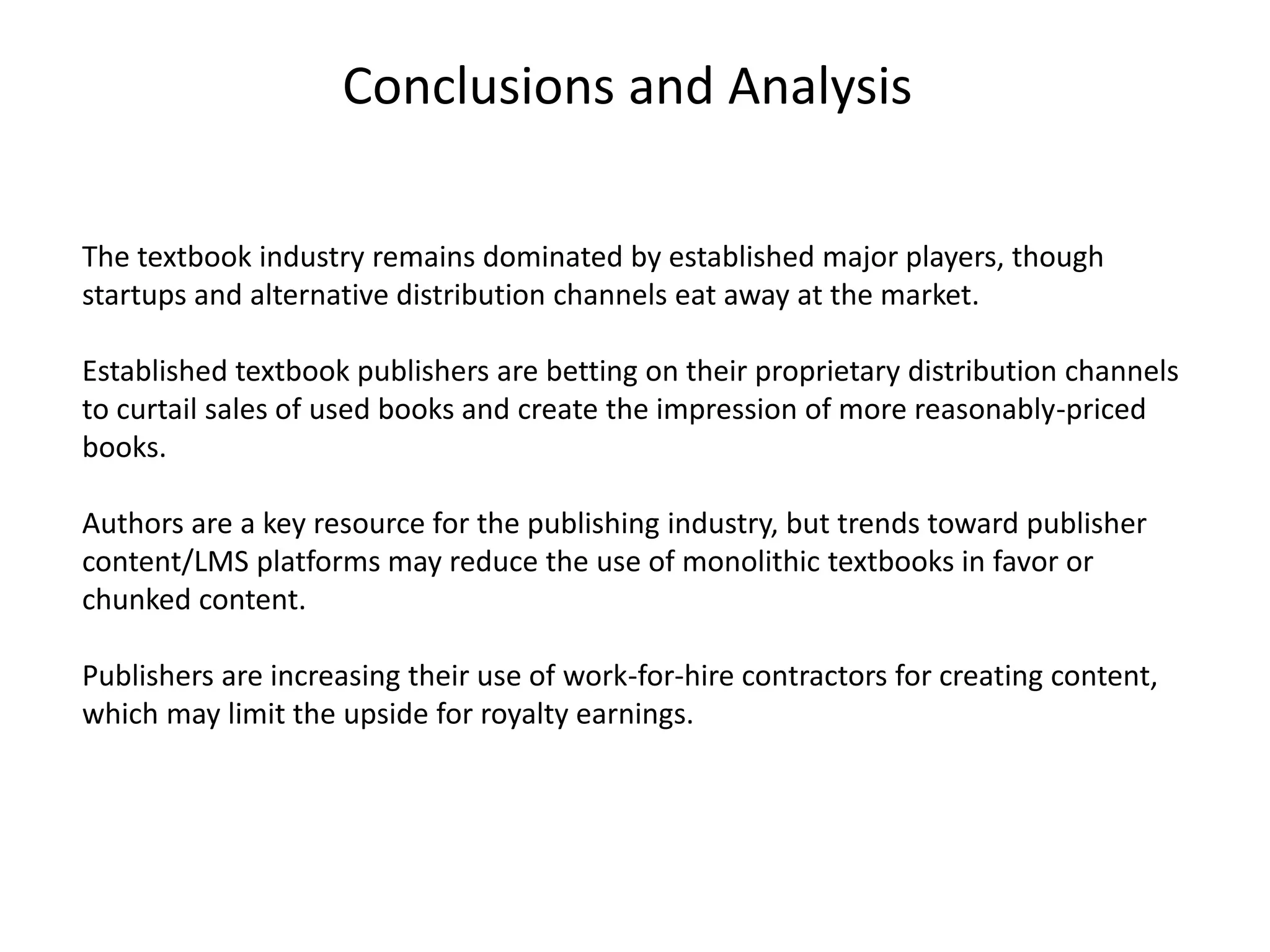
The textbook industry remains dominated by established major players, though
startups and alternative distribution channels eat away at the market.
Established textbook publishers are betting on their proprietary distribution channels
to curtail sales of used books and create the impression of more reasonably-priced
books.
Authors are a key resource for the publishing industry, but trends toward publisher
content/LMS platforms may reduce the use of monolithic textbooks in favor or
chunked content.
Publishers are increasing their use of work-for-hire contractors for creating content,
which may limit the upside for royalty earnings.
Conclusions and Analysis
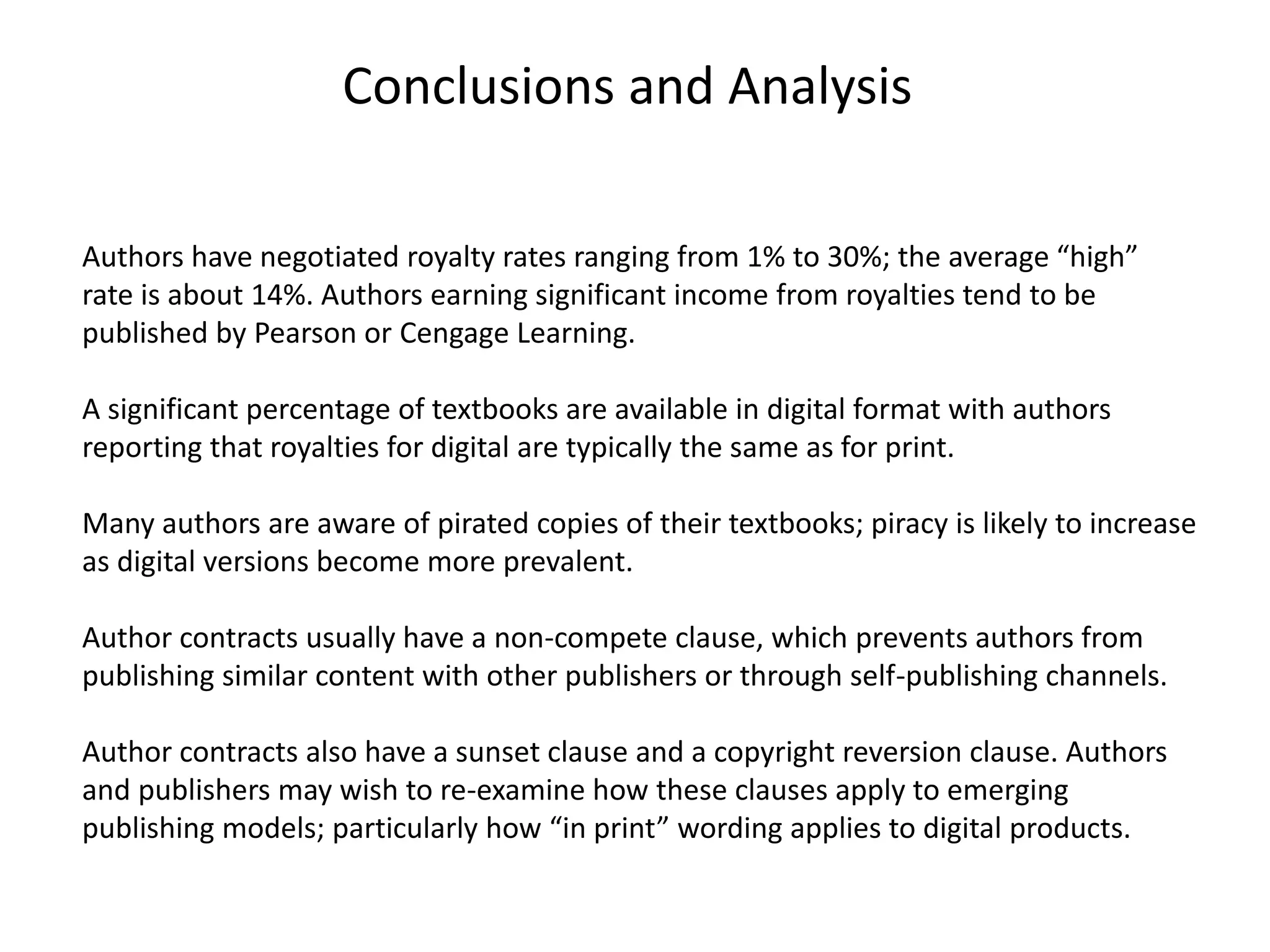
Authors have negotiated royalty rates ranging from 1% to 30%; the average “high”
rate is about 14%. Authors earning significant income from royalties tend to be
published by Pearson or Cengage Learning.
A significant percentage of textbooks are available in digital format with authors
reporting that royalties for digital are typically the same as for print.
Many authors are aware of pirated copies of their textbooks; piracy is likely to increase
as digital versions become more prevalent.
Author contracts usually have a non-compete clause, which prevents authors from
publishing similar content with other publishers or through self-publishing channels.
Author contracts also have a sunset clause and a copyright reversion clause. Authors
and publishers may wish to re-examine how these clauses apply to emerging
publishing models; particularly how “in print” wording applies to digital products.
June Jamrich Parsons is a textbook author,
digital publishing pioneer, and a fellow at the
Textbook and Academic Authors Association.
Contact the author via LinkedIn

Digital Textbook Report 2015

  • 1.
    THE DIGITAL Text BOOKREPORT 2015 JUNE JAMRICH PARSONS Presented at the Text and Academic Authors Association (TAA) Conference Las Vega, NV June 2015
  • 2.
    BARGAINING POWER OF SUPPLIERS THREAT OF NEW ENTRANTS INDUSTRY RIVALRY MOOCs Boundless PIRATE USED DON’TBUY BARGAINING POWER OF BUYERS THREAT OF SUBSTITUTE PRODUCTS OR SERVICES Last year’s Digital Book Report was structured on Michael Porter’s Five Forces model, with an emphasis on four of the five factors: industry rivalry, threat of new entrants, bargaining power of buyers, and threat of substitute services.
  • 3.
    INDUSTRY RIVALRY In 2015, thetextbook industry is still dominated by a handful of ESTABLISHED PUBLISHERS. 1 Pearson, Cengage Learning, and McGraw-Hill are the top higher-ed publishers, while Pearson, Houghton Mifflin Harcourt, and McGraw-Hill are the top K-12 publishers.
  • 4.
    New entrants areno longer “new,” but no startups have yet managed to unseat any of the dominant textbook publishers. 2 THREAT OF NEW ENTRANTS Instead, a bevy of small startups and alternative distribution models chip away many small pieces of the textbook market.
  • 5.
    Buyers continue toseek less expensive ALTERNATIVES to mainstream textbook distribution channels, such as rentals and used books. USED PIRATE BARGANING POWER OF BUYERS 3
  • 6.
    Alternative distribution modelsmay cut off income streams to publishers and authors. USED PIRATE BARGANING POWER OF BUYERS 3
  • 7.
    The economics ofmainstream publishing do not have much wiggle room for reduced pricing. Author royalties, editorial costs, sales costs, and overhead make producing a high-quality academic book expensive. Simply “going digital” does not offer much cost savings. The current model in which textbooks are offered in print and as digital actually increases costs because of the expense of the digital platform and conversion. The digital solution DOES, however, offer a way to eliminate used books.
  • 8.
    Source: McGraw-Hill GlobalEducation Holdings Q1 2015 Investor Update The digital solution DOES, however, offer a way to eliminate used books.
  • 9.
    THREAT OF SUBSTITUTE PRODUCTS OR SERVICES DIGITALBOOKS were once considered a huge threat to the textbook market. Would edtech companies eliminate the market for printed textbooks? The surge in overall digital book sales that began in 2010 reached a plateau in 2014. Several studies show that most students still prefer printed textbooks over digital formats.
  • 10.
    THREAT OF SUBSTITUTE PRODUCTS OR SERVICES DIGITALBOOKS might not be the biggest threat to the traditional publishing model. DIGITAL PLATFORMS may offer a bigger threat. 4
  • 11.
    THREAT OF SUBSTITUTE PRODUCTS OR SERVICES Authorsneed to remain aware of the trend toward online learning platforms. 4
  • 12.
    THREAT OF SUBSTITUTE PRODUCTS OR SERVICES Theseplatforms essentially merge a content management system with a learning management system. 4
  • 13.
    THREAT OF SUBSTITUTE PRODUCTS OR SERVICES Learningcontent is served to students from within the platform. 4
  • 14.
    THREAT OF SUBSTITUTE PRODUCTS OR SERVICES Theseplatforms use “chunked,” or modular content rather than monolithic textbooks. 4
  • 15.
    THREAT OF SUBSTITUTE PRODUCTS OR SERVICES Theseplatforms may not require textbooks as we know them, or even digital versions of the textbooks we create. 4
  • 16.
    THREAT OF SUBSTITUTE PRODUCTS OR SERVICES Theseplatforms do need CONTENT, however, but supplying that content may require authors to learn new skill sets in pedagogy and in the process of creating and submitting material. 4
  • 17.
    THREAT OF SUBSTITUTE PRODUCTS OR SERVICES Publishersare likely to pay content creators using a work-for-hire model rather than a royalty model. 4
  • 18.
    THREAT OF SUBSTITUTE PRODUCTS OR SERVICES Thework-for-hire model will severely curtail upside profit potential for authors. 4
  • 19.
    BARGANING POWER OF SUPPLIERS The publishingindustry has SUPPLIERS that include paper merchants and commercial printing companies for print books; and cloud service providers, programming teams, and digital developers for content delivered digitally. And then there are AUTHORS. 5
  • 20.
    Source: Margaret Atwoodpresentation Tools of Change conference 2012 In any ecosystem or business system, there are interdependencies.
  • 21.
    Source: Margaret Atwoodpresentation Tools of Change conference 2012 The publishing ecosystem cannot exist without content creators—authors.
  • 22.
    BARGANING POWER OF SUPPLIERS What dowe know about textbook AUTHORS AS SUPPLIERS in the publishing industry? 5
  • 23.
    “Textbook Author Survey” •April 23, 2015 through May 30 • 92 participants A high percentage of survey participants have been active authors for more than 25 years.
  • 24.
  • 25.
    Humanities 6 6.7% SocialSciences 16 17.8% Natural Sciences 15 16.7% Mathematics or Computer Science 14 15.6% Law 1 1.1% Medicine 5 5.6% Education 9 10.0% Business 10 11.1% Other 14 15.6% What is your main subject area?
  • 26.
    How many yearsdid you teach in the subject area for which you write textbooks? Survey participants are experienced subject- area teachers.
  • 27.
    What company isyour primary publisher? Pearson 27 29.7% Cengage 28 30.8% McGraw-Hill 13 14.3% Georg von Holtzbrinck 3 3.30% John Wiley & Sons 2 2.2% Wolters Kluwer 0 0% Reed Elsevier 1 1.1% Informa 0 0% Houghton Mifflin Harcourt 1 1.1% Other 16 17.6%
  • 28.
    What is theHIGHEST royalty rate you’ve negotiated for a print book you’ve authored? The average “high” royalty rate paid to survey participants was 14.21%.
  • 29.
    What is theHIGHEST royalty rate you’ve negotiated for a print book you’ve authored? A breakdown of the bracket with the highest frequency shows 15% and 18% to be common.
  • 30.
    What is theLOWEST royalty rate you’ve negotiated for a print book you’ve authored? The average “low” royalty rate paid to survey participants was 9.2%.
  • 31.
    What is theLOWEST royalty rate you’ve negotiated for a print book you’ve authored? A breakdown of the bracket with the highest frequency shows 10% and 12% to be common.
  • 32.
    Are any ofyour textbooks sold in digital editions? Yes 70 76.9% No 14 15.4% Not sure 7 7.7% A significant number of textbooks appear to be available in digital formats.
  • 33.
    In which formatsare digital editions of your textbook sold? Publisher’s proprietary formats are the most popular for digital textbooks.
  • 34.
    Yes 43 61.4% No27 38.6% Have you viewed your digital book?
  • 35.
    Did you haveinput into any of the following for your digital book? Layout 10 33.3% Interactive quizzing 13 43.3% Pedagogy 16 53.3% Media (videos, animations, audio) 18 60.0% Other 6 20.0%
  • 36.
    Which best describesthe royalty rate for digital versions of your textbook? Royalty rates are the same for digital and print 43 63.2% Higher royalty rate for the digital version 4 5.9% Lower royalty rate for the digital version 21 30.9% The trend is one royalty rate for print and digital.
  • 37.
    Yes 36 40% No54 60% 40% 60% Are you aware of any pirated copies of your textbooks? As more textbooks are distributed digitally, piracy is likely to increase.
  • 38.
    40% 60% Are you awareof any pirated copies of your textbooks? Pirated copies reduce sales and royalties. Authors can help publishers by watching for incursions and reporting them to the publisher. Authors should be aware of contract wording that describes the publisher’s responsibilities in curtailing piracy.
  • 39.
    When your booksare sold outside of North America, is the royalty rate reduced? Yes 67 74.4% No 13 14.4% Not sure 10 11.1% 74.4% 14.4% 11.1%
  • 40.
    When your booksare sold outside of North America, is the royalty rate reduced? 74.4% 14.4% 11.1% Digital versions typically do not incur costs for shipping and exporting, therefore tiered pricing based on location may not be equitable for authors.
  • 41.
    Is your royaltyrate reduced when your textbooks are sold in bulk or wholesale? Yes 34 37.4% No 23 25.3% Not sure 34 37.4% 37.4% 25.3% 37.4%
  • 42.
    Is your royaltyrate reduced when your textbooks are sold in bulk or wholesale? 37.4% 25.3% 37.4% Authors should be aware how “bulk” and “wholesale” are contractually defined. Are Amazon, iBooks, and Nook sales included in this category?
  • 43.
    67.8% 26.7% 5.6% Do you havea non-compete clause in your contract(s)? Yes 61 67.8% No 24 26.7% Not sure 5 5.6% Although most authors have non-compete contract clauses, this limitation is not universal.
  • 44.
    Does your contractgive you the right of first refusal for revisions of new editions? Yes 43 47.3% No 14 15.4% Not sure 34 37.4% 47.3% 15.4% 37.4%
  • 45.
    Yes 39 42.9% No19 20.9% Not sure 33 36.3% Not Sure Yes No When the publisher no longer wants to publish one of your textbooks, does the copyright revert to you?
  • 46.
    56.0% 16.5% 27.5% Yes 51 56.0% No15 16.5% Not sure 25 27.5% Do you have a sunset clause in your contract(s)?
  • 47.
    I get halfof my previous royalty rate for all subsequent editions 0 0% I get half of my previous royalties for the first edition, then 25% for the next edition, then 2% for all subsequent editions 4 8% I get half for the first edition, then 25%, then nothing 21 42% I get 10% of the previous royalty rate for all subsequent editions 1 2% I get 2% royalty rate for all subsequent editions 0 0% I get no royalties for editions that I don't participate in 1 2% Not sure 5 10% Other 18 36% Which of the following best describes your contract’s sunset clause?
  • 48.
    In 2014, approximatelyhow much did you receive in royalties for your textbook(s)? Less than $5,000 17 20.0% $5,000-$9,999 2 2.4% $10,000-$19,999 10 11.8% $20,000-$29,000 5 5.9% $30,000-$39,000 4 4.7% $40,000-$49,000 4 4.7% $50,000-$99,999 11 12.9% More than $100,000 33 37.7%
  • 49.
    Pearson Cengage Holtzbrinck Authors earning morethan $100,000 Others McGraw-Hill
  • 50.
    Conclusions and Analysis Thetextbook industry remains dominated by established major players, though startups and alternative distribution channels eat away at the market. Established textbook publishers are betting on their proprietary distribution channels to curtail sales of used books and create the impression of more reasonably-priced books. Authors are a key resource for the publishing industry, but trends toward publisher content/LMS platforms may reduce the use of monolithic textbooks in favor or chunked content. Publishers are increasing their use of work-for-hire contractors for creating content, which may limit the upside for royalty earnings.
  • 51.
    Conclusions and Analysis Authorshave negotiated royalty rates ranging from 1% to 30%; the average “high” rate is about 14%. Authors earning significant income from royalties tend to be published by Pearson or Cengage Learning. A significant percentage of textbooks are available in digital format with authors reporting that royalties for digital are typically the same as for print. Many authors are aware of pirated copies of their textbooks; piracy is likely to increase as digital versions become more prevalent. Author contracts usually have a non-compete clause, which prevents authors from publishing similar content with other publishers or through self-publishing channels. Author contracts also have a sunset clause and a copyright reversion clause. Authors and publishers may wish to re-examine how these clauses apply to emerging publishing models; particularly how “in print” wording applies to digital products.
  • 52.
    June Jamrich Parsonsis a textbook author, digital publishing pioneer, and a fellow at the Textbook and Academic Authors Association. Contact the author via LinkedIn

Editor's Notes

  • #3 Last years digital book report was structured on Michael Porter’s Five Forces model, with an emphasis on four of the five factors: Industry rivalry, threat of new entrants, bargaining power of buyers, and threat of substitute services.
  • #4 Pearson, Cengage, and McGraw-Hill are the top higher-ed publishers, while Pearson, Houghton Mifflin Harcourt, and McGraw-Hill are the top K-12 publishers.
  • #5 New entrants are no longer “new.” They are established alternatives to the traditional publishing model. But new entrants chip away at the established publishers share of revenue.
  • #6 BUT the economics of mainstream publishing do not have much wiggle room for reduction. Author royalties, editorial costs, sales costs, and overhead make producing a high-quality academic book expensive. Simply “going digital” does not offer much cost savings in those areas. The digital solution DOES, however, offer a way to eliminate used books.
  • #7 BUT the economics of mainstream publishing do not have much wiggle room for reduction. Author royalties, editorial costs, sales costs, and overhead make producing a high-quality academic book expensive. Simply “going digital” does not offer much cost savings in those areas. The digital solution DOES, however, offer a way to eliminate used books.
  • #8 BUT the economics of mainstream publishing do not have much wiggle room for reduction. Author royalties, editorial costs, sales costs, and overhead make producing a high-quality academic book expensive. Simply “going digital” does not offer much cost savings in those areas. The digital solution DOES, however, offer a way to eliminate used books.
  • #11 As authors, we need to remain aware of the trend toward online learning platforms. These platforms may not require textbooks as we know them, or even digital versions of the textbooks we create. These platforms do need CONTENT, however, but supplying that content may require authors to learn new skill sets in pedagogy and in the process of creating and submitting material.
  • #12 As authors, we need to remain aware of the trend toward online learning platforms. These platforms may not require textbooks as we know them, or even digital versions of the textbooks we create. These platforms do need CONTENT, however, but supplying that content may require authors to learn new skill sets in pedagogy and in the process of creating and submitting material.
  • #13 As authors, we need to remain aware of the trend toward online learning platforms. These platforms may not require textbooks as we know them, or even digital versions of the textbooks we create. These platforms do need CONTENT, however, but supplying that content may require authors to learn new skill sets in pedagogy and in the process of creating and submitting material.
  • #14 As authors, we need to remain aware of the trend toward online learning platforms. These platforms may not require textbooks as we know them, or even digital versions of the textbooks we create. These platforms do need CONTENT, however, but supplying that content may require authors to learn new skill sets in pedagogy and in the process of creating and submitting material.
  • #15 As authors, we need to remain aware of the trend toward online learning platforms. These platforms may not require textbooks as we know them, or even digital versions of the textbooks we create. These platforms do need CONTENT, however, but supplying that content may require authors to learn new skill sets in pedagogy and in the process of creating and submitting material.
  • #16 As authors, we need to remain aware of the trend toward online learning platforms. These platforms may not require textbooks as we know them, or even digital versions of the textbooks we create. These platforms do need CONTENT, however, but supplying that content may require authors to learn new skill sets in pedagogy and in the process of creating and submitting material.
  • #17 As authors, we need to remain aware of the trend toward online learning platforms. These platforms may not require textbooks as we know them, or even digital versions of the textbooks we create. These platforms do need CONTENT, however, but supplying that content may require authors to learn new skill sets in pedagogy and in the process of creating and submitting material.
  • #18 As authors, we need to remain aware of the trend toward online learning platforms. These platforms may not require textbooks as we know them, or even digital versions of the textbooks we create. These platforms do need CONTENT, however, but supplying that content may require authors to learn new skill sets in pedagogy and in the process of creating and submitting material.
  • #19 As authors, we need to remain aware of the trend toward online learning platforms. These platforms may not require textbooks as we know them, or even digital versions of the textbooks we create. These platforms do need CONTENT, however, but supplying that content may require authors to learn new skill sets in pedagogy and in the process of creating and submitting material.
  • #20 The publishing industry has suppliers that include paper suppliers and commercial printing companies for print books; and cloud service providers, programming teams, and digital developers for content delivered digitally.
  • #23 The publishing industry has suppliers that include paper suppliers and commercial printing companies for print books; and cloud service providers, programming teams, and digital developers for content delivered digitally.
  • #26 Future Research: Correlation between royalty rates and subject area.
  • #28 Future Research: Correlation between publisher and royalty rates.
  • #30 Oddly, on my primary text, I was able to negotiate a 30% royalty on books sold outside the United States. The rate in the US is 15%.
  • #38 Pirated copies reduce sales and royalties, Digital versions tend to be more vulnerable to piracy and unauthorized sharing. Make sure to watch for incursions and report them to your publisher. Consider adding contract clauses that would compel your publisher to take steps to pursue content pirates.
  • #39 Pirated copies reduce sales and royalties, Digital versions tend to be more vulnerable to piracy and unauthorized sharing. Make sure to watch for incursions and report them to your publisher. Consider adding contract clauses that would compel your publisher to take steps to pursue content pirates.
  • #42 Be especially vigilant about what your contract says about both print and digital sales through Amazon and similar channels. Your publisher may consider these channels wholesalers and reduce your royalties accordingly.
  • #43 Be especially vigilant about what your contract says about both print and digital sales through Amazon and similar channels. Your publisher may consider these channels wholesalers and reduce your royalties accordingly.
  • #44 Publishers see a future in which all content is created by cheap work-for-hire-style contactors with no on-going attachment to future editions. Although non-compete clauses are standard, authors can try to craft the wording of these clauses to provide leeway for writing material that does not directly compete with content they have written for a publisher. One respondent mentioned described a non-compete clause that was in effect only as long as the publisher did not publish any works that competed with the work provided by the author!
  • #45 Future Research: We need to watch this trend. A decline in right of first refusal would indicate publisher's desire to move toward work-for-hire style content.
  • #46 J.K. Rowling kept the copyright to all her work. Make sure you work with a knowledgeable lawyer or agent to protect your copyright. Publishers will try to weasel this clause by keeping book “in print” but not marketing them in an effort to keep them off the market and out of the hands of rival publishers. You out-of-print clause should specify what constitutes “out-of-print” and the timeline for copyright reversion.
  • #47 Knowing that your publisher may be looking for ways to turn your work into a work-for-hire produced by someone other than yourself, e mindful of the contract clauses that specify what happens when you no longer work on editions of your book. As the original author of a book, you have continued intellectual property expectations that should be reflected in contract wording.
  • #49 Textbook authoring can be surprisingly lucrative.