Australian School Library
Association Inc.
DIGITAL RESOURCES
FOR THE
SCIENCE CURRICULUM
PRESENTED BY
ISOBEL WILLIAMS
PRESIDENT, ASLA
Introduction
2

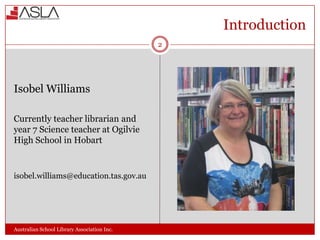
Isobel Williams
Currently teacher librarian and
year 7 Science teacher at Ogilvie
High School in Hobart

isobel.williams@education.tas.gov.au

Australian School Library Association Inc.
Australian Curriculum - Science
3

 Science Understanding
 Science as a Human Endeavour
 Science Inquiry Skills

Australian School Library Association Inc.
4

 Science Understanding
 Biological sciences
 Chemical sciences
 Earth and space sciences
 Physical sciences

Australian School Library Association Inc.
5

 Science as a Human Endeavour
 Nature and development of science
 Use and influence of science

Australian School Library Association Inc.
6

 Science Inquiry Skills
 Questioning and predicting
 Planning and conducting
 Processing and analysing data and information
 Evaluating
 Communicating

Australian School Library Association Inc.
Science Understandings
7

 Biological Sciences - year 5 - 10
 Features and adaptations to survive in their environment
 The growth and survival affected by the physical conditions
 Classification helps organise this diversity
 Food chains and food webs
 Cells are the basic units of living things
 Multi-cellular organisms contain systems of organs
 Multi-cellular organisms rely on coordinated and
interdependent internal systems
 Energy flow through ecosystems
 DNA and genes
 The theory of evolution by natural selection
Australian School Library Association Inc.
Science Understandings
8

 Chemical Sciences Year 5 - 10
 Solids, liquids and gases
 Physical and chemical change
 Separating mixtures
 motion and arrangement of particles
 Differences between elements, compounds and mixtures
 reactions form new substances
 All matter is made of atoms
 natural radioactivity
 mass is not created or destroyed
 Chemical reactions involve energy transfer
 The Periodic Table
 Different types of chemical reactions
 Different rates of reaction

Australian School Library Association Inc.
Science Understandings
9

 Earth and space sciences - year 5 - 10















The Earth is part of the solar system
Sudden geological changes or extreme weather conditions can affect
Earth’s surface
Seasons and eclipses

Renewable and non-renewable resources
Water cycle
Sedimentary, igneous and metamorphic rocks
The theory of plate tectonics
galaxies, stars and solar systems
The Big Bang theory
Global systems and cycles involving the biosphere, lithosphere,
hydrosphere and atmosphere

Australian School Library Association Inc.
Science Understandings
10

 Physical Sciences - year 5 - 10
 Light can be absorbed, reflected and refracted
 Electrical circuits
 Energy can be used to generate electricity
 Forces
 Earth’s gravity
 Energy appears in different forms
 Energy transfer can be explained using wave and particle
models
 Energy conservation in a system
 The motion of objects
Australian School Library Association Inc.
Science as a Human Endeavour
11











Science involves testing predictions by gathering data and
using evidence
Important contributions have been made by people from a
range of cultures
Scientific knowledge changes as new evidence becomes
available
Science knowledge can develop through collaboration
Scientific understanding are refined over time through a
process of review
Science and technology are linked

Australian School Library Association Inc.
Science as a Human Endeavour
12











Science is used to solve problems
Scientific knowledge is used to inform decisions
Science and technology find solutions to contemporary issues
Science involves ethical considerations
Science influences human activity
People use science in their occupations
People can use scientific knowledge to evaluate decisions
Advances in science and technology significantly affect
people’s lives
The values and needs of contemporary society focus scientific
research

Australian School Library Association Inc.
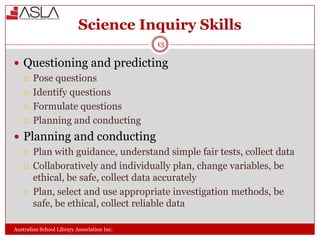
Science Inquiry Skills
13

 Questioning and predicting
 Pose questions
 Identify questions
 Formulate questions
 Planning and conducting
 Planning and conducting
 Plan with guidance, understand simple fair tests, collect data
 Collaboratively and individually plan, change variables, be
ethical, be safe, collect data accurately
 Plan, select and use appropriate investigation methods, be
safe, be ethical, collect reliable data
Australian School Library Association Inc.
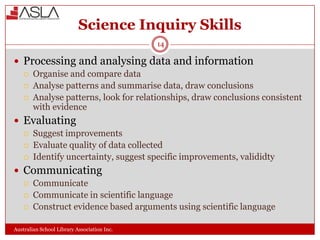
Science Inquiry Skills
14

 Processing and analysing data and information





Organise and compare data
Analyse patterns and summarise data, draw conclusions
Analyse patterns, look for relationships, draw conclusions consistent
with evidence

 Evaluating




Suggest improvements
Evaluate quality of data collected
Identify uncertainty, suggest specific improvements, valididty

 Communicating





Communicate
Communicate in scientific language
Construct evidence based arguments using scientific language

Australian School Library Association Inc.
15

Any questions?

Australian School Library Association Inc.
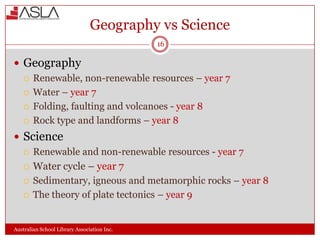
Geography vs Science
16

 Geography
 Renewable, non-renewable resources – year 7
 Water – year 7
 Folding, faulting and volcanoes - year 8
 Rock type and landforms – year 8
 Science
 Renewable and non-renewable resources - year 7
 Water cycle – year 7
 Sedimentary, igneous and metamorphic rocks – year 8
 The theory of plate tectonics – year 9

Australian School Library Association Inc.
What I look for
17

 Covers aspects of the curriculum
 Has potential to demonstrate some aspect that is





harder to show in the classroom/lab
Is more than a point and shoot game
Is at the appropriate level for students
Has some degree of interactivity – student not a
passive receiver
Ideas

Australian School Library Association Inc.
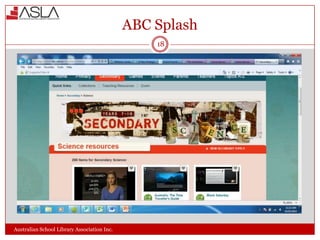
ABC Splash
18

Australian School Library Association Inc.
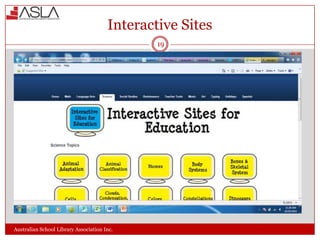
Interactive Sites
19

Australian School Library Association Inc.
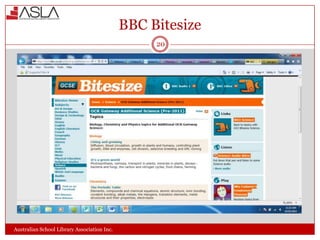
BBC Bitesize
20

Australian School Library Association Inc.
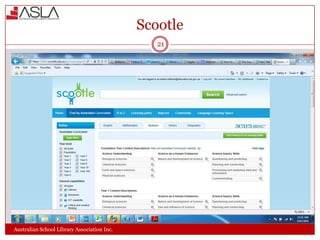
Scootle
21

Australian School Library Association Inc.
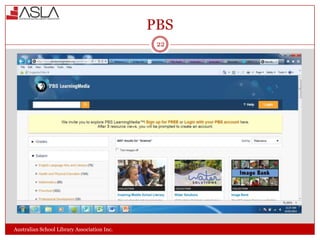
PBS
22

Australian School Library Association Inc.
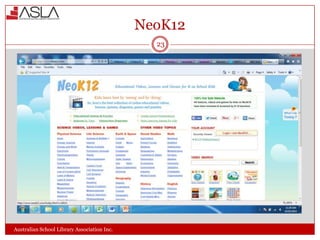
NeoK12
23

Australian School Library Association Inc.
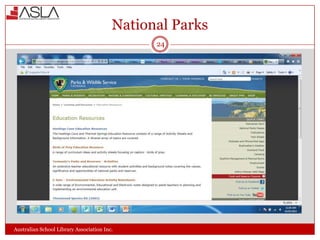
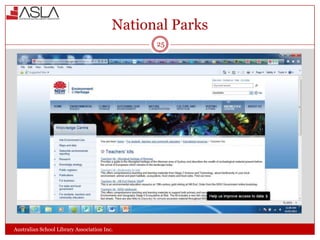
National Parks
24

Australian School Library Association Inc.
National Parks
25

Australian School Library Association Inc.
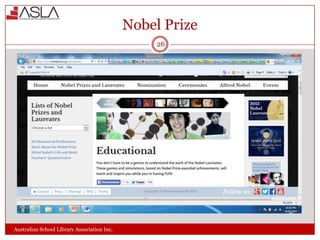
Nobel Prize
26

Australian School Library Association Inc.
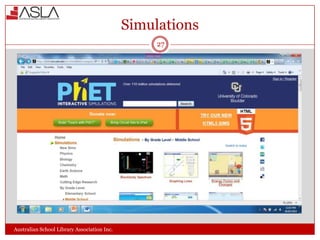
Simulations
27

Australian School Library Association Inc.
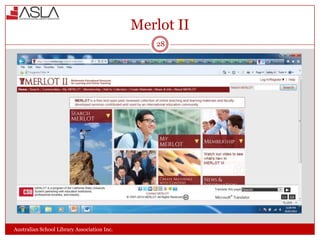
Merlot II
28

Australian School Library Association Inc.
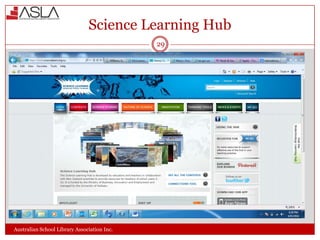
Science Learning Hub
29

Australian School Library Association Inc.
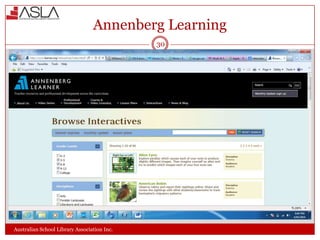
Annenberg Learning
30

Australian School Library Association Inc.
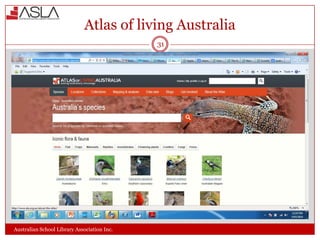
Atlas of living Australia
31

Australian School Library Association Inc.
Science Inquiry Skills
32






Questioning and predicting
Planning and conducting
Processing and analysing data and information
Evaluating
Communicating

Australian School Library Association Inc.
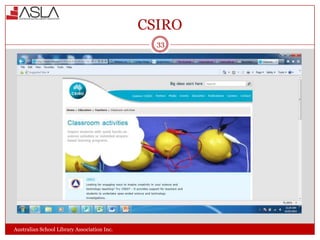
CSIRO
33

Australian School Library Association Inc.
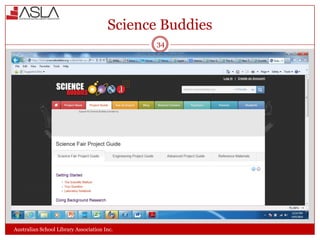
Science Buddies
34

Australian School Library Association Inc.
iPad
35

 Educational objectives
 Critical thinking skills
 Some control over level of difficulty
 Clear and simple instructions
 Assess progress
 Value for money
 Does not allow access to external providers
 Does not require in-app purchases to work
 Does not ask for personal data
Australian School Library Association Inc.
Some iPad ideas – mostly free
36

 Monster Physics

 Shout Science

 Food Webs

 Khan Academy

 goReact

 Hudson alpha icell

 Rube Works

 Kids discover – Cells $

 Science 360 for iPad

 Cells (school)

 Chemist

 Journey of invention (15

 Go SkyWatch

object free then $)
 Energy Island

 NASA science
 Aero!
Australian School Library Association Inc.
Post-webinar information
37

Resource list and certificate of attendance
will be emailed
Membership information is available at
http://www.asla.org.au/membership.aspx
Future Webinars
http://www.asla.org.au/Professional-learning/webinars.aspx
Follow ASLA on Twitter
https://twitter.com/aslanational
Like us on Facebook
https://www.facebook.com/ASLAOnline

Australian School Library Association Inc.

Digital Resources for the Science Curriculum

  • 1.
    Australian School Library AssociationInc. DIGITAL RESOURCES FOR THE SCIENCE CURRICULUM PRESENTED BY ISOBEL WILLIAMS PRESIDENT, ASLA
  • 2.
    Introduction 2 Isobel Williams Currently teacherlibrarian and year 7 Science teacher at Ogilvie High School in Hobart isobel.williams@education.tas.gov.au Australian School Library Association Inc.
  • 3.
    Australian Curriculum -Science 3  Science Understanding  Science as a Human Endeavour  Science Inquiry Skills Australian School Library Association Inc.
  • 4.
    4  Science Understanding Biological sciences  Chemical sciences  Earth and space sciences  Physical sciences Australian School Library Association Inc.
  • 5.
    5  Science asa Human Endeavour  Nature and development of science  Use and influence of science Australian School Library Association Inc.
  • 6.
    6  Science InquirySkills  Questioning and predicting  Planning and conducting  Processing and analysing data and information  Evaluating  Communicating Australian School Library Association Inc.
  • 7.
    Science Understandings 7  BiologicalSciences - year 5 - 10  Features and adaptations to survive in their environment  The growth and survival affected by the physical conditions  Classification helps organise this diversity  Food chains and food webs  Cells are the basic units of living things  Multi-cellular organisms contain systems of organs  Multi-cellular organisms rely on coordinated and interdependent internal systems  Energy flow through ecosystems  DNA and genes  The theory of evolution by natural selection Australian School Library Association Inc.
  • 8.
    Science Understandings 8  ChemicalSciences Year 5 - 10  Solids, liquids and gases  Physical and chemical change  Separating mixtures  motion and arrangement of particles  Differences between elements, compounds and mixtures  reactions form new substances  All matter is made of atoms  natural radioactivity  mass is not created or destroyed  Chemical reactions involve energy transfer  The Periodic Table  Different types of chemical reactions  Different rates of reaction Australian School Library Association Inc.
  • 9.
    Science Understandings 9  Earthand space sciences - year 5 - 10           The Earth is part of the solar system Sudden geological changes or extreme weather conditions can affect Earth’s surface Seasons and eclipses Renewable and non-renewable resources Water cycle Sedimentary, igneous and metamorphic rocks The theory of plate tectonics galaxies, stars and solar systems The Big Bang theory Global systems and cycles involving the biosphere, lithosphere, hydrosphere and atmosphere Australian School Library Association Inc.
  • 10.
    Science Understandings 10  PhysicalSciences - year 5 - 10  Light can be absorbed, reflected and refracted  Electrical circuits  Energy can be used to generate electricity  Forces  Earth’s gravity  Energy appears in different forms  Energy transfer can be explained using wave and particle models  Energy conservation in a system  The motion of objects Australian School Library Association Inc.
  • 11.
    Science as aHuman Endeavour 11       Science involves testing predictions by gathering data and using evidence Important contributions have been made by people from a range of cultures Scientific knowledge changes as new evidence becomes available Science knowledge can develop through collaboration Scientific understanding are refined over time through a process of review Science and technology are linked Australian School Library Association Inc.
  • 12.
    Science as aHuman Endeavour 12          Science is used to solve problems Scientific knowledge is used to inform decisions Science and technology find solutions to contemporary issues Science involves ethical considerations Science influences human activity People use science in their occupations People can use scientific knowledge to evaluate decisions Advances in science and technology significantly affect people’s lives The values and needs of contemporary society focus scientific research Australian School Library Association Inc.
  • 13.
    Science Inquiry Skills 13 Questioning and predicting  Pose questions  Identify questions  Formulate questions  Planning and conducting  Planning and conducting  Plan with guidance, understand simple fair tests, collect data  Collaboratively and individually plan, change variables, be ethical, be safe, collect data accurately  Plan, select and use appropriate investigation methods, be safe, be ethical, collect reliable data Australian School Library Association Inc.
  • 14.
    Science Inquiry Skills 14 Processing and analysing data and information    Organise and compare data Analyse patterns and summarise data, draw conclusions Analyse patterns, look for relationships, draw conclusions consistent with evidence  Evaluating    Suggest improvements Evaluate quality of data collected Identify uncertainty, suggest specific improvements, valididty  Communicating    Communicate Communicate in scientific language Construct evidence based arguments using scientific language Australian School Library Association Inc.
  • 15.
    15 Any questions? Australian SchoolLibrary Association Inc.
  • 16.
    Geography vs Science 16 Geography  Renewable, non-renewable resources – year 7  Water – year 7  Folding, faulting and volcanoes - year 8  Rock type and landforms – year 8  Science  Renewable and non-renewable resources - year 7  Water cycle – year 7  Sedimentary, igneous and metamorphic rocks – year 8  The theory of plate tectonics – year 9 Australian School Library Association Inc.
  • 17.
    What I lookfor 17  Covers aspects of the curriculum  Has potential to demonstrate some aspect that is     harder to show in the classroom/lab Is more than a point and shoot game Is at the appropriate level for students Has some degree of interactivity – student not a passive receiver Ideas Australian School Library Association Inc.
  • 18.
    ABC Splash 18 Australian SchoolLibrary Association Inc.
  • 19.
  • 20.
    BBC Bitesize 20 Australian SchoolLibrary Association Inc.
  • 21.
  • 22.
  • 23.
  • 24.
    National Parks 24 Australian SchoolLibrary Association Inc.
  • 25.
    National Parks 25 Australian SchoolLibrary Association Inc.
  • 26.
    Nobel Prize 26 Australian SchoolLibrary Association Inc.
  • 27.
  • 28.
    Merlot II 28 Australian SchoolLibrary Association Inc.
  • 29.
    Science Learning Hub 29 AustralianSchool Library Association Inc.
  • 30.
  • 31.
    Atlas of livingAustralia 31 Australian School Library Association Inc.
  • 32.
    Science Inquiry Skills 32      Questioningand predicting Planning and conducting Processing and analysing data and information Evaluating Communicating Australian School Library Association Inc.
  • 33.
  • 34.
    Science Buddies 34 Australian SchoolLibrary Association Inc.
  • 35.
    iPad 35  Educational objectives Critical thinking skills  Some control over level of difficulty  Clear and simple instructions  Assess progress  Value for money  Does not allow access to external providers  Does not require in-app purchases to work  Does not ask for personal data Australian School Library Association Inc.
  • 36.
    Some iPad ideas– mostly free 36  Monster Physics  Shout Science  Food Webs  Khan Academy  goReact  Hudson alpha icell  Rube Works  Kids discover – Cells $  Science 360 for iPad  Cells (school)  Chemist  Journey of invention (15  Go SkyWatch object free then $)  Energy Island  NASA science  Aero! Australian School Library Association Inc.
  • 37.
    Post-webinar information 37 Resource listand certificate of attendance will be emailed Membership information is available at http://www.asla.org.au/membership.aspx Future Webinars http://www.asla.org.au/Professional-learning/webinars.aspx Follow ASLA on Twitter https://twitter.com/aslanational Like us on Facebook https://www.facebook.com/ASLAOnline Australian School Library Association Inc.