The Teaching of Science in Primary Schools 4th Edition Anne Qualter
The Teaching of Science in Primary Schools 4th Edition Anne Qualter
The Teaching of Science in Primary Schools 4th Edition Anne Qualter
The Teaching of Science in Primary Schools 4th Edition Anne Qualter
The Teaching of Science in Primary Schools 4th Edition Anne Qualter
1.
The Teaching ofScience in Primary Schools 4th
Edition Anne Qualter download
https://ebookgate.com/product/the-teaching-of-science-in-primary-
schools-4th-edition-anne-qualter/
Get Instant Ebook Downloads – Browse at https://ebookgate.com
2.
Get Your DigitalFiles Instantly: PDF, ePub, MOBI and More
Quick Digital Downloads: PDF, ePub, MOBI and Other Formats
Assessment for Learning and Teaching in Primary Schools
Achieving Qts 2nd Edition Mary Briggs
https://ebookgate.com/product/assessment-for-learning-and-
teaching-in-primary-schools-achieving-qts-2nd-edition-mary-
briggs/
Bloomsbury Curriculum Basics Teaching Primary Science
1st Edition Peter Riley
https://ebookgate.com/product/bloomsbury-curriculum-basics-
teaching-primary-science-1st-edition-peter-riley/
Teaching in the Middle and Secondary Schools 10th
Edition Jioanna Carjuzaa
https://ebookgate.com/product/teaching-in-the-middle-and-
secondary-schools-10th-edition-jioanna-carjuzaa/
Creativity in the Classroom Schools of Curious Delight
4th Edition Alane Jordan Starko
https://ebookgate.com/product/creativity-in-the-classroom-
schools-of-curious-delight-4th-edition-alane-jordan-starko/
3.
The Brain TargetedTeaching Model for 21st Century
Schools Mariale Hardiman
https://ebookgate.com/product/the-brain-targeted-teaching-model-
for-21st-century-schools-mariale-hardiman/
Explaining in the Secondary Schools Successful Teaching
Series London England 2nd Edition E. C. Wragg
https://ebookgate.com/product/explaining-in-the-secondary-
schools-successful-teaching-series-london-england-2nd-edition-e-
c-wragg/
Primary Mathematics Teaching for Understanding 1st
Edition Patrick Barmby
https://ebookgate.com/product/primary-mathematics-teaching-for-
understanding-1st-edition-patrick-barmby/
Primary ICT for Teaching Assistants 1st Edition John
Galloway
https://ebookgate.com/product/primary-ict-for-teaching-
assistants-1st-edition-john-galloway/
Primary Mathematics for Teaching Assistants 1st Edition
Sylvia Edwards
https://ebookgate.com/product/primary-mathematics-for-teaching-
assistants-1st-edition-sylvia-edwards/
Related titles ofinterest
Progression in Primary Science Holllins & Whitby (1-85346-748-0)
Science and ICT in Primary Education Meadows (1-84312-120-4)
Active Assessment Naylor & Keogh (1-84312-145-X)
Using Science to Develop Thinking Skills at Key Stage 1 De Boo (1-84312-150-6)
ii
Brief Contents
1 Gettingstarted
1. Primary science in action 3
2. Children’s own ideas 14
3. Teachers’ and children’s questions 23
4. Talking, listening and using words 37
5. Experiences that promote learning in science 48
2 Learning and teaching for understanding
6. The goals of learning science 61
7. A framework for learning in science 72
8. Creative learning and creative teaching 82
9. Ways of helping the development of ideas 91
10. Ways of helping the development of process skills 100
11. Ways of helping the development of attitudes 110
3 Assessment
12. Assessment: what, how and why 121
13. Using assessment to help learning in science 132
14. Finding out children’s ideas 140
15. Finding out children’s process skills and attitudes 151
16. Using information for formative assessment: deciding and communicating
next steps 165
17. Involving children in assessing their work 174
18. Summing up achievement 183
4 Practical work and using ICT
19. The role and organisation of practical activities 195
20. Equipment, safety and visits 208
21. The role of ICT 217
5 Planning and managing primary science
22. Planning a school programme 233
23. Planning at the class level 246
24. Recording and reporting 257
25. The science subject leader 269
v
10.
Contents
Acknowledgements ix
Introduction x
1Getting started
1. Primary science in action 3
Introduction – Two brief case studies – Key features of the case studies –
The importance of careful planning – Summary
2. Children’s own ideas 14
Introduction – The significance of children’s ideas –
Reasons for taking children’s ideas seriously – Some examples of children’s ideas –
Characteristics of children’s ideas – Summary
3. Teachers’ and children’s questions 23
Introduction – Teachers’ questions – Children’s questions –
Handling children’s questions – Summary
4. Talking, listening and using words 37
Introduction – The roles of talk in learning – Organising class and group discussions
– Introducing scientific words –Summary
5. Experiences that promote learning in science 48
Introduction – What kinds of experience promote learning in science? –
Using criteria for evaluating and adapting activities – Planning for experiences that
promote learning – Summary
2 Learning and teaching for understanding
6. The goals of learning science 61
Introduction – Scientific literacy: an overall aim – The contribution of primary
science to scientific literacy –Constituents of scientific literacy – Understanding the
nature (and limitations) of science – Summary
7. A framework for learning in science 72
Introduction – Analysing learning in Graham’s classroom – A general framework for
learning in science – The role of process skills in the development of ideas –
The development of ‘bigger’ ideas – Summary
vi
11.
8. Creative learningand creative teaching 82
Introduction – Can science be creative? – The teacher’s role –
Using published curriculum materials and schemes – Summary
9. Ways of helping the development of ideas 91
Introduction – The importance of starting from children’s ideas – Strategies for
helping the development of ideas – Summary
10. Ways of helping the development of process skills 100
Introduction – Developing skills in the context of science activities – Ways of
developing particular process skills – Some general strategies for developing
process skills – Summary
11. Ways of helping the development of attitudes 110
Introduction – Encouraging motivation for learning – General approaches to the
development of attitudes – Ways of developing scientific attitudes – Summary
3 Assessment
12. Assessment: what, how and why 121
Introduction – The meaning of assessment – The purposes of assessment –
The characteristics of formative and summative assessment – Summary
13. Using assessment to help learning in science 132
Introduction – How formative assessment helps enquiry learning in science –
The teacher’s view of learning – The impact on learning – Summary
14. Finding out children’s ideas 140
Introduction – Having the goals in mind – Gaining access to children’s ideas –
Summary
15. Finding out children’s process skills and attitudes 151
Introduction – A structure for assessing process skills and attitudes –
Gathering evidence about process skills and attitudes – Planning to gather
evidence during activities – Summary
16. Using information for formative assessment: deciding and communicating
next steps 165
Introduction – Deciding next steps in process skills – Interpreting information
about children’s ideas – Feedback – Summary
17. Involving children in assessing their work 174
Introduction – Why involve children in assessing their work? – Sharing goals with
children – Involving children in judging the quality of their own work – Involving
children in deciding next steps – Summary
18. Summing up achievement 183
Introduction – Assessment for summative purposes – Summarising learning over
time – Checking up by testing – The effects of ‘high stakes’ testing – Summary
Contents vii
vii
12.
4 Practical workand using ICT
19. The role and organisation of practical activities 197
Introduction – The role of first-hand experience in children’s learning –
Types of investigation – Organising practical work – Summary
20. Equipment, safety and visits 210
Introduction – Equipment and materials – Visits and field trips – Safety
in and out of school – Summary
21. The role of ICT 219
Introduction – Current practice: How well are we doing? – The functions of ICT –
Integrating ICT in planning – Using ICT to bring the outside world into the
classroom – The role of ICT in professional development – Summary
5 Planning and managing primary science
22. Planning a school programme 235
Introduction – Overview of planning – Planning and curriculum coverage –
Science and other subjects – Transition and transfer – Summary
23. Planning at the class level 248
Introduction – Thinking through planning a lesson – Evaluation and review –
Summary
24. Recording and reporting 259
Introduction – Functions of a record – Records of activities of individual children –
Ongoing records of children’s achievement – Involving children in keeping records –
Summative records – Reporting to parents or carers – Summary
25. The science subject leader 271
Introduction – The roles of the subject leader – Summary
References 281
Index 289
viii
viii The teaching of science in primary schools
13.
Acknowledgements
We are gratefulto the following for permission to reproduce figures from their
publications:
■ The Association for Science Education for permission to reproduce material
from various isues of Primary Science Review and from Primary Science;
■ RoutledgeFalmer for permission to reproduce material from Coordinating
Science across the Primary School by L.D. Newton and D.P. Newton (1998);
■ Paul Chapman Publishing for permission to reproduce materials from
Assessing Science in the Primary Classroom: Written Tasks by M. Schilling, L.
Hargreaves, W. Harlen and T. Russell (1990);
■ Stuart Naylor and Brenda Keogh for permission to reproduce a concept
cartoon from Concept Cartoons in Science Education (2000);
■ Taylor & Francis for permission to reproduce material from Making Progress
in Primary Science Handbook (Second Edition) by W. Harlen, C. Macro, K
Reed and M. Schilling (2003);
■ Liverpool University Press for permission to reproduce various drawings
from SPACE Research Reports on Growth (1990), Sound (1990), Processes of
Life (1992) and Evaporation and Condensation (1990).
ix
14.
Introduction
Four years isquite a long time in primary science, it seems. Although science now
has a well-established place in the primary school curriculum it is far from just
‘ticking over’. There have been various changes, both favourable and
unfavourable, in recent years, which justify a fresh look at some of the ways we
deal with science in practice. This is what is attempted in this new edition of The
Teaching of Science in Primary Schools, the fourth since the first edition was
published in 1992. Since then it has been revised every four years.
This edition differs from the previous one in some important respects: in
authorship, in structure and in content. Beginning with authorship, I am
extremely pleased that Anne Qualter agreed to join me in revising the book,
adding to this edition her considerable experience as a researcher, teacher
educator, practitioner and author. Anne and I have worked together on several
primary science projects since we first met over twenty years ago, when we were
both working for the Assessment of Performance Unit in London. Since then
Anne has been involved in several projects relating to the National Curriculum in
science, based at the University of Liverpool. She is author of Differentiated Primary
Science (Open University Press 1996).
In terms of structure, this edition retains the form of short chapters that enable the
reader to dip straight into topics of interest at a particular time, helped by cross-
referencing between chapters. But in this edition the chapters are organised into
five parts to make the book more accessible. Part 1, ‘Getting started’, brings to the
front of the book topics regarded as essential for effective primary science teaching.
These include using children’s ideas, teachers’ and children’s questions, the
importance of talk and dialogue and adapting activities to increase opportunities
for learning. While the practices discussed in this first part are all based on a theory
of learning and on research, the supporting arguments and evidence are provided
later in the book, to leave the initial focus primarily on classroom events.
The theory of learning underpinning the approach to learning and teaching
pervading the book is discussed in Part 2, ‘Learning and teaching for
understanding’. Here we provide a theoretical model of learning that describes
x
15.
how learners useand develop their existing ideas, constructing more scientific
ideas by using evidence. The model highlights the role in this process of the
mental skills, which are variously described as enquiry or investigative skills and
for which we use the term process skills. The model helps to identify the overall
direction of progression in the development of ideas, process skills and scientific
attitudes and the teacher’s role in helping this progress.
Part 3 comprises seven chapters on the subject of assessment, a topic that has
grown in significance in all areas of the curriculum. The major focus in these
chapters reflects the recent move away from thinking of assessment only in terms
of measuring what has been learned, to identifying its role in helping learning.
Thus the emphasis is on formative assessment (or assessment for learning) and
the content has been updated to reflect recent developments in ways of putting
this into practice in the classroom. This work has served to emphasise in
particular the role of children in self-assessment and highlights all that this
implies for the teacher. The latter includes clarifying and communicating with
children the goals of activities, sharing with them the standards of quality in their
work that they should be aiming for and providing constructive feedback during
discussion and from marking work. The discussion of summative assessment
includes references to research on the negative impact of ‘high stakes’ testing on
children’s motivation for learning. Despite the greater attention to process skills
in recent national tests in England, there is still a need to question the value of
external tests in primary school science.
Part 4 comprises chapters focusing on the provision for practical work in science.
This part also includes what is perhaps the fastest changing area in education, the
use of information and communications technology (ICT). However, although
ICT can give children access to a wider range of evidence than from their first-
hand enquiries, we have to remember that direct experience – through which
children come to realise that they can find answers to their questions by their
own actions – remains paramount in early science education. But ICT can also
support primary science in ways other than supplementing and aiding practical
experience. The use of interactive whiteboards and the digital camera, for
instance, can support discussion and sharing of ideas, which are important in
helping children to think through their own ideas and develop understanding
that is shared with others.
In the final part, we deal with the important topics of planning at the class and
school levels. The role of the subject leader has become better defined and more
significant in all subjects in recent years, and science is no exception. The benefits
of having nationally agreed programmes of study or guidelines depends on how
these general statements are translated into provision for the learning of
individuals and groups of children. Collaborative planning, coordinated by the
subject leader, is essential for achieving the delicate balance between the
flexibility that a teacher must have to meet the needs of individual children and
the requirement to ensure coherence and continuity in the school programme.
Introduction xi
xi
16.
In conclusion, wehave endeavoured in revising the book to preserve those parts
of the previous edition that have an enduring relevance and remain useful to
teachers today, while adding new information and thinking, particularly about
developments in the use of ICT, using assessment to help learning, the
organisation of science and the role of science subject leaders in this, planning at
the classroom level and the emphasis on creativity in science education. As
before, the aim is to increase teachers’ understanding of underlying reasons and
issues in teaching science. We hope this will add to the pleasure of teaching and
of helping children to enjoy investigating and developing understanding of the
scientific aspects of the world around them.
Wynne Harlen
2004
xii Introduction
xii
1 Primary sciencein action
3
1
Introduction
In the first part of this book the five chapters focus on what can be described as
the key aspects of effective primary science teaching. These are: using children’s
own ideas; asking and responding to questions; talk, between teacher and child
and between child and child; and providing experiences that promote the
development of scientific ideas, process skills and attitudes. In later parts we deal
with the theory behind these aspects of activities and with matters related to
assessment, with the provision of resources and with planning of activities and
programmes. These are not less important but, no matter how much theory one
knows and planning one does, primary science will not take off without attention
to the topics in this first section.
It is no longer necessary, as was the case 20 years ago, to argue for the value of
teaching science in the primary school. It is universally accepted that learning
science is important for the future lives of all citizens and because of this it is a
required part of primary and secondary education in practically all countries.
Science is a major area of human mental and practical activity and the knowledge
that it generates plays a vital part in our lives and in the lives of future generations.
It is essential that the education of the whole population, not just of future
scientists, provides them with a broad understanding of the status and nature of
scientific knowledge, how it is created and how dependable it is.
That said, we begin by going straight into the classroom to provide a picture of
primary science in action in two classes, one of nine- and ten-year-olds and one of
six- and seven-year-olds. These provide some real events, which convey
something of what happens when primary children are involved in learning
science. We return to these examples at several points later in the book. The
discussion of certain features of these mini-case studies, in this chapter, starts an
analysis of what is going on, the rationale for including these features and what lies
behind them in terms of preparation by the teacher.
20.
Two brief casestudies
We begin by looking into two classrooms where science is in progress. These case
studies, in Boxes 1.1 and 1.2, were created by observing and talking to real
teachers in real classrooms. Thus not everything that happens is exemplary; they
are not ‘model’ lessons to be followed. Indeed, they clearly have features specific
to the classes, teachers and contexts involved that make them difficult to transfer
to other classrooms. But they also have features that are common to good practice
in primary science and they provide us with real examples that help to
communicate these features both later in this chapter and in the chapters that
follow in this book.
Box 1.1 Graham’s class investigating soil
Graham was introducing science activities within an overall topic about growing
food to his class of nine- and ten-year-olds. He planned that the children should
discuss and investigate the differences between types of soil. He had in mind that
the children should undertake some investigations of sandy, loamy and clay soil,
so he provided samples of each of these, to which some of the children
contributed samples that they brought from gardens at home. He wanted the
investigations to advance the children’s ideas and therefore to start from their
ideas and questions. It would have been easy to ask the children to find out, for
example, ‘Which soil holds most water?’ ‘Does water drain more quickly through
some soils than through others?’ and to start the children’s investigations from
these questions. These are perfectly good questions for children to investigate
and likely to be among those the children ended up investigating, but he wanted
to hold back his questions to find out what the children would ask and what ideas
they had.
The first part of the work was an exploratory phase of looking at the different soils.
In groups, the children were given samples of the three main types, some hand
lenses, sieves, disposable gloves and some very open instructions:
■ Separate the different parts that each of the soils contains.
■ Find out what is contained in all the soils.
■ Find out what is different in each soil.
■ Think about how these differences might affect how well plants grow in the
soils.
This task required children to use their ideas about soil in making their observations.
It encouraged them to look closely at the soil and to think about the differences
they found. During this activity the teacher visited each group to listen in to what
the children were saying about the types of soil. Many of their statements at this
4 The teaching of science in primary schools
4
21.
stage contained hypothesesand predictions. The children were quick to say which
they thought would be best for plants to grow in (the darkest coloured one) and to
identify the ability to hold water as a property that was needed.
There was then a whole-class discussion, pooling findings and ideas from different
groups. Graham said that they would test their ideas about which was best for
growing plants when they had found out more about the soils and the differences
that might make one better than another. What would the plants need to grow?
Water was the most popular answer. Some mentioned ‘fertiliser’ and there was a
discussion of what this meant in terms of the soils they had looked at. It was
eventually identified with the bits of leaves and decayed plant material they had
found, particularly in the loam. Graham introduced the word ‘humus’ to describe
this part of the soil.
No one mentioned the presence of air in the soil until the teacher asked them to
think about the difference between soil that was compressed and the same soil in
a loose heap. He challenged them to think about whether there was the same
amount of air between the particles in each soil and whether this was likely to
make a difference to how well plants would grow in it.
The discussion identified four main differences to be investigated: the differences
in the amount of water held in the soil; how quickly water drained through each
one; the amount of humus in each; and the amount of air. Each of the six groups
in which the children were working chose one of these and set about planning how
they would go about their investigation. Although having different foci, the
investigations of all the groups were relevant to developing understanding of the
nature and properties of soil so that, when they did the trial of which enabled
plants to grow best, they would be able to explain and not just observe the result.
The investigations provided opportunities to help the children to develop their
process skills, in order to carry out systematic and ‘fair’ tests through which they
would arrive at findings useful in developing their ideas. He asked them first to
plan what they would do and identify what they would need in terms of
equipment. He probed their thinking about what variables to control and what to
observe or measure by asking questions such as ‘How will you be sure that the
difference is only caused by the type of soil? How will you be able to show the
difference?’ He had ideas, gathered from various sources, about useful
approaches, but kept these ‘up his sleeve’ to be introduced only if the children did
not produce ideas of their own. Graham encouraged the children to make notes
of what they found as they went along and then use these to prepare a report from
each group to the whole class. He told them that they should report what they did
and what they found, but also say whether it was what they had expected and try
to explain the differences they found.
At the end of the practical work and after a period for bringing their ideas together
in their groups, each group in turn presented a report, while other children were
Primary science in action 5
5
22.
given the opportunityto question. Graham refrained from making comments at
this stage and asked questions only for clarification. When all the reports had been
given he listed the findings for each soil and asked the children to decide which
might be best for growing some seedlings. The choice was not as obvious as some
children had initially thought, so they were very keen to try this next investigation
and find out what really would happen.
Graham then turned to the samples of soil that the children had brought from
home. In order to compare them with the three soils they had investigated he
suggested mixing some of each with enough water to loosen the parts from each
other and allow the constituents to separate as they settled to the bottom. They
then used these observations on what they had found about soil to predict which
might be ‘good growing’ soils. These samples were then included in the seedling
trials.
Before going on to set up the next investigations, Graham asked the children to
reflect on which parts of the work just completed they had enjoyed most, which
they would do differently if they could start again and what they now felt they
could do better than before.
Box 1.2 Chris’s class investigating ice
Chris’s class of six- and seven-year-olds were working on a broad topic of changing
materials. The children had made a collage using natural materials, they had made
cakes and animals out of clay, they had developed appropriate language to
describe materials and they had experience of making predictions. They were now
moving on to look at ice. Chris wanted the children to explore ice, describe it and,
by thinking about how to slow down melting, consider fair testing.
In the morning the children were told that there was something different about
their classroom. A notice on the door read ‘Penguins in Year 2, take care!’ The
children were encouraged to creep into the classroom, which was in semi-darkness
and rather cool. They found some footprints on the floor, a large ‘iceberg’ in the
middle of the room and two penguins sitting on it. The iceberg was constructed
from the polystyrene packing materials around a new television, and some tinsel
to make it glisten. Ice cubes were found in crevasses in the iceberg, and around it,
along with some small pebbles. The children’s imagination was fired and they were
full of questions about icebergs, ice and the penguins. It transpired that the two
penguins (puppets), Flapjack and Waddle, spent much of their time in the freezer
department of the local supermarket but had been banned for leaving footprints
in the ice cream. They had arrived with plenty of ice borrowed from the super-
market.
6 The teaching of science in primary schools
6
23.
The children weregiven ice cubes on small dishes to explore and asked to look
after them for the morning. The literacy lesson that morning involved the children
describing their ice, finding lots of ‘icy’ words and, after much discussion, writing
some sentences about ‘what I know about ice’.
The afternoon began with Chris calling the register, including Flapjack and
Waddle, and some discussions with the two puppets. Chris asked where penguins
come from and what sort of temperatures they are used to. The children knew they
came from Antarctica and that this was a very cold place where it was difficult to
keep warm. They talked about how people generally preferred warmer climates.
The teacher showed the children a big book about penguins. They discussed how
flocks of penguins keep warm, huddling together and taking turns to be in the
centre of the group. Chris emphasised the fact that this meant that all the
penguins had an equal chance of keeping warm, that they made it fair.
Chris reviewed with the children what they know about ice, using their sheets from
the literacy session. ‘Ice melts in the sun’, ‘There are cold icebergs’, ‘Ice can build
you a house’, ‘Ice is frozen water’, ‘Ice is “see-through”’, ‘Ice can be dangerous’.
One child then told how he had swallowed an ice cube once. In discussion it was
established that his warm body had melted the cube, although it had felt very cold
and hard going down. Chris asked the children to describe their ice cubes,
Chris: Who rubbed it on their forehead? [Many hands went up] How did it feel?
Hannah: Cold and wet.
Chris: What happened to your ice cube?
Scott: It gone watery.
Lianne: Spread over the dish.
Ryan: Runny.
Paula: Melted.
The penguins confided that, having borrowed the ice from the supermarket, they
were keen to find the best place to store their ice so that it would not melt too
quickly. Chris brought some more ice from the store cupboard. She had kept it in
a freezer bag wrapped in layers of paper. Chris pointed out that the ice that was
in the ‘iceberg’ crevasses had not melted away. She wondered why this was.
John: Maybe the penguins cuddled it under their legs.
Chris: But wouldn’t that make it warmer?
Paula: There was not just one block, but a lot of blocks together.
The class found this idea extremely difficult and Chris realised that, apart from
Paula, they were not yet ready to consider it. She told Paula that they would come
back to this ‘brilliant’ idea later.
The children decided to put ice cubes in different places in the classroom and see
how long they took to melt. Flapjack then selected an ice cube from the tray to
Primary science in action 7
7
24.
test, and Waddleselected a large cube made in an ice cream tub. The children
could immediately see that this was not fair. They discussed how to make their test
fair.
Back at their tables, each group was given four ice cubes on small dishes and
asked to think about where they might put them. The teacher gave them a simple
worksheet for planning and recording, as in Figure 1.1
Figure 1.1 What happens to ice?
The children began to discuss where they would place their ice cubes. Some
children had asked to put their ice cubes in the freezer, some wanted to put them
in the school office (as it always seems cold in there). This caused a good deal of
discussion about which was the coldest place, but for their investigation they had
to stay in the classroom.
Many found the worksheet a challenge. However, they were seen to be moving
around the room, and some held out their hands to test the temperature of
different locations. Chris circulated among the groups asking them to explain why
they had chosen particular places. She was keen to find out their ideas about why
the ice melts. ‘Why do you think that might be a good place to keep the ice?’ One
thing that emerged was that a number of children seemed to believe that sunlight
8 The teaching of science in primary schools
8
Where it was Prediction Result
1. I think
2. I think
3. I think
4. I think
I think the ice changed because
25.
was a factorand that putting ice in the dark (as in the store cupboard or in the
cardboard (Peter’s) house) would slow down melting. However, when one child
suggested wrapping the cube in plastic the other children rejected the idea
because that would make it warmer.
The children went out for break and on returning looked at their ice cubes. Chris
asked them to think about which was the best place to keep the ice cubes for
longest.
At the end of the afternoon the children sat on the floor to discuss their findings
with Chris, Flapjack and Waddle. It was agreed that the coolest place in the
classroom was on the windowsill. The children thought that the cold wind coming
in kept the cubes frozen for longer. Yet the cubes in the iceberg were still there.
Paula, having thought about the problem, suggested that ‘The polystyrene might
have kept it cooler than the cups did.’ Again other children struggled, finding this
emerging idea of insulation a challenge.
The final part of the lesson considered the problem of how to get ice back for
Flapjack and Waddle to take back to the supermarket. The children were asked to
think about this overnight as the follow-up lesson would look at making ice from
water.
In reviewing her lesson Chris felt that the children had enjoyed the lesson and that
they had been able to explore ice and were aware that ice melts at different rates
in different temperatures. During the practical activity she had focused her
observations on a small number of children who, she felt, might struggle with the
investigation. As she discussed the work with the children she found that they had
not really grasped the purpose of the activity. They were struggling with the notion
of fair testing and had difficulty understanding what was meant by a prediction.
Many of the children had trouble completing the worksheet. Although individual
questioning revealed that they were able to make and support their predictions,
their difficulties were in articulating this in writing. She felt that some children were
still at the stage of exploring and describing materials, while others were at a point
where they understood the idea of a fair test, could make predictions and could
describe and compare the properties of materials. However, most were not able
to record their ideas clearly in the table provided. She decided that, in the next
lesson, she would focus more on fair testing and on prediction and perhaps find
less demanding ways to record findings.
Key features of the case studies
As already noted, these examples are not being held up as good lessons to be
copied. Both teachers would no doubt see ways of improving their lessons. Chris,
in particular, in reviewing her lesson, identified aspects that needed to be
changed. The worksheet, particularly, was not as successful as she had hoped.
Primary science in action 9
9
26.
However, her reflectionon this and recognition of the problem is part of good
practice. All we want to do here is to pick out for comment certain features that,
despite the differences in the two classes, indicate how the teachers provided
opportunities for the children’s learning in science. A more detailed list is
considered in Chapter 5.
Creating links to the children’s experience
The overall goal of primary science is to help children to make sense of the
phenomena and events in the world around. So it is important for the children
(and not just the teacher) to see that what is being investigated helps in
understanding their everyday experiences. Graham made the link to the
children’s experience by inviting them to bring soil samples from home so that
even the samples that Graham provided were seen as ‘real’. The ‘reality’ that Chris
provided was through the make-believe iceberg and the toy penguins, but this
clearly caught the children’s imagination and provided the motivation to take the
question they were investigating seriously.
Providing first-hand experience
Both teachers provided not only the materials for first-hand experience but also
the time to explore them – to look closely at the soils using hand lenses, to feel
the ice in their hands and against their foreheads. Although not all primary
science can involve first-hand manipulation of the objects being investigated
(think of Earth in space topics and some concerning the human body), where this
is possible it helps understanding, since young children need to see, feel and
experience for themselves. However, the most important thing is that the
children have evidence against which to judge the adequacy of their ideas.
Sometimes this evidence comes from secondary sources, but where possible
children should collect the evidence through their own action. In Chris’s class
they did this by seeing where the ice cubes melted more quickly. In Graham’s class
it was by measuring the amount of water draining through the soils, seeing the
difference in growth of seedlings in different soils and so on.
Giving children the opportunity to use their own ideas
Although both teachers had in mind the goals they wanted their children to
achieve, they provided opportunities for the children to express their own ideas
and to investigate them. In Graham’s class the children’s ideas about the factors
that made one soil better than another for growing plants were the starting point,
but he also extended their first ideas so that a more complete set of variables,
including air, were investigated. Chris used the literacy lesson to gather some of
10 The teaching of science in primary schools
10
27.
the children’s ideasabout ice and encouraged the children to express their ideas
about what prevented ice from melting, as well as what made it melt. She
challenged John’s idea that the penguins cuddling ice might keep it from melting,
although she could have asked John to try this to see what happened.
Ensuring the development of process skills
The goals of both teachers included the development of investigative skills, and
the investigations provided opportunities for thinking about fair tests. In neither
class did the teacher dictate to the children what to do: ‘put one ice cube here and
another there . . . ’ or ‘put the same amount of each of the soils and the same
amount of water. . . ’. Instead, both gave the children the opportunity to decide
what to do. This not only gave them some ownership of their investigations, but
provided the opportunity for them to use and develop process skills, such as
planning a fair test, making a prediction and communicating a result.
For Chris’s class the development of these skills was only at the starting point and
it was clear that in several cases the children needed more opportunities to
develop them. Chris built into her planning the penguins’ unfair suggestion to
start the children thinking about fair testing. She found that the children were
not as sure about what making a prediction meant as she had assumed on the
basis of their previous experience of doing this. The difficulties the children had
in using the worksheet that she provided led to her realising that communication
on paper was more difficult for the children than talking about their ideas.
Graham’s focus was on helping the children to develop their planning skills and
their use of notes during the activity to help in producing a final report. He also
encouraged their reflection on how they could have improved their
investigations. These differences between the two classes reflected the maturity of
the children.
Giving children chance to share experiences and ideas
Children’s own ideas (as we see in Chapter 2) result from their thinking and
individual experience. Finding out what others think is a key factor in developing
more widely shared ideas. Douglas Barnes (1978) calls this ‘co-constructing’ ideas,
helping each other to make sense of things. In simple terms it means ‘putting our
heads together’, which we know so often leads to a better understanding than
anyone working things out alone. The importance of talk and discussion is a
theme throughout this book and cannot be overemphasised. In both Graham’s
and Chris’s classes groups tried different things, so combining the experiences of
different groups was important to get an overall result. Reporting to each other
had a definite purpose and whether done formally, with preparation, as in
Graham’s class or less formally as in Chris’s it provided the opportunity for
Primary science in action 11
11
28.
children to combineexperience and evidence to reach a shared result and
understanding.
The importance of careful planning
Behind the events in both these case studies, there was, of course, a great deal of
planning – long-term, medium-term and short-term. The topics fitted in to the
long-term plans of each school’s programme, devised to ensure progression in
development of conceptual understanding and skills and meet the requirement of
the national guidelines. In his medium-term planning, Graham worked out how
the work on soil fitted into the current term’s work and built on what the children
had done previously about what was needed for plant growth and how it would
lead on to ideas about the formation of soil and how its fertility has to be
preserved. In his short-term planning, he worked out what both he and the
children would do, considered some of the questions he would pose and prepared
himself with information about the ideas children might have and with
suggestions for activities from sources such as the Rocks, Soil and Weather Teachers’
Guide of Nuffield Primary Science. Chris’s school was following the published
scheme of work (DfES 1998) and her lesson fitted into Unit 2D.
Underpinning all of this planning was a view of the learning that the teachers
wanted to promote and of the kinds of activities and interactions most likely to
bring this about. The teachers’ view of these things helps to answer questions
such as why Graham decided to start by making sure that the children looked
closely at the soil samples and identified for themselves what kind of things they
contained, instead of telling them what soil contains (which would certainly have
been quicker and much less trouble to organise). Why did he not demonstrate, for
example, how to find out how much air is in a certain amount of soil and then
let the children do this, rather than asking them to work it out for themselves?
Why did he want them to try to explain their findings rather than just know what
happened?
The answers lie in an understanding of the meaning of ‘learning science’, which
in turn depends on a view of learning and a view of science. These are matters
that we discuss in Part 2 of this book. At this point it is enough to note that both
teachers were committed to the view of learning described as ‘constructivist’,
which takes seriously the ideas that children have already formed about the
materials and events being investigated. We look at some children’s ideas in
Chapter 2. It is also clear that the teachers worked out what questions they would
ask in order to access the children’s ideas or to encourage them to use process
skills. There is more about this in Chapter 3. There was also careful planning to
ensure the right contexts and time for children to talk about their investigations
and share their results and ideas; points that we take up in Chapter 4. In Chapter
5 we look at the activities again in relation to some criteria for evaluating the
opportunities for learning that they provided.
12 The teaching of science in primary schools
12
29.
Summary
This initial chapterhas provided two short case studies showing primary science in
action and an initial analysis of some of their key features. The main points
highlighted were:
■ The importance of links to children’s experience.
■ The provision of first-hand experience.
■ The opportunities for children to use their own ideas.
■ The use and development of process skills.
■ The importance of facilitating discussion.
■ The detailed planning that is necessary and the way in which this planning is
influenced by the teachers’ views of what it is to learn science.
All these points are taken further in later chapters.
Primary science in action 13
13
30.
2 Children’s ownideas
14
Introduction
One of the key themes in this book is that developing children’s understanding in
science has to start from children’s existing ideas. It is appropriate, therefore, that
in one of the first chapters we look at children’s ideas and begin to consider the
implications of taking them into account in teaching. In this chapter we refer briefly
to reasons for doing this and then look at some examples of children’s ideas. The
chapter concludes with a list of characteristics of children’s ideas that give clues to
helping children to develop more scientific ideas. We pick these up later, in
Chapter 9.
The significance of children’s ideas
One of the points of difference between the teachers in the vignettes in Chapter
1 was in relation to their use of the ideas that the children had about the materials
they were investigating. Graham gave opportunities for the children to explore
different soils and then held a discussion pooling ideas and observations. He
prompted them to extend their ideas about the differences between the soils so
that the variables they investigated were ones they thought to be important. He
questioned them about their reasons for thinking one soil might be better than
the others for growing the seedlings and what were the important factors that
made a difference. Chris, dealing with much younger children, asked mainly
questions that children answered by reporting their observations rather than their
ideas. So she missed the opportunity to find out what they thought had made the
ice melt. When she ‘wondered aloud’ about why the ice cubes encased in
polystyrene had not melted, two ideas were suggested. One of these was not
something that could be followed up immediately but she promised to return to
it. This acknowledged the value of the idea. The other suggestion was something
of a surprise and she did not follow up the child’s idea behind it.
31.
Reasons for takingchildren’s ideas seriously
Finding out children’s ideas – and more importantly being serious about taking
them into account in teaching – is a relatively recent aspiration in education,
although the background in Box 2.1 acknowledges that this is a development
with long roots.
Box 2.1 Developments in understanding and using children’s ideas
Pioneers of elementary science (for example, Susan Isaacs 1930; Evelyn Lawrence
1960) urged this in the earliest years of the twentieth century but, by and large,
most educators woke up to the significance of children’s ideas through the work of
Piaget (1929, 1955, 1956). It was not until the 1960s that the notion of ‘starting
from where the child is’, and so taking their ideas seriously, became part of the
thinking that went into curriculum reform and so into (some) classrooms. Where
this happened it was due to pioneering projects such as the Nuffield Junior
Science project and Science 5–13 (and the Elementary Science Study in the USA
and the African Primary Science Project). The authors of these early curriculum
materials used their observation of and experience with children as the basis for
their work, for in the 1960s and 1970s there was no systematic research into
students’ ideas, beyond that of Piaget and those who replicated his studies.
Systematic research into children’s ideas in science began in the late 1970s with
work mainly at the secondary level. The main work of this kind at the primary level
began with ground-breaking studies in New Zealand in the 1980s (Osborne and
Freyberg 1985) and the SPACE (Science Processes and Concepts Exploration)
project in the UK (1987–92). The SPACE project studied children’s ideas across the
full range of the curriculum for children aged five to eleven years.
There are several reasons why we should start, in developing children’s scientific
ideas, from their initial ideas, rather than just ‘telling them the correct ideas’.
There are theoretical reasons related to how children learn, which will be explored
in Chapter 7. There are also practical reasons: the latter method just does not
work. If you insist on children ‘learning’ the correct idea when they still have
their own ideas, they will possibly memorise the correct one, but without really
believing it, and will hold on to their own ideas in the way they make sense of
real phenomena around them.
The strongest reason of all comes from looking at what the children’s ideas are. If
we do this it reveals that the ideas are the product of thinking about experience
(necessarily limited experience) and are not childish fantasy. The children have
reasons for what they think and unless they are helped to have even better
reasons for thinking differently and more scientifically, they will retain their own
Children’s own ideas 15
15
32.
ideas. So thisis why we now look at some examples of children’s ideas, mostly
from the SPACE research.
Some examples of children’s ideas
Ideas about growth inside eggs
Research in the SPACE project studied the ideas
of children about what was happening inside
hens’ eggs that were being incubated in the
classroom. The most popular idea was that there
was a miniature but mainly complete animal
inside the egg, feeding on what was there. This
is evident in the drawings made by the children
when asked to depict what they thought was
inside an egg while it was incubating. An
alternative was that the complete animal was
inside simply waiting to hatch. There was also
the view that the body parts were complete but
needed to come together.
The more scientific view that transformation
was going on inside the egg was evident in some
children’s ideas. It was also clear that the
children used knowledge derived from experience of reproduction of pets and
observations of human babies when trying to understand what was going on
inside the eggs.
16 The teaching of science in primary schools
16
Figure 2.1 A child’s idea of what is inside a hen’s
egg when incubating (from Russell and Watt
1990: 31)
Figure 2.2 A child’s idea of what is inside a hen’s
egg when incubating (from Russell and Watt
1990: 10)
Figure 2.3 A child’s idea of what is inside a hen’s
egg when incubating (from Russell and Watt
1990: 26)
33.
Ideas about growthin plants
When asked ‘What do you think plants need to help them grow?’ infant (Key
Stage 1) children generally mentioned one external factor. For example, Figure 2.4
suggests that light is necessary.
Other young children men-
tioned soil or water or sun, but
rarely all three. Character-
istically the younger children
made no attempt to explain
why these conditions were
needed or by what mechanism
they worked. Junior children,
however, made efforts to give
explanations, as in Figure 2.5.
Ideas about how sounds are made and heard
Children’s ideas about sound were explored after they had the opportunity to
make sound with a variety of instruments. The instance in Figure 2.6 suggests no
mechanism for sound being produced by a drum or for it being heard; it is as if
being ‘very loud’ and ‘listening hard’ are properties that require no explanation.
Children’s own ideas 17
17
Figure 2.4 A young child’s idea of what plants need to help them
grow (unpublished SPACE research)
Figure 2.5 An older
child’s idea of what
plants need to help
them grow
(unpublished SPACE
research)
34.
The simplest mechanismsuggested is that the impact of hitting produces ‘sound’.
In contrast, Figure 2.7 explains the sound in terms of vibration. But notice that
the vibration comes out of the drum through ‘the hole’. A very common
understanding of children was that sound travelled through air, or at least
through holes in solid objects, and not through the solid itself.
The notion of ‘vibration’ was associated with sound in ambiguous ways, with
sound sometimes being the same as vibration and sometimes having some cause
and effect relationship to it. Figure 2.8 illustrates this struggle to connect the two.
18 The teaching of science in primary schools
18
Figure 2.6 A young child’s idea of how a drum makes a sound and how the sound is
heard (from Russell and Watt 1990: 36)
Figure 2.7 An older child’s idea of how a drum makes a sound and how the sound is
heard (unpublished SPACE research)
35.
Ideas about forces
Children’sideas about how things are made to move and what makes them stop
were explored in various contexts, including the ‘cotton reel tank’, which is
propelled by the energy put into twisting a rubber band. Again the younger
children found no need to explain more than ‘it works because you’re turning it
round’ and ‘it stops because it wants to’. Another six-year-old could see that the
pencil (used to twist the rubber band) was important but the idea of why went no
further than its presence: ‘When we wind it up it goes because of the pencil.
When the pencil goes to the tip it stops.’ Energy was mentioned in the ideas of
older children (Figure 2.9) but the meaning the word was given was not entirely
consistent.
Children’s own ideas 19
19
Figure 2.8 A child’s idea of how a ‘string telephone’ works (unpublished SPACE research)
Figure 2.9 A child’s idea
of how a ‘cotton reel
tank’ works
(unpublished SPACE
research)
36.
Ideas about solids,liquids and gases
The idea that air is all around, including inside ‘empty’ containers, was expressed
in some way by most junior age children but by a much smaller proportion of
five- to seven-year-olds. This statement by an eight-year-old shows a child who
has not yet acquired an idea of air as a substance, although its presence is
accepted: ‘You can’t see the air, but sometimes you think there is nothing in there
’cos you can’t see anything, but it isn’t a matter of seeing, it’s a matter of
knowing.’
Even young children have relatively little difficulty in identifying something
hard, such as steel, as solid, and something watery as a liquid. A five-year-old,
after activities with liquids, managed to give a general definition: ‘Liquids are all
kinds of things that don’t stay where you put them. They just run. If you put
them on the table it runs along the table.’ But where does talcum powder fit? One
explanation was:
It’s something like a kind of liquid, but it isn’t a liquid, it’s talcum powder. It goes fast
like vinegar and it’s not a solid because you can put your finger through it. It’s a bit
solid, but not like a liquid. A liquid feels wet and this doesn’t.’
(Quoted in Russell et al. 1991)
Ideas about changes in materials
In relation to changes in materials, too, there is a stage in which there seems to
be no need for explanation. Children use their experience of finding rust under
bubbles of paint on metal gates or bicycle frames to conclude that rust is already
there under the surface of metal. Hence there is no need to explain what causes it
to form. For example, an eight-year-old wrote the explanation in Figure 2.10. For
other examples of ideas about materials, see Chapter 14, Figures 14.2 and 14.3.
20 The teaching of science in primary schools
20
Figure 2.10 An eight-year-old’s idea about rust (from ASE 1998)
37.
Characteristics of children’sideas
It is not difficult to see some reasoning, albeit limited, in these ideas and that they
may well make sense to the children themselves. It is precisely because of this that
we must take these ideas seriously. If we just ignore them, the children may well
hold on to them, since non-scientific explanations often seem more rational to
children than the scientific ones. (For instance, it makes more sense to conclude
that puddles dry up because water seeps away through the ground than that water
particles fly off the surface into the air.)
Looking through these examples, it is evident that the ideas have certain
characteristics. In many cases it is easy to see why children might come to hold
these ideas. After all, they reflect what the children have experienced and clearly
indicate an effort to make sense of their experience. Would anyone know what is
inside an incubating egg unless they had seen it? But clearly this doesn’t stop
children thinking about it and forming their own ideas. Often, however, the ideas
seem to result from a limited reasoning that ignores some of the evidence that is
available to them. Indeed, there are several general features of the children’s ideas,
such as those identified in Box 2.2
Box 2.2 Some general characteristics of children’s own ideas
■ Generally children’s ideas are based on experience but this is necessarily
limited and therefore the evidence is partial. So children may well consider rust
to be within metals if they have only noticed it when it appears under paint or
flaking chromium plating.
■ Children pay attention to what they perceive through their senses rather than
the logic that might suggest a different interpretation. So if the sun appears to
move around and follow them, then they think it does move in this way.
■ Younger children particularly focus on one feature as a cause for a particular
effect rather than the possibility of several factors. For example, children of six
or seven might mention water or light or soil as needed by plants to grow, but
not all of these.
■ Although it may satisfy them, the reasoning children use may not stand com-
parison with scientific reasoning. For example, if they were to make genuine
predictions based on their ideas, these ideas would be disproved. But instead
they may ‘predict’ what they know to fit their idea.
■ They often hold different ideas about the same phenomenon when it is
encountered in different contexts. For example, while they may realise that
exposure to air helps washing to dry outside, they often consider that puddles
on the road dry up only because the water leaks through the ground.
Children’s own ideas 21
21
38.
■ Children mayuse words without a grasp of their meaning. We have seen that
this can happen with ‘vibration’ and ‘evaporation’ but many more examples
could be cited.
■ They may hold on to earlier ideas even though contrary evidence is available
because they have no access to an alternative view that makes sense to them.
In such cases they may adjust their idea to fit new evidence rather than give it
up, as in the examples given later in Chapter 7.
We return to these characteristics in Chapter 9, for they give important clues to
how to help children’s development of more scientific ideas. When we do so we
need to start from their ideas and help them, through scientific reasoning or
testing, to change them or replace them with ideas that fit the evidence better
than their own.
Summary
This chapter has been concerned with the reasons for taking children’s ideas into
account in science education. The main points are:
■ The reasons are related to the way we understand children’s learning (taken
further in Chapter 7), what is found in practice about how to change children’s
ideas and the characteristics of the ideas.
■ From considering examples of children’s ideas we find that they are the
product of reasoning, and so make sense to the children. It follows that these
ideas have to be taken seriously and addressed in helping children to come to
hold more scientific ideas.
■ The characteristics of children’s ideas help in indicating how more scientific
ideas can be developed (taken further in Chapter 9).
22 The teaching of science in primary schools
22
39.
3 Teachers’ andchildren’s
questions
23
Introduction
A feature of effective primary science teaching noted in the vignettes in Chapter
1 is the role of the teachers’ questions. Changing practice in questioning is one of
the most effective ways of improving opportunities for children to develop their
understanding. In this chapter we look at the kinds of questions that teachers can
ask to encourage children’s active enquiry, and at the importance of giving
sufficient time for children to answer questions. We also deal with encouraging
children to ask questions, since this is an important way of indicating where their
understanding has reached. However, when children ask questions, they have to
be answered, or at least addressed in some way. This is often a worry to teachers
who feel that their knowledge of science is not adequate. So in the final section
we look at ways of dealing with children’s questions of different kinds.
Teachers’ questions
Questioning is frequently mentioned in discussions of the teacher’s role and is
perhaps the main means of encouraging children’s thinking and use of process
skills. But what kinds of questions? Teachers ask many questions, but the
overwhelming majority are ‘closed’ and a large proportion of these ask for facts.
Occasional questioning of what the children know is expected, but often teachers
ask a factual question when they really want children to give their ideas or think
things out. The question does not achieve its purpose. The change that is needed
is not in the number of questions asked but in their form and content.
The form of questions
In relation to form, the important distinctions are between open and closed
questions (Box 3.1) and between person-centred and subject-centred questions
(Box 3.2).
40.
Box 3.1 Openand closed questions
Open questions give access to children’s views about things, their feelings and
their ideas, and promote enquiry by the children. Closed questions, while still
inviting thought about the learning task, require the child to respond to ideas or
comments of the teacher. For example, the questions
What do you notice about these crystals?
What has happened to your bean since you planted it?
are more likely to lead to answers useful to both teacher and children than their
closed versions:
Are all the crystals the same size?
How much has your bean grown since you planted it?
Closed questions suggest that there is a right answer and children may not
attempt an answer if they are afraid of being wrong.
Box 3.2 Person-centred and subject-centred questions
A subject-centred question asks directly about the subject matter; a person-
centred question asks for the child’s ideas about the subject matter.
Subject-centred questions such as
Why do heavy lorries take longer to stop than lighter ones?
Why did your plant grow more quickly in the cupboard?
cannot be answered unless you know, or at least think you know, the reasons. By
contrast, the person-centred versions
Why do you think heavy lorries take longer to stop than lighter ones?
Why do you think you plant grew more quickly when it was in the cupboard?
can be attempted by anyone who has been thinking about these and has some
ideas about them, whether or not correct.
When the purpose of the question is to explore children’s reasons and the ideas
behind them, or to encourage their process-based thinking, person-centred
questions are clearly essential. At other times, too, they are a more effective, and
a more friendly, way of involving children in discussions that help in making
sense of their work.
24 The teaching of science in primary schools
24
41.
The content ofquestions
Elstgeest (2001) distinguished between ‘productive’ and ‘unproductive’ teachers’
questions. The latter are questions that ask directly for facts or reasons where
there is clearly a right answer. The former are far more useful in helping children’s
investigation and thinking. There are different kinds of productive question, set
out in Box 3.3, which serve different purposes in encouraging enquiry.
Box 3.3 Elstgeest’s types of productive questions
Attention-focusing questions have the purpose of drawing children’s attention to
features that might otherwise be missed. ‘Have you noticed...?’ ‘What do you think
of that?’ These questions are ones that children often supply for themselves and the
teacher may have to raise them only if observation is superficial and attention
fleeting.
Comparison questions – ‘In what ways are these leaves different?’ ‘What is the
same about these two pieces of rock?’ – draw attention to patterns and lay the
foundation for using keys and categorising objects and events.
Measuring and counting questions – ‘How much?’ ‘How long?’ – are particular
kinds of comparison questions that take observation into the quantitative sphere.
Action questions – ‘What happens if you shine light from a torch on to a worm?’
‘What happens when you put an ice cube into warm water?’ ‘What happens if . . . ? ’
– are the kinds of question that lead to investigations.
Problem-posing questions give children a challenge and leave them to work out
how to meet it. Questions such as ‘Can you find a way to make your string
telephone sound clearer?’ and ‘How can you make a coloured shadow?’ require
children to have experience or knowledge that they can apply in tackling them.
Without such knowledge the question may not even make sense to the children.
Questions for different purposes
It is evident from what has just been said that questions should be framed so that
their form matches their purpose.
Questions for finding out children’s ideas
The following questions were among those designed to be used by teachers to find
out children’s ideas in the SPACE project. They are the kinds of questions that led
to the children’s work presented in Chapter 2. These particular questions were
used when children had been involved in handling, observing and drawing
sprouting and non-sprouting potatoes:
Teachers’ and children’s questions 25
25
42.
What do youthink is coming out of the potato?
What do you think is happening inside the potato?
Why do you think this is happening to the potato?
Do you think the potato plant will go on growing?
Can you think of anything else that this happens to?
(Russell and Watt 1990: A-10)
They can readily be seen to be open, person-centred questions, since there was a
need for children to be given every encouragement to express their thoughts at
the time before investigations started, so that the teachers would know the
children’s initial ideas.
Questions for developing ideas
According to the kinds of ideas the children start from, activities to develop them
may take various forms, as discussed in Chapter 9. Questions can be used to
initiate investigation of children’s ideas. For example, questions of the kind ‘What
evidence would you need to show that your idea works?’ ‘What would show
that . . . was better than . . . ? ’ ‘What could you do to make it even better?’ require
children to think through the implications of an idea and extend its application.
When the development of children’s ideas seems to require further experience
and comparisons between things, then attention-focusing, measuring and
counting and comparison questions are the most useful. For applying ideas, the
problem-posing questions are appropriate. For discussing the meaning of words,
it is best to ask for examples rather than abstract definitions, through questions
such as ‘Show me what you do to “dissolve” the butter’, ‘How will you know if
the sugar has dissolved?’ and other questions discussed in Chapter 4.
Questions for encouraging process skills
Questions can be framed so that children have to use process skills to answer,
encouraging process-based thinking and giving the teacher the opportunity to
find out how far the skills have been developed. The following examples of
questions relating to some of the process skills are set in the context of children
investigating a collection of different seeds.
Observing
■ What do you notice that is the same about these seeds?
■ What differences do you notice between seeds of the same kind?
■ Could you tell the difference between them with your eyes closed?
■ What difference do you see when you look at them using the lens?
Predicting
■ What do you think the seeds will grow into?
26 The teaching of science in primary schools
26
43.
■ What canwe do to them to make them grow faster?
■ What do you think will happen if they have water without soil?
■ What do you think will happen if we give them more (or less) water, light or
warmth?
Planning
■ What will you need to do to find out . . . (if the seeds need soil to grow)?
■ How will you make it fair (to be sure that it is the soil and not something else
that is making the seeds grow)?
■ What equipment will you need?
■ What will you look for to find out the result?
Interpreting
■ Did you find any connection between . . . (how fast the plant grew and the
amount of water, light or warmth it had)?
■ Is there any connection between the size of the seed planted and the size of
the plant?
■ What made a difference to how fast the seeds began to grow?
Giving time for answering
Allied to the careful selection and framing of questions to promote thinking and
action is the need to allow time for children to answer and to listen to their
answers. Questions that ask children to think require time to answer. Teachers
often expect an answer too quickly and in doing so deter children from thinking.
Research shows that extending the time that a teacher waits for children to
answer increases markedly the quality of the answers (Budd-Rowe 1974). This is a
case where patience is rewarded and time saved overall by spending a little more
in allowing children to think about their answers before turning to someone else,
or rephrasing the question. The time given for answering has become known as
‘wait time’ (see Box 3.4).
Box 3.4 ‘Wait time’
In 1974 Mary Budd-Rowe published significant research on teachers’ questions in
elementary science classes in the USA. She reported that teachers waited on
average less than one second after asking a question before intervening again if
no answer was forthcoming. Teachers tended to rephrase the question or ask a
different one that the children could answer more quickly – invariably making the
Teachers’ and children’s questions 27
27
44.
question more closedand fact-related. Research in the UK confirmed that this
situation was far from being confined to American classrooms.
Budd-Rowe found that when teachers were advised to increase the ‘wait time’
after asking questions requiring explanations, the children’s answers were longer
and more confident. Moreover:
■ the failure to answer decreased;
■ children challenged, added to or modified each other’s answers;
■ children offered more alternative explanations.
Recent research with teachers (Black et al. 2003) has found that increasing wait
time for answering, without feeling the need to ‘fill the silence’, has led to
more students being involved in question and answer discussions and to an increase
in the length of their replies. One particular way to increase participation is to ask
students to brainstorm ideas, perhaps in pairs, for two or three minutes before the
teacher asks for contributions. This allows the students to voice their ideas, hear other
ideas and articulate a considered answer rather than jumping in to utter the first thing
that comes into their head in the hope that it is what the teacher is seeking.
(Black et al. 2003: 35)
Children’s questions
Asking questions is an important means for adults as well as children to try to
understand the things around us. When engrossed in the study of something new
we use our existing knowledge to make sense of it and try out the ideas we already
have to see if they fit. When we find a gap between what we already know and
making sense of something new, one way of trying to bridge it is to ask questions.
We might do this immediately by asking a question if there is an authority
present, as might happen at an exhibition, on a guided tour or in a class or
lecture. At other times the question may remain unspoken but guide us to a
source of information that is then more efficiently used because we know what
ideas or information we are looking for.
Encouraging children’s questions
We all, adults and children alike, ask a number of kinds of question as well as
those seeking information or ideas. Some questions are rhetorical and some just
show interest; neither of these expects an answer. Some questions are asked so as
to establish a relationship with someone, or to gain a response; some to attract
28 The teaching of science in primary schools
28
45.
attention; some evento irritate or harass (as in parliaments). Questions that arise
from curiosity and the desire to understand have the main part to play in learning
science but it is important not to discourage any questions by implying that only
some are worth answering. At the same time, while we recognise the value to
children of encouraging the expression of their questions, including the vague
and unspoken ones, it is helpful to their learning if they begin to recognise the
kinds of questions that can be addressed through scientific activity (see Box 3.5).
Box 3.5 The importance of children raising questions they can investigate
Science is concerned with questions about the ‘what, how and why’ of objects and
relationships in the physical world. The most productive kinds from the point of
view of learning science are those that enable children to realise that they can raise
questions and answer them for themselves, i.e. investigable questions. These are
the questions that keep alive the close interaction between child and environment,
between question and answer.
Children who realise that they can find out answers to ‘what, how and why’
questions by their own interaction with things around have made the best start
they can in scientific development. They realise that the answers to ‘Why do
daisies spread out their leaves?’ ‘Why do paper tissues have three thin layers
rather than one thick one?’ ‘What happens when you turn a mirror upside down?’
are to be found directly from observations and actions on the daisies, the tissues,
the mirror.
The importance of stimulating questions means that the classroom should foster
the curiosity from which they arise. Here are some ways of doing this:
■ provide plenty of interesting materials for children to explore;
■ make provision for children to bring materials and objects into the classroom,
for these have built-in interest that is likely to be shared by other children;
■ set up a ‘question corner’ or a ‘question of the week’ activity where there are
materials to stimulate enquiry that might be incorporated into class work;
■ while introducing new or unusual things to stimulate curiosity, provide
familiar materials as well (see Box 3.6);
■ encourage children to question as well as to report what they have done and
to say what they don’t understand;
■ more generally, and importantly, regularly extend the invitation ‘what
question would you like to ask about . . . ’ either orally or in writing on work-
cards or worksheets;
■ resist the temptation, as a teacher, to do all the question raising.
Teachers’ and children’s questions 29
29
46.
Box 3.6 Astimulating display of familiar things
A display of different tools, nuts and bolts and screws was set up with a ‘question
box’, enabling children to post their questions on small pieces of paper. The
apparently sex-biased subject matter produced no bias in the interest and
questions when this was put into practice. When the box was opened and each
question was considered, girls were as ready as boys to come up with reasons for
different sizes and shapes of heads of screws, why screws had threads but nails did
not or whether the length of the handle of a screwdriver made any difference.
They followed up some suggestions through practical investigations and others
were left pinned to the display board awaiting information from an ‘expert’. The
work added considerably to their experience of materials and their properties, as
well as showing that questions were valued.
Handling children’s questions
Despite the value to children’s learning of encouraging their questions, many
teachers are worried about answering children’s questions and, perhaps
unconsciously, adopt classroom strategies that reduce opportunities for children
to ask questions. So if questioning is to be encouraged, being able to handle the
questions that children raise has a high priority.
Fortunately, handling questions is a skill that can readily be developed. It requires
thought about the kind of question being asked and about the likely motive for
asking it, and knowledge of how to turn a question into one that can be a useful
starting point for investigation. The word ‘handle’, rather than ‘answer’, is used
deliberately here. One of the first things to realise – perhaps with some relief – is
that it is often better not to answer children’s questions directly (even if the
teacher does know the answer). But it depends on the question that is asked and
so we look now at what is appropriate for different types of question.
Responding to some different types of question that children ask
Most questions children ask in the context of science activities fall into one of five
categories, chosen because they group together questions requiring certain kinds
of response.
Comments expressed as questions
These are questions that children ask when they are intrigued or excited. The
questions don’t really need to be answered but there has to be some response that
acknowledges the stimulus that gave rise to the question. For example, here is
how an infants’ teacher handled a question from a six-year-old when she and a
30 The teaching of science in primary schools
30
47.
group of childrenwere examining a bird’s nest:
Child: How do they weave it?
Teacher: They’re very clever. . .
Child: Birds are very clever with their beaks.
Child: Nobody would ever think they were because they’re so small.
Teacher: Yes, it’s wonderful isn’t it? If we turn this right round and let you have a
look at this side . . .
The child’s question was used to maintain the close observation of the nest and a
sense of wonder. She might have replied ‘Look carefully and see if you can tell
how it is done?’ but perhaps she judged that this was too early a stage in the
exploration for focusing on one aspect, and her response leaves open the
possibility of returning to the subject in this vein if the children’s interest is still
there. Another way of putting this is that she judged the question to be a way of
expressing wonder rather than a genuine query. The child might just as easily
have said ‘Look at how it’s woven!’
Philosophical questions
This is another category of questions to which the response has to be of the ‘yes,
isn’t it interesting/intriguing’ kind, sharing the wondering behind the question.
‘Why do we have birds and all different things like that?’ is such a question. Taken
at face value the only answer is to say that there is no answer. However, we should
not read too much into the exact words children use. They often phrase questions
as ‘why’ questions, making them sound philosophical, when the answer they are
wanting is much more related to ‘what makes it happen’ than to ‘why does it
happen’. When children’s questions seem philosophical the initial step is to ask
them to explain their question. It may well then turn into a question in a
different category, but if not it should be treated as an interesting question but
one to which no one can give a definite answer.
Requests for simple facts
These are questions that satisfy the urge to name, to know, to identify. These are
questions to which there are simple factual answers, which might help the
children to give a context to their experience and their ideas, as, for example, in
Box 3.7 about the lives of birds. The teacher may know the answers and if so there
is no point in withholding them.
Box 3.7 The lives of birds
The children looking at the bird’s nest asked ‘Where did it come from?’ ‘What kind
of stuff is this that it’s made of?’ ‘How long do the eggs take to hatch?’ In this case
the teacher knew where the nest had come from and helped the children to
Teachers’ and children’s questions 31
31
48.
identify the ‘stuff’as hair. But for the length of hatching she did not have the
knowledge and the conversation ran on as follows:
Teacher: Well, you’ve asked me a question that I can’t answer – how many days it
would take – but there’s a way that you could find out, do you know how?
Child: Watch it . . .
Child: A bird watcher. . .
Child: A book.
Teacher: Yes, this is something you can look up in a book and when you’ve found
out . . .
Child: [who had rushed to pick up the book by the display of the nest. I’ve got one
here, somewhere.
Child: Here, here’s a page about them.
Teacher: There we are . . .
The children were engrossed in the stages of development of a chick inside an
egg for some time. The question was answered and more was learned besides.
Had the book not been as readily available the teacher could have suggested that
either she or the children could look for the information and report back another
day.
Requests for names of things fall into this category, as do definitions that arise in
questions such as ‘Is coal a kind of rock?’ While names can be supplied if they are
known, undue attention should not be given to them. Often children simply
want to know that things do have a name and, knowing this, they are satisfied. If
work requires something to be named and no one knows the proper name at that
moment then children can be invited to make up a name to use. ‘Shiny cracked
rock’, ‘long thin stem with umbrella’, ‘speedy short brown minibeast’ will actually
be more useful in talking about things observed in the field than their scientific
or common names. Later the ‘real’ names can be gradually substituted.
Some requests for simple facts cannot be answered. Young children often have a
view of their teacher as knowing everything and it is necessary to help them to
realise that this is not the case. When the children ask ‘Where are the birds now,
the ones who built the nest?’ they are expecting a simple question to have a
simple answer. In this case the teacher judged that the kind of answer they
wanted was ‘They’ve probably made their home in another shed, but I really don’t
know for sure’, rather than an account of all the possibilities, including migration
and whether or not birds tend to stay in the same neighbourhood. A straight ‘I
don’t know’ answer helps children to realise the kinds of questions that cannot
have answers, as well as that their teacher is a human and not a superhuman
being.
32 The teaching of science in primary schools
32
of $25 inbooks will be awarded for the best original thesis upon any
of the assigned topics.
The Juniors begin Hallam’s Constitutional History of England as a
text, with Green’s Shorter History or Bright’s School History as
collateral reading (required.) The term’s work will end with an
oration and a prize of $25 in cash is offered for the best one.
Encouraging reports are coming in from those who went home to
secure help for the new building. There is no doubt of its speedy
erection, if the Alumni respond to the proposition of “Alumnus.” The
students are determined that this building shall go up. They are
ready to make sacrifices, and are making them, to accomplish their
purposes. Contributions should be sent
to Prof. J. L. Armstrong, who will acknowledge them in the Raleigh
Christian Advocate and in The Archive.
Several of the larger classes in the preparatory department will be
divided on the basis of scholarship.
51.
BURKE AND WEBSTER.
Eloquencedoes not always display itself in the same form. In
reading critically the speeches of Burke and Webster, we find quite a
contrast in their styles, yet each ranks amongst the foremost orators
of his nation. Each moved thousands by the power of his words, and
each possessed a style peculiarly his own.
The first thing noticeable in Burke’s style is its remarkable
clearness. He presents his thoughts in such a plain, simple manner
that they are easily comprehended, although he handles the deepest
subjects with which statesmanship deals. He leaves nothing obscure.
We are never at a loss to know what words his relative pronouns
relate to, or his conjunctions connect. Few authors could have
expressed with such precision and perspicuity as Burke the thought
contained in the following sentence: “This commercial motive never
was believed by any man, either in America, which this letter is
meant to soothe, or in England, which it meant to deceive.”
In regard to clearness, Webster’s style resembles that of Burke.
The great American statesman seemed to possess the happy faculty
of adapting himself to his audience. If he addressed the Senate of
the United States, he was dignified and stately; if he spoke to an
assembly of peasants, he made himself perfectly intelligible.
Burke frequently uses pointed satire and bitter sarcasm in his
speeches. He says: “By such management, by the irresistible
operations of feeble councils, so paltry a sum as three-pence in the
eyes of a financier, so insignificant an article as tea in the eyes of a
philosopher, have shaken the pillars of a commercial empire that
circled the whole globe.” Again: “I conceal the ridiculous figure of
parliament hurling its thunders at the gigantic rebellion in America.”
In this kind of writing Burke is undoubtedly Webster’s superior.
52.
Burke uses connectiveswith more skill, perhaps, than any other
author in the English language. This is an art of which he was
master. There is not space to give quotations illustrating this, but
any one who studies his works cannot fail to observe it.
Webster, although he was not so skilful in the use of connectives
as Burke, used them well, as the following extract from his speech in
Faneuil Hall will show: “Do they find, and
do they admit, and do they feel, that money is scarce and dear?
——And how in my judgment, further, so long as this sub-treasury
lasts, so long as the tariff of 1846 continues, this state of
accumulation by the rich, of distress of the industrious, and of the
aggravated poverty of the poor, will go on from degree to degree, to
an end which I shall not attempt to calculate.”—Webster is especially
fond of beginning his sentences with ‘and.’ Burke and Webster do
not use figures of speech to excess, and they use them very
advantageously. Burke, in making comparisons, employs the
Antithesis effectively. Thus: “Compare the two. This I offer to give is
plain and simple, the other full of perplexed and intricate mazes.
This is mild, that is harsh. This is found by experience effectual for
its purpose, the other is a new project. This is universal, the other
calculated for certain colonies only. This is immediate in its
conciliatory operations, the other remote, contingent, full of hazard.”
Burke at times uses the Climax also. The chief difference between
Burke and Webster, as regards the use of figures, is that the former
generally employs the strongest Metaphors, while the latter uses
Similes more frequently. Note this as a sample of Webster’s style:
“We shall see Carolina looming up like one of the Southern
Constellations.” Burke, in his speech on
Conciliation with America, argues by means of strong historical
illustrations. Webster, on the other hand, often reasons by means of
interrogations, and then by appealing strongly to the feelings of his
audience. It is said that a dash may be eloquent. This is well
illustrated in Webster’s speech in Faneuil Hall.
53.
On the whole,we may say that Mr. Webster was a strong, forcible
speaker and writer. His style is smooth and flowing. His arguments
are powerful and convincing. The great peculiarity of Burke’s style is
that every sentence “grows in the very act of unfolding it.”
H. S.
54.
ORIENTAL AND OCCIDENTALCHARACTER.
Whether the Roman idea, that climate affects character be true or
not, the Orientals exhibit a character very unlike that of the
Occidentals. With the one, impulse is the ruling power, and all others
are subordinate to it; with the other, reason interposes to check the
uprising passions, and to guard against the extremes of thought or
deed. No Western writer would ever have thought of devising the
inhuman course pursued by Schahriar, king of Persia, to maintain the
honor of his harem, and perhaps no maiden of this hemisphere
would have subjected herself to such imminent danger as did the
beautiful and accomplished Scheherazade to deliver her sex from
the cruel revenge of a blood-thirsty prince. Both were acting from
impulse rather than from reason, and in this at least they conformed
to the general character of the Orientals. Capable of the most
passionate love yet extremely revengeful, the Oriental is the kindest
friend yet the bitterest enemy, the most extravagant in grief yet the
most relentless in those things which produce it in others. Such a
medley of contradictions and seeming paradoxes are interwoven in
Eastern character, making it one of the greatest extremes.
Again, the Orientals are more mythical than the Occidentals. They
have chimerical ideas of life. Their minds are shadowy and fanciful in
their tendency. There is the home of the genii, the ghouls, and the
houri. Their literature is burdened with mythical legends, which show
that their minds, the foundation of all character, drift toward the
fanciful and unreal. In the literary lore of the West, we find no such
fabulous stories as that of Aladdin and his “wonderful lamp,” or of a
Samandal, reigning over the empire of the ocean. Where else but in
the literature of the Orientals could we hope to find the origin of
such a story as the history of Beder presents? The most exciting
55.
incidents of fictioncontained in Western authors appear tame in
comparison.
The Western man, on the contrary,
looks upon life as a reality. He employs no imaginary genie to
work miracles for him, but depends upon the strength of his muscle
and the ingenuity of his brains for his support. Reason and intuition
are the lights which he follows, and, guided by them, he grapples
with life as with a real entity—a something that can be realized.
M.
56.
NIGHT ON THEPLAINS OF THE NEW WORLD.
[From the French of Chateaubriand.]
One evening I was wandering in the forests at some distance from
the Falls of Niagara. Soon I saw the day fade out around me, and I
experienced, in all its solitude, the beautiful spectacle of a night on
the plains of the New World. An hour after the setting of the sun,
the moon showed herself above the trees. In the opposite horizon, a
perfumed breeze, which conducted her from the east, seemed to
preceed her as a fresh breath among the forests. Little by little the
queen of night majestically mounted the heavens, now following
peaceably her azure course, now reposing on a group of clouds
which resembled the tops of high mountains crowned with snow.
These clouds, furling and unfurling their sails, rolled around in
transparent zones of white satin, dispersed themselves in light,
foamy flakes, or formed themselves into gigantic banks of dazzling
aspect, so agreeable to the eye that one
seemed to feel their softness and elasticity.
The scene upon the earth was not less charming. The blue and
velvety light of the moon descended at intervals among the trees,
and cast islands of light into the blackness of darkness. The river,
which flowed at my feet, now lost itself in the shadow of the woods,
now re-appeared all brilliant with the constellations of night which it
reflected on its bosom. Upon the vast prairie on the opposite side of
the river, the light of the moon slept immovably on the turf. Some
birch-trees, dispersed here and there in the savannah, agitated by
the breeze, formed isles of floating shadows upon an immovable sea
of light. Near, all was silence and repose, except the falling of some
leaves, the brusque passage of a sudden wind, or the rare and
interrupted hooting of an owl; but at a distance was heard, at
57.
intervals, the solemnroaring of the cataract of Niagara, which, in the
calm of the night, prolonged itself from plain to plain, and expired in
traversing the solitary forests.
The grandeur, the wondrous melancholy of the picture, could not
be expressed in human language; the most beautiful night in Europe
cannot give an idea. In vain, in our cultivated countries, the
imagination seeks to extend itself; it meets everywhere the
habitation of man; but in those desert countries the soul delights to
sink into
an ocean of forests, to soar over the gulf of cataracts, and, as it
were, to find itself only in the presence of God.
B. T.
CHORUS.
From Translation of Aristophanes’ Thesmophoriazusæ.
BY W. L. COLLINS.
They’re always abusing the Women as a terrible plague to men:
They say we’re the root of all evil, and repeat it again and again;
Of war and quarrels and bloodshed; all mischief, be it what it may;
And, pray then, why do you marry us, if we’re all the plagues you say?
And why do you take such care of us, and keep us safe at home;
And are never easy a moment, if ever we chance to roam?
When you ought to be thanking heaven that your Plague is out of the way,
You all keep fussing and fretting—“where is my Plague to-day?”
If a Plague peeps out of the window, up go the eyes of the men;
If she hides, then they all keep staring until she looks out again.
58.
And for waysand means,
Trust us, there’s nothing cleverer than a woman.
And as for diplomacy, they’ll be hard indeed
To cheat—they know too many tricks themselves.
Ecclesiazusæ.
60.
Correspondence.
To the Editorsof the Archive:
All of your readers ought to feel interested in the erection of the
proposed new building which you mentioned in the December
number of the Archive. No one will question the necessity of such a
building. The only trouble now arises from a lack of funds. This
seems strange when we look over the list of Alumni, who could
furnish the money with little, if any, inconvenience to themselves.
There are one hundred Trinity graduates in North Carolina to-day
who could give fifty dollars without having to borrow the money. We
are indebted to our Alma Mater for a great measure of our success,
and I think we have at this peculiar time a rare opportunity of
making a substantial demonstration of our gratitude. I offer this plan
to your readers: Let one hundred Alumni send in their names and
pledge themselves to the amount of fifty dollars, to be paid as soon
as the hundredth man’s name is received. I am ready to give my
name.
Yours very truly,
Alumnus.
To the Editors of the Archive:
Soon after Conference I was conversing with a minister in high
standing in our State, and during the conversation he spoke these
words: “Every preacher
61.
in North Carolinawho heard President Crowell’s Report, thinks that
Trinity has got the biggest man in the State.” This did me good—
much good. Still, I should not be altogether satisfied to know that
you had but one man in Trinity. I have heard just as many good
things about the Faculty and their untiring efforts. The boys, too,
have done their part this session. I have had the good fortune to be
at the College once or twice since the new administration began. I
can safely say (and I don’t mean to disparage the former order of
things) that a new life exists around old Trinity. I met many of my
old friends; they seemed glad to see me, but did not have time to
talk much with me. They were busy. Such administration as that
needs no comment. I am glad to see that the two societies have
consolidated the Libraries, and that they are determined to put up a
new building. Every Alumnus who doesn’t send some money to help
you all out in this matter ought to be ashamed of himself. It would
be worth fifty dollars to every old Trinity boy to see that fine building
every Commencement. If all the Alumni would club together and
come to the rescue, it would be as easily built as an air castle. I am
not making much money, but I am willing to give ten per cent. of
what I make until I see the project completed, if I am encouraged
by all the brethren. Some
time soon I will tell you the impressions made upon me by my
second visit to Trinity. For the present, enough has been said.
A Trinity Boy.
HOLIDAYS.
ON ARRIVING AT HOME.
The old homestead looms into view. How sweet the dear old
salutations sound! The hackneyed sound of the college bell has been
transformed into the lovely echoes of a sister’s voice. The grim
countenances of college professors are, in our minds, readily
62.
replaced by thepiercing glances and approving smiles of lovely
maidens. The dark pages of textbooks give way to the cheery
bonfires of Christmas Eve. Our boyhood days flash into renewed
existence, and we seem to live over again the scenes of our
childhood. We are wafted back on the wings of imagination to the
time when, long before we had heard of college, we used to hang
our stockings by the chimney and await with impatience the coming
of Santa Claus. O that we could all live and die without learning too
much of this kind old man! This “ignorance is bliss.” We are again in
the family circle; the benevolent face of the father is before us; the
tender words of a loving mother sound again in our ears. But in this
time of great rejoicing we pause and say, May God bless the
Christmas of
our kind faculty, who so willingly granted us the great privilege of
spending Christmas at home.
CHRISTMAS IS OVER.
Although joyful was Christmas, and although charming were its
scenes, the flying moments could not be either lengthened or
checked. The great wheel of time continuing to turn has carried us
from the jolly days of Christmas into the calm days which always
follow. If to see friends, if to be with loved ones, if to eat turkey, if to
have a good time, is a big Christmas, we can say that, if possible,
we have had more than our share. Although we have been greatly
refreshed and invigorated for the work of the ensuing term, yet, so
pleasant was our stay at home that we are led to approve the
sentiment of the old darkey, who said:
“Oh! what a blessin’ it would ‘a’ been,
If Santa had been born a twin;
For then we’d ‘a’ had two Chrismusses a year,
And prob’bly one would ‘a’ settled here.”
63.
But, recognizing thefact that pleasure is always sweetest when it
follows duty well performed, we readily loose our moorings, and with
purer motives, with nobler aims, set sail for our summer vacation.
R. R.
Letters from Trinity’s Alumni are invited. If you would like to hear
from a college friend of days long gone by, a few lines in the Archive
might reach his eye.
65.
Editorials.
J. S. BASSETT,Hesperian, } Editors.
G. N. RAPER, Columbian, }
This is an age of steam and electricity, of specialties and of cranks.
There are many unjustly called cranky by those unable to appreciate
enthusiasm and persistent effort, but there is a tendency among too
many men of the present age to neglect everything except that and
that alone which pertains to one narrow subject. This tendency is
becoming more prevalent, especially among American students. A
man can make a better success in a special line of work, provided he
has made a deep and broad foundation upon which to place his
desired vocation in life. But how can a man be a scientific
investigator of the wings of bugs without a knowledge of bugs, or a
successful geologist without a knowledge of Botany and Zoölogy?
Why do boys spend so much money for cigarettes? Some do this
to gratify their appetite for smoking paper, others for the illustrations
of art found within the packages. It is contrary to every idea of
decency and morality to strive to lead boys into the gratification of
an appetite, which is, to say the least, useless, by appealing to one
far more
dangerous in its nature, to one which, if aroused, may be the
cause of their eternal ruin.
66.
The greatest needin Southern Colleges is a well-equipped
gymnasium. Every institution of learning ought to have this requisite,
and to compel all its students to use the advantages which a
gymnasium affords. If a boy shines forth by brilliancy of intellect
while at College, it is too often the case that before he has reached
the prime of manhood, before he has done one-tenth of what was
possible for him to do, his constitution becomes a mere wreck, and
he soon becomes the victim of untimely death. Now, while the South
is striving with all her might to establish Colleges for intellectual and
industrial training, why should we neglect physical culture? It is like
building a house upon the sand. When the burdens and cares of
active life assail a weakened constitution, it is compelled to give way,
and there is no more happiness for the unfortunate victim.
The time has at last come when nations begin to realize that
“man’s inhumanity to man makes countless thousands mourn.” But a
few weeks ago Chickering Hall in New York was densely packed to
receive the three
members of the English parliament who have come to America,
not as deputized commissioners but as humanitarians, to arrange
with the United States the necessary preliminaries for establishing an
international court of arbitration. These men are on just as noble a
mission as the missionary who carries christianity to the heathen.
Even Gladstone and Bright, together with many members of both
Houses of parliament sanction this move for “the glorious parliament
of man and the federation of the world.” How much better it is to
settle international disputes on common sense principles than by
means which, in the language of Cicero, are characteristic of beasts!
War always implies wrong action on the part of one nation at least,
and in the majority of cases both parties are in fault.
The announcement of the death of Dr. Burkehead in Fayetteville,
Dec. 1, 1887, was a painful surprise to his friends in Trinity as well as
67.
in other places.He died, as he had lived, actively engaged in the
work of the Master.
Lingurn Skidmore Burkehead was born in Davidson county, N.C.,
May 17th, 1824. At the age of twenty-five, he joined the Methodist
Conference at
Oxford, and then began a life of such firm and able devotion to his
duty that he was advanced to all the positions of honor within that
body. He was an able speaker, a kind friend and a genuine
Methodist. Trinity College found in him a staunch supporter, and the
Board of Trustees, of which he was for a long time President, lost in
him an energetic member. He actively exerted himself in securing
the present administration, and now that he is gone we indeed feel
that Trinity has lost a friend. He died about a year later than his
wife, and has left three daughters and four sons, one of whom, L. L.
Burkehead, is a member of the Junior class. To all of these The
Archive extends its heartfelt sympathy.
Just as the Archive goes to press, we learn that ladies from the
Greensboro Female College have kindly consented to come to Trinity
the latter part of this month and give a concert for the benefit of the
new building fund. The students appreciate this interest in their
efforts, and will manifest their appreciation by giving the ladies a full
house. Such treats are rare and greatly enjoyed. Due notice of the
exact date will be given through the newspapers and through
circulars.
69.
Reviews.
G. T. ADAMS,Hesperian, } Editors.
D. C. ROPER, Columbian. }
American Statesmen: John Quincy Adams. By John F. Morse, Jr.,
Boston: Houghton, Mifflin & Company. 1886, 16 mo. pp. 315.
Of Mr. Morse’s series of Biographies of men conspicuous in the
Political History of the United States, this volume treats of the life of
a man much abused and cruelly misappreciated in his own day, but
whom subsequent generations already begin to honor as one of the
greatest American Statesmen. The author presents this book in
three chapters. In the first of these divisions, the precocious Adams
is taken from his infancy, through the varied scenes of youthful life
to the end of his diplomatic career in Europe. Next, the author
graphically traces the life of Mr. Adams as Secretary of State in the
Cabinet of James Monroe (where he was instrumental in forming the
famous “Monroe Doctrine”) on through his Presidential career, which
terminated in 1828. The latter days of the ex-President were spent
in representing the Plymouth (Mass.) district in the national House of
Representatives. The same accuracy of statement and scholarly
vigor that characterize the other editions in this series are
exemplified with emphasis in this work. The diction is simple and
pure, the style is clear and direct, fitting the
70.
book for itshigh place in the already brilliant series of “American
Statesmen.”
Our Country: Its Possible Future and Its Present Crisis. By Rev.
Josiah Strong, D. D. Published by the Baker and Taylor Co., 9 Bond
St., New York. pp. 229.
No duty devolving upon American citizens is of more importance
than the defence and perpetuation of the principles upon which our
government is based. That perils of no small import are now
menacing these principles is evident to intelligent minds. The most
dangerous of these evils it is the object of this work to point out,
and by an accumulation of verified facts to prove that these perils do
really overhang the government and should be averted. Among the
most serious are mentioned Mormanism, Romanism, Socialism,
Immigration and Intemperance. Each of these subjects is treated in
a masterly manner. The author has exercised rare skill in collating
the facts which are corroborated by the testimony of men whose
veracity cannot be doubted. The central idea enforced by this
volume is crisis in the destiny of the United States and, through it, in
the destiny of the world. The author’s argument reaches its climax in
viewing the relation of this country to the world. The present is
considered the “nick of time.” He shows clearly that the
evangelization of the world depends largely upon the
progress made in evangelizing this country. It is a powerful book
and should be read carefully by every one who has an interest in the
welfare of our country.
By good fortune, the publisher of the “Series of Brief Grammars of
the Germanic Dialects,” invited Professor Sievers, then of the
University of Jena, now of Tübingen, to prepare the Old English
member of the series; and, by as rare good fortune, Professor Albert
S. Cook, of the University of California, became the translator, or,
more properly speaking, the American editor. The first edition was
immediately received as highest authority on both sides of the
71.
ocean, and thesecond edition, which enriches the former with the
result of recent investigations, is all that can be expected for the
language from the sources at command. The grammar was written
for beginners, but it presumes an age and an acquaintance with the
theory of language not found in the class of students in our colleges
who begin the study of Old English. It recalls the experience of two
American students at the University of Leipsic, who, when they saw
the announcement of “Lectures for Beginners in Sanskrit” by
Professor Windisch, made up their minds to take the course. Seats
were reserved and the first lecture came on. The Professor dashed
into the alphabet, swirled through declension, called a halt in the
verb, and, when he departed, left them in a state of bewilderment
whose uppermost idea was that there must be, away down below
“beginners,” some place where they belonged.
The extent to which comparative philology has thrown syntax into
the shade is exemplified by the fact that one half of the “grammar”
is devoted to phonology and the other half to inflection, while syntax
gets not a word. True, it may well be said that many MSS. must yet
be edited before a satisfactory syntax can be written. That, however,
does not affect the proposition above. One hundred years ago, with
the same material, the order would have been almost reversed. It
must be this passion for philology that has drawn the best minds
away from investigations in the syntax of modern English and
consigned our grammars to the care of third-rate men who continue
to mangle “English as she is wrote.”
There is coming a time when all teachers of English Grammar will
have to be versed in the language and its history from the time of
Alfred down, but to confuse pupils by bringing into the grammar Old
English words is worse than useless. In spite of this blot, Prof.
Meiklejohn (“The English Language.” Boston: D. C. Heath & Co.,
1887) manages to explain some things clearly; yet a man who still
calls the infinitive a mood is not to be trusted. The author seems to
have emulated Mr. G. W. Tarbox’s “Album of Universal Information,”
72.
for he haswithin the lids of one book a Grammar, a Rhetoric, a
History of the Language, and a History of the Literature. The
machine made to wash clothes, run the sewing-machine, rock the
cradle and spank the baby, failed for reasons too obvious to need
mention.
74.
Exchanges.
M. C. THOMAS,Hesperian, } Editors.
W. A. BARRETT, Columbian, }
The last number of the Binghamite shows decided improvement.
The December number of the Wake Forest Student is the best
number of this excellent magazine that has yet been received. The
articles by contributors are of a high order. The Archive extends its
congratulations to the Student’s editors upon their success in College
Journalism.
The Haverfordian, for December, has arrived. Its contents are
calculated to be of special interest to those who are enamored of
athletics. It has a very sensible editorial on the study of Political
Economy. The magazine does credit to the institution which it
represents.
The receipt of the Randolph-Macon Monthly is acknowledged. It
exhibits literary merit. Fifteen or twenty of its pages are filled with
advertisements, and upon this remunerative source depends, no
doubt, in a large degree the success of the magazine.
The last number of the Davidson Monthly shows considerable
signs of improvement on former numbers. Stick to the “Boycott,” as
it is nothing but fair to those who support the magazine. Every
College magazine would do well to adopt the same plan. The
Monthly is getting to be one of the best among our exchanges.
75.
In the RoanokeCollegian’s latest number is a very pertinent article
relating to Exchange Departments. It deals the “exchange man,”
whom it terms the “mud-slinging politician of the future,” a well-
directed blow. There is a disposition existing in some college journals
to point out the defects of their neighbors and acquaintances,
seemingly blind to the merits of the magazine criticised, and uttering
only the venomous sentiments generated by a fault-finding
disposition. There is a happy medium between a servile, insincere
adulation and a withering, malicious criticism. The magazine that
offers critical remarks sincerely, and for the improvement of the one
criticised, has found that medium.
The Vanderbilt Observer is on our table. Its pages are pregnant
with life and original thought. Among other articles, the one entitled
“Edgar Allen Poe” deserves mention. The author proves, by means
of unquestionable authority, that the base slander which has been
asserted against the fame of the author, whose productions have
been translated into more languages than those of any other
American writer, and who has been the most brilliant star in
American literature, was wholly undeserved.
The Statesman, a periodical published at Chicago, Ill., and devoted
to the cause of prohibition, and the December number of the
University Monthly have arrived on the eve of going to press.
77.
Locals.
D. C. BRANSON,Hes., } Reporters.
J. C. MONTGOMERY, C., }
Examinations are over. “Did you get through?”
Endowment now reaches about $40,000.
On his return from Conference, Dr. M. L. Wood spent a few days
with his friends in Trinity.
Capt. Arthur Frazer, conductor on the Western road, spent Sunday
with relatives in our town.
Rev. A. D. Betts came by to see his son and preached for us the
Sunday before Conference. His friends were glad to see him.
Dr. McCanless is making preparations to build a residence just
above Prof. Gannaway’s.
Rev. V. A. Sharpe, Presiding Elder of this District, will make Trinity
his home this year.
Mrs. James W. Ward, of Greensboro is spending a few days here,
visiting Prof. Carr’s family.
Misses May Carr and Nellie Edwards, who have been attending the
Lexington Female Seminary, are home enjoying the holidays.
Miss Linton and Miss Minnig of Penn., are visiting the President’s
family.
78.
Prof. Armstrong spentseveral days in Greensboro during the
holidays visiting the family of Dr. T. M. Jones.
Mr. Dred. Peacock and wife of Lexington spent Christmas with us.
They are visiting Prof. Carr’s family.
Rev. Mr. Rush has retired temporarily from itinerant work and will
remain in our little town this year. His daughter, Mrs. Bost of
Concord, is visiting him.
All of the examinations except those of three or four small classes,
were held in the old chapel. It is the general opinion that it is harder
to cheat one’s way through than to make proper preparation and
stand fairly.
Mr. Eshelman, of Lebanon, Pa., is here prospecting with a view to
permanent location. He wishes to embark in the mercantile business.
We hope that he will find it to his interest to cast his lot with us.
Friday night before Christmas, about a dozen boys went over to
Thomasville to the entertainment given by the young ladies of the
Female College. The occasion was one of enjoyment, especially after
the public exercises.
As the old year is passing away, it is pleasant to look back upon a
term so well spent. Both Faculty and students have worked faithfully,
and this co-operation has not failed to produce the desired result—
mutual confidence and affection.
If we may “size up” the morals of a place by the number of
preachers it contains, Trinity can say Adsum when its name is called
on the last day. We have only eleven licensed preachers with us at
present.
Most of the boys spent Christmas at home, but a great many have
already returned in order to do some special work before the Spring
Term begins. Several did not intend leaving college, but did so for
the purpose of raising money for the new building.
“Yowzer” went out to see his “best” girl the other night, and about
10:30 o’clock he was found in a newly dug ice-house “making night
79.
hideous” with hisunearthly yells. We are not prepared to state who
is responsible for this sad dilemma, but madam rumor hath it that
the fair Dulcinea was implicated in the plot.
On Wednesday evening, Dec. 21st, a small circle of friends met to
witness the marriage of Capt. Jefferson Davis, Class of ’86, now of
the Davis School, La Grange, N.C., to Miss Mamie B., daughter of
Prof. Gannaway. The ceremony was performed at the residence of
the bride’s father, Rev. F. H. Wood officiating.
First Student: “Where is the President this morning?”
Second Student: “He went to Greensboro last night to attend a
meeting of the Executive Committee.”
First Student: “Yonder he comes now.”
Second Student: “Well, sir, he can be in more places at one time
than any man I ever saw.”
The average small boy still finds pleasure in bean-shooters, pop-
guns, and sling-shots. It amuses him yet “to
perform such tricks before high heaven as make the angels weep.”
Yes, it is even so, and “Cub” is not an exception to the general rule.
A few nights since he decided to try his skill in throwing by seeing
how many window-lights he could break out of Duke Harris’s store.
About the time he had broken two or three, and was secretly
congratulating himself on his grand success, one of the Faculty fell
upon him like a vulture on his prey. The marauder was taken before
the “city fathers” and fined $3.10, to be devoted to the road-
improvement fund. “He that hath ears to hear, let him hear.”
Saturday evening, Dec. 24th, the ever hospitable Mr. Hundley gave
a supper complimentary to Mr. and Mrs. Jeff. Davis. Several friends
were invited to participate in the festivities of this pleasant occasion.
The festal board was loaded with such delicacies as would tempt the
appetite of the most fastidious. The host was running over with good
humor, and the social feature was by no means the least enjoyable
part of this happy time. In the presence of the young couple, there
80.
was another whomwe have not yet mentioned. Yes, he was there
and did his work. His name was——Cupid.
Mr. Tom Finch, a member of the Board of Trustees, died at his
home near Trinity, Saturday, Dec. 10th.
Mrs. Martha Robbins, widow of the late Ahi. Robbins, died at her
home Saturday, Dec. 3rd.
82.
Alumni.
E. L. MOFFITT,Hesperian, } Editors.
W. H. RHODES, Columbian, }
—E. J. Kennedy, ’75, a successful lawyer at Chesterfield C. H.,
S.C., is a member of the legislature.
—B. N. Bodie, ’81, is merchandising in Leesville, S.C. He is also
ticket agent of the R. & D. R. R., and mayor of the town. Mr. Bodie is
a firm friend of Trinity.
—W. A. Allen is a very promising young lawyer in Goldsboro, N.C.
-Y. P. Ormond, ’78, is farming near Hookerton, N.C. He married a
daughter of Rev. J. E. Mann, and is now the head of a family.
—W. P. Bynum, ’83, one of Trinity’s most thorough students,
having practiced law in Charlotte four years with his uncle, Judge
Bynum, moved on the 25th of last October to Greensboro, where, in
partnership with Bartlett Shipp, Esq., he is destined to become one
of the first lawyers in the state.
—D. B. Nicholson, ’75, after graduating, returned to Duplin county,
and taught school a year and a half. Dec. 20th, 1876, he married
Miss Katie Powell, of Sampson county, and spent several years in
farming and teaching. He was admitted to the bar Jan., ’80, and
after practising law in Duplin two years moved to Clinton, where he
taught in the Clinton Collegiate Institute one year. Since then he has
devoted
83.
himself to lawand journalism—is now one of the editors of the
Weekly Caucasian, published in Clinton. During the session of ’81 he
represented Duplin county in the legislature, and last winter served
as Reading Clerk in the State Senate. Mr. Nicholson has five children.
Four of them are boys whom he will some day send to Trinity. The
Archive sends Christmas greetings to the Caucasian, and takes
pleasure in placing it on the list of exchanges.
—L. J. Best, ’86, completed his course at the Dick and Dillard Law
School, Greensboro, N.C., and is now practicing law in Goldsboro,
N.C.
—J. C. Pinnix, ’86, having completed his law course at Greensboro,
and having been admitted to the bar, is now located at Yanceyville,
N.C.
—S. M. S. Rolinson is in charge of the Hatteras school. He has
enrolled this year a large number of pupils.
—J. A. Bell, ’86, after teaching a while, began the study of law in
Statesville, N. C., and speaks of going West. How is this for Carolina,
Jim?
—E. S. Gunn, ’84, is taking a theological course at Vanderbilt
University.
—T. N. Ivy, ’79, taught several years in Western North Carolina
before joining the N.C. Methodist Conference. He is now stationed at
Lenoir, Caldwell county.
—S. Leffers says he is still “invigorated by the gentle breezes of
the North Carolina coast.”
Mr. John D. Ezzell, class of ’85, has been principal of the Belle Voir
High School, Sampson County, N.C., since the summer of his
graduation. He was seen at Conference by a representative of the
Archive, and he reported his school in a flourishing condition.
—Among the most prominent applicants for admission at the
recent session of Conference were Messrs. J. W. Clegg and L. M.
84.
Welcome to OurBookstore - The Ultimate Destination for Book Lovers
Are you passionate about books and eager to explore new worlds of
knowledge? At our website, we offer a vast collection of books that
cater to every interest and age group. From classic literature to
specialized publications, self-help books, and children’s stories, we
have it all! Each book is a gateway to new adventures, helping you
expand your knowledge and nourish your soul
Experience Convenient and Enjoyable Book Shopping Our website is more
than just an online bookstore—it’s a bridge connecting readers to the
timeless values of culture and wisdom. With a sleek and user-friendly
interface and a smart search system, you can find your favorite books
quickly and easily. Enjoy special promotions, fast home delivery, and
a seamless shopping experience that saves you time and enhances your
love for reading.
Let us accompany you on the journey of exploring knowledge and
personal growth!
ebookgate.com

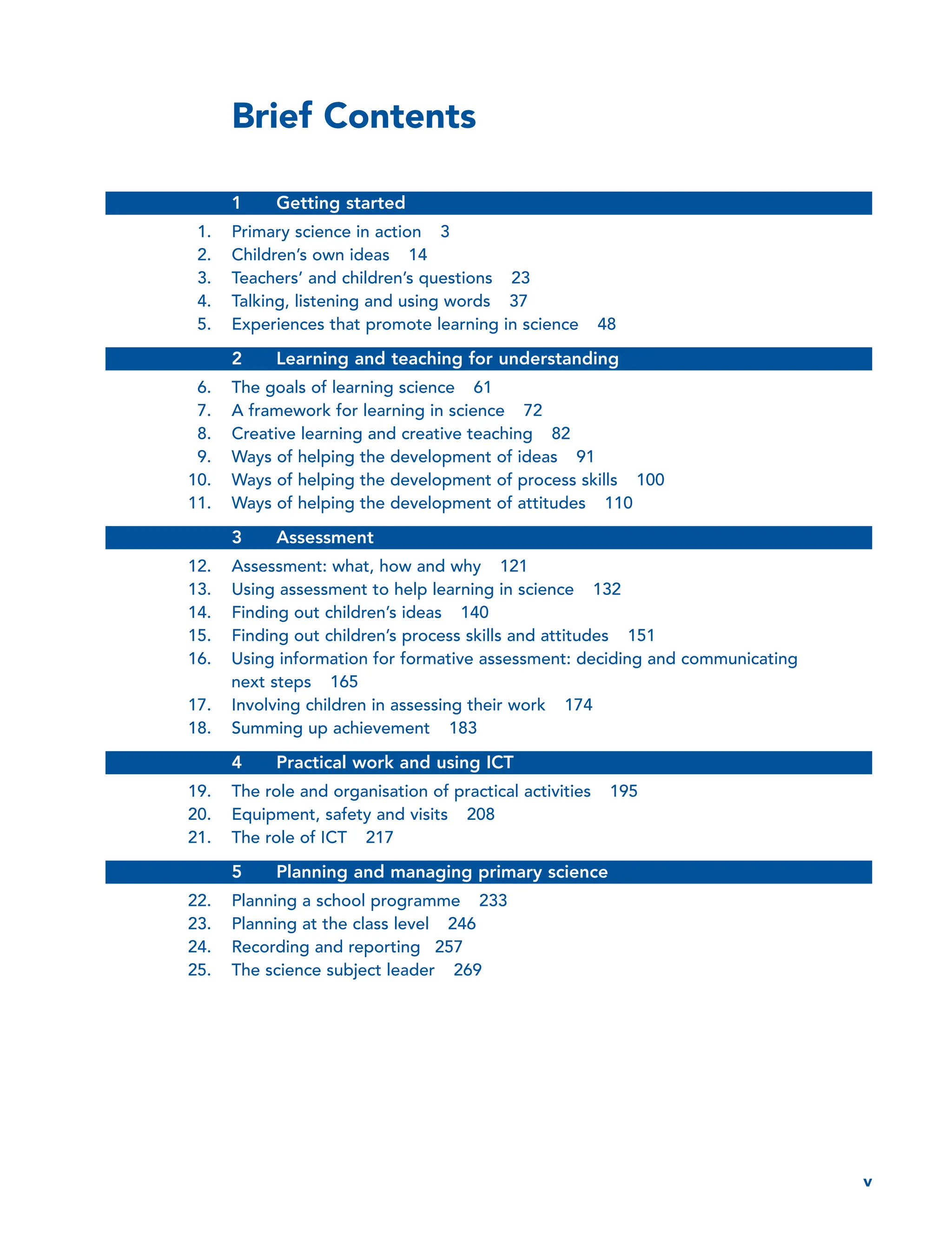
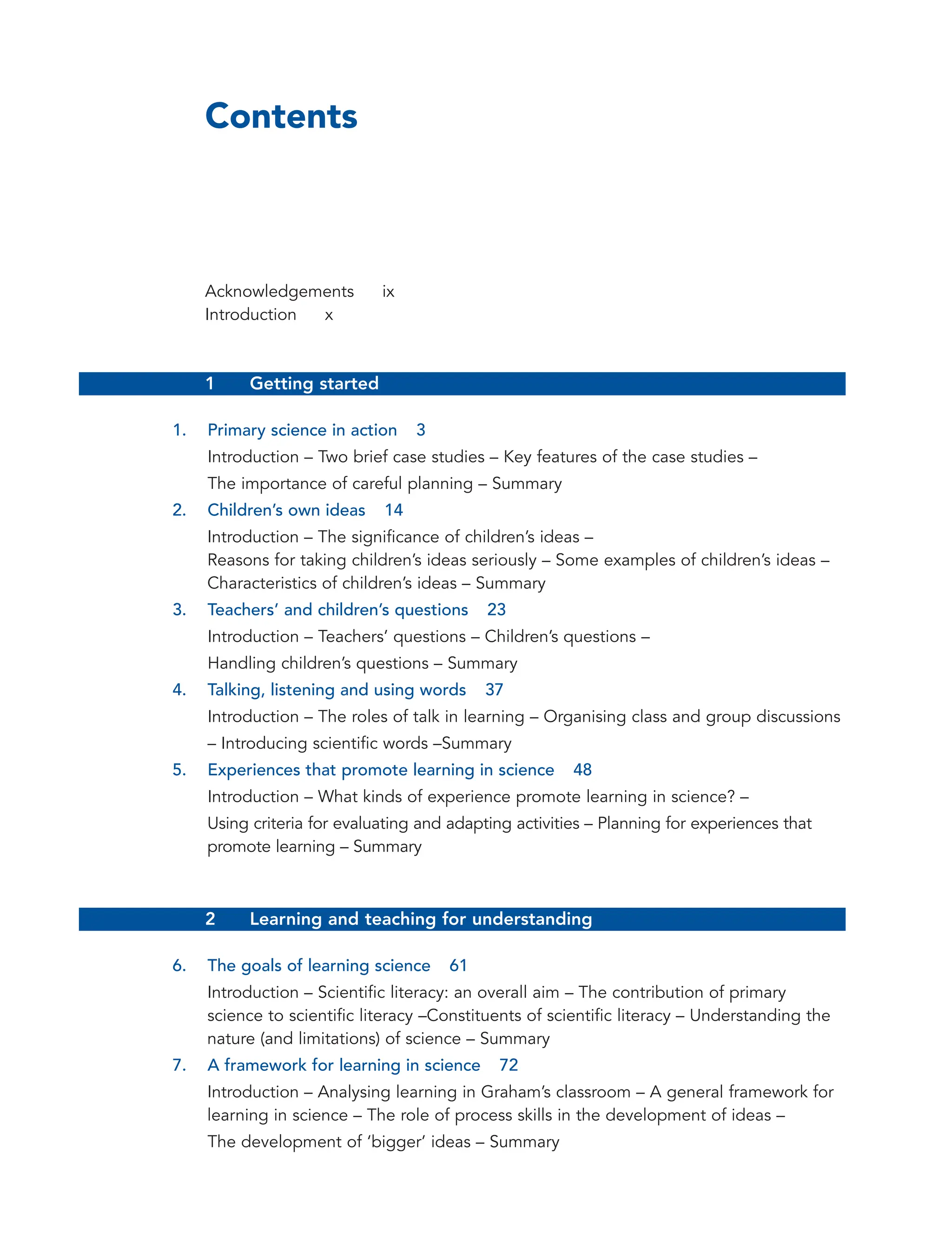


![The children were given ice cubes on small dishes to explore and asked to look
after them for the morning. The literacy lesson that morning involved the children
describing their ice, finding lots of ‘icy’ words and, after much discussion, writing
some sentences about ‘what I know about ice’.
The afternoon began with Chris calling the register, including Flapjack and
Waddle, and some discussions with the two puppets. Chris asked where penguins
come from and what sort of temperatures they are used to. The children knew they
came from Antarctica and that this was a very cold place where it was difficult to
keep warm. They talked about how people generally preferred warmer climates.
The teacher showed the children a big book about penguins. They discussed how
flocks of penguins keep warm, huddling together and taking turns to be in the
centre of the group. Chris emphasised the fact that this meant that all the
penguins had an equal chance of keeping warm, that they made it fair.
Chris reviewed with the children what they know about ice, using their sheets from
the literacy session. ‘Ice melts in the sun’, ‘There are cold icebergs’, ‘Ice can build
you a house’, ‘Ice is frozen water’, ‘Ice is “see-through”’, ‘Ice can be dangerous’.
One child then told how he had swallowed an ice cube once. In discussion it was
established that his warm body had melted the cube, although it had felt very cold
and hard going down. Chris asked the children to describe their ice cubes,
Chris: Who rubbed it on their forehead? [Many hands went up] How did it feel?
Hannah: Cold and wet.
Chris: What happened to your ice cube?
Scott: It gone watery.
Lianne: Spread over the dish.
Ryan: Runny.
Paula: Melted.
The penguins confided that, having borrowed the ice from the supermarket, they
were keen to find the best place to store their ice so that it would not melt too
quickly. Chris brought some more ice from the store cupboard. She had kept it in
a freezer bag wrapped in layers of paper. Chris pointed out that the ice that was
in the ‘iceberg’ crevasses had not melted away. She wondered why this was.
John: Maybe the penguins cuddled it under their legs.
Chris: But wouldn’t that make it warmer?
Paula: There was not just one block, but a lot of blocks together.
The class found this idea extremely difficult and Chris realised that, apart from
Paula, they were not yet ready to consider it. She told Paula that they would come
back to this ‘brilliant’ idea later.
The children decided to put ice cubes in different places in the classroom and see
how long they took to melt. Flapjack then selected an ice cube from the tray to
Primary science in action 7
7](https://image.slidesharecdn.com/65998-250510125028-aa6a0ad2/75/The-Teaching-of-Science-in-Primary-Schools-4th-Edition-Anne-Qualter-23-2048.jpg)
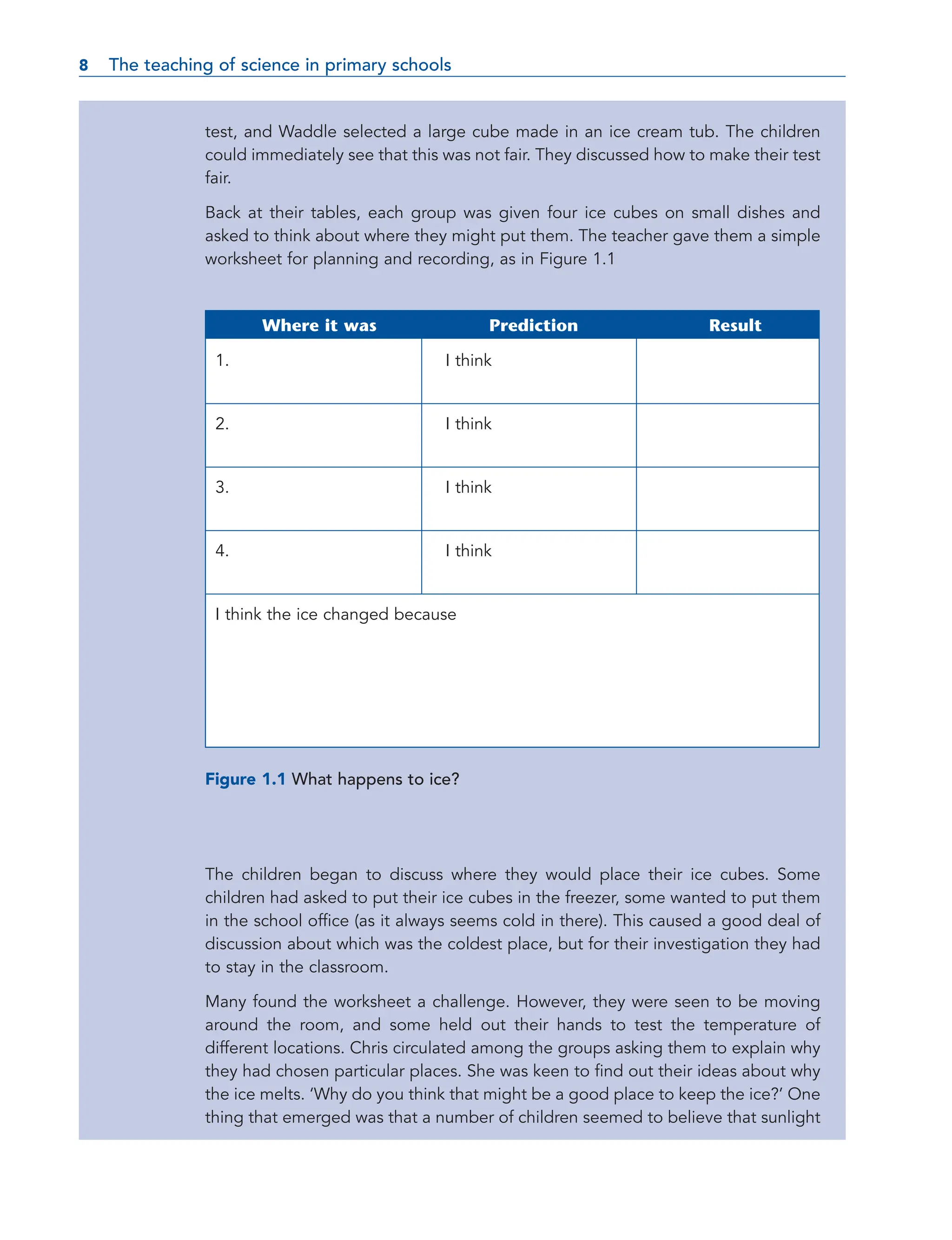
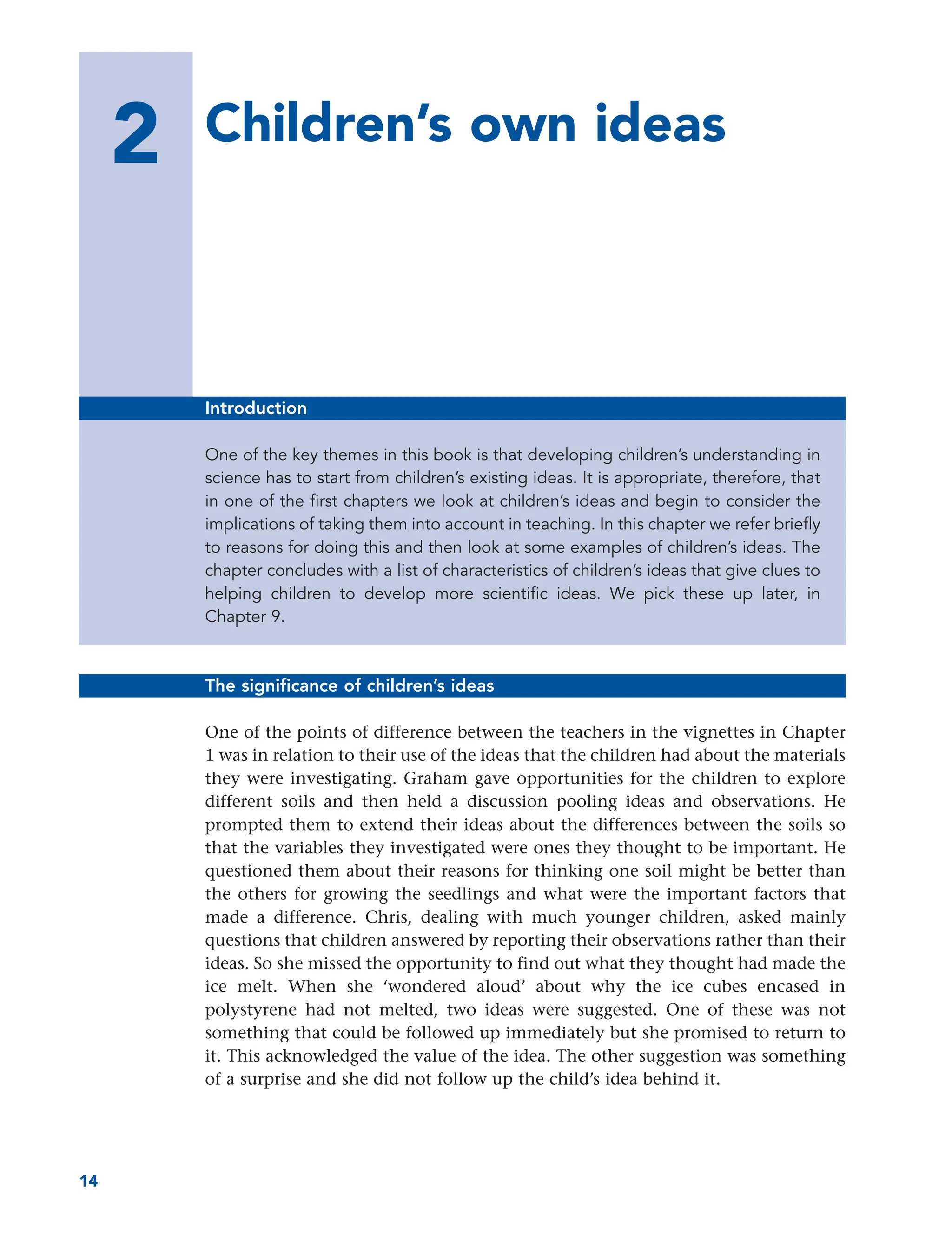
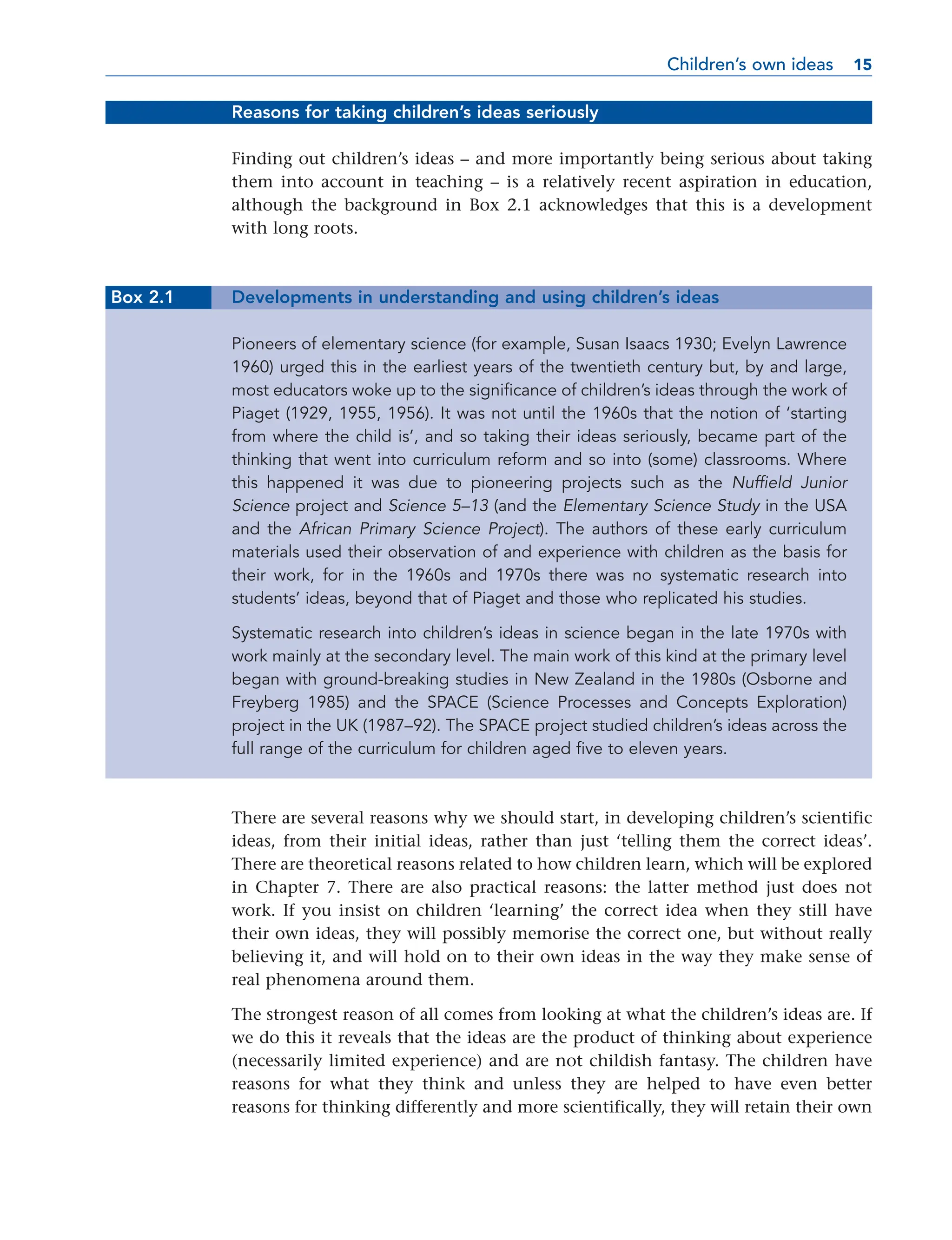
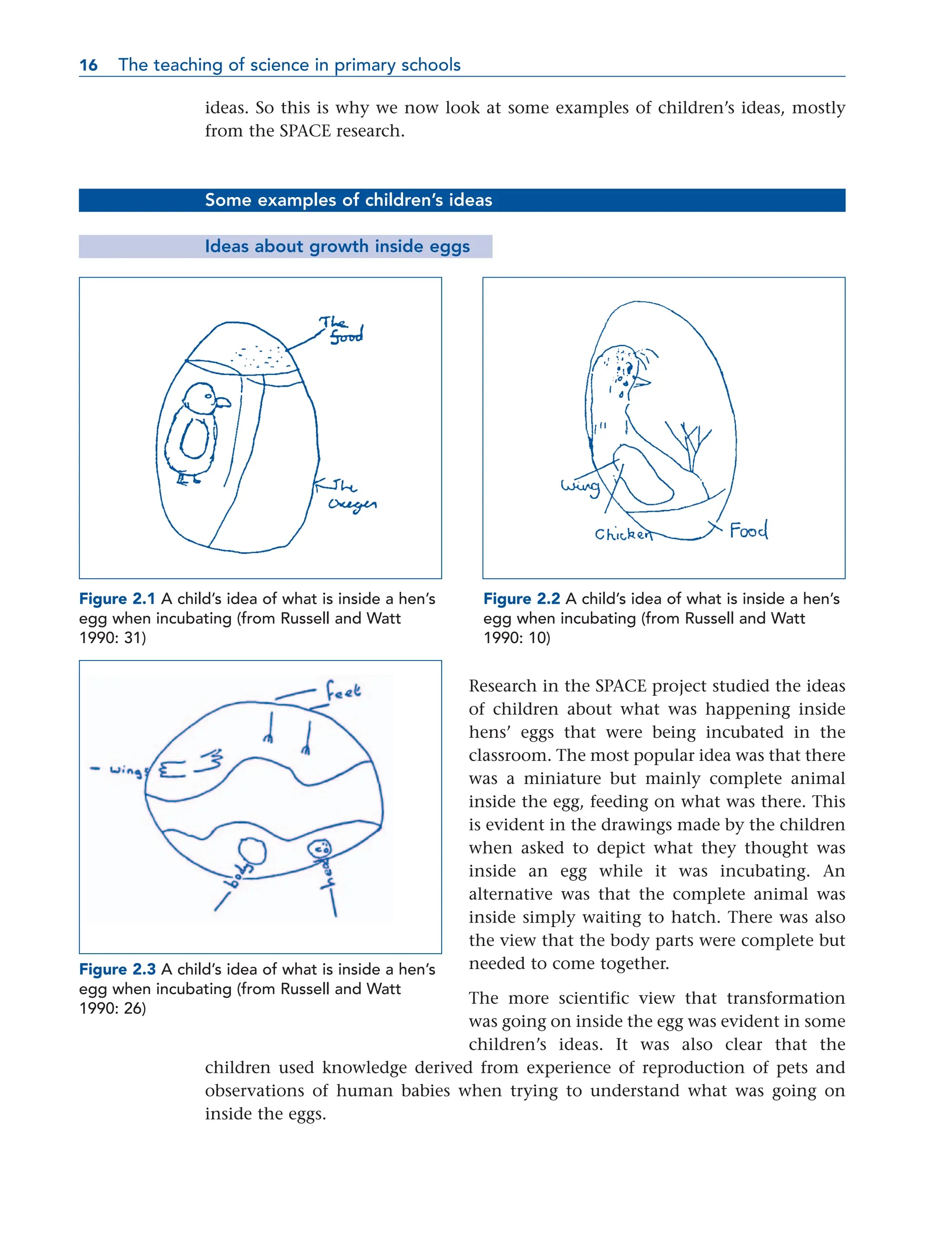
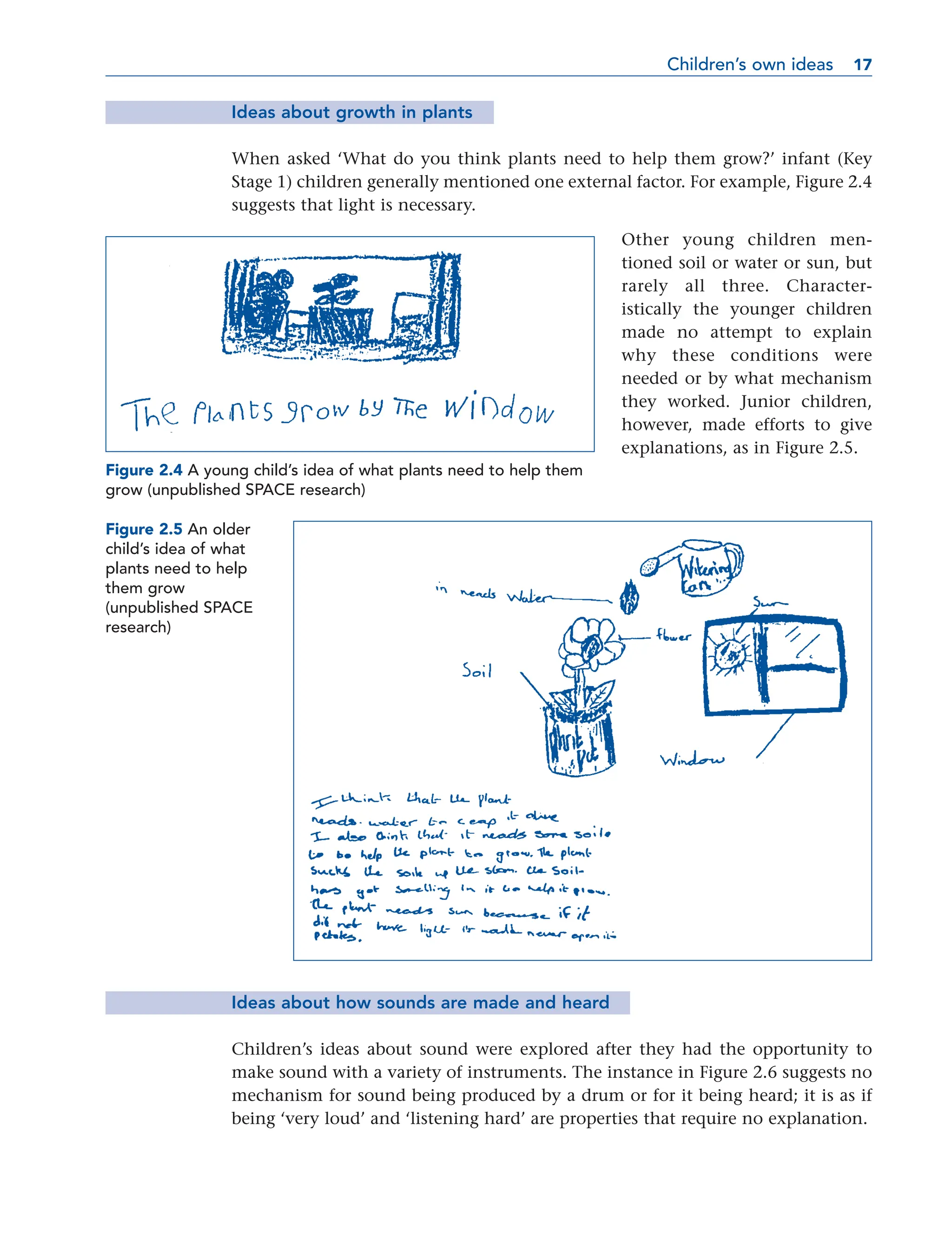
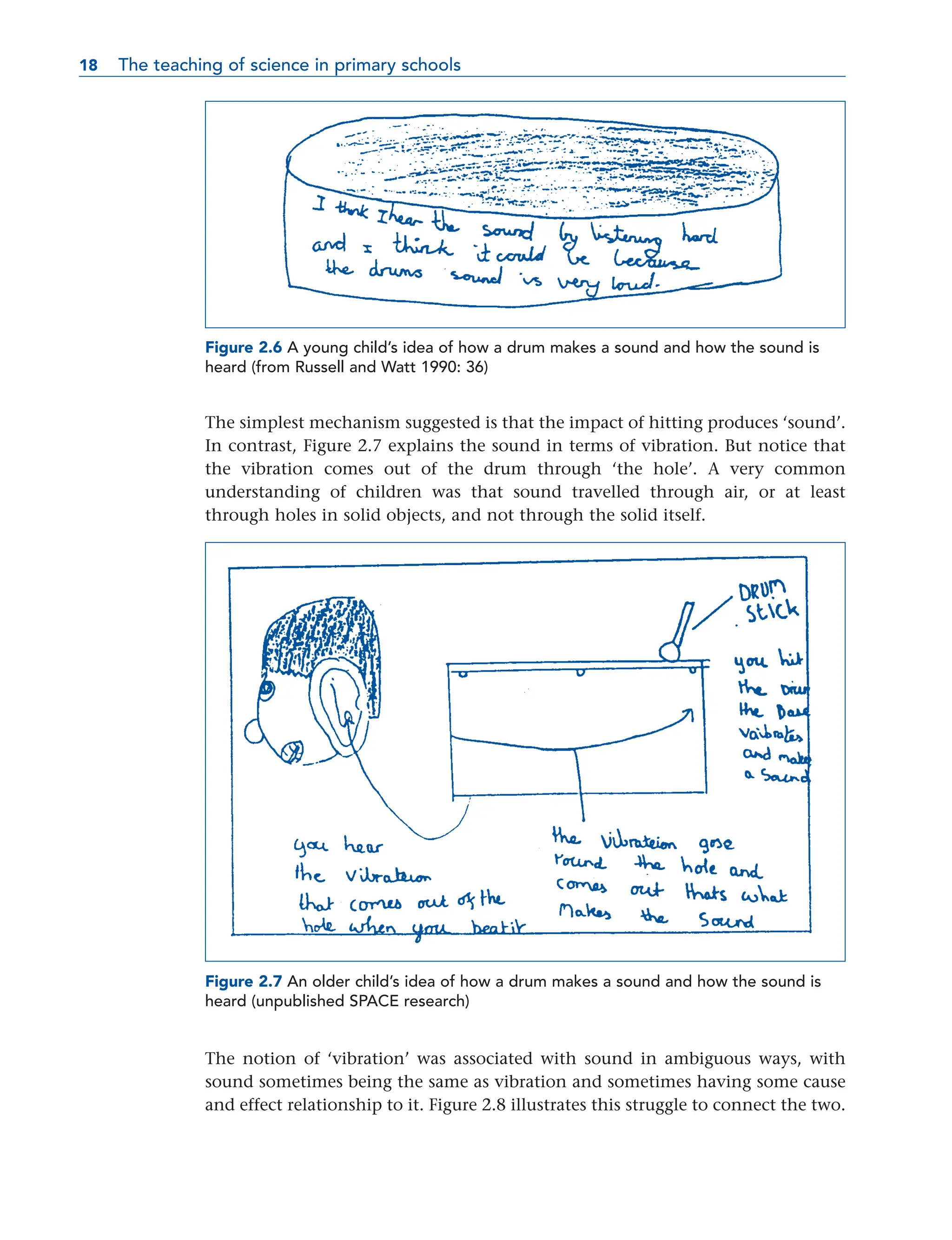
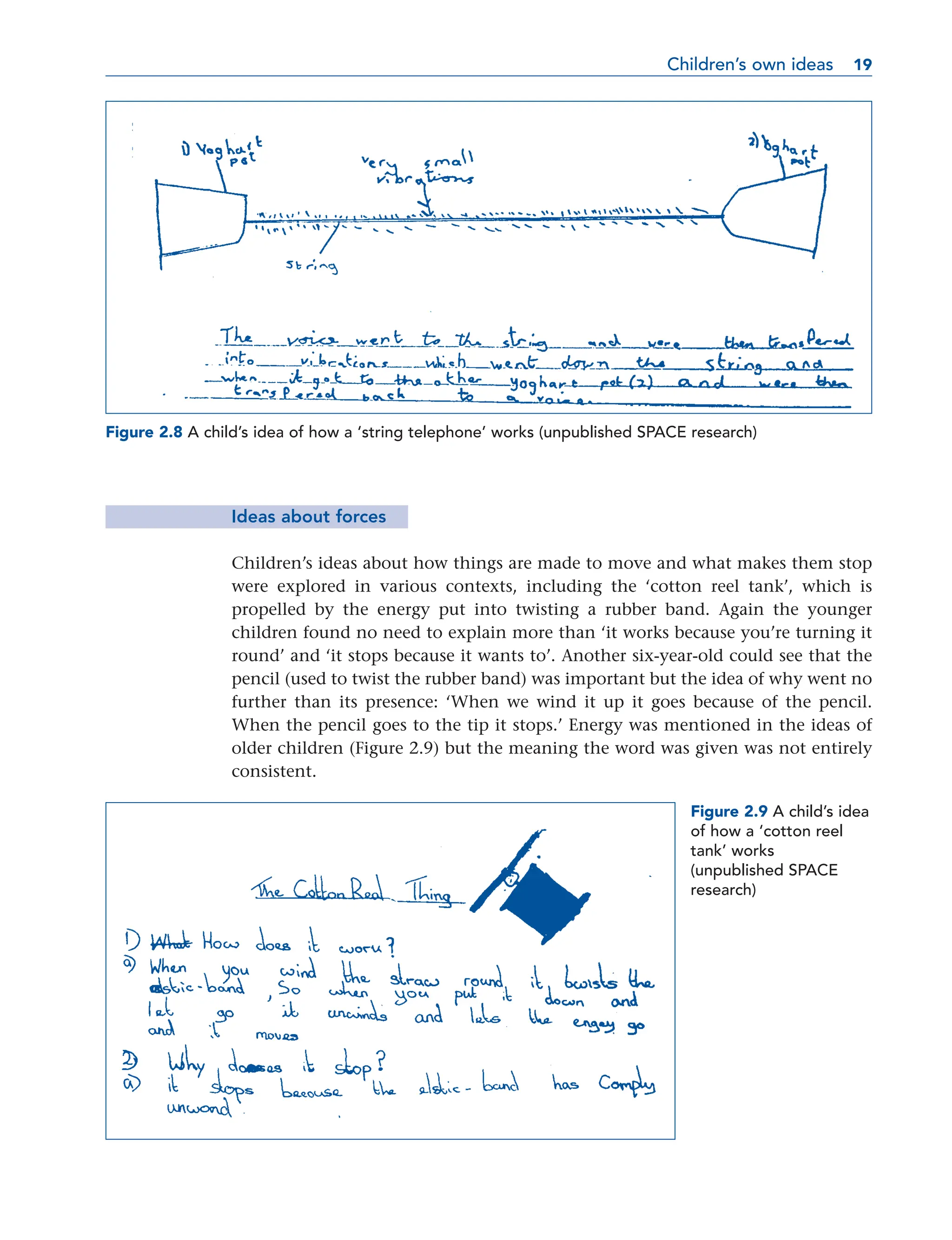
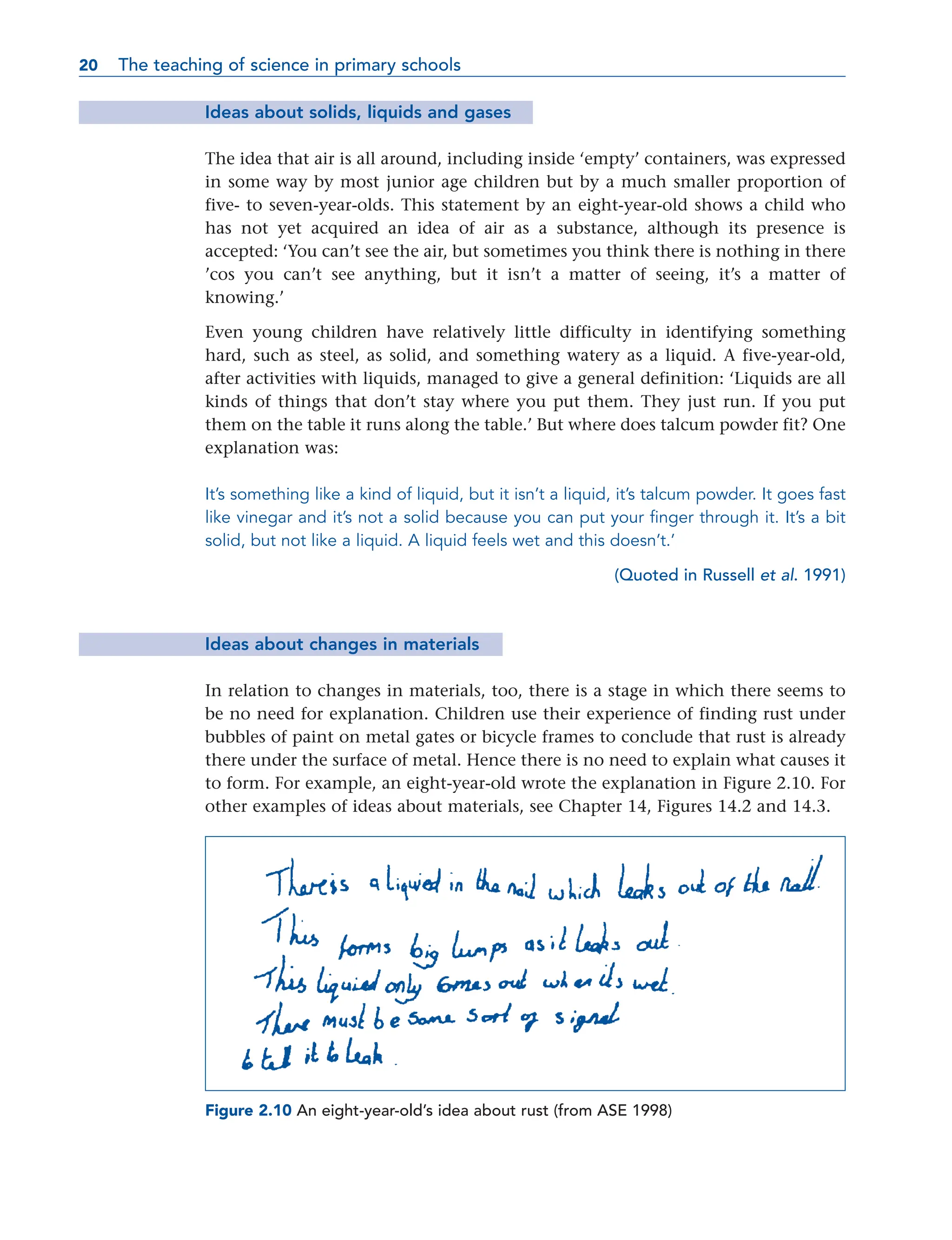
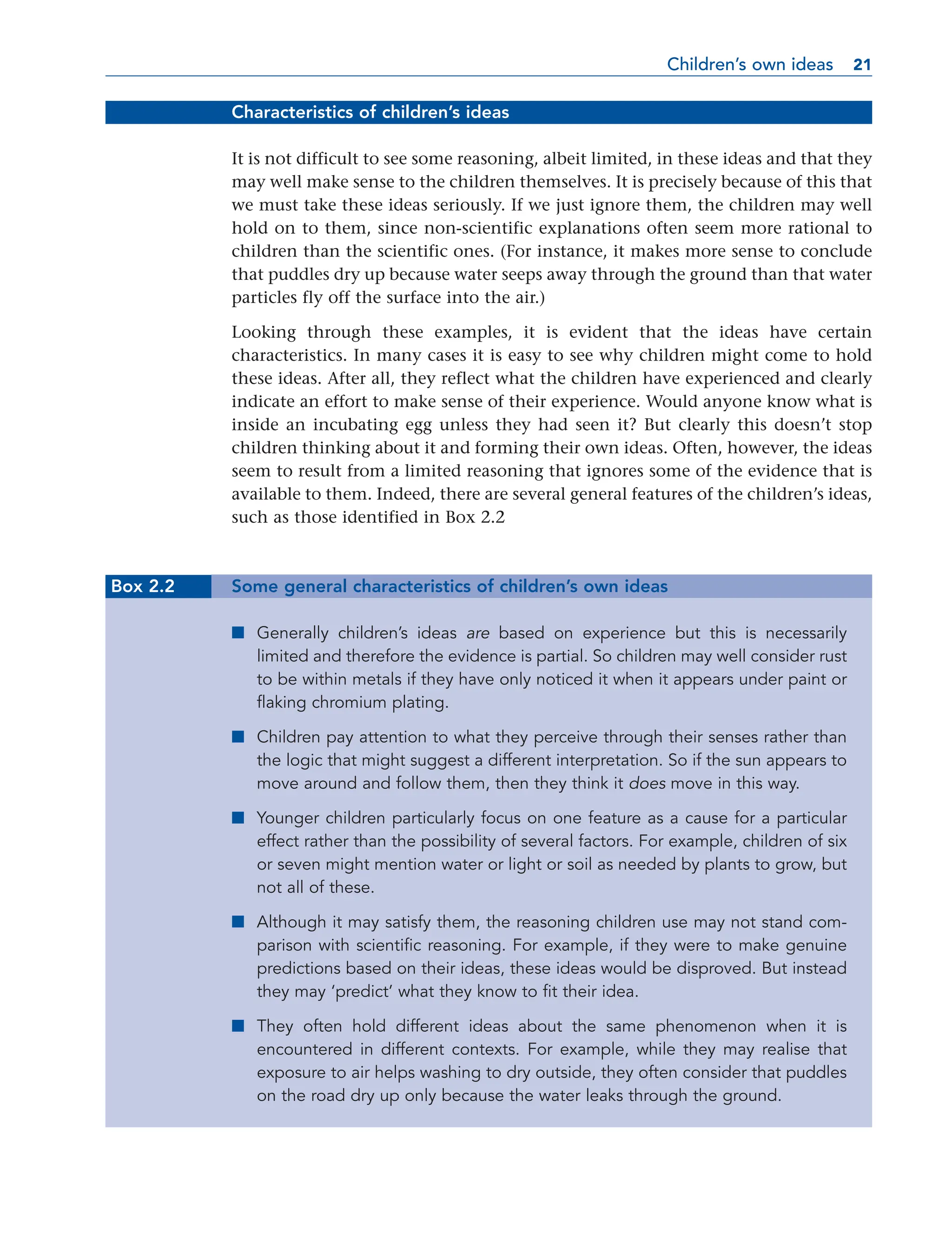

![NIGHT ON THE PLAINS OF THE NEW WORLD.
[From the French of Chateaubriand.]
One evening I was wandering in the forests at some distance from
the Falls of Niagara. Soon I saw the day fade out around me, and I
experienced, in all its solitude, the beautiful spectacle of a night on
the plains of the New World. An hour after the setting of the sun,
the moon showed herself above the trees. In the opposite horizon, a
perfumed breeze, which conducted her from the east, seemed to
preceed her as a fresh breath among the forests. Little by little the
queen of night majestically mounted the heavens, now following
peaceably her azure course, now reposing on a group of clouds
which resembled the tops of high mountains crowned with snow.
These clouds, furling and unfurling their sails, rolled around in
transparent zones of white satin, dispersed themselves in light,
foamy flakes, or formed themselves into gigantic banks of dazzling
aspect, so agreeable to the eye that one
seemed to feel their softness and elasticity.
The scene upon the earth was not less charming. The blue and
velvety light of the moon descended at intervals among the trees,
and cast islands of light into the blackness of darkness. The river,
which flowed at my feet, now lost itself in the shadow of the woods,
now re-appeared all brilliant with the constellations of night which it
reflected on its bosom. Upon the vast prairie on the opposite side of
the river, the light of the moon slept immovably on the turf. Some
birch-trees, dispersed here and there in the savannah, agitated by
the breeze, formed isles of floating shadows upon an immovable sea
of light. Near, all was silence and repose, except the falling of some
leaves, the brusque passage of a sudden wind, or the rare and
interrupted hooting of an owl; but at a distance was heard, at](https://image.slidesharecdn.com/65998-250510125028-aa6a0ad2/75/The-Teaching-of-Science-in-Primary-Schools-4th-Edition-Anne-Qualter-56-2048.jpg)